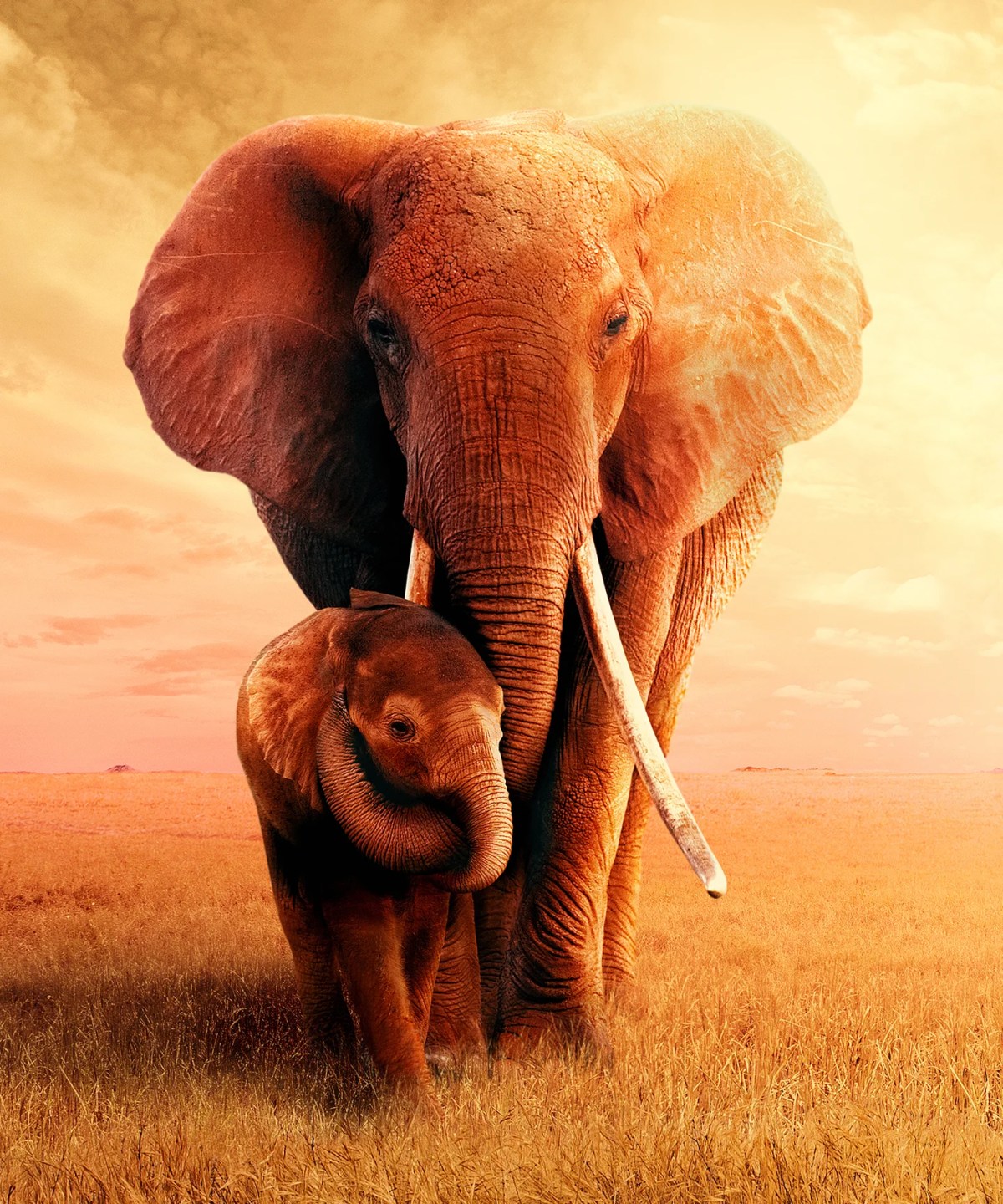
The Elephant Queen Is A Love Letter To Some Of The Most Extraordinary Creatures On Earth

The filmmakers spent four years with matriarch Athena and her herd.

Athena learned the seasonal migratory path from sanctuary to sanctuary from her mother, who in turn learned from her mother, in an unbroken chain that goes back as long as elephants have walked the savanna we call the Maasai Mara.

Every bend, every life-sustaining water hole, every spot where the most nutritious plants grow — and especially the final resting places of her relatives, those who didn’t survive the long journeys to water and shade during drought seasons.

The 50-year-old matriarch, one of the Earth’s last “super tuskers,” has seen her family through so many difficult times that the members of the herd don’t question her even when her decisions could mean life and death for them.

She is their matriarch, and their trust in her is absolute.

During times of drought, all animals converge on the same watering holes. Credit: Apple TV

Athena is also the herd’s protector, which means being wary of humans is her default. It has to be, since humans have poached her kind to the brink of extinction to feed the insatiable Chinese ivory trade.

Filmmakers Victoria Stone and Mark Deeble spent four years with Athena and her herd while filming The Elephant Queen, and earning Athena’s trust was a laborious process.

At first, the wise matriarch wouldn’t let the documentary team anywhere near her family. That slowly began to change as they showed her they meant her no harm.

“But we could see that with her herd, with her family, she was a really calm, beautiful, temperate matriarch,” Deeble explained after a film festival screening of the documentary “And we would just spend time with her.”

Still, the filmmakers had to pass a test before Athena extended her trust:

‘Over the course of several weeks, Athena had allowed the small crew closer and closer, until they were about 40 meters from her. One day, Athena walked away to let her calf stand between her and the crew. That’s a rare occurrence for a mother.

“At that stage two things can happen,” Deeble said. “Either she can realize that it was a mistake, and if we’re in the middle of them we’re going to get trampled, or, and what I like to think happened, she was just testing us. Because after a while, she made a very low rumble and the calf looked up, and she wandered very calmly around the front of the calf. And from that day on, she allowed us amazing access.”’

The Elephant Queen first finds Athena’s herd during a time of plenty, when water and food are abundant, and the herd’s babies — curious Wewe, a boy, and little Mimi, a female and the youngest member of the herd — get to splash around and explore their new world.

Satao, a male “super-tusker,” arrives at the watering hole for hydration and to find a mate. Credit: Apple TV

But every year there comes a time when the water hole starts to dry out and the herd must begin a long march spanning more than 100 miles to reach a more reliable source of water.

The year Stone and Deeble began following the herd, the drought was so severe that Athena made the difficult decision to march for a far-off sanctuary, the closest known permanent water hole fed by an underground spring.

It’s a long, exhausting journey, and newborns can’t make it, so Athena is forced to delay their departure for as long as she can to give Mimi and Wewe enough time to feed and grow stronger.

Elephant calves are dependant on their mothers’ milk for two years. Credit: Wikimedia Commons

The gestation period for African elephants is about two years, and the entire herd is protective of the babies. The adults cooperate to shield them from predators and the sun, using their bodies to do both. They’re also extremely cautious around hazards like rapidly drying mud holes, which can trap young elephants.

The Elephant Queen’s stars are its titular species, but the documentary does an outstanding job not only showing us the other animals who inhabit the elephant kingdom, but also making clear the many ways those animals depend on elephants for their survival.

From geese, frogs and terrapins who rely on elephants to dig water holes, to dung beetles for whom elephant waste is a bounty, to kilifish whose eggs hitch a ride on the massive animals toward the next water source, the entire ecosystem is balanced on the broad backs of the gentle giants.

As narrator Chiwetel Ejiofor (Doctor Strange, The Martian, 12 Years A Slave) notes, elephants are tactile creatures, and when they nudge a terrapin or knock a frog off a tree branch, it’s curiosity, not malice, that motivates them. They’re herbivores, despite their enormous size, and gain nothing from harming other creatures.

Credit: Wikimedia Commons

It’s impossible to watch a documentary like this without looking into the eyes of elephants like Athena and wondering about the intellect behind them, the thoughts and emotions that motivate their actions.

In one scene, as Athena leads her herd through a parched landscape with nothing but dust and dead trees in every direction, she stops. There’s no water or food. There’s only an elephant skull, the remains of a family member who died on one of the treacherous journeys toward refuge during drought season.

The elephants crowd around the skull, gently running their trunks along its tusks the way they do every day to greet one another. Even with the body long since decomposed, with nothing but a skull remaining, they recognize one of their own.

Some will dismiss the idea that the elephants are mourning, claiming that ascribing emotions to animals is anthropomorphizing them. But if they’re not mourning, what are they doing? If they’re not remembering an individual they loved, why would they stop when it’s crucial to find water and food?

Indeed, the only other time Athena calls a halt is when one of her pregnant sisters goes into labor.

Credit: Wikimedia Commons

Documentaries like The Elephant Queen don’t exist solely for entertainment value. Despite intense efforts to protect elephants, poachers still kill an estimated 20,000 each year.

Just 100 years ago, 10 million elephants inhabited almost every corner of Africa. A 2016 study put their number at 415,000, and while there have been successes in conservation efforts, it’s difficult to ascertain whether they balance out the relentless poaching and habitat loss.

The Elephant Queen acknowledges threats to the continued existence of elephants, but doesn’t dwell on them. There’s good and bad to that: in some ways it’s a missed opportunity to galvanize viewers, but it also ensures the film is family friendly, without gore or violence. The film doesn’t sugar coat the fact that nature is unforgiving, but you’re not going to see a poacher raid on a herd.

The Elephant Queen is an Apple TV documentary and premiered on the streaming service after a limited theatrical run. I stumbled upon it as a subscriber after it appeared prominently in the app.

And while it was released in 2019, its message is still as relevant today. Whether you’re fascinated by elephants or appreciate wildlife in general, The Elephant Queen is a great example of how powerful documentaries can be, especially in transporting us to real places that exist in our world, but remain out of reach for the majority of us.
Pope Benedict Asked Us To Be Compassionate Toward Cats And Other Animals

The late Pope Benedict was well known for his lifelong love of cats, but he was also a champion of animals and spoke out about the cruelties visited upon them by humankind.

Long before he was the pontiff, when he was just a young man named Joseph Ratzinger, the future Pope Benedict was known as a cat guy.

Growing up in the village of Hufschlag, about 55 miles southeast of Munich, Benedict’s family always had pet felines and he fed strays who spent time in their garden. During his years teaching theology to students at Bavaria’s University of Regensburg in the 1970s, then-professor Ratzinger was often seen followed by an entourage of cats — the little ones he fed and cared for — as he crossed campus.

“They knew him and loved him,” said Konrad Baumgartner, a fellow theologian at Regensburg.

His affinity for his four-legged friends never faded, even as he took on more responsibility and had more demands on his time. Cardinal Tarsicio Bertone, one of Benedict’s colleagues, said the German clergyman had a natural connection with animals.

“On his walk from Borgo Pío to the Vatican, he stopped to talk with the cats; don’t ask me in what language he spoke to them, but the cats were delighted,” Bertone recalled. “When the cardinal approached, the cats raised their heads and greeted him.”

The Pope and the Cat
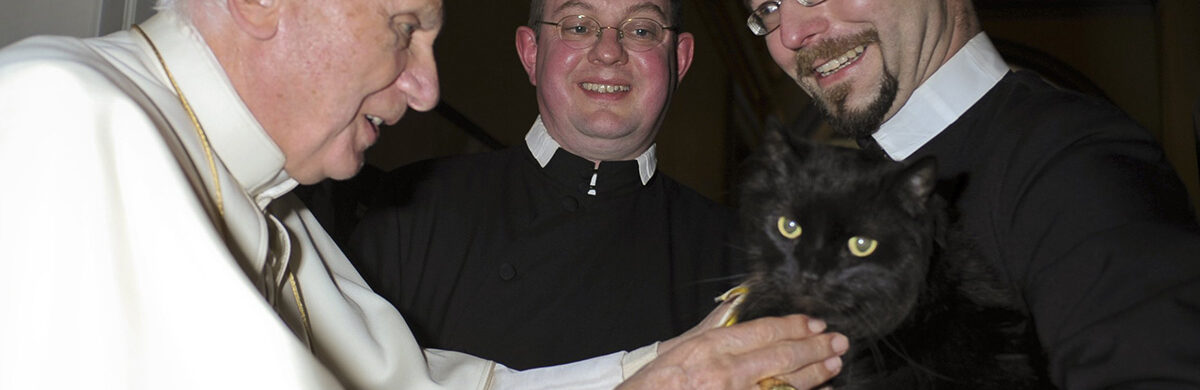
Pope Benedict with one of his cats.

As pope, Benedict continued to care for strays, and had two cats of his own — one who’d been with him since before he was made the leader of the global church, and another he rescued off the streets of Rome.

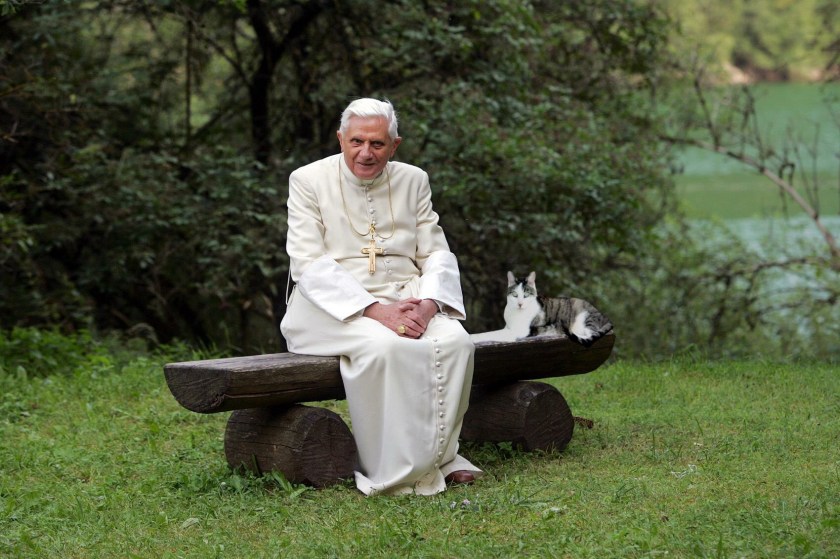
Photos of Pope Benedict with cats are different than the typical shots showing him meeting with world leaders or waving to crowds. His expression and posture are more relaxed in the presence of felines, and he’s often smiling in the images that show him holding a cat.

But it wasn’t just personal for Benedict.

“Dominion” over animals

For centuries, some people — mostly outside Catholicism, but some Catholics too — have argued that animals exist for the use of mankind, that their purpose on this Earth is to serve as resources. Proponents of the view point to a handful of Old Testament quotes, including a famous quote from Genesis that says God gave man “dominion over the fish of the sea, and over the birds of the air, and over the cattle, and over all the wild animals of the earth, and over every creeping thing that creeps upon the earth.”

Genesis 9:3 attributes this quote to God: “Every moving thing that lives shall be food for you.”

The Pope and the Cats
Pope Benedict was well known for his love of cats, from his childhood in Bavaria to his days as pope emeritus living in retirement.

Other verses detail precisely which animals they can eat and remain in His good graces, and many Christian sects see those lines as a clear indication that God intended for animals to serve the needs of men.

But the Old Testament also tells us we can take slaves (Leviticus 25:44-46), that parents can have their kids stoned to death for disobeying them (Deuteronomy 21:18-21), that when children make fun of others, it’s totally cool to call upon righteous bears to maul them to death (2 Kings 2:23-24), and that people with blindness, flat noses and other ugly “blemishes” should wait outside church with the rest of the rejects while the good-looking people pray. (Leviticus 21:17-24).

Don’t even get me started on Sampson and the Book of Numbers.

The point is, if you’re going to be a stickler for things supposedly okayed or forbidden in the Old Testament, animals are the very least of your problems, especially if you trim your beard, let your hair get too long, wear shirts made of two different materials, or have ever placed a bet on DraftKings.

“Animals are God’s creatures”

As we look back on the life of the late pope emeritus, it’s worth noting that Benedict and his successor, Pope Francis, have rejected the view that animals are God’s version of scripted NPC automatons who exist so we can eat steak and wear leather jackets.

“Clearly, the Bible has no place for a tyrannical anthropocentrism unconcerned for other creatures,” Pope Francis declared in 2015.

Benedict spoke out about the cruelty inflicted on animals, the incalculable suffering of animals in industrial farming circumstances, slaughtered by the billions for food after short, brutal lives in which no consideration is given to them as living, sentient creatures.

In a 2002 interview, Benedict called animals “companions in creation” and criticized the modern food industry for its “degrading of living creatures to a commodity.”

“Respecting the environment,” he said in a 2008 interview, “means not selfishly considering [animal and material] nature to be at the complete disposal of our own interests.”

Francis made the church’s position absolutely clear with an encyclical — an official letter to members of the church — called Laudato Si. In it, he condemned the “ruthless exploitation” of animals as commodities and asserts they are individuals who are recognized by God. He urged Catholics to treat them well, to respect and protect wildlife and the environment they depend on.

Animal life has “intrinsic value,” Francis said, adding that Christians must reject the idea that animals are “potential resources to be exploited.”

As if speaking directly to people who use the aforementioned Old Testament quotes to support practices like factory farming, harvesting animals en masse for pelts and hunting for the “fun” of it, Francis said:

“We must forcefully reject the notion that our being created in God’s image and given dominion over the earth justifies absolute domination over other creatures.”

Both popes also noted that, in addition to the suffering we cause, when we exploit animals as are also behaving in a way beneath the dignity of humankind. It’s a stain on our collective identity as a species, a betrayal of our roles as wardens of the planet.

Let’s put aside the moral considerations for a moment. The continued existence of the complex ecosystems on our planet — and indeed of humanity itself — depends on the many roles animals play, from carrying seeds to pollinating plants, limiting the growth of flora that would otherwise dominate and destroy other plants, rerouting water systems by creating dams, controlling the populations of creatures that would otherwise multiply unchecked, and the thousands of other roles they play in maintaining the balance of ecosystems.

Benedict left this Earth on Dec. 31, 2022, at a time when we have killed off almost 70 percent of all wildlife in the entire world. It’s not just a matter of living on a lonely planet, or tucking future children into bed while telling them that, no, they can’t see elephants or tigers because the last of them are dead. Removing keystone species, extirpating entire genera while rendering vast stretches of the planet uninhabitable, purging the oceans of life as they accumulate literal continents of plastic waste, means we’re marching toward a cascade failure most of us won’t even see coming as we argue about carbon credits, politicize common sense, tinker with viruses and edit genomes.

It’s long past time we recognize the fact that we share this planet with billions of other minds and start living in a way that respects them. If we can save them, perhaps we can save ourselves too.

Great Pacific Garbage Patch
The 1.6 million square kilometer Great Pacific Garbage Patch, which weighs more than 80,000 metric tons.