Angry locals say they’ll kill the tiger if forest rangers do not after the predator ambushed and ate a mother of two in southern India on Friday.
Forest rangers are on the hunt to capture a man-eating tiger who killed a woman and dragged her body into a forest on Friday, while frustrated locals say they’ll destroy the predator if the government does not.
The victim, a 45-year-old woman named Radha, was employed by a local coffee plantation in Mananthavady and was harvesting coffee beans when the big cat ambushed her, according to multiple reports in local media. Mananthavady is a city of about 47,000 people in southern India surrounded by rural farmland.
A Thunderbolt team — a special forces unit trained in counter-insurgency — was patrolling the area when they found blood and signs of a struggle. They followed the tiger’s pug marks into a nearby forest, where they found Radha’s body “half eaten,” the New Indian Express reported.
The attack and the livid response of people in the area highlight the conflicts that India must manage as it works to save tigers, the country’s critically endangered national animal, while also protecting the public. India’s government has relocated thousands of families away from the vast country’s 27 tiger preserves, but the big cats are oblivious to the boundaries of the preserves.
Earlier this month, people living in several contiguous towns over a stretch of more than 130 miles in eastern India barricaded themselves indoors, refusing to leave for work or to travel to local markets, after a pair of hungry tigers had drifted off a preserve and had begun to feast on local livestock.
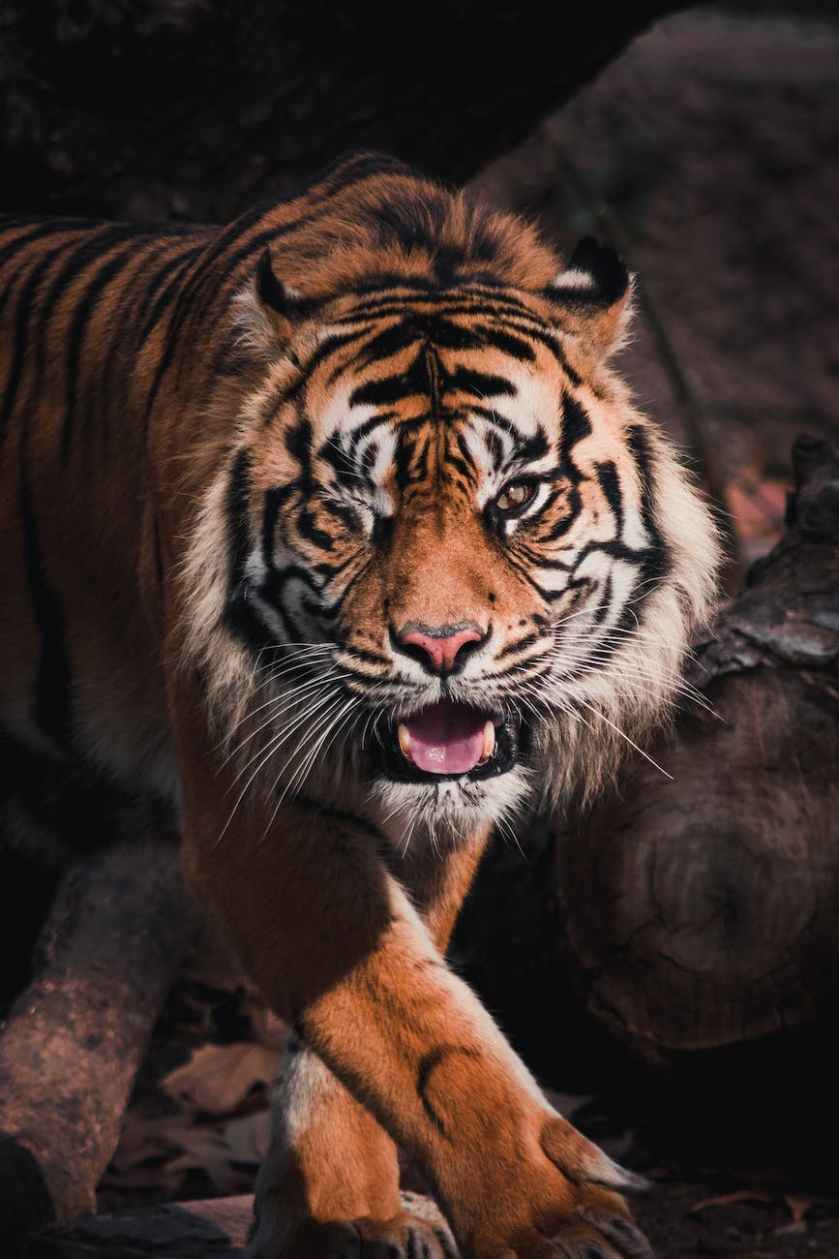
A tiger who was seized and relocated from a roadside zoo operated by Joseph “Tiger King” Maldonado-Passage. Credit: Wikimedia Commons
In Mananthavady, locals threatened a hartal, a form of strike aimed at gaining concessions from the government, if the tiger is not killed. Forest rangers and local government leaders said they would capture and relocate the tiger, who has been spotted on a trail camera, but the locals say that’s not good enough.
“If you can’t shoot the tiger, then shoot us instead,” one protester told forestry officials.
Others said they’d take matters into their own hands if authorities don’t kill the tiger. It’s not an empty threat: in 2019, a mob of enraged villagers beat a tigress to death after she attacked a person.
Radha was the third person to be killed by tigers in the area since 2023, when two farmers were killed by the endangered apex predators in incidents about 11 months apart.
In addition to the anger and grief felt by family and friends of the victims, the government’s compensation program is also controversial. Radha’s family will receive ₹11 lakh, according to reports, which was about $12,800 in USD according to exchange rates on Jan. 25.
The program has been condemned by people who say the government is wrong to put an arbitrary monetary value on human life, and in recent years there have been attempts to provide families with resources like job training in addition to monetary compensation. The issue remains a sore spot and a topic of ongoing litigation because the government did not compensate victim families for decades, and does not automatically provide compensation if the victims trespass onto preserve land.
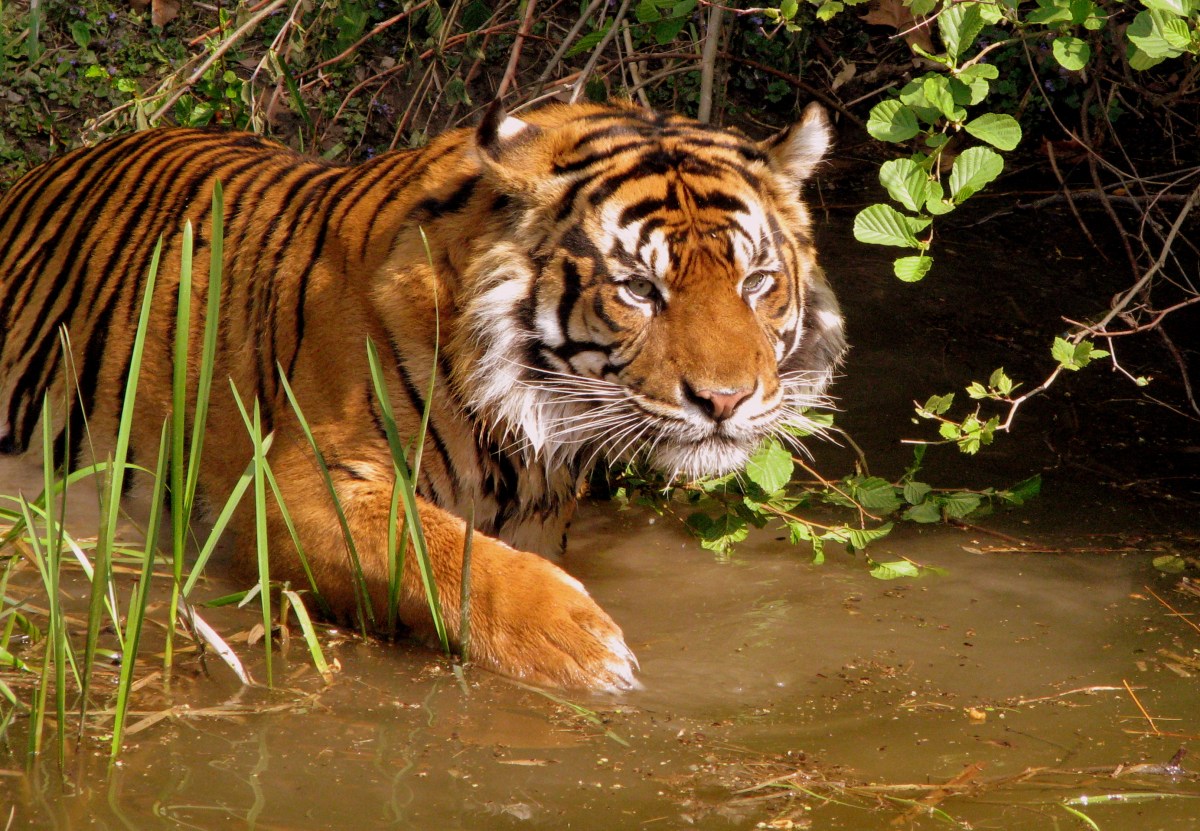
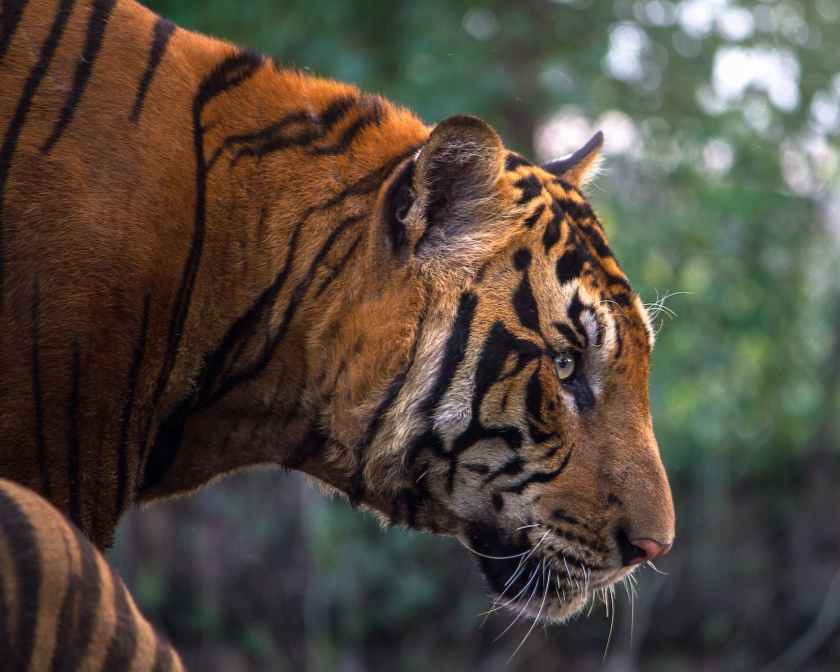
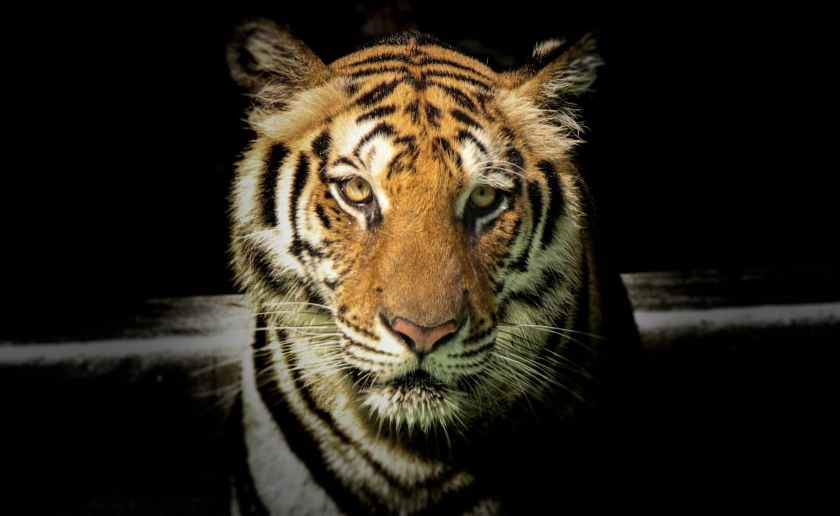
Tigers are the largest and most dangerous of all cat species, and are arguably the most dangerous land animal on the planet, but the vast majority of them do not attack humans and give people a wide berth. Unlike most other felids, they enjoy water and swimming, especially in warm climates. Credit: Warren Garst/Wikimedia Commons
In the meantime, a team comprised of rangers, veterinarians, expert trackers and others — totaling about 100 people — was racing to get to the tiger before the mobs do, utilizing drones, traps and thermal imaging cameras to find and capture the elusive predator.
“The animal is still roaming in the same vicinity, and we are strengthening local patrols to prevent further casualties,” KS Deepa, chief conservator of forests in the region, told local media.
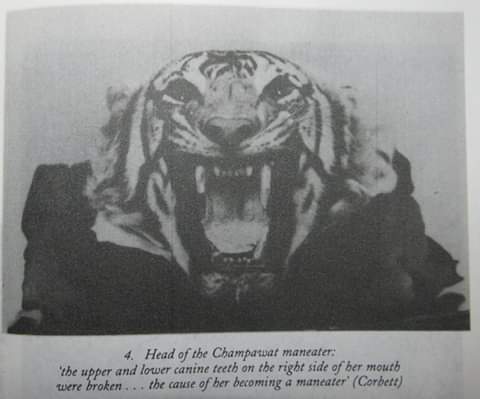
Most tigers who turn man-eater do so because they can no longer take down their usual prey without difficulty, either due to old age or because their teeth are damaged. The infamous Champawat tigress, who killed 436 people during a decade-long reign of terror from the late 1890s through 1907, turned man-eater when a hunter’s bullet shattered one of her canines.
It’s wasn’t clear what forestry officials planned to do with the tiger if it’s captured, but they told reporters they are forbidden by law from killing the animal unless other options are exhausted.
“There are three ways to capture the tiger,” A.K. Saseendran, India’s minister of forests and wildlife, told The Hindu. “We will try to cage it as the first step. If that fails, we will try to tranquilize it and move it out of Wayanad. Killing the tiger is the last resort.”
Tiger attacks are a real danger in rural India, where the big cats kill people and livestock. To protect the species, the government pulls off a difficult balancing act aimed at minimizing inter-species conflict.
In his memoir, Man-Eaters of Kumaon, legendary tiger hunter (and later staunch conservationist) Jim Corbett described how he and his men arrived to find a ghost town when they tracked a man-eating tiger to a rural village.
Every door was closed and locked, shutters were closed tight, and despite the fact that it was harvest time, not a single person was working the nearby fields.
The people who lived there had good reason to be petrified. The infamous Champawat tigress had killed more than 430 people by that point, including a young woman from the village just a few days earlier. Usually the tigress would vanish from an area after a kill, frustrating locals and hunters by popping up virtually anywhere in a 50-mile radius, but for some reason she stuck around the village and sat on the outskirts at night, keeping the local people awake with her calls.
Corbett’s famed hunt of the “demon of Champawat” happened in 1907, and although it might sound like a problem from the past, it’s current reality for people in parts of India, Nepal and, to a lesser extent, the sparsely populated mountain forests in eastern Russia.
In Garwha and Ranchi, two towns in eastern India about 215km (133 miles) apart, “villagers have stopped using forest routes to reach markets and are reluctant to leave their homes for work,” the Times of India reported on Monday.
That’s because hungry tigers have been on the prowl, demonstrating little fear of people as they help themselves to livestock. Between Jan. 1 and Jan. 6, the tigers killed and ate three cattle and a buffalo.
Tigers require large, contiguous tracks of land measuring in the hundreds of square miles. India and Russia have both set aside massive preserves for the apex predators to increase their numbers in the wild. Image credit: Wikimedia Commons
So far they’ve eluded camera traps, but forest rangers say they believe there are two tigers because of the distance between Garwha and Ranchi, which is almost three times the typical tiger range.
In places where big cats live in proximity to humans, especially farmers, the government pays compensation to the owners of livestock killed and eaten by the predators.
There’s also a separate, more controversial compensation program for the families of people killed by tigers. Recent court cases in the country have hinged on the cold calculations of attaching monetary value to human life, and whether families are owed compensation if their relatives knowingly entered tiger preserves.
For India, it’s part of a delicate balancing act between conserving the country’s national animal and one of nature’s most beloved species, and avoiding the ire of people who are impacted by their presence. When big cats prey on livestock, if the government does not address the situation, locals will eventually take matters into their own hands and try to kill the apex predators. That usually doesn’t work out well for either side.
On average, about 60 people are killed each year by tigers in India, according to government statistics. There’s been a sharp increase in victims in recent years, with tigers taking 110 human lives in 2022 and 83 in 2023, although it’s not yet clear why.
As for livestock, a 2018 study by wildlife biologists with the Corbett Foundation documented 8,365 reported instances of big cats killing cattle, buffalo and other animals between 2006 and 2015. That works out to about 830 per year, with tigers responsible for 570 livestock kills on average and leopards responsible for the rest.
To reduce the number of inter-species conflicts, the government of India has relocated thousands of families away from the country’s 27 tiger preserves in addition to compensating farmers for their losses.
A tiger cub on a preserve in India. Credit: Wikimedia Commons
On a tangential note, this is another reason why the persistent claims of big cats stalking the British countryside strain credulity.
To paraphrase wildlife conservationist Egil Droge of the University of Oxford, when big cats live in an area, you know it because the signs are everywhere — massive and unmistakable pug marks (paw prints) on the ground, trees left with deep gauges by males marking their territory, and dung also serving as a territorial marker.
“I’ve worked with large carnivores in Africa since 2007 and it’s obvious if big cats are around. You would regularly come across prints of their paws along roads. The rasping sound of a leopard’s roar can be heard from several kilometres,” Droge wrote in a 2023 post about alleged big cat sightings in the UK.
Last but not least, big cats eat. A lot. A reliable supply of large prey animals is necessary to support even the smallest of breeding populations, and felids of all species are known to go for easy meals — in this case livestock — when the opportunity presents itself.
Still, the idea refuses to die, and there are still regular reports from people who have seen large cats and insist they’re not our domesticated friends.
“So we left the sheep there at the edge of the field and made sure the lady saw us before we buggered off over the fence. Next day, we was in all the papers! A right laugh that was, mate.”
The tiger had authored an unprecedented reign of terror, killing more people than any other animal in recorded history. Some villagers thought the ferocious cat was supernatural and dubbed it the Demon of Champawat.
They called it the Land of the Gods.
The northern Indian state of Uttarakhand was known for its ancient Hindu temples, the ruins of a once-mighty kingdom called Kumaon, and sprawling wilderness dotted with villages mostly inhabited by farmers and craftsmen living in the shadows of the Himalaya mountains.
But when Jim Corbett arrived in 1907, it was a ghost state.
Doors were closed, windows were shuttered, village greens were abandoned. The fields lay dormant, their crops unharvested and ripening on the vine as farmers refused to leave their homes. When people had to venture out for fire wood they did so only in armed groups, with dozens of adult men wielding blades and repurposed farming tools, making a ruckus as they set out.
No one dared go out at night. Travel between villages had become rare, and if necessity forced people to travel, they did so in the heat of the mid day and only in numbers resembling small armies.
It wasn’t war, disease or superstition that kept the people of Kumaon huddled in their homes, terrified to step out.
It was a tiger.
The Katarmal Sun Temple in Kumaon. The area is known for its temples and religious sites. Credit: Wikimedia Commons
A map from 1857 showing Kumaon, highlighted in purple, on India’s border with Nepal.
Kumaon sits in the shadow of the Himalayas, with the Sharda River serving as its border with Nepal. Credit: Wikimedia Commons
Or a tigress, as Jim Corbett found when he set eyes on the first pug marks — paw prints — left by the notorious man-eater.
The paw pads of male tigers are ovular with distinctive gaps between the toes, while the impressions left by females are more compact, with toe pads that leave unmistakable teardrop shapes in mud and dirt. The pug marks revealed it was massive adult female Bengal. Corbett suspected it was the same tigress who had terrorized the people of Nepal from the late 1890s until 1903, killing hundreds before the Nepalese army was called in.
Not even the soldiers managed to stop her, and when the tiger’s death toll topped 200 and local leaders were running out of options, the army organized a massive beat — essentially a wall of people wielding torches and guns, advancing in unison — to drive the tigress out of her territory, over the River Sharda and deep into neighboring India.
They hoped the tigress would become someone else’s problem — and she did, continuing her reign of terror for four more years in Kumaon, bringing life in the region to a standstill.
Credit: Wild Trails
Credit: Wild Trails
The tigress was ruthless and efficient, striking farmers working the edges of fields, children sent to fetch wood, fishermen sitting by streams. She seemed to have lost her fear of man completely, hunting in broad daylight and picking her victims off regardless of whether they were alone or surrounded by others.
The local villages dispatched hunters who went after the tiger and never returned. Pooling their money — no small feat in a poor, rural state of India — they hired professionals who set out and weren’t heard from again. One party comprised of a dozen seasoned hunters armed with rifles tried challenging the tigress on her own turf, entering the jungle and using a fresh animal carcass to draw her out.
The tigress was cunning. She knew human hunting parties were after her, and she changed her behavior in response. Although the town of Champawat remained the center of her new territory, she widened it considerably and ranged great distances in between kills.
Instead of terrorizing one area, now she was stalking a wide swath of greater Uttarakhand. She’d appear on the outskirts of a village one day, killing a housewife out collecting herbs and firewood, then pop up 20 miles away by the next sunrise, striking as opportunity presented itself.
But the Demon of Champawat, as she came to be known, wasn’t the only tiger in the region. Many people who’d seen her didn’t live to provide a description, so she became the shadow at the edge of the forest, the monster lurking in the grass.
Every time villagers heard a tiger’s roar echo from the jungle, they dropped their tools and ran for the safety of their homes. Every roar became the roar of the Champawat tigress. She was seemingly everywhere at once, taking on almost supernatural qualities in the minds of those she terrorized.
A desperate community seeks help
The Tahsildar — a local government official who serves as administrator and tax collector — was desperate. Many of the families in Uttarakhand were subsistence farmers, meaning abandoned fields weren’t just taking an economic toll on the area.
If the local farmers didn’t harvest, they wouldn’t eat.
The Tahsildar was the one who had to look grieving parents, siblings and children in the eye, telling them the government would figure out a way to stop a “demon” who had eluded hunters and soldiers for years.
When the Tahsildar approached Corbett, the Champawat tiger had killed an inconceivable 434 people. No other animal in recorded history had taken as many lives, let alone evaded retribution during a nearly decade-long stretch straddling two centuries and the border of two countries.
The notorious man-eater was loitering around a village called Dhari, where it had been spotted on the outskirts. For three nights the villagers were kept awake by the roars coming from the man-eater at the edge of the jungle.
Others were trying to track the tiger, the Tahsildar said, drawn by the considerable reward for the hunter who could finally rid the region of its felid scourge.
But Corbett didn’t want the money, saying he had an “aversion to being classed as a reward-hunter,” and he asked the Tahsildar to call off the other hunters for fear of getting caught in friendly fire.
After the men agreed to terms, Corbett and his small party set off on the 17-mile journey to Dhari. No one came to greet them when they arrived, wearily dropped their packs and sat down in a central courtyard. The place looked abandoned.
“The people of the village, numbering some fifty men, women and children, were in a state of abject terror, and though the sun was still up when I arrived, I found the entire population inside their homes behind locked doors,” Corbett wrote in his memoir, Man-Eater of Kumaon. “And it was not until my men had made a fire in the courtyard and I was sitting down to a cup of tea that a door here and there was cautiously opened, and the frightened inmates emerged.”
“That the tiger was still in the vicinity was apparent,” Corbett wrote. “For three nights it had been heard calling on the road, distant a hundred yards from the houses, and that very day it had been seen on the cultivated land at the lower end of the village.”
Corbett confirmed it was the tigress he sought, and the death toll had climbed to 435 when villagers reported the disappearance of Premka Devi, a teenage girl.
Devi had been gathering wood and foraging with a handful of other women when the tigress leaped out of cover, snared her foot and began dragging her away. She fought, holding onto a tree branch while trying to wriggle free, but the man-eater let go of her foot, lunged forward and sank her teeth into Devi’s neck in the fashion tigers most often use when taking down prey.
When the other women came running back to Dhari, a party of men set out to find Devi, but found only blood and torn clothing.
While the Demon of Champawat was known for disappearing into the night after her kills and re-emerging miles away, for reasons no one understood she continued to stalk the outskirts of Dhari. It was as if she was determined to take another life from the same village.
After the locals told him the animal had a “habit of perambulating along” the road leading into the village, Corbett decided he would try for the tigress that first night before she decided to range miles away to another village, as she was fond of doing when she knew she was being hunted.
The first hunt: Fear and regret
James Edward Corbett knew rural India. The son of a low-level official in the British Raj, Corbett grew up in poverty among 12 brothers and sisters in the Indian countryside, where he learned to track and hunt as a boy, traversing rough terrain barefoot and deciphering the clues left behind in the jungle when big cats and other predators took their prey.
Today Corbett’s name is still familiar to the people of Uttarakhand, with the largest national park — land he helped secure for a tiger habitat — bearing his name.
Photographers on a tour of the tiger reserve in Jim Corbett National Park.
The tiger reserve within Jim Corbett National Park. Credit: Jim Corbett National Park
He’s remembered as a champion of the often-forgotten rural poor and a legendary figure in big cat conservation circles. Long before he became a tiger conservationist later in life — calling the extraordinary animals “large-hearted gentlemen” who avoided conflicts with humans the vast majority of the time — he’d built a reputation as a man who could handle the most dangerous felid predators, tigers and leopards who had developed a taste for human flesh.
These were not the canned “hunts” of modern day, facilitated by teams of guides armed to the teeth with cutting-edge gadgetry and tracking devices, chauffeuring well-off weekend warriors in climate-controlled vehicles and luring unaware animals directly into their paths. Corbett and men like him hunted at extraordinary risk to themselves, on foot, at the mercy of the most cunning predators on the planet.
The Rigby .275, Corbett’s most famous rifle, was given to him by grateful officials of India’a government. Corbett’s reputation grew as he successfully hunted man-eating tigers and leopards, particularly those that had eluded other hunters and even the military. Credit: The Vintage Gun Journal
But at 31 years old, despite his repute as an excellent hunter, Corbett was in new territory. The Champawat tiger was his first man-eater, and nerves got to him. As he stood watch that first night at the edge of the village, he wondered if he’d made a lethal mistake.
“I had spent many nights in the jungle looking for game, but this was the first time I had ever spent a night looking for a man-eater,” he wrote. “The length of the road immediately in front of me was brilliantly lit by the moon, but to right and left the overhanging trees cast dark shadows, and when the night wind agitated the branches and the shadows moved, I saw a dozen tigers advancing on me, and bitterly regretted the impulse that had induced me to place myself at the man-eater’s mercy.”
Counterintuitively because of their coloring, tigers are exceptional at blending into high grass, jungle and forest.
The next day, Corbett asked the men of the village to show him several spots where the tigress had been sighted, but they refused. He was determined to resume the hunt at night, taking advantage of the full moon, and the villagers knew every inch of the surrounding territory. He needed their cooperation if he was going to successfully navigate the terrain by moonlight, avoiding pitfalls and places where he was likely to be ambushed.
Instead, the villagers wanted his help with a more mundane — but vital — task.
The village’s “headman” told Corbett that “if the crop was not harvested in my presence, it would not be harvested at all, for the people were too frightened to leave their homes.”
So Corbett stood watch with his Martini-Henry rifle as “the entire population of the village” emerged, and with the help of Corbett’s men, began harvesting their crops in double time, clearing almost everything before the sun set.
Earning the trust of the village
Still getting nowhere with his requests that the villagers show him where the tiger had been spotted, Corbett changed his approach the next day. He would embark on a hunt, he announced, and sought to kill a ghooral — a wild, goat-like animal — to provide meat for his men. If some of the villagers were willing to help point him in the right direction, he’d hunt two ghoorals for the villagers as well.
Some men of the village, who had never seen anyone fire a rifle, accompanied the hunter and, for a short time, forgot about the tigress who had taken over their lives.
“The expedition was a great success in more ways than one,” Corbett wrote, “for in addition to providing a ration of meat for everyone, it gained me the confidence of the entire village. Shikar yarns, as everyone knows, never lose anything in repetition, and while the ghooral were being skinned and divided up the three men who had accompanied me gave full rein to their imagination, and from where I sat in the open, having breakfast, I could hear the exclamations of the assembled crowd when they were told that the ghooral had been shot at a range of over a mile.”
With their neighbors and friends vouching for him, the villagers were more willing to believe this man who had arrived seemingly from nowhere, at the behest of the Tahsildar, really was a competent hunter and might be the one who could finally stop the tigress.
After they ate, some of the men — having seen Corbett’s professionalism and marksmanship for themselves — agreed to show him the tiger’s recent haunts.
The men brought Corbett to the stand of trees where Devi had been ambushed. Noting that “jungle signs are a true record of all that has transpired,” Corbett realized the tigress had approached the group of women from a ravine, slipping between a pair of large rocks unseen before seeing her opportunity.
“The victim had been the first to cut all the leaves she needed,” Corbett wrote, “and as she was letting herself down by a branch some two inches in diameter the tigress had crept forward and, standing up on her hind legs, had caught the woman by the foot and pulled her down into the ravine.
“The branch showed the desperation with which the unfortunate woman had clung to it, for adhering to the rough oak bark where the branch, and eventually the leaves, had slipped through her grasp were strands of skin which had been torn from the palms of her hands and fingers.”
A blood trail ran from the ravine to the ground cover of some bushes where the Champawat tiger “had eaten her kill.”
The party found Devi’s clothes “and a few pieces of bone which we wrapped up in the clean cloth we had brought for the purpose.”
“Pitifully little as these remains were, they would suffice for the cremation ceremony which would ensure the ashes of the high caste woman reaching Mother Ganges.”
For the next three days, Corbett tried unsuccessfully to find traces of the tigress as he moved between her haunts from dawn to dusk.
Credit: Enric Cruz/Pexels
Following the trail to Champawat
It was clear the big cat had moved on, so the hunter and his men decided to walk to Champawat town, the closest thing to a population center in the area. There, perhaps, they could pick up the trail again.
While on the road they were joined by local men who wanted to help, their numbers swelling as they passed villages. Some of the men told Corbett they’d seen the tigress dragging a still-living, screaming woman in a valley below the main road to Champawat two months earlier. Frozen with fear, the men did nothing even as the victim screamed for help and beat her fists against the predator’s flank. They were ashamed, they told Corbett, but they were farmers armed with sickles and machetes, without a firearm between them, terrified of approaching an animal who had killed everyone who went after her.
Corbett took up residence in an abandoned hut close to the site of several earlier killings, looking for signs of the tiger. Two days later, a man from Champawat town came running up, out of breath.
The tiger had struck again, he said. A girl of about 16 or 17 years was gathering sticks with a group of women when the tiger pounced, snapping her up in its jaws and already dragging the victim away before the others realized what was happening.
He brought Corbett to the spot, and the hunter began to follow a distinct blood trail. After following the predator’s path through nettles and over difficult-to-negotiate rocks, Corbett descended into a ravine where a pool of freshwater fed a stream.
He’d recovered the victim’s shattered necklace of bright blue beads and found her sari at the top of a hill, but now Corbett found himself looking at something he couldn’t place in context until he realized with horror that it was the girl’s leg “bitten off a little below the knee as clean as though severed by the stroke of an axe, out of which warm blood was trickling.”
Without knowing how close he was, Corbett had blundered his way in and interrupted the tigress in mid-meal. Now, he realized, he was standing still, exposed at the bottom of the ravine.
He turned and raised his rifle just in time to save his own life. The tigress had the high ground and was about to strike but turned and bolted when it saw the weapon, dislodging dirt and rocks from the lip of the ravine.
Corbett ran after her.
Credit: Pixabay
For the first time the tigress was put on the defensive, carrying her kill as she sought to shake the hunter on her tail. Several times Corbett found a larger pool of blood where the tigress had briefly put the girl’s body down.
Annoyed that a human was actually following her rather than running in the other direction, the tigress “now began to show her resentment by growling.” It was an intimidation tactic by a skilled predator who understood something of human psychology. When she realized Corbett still wasn’t dissuaded from following, the tigress went silent again so she wouldn’t give away her position.
Corbett’s heart pumped and he was driven on by a heady brew of excitement and fear. He could be eviscerated at any moment, or he could be the one who finally stopped the Demon of Champawat, killing her on the day she claimed her 436th victim.
It wasn’t to be.
With the sun low on the horizon, Corbett knew he had to backtrack to avoid being stuck in the open at night with the irritated tiger fixated on him. He made his way back, drawing relieved sighs from his new friends as he reappeared.
Hunter and hunted
That night, Corbett decided to change tactics. Instead of chasing the Demon of Champawat, he’d organize a beat like the Nepalese army had years ago, but this time instead of driving the tigress across a river, they’d attempt to drive her to Corbett and his rifle.
With the help of the Tahsildar, Corbett was able to enlist 298 men by noon of the next day, a ragtag group carrying weapons that “would have stocked a museum,” including a handful of vintage, illegal firearms. The Tahsildar distributed ammunition to the men who had guns, and Corbett had them line up on the ridge where the tigress had killed her last victim.
The Indochinese tiger, Panthera tigris corbetti, was named after Corbett. Credit: GlobalConservation
Corbett continued to the next hill with the Tahsildar. The terrain was rough and their progress slow. Perhaps believing Corbett had forgotten to signal, the men fired their weapons into the air and made as much noise as they could by shouting, beating drums and rolling rocks down the ridge. Leaving the Tahsildar on the hill, the hunter ran to an open field ahead and positioned himself between the ridge and a gorge, hiding in waist-high grass with his rifle.
He caught movement in the distance. It was the tigress. But instead of running from the commotion, she made to move toward it.
“When the din was at its worst I caught sight of the tigress bounding down a grassy slope between two ravines to my right front, and about three hundred yards away,” Corbett recalled. “On hearing the shots the tigress whipped round and went straight back the way she had come, and as she disappeared into the thick cover I threw up my rifle and sent a despairing bullet after her.”
The nearly 300-strong group spanning the top of the ridge threw up a cheer, thinking Corbett must have taken the tiger down with the shot. They fired off the last of their rounds in celebration. Corbett listened with grim anticipation, expecting to hear screams at any moment as the tigress broke cover and attacked the men.
But the Demon of Champawat had thought better of it and reappeared, running for the gorge behind Corbett at full speed.
Corbett raised his rifle and squeezed off another round.
“When the tigress stopped dead,” he wrote, “I thought the bullet had gone over her back, and that she had pulled up on finding her retreat cut off.”
But as he watched the murderous big cat regard him, Corbett realized he’d injured her. She lowered her head, closing to within thirty yards. Corbett fired again. The bullet missed its target. The tigress flinched but stood her ground “with her ears laid flat and bared teeth.”
Both man and tiger were unsure what to do next. Corbett froze. His rifle was empty. He’d brought three cartridges, reasoning he’d get no more than two shots off no matter what happened. The third, he wrote, was for emergencies. The tigress made to charge, coiling her body as she crouched low.
But the big cat had no way of knowing Corbett was out of ammunition and turned slowly, keeping an eye on the man who had clipped her. Then she took off, bounding over a stream, across a rough span of rocks and up the nearby hill.
Corbett ran back to the Tahlsidar and took his rifle, then went after the tigress.
He climbed the hill warily and watched the tigress turn to face him again. She charged. Praying that the Tahsildar’s rifle would strike true, Corbett aimed for the enraged cat’s head — and missed. But the shot caught the tigress’ right paw. She lurched, lost her footing and collapsed, coming to rest on the lip of a large rock at the summit of the hill.
One of Corbett’s earlier shots must have been more accurate than he realized, and the charge was the last desperate move by the severely injured animal. But Corbett didn’t have the time to think about that because the men of the beat were coming closer, screaming and working themselves into a frenzy.
“There it is on the rock!” one man shouted. “Pull it down and let us hack it to bits!”
“This is the shaitan that killed my wife and my two sons!” the ring-leader declared, waving a sword.
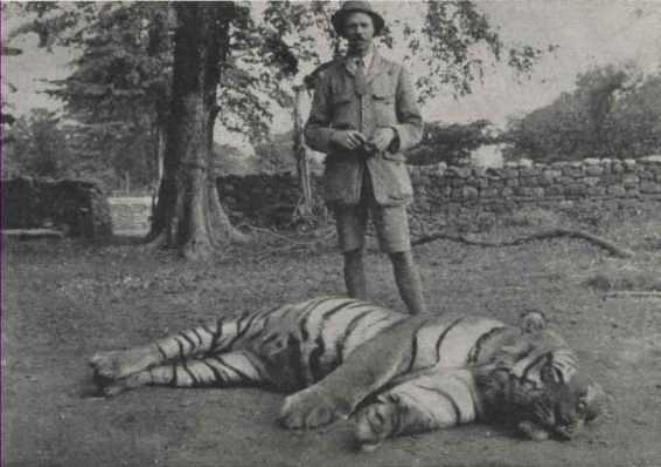
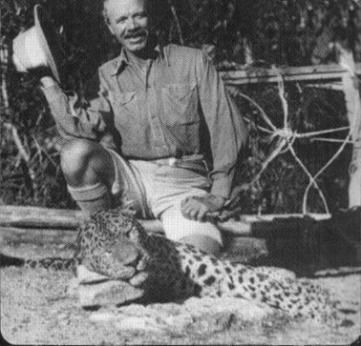
Corbett in the winter of 1930 after killing a massive male called the Bachelor of Powalgarh. Credit: Wikimedia Commons/historical file
But reason prevailed, the crowd’s rage died down, and for the first time Corbett was able to examine the tiger up close. He saw something he’d find again and again over the following years, as he became a famed hunter with a reputation for stopping man-eating tigers and leopards.
Tigers don’t become man-eaters by choice, and there’s no evidence they enjoy eating humans. Eating people is a dangerous business even for apex predators, who tend to have short lives once they start hunting humans.
They do it out of necessity, almost always as a result of human action: Hunters who hobble them but fail to finish the job, or fire errant shots that shatter one of their terrifying canines, rendering them incapable of taking down their usual prey, or making their preferred hunts much more difficult.
Those unfortunate tigers are left with two options: Find easier-to-kill prey, or starve to death. Even if the taste of human flesh is revolting to them, the madness of hunger compels them to hunt.
That, it turns out, is exactly what had turned the Chamapwat tiger into a man-eater. A hunter’s shot wasn’t true and shattered two of the big cat’s fangs, impeding her ability to deliver a proper kill bite in the instinctive fashion tigers kill their prey.
“When the tigress had stood on the rock looking down at me I had noticed that there was something wrong with her mouth, and on examining her now I found that the upper and lower canine teeth on the right side of her mouth were broken, the upper one in half, and the lower one right down to the bone,” Corbett wrote. “This permanent injury to her teeth — the result of a gun-shot wound — had prevented her from killing her natural prey, and had been the cause of her becoming a man-eater.”
The head of the “Demon of Champawat.” Note the broken upper and lower canines on the tiger’s right side. Credit: Wikimedia Commons
The truth, sadly, is that man-eaters are almost always “created” by men.
“A man-eating tiger is a tiger that has been compelled, through stress of circumstances beyond its control, to adopt a diet alien to it,” Corbett wrote. “The stress of circumstances is, in nine cases out of ten, wounds, and in the tenth case old age. The wound that has caused a particular tiger to take to man-eating might be the result of a carelessly fired shot and failure to follow up and recover the wounded animal, or be the result of the tiger having lost his temper when killing a porcupine. Human beings are not the natural prey of tigers, and it is only when tigers have been incapacitated through wounds or old age that, in order to live, they are compelled to take a diet of human flesh.”
While tigers become man-eaters out of necessity and don’t like the taste of human flesh, man-eaters are not “old and mangy,” as some people believe, and there’s no indication that human flesh is detrimental to them. On the contrary, Corbett wrote, a diet of human flesh “has quite the opposite effect, for all the man-eaters I have seen have had remarkably fine coats.”
Corbett with the corpse of the Leopard of Rudraprayag, which officially killed 125 people during an eight-year streak of terror. Historians believe the leopard’s kill count was likely much higher, as many deaths in rural India went unrecorded. Unusually for leopards — who are said to retain their fear of man even after turning to eating humans — the Leopard of Rudraprayag was extremely aggressive, even breaking into homes to find its victims. The big cat, a male, eluded soldiers of the British Raj as well as Gurkhas for years until Corbett took on the hunt.
The last tigers
Today, with the World Wildlife Federation warning we’ve wiped out an incomprehensible 70 percent of the world’s wildlife in the last 50 years, and tigers numbering only 4,000 or so in the wild, you’d think man-eaters would be a thing of the past.
They’re not. In a five-year period from 2014 to 2019, tigers killed 255 people in India, where the majority of the world’s remaining wild tigers live.
In 2014, a male Bengal killed at least 10 people in northern India before moving on or limiting himself to natural prey. His reign of terror cast a shadow over a wide section of southern India’s Tamil Nadu. Some 65 schools were closed, people refused to travel at night and families stayed behind locked doors just as their countrymen did a hundred years ago when the Champawat tiger killed with impunity. The male tiger was never caught.
That same year, a man-eater who had killed three people was shot dead before it could take more lives. Local authorities used modern tools, including a network of 65 trail cameras, to hunt the big cat. Since then there have been sporadic conflicts between the big cats and rural villagers, often sparked by tigers and leopards going after livestock.
The felid-human conflicts happen because of habitat destruction. The tigers simply can’t avoid people because people are everywhere.
Yet even Corbett, who was known for killing them, eventually became known for saving them. By becoming the foremost expert on man-eaters after successfully hunting 33 of them, he understood better than anyone the pressures faced by big cats in a world where humans were rapidly expanding and clearing jungle.
A hundred years ago when India was home to an estimated 100,000 tigers and 300 million people, Corbett understood the tigers were in danger. Now the tigers number 4,000 and the humans 1.4 billion, and the situation for one of nature’s most iconic animals is extremely precarious.
Corbett played a big part in changing attitudes toward tigers and other big cats. A century ago most people hadn’t even heard of the concept of conservation. Corbett believed it’s possible for humans and big cats to live in proximity, and indeed India has seen the peculiar emergence of the so-called “urban leopard,” with that species proving adaptable as its surroundings change. Conservationists credit leopards with saving countless human lives by preying on the innumerable wild dogs who patrol the outskirts of cities and towns, including major cities like Mumbai.
“The author who first used the words ‘as cruel as a tiger’ and ‘as bloodthirsty as a tiger’ when attempting to emphasize the evil character of the villain of his piece, not only showed a lamentable ignorance of the animal he defamed, but coined phrases which have come into universal circulation, and which are mainly responsible for the wrong opinion of tigers held by all except that very small proportion of the public who have the opportunity of forming their own opinions,” Corbett wrote almost 40 years after the events in Champawat.
Corbett at 68 years old, in 1944. By that time he’d dedicated himself to the protection and conservation of tigers and other wildlife, warning that they would go extinct if measures weren’t taken to protect them. Credit: Wikimedia Commons
Reflecting on his youth in the British Raj, the hunts he embarked on as a kid and as a teenager, and the nights he spent alone in the jungle with nothing but a small fire to keep him company, Corbett recalled hearing the calls of tigers and knowing that “a tiger, unless molested, would do him no harm.”
He recalled stumbling upon a tiger as he was hunting jungle fowl, watching the huge cat emerge from a plum bush and regard him with a look that said: “‘Hello, kid, what are you doing here?’ And, receiving no answer, turning around and walking away very slowly without once looking back.”
“And then I think of the tens of thousands of men, women and children who, while working in the forests or cutting grass or collecting dry sticks, pass day by day close to where tigers are lying up and who, when they return safely to their homes, do not even know that they have been under the observation of this so-called ‘cruel’ and ‘bloodthirsty’ animal.”
Corbett dedicated the later part of his life to the conservation and protection of tigers, and India’s first national park was named in his honor. In 1973, Jim Corbett National Park — an area covering more than 520 square kilometers — became the first implementation site for Project Tiger, a conservation plan by India’s government that has been credited with increasing the number of wild tigers in the country by three-fold, from a dismal low of 1,411 tigers in 2006 to almost 4,000 today.
And in 1968, Czech biologist Vratislav Mazák named a newly-recognized subspecies — the Indochinese tiger — Panthera tigris corbetti in honor of the famed hunter.
More than anyone, Corbett understood how dangerous tigers can be, but he also came to appreciate their strength, beauty and spirit.
“The tiger is a large hearted gentleman with boundless courage,” he wrote decades after that first man-eater hunt, “and that when he is exterminated — as exterminated he will be, unless public opinion rallies to his support – India will be the poorer by having lost the finest of her fauna.”
If you enjoyed this story, please consider disabling your ad blocker when reading Pain In The Bud, and give us a follow on our new Facebook page.
Happy Super Bowl, a special day when Americans across the country will gather and watch more than 200 commercials, and some team will play some other team in just 11 minutes of actual game time.
No wonder the NFL and its advertising partners try to sell the commercials as entertainment in their own right: If you watch the Super Bowl, you’ll be subjecting yourself to an relentless onslaught of adverts for everything from Budweiser to Booking.com, insurance companies trying to out-zany each other, and gambling commercials. Lots and lots of gambling commercials for sites like DraftKings, Caesars Sportsbook, MGM and FanDuel.
Super Bowl Sunday was previously made brighter by the Kitten Bowl, but Hallmark canceled the cute fan favorite last year, saying only that it’s “not currently developing original animal-centric programming.”
It was inevitable that another network would move in to capitalize on Hallmark dumping its popular annual special, and taking the place of Kitten Bowl is the Great American Rescue Bowl, an event by the Great American Family Channel and the North Shore Animal League which will feature adoptable dogs and cats on a pet-size football field, along with host Beth Stern revisiting the stories of kittens, cats, puppies and dogs who were featured last year and found their forever homes. If you don’t get the Great American Family Channel you can stream the event on Hulu beginning at 10:30 a.m. (See the previous link for other streaming options.)
Viva la Tiger Bowl!
Watch this space in the coming week for a new longform story about the Champawat tiger, the most dangerous animal documented in more than 5,000 years of recorded human history. Little Buddy and I did quite a bit of research for this one, and we hope it’ll make for a good read.














 Pain In The Bud