Another Viral Story Claims A Student Identifies As A Cat

Why is it always cats? Why don’t people make up stories about kids identifying as aardvarks or kangaroos?

Humans have dragged cats into the culture wars, and it seems our furry friends can’t claw their way out.

Australia’s Herald-Sun claimed this week, without any evidence, that a “phenomenally bright” teenage girl at a private school in Melbourne identifies as a cat, and the adults who run the school are cool with it as long as she isn’t too much of a distraction to her classmates.

This is the fifth or sixth viral story about school kids “identifying as cats” so far in 2022. They vary in details — some articles claim schools provide litter boxes in student bathrooms, while others assert teachers were fired for refusing to “meow back” to cat-identified children — but they’re all variations on the same theme.

None of the stories have turned out to be true.

There are big time red flags in this story. It doesn’t name the student, but that’s not uncommon. Unless a kid decides to speak to the media directly, most outlets refrain from naming minors. But the article doesn’t name the school and it’s based on the word of one person, with all the details attributed to someone described as “a source close to the family.”
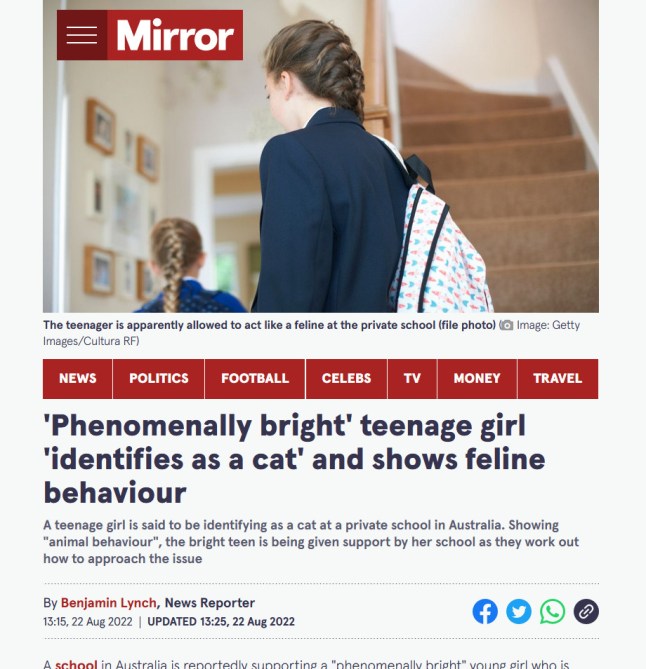
Viral story about alleged cat-identified teenager
The Herald-Sun’s story has spread via News Corp.’s digital platforms to social media, clickbait sites and less scrupulous publishers.

Single-source stories are no-nos in journalism, for obvious reasons. There’s an old joke among journalists: “If your mother tells you she loves you, confirm it with a second source.”

In other words, assume nothing and verify everything, especially if the claim is unusual or extraordinary. The absolute minimum standard is two sources, preferably three.

It used to be that breaking this rule was playing Russian roulette with your career, because it’s bound to blow up in your face at some point, and no editor worth her salt would run a story like that. Unfortunately in the age of “publish now, verify never” the veracity of a story is a secondary or tertiary consideration, far less important than an article’s potential to catch fire, go viral and reel in clicks.

This story doesn’t even come close to meeting minimum standards, because the claims come from someone whose name isn’t revealed. When the source is anonymous, the need to verify becomes even more important.
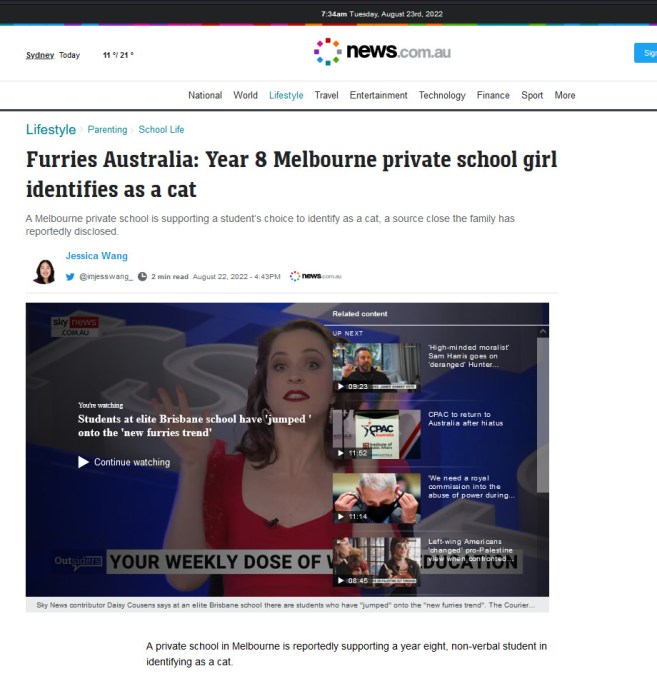
Viral hoax story
Another News Corp. platform promotes the story.

In this case, if a friend of the girl’s family claims the girl is allowed to behave like a cat in school, and that friend isn’t willing to stand by that claim, no reputable news organization should run the story unless they have confirmation from the school or a legitimate document (like a letter to parents from the school) that backs up the claim.

The Herald-Sun story says the school issued a statement in response to the alleged controversy, but again, the school isn’t named so it’s impossible to confirm any details.

Finally, the Herald-Sun is a News Corp.-owned tabloid whose editors have a reputation for printing stories designed to rile up their readership and drive clicks online. The paper gives its reporters bonuses based on traffic numbers, which is an incentive to fabulate outrageous nonsense and ignore crucial but time-consuming work like serving as watchdogs of government.

The editors of the Herald-Sun may not be stupid, but they’re willing to destroy the remaining scraps of credibility the media still has to enjoy one-time spikes in traffic. They know a story like this will make the rounds on Twitter, Facebook, Youtube, TikTok and the personal sites of culture war vultures whose formula for drawing readership is whipping readers/viewers into a frenzy.

In the meantime, the most recent polls show media credibility with the public is at an all-time low, which is what happens when journalism becomes a race to the bottom. We used to laugh at junk tabloids that ran cover stories about alien abductions and Elvis sightings. Now we click on them and share them on social media.

Thankfully cats remain oblivious, and ignorance is bliss.
Felines Blast Humans For Cultural Appropriation: ‘You Can’t Identify As A Cat!’

“Will you humans please stop trying to be cats? If you take our napping spots, we’re going to be very angry.”

NEW YORK — Responding to the increasingly common phenomena of humans claiming they “identify as cats,” the country’s felines blasted the offenders on Tuesday for “stealing from a culture that isn’t theirs.”

The angry cats hastily organized a press conference, then had a short nap before addressing a group of about 50 reporters from news agencies across the world.

“It’s come to our attention that certain humans have been meowing, lapping water from bowls and even doing their business in litter boxes instead of toilets,” said Chonkmatic the Magnificent, King of North American cats. “While they say imitation is the most sincere form of flattery, we’re concerned that these humans are essentially cosplaying as felines and remain ignorant of our traditions. After all, things like the Ritual of 3 a.m. Zooms and the Making of Biscuits have a long and storied cultural history, and are sacred to our kind. We sing the Song of Our People and rocket around the house like pinballs at ungodly hours in tribute to our ancestors.”

While some stories — such as high schools allegedly accommodating “cat-identified” students by placing litter boxes in student bathrooms — have turned out to be hoaxes, there is a growing movement of self-described “catgender” people who use pronouns like “mew/purr” and “nya/nyan.” The latter is based on the onomatopoeic word for “meow” in Japanese.

For example, a sentence referencing a catgender-identified person might look like this: “Nyan wasn’t feeling well and decided to take one of nya’s sick days.”

1639487420771
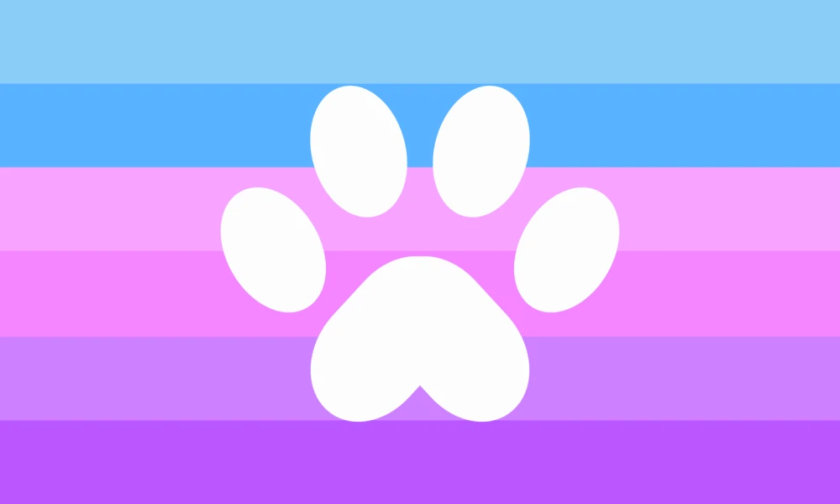
An “inclusive catgender flag” that represents catboys, catgirls, demicats, pancats, meowgender, mewgender, emo catgender, catsexuals and others who “strongly identify with felines or feline characteristics.”

Catgender falls under the larger umbrella of xenogender, according to people who keep track of these things, and is not the same as “cat sexual,” which presumably involves attraction to cats. (This reporter, afraid of what he might find, refrained from investigating that particular identity.)

While it may be tempting to wave off the idea of xenogender, catgender and associated identities like kittengender as the mad rants of Extremely Online People who populate sites like Tumblr, concepts like xenogender and neopronouns have already gained more than a foothold in the real world, with institutions of higher education like the UK’s University of Bristol ordering employees to acknowledge and use exotic neopronouns and their associated identities.

A person who identifies as a rabbit, for example, might use the pronouns “bun/bunself,” while a person who identifies as a vampire may use “vamp/vampself,” according to the New York Times.

identifycat
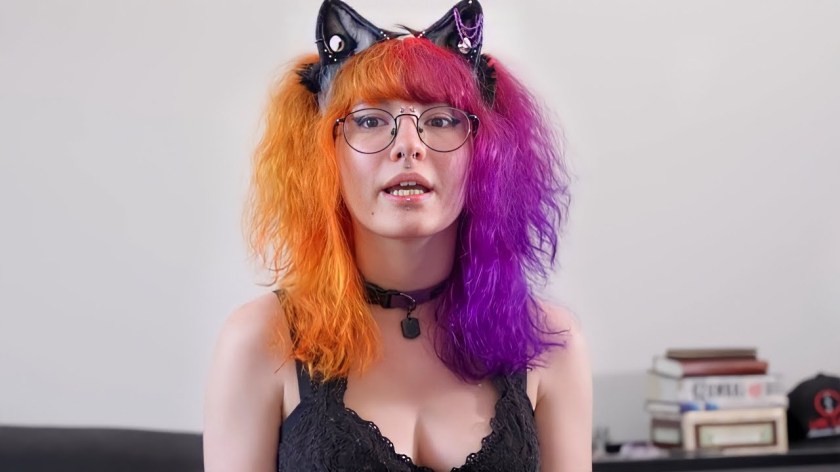
Abigail of Greenville, NC, says she identifies as a cat. Her boyfriend dispenses treats for her and calls her a “good girl.” Credit: Barcroft TV

Regardless, felines aren’t sold on the idea of species fluidity. They point out humans are “terrible groomers,” utterly hopeless at speaking tail and whisker, cursed with dead noses, and partial to “disgusting food” including fruits and vegetables.

“A real cat wouldn’t eat broccoli or oranges even if they were wrapped in a deliciously crispy crust of deep-fried turkey,” King Chonkmatic said matter-of-factly.

American cats said they are concerned that if the so-called cat identity catches on, confused humans may begin to compete with them for prime napping spots, treats, affection and even catnip.

The latter plant carries particular significance in feline culture, and cats aren’t pleased that it’s been commodified by humans and sold alongside Jimi Hendrix posters and lava lamps in head shops.

“Catnip is a ceremonial and spiritual plant reserved only for the most solemn of felid rituals,” said the Very Rev. Mr. Fuzzypants, a 9-year-old ragdoll who serves as president of the National Association for Responsible Catnip Consumption (NARCC). “Humans who are ignorant regarding its religious importance think it’s merely a recreational substance that inspires silly behavior, and frankly that’s offensive.”

Felines said they were incensed with generations Y and Z for co-opting their sleeping habits.

“Millennials and their younger cohort say they’re always tired and they’re constantly taking naps to seem more cat-like,” said Buddy the Cat, former President of the Americats. “But as we know, naps have a long and profound history among our people, who are so devoted to sleep that we enjoy up to 16 hours of it per day.

“Napping is deeply ingrained in our culture, and shouldn’t be a fashion statement for teenagers who want to seem ‘cool’ by being lazy and apathetic. Now if you’ll excuse me, it’s time for my seventh nap.”

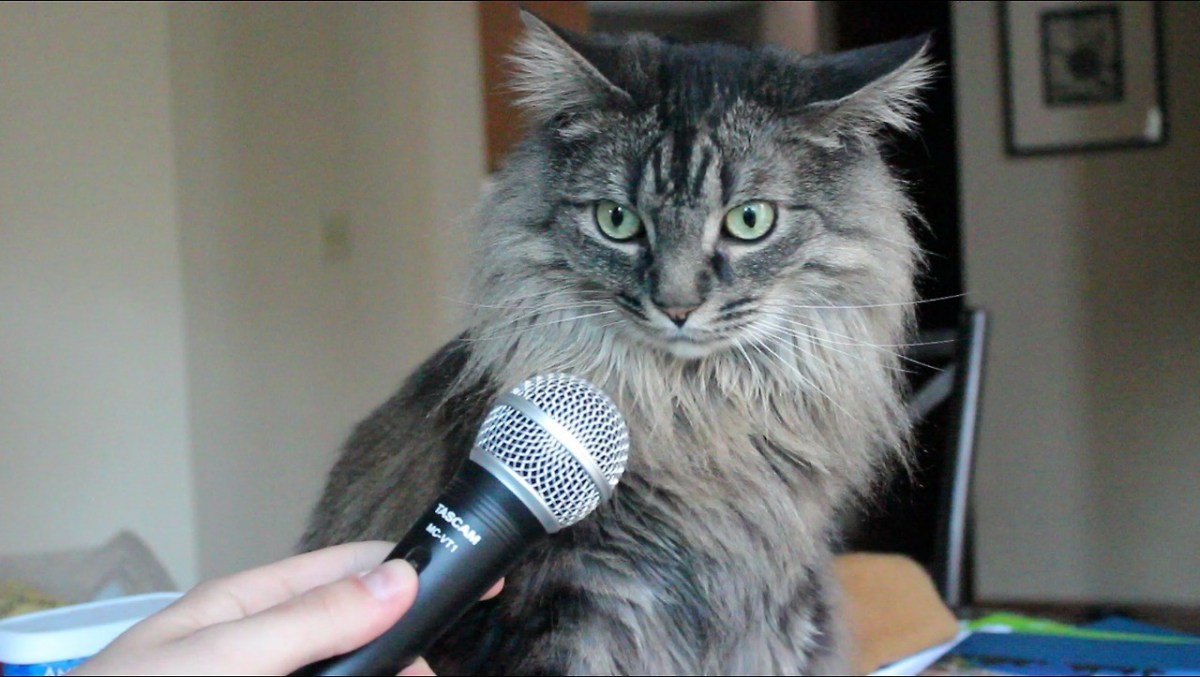
chonkmatic
Chonkmatic the Magnificent, King of All North American Cats, is not pleased with human encroachment on feline culture.