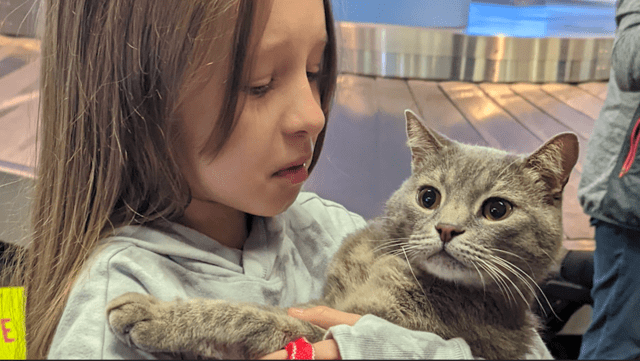
Ten-year-old Agnessa had to leave her cat, Arsenii, behind in Romania and was distraught at being separated from him.
Call me cheesy, but despite the polarization in our country, despite our disgusting political system and despite the fact that we’ve got plenty of flaws, America is still a good place to live and most Americans are good people.
I’m reminded of how lucky we have it here when I see photos of Uyghurs lined up by the thousands with their dead eyes in China’s concentration camps, and when I see clips of ghoulish Putin cronies on Russian state TV gleefully cackling at footage of destroyed Ukrainian hospitals, and laughing as they talk about drowning Ukrainian children.
I’m reminded of it in a much more hopeful way when I read stories like this one about 10-year-old Ukrainian Agnessa Bezhenar, whose family fled their war-torn country, spent time in Romania as refugees and eventually ended up in California.
Not only did Agnessa have to leave the only country she’d ever known and adjust to two foreign countries, and not only does she have to learn a new language and adjust to a new school, but her heart’s been broken since she had to leave behind her cat, Arsenii.
Agnessa was overcome with emotion after reuniting with Arsenii. Credit: Maria Bezhenar
Thanks to the efforts of two kind flight attendants, a volunteer at an animal rescue and her supportive new community in Cloverdale, Cali., Agnessa was finally reunited with Arsenii, a silver tabby with decidedly Buddesian looks. (No wonder Agnessa loves him so much!)
Geoffry Peters, the Californian who provided his second home to the Bezhenar family, also helped arrange to have Arsenii brought to the US.
“Can you imagine your life being turned upside down and you have to leave a country you’ve never left before, ride on an airplane you’ve never done before? Arrive in a new country, learn a language,” Peters told CBS News. “I mean, it’s like starting from scratch, only it’s on steroids. It’s like everything moving 100 miles an hour.”
Peters connected with the family through a program that helps Ukrainian refugees find homes in the US.
“Maria [Bezhenar] sent an email saying we’ve been matched and we have a family of six,” Peters said. “And so I went to my son and I said instead of renting this house, which he was planning on doing, would you be willing to donate it for two years?”
A flight attendant the Bezhenars met en route to the US connected the family with a fellow flight attendant who does animal rescue and recommended a local animal non-profit. When the staff at that rescue were told about Agnessa’s predicament, they contacted a colleague who was vacationing in Greece. That colleague agreed to travel to Bucharest, where Agnessa’s uncle had stayed behind and was caring for Arsenii. (A Ukrainian version of the Greek name Arsenios.)
The colleague brought Arsenii to California, a trip that took human and cat from Bucharest to Greece to Montreal, then Seattle and finally to Cloverdale. In all, Arsenii traveled more than 7,000 miles to be reunited with Agnessa.
Agnessa and her older sisters waiting for Arsenii to arrive at the airport. Credit: Maria
Much like the Bezhenar family had arrived in the US to find Cloverdale locals holding up signs welcoming them to the US, the Bezhenars greeted Arsenii with their own signs — and lots of tears — when his long journey was finally over.
It’s been a rough year filled with trauma for the Bezhenar family, but they’ve found a new community, new friends like Peters, and have the support of people in Cloverdale, who worked together to make sure the Bezhenar’s new home was furnished when they moved in. They even got a piano for the home after hearing the kids liked to play.
The US is evenly split between 25 cat states and 25 dog states.
I spent a weekend dog-sitting for the first time ever in the spring of 2 B.B. (Before Buddy), rising early to walk my brother’s Chihuahua-terrier before work.
The Manhattan of 7 am is a different world: Everywhere I looked, bleary-eyed New Yorkers clutched leads, yawning as dogs of all shapes and sizes pulled them along. I never knew there were so many dog-friendly apartments, let alone so many people willing to share cramped spaces with dogs of all sizes. Seven-pound Cosmo was one thing, Greate Danes and Dobermans quite another.
You’d think New York City, with its sky-high population density, would be a cat town. It isn’t. Neither is New York State as a whole.
Sadly, Buddy and I live in a state dominated by dog-lovers, one of 25 including California, Texas, Florida, Virginia and both Carolinas. Although cats are the most popular pets in 25 states as well, feline strongholds tend to be in places with lower population density, from Oregon and Washington in the west to Louisiana, Arkansas and Mississippi in the south, to Pennsylvania, New Jersey and Maine in the east.
The information was compiled by market research firm Time2Play, which surveyed more than 3,000 Americans. The team also asked respondents whether they posted photos and videos of their pets online. Even though cats remain the undisputed masters of digital space, almost 57 percent of dog people showed off their pooches online, while only 43 percent of cat servants did.
Bud and I have been thinking about moving someplace warmer for years, but of course the king’s needs come first. Maybe we’ll settle in Louisiana or Nevada, where Buddy can establish a new realm for himself.
An experimental new drug offers hope for cats infected with FIPV, which is almost always fatal.
Anae Evangelista was reeling from the deaths of two close friends when she saw Parsnip in a local shelter’s online post.
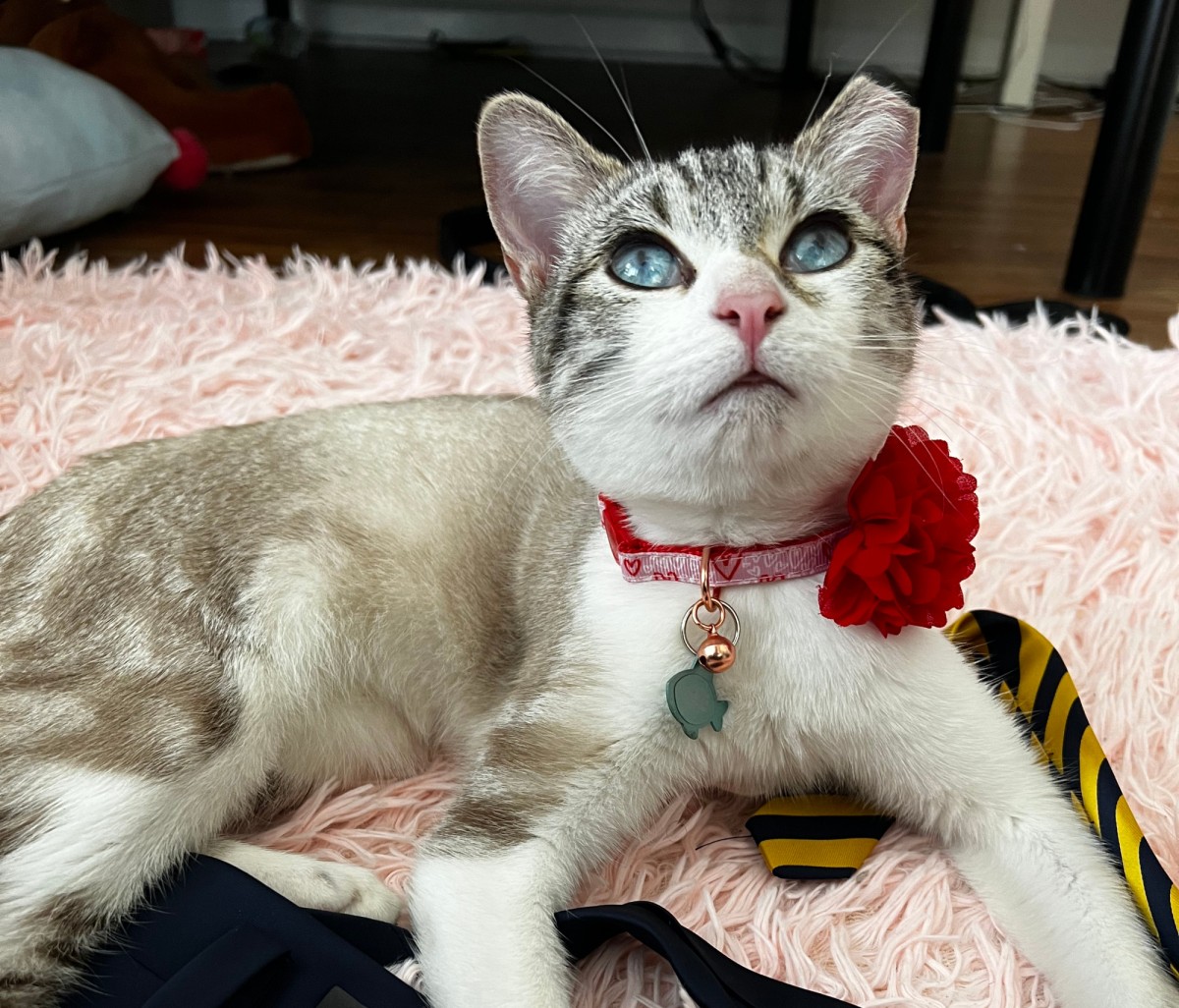
The 21-year-old college student had been thinking of getting a cat for weeks after accompanying a friend to a local shelter. After checking the shelter’s adoptable pets again, she fell in love with an adorable tabby with a clipped ear and sky blue eyes and immediately made plans to see her in San Diego.
Parsnip took to Evangelista immediately.
“She was so affectionate, pushing her head into my hand for pets, and I knew she was the one,” Evangelista told PITB.
Although many cats take days or weeks to adjust to their forever homes, Parsnip “strutted into my apartment as if she owned it from day one, zooming all over the place [with] enough energy to bounce off the walls,” Evangelista said.
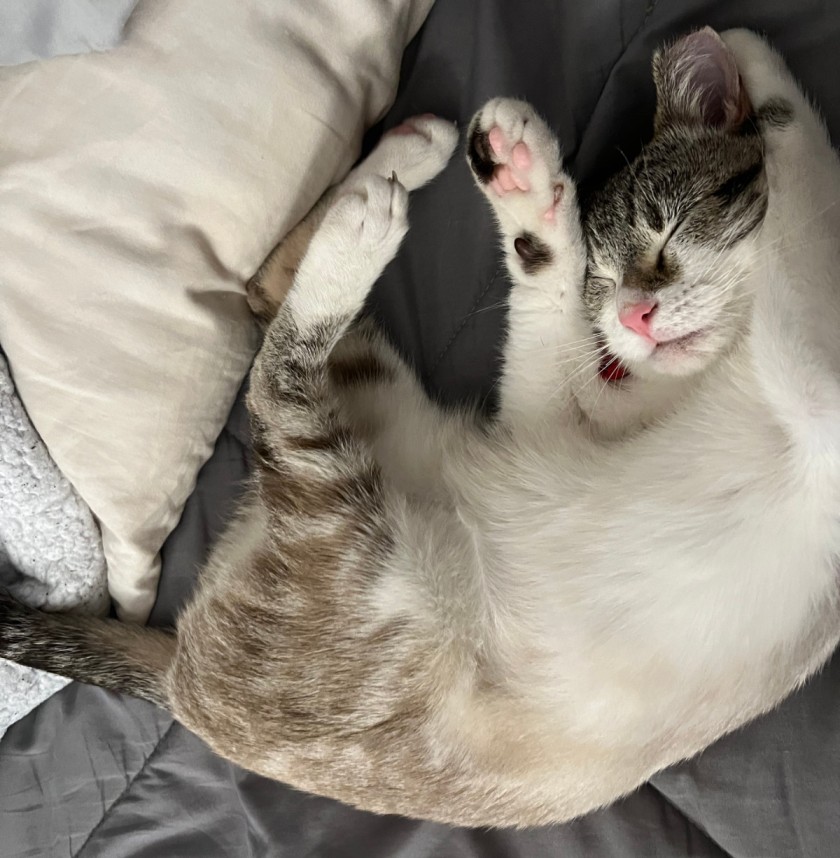
Parsnip enjoys a snooze with toe beans on display.
Although she had a rough start to life and was rescued from a hoarding situation, Parsnip was friendly, affectionate and warmed quickly to her new home. As human and kitten became fast friends, Parsnip’s presence was an immediate boost to Evangelista’s mental health.
‘She’s been my rock,” she said, “and although she can’t talk, I feel as if she’s constantly encouraging me to stay strong.”
But after about six weeks Parsnip’s energy level took a distressing dive. She was weak, slept a lot and wouldn’t eat much. A vet visit didn’t yield any answers, and the next day Parsnip displayed more telltale signs of a seriously sick cat — she stopped eating and drinking entirely, and began eliminating outside of her litter box.
After consulting another veterinarian, Evangelista finally had an answer. Little Parsnip was suffering from Feline infectious peritonitis, a more virulent strain of feline coronavirus that infects white blood cells resulting in dangerous inflammation, per the Cornell Feline Health Center.
“An intense inflammatory reaction to FIPV occurs around vessels in the tissues where these infected cells locate, often in the abdomen, kidney, or brain,” according to Cornell. “It is this interaction between the body’s own immune system and the virus that is responsible for the development of FIP.”
The disease is “usually progressive and almost always fatal without therapy.”
But there’s hope for Parsnip: With the help of her veterinarian and an online group for people whose cats have FIPV, Evangelista was able to get her kitty accepted for experimental treatment with GS-441524, a nucleoside analogue antiviral drug that has proven effective at treating all types of FIP in several trials in recent years. (It’s been so effective, in fact, that Chinese pharmaceutical manufacturers have been supplying GS-441524 on the black market to cat caretakers who haven’t been able to get their cats into trials.)
Since starting the treatment, Parsnip’s responded well: She’s eating again, the swelling has been in retreat, and she’s once again interested in play time, exploring and other things cats love to do. She’s even able to hop up on the couch again.
That’s a far cry from her condition just three weeks ago when she had a 105-degree fever, no interest in things around her and couldn’t get up under her own power.
The 84-day treatment, subsequent vet visits, monitoring and blood work is expensive: Evangelista estimates it’ll cost her about $5,000 in total. She’s looking to raise half that amount via a GoFundMe. It’s a huge expense, especially for a college student, but for Evangelista, spending the money is without question.
“She’s been my foundation and she deserves the world,” she said, “so I want to give her the chance to live to see it.”
The proposed law would declare cats and dogs have rights, but it doesn’t do much besides that.
Declaring cats and dogs should have fundamental rights, an assemblyman in California has introduced a law that would create a Bill of Rights for the two most popular companion animal species.
The text of the proposed legislation covers the basics including the right to food and water, veterinary care and a life free from abuse, neglect and anxiety. It recognizes felines and canines as sentient animals who need mental stimulation, and says adopting means committing to caring for an animal for its entire life.
But it’s really about pushing for an even greater effort to spay and neuter both species to avoid euthanizing almost a million unwanted cats and dogs every year.
There’s been great progress in the last decade alone: In 2011, kill shelters and animal control departments in the US put down more than 2.6 million cats and dogs. In recent years that number has fallen to 920,000, including 530,000 cats, according to the ASPCA.
That’s still a staggering number of lives taken, and animal advocates think the US can continue the downward trend in euthanizing pets via efforts to educate people and execute trap, neuter, return (TNR) plans.
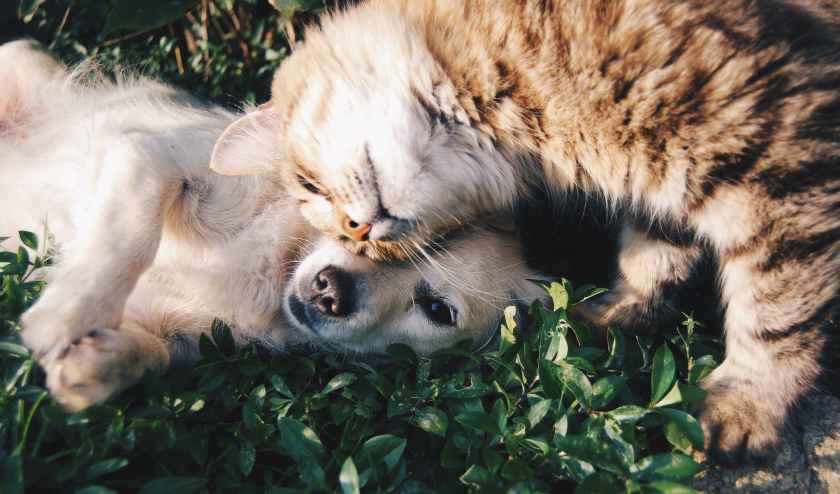
An orange tabby and his puppy friend. Credit: Snapwire/Pexels
It’s already a crime in California to harm an animal as opposed to the majority of states, where pets are considered property and the consequences for hurting or killing someone’s beloved cat or dog don’t go beyond providing monetary compensation. (However, it’s notable that the proposed cat and dog bill of rights would be added to California’s Food and Agriculture Code, not the Criminal Code. The fact that animal welfare legislation continues to exist in agriculture law instead of criminal is a relic of times when the only laws concerning animals were written to regulate their ownership, sale and slaughter.)
Santiago’s bill doesn’t specify a new plan for spaying and neutering more felines and canines. It doesn’t include funds for TNR or fund new enforcement efforts, and it doesn’t provide welfare groups with new tools.
Mostly what it does is require shelters and rescues to display the pet bill of rights in “a conspicuous place” or face a potential $250 fine. It doesn’t even specify how money collected via fines would be used.
“It sounds pretty simple,” Santiago said, “but we need to talk about it.”
Santiago’s proposed legislation has the support of Judie Mancuso, president of the animal advocacy group Social Compassion in Legislation.
“Those rights go beyond just food, water, and shelter. As stated in the bill, dogs and cats have the right to be respected as sentient beings that experience complex feelings that are common among living animals while being unique to each individual. We’re thrilled to be codifying this into law.”
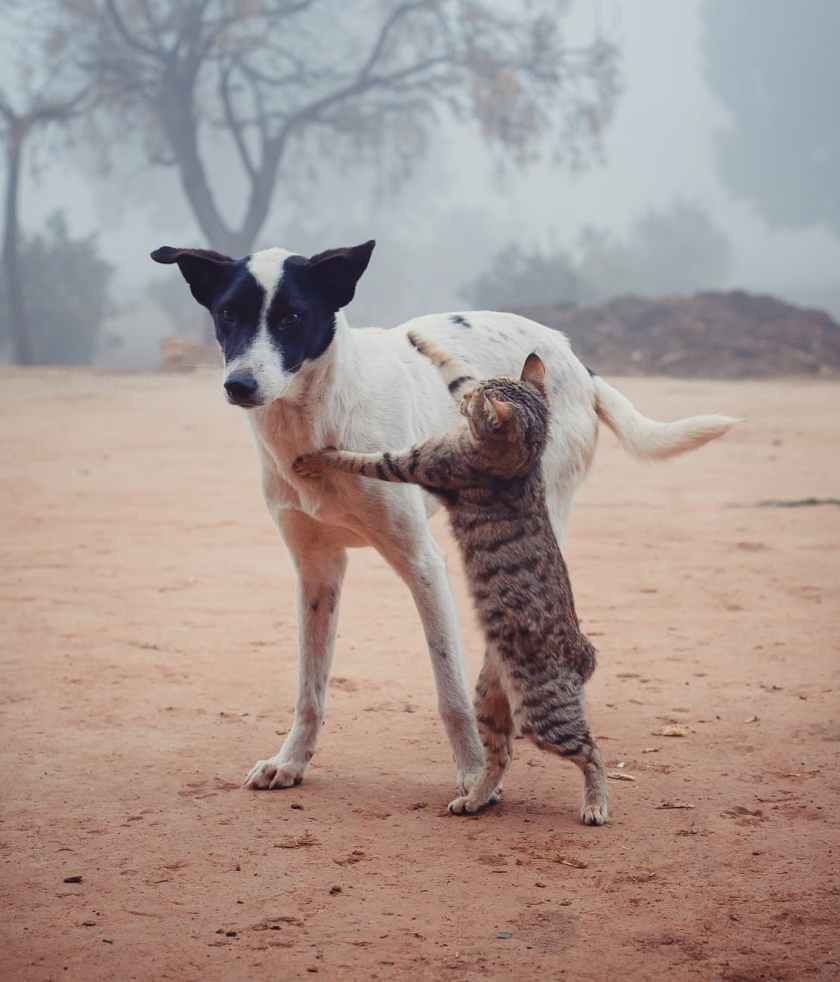
“So did you hear about the new bill of rights for cats and dogs? It says I have a right to ride you like a horse. No, seriously. Crouch down so I can get up there!” Credit: Tehmasip Khan/Pexels
There’s a long way to go yet for the potential law.
The bill doesn’t have any co-sponsors and it’s not clear how much support it has among other lawmakers. Without significant support it might not be put forth for consideration at all. New York’s assembly, for example, declined to put a declawing ban on the floor for a vote for years until it finally garnered enough support among politicians on both sides of the aisle, as well as voters and organizations like the PAW Project. The declawing ban finally passed in October of 2019.
Even if Santiago gets co-sponsors and convinces enough colleagues to proceed, it would have to pass in the state senate as well. As for PITB, we think failing the first time around might not be a bad thing if it forces Santiago to think bigger and smarter so it includes real measures to get more pets spayed and neutered. A bill of rights is a nice sentiment, but it won’t change much the way it’s written.
If Santiago and future allies lay out a competent plan for tackling companion animal overpopulation, perhaps it could be a model for other state to follow.
A couple who rented an Airbnb took a man’s cat, believing she was a neglected stray. The man says the cat is well-loved and desperately wants her back.
Troy Farrell’s cat, Nubbins, has been missing since October.
Neighbors told the Sonoma man that a couple who rented an Airbnb two houses down the street had been asking about the nearly tailless tabby and had seemed fond of her. That was Farrell’s only lead, but the owner of the Airbnb rental wouldn’t tell him who rented the place at the time Nubbins vanished.
When I read about Nubbins my first thought was that she was probably snatched up by people who thought they were doing the right thing by “rescuing” a neglected cat.
It turns out that’s exactly what happened.
First a veterinarian from Long Beach, more than 400 miles away, called Farrell and told him Nubbins had been brought into the vet’s practice for a health checkup. When they scanned the kitty’s microchip, Farrell’s contact information came up.
Farrell says he thought his ordeal was over, but the veterinarian — citing obligation to the client — wouldn’t tell him who brought the cat in. Instead, the vet said she’d pass along Farrell’s contact information and ask the couple to return the cat.
When they didn’t return Nubbins, Farrell filed a police report with the Sonoma County Sheriff’s Office, hired a private investigator and implored the local district attorney to look into the case.
“Those are evil people,” Farrell told an interviewer in late January. “Those are people without a conscience, those are people without a heart.”
He said he’s been lost without Nubbins.
“I don’t have kids. She’s my kid and she’s seen me through so many things. And they took her, and I want her back,” Farrell said. “The second I’d open that door or drive up the driveway or go out back … There’s Nubbins just in my lap.”
Nubbins in Farrell’s home. Originally a stray who escaped California’s wild fires, Nubbins gave birth to a litter before Farrell had her spayed and chipped.
The ‘catnapper’ comes forward
Now there’s a new development in the case: A man has come forward and admitted he took Nubbins, describing her as a neglected street cat who had been left outside to fend for herself in the cold without access to food or water.
The man detailed the allegations in a letter to Sonoma County Sheriff Mark Essick, and he’s not hiding his identity or denying he took the cat without asking Farrell. He identified himself as James R. Wakefield, an attorney in private practice out of Irvine, California.
“[W]e were never going to let that cat get put back in the living condition she was in without a fight,” Wakefield wrote in the letter to the sheriff.
While vacationing at the Airbnb in California wine country, Wakefield encountered Nubbins, saying she was “obviously hungry” and “she scarfed down the food” the vacationing couple gave her. Wakefield said that when he asked the Airbnb’s owner about the cat, the man said she was a local stray who needed a home.
Describing him and his wife as “70-year-old catnappers,” Wakefield said they’d do “everything in our ability to protect” Nubbins.
Farrell disagrees. He said the stumped tail and damage to Nubbins’ lip were from her days as a stray, when she escaped California wildfires several years ago and wandered into Farrell’s neighborhood. He took her in, he said, and she’s been his cat since. Nubbins is allowed in and out of the home as she pleases, he said, and always returns after she’s had her day’s adventures.
Nubbins refuses to be an indoor cat, Farrell said, and is well known to neighbors on the block, who also feed her and look out for her. It’s not uncommon for outdoor cats to make small circuits around their neighborhoods, visiting friendly neighbors for snacks and scritches before heading home for the day.
“That cat lives so large it’s not even funny,” Farrell said. “That cat has so many houses, so many people, so many little girls to play with down the block.”
Nubbins lounging outside. Her human, Troy Farrell, says the former stray likes to visit his neighbors every day.
That appears to be true: Farrell’s neighbors have backed up his story to the press, there are videos of the beloved cat hanging out in yards on the street, and one concerned neighbor even wrote a letter to the local newspaper imploring the police to get the situation sorted and return Nubbins to Sonoma.
The police have told Wakefield to return the cat to Farrell, while a spokesman for the district attorney told the Sonoma Index-Tribune that the DA is still reviewing the case. Like many other states, California considers pets as “property,” and authorities would have to determine if Nubbins is “worth” at least $950 to file criminal charges.
If Farrell can’t get Nubbins back via law enforcement his remaining recourse would be a civil trial, the newspaper noted.
Is it ever okay to steal someone’s pet?
This case raises some thorny questions. Farrell seems lost without his cat and has been clearly emotional in interviews with reporters as the saga of Nubbins has stretched on over the months. Meanwhile, I don’t think there’s any doubt Wakefield and his wife thought they were doing the right thing.
At least part of this standoff can be chalked up to misinformation and a lack of information: Matthew Knudsen, the man who rented the vacation home to the Wakefields, told them Nubbins was a stray who didn’t belong to anyone, according to Wakefield’s letter to the sheriff. Farrell said Knudsen owns and rents the house two doors down but doesn’t actually live in the neighborhood and doesn’t know how well Nubbins is cared for.
So from the Wakefields’ point of view, they thought they were rescuing a neglected cat and doing a good thing. At the same time, any cat servant should be able to empathize with the anguish another cat lover feels if their beloved feline goes missing or is stolen.
It’s easy to read the details and think maybe Farrell wasn’t doing right by his cat, and as readers of this blog know, I’m a strong advocate of keeping cats indoors for a long list of reasons, including myriad dangers to outdoor cats and the damage cats can do to local wildlife like birds, small mammals and lizards.
But I also know how easily people tend to toss out accusations of animal abuse and/or neglect. One reader was very upset with me when I posted a photo of Buddy with his paws stuck in the screen door that opens from the living room to the balcony. She strongly felt I was abusing Bud by allowing him to hang there for a few extra seconds while I snapped a few photos.
Buddy has gotten his claws stuck on the screen more times than I can count.
“Lies! The door attaches itself to my claws, that’s why I get stuck!”
Context is important in that case too. Buddy loves to lounge on the balcony in the summer, and he’s gotten his claws stuck on that damn door more times than I can count. (The many claw marks on the screen attest to that.) When he gets stuck he cries pitifully until I drop whatever I’m doing, lift him gently off the ground so he can unhook his claws without hurting himself, and reassure him in a soothing voice that he’s okay. It’s the cat dad equivalent of putting a band aid on a scraped knee.
No matter how many times Buddy gets stuck, no matter how many times I tell him “No!” and try to discourage him from scratching the door, he won’t stop doing it. He’s even got a four-foot-tall, sturdy scratcher literally a foot away, just a step inside the door! Clearly he has alternatives.
Not only is Buddy incredibly stubborn, but the day I took the above photographs, he’d already gotten stuck twice — including 20 or 30 minutes prior.
So yeah, I took the photos. Does that make me an animal abuser or guilty of neglect?
That woman thought so. If she’d been in a position to take Buddy, maybe she would have.
At the very least, the saga of Nubbins provides another good reason to keep cats indoors, even if they’re former strays who like to go outside. (Easier said than done, I realize.) But I don’t think there are any bad guys here, just people who thought they were doing the right thing without complete information.







 Pain In The Bud