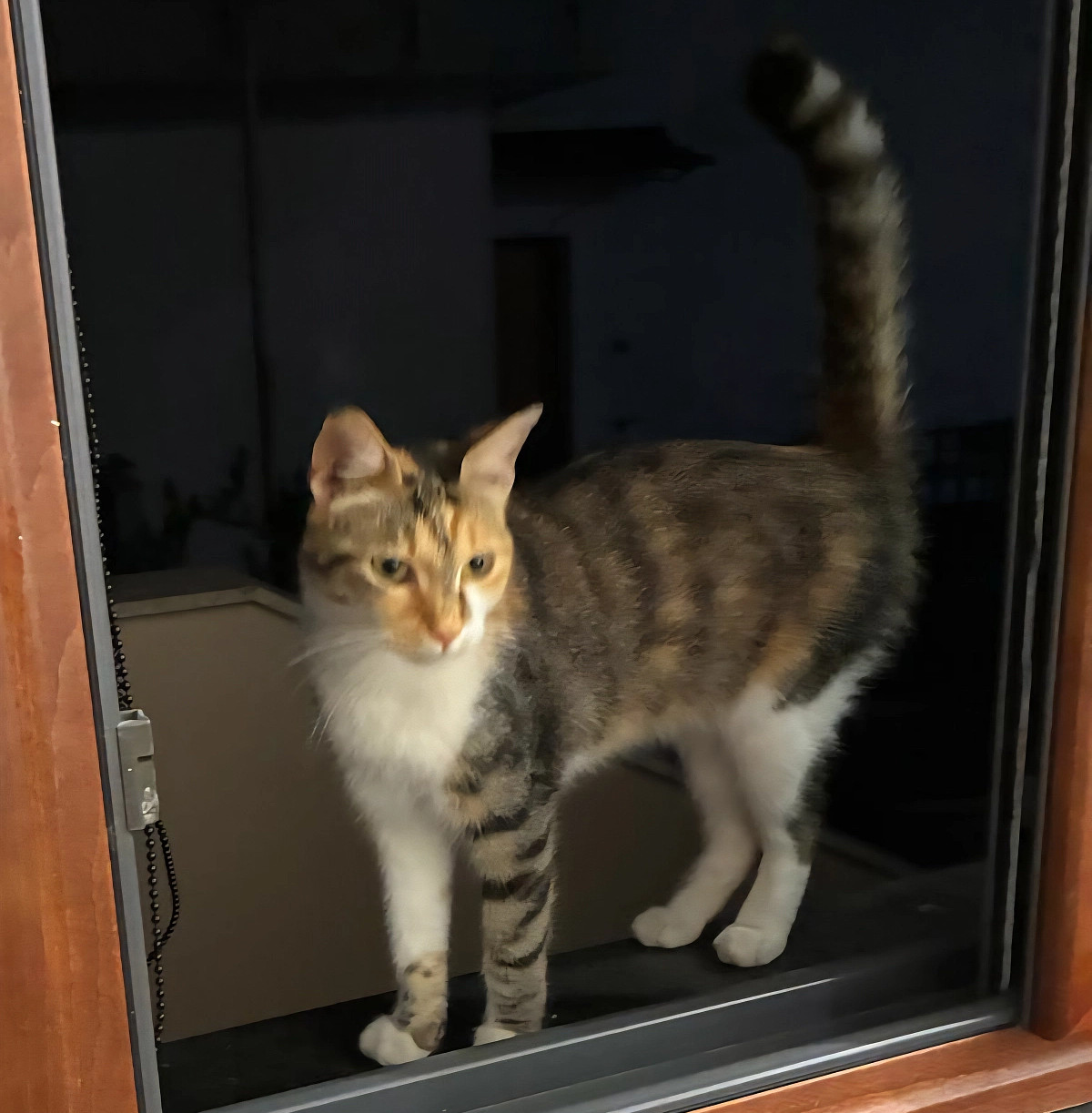
Twix the cat is a beautiful Calico living in sunny coastal Italy.
Wary as he may be of them sometimes, Bud is the “family cat” to my nieces.
Now 12 and 8, they’ve wanted a cat for a long time but were vetoed by their parents, since the family was moving to Italy and it appeared my younger niece had allergies.
Well, now they’re finally settled in Italy, tests have confirmed my niece is not allergic to cats, and it turns out their new home comes with a feline.
A beautiful, super-friendly and affectionate Calico named Twix, who was fed, spayed and given veterinary care by the home’s previous family.
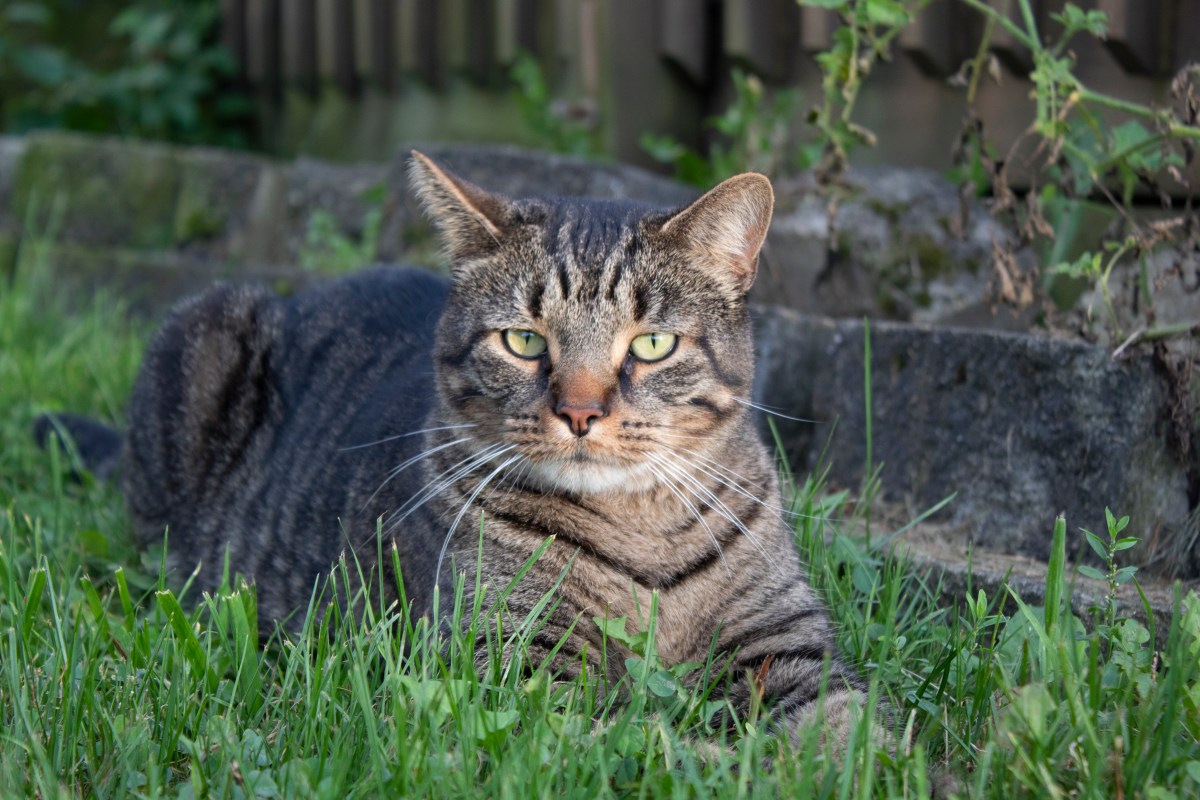
“She is super affectionate and lets us pet her a lot,” my brother texted me along with photos of Twix on a window sill and on the grass outside, enjoying scritches from the kids. “Even rolls on her back and has her stomach scratched.”
“Shiiit,” I responded. “Touching the stomach would get you killed with Bud … Well, you got a cat, whether you like it or not.”
The friendly Twix with the girls.
It also looks like Bud will have a potential lady friend. I plan to visit for an extended amount of time and use my brother’s house as a base from which to explore Europe, and there’s just no way I’m going to leave Bud for months, especially when he’ll be 12.
He can handle a long weekend and even a couple of weeks, but months? I don’t think that would be good for either of us, and I worry that he may think I’m not coming back. We have never been separated for that long. He’s coming to Italy with me.
As for Twix, it looks like she’s been living on the property for quite a while. The kids have set up a little shelter for her with blankets. I advised my brother to make sure she has a water bowl that’s refilled regularly with fresh water, they’re feeding her wet food, and I’ll work on getting little Twix inside permanently if she isn’t already a house cat by the time I get there. I can be persistent! It looks like she can come and go as she pleases, so it may not be long before she decides it’s better to be inside and safe.
A friend once taught me that you can “speak Italian” by adding -are (“RA”) onto anything. “Grazie! La felinare!”
When serial cat killers serve sentences of less than a year due to plea deals and early release for good behavior, how much deterrent value do our laws have? Not much, it seems.
Note, 5/3/2025: We’ve heard from two readers who say the MyNorthWest report contains inaccuracies. We’ve reached out to the police and will follow up with police and courts on Monday to verify the facts and correct potential misinformation. Apologies for the confusion.
Every couple of months, at least in the last year or two, I’ve slowed down on posting, and almost always for the same reason: my cat-related news alerts are seemingly endless streams of depressing stories about people shooting, strangling or dismembering cats.
It never ends, and sometimes it’s so overwhelming that I’m put off from writing for days. At the same time, I am not a believer in the idea that all animal blogs should be saccharine feel-good fests about fluffy kittens and TikTok videos of cats doing silly things.
There’s always a place for celebrating cats, but if they’re in danger, and if the stories point to wider trends that cat lovers should know about, then I think it’s our responsibility to remain educated. Not only so we can guard against threats to our little friends, but also so we can add our voices to the chorus calling for tougher laws and greater accountability.
That’s ultimately what this is about: accountability.
Stories about two cat serial killers in about a week have made it clear that even the strengthened animal protection law — the Preventing Animal Cruelty, or PACT Act — passed in 2019, during the first Trump administration, raising animal cruelty and murder to the level of a felony, are still not enough. They’re not a deterrent, especially when the convicted abusers and killers end up serving a year or less because prisons are overcrowded and the wider law enforcement community still doesn’t take animal-related crime as seriously as other violence.
Antoine Leander Runner Jr. is a serial murderer of cats. The Seattle man was recently released from prison after serving just a year for a felony animal cruelty conviction.
The 43-year-old’s modus operandi was setting up crude, homemade snares and traps to capture and harm felines. He was also known in cat rescue circles, where he posed as a cat lover and took advantage of programs to get free supplies, including “cat food, kennels, collars, leashes, and treats to lure cats and kill them,” according to MyNorthWest, a Seattle news site.
When locals discovered new homemade traps in Runner Jr.’s old haunts and trail cameras picked up images of the man himself stalking wooded areas, neighbors called police and area shelters. The evidence showed Runner Jr. was allegedly visiting cat colonies at night and had picked up right where he left off. One colony cat’s body was discovered on March 31, “disemboweled and publicly displayed.”
“Animal Control confirmed the injuries to the cats were human-caused,” MyNorthWest reported, adding that it appears Runner Jr. was visiting colonies “every night” to hunt cats.
Above images by u/picardhasyourback, posted to the SeattleWA subreddit. Click on the images to see full-size versions.
Runner Jr. was picked up by Seattle police this weekend after a neighbor spotted him in a wooded area and phoned authorities. The convicted cat killer, who had a new bench warrant out for his arrest, was charged with a misdemeanor, but more charges are likely as police investigate his latest alleged attacks on Seattle-area cats.
The Seattle man was originally arrested for killing cats in 2023, but was released early. The Seattle area was also terrorized by a serial cat killer who stalked the area in 2018, mutilating cats so badly that I won’t repeat the details on this blog out of respect for readers.
It should be made clear that Runner Jr. was not connected to the 2018 killings, but police should reconsider those cases as well because if it turns out Runner Jr. is guilty of these latest cat murders, it will be abundantly clear that he is a high recidivist offender who cannot be trusted to leave the animals alone. He should serve a long, unabridged prison sentence and be subject to constant monitoring when he’s released.
Antoine Leander Runner Jr. was arrested this weekend by Seattle police. Credit: Sarah Seiler/Facebook Georgetown Community Discussion Group
What’s the solution here? Increasingly tough criminal penalties for animal abuse and murder? Expensive monitoring equipment to watch over every cat colony? Education and training for law enforcement so violence toward animals is taken as seriously as it should be?
I hate to keep pointing out that people who harm animals are likely to “graduate” to harming humans, as many studies have shown, because it implies that we should only be concerned about animal abuse for its tendency to turn into human abuse. It obscures the fact that animal life is intrinsically valuable, and that cats — and dogs, many bird species, mammals and marine life — are sentient, with their own thoughts and emotions. But if that’s what it takes for people to take this sort of thing seriously, then it’s worth repeating the point.
Chris Arsenault ran back into the fire in an attempt to save more cats and never reemerged.
A man who founded a cat sanctuary to honor the legacy of his deceased son was killed, along with some 100 of the cats he cared for, in a raging fire Monday morning.
Christopher Arsenault, 65, lived on the premises of the Happy Cat sanctuary in Medford, along with about 300 cats he’d saved from euthanasia, dangerous situations and difficult lives as strays.
Firefighters were dispatched a few minutes after 7 am and it took them an hour and 20 minutes to bring the powerful blaze under control. Arsenault was able to get out of the main structure on the Suffolk County, Long Island, compound, but dashed back in to save more of his cats, according to neighbors who witnessed the fire.
Chris Arsenault at Happy Cat sanctuary. Credit: Happy Cat Sanctuary
The Suffolk County homicide and arson investigation squads are assigned to the case, Suffolk police Chief of Detectives William Doherty told the New York Post.
However, it can take weeks for lab results from the state police crime lab in Albany, and fire investigators will need to comb through the remains of the ruined structure and the rubble to find a point of origin.
“It’s too early in the investigation to determine any cause,” Doherty told the Post.
The grounds and facilities at Happy Cat sanctuary were meticulously maintained, but that did not stop some in the community from complaining about the existence of the sanctuary.
Arsenault “vowed to take the unwanted, discarded, homeless [cats], the ones that people were going to euthanize, he refused and he took them into his sanctuary, sometimes for no money at all,” Lisa Jaeger, a local cat rescuer who worked with Arsenault, told NBC New York. “He started the sanctuary [in 2007]. This was his life. He gave his life to save these cats.”
The sanctuary’s Facebook page was flooded with an outpouring of grief on Monday from people who knew and supported Arsenault.
“He was always so concerned about each and every single cat he had in his care. Didn’t matter how many… they were all his babies,” one distraught woman wrote. “To think he literally lost his life trying to save them breaks my heart and makes all the sense in the world that he would never leave them behind.”
Local rescuers and the county SPCA were trying to corral the surviving 200 cats on Monday. Some fled the grounds during the fire and remained unaccounted for, while others remained close to the destroyed sanctuary despite the chaos and the significant amount of activity from first responders.
Despite his efforts, Arsenault was the subject of a harassment campaign on social media from neighbors and a small group of people who alleged Arsenault wasn’t properly caring for cats. There’s no evidence to back up those claims, and Happy Cat has not been the subject of any violations.
A petition on Change.org posted last year demanded a stop to the alleged harassment of Arsenault by neighbors and a local code enforcement officer. It garnered 28,665 verified signatures.
Despite locals standing up for him, Arsenault had found a piece of property in upstate New York and was preparing to move his cats and sanctuary to that location.
John DeBacker, who participates in local trap, neuter, return (TNR) efforts, referenced the push back against Happy Cat in a post about the fire on Monday.
“Despite being harassed for months, he continued to fight for the cats,” the post read, “and I truly hope everyone can screenshot posts from one of the groups that has been harassing him in case arson is connected.”
An outdoor area at Happy Cat sanctuary. Credit: Happy Cat Sanctuary
It’s important to note that there is no evidence connecting any of the critics to the fire, authorities have not commented on the source of the fire, and any speculation about the cause is just that: speculation. It’s also important to emphasize that just because police homicide and arson squads are investigating an incident does not mean either of those crimes has taken place. Authorities won’t know anything for sure until they can thoroughly investigate the fire scene and get lab reports on evidence.
Arsenault himself said he felt compelled to respond to critics last month in a video he posted to Youtube.
“The audacity of these people to call Happy Cat sanctuary a hoarding situation, to be claiming that we’re committing animal abuse and animal neglect,” he said “The cats that I see…these are cats that are out there and have nowhere to go. These are cats that are suffering out there. And this is where sanctuaries come in … Right now [the critics are] just taking a big handful of spaghetti, and they’re just throwing it up against the wall to see what sticks to come after Happy Cat sanctuary.”
A report commissioned by the Scottish government blames cats for killing 27 million birds annually in the country.
“They may take our lives, but they’ll never take our freedom! Except maybe to keep pet cats.”
Mel Gibson’s iconic pre-battle rallying cry as Braveheart’s William Wallace might have to be amended if some Scottish politicians get their way and restrict the ownership of pet cats.
Cat lovers in Scotland were up in arms this week after several reports in Scottish and UK media said the Scottish National Party — Scotland’s most powerful political party, which controls almost half the seats in its parliament — is looking to ban cats in a bid to protect local wildlife.
They point to a recently released Scottish Animal Welfare Commission (SAWC) report that claims there are some 800,000 outdoor cats roaming the country, and those felines are responsible for 27 million birds every year, in addition to small mammals.
Meanwhile, other Scottish press pushed back on the claim, saying the SNP hasn’t voted to ban cats yet and isn’t really looking to stop people from having pet cats.
A report from the Scottish government recommends restricting cats to indoors, among other measures. Credit: Wikimedia Commons
In addition to a law requiring people to keep their pet cats indoors, the report suggested curfews and, yes, legislation that would forbid people from keeping pet cats if they live in certain places deemed “vulnerable” to feline predatory habits. That means if wildlife biologists identify an endangered bird that nests in an area, for example, people who live there would not be permitted to have pet cats.
However, the report does not call for a general or widespread ban, as some media reports suggested.
The report credited Australia, where several states have enacted strict measures forbidding people from allowing their cats outside, prohibiting them from owning cats in some places, and even embarking on an infamous campaign to kill three million domestic cats by air-dropping sausages laced with a poison that is lethal to felines, but supposedly not harmful to other animals.
That measure preceded several years of “biblical” rodent plagues, with hordes of mice rampaging across entire swaths of the country and causing billions of dollars in damage to residential and commercial property. Cats are, of course, the natural predators of rodents, and domestic cats wouldn’t exist as a species if they weren’t attracted to human settlements where mice and rats feasted on grain reserves.
CreditL Wikimedia Commons
I haven’t had the chance to take a deep dive into the SAWC report yet, so I don’t know precisely how the commission arrived at the numbers it did, or if the research is original. Hopefully I’ll have a follow up on that soon.
While the truth is somewhere in the middle, so is the solution. People who love cats are happy to voluntarily meet certain guidelines, and they should be, because if we’re uncooperative, someone will eventually turn to compulsion through law. Likewise, concern for the welfare of cats and wild animals aren’t mutually exclusive.
In the meantime, Scotland’s government is likely to spend more money studying the problem before acting.
A feel-good video about a kitten who was rescued from the brink of death.
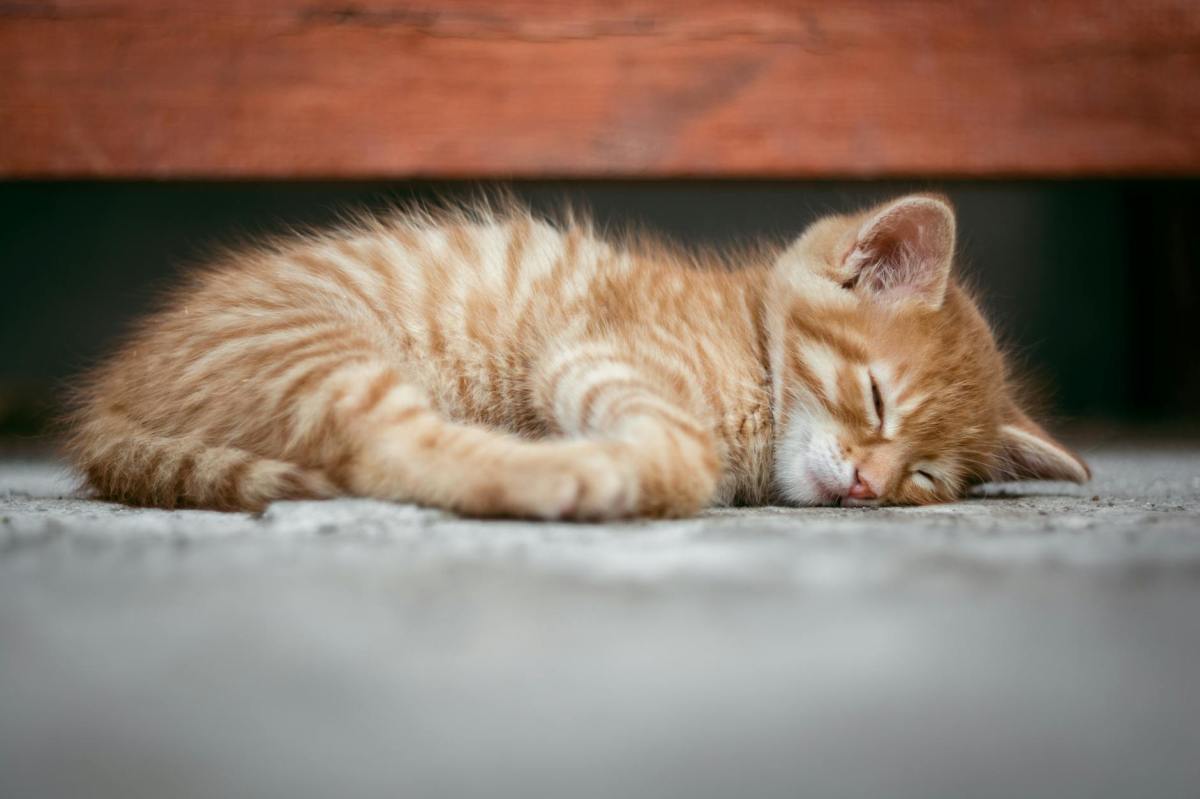
The girl in this video found an orange tabby kitten on the verge of death in Hubei, China, and refused to give up on the little one.
Through tears, she used a hair dryer to warm the kitten while her 39-year-old dad filmed her efforts. She was successful! The kitten slowly began to stir and felt well enough after two hours to lap up some milk.
Temperatures in Hubei can plunge into the 20s and 30s overnight this time of year, so the kitten would have died without the little girl’s intervention.








 Pain In The Bud