A new study reveals some surprises, while The Other Buddy continues to make progress after surviving an attack by two dogs.
I know you’re going to read this and think, “Okay, what have these two wiseasses come up with this time?” but I swear we didn’t make this one up!
It even appears to be a legitimate research paper, despite first attracting media attention on April Fool’s Day. (The paper itself was accepted in late 2021 and published in the journal PeerJ on March 25.)
To put it simply, adopting a cat will make all your wildest dreams come true. Buddy was right!
Cat servants are rated more attractive than people who don’t share their homes with cats, rate higher on traditional measurements of attractiveness like facial symmetry, and even weigh less (women) or, if they’re men, have higher levels of testosterone.
That’s according to a multinational research team led by Javier Borráz-León of Finland’s University of Turku.
How is this possible?
The team — which also consists of scientists from Latvia, Estonia and Mexico — believes it’s because of the infamous toxoplasma gondii, a parasite that infects cat droppings and can pass to humans and other animals.
T gondii nudges its hosts toward behavior that propagates the parasite itself.
“First, we found that infected men had lower facialfluctuating asymmetry whereas infected women had lower body mass, lower body mass index, a tendency for lower facialfluctuating asymmetry, higher self-perceived attractiveness, and a higher number of sexual partners than non-infected ones,” the study authors wrote. “Then, we found that infected men and women were rated as more attractive and healthier than non-infected ones.”
There’s precedent for this. Earlier studies have found that while most parasites make their hosts less likely to reproduce because they cause detectable negative health defects, toxoplasma gondii does the opposite. Male rats who are infected by t. gondii are more attractive to potential sexual partners in an example of a parasite that “can indeed manipulate host sexual signaling to their own advantage.”
That’s not to say you’d want to go and get yourself infected. Toxoplasma gondii can cause negative health effects, most famously in pregnant women, and may be responsible for agitating certain mental health issues. Some scientists have said fears about the parasite are overblown, and cats aren’t actually the primary culprits: People are more likely to become infected by drinking water from unsanitary sources, eating undercooked meat or shellfish, or eating unwashed vegetables and fruits from contaminated soil.
Still, it’s possible to get the parasite from being careless around cat litter, especially if your cat spends time outdoors. It’s another good reason to keep your kitties inside.
Your feel-good story of the morning. The @PSPCA says Buddy has left the building. He’s heading to his foster home this morning. One of his foster parents is a veterinarian who treated Buddy. ♥️ https://t.co/EEaIYBaO1l
The little guy made headlines and captured hearts around the world with his ordeal, his bravery and the strength he showed as he clung to life in those first few days, when veterinarians feared he could succumb to his many wounds.
But late this week, Buddy was able to stand up for the first time since the attack, and he had a big appetite after so many days spent incapacitated and on pain medication.
The little fighter still needs time to recover before the Pennsylvania SPCA finds a good home for him. From what we hear, there are no shortage of applications from people who would love to give him the best life possible. For the time being, he’s staying with one of the veterinarians who cared for him during those fraught early days, so it’s good to know the good boy will have a familiar face around.
Looking to break into the profitable hypoallergenic cat market, scientists have turned their efforts to editing cat DNA.
On paper, the promise of “hypoallergenic cats” sounds great.
For the first time, people who love cats but are allergic to the furry little guys would be able to open up their homes to them. More cat lovers and more homes for cats is always a good thing, right?
Maybe not in this case.
The quest to create cats who do not trigger allergies depends on CRISPR gene editing, a method that allows scientists to edit, delete and replace sections of the genome. In this case, Virginia-based biotech company InBio wants to edit the genome of domestic felines to block Fel d 1 (Felis domesticus allergen I), a protein produced in cat saliva and in tiny subdermal exocrine glands, which secrete the protein via the same ducts that allow a cat’s fur to grow out from its skin.
Since cats are fastidious neat freaks and groom themselves constantly, the Fel d 1-carrying saliva is applied to their coats several times a day. When it dries, it contaminates a cat’s living space by flaking off the fur as dander or by shedding.
That’s why people who are allergic to cats can suffer symptoms like sneezing, itching and watery eyes not only from petting them, but also from spending time in homes where cats live.
What does Fel d 1 do, and why do cats need it?
The problem is that no one knows why cats produce Fel d 1 and what purpose it serves. Other proteins, like Fel d 4 found in pheromones and Fel d 2, help cats communicate by scent and prevent certain fluids from leaving the bloodstream, respectively.
Take a look at this quote from Nicole Brackett, a geneticist at InBio: (The emphasis on certain words is ours)
“The gene sequences don’t appear to be that well conserved over the course of evolution, which suggest things about whether or not the gene is essential,” Brackett told BioSpace, a life sciences publication. “An essential gene, one that would be required for survival or viability, generally doesn’t change much over evolution, and we’re seeing change between the exotic and domestic cat that suggests that maybe those sequences are not conserved, and maybe the protein is not essential.”
While we understand scientists have to be circumspect, especially regarding research that breaks new ground, that’s a lot of hedging and a lot of uncertainty. (It’s also not clear if Brackett is comparing domestic feline Fel d 1 levels to wild cats — felis sylvestris and lybica — wild felids in general, or hybrids like Bengals and Savannah cats, which are more commonly called exotics.)
Credit: cottonbro/Pexels
The team members developing the allergen gene edit assume Fel d 1 doesn’t have a critical function because individual domestic cats and other species of felids may produce different quantities of the protein.
But that’s a huge assumption, and it’s also presumptuous to assume we humans would know whether the gene edits have a major impact on felines. After all, we still don’t always know when cats are in pain or the reasons for many of their behaviors, and we don’t know what sort of cascade effect can be triggered by shutting down the production of a protein.
The race to make cats hypoallergenic
Companies see a huge opportunity for profit in the cat allergy alleviation market. Last year, Purina announced to much fanfare the availability of a new kind of cat food the company claimed would drastically reduce allergens after about three weeks of putting kitties on the new grub.
The claims haven’t been independently verified, and most press coverage is either credulous or consists of marketing masquerading as news coverage, like this advertisement from Purina that is presented like a news story in USA Today.
Back when a company called HypoCat announced it had conducted successful trials of a “vaccine” that would “neutralize’ Fel d 1, we spoke with immunologist Kamal Tirumalai, who pointed out that humans making such profound changes to companion animals for the sake of human convenience “passes neither the scientific nor the moral smell test.”
Like others, Tirumalai said she worried about unintended consequences.
“A vaccine given to cats to reduce their allergenicity for humans burdens them unnecessarily when human allergy to cats is primarily a human problem and should have a human solution in the form of reducing people’s cat allergies,” Tirumalai told PITB at the time. “Cats are perfect as they are. Why should they be the ones forced to change in order to be accommodated by a human whose immune system happens to have a problem with one of their proteins? This solution just doesn’t pass the moral smell test.”
HypoCat uses an injection to “induce anti-Fel d 1 antibodies in the cat,” while the CRISPR technique would snip the relevant DNA out entirely.
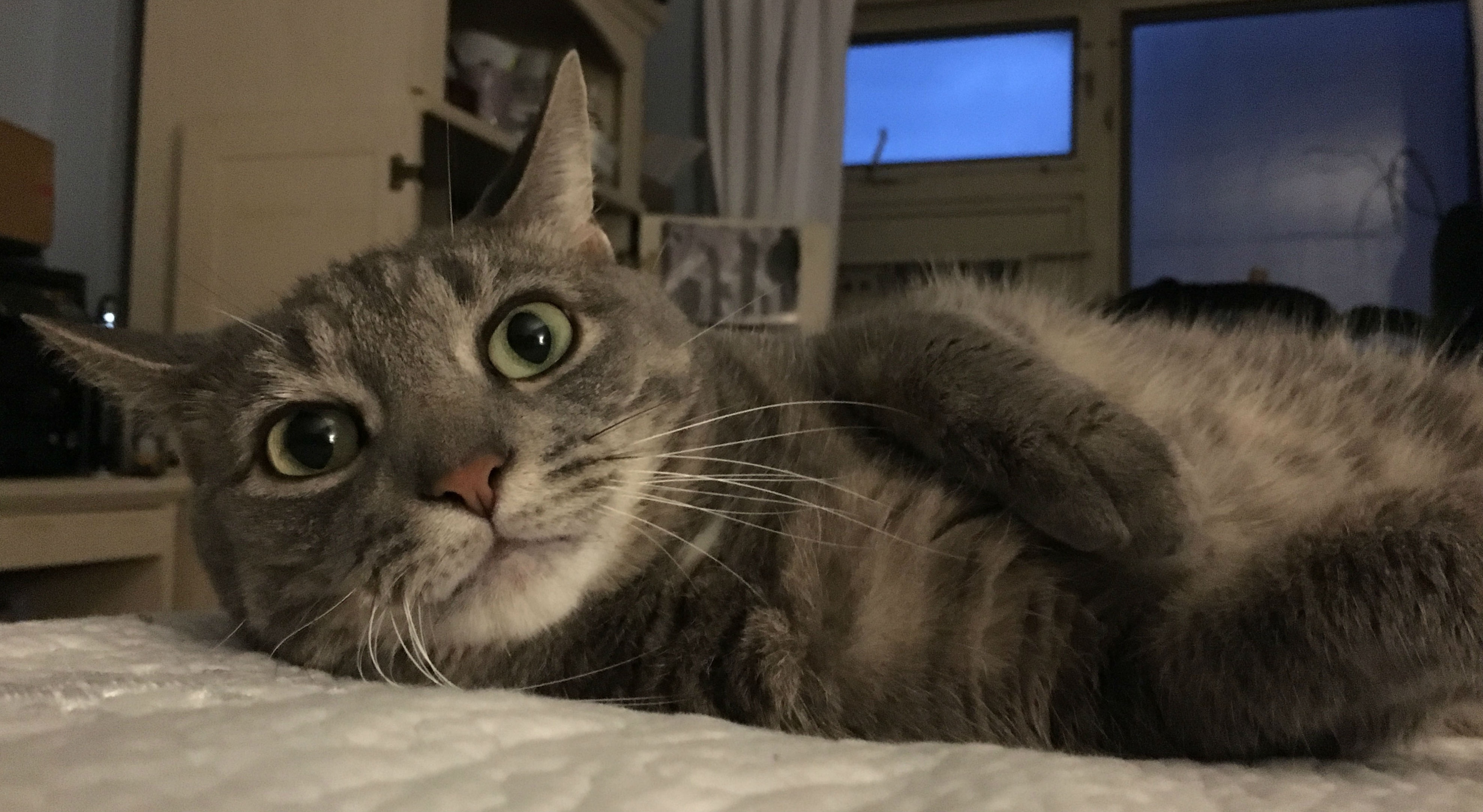
“Come now, let us not be absurd. Do you really think a designer kitten could be as handsome as I am?” Credit: Big Buddy
So far, Brackett and her colleagues have deleted one of two cat cells that produce Fel d 1 in samples in a petri dish, and have not made any changes to live animals. The experiments yielded a “55 percent knockout rate” for the Fel d 1 allergen, Brackett said, “which we were really happy with.”
Designer kittens: Gattaca for cats
If subsequent attempts are successful and the company sees commercial promise in editing feline genes, the process could be used to create “designer kittens” or to alter the genomes of existing cats. Brackett told Smithsonian magazine that the goal is to accomplish the latter.
But if it turns out the edits don’t work for existing cats, or the designer kitten trend becomes a thing, there’s another major moral concern similar to the objections to cat cloning. If people buy designer kittens, they’re not opening their homes to the millions of cats who need them.
Manipulating feline DNA isn’t a novel idea. A decade ago, a research team spliced genes from jellyfish using a different method to create cats who glow in UV light as part of a study into feline immunodeficiency virus (FIV).
Ultimately it comes down to what we’re willing to do for the sake of our own convenience. At a time when declawing has finally been outlawed in two states and dozens of cities, and people are more conscientious than ever with regard to their pets, do we want to risk their health so we don’t have to pop a few Benadryl?
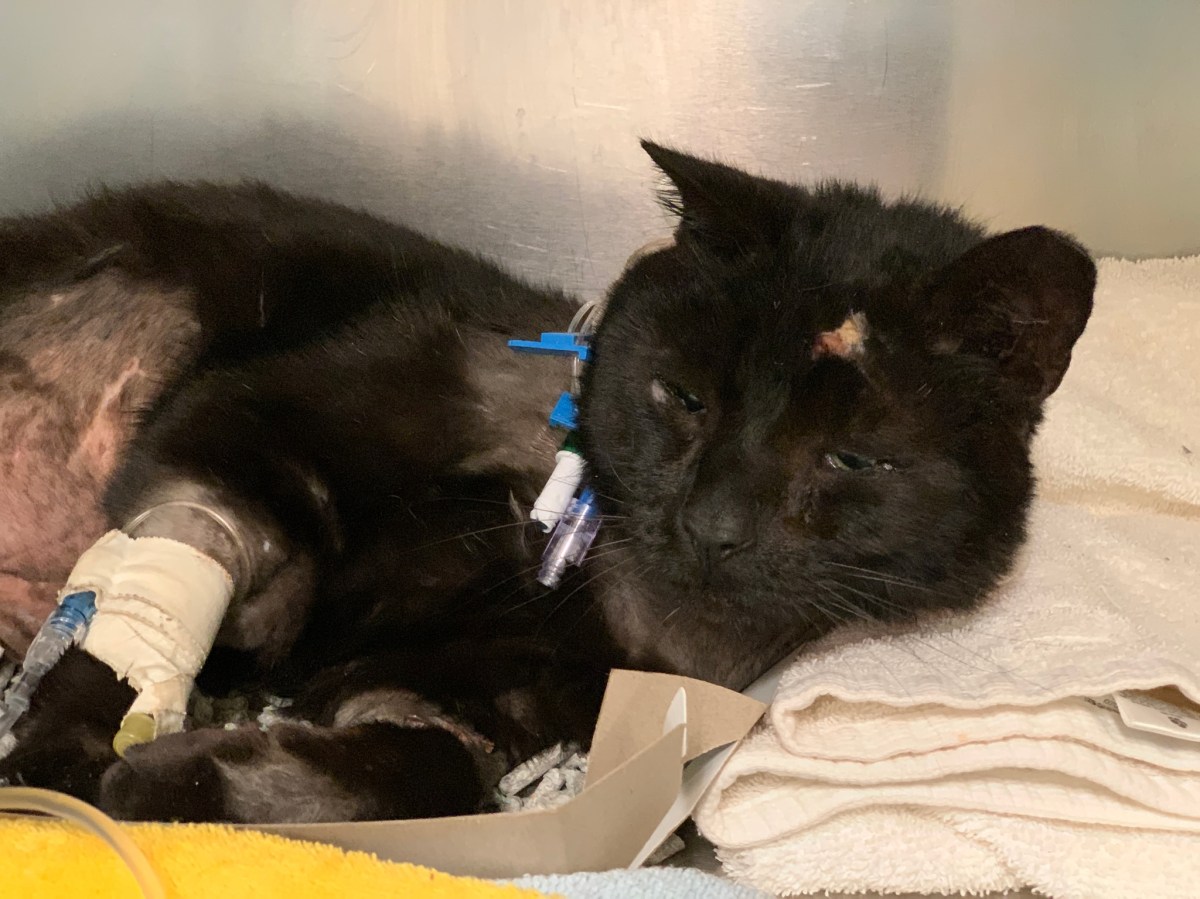
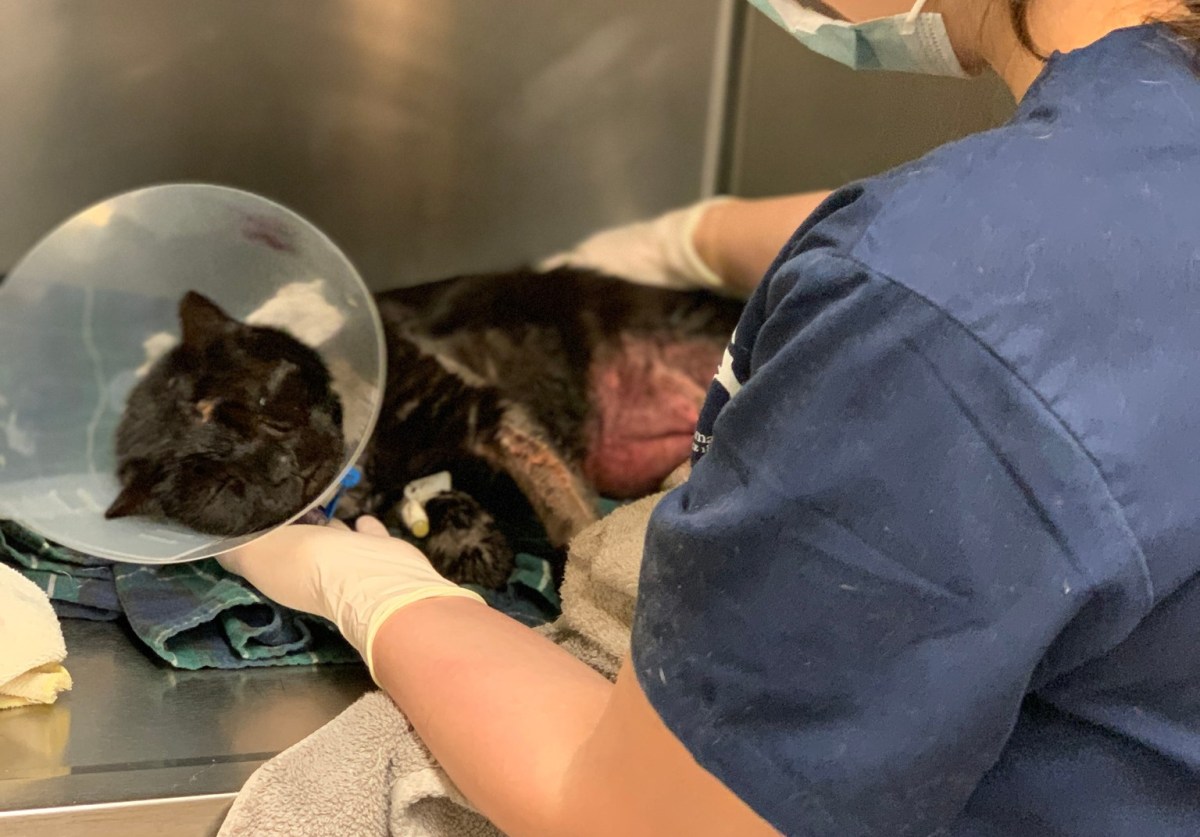
Buddy, the cat who was brutally assaulted when two teenagers sicced their pitbulls on him in Philadelphia last week, is making progress every day.
The little guy began opening his eyes again a few days ago, the Pennsylvania SPCA said, and now they’ve shared a short video of Buddy the Black Cat sitting up, licking his lips and tucking into some yums:
Little Buddy the Cat has been pulling for his fellow Buddy. In the meantime, a lot of people have been asking the SPCA how they can help. Here’s a way to do that and get something in return: A spiffy t-shirt that says “Save Every Buddy” with an original design:
Cloning still has a disturbingly low success rate, more often than not leading to the birth of sickly animals with fatal defects, or animals who don’t make it to term.
I’d like to call your attention to a paragraph in this CNBC story about Instagram and TikTok influencers cloning their famous pets.
The story begins with an anecdote about Kelly Anderson, a woman from Austin, Texas, whose cat Chai had become Internet Famous:
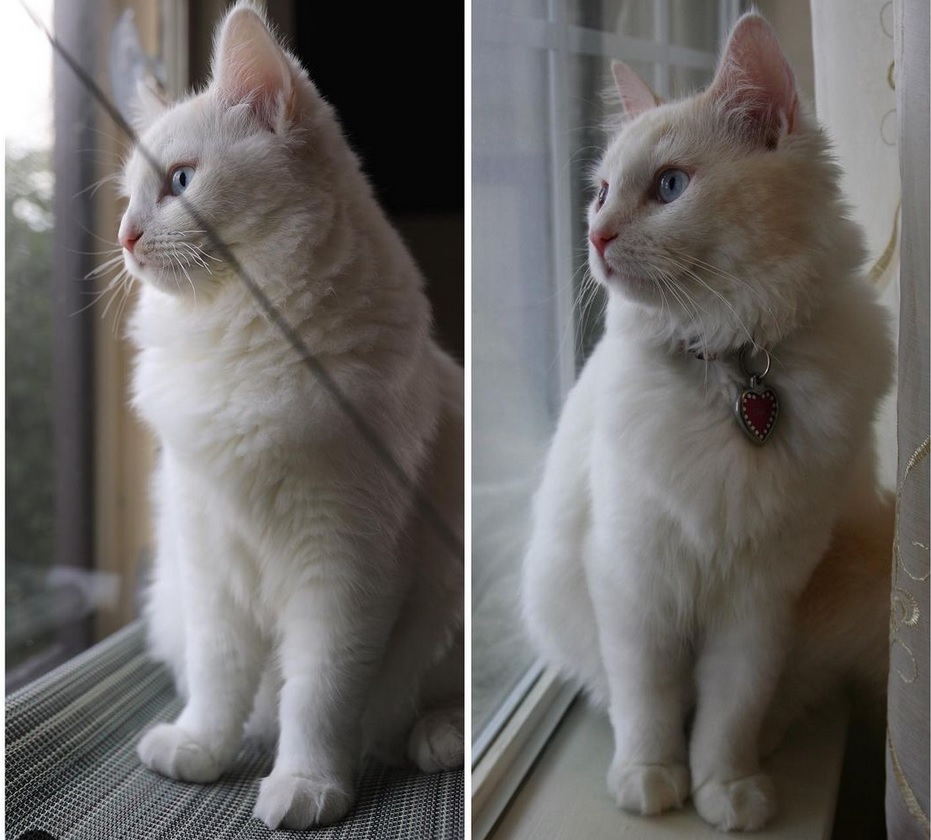
The white and tan ragdoll had 85,000 followers on Anderson’s Instagram account @adogandacat when she died from complications following a surgery.
“I lost about 20,000 followers on Instagram after Chai passed,” she explained.
Anderson said she sent a sample of Chai’s DNA to the Texas-based pet cloning company ViaGen Pets shortly after she died. It took four years and $25,000 for Anderson to get a successful clone, and now she’s back in business with Chai’s identical genetic clone named Belle, who was born in 2021.
Stop.
Read it again.
Now think about that last bit: Anderson sends the DNA sample to ViaGen, one of two commercial pet cloning operations in the world. (The other is in South Korea.) “It took four years” the article says “to get a successful clone.”
It doesn’t take four years to extract DNA from a viable sample. It doesn’t take four years to implant that DNA in an unfertilized egg, and it sure doesn’t take four years to bring a cloned cat to term.
So what happened in that interregnum between Anderson submitting Chai’s DNA and ViaGen producing “a successful clone”?
A damn horror show, that’s what.
The first cloned dog, an Afghan hound named Snuppy, was “successfully” brought to term and survived after birth in 2005, but only after the South Korean lab implanted more than 1,000 embryos into 123 surrogates.
Things have improved since then, if you can call it improvement: Success rates reached the high single digits by about 2010, and now the most successful labs produce “viable” clones about 20 percent of the time, according to geneticists.
What happens to the other animals?
The cloning industry likes to talk about its victories and present stories about grieving people reunited with their beloved cats and dogs, but cloning companies suddenly go mum when they’re asked about the animals who don’t make it to term, the kittens and puppies who are born with horrific defects, and the many animals put down because they don’t match the customers’ specifications. (Cloning companies don’t talk about the puppies and kittens who don’t physically match the clients’ late pets, but it’s safe to say they wouldn’t be reticent if the “wrong” babies had happy endings.)
Cloning results in “lots of abnormalities and genetic defects–and a significant percent of newborn animals die in the first few days or weeks of life,” geneticist Robert Lanza says.
Or as a paper in the peer-reviewed journal Scienceput it: “In all mammalian species where cloning has been successful, at best a few percent of nuclear transfer embryos develop to term, and of those, many die shortly after birth…. Even apparently healthy survivors may suffer from immune dysfunction or kidney or brain malformation, perhaps contributing to their death at later stages. Most frequently cloned animals that have survived to term are overgrown, a condition referred to as ‘large offspring syndrome.’”
Even when it appears a cloning has been successful, the cloned pets often succumb to ailments caused by congenital defects both in the short term and long term.
By 2008, just three years after the birth of Snuppy, “a total of 3,656 cloned embryos, more than 319 egg ‘donors,’ and 214 surrogate mothers ha[d] been used to produce just five cloned dogs and 11 cloned cats who were able to survive 30 days past birth,” the Humane Society and American Anti-Vivisection Society warned in a report about the trend.
The failed clones aren’t the only ones who suffer. The cloning industry has created “a whole canine underclass that remains largely invisible to us but whose bodies serve as a biological substrate” bioethicist Jessica Pierce wrote in a 2018 op-ed in the New York Times. A similar “underclass” of feline surrogate mothers exists, constantly being impregnated and giving birth to kittens who will mostly suffer brutally short lives.
Kelly Anderson had her cat, Chai, cloned. The result is Belle, left, who looks the same but “is completely different” personality-wise.
Indeed, cloning doesn’t guarantee anything: It doesn’t mean the genetic copy of your pet will have the same coat color, pattern or personality. It does not produce the same animal, nor a real copy of the animal.
Barbra Streisand admitted as much in 2018 when she let slip in an interview that she’d had her late dog cloned, then wrote an op-ed in the New York Times to defend her decision after taking criticism from animal welfare groups. Streisand wanted another dog just like her late Sammie.
“One of the reasons I chose cloning was because I couldn’t find another curly-haired Coton [de Tulear],” Streisand wrote.
Cotons de Tulear usually sell for between $2,000 and $4,000 from breeders. Five puppies were born to a successful litter using Sammie’s DNA. The runt died shortly after birth, while Streisand gave two puppies away to friends and kept two.
Streisand said she’s happy with her decision and thinks of her Sammie every time she looks at the puppies, but says neither of them have Sammie’s disposition.
“You can clone the look of a dog,” she wrote, “but you can’t clone the soul.”
Really what the cloning companies are offering is a replacement built off the same genetic template. The clones are brought to life by crude, Frankensteinesque processes, and opponents say cloning takes away potential homes for lovable cats and dogs who already exist in our shelters.
Then there’s the whole nature versus nurture debate. Doubtless the way a cat or dog is raised will have a significant impact on personality, but a clone with the same DNA, raised precisely the same way as the original, could still have a much different personality.
Cloning opponents argue commercial pet cloning companies are grief vampires in the same way self-proclaimed mediums and psychics are in their willingness to exploit people for profit. The desperate daughter willing to fork over $800 so a vulgar woman with a beehive hairdo can abuse the memory of her father by “connecting” with him in death to discuss trivialities is in an emotionally fragile state, but so is the grieving cat or dog lover reeling from the loss of an animal companion who was closer to them than most humans.
I realize it’s easy to criticize. I can’t even contemplate the eventuality of saying goodbye to Bud, and I haven’t walked a feline companion to the foot of the rainbow bridge yet.
But there is no other Buddy. The idea that I could replace him like getting a new car or a new phone would be an insult to his memory, to his dignity and to his existence as a genuine individual. It’s an insult to our friendship, our bond, our shared experiences. The time he wouldn’t leave my side when I was stricken with Bell’s Palsy and the mother of all headaches, the many times he’s sensed my discomfort and offered comfort in his way, purring and nuzzling, the wonders he’s done for my seasonal affective disorder.
The time he pigged out on closed pistachios and I comforted him as he cried and cried until his tummy was better. The time I forgot he was sleeping on my back, let slip a fart and heard a confused “Mmmmmrrrrrppp?”, prompting me to laugh so hard, tears were streaming down my cheeks.
“Big Buddy lies! I did NOT cry.”
The time he jumped off the balcony as a kitten without thinking of how he’d get back inside, and I realized how much I loved the little guy as I searched for him and tried to bury the thought that I might never see him again.
No. A clone wouldn’t be Buddy, wouldn’t have his friendly nature, his boldness, his kittenish meow or, dare I say it, his singular obsession with turkey.
We can’t honor our little friends by paying large sums of money for a laboratory horror show to create a clone so we can pretend that clone is the pet we miss. But we can honor them by doing for other cats what we did for them, opening our homes and our hearts and making a difference to one animal at a time.
As for me, I’m pretty sure Bud would haunt me for the rest of my days if I cloned him. “That’s my turkey!” ghost Buddy would say. “That’s my toy! That’s my laser laser! That’s MY spot on the couch, that’s MY spot on your lap and your chest! Who is this pretender, and why does he look like me except less handsome and charming? Big Bud, you have some splainin’ to do!”
While the surveillance footage appeared to show a pair of men siccing pitbulls on a semi-stray cat named Buddy, the suspects are 17 and 12 years old respectively, according to the SPCA.
Investigators were able to ID the pair after getting leads from the public, and on Friday the 17-year-old came in accompanied by a parent to surrender himself to authorities. The 12-year-old has agreed to turn himself in today, March 26, according to the local NBC affiliate.
Authorities said they’ll charge the pair with animal fighting, aggravated animal cruelty and conspiracy for the unprovoked attack, in which they encouraged their dogs to hurt the much smaller cat. The first two charges are felonies.
However, there are caveats. Because the suspects qualify for youthful offender status, they cannot be tried as adults and may be able to wipe the convictions from their records in the future. Such deals are at the discretion of judges, and typically involve the completion of certain programs and require that the offenders stay out of trouble for a set time period after conviction.
Because of that, their names will be sealed in court records. Youthful offender deals are usually reserved for first-time offenders. It’s not clear if the teenagers in this case have priors, and it will be up to the judge to decide the terms of their sentencing if they are convicted or agree to plead to the charges.
The SPCA has taken custody of the dogs, although their fate remains unclear. Hopefully they can be rehabilitated and adopted by experienced owners.
There’s been an outpouring of support for Buddy, with well-wishers across the world donating tens of thousands of dollars toward his veterinary care and related costs, Pennsylvania SPCA’s Julie Klim said.
“While we certainly see a lot of bad as we fight to end animal cruelty, we also see how much good there is, especially in a case like this, from all corners of the globe,” Klim said. “We will do everything humanly and medically possible to ensure Buddy’s future will be a bright one.”
In the meantime, Buddy still clings to life. He remains in critical condition, according to the SPCA, but veterinarians are “hopeful” he’ll pull through. Here’s a video of the little fighter trying to comfort himself by making biscuits on a soft blanket at a veterinary hospital:
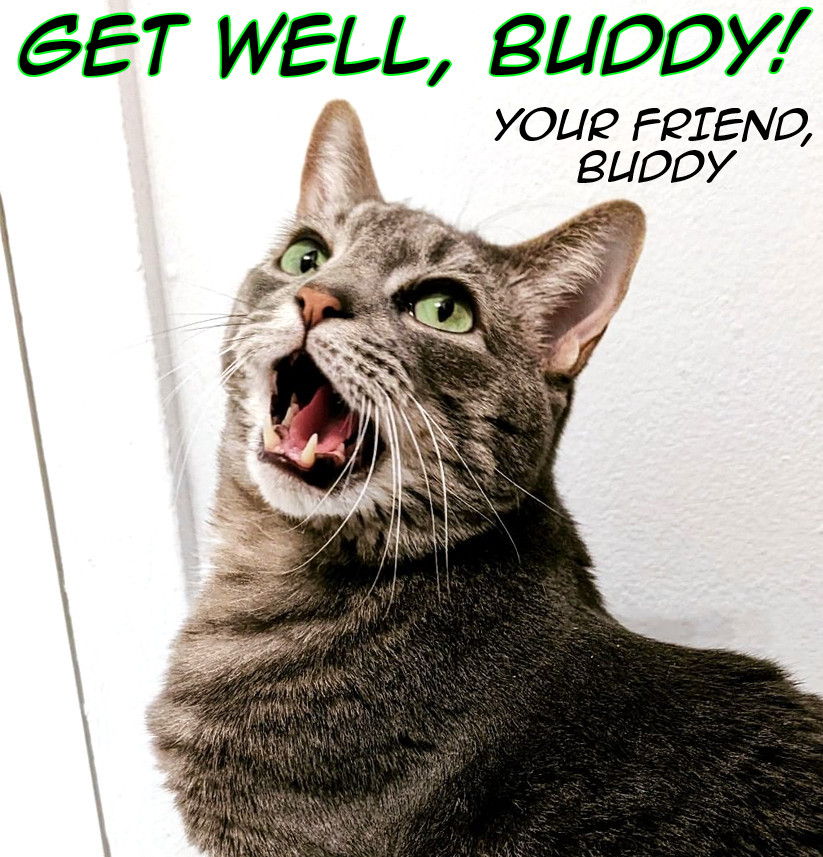
Welcome, new readers! This blog is about a different Buddy the Cat, but we also cover news about felines, animal welfare, the pet industry and other cat-centric topics, in addition to frequent humor posts about our benevolent, furry overlords. Buddy the Cat from New York is pulling for Buddy the Cat from Philadelphia, and hopes his fellow Buddy makes a full recovery before finding a loving family and forever home.

 Pain In The Bud