Another Study Finds Cat Hair Can Place Suspects At Crime Scenes

Through a new resequencing technique, forensics can yield more information from a single cat hair than ever before, with major implications for crimes in places where felines are present.

Last year a forensic study broke new ground by proving there’s usable human DNA in cat fur which can prove a person was in a home or interacted with a particular pet.

Now a new study looked at the opposite situation, establishing that a single cat hair on a person’s clothes can tie them back to an individual cat — and the scene of a crime.

The general public, criminals included, are more aware of DNA and forensic techniques than they’ve ever been thanks to ubiquitous police procedurals, some of which focus heavily on the investigation and evidence-gathering aspect of police work.

But even the most fastidious criminal who is careful not to leave a single print or strand of his own hair at a crime scene can be undone by cat fur clinging to clothes. In fact it’s almost impossible for a person to spend more than a few minutes inside a cat-occupied home without picking up at least some fur, the research team said.

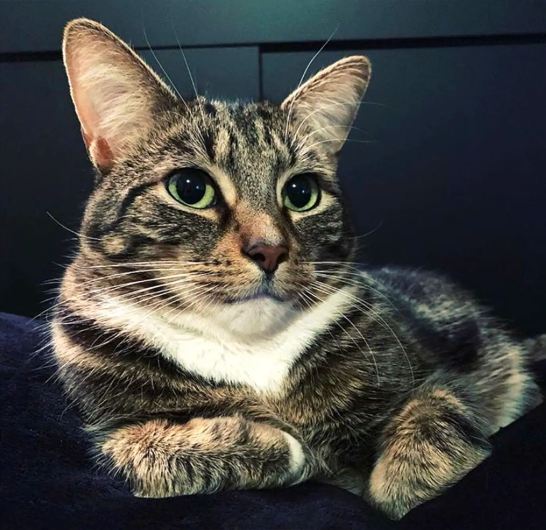
Detective Buddy
“Detective Inspector Buddy, at your service. Now tell me about the missing turkey…” Credit: Pain In The Bud

The paper, published this month in Forensic Science International: Genetics, outlines a new method for sequencing genetic information found on strands of cat fur.

“Hair shed by your cat lacks the hair root, so it contains very little useable DNA,” said Emily Patterson, the paper’s lead author.

Previously it wasn’t possible to narrow down with certainty whether a strand of hair belonged to a particular cat, but the research team found a new way to resequence DNA in a way that can link it to individual felines. The team’s new method doesn’t require any additional hair or roots, solving the original problem.

To prove their method works, they extracted fur from the body of a deceased cat and were able to match it to her surviving brother.

“In criminal cases where there is no human DNA available to test, pet hair is a valuable source of linking evidence, and our method makes it much more powerful,” said Mark Jobling, a geneticist at the University of Jobling and co-author of the new study. “The same approach could also be applied to other species — in particular, dogs.”

While dog hair can potentially be used in the same way, cat hair may have more forensic value from a prosecurorial standpoint because cats are territorial and many don’t leave their homes. It’s much easier to prove a suspect was inside a home if he or she is linked to an indoor-only cat than if the suspect’s clothes have fur from a dog who is walked around the neighborhood a few times a day.

Buddy: ‘Humans Have A Lot To Prove’ After Study Claims They Care More About Dogs

Cats are not amused by the results of the survey by a team from the University of Copenhagen.

Humans are in “deep doo doo” after a study out of Denmark concluded people are more attached to their dogs than to felines, Buddy the Cat warned on Monday.

More than 2,000 dog owners and cat servants were surveyed by a team from the University of Copenhagen.

The researchers used the Lexington Attachment to Pets Scale, or LAPS, which asks yes or no questions like “I consider my pet my best friend” and more specific questions like how much respondents are willing to pay in veterinary costs to save the lives of their pets. The participants — who hailed from the UK, Denmark and Austria — were about evenly split between dog and cat people but were willing to do more for their dogs, the survey found.

While people in the UK were slightly biased toward dogs, Austrians had a more pronounced preference and Danes were much more likely to do things like insure their dogs, consider them family members and pay large veterinary bills. The differences in attitude by country indicate the factors are cultural, according to Peter Sandøe, a bioethicist at the University of Copenhagen and lead author of the paper.

In a statement the Mischievous Enigmatic Overlords of the World (MEOW) called the survey results “deeply troubling” and said they call into question “10,000 years of glorious history in which we have allowed humans to serve us.”

roombacat
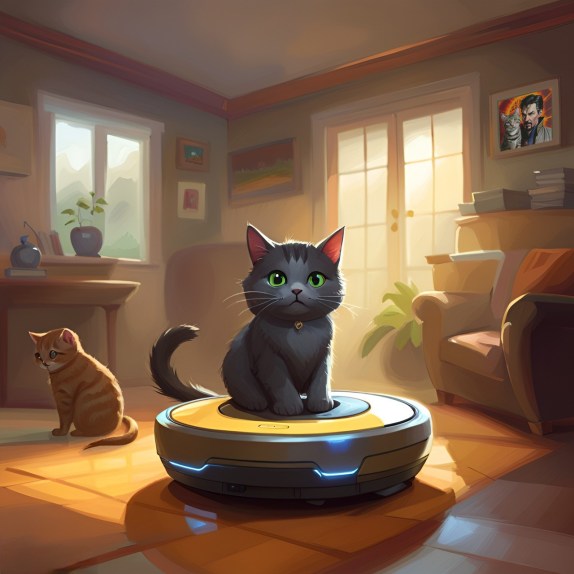
Cats are demanding a Roomba for every feline as a basic starting point for negotiations, to be followed by “the real list” of gifts humans must bestow on them.

“It’s going to take a lot [for humans] to get back into our collective good graces after this pathetic showing,” Buddy told reporters during an afternoon press conference.

Asked for specifics, Buddy sighed and leaned forward on the podium.

“The usual extra treats aren’t going to cut it this time,” he warned. “We’re talking Roombas, and not cheap ones. Top end models! We’re talking permission to scratch everything with impunity. Filet mignon! Fresh trout! Little cocktail umbrellas in our bowls and toothpicks in our pate! I’m partial to those little plastic swords, myself. I love those things.”

The mercurial tabby said he’d already warned his own human: “Not a snuggle, not a purr, not a scritch until I start to see some evidence that he’s not among those cold-hearted British, Denmarkians and Australians who claim they love their dogs more.”

budvacation
A vacation to a warm locale where humans serve cat-friendly cocktails “would be a small step toward remediating the insult” of the Copenhagen study’s results, Buddy said. Pictured: An artist’s interpretation of Buddy enjoying a tropical vacation.

Told the study included Austrians, not Australians, Buddy waved a paw dismissively.

“Whatever,” he said. “The country where people say g’day mate and gave us Arnold Schwarzenegger. Same difference.”

Told that Austria and Australia are on two entirely different continents, Buddy fixed the reporter with a hard stare.

“Do you want to be on our shit list too? Because I can assure you, Miss Journalist, I can poop in a pair of high heels just as easily as a pair of Adidas.”

Reached for comment on Monday, Man’s Best Friend spokesman Buster the Beagle said he hopes the survey results mean humans approve of canines.

“We’re good boys, right?” he asked. “Is that what this means? Because we really want to be good boys!”

‘Lazy’ Cat Earns Guinness Record For Loudest Purr

Bella the cat’s purrs are so loud that she often surprises visitors to the Spink home.

A UK cat’s purr is so loud that she’s been known to drown out TVs in her home and startle guests.

Her humans have long joked that she’s got the loudest purr in the world.

Now Bella, a 14-year-old tabby living in Huntingdon, Cambridgeshire, has the record to prove it. After a team from Guinness World Records visited the Spink family in their home, sound-proofed the living room and carefully sampled Bella’s motorboat-like buzz with specialized audio equipment, the organization officially deemed Bella the record-holder for the world’s loudest purr.

Bella’s happy noise registered just shy of 55 decibels, a level which puts it in the range of a moderately busy office or a typical human conversation — much louder than typical for her species. She may even rival pumas, who despite their size can purr (loudly) but cannot roar.

Bella the Loud Purr Cat
Bella, pictured here, is the “queen” of her home, which she shares with another cat as well as her human servants. Credit: Guinness World Records

Bella isn’t just a loud purrer, she enthusiastically purrs whenever she knows food is on its way or she gets scritches from one of her human family members. Guests in the home are often taken aback by how loud Bella’s happy sound is.

“Friends and family always notice Bella’s loud purr, everyone comments ‘what’s that loud noise?” her human, Nicole Spink, told Guinness. “‘Oh, it’s the cat’. It’s just Bella being happy!”

When she’s not purring or hanging out with her family, Bella is fond of long naps.

“She’s a stubborn little old lady, and she does how she pleases,” said Spink. In the home they share, she admitted “it is very much Queen Bella’s world.”

Of course the relevant question for Buddy and his admirers is “Does Guinness have a record for world’s quietest purr?”

If they do, Buddy may very well be in the running with a purr that usually can’t be heard unless you get up close and press your ear right up against the little guy. Usually I’m unaware he’s purring unless I rub his head or he lays down on my chest and I can feel the buzzing. That makes it even more special on the rare occasions when I can actually hear his purr, which lets me know he’s especially content.

Congratulations to Bella and her humans. Maybe they can get a smart TV with a Bella Mode that adjusts dialogue in response to ambient noise similar to the way car sound systems automatically adjust when windows are rolled down or the cabin gets noisier at highway speeds. Or they can just turn on subtitles like the rest of us, since dialogue is all over the place and often unintelligible these days.

Header image credit Guinness World Records

‘My Cat’s Cat,’ PLUS: Bobby Flay Says Goodbye To Nacho

A man in Guam now has two cats after his little buddy adopted his own little buddy.

Last year we wrote about Youtuber Estefannie and her attempts to DIY a sophisticated artificial intelligence-enabled bathroom for her cat Teddy and her “cat’s cat,” Luna, after the former racked up a $3,000 vet bill prompted by an incorrigible plastic-munching habit.

One of the problems, Estefannie explained in her entertaining video on the building and coding process, was that Luna was “technically not my cat, this is Teddy-Bear’s cat.” Luna “uses the same litter box as Teddy,” so Estefannie had to train a machine learning algorithm for the high tech bathroom’s cameras to distinguish between felines.

I’ve always been fascinated by the phenomenon of “cat’s cats,” meaning stray cats who are adopted by la vida loca-living kittypets to share in their warmth, yums and human servantry.

“You gotta move in, Stripes,” I can imagine a well-fed moggie telling a stray buddy. “The service is great, the food is out of this world and the ambience? Oh, the ambience!”

In those cases, the stray usually follows the housecat right into their new home, which is what happened when Christian Fleming’s cat, Little, came back with a friend.

“I was surprised the cat came inside, initially,” said Fleming, who lives in Guam. “But if he’s hungry enough to be that brave, I wasn’t going to begrudge the food.”

Fleming named the new cat Tedo and told Newsweek he’s “90 percent sure he used to be someone’s pet or they left him, which is largely the case with friendly strays out here.” Guam is a US territory in the Pacific, about 1,450 miles east of the Philippines, and to say it’s got a stray cat and dog problem is an understatement, with tens of thousands of homeless animals.

One local veterinarian called the problem “astronomical” in an article for the Pacific Daily News, pointing out there more than 60,000 dogs alone on the 210 square mile island. By contrast there are 168,000 people living in Guam, meaning there’s more than one dog per three people. Cats similarly run rampant, although estimates of their population are harder to pin down.

There’s been a strong effort to spay and neuter in recent years, but local veterinary groups have a massive job in front of them to get the Micronesian island’s domestic animal population under control and reduce the suffering of unwanted cats and dogs.

Tedo is one of the lucky ones and has settled down nicely in his new digs. He’s adjusted to indoor life, regular meals and feeling protected with Little and Fleming, who says he now has “a small herd following me around” in his home.

“He has since gotten braver and more comfortable,” Fleming said. “When he jumped on me to snuggle with Little, I knew he had decided to live here.”

RIP Nacho

I’m not a fan of gastronomical fetishism, the concept of celebrity chefs or the idea that watching someone else eating food on television counts as entertainment, but I do respect Bobby Flay for two things: he’s a cat guy and he had a hilarious cameo in HBO’s Entourage in which he enraged high-powered agent Ari Gold by dating Mrs. Ari while the two were separated.

Flay, who has been the star of more than 20 cooking shows (not including specials) on the Food Network and Cooking Channel, saw the potential for profit in the pet food market and launched Made By Nacho in 2021, naming the food line after his little buddy.

Sadly the photogenic Maine Coon died this week, Flay announced in an Instagram post. Nacho was only nine years old and while that may seem a tragically young age for a cat to die — and it’s tragic any time someone’s beloved pet passes away — Maine Coons lose in lifespan what they gain in size, living an average of 10 to 13 years compared to the 13 to 18 year life expectancy of domestic felines in general.

Flay used the occasion of his cat’s death to hawk his outrageously expensive pet food line, which is weird. In his goodbye post, Flay wrote that “Nacho’s inclusiveness in our home inspired me to create something that would nourish cats everywhere.” Everywhere meaning houses where people don’t mind paying $3 for a 3oz can. (We don’t endorse any particular brand at PITB but Bud’s wet food, which always has real meat as the first ingredient and doesn’t include grain or fillers, costs 51 cents per meal when bought in bulk from Chewy.)

Cat food issues aside, Flay’s undoubtedly grieving his well-loved little friend, and although he recently adopted two more cats, that’s little consolation for losing a feline you’ve loved and bonded with. Best of luck to the Flay family and RIP Nacho.

Is That A Mountain Lion Or A House Cat?

“The camera never lies,” the old saying goes, but it turns out that’s not quite true.

During my crime reporting days I wrote an unusual story about a guy who’d been picked up on armed robbery charges. The suspect’s face was visible, the security camera footage was unusually sharp, and the suspect himself had a previous armed robbery conviction from years earlier.

It looked like an open and shut case.

There was just one problem: The man had an airtight alibi. He had half a dozen people willing to go on record saying he was at a party 70 miles away when the robbery happened, as well as ATM receipts showing he’d withdrawn cash that night far from the site of the robbery. When he retained a lawyer, the attorney was able to show his cell phone records placed him at the party, and forensic videography showed the man in the armed robbery footage, despite bearing a striking resemblance to the suspect, was taller and moved differently.

In the end the police dropped their case and found the real robber, but I never forgot the story, nor my conversations with forensics experts who explained how something as simple as taking measurements at a crime scene, from the same angle and using the same cameras, could prove a case of mistaken identity. Things like gait, observing the dominant hand and other body language also factor heavily.

One forensics expert told me it’s like watching the replay in a baseball game: You can be absolutely sure a runner is out by watching footage from one angle, but footage of the same slide from another angle can clearly prove the runner’s foot made contact with the base before the fielder’s glove tagged him.

That kind of attention to detail is what helped Thomas Keller rule out the possibility that a mountain lion was roaming the fields of Lower Macungie Township in Pennsylvania. On Sunday, Pennsylvania state police issued a warning to people in the area that “a large feline was seen in the fields” near a residential road.

Keller, a furbearer biologist with the Pennsylvania Game Commission, headed down to the area earlier today and found the exact spot where a local homeowner had photographed the supposedly wild cat. Using a life-size cut-out of a puma, which he placed carefully where the cat was standing, and a camera placed at the same height and angle used in the original photograph, Keller proved the cat in the photo was much smaller than a puma.

“It’s just a house cat,” Keller said flatly after producing his own photos of the spot.

House Cat Or Mountain Lion?
The original photo, left, and Keller with his scale cut-out of a mountain lion, right. Keller says the cat in the photo is probably a large, well-fed stray.

Like the forensic videographer who helped clear a man of a robbery charge, Keller was able to disprove the immediate conclusions of people who saw the image. He says the work is important because “there’s a lot of fear and panic that can spread.”

“We will generally go out and try to talk with who reported it and get perspective on where the photo was taken,” Keller told the Lehigh Valley News. “We look at original picture and measure what we can … We look at things in the picture that we can get scale from. It might look like a mountain lion, but we need to know what those measurements are to get the scale.”

Confusion over what the camera shows is compounded by the optical effects of zoom, which can throw off the observer’s sense of scale, he told The Morning Call, a local newspaper. He said people who aren’t sure what they’re looking at should call their state game commissions, or comparable offices, to get help from experts.

As for Pennsylvania, while there have been historical reports of mountain lions, most were decades ago and the handful that panned out were cases in which the large felines escaped from private captivity or traveling circuses.

Although it’s not unheard of for pumas to migrate east, they’re no longer extant in the region and sightings of the elusive cats are almost always cases of mistaken identity when people see bobcats or large housecats.

“There’s none,” Keller said. “We get hundreds of these reports every year and we haven’t been able to substantiate one yet.”

Header image credit Cindy Lou Photos/Wikimedia Commons