A feel-good video about a kitten who was rescued from the brink of death.
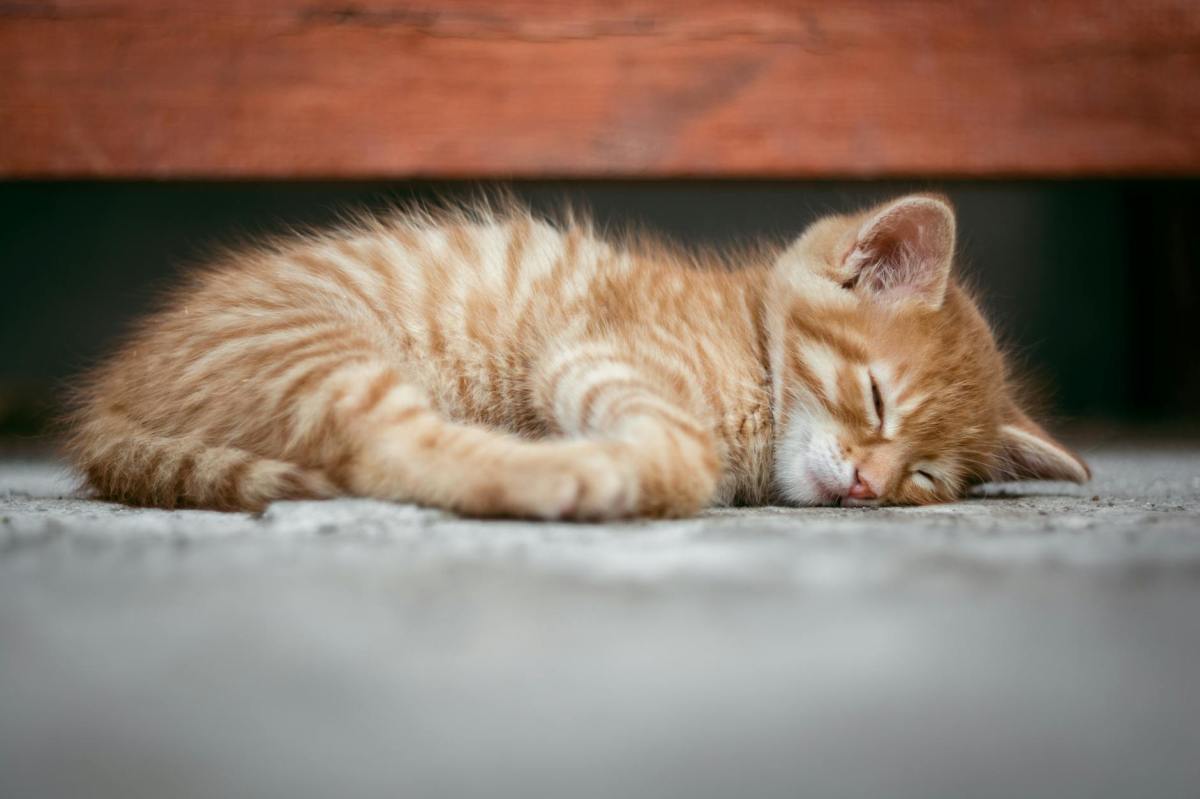
The girl in this video found an orange tabby kitten on the verge of death in Hubei, China, and refused to give up on the little one.
Through tears, she used a hair dryer to warm the kitten while her 39-year-old dad filmed her efforts. She was successful! The kitten slowly began to stir and felt well enough after two hours to lap up some milk.
Temperatures in Hubei can plunge into the 20s and 30s overnight this time of year, so the kitten would have died without the little girl’s intervention.
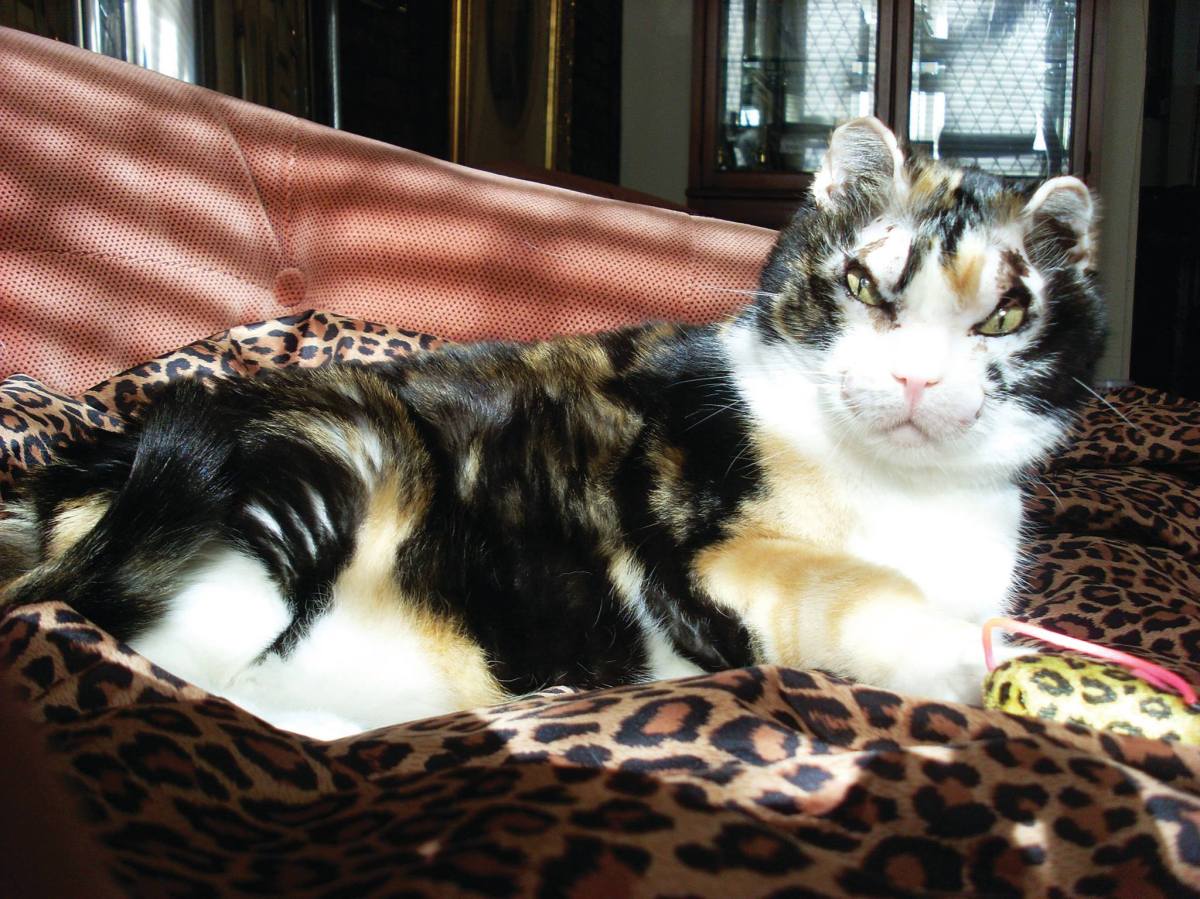
When the abandoned garage she was sheltering in caught fire on a cold day in 1996, Scarlett the cat was determined to get all five of her babies to safety.
The night of March 30, 1996, was unseasonably cold, and as temperatures dipped below freezing, a young cat and her litter of five found shelter in an abandoned garage in Brooklyn.
Unfortunately for them a few humans had the same idea, huddling for warmth in the garage as they smoked crack.
Prodigy’s “Firestarter” was at the top of the charts at the time, an apt soundtrack for what would happen next — the crack-addled humans started a fire that spread quickly and took the young feline mother by surprise.
That momma, who would later be named Scarlett, scooped up one of her kittens and brought it to safety before immediately heading for the flames again.
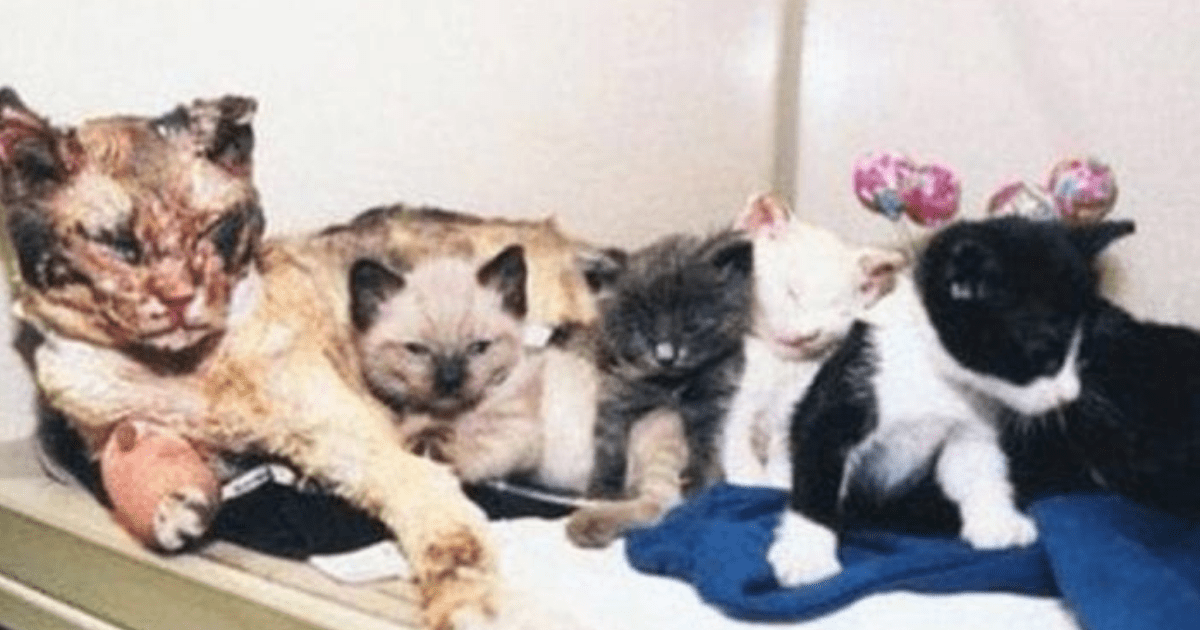
Scarlett, badly burned and bandaged, with her kittens at the North Shore Animal League. Credit: North Shore Animal League
FDNY firefighter David Giannelli was among the first responders at the engulfed garage and realized the small calico was rescuing her babies, running back into the flames to carry them out one by one.
When Scarlett had retrieved the last kitten, Giannelli watched her as she nuzzled all five of them to count them because she could no longer see — her eyes were sealed with burns and blisters.
Satisfied that her kittens were out of harm’s way, Scarlett collapsed.
She paid a heavy toll for her actions. Her whiskers and the fur on her face was singed off, her ears were disfigured and she nearly died from smoke inhalation.
Giannelli brought the unconscious cat and her babies to New York’s North Shore Animal League, where veterinarians saved her life and put her on a path to recovery while also housing her with her beloved kittens.
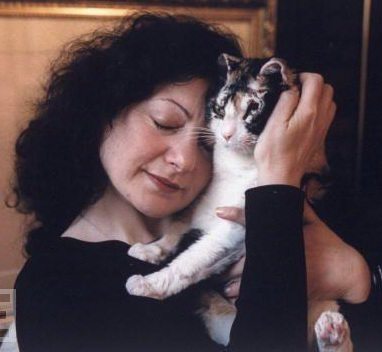
Four of Scarlett’s kittens survived and were adopted out in pairs. Scarlett herself was adopted by New Yorker Karen Wellen, who was chosen out of thousands of applicants who wrote to the shelter. Wellen, who had suffered a medical emergency of her own, was specifically looking to adopt a special needs cat.
Scarlett’s kittens went to nearby families, who kept in touch with Wellen and scheduled reunions between her and the kittens she risked her life for.
“This cat is definitely the queen of the house,” Wellen told a TV news crew during a segment about Scarlett in the late 90s. “Whatever she wants is hers.”
Scarlett was a house cat for the rest of her life, living comfortably until she passed away on Oct. 11, 2008, at 13 years old.
Wellen with Scarlett.
Little Scarlett’s story is not only an example of extraordinary bravery, it’s testament to how much mother cats love their kittens and should give us pause before we separate mothers from their babies too early. The absolute minimum is eight weeks, but many shelters will only allow kittens to go home with adopters at 12 weeks old or older, which they say gives them enough time with their mothers and siblings to learn crucial social skills, like sharing, not playing too rough, and proper self-grooming.
In recent years, many shelters and rescues have enacted policies of requiring that kittens are adopted in pairs. Even when they’ve got loving homes with humans who dote on them and provide them with plenty of attention, having another kitten around to grow with and learn from has a huge positive effect on a young cat’s development.
Buddy’s my first cat, as regular readers of PITB know, and if I could do it all over again, I’d have adopted one of his litter mates too. And who knows? Maybe in the future we’ll learn that keeping feline families together is optimal. Scarlett is testament to the fact that mother cats will sacrifice their own lives to save their babies. If that’s not love, what is?
Moms are the best. They tell us we’re good at things even when we’re not, they put up with all our nonsense, and they never stop worrying about us even when we’re adults.
They make us feel better when we’re down and they don’t hesitate to tell us when we’re being stupid. They make the special meals that we love, and use love as a special ingredient. I can still taste the bologna sandwiches my mom used to make for me in my school lunches. Somehow they were always more delicious than any sandwich I could make. Now that I’m an adult and have been a vegetarian for years, she makes pastitsio for me on special occasions. Thanks, mom!
Animal moms love their kiddos too, as we can see in these photos. Happy Mother’s Day to all moms!
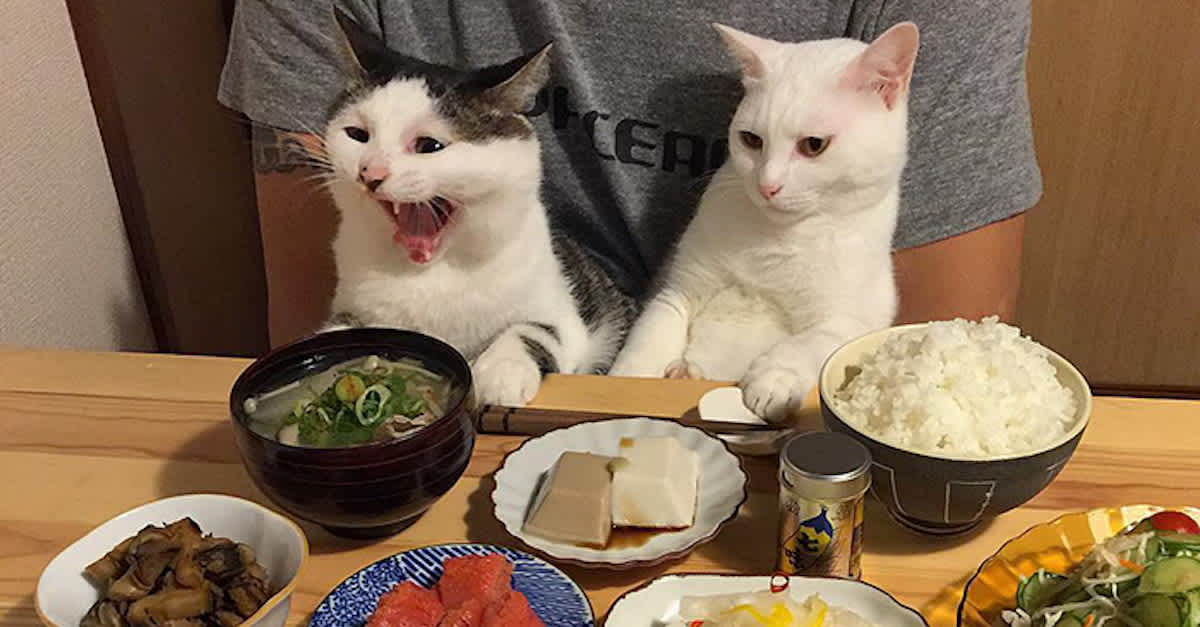
A cat eating at the table with his humans? Let’s hope Bud doesn’t get any ideas!
File this under “Information that must be hidden from Buddy at all cost, lest he get ideas.”
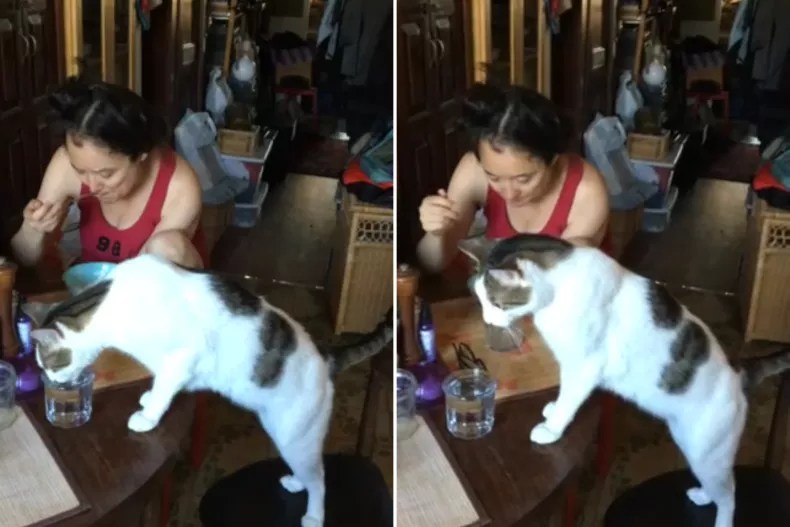
Franklin, a cat who lives in Brooklyn, has gone from fending for himself on the streets of New York to a very comfortable indoor existence with two humans who are happy to let him sit at the table with them for meals. Bowls? Pfffft. Franklin drinks from his own glass:
Credit: Andrea and Alice via Newsweek
As the dutiful servant to a cat who most definitely believes he’s a human — or should have all the privileges and none of the responsibilities of one — this makes me uneasy. If Bud were to somehow find out about this, all hell would break loose and before I know it he’ll be demanding custom cutlery and a silk pillow on which to rest his behind and elevate him to the level of the table.
As a vegetarian I don’t necessarily have to worry about Bud eating my food, but he sure does love sticking his face in it and giving it an exploratory lick or three.
“Is that…? Dude, let me in there, I just wanna stick my face in your mashed potatoes and confirm I don’t like them,” I imagine him saying. “Yep. Still don’t like them. Oh stop being so dramatic, you can pick the fur out!”
A reasonable take on the kitten/climate change claims
The Grist has a new story about the alleged connection between an “increase” in kittens and climate change, and while it unfortunately links to one of the bunk studies that uses meta-analysis to make wild claims about feline impact on the environment, it does include the most measured and reasonable take so far on the claims:
“Others, like Peter J. Wolf, a senior strategist at the Best Friends Animal Society, think the increase comes down to visibility rather than anything biological. As the weather warms, Wolf said people may be getting out more and noticing kittens earlier in the year than before. Then they bring them into shelters, resulting in rescue groups feeling like kitten season is starting earlier.”
As we noted on Sunday, the claim that there are more kittens, or that kitten season is longer, is entirely dependent on anecdotal evidence. Unfortunately no one has any data for baseline population numbers when it comes to cats in the US, let alone historical data that allows us to say there are more kittens born in recent years.
The best we’ve got is the excellent but single-city DC Cat Count, and to establish a convincing link between climate change and kittens we’d not only need hard data, but we’d also need to eliminate dozens of other potential factors like ever-increasing light pollution, urban heat islands and wave effects from 2020, when society went into lockdown and animals were mostly left to their own devices.
Once again, there’s only one measurement that really matters in the end, and that’s the number of cats euthanized annually because there aren’t homes for them. Spaying/neutering and education efforts have driven that number down dramatically over the past 20 years, and ultimately that’s the best solution we have.
Is there any evidence to support claims of a longer kitten season?
Is kitten season getting longer because of climate change?
Some rescuers in California think so, according to a story in Santa Rosa’s Press-Democrat.
“Heat and warmth is what it’s all about,” said Mary Pulcheon, trapping coordinator for Forgotten Felines of Sonoma County.
Pulcheon and the executive director of Forgotten Felines, Pip Marquez de la Plata, told the Press-Democrat that strays in their care had given birth as late as December in 2023 when kitten season generally runs from late March through October.
They say the typical kitten season has shifted and is now longer due to rising temperatures caused by climate change.
It’s an unverifiable claim for several reasons.
First, we don’t have reliable estimates for how many cats there are in the US, let alone stray and feral cats. Any estimates are guesses, and they vary wildly from 20 million on the low end to 120 million, which seems an excessive and unrealistic number.
To date there’s been a single comprehensive feline census in the US, the D.C. Cat Count. It took three years, several million dollars, hundreds of trail and trap cameras, and the efforts of an army of volunteers and staff.
The final tally: 203,595, with only 6,533 unowned cats fending for themselves and drifting between managed colonies.
Credit: Ejov Igor/Pexels.com
The DC Cat Count is historic and has already proven its value by facilitating informed debate, showing rescuers/TNR volunteers where to direct their efforts, and yielding valuable data on local ecological impact.
Alas it’s a one-off, so we don’t know anything about how the population has changed over time.
Secondly, while there absolutely is scientific consensus that human activity is driving global temperatures up, there’s debate about how much temperature flux is directly attributable to modern civilization. We’re also looking at planetary timescales here, tracking changes that happen not just over decades, but centuries and millennia.
Attributing shifts in kitten season to climate change is a bit like attributing single storms to climate change. These are single data points from which we can’t draw conclusions.
Credit:Cats Coming/Pexels
Lastly, there could be dozens of factors skewing “normal” kitten season, and that’s assuming the March through October season is normal by historical measurements. We don’t know that for sure, and we can’t know it without data.
I’m limited by a lack of imagination here, but changes in kitten season could be regional, reflect non-climate weather patterns, or adjust according to cyclical patterns. Things as seemingly unimportant as ambient light pollution can have a profound effect on animal behavior, and it always helps to remember that felines are sensitive to stimuli that we literally cannot detect. Cats can pick up high frequency sounds we can’t hear and smell things beneath the notice of our own weak noses. They even have a second form of olfactory input, a literal sixth sense that is unmatched by anything in human biology.
We understand very little about how those things impact feline behavior.
With all things considered there could be hundreds of reasons for changes in kitten season, and that’s assuming the changes are real and people aren’t mistaking outliers for trends.
Ultimately we don’t need to draw conclusions about whether there are more kittens born each season. We know TNR, while imperfect, is the best way to humanely reduce stray and feral populations, and we still have a way to go before cats are no longer euthanized because we can’t find homes for them.



 Pain In The Bud