Through a new resequencing technique, forensics can yield more information from a single cat hair than ever before, with major implications for crimes in places where felines are present.
Last year a forensic study broke new ground by proving there’s usable human DNA in cat fur which can prove a person was in a home or interacted with a particular pet.
Now a new study looked at the opposite situation, establishing that a single cat hair on a person’s clothes can tie them back to an individual cat — and the scene of a crime.
The general public, criminals included, are more aware of DNA and forensic techniques than they’ve ever been thanks to ubiquitous police procedurals, some of which focus heavily on the investigation and evidence-gathering aspect of police work.
But even the most fastidious criminal who is careful not to leave a single print or strand of his own hair at a crime scene can be undone by cat fur clinging to clothes. In fact it’s almost impossible for a person to spend more than a few minutes inside a cat-occupied home without picking up at least some fur, the research team said.
“Detective Inspector Buddy, at your service. Now tell me about the missing turkey…” Credit: Pain In The Bud
The paper, published this month in Forensic Science International: Genetics, outlines a new method for sequencing genetic information found on strands of cat fur.
“Hair shed by your cat lacks the hair root, so it contains very little useable DNA,” said Emily Patterson, the paper’s lead author.
Previously it wasn’t possible to narrow down with certainty whether a strand of hair belonged to a particular cat, but the research team found a new way to resequence DNA in a way that can link it to individual felines. The team’s new method doesn’t require any additional hair or roots, solving the original problem.
To prove their method works, they extracted fur from the body of a deceased cat and were able to match it to her surviving brother.
“In criminal cases where there is no human DNA available to test, pet hair is a valuable source of linking evidence, and our method makes it much more powerful,” said Mark Jobling, a geneticist at the University of Jobling and co-author of the new study. “The same approach could also be applied to other species — in particular, dogs.”
While dog hair can potentially be used in the same way, cat hair may have more forensic value from a prosecurorial standpoint because cats are territorial and many don’t leave their homes. It’s much easier to prove a suspect was inside a home if he or she is linked to an indoor-only cat than if the suspect’s clothes have fur from a dog who is walked around the neighborhood a few times a day.
Tux the cat was found frightened, dehydrated and “covered in fleas.” It’s still not clear precisely what happened to her.
For a nightmarish 34-hour stretch, Palash Pandey thought he’d never see his cat again.
On Saturday afternoon the Austin man took a Lyft to an animal hospital in his city, got out of the car and was walking around to get his cat, Tux, out from under the passenger seat on the other side when the driver pulled away. Pandey ran after the car, yelling for the driver to stop.
“I like ran behind him, screaming like ‘wait, wait, wait,’ I banged on his windows hoping that he would notice me and just stop. But instead of that he just like, peeled off, he drove away,” Pandey told Austin NBC affiliate KXAN. “I don’t know how else you would perceive somebody who you just dropped off running behind you and banging on your windows and doors. I don’t know if there’s a charitable explanation for that.”
He sent a series of frantic messages to the driver through the Lyft app, offering to pay him to return Tux and begging for information, but didn’t hear back until several hours later when the driver texted: “she isn’t there, sorry”.
You're right. The initial response was awful. Since then, we've done a lot behind the scenes, but I know we haven't communicated enough. We're very focused on this and will keep the community up to date.
The driver said he didn’t see the carrier or the cat in the car, and said several riders he’d picked up later didn’t mention a cat either.
After Lyft’s live customer service wasn’t helpful, Pandey turned to Twitter and Reddit, explaining the situation in detail, providing information and asking people in Austin to share a missing cat flyer with Tux’s photo and information.
In the meantime Lyft’s CEO got involved, apologized for the poor initial response and devoted significant resources to the incident. The company sent alerts to all of its drivers and riders in the Austin area, notified police and dispatched its own staff to help find Tux.
Canvassing the area around the animal hospital and following tips from the public, Lyft’s team eventually tracked her down at about 1:30 a.m. Monday morning, spotting her in the rear of an office building a little more than a mile from the animal hospital. Tux was frightened and climbed a flight of stairs when the Lyft staffers approached, but they were able to wrap her in a t-shirt and get her into a carrier they’d brought with them.
Pandey was overjoyed to be reunited with Tux and thanked everyone who helped looked for her, but in an update said she was scared, “covered in fleas and dehydrated.” He said she was eating, which was a good sign, and he planned to bring her to the veterinarian on Monday.
However, the fact that Tux was found alone without her carrier, dirty and wandering near a busy road indicates someone intentionally took her, then dumped her like a hot potato after realizing thousands of people, the police and a corporate response team were looking for her.
The Lyft driver isn’t suspected of anything but perhaps poor customer service. He told his employers that he didn’t stop when Pandey began banging on his windows because he didn’t realize there was a cat in the car and thought Pandey had become belligerent for some reason.
Pandey believes the person who took Tux will be caught.
“F—ing coward saw what was coming for him and left her on the side of the road,” Pandey wrote on Reddit in an update. “There’s plenty of cameras around, he’s not going to get away with this.”
Police say foxes are responsible for killing cats in London, but animal welfare activists insist there is indisputable evidence of human cruelty.
It’s difficult to know what to make of the Croydon cat killer story.
Initially, people from London-area cat rescues said they were looking for a person who had mutilated dozens of cats in the South London area. As the number increased to more than 100 and public outrage became palpable, police opened an investigation.
The story was wild. Newspapers bandied about disturbing figures, claiming hundreds of cats mutilated at the hands of a sick individual or several people. There were reports of feline remains artfully arranged in the driveways and on the front steps of victims’ homes to inflict maximum trauma on the people who discovered them, with allegedly clean cuts indicating a human with a blade was responsible.
Then in 2021, the Metropolitan Police announced they were closing their case after three years and almost $200,000 spent.
Foxes, not cruel humans, were responsible for the cat killings, they said. A study in the journal Veterinary Pathology found fox DNA on the corpses of 32 cats and said puncture wounds on the feline bodies were consistent with fox bites.
London-area animal rescues disputed the findings, saying the study couldn’t account for the mutilation of so many animals. The study’s authors blamed “badly behaved foxes” who were scavenging on the remains of strays and pets killed in traffic or by ingesting antifreeze.
Credit: Fajer u015eehirli/Pexels
Lots of other people refused to accept the Metropolitan Police conclusion, including people whose cats had been victimized. In some of those cases, veterinarians concluded the cats were killed by humans, not animals.
Which brings us to now.
The Mirror has teamed up with the South London Animal Rights Network (SLAIN) to create an interactive map showing the locations where more than 1,000 dead cats were found over the past several years.
“This map shows where incidents have occurred but also and perhaps just as important, where incidents have never happened,” SLAIN’s Boudicca Rising told the paper. “If you know of someone who made journeys to these locations on these dates please do get in touch with us. All information will be treated in the strictest of confidence.”
Documents obtained by journalists in London indicate there was internal tension at the Metropolitan Police over the resources that had been allocated to the cat case, and spokesperson for the force admitted that was a consideration. But the department stands by its assessment and says there’s no evidence a serial cat killer is on the loose.
It’s difficult to believe someone or a group of people could evade capture while allegedly killing more than 1,000 cats since 2015, especially in a city like London where CCTV cameras blanket most neighborhoods.
There are an estimated one million CCTV cameras covering 607 square miles of London, and the commonly-cited statistic claims Londoners are caught on CCTV cameras an average of 300 times per day. Other estimates claim that number is too high, and the average UK citizen is spotted on a municipal surveillance camera 70 times a day.
Notably, those figures do not include private cameras like Ring systems and surveillance operated by private businesses. The point is, it’s very difficult to avoid cameras in London, and if there are human feline killers out there, they must know an awful lot about where the cameras are.
If the phantom cat-killers are real, not only have they been able to avoid appearing on surveillance, they’ve evaded the watchful eyes of neighbors as the story circulated widely in the press. The theory that the killings were the work of animals, mostly under the cover of night and beneath the notice of people, sounded more plausible to many people.
Still, the theory doesn’t neatly fit the evidence.
Not all veterinarians agree that foxes are the culprit. While the veterinary pathologists who authored the study looked at photographs of the mutilated felines, some veterinarians who directly examined the bodies of slain cats concluded they were killed with blades. When experts are at odds over evidence, what can you do but gather more information and hope for the best?
London may have to do what Washington, D.C. did and deploy low-to-the-ground trail cameras and regular surveillance cameras around the city. In Washington, the goal was to get an accurate census on the number of strays and ferals living within city limits. In London, a census could be a bonus as they finally get an answer to the question of who’s been killing all those cats.
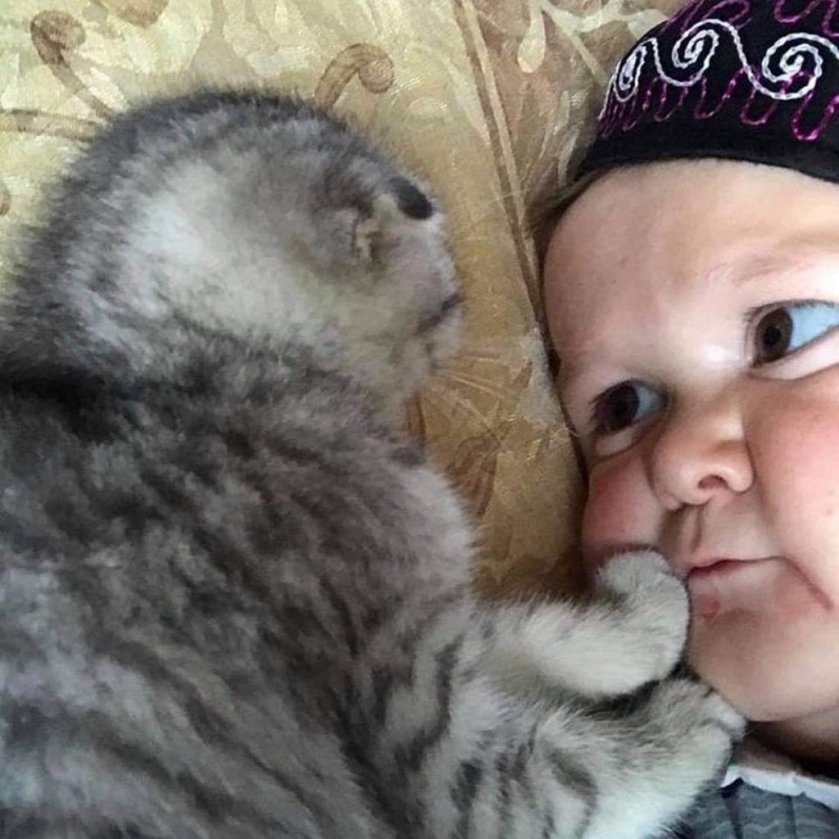
Hasbulla filmed himself pulling his cat by its ear and repeatedly smacking it.
Even if you haven’t heard the name Hasbulla Magomedov, chances are you’ve seen images of the Russian’s cherubic face, which exists in the pantheon of internet memes with the likes of Cash Me Outside Girl, Kermit and Condescending Wonka.
Magomedov is not a child, despite his 3’4″ stature and toddler-like appearance. He’s an adult man who suffers from a form of dwarfism, although he’s never publicly spoken about his condition in detail.
Normally known simply by the mononym Hasbulla, beyond his status as a meme the diminutive Russian is mostly known for hawking garbage (cryptocurrency, self-branded merchandise, supplements) and for his nebulous association with mixed martial arts, existing as a sort of barnacle on the UFC where he appears at weigh-ins, uploads video of himself providing commentary and is carried around as a kind of good luck totem by Russian fighters.
Now Hasbulla is famous for something else — horrifically abusing his cat.
In a new video — which Habsulla was apparently proud of and voluntarily shared publicly — the 20-year-old speaks in his native Russian while pulling violently on his cat’s ear. The feline — which is terrified of Hasbulla and flinches when he approaches — escapes to the safety of a shoe box, but his tiny tormentor follows, smacking the poor cat on its body and head while barking in the gutteral nonsense that passes for a language in his gas station of a country:
Hasbulla boasts six million followers on Instagram, 1.5 million on Twitter, and his videos on TikTok have amassed an astounding 10.3 billion views.
The video is disturbing enough on its own, though I can’t help but wonder if Hasbulla is willing to share this kind of behavior, what’s going on when the cameras are off?
And if people are willing to physically abuse their cats to feed the content beast and keep their viewers “entertained,” how will they lower the bar in the future when their clicks slow down and they feel they need to do something even more shocking to reignite interest?
An older photo of the same cat in kittenhood, when Hasbulla introduced the kitty to his followers. The sweet cat
Drug cartel members are infamous for keeping animals as status pets.
Buddy is now on Facebook! Follow him to receive automatic updates, learn exciting new turkey recipes and view exclusive photos of Bud flexing his impressive meowscles!
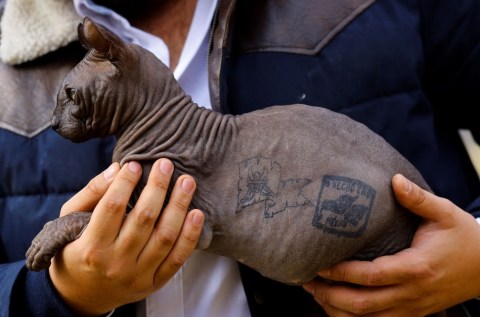
A cat who until recently belonged to a notorious cartel boss now has a perfectly normal home in Texas after spending the first three years of his life in the notorious CERESO 3 prison in Juarez, Mexico.
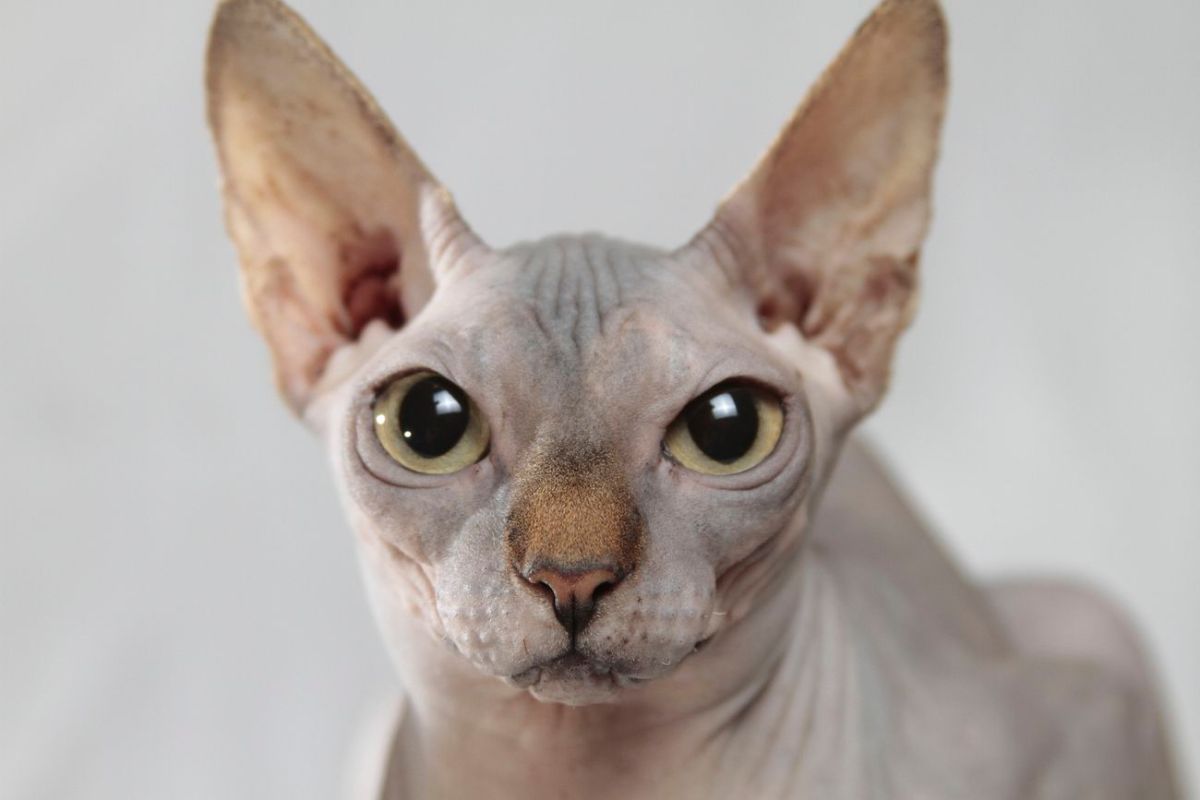
The unnamed feline is a hairless Egyptian who was the personal pet of Ernesto Alfredo Piñon de la Cruz, aka “El Nato,” the former leader of the Sinaloa cartel-aligned Los Mexicles gang. Cruz, who lived in a “luxury cell” at CERESO like other drug lords incarcerated there, had the kitty tattooed with a skull flag and the phrase “Hecho en Mexico,” or “Made in Mexico,” a slogan of Los Mexicles.
Cruz and dozens of fellow inmates instigated a riot at CERESO 3 on Jan. 1, leading to the death of 10 prison guards and seven inmates, and the escape of 30 more. He died along with several others in a shoot-out with Mexican authorities three days later and the rest were apprehended.
When Juarez’s governor ordered a thorough sweep of the prison — in which the inmates had become the de facto wardens and guards had lost control of the cell blocks — armed police squads found the forgotten feline, along with thousands of illegal amenities like couches, plasma TVs, video game consoles, air conditioners, heaters, personal laundry machines and even a mechanical bull.
A council of authorities and animal welfare officials from Juarez whittled applications to adopt the cat down to 10 finalists and decided to go with an American adopter in Texas who already has one Egyptian, is well versed in their care, and can offer the tattooed cat a stable environment.
They haven’t identified the adopter, which is probably for the best in a situation where even the police often wear masks to conceal their identities when conducting operations against cartel targets, for fear of retribution if they’re identified.
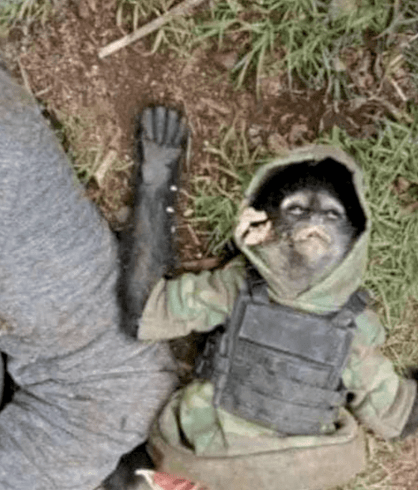
A so-called “sicario monkey” was incidentally shot in a shoot-out with his cartel member “owner” in June of 2022. Credit: Texcaltitlan police
As the Washington Post notes, stories of “status” animals are common with cartels. In Colombia, hippos acquired decades ago by notorious drug lord Pablo Escobar for his private zoo were allowed to roam free, multiplying to more than 130 today and causing problems in the areas they frequent. And in the summer of 2022, police in a shootout with gangsters killed a member of the notorious La Familia Michoacana cartel along with his pet spider monkey, who wore a tactical vest and a custom camouflage jacket. A Bengal tiger, also illegally acquired by the cartel, was unintentionally set loose in the chaos during the same raid, but was not killed.
Cat in the bag
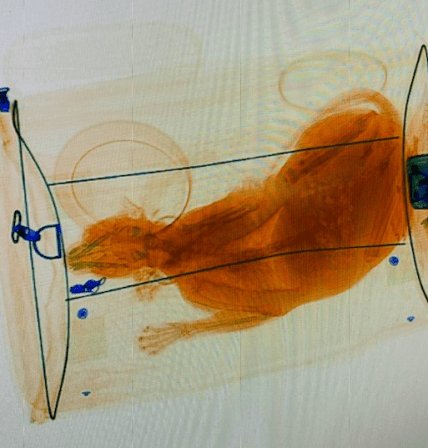
TSA found another pet cat in the luggage of a traveler, this time at Norfolk Airport in Virginia on the morning of Friday, March 3.
This time the cat’s caretaker did intend to travel with their pet but forgot to take the little one out before putting luggage through an X-ray machine. TSA spokeswoman Lisa Farbstein, who regularly works puns into her announcements about cats found in luggage, had fun with the discovery while also reminding people it’s not a good idea to send pets through X-ray scanners.
“Attention pet owners: Please do not send your pet through the X-ray unit. Cat-astrophic mistake!” Farbstein tweeted Friday.
An image of the cat as it passed through a security scan at Norfolk Airport in Virginia on March 3, 2023. Credit: TSA
Although the cat seems unharmed and the TSA said there’s likely no damage caused by a single trip through the machine, Farbstein said passengers should still be careful.
“The passenger needs to remove the pet from a carry case and carry it through the walk-through metal detector or walk the pet through the metal detector on a leash,” she told CNN. “This is typical of how people travel with small dogs. In the case of a cat, if there is no leash, we strongly recommend that the passenger requests screening in a private screening room” to prevent the cat from freaking out and getting loose in the airport.
What’s your favorite thing about your cat(s)?
Buddy has free reign when it comes to 95 percent of the home and the only times I stop him from doing something are when he might hurt himself, such as trying to steal a piece of food that’ll make him sick or chewing electrical wires.
Thankfully he gives himself away when he’s about to do something he knows he shouldn’t do, making a hilarious vocalization — a trill that sounds like “Hmmm I know I’m not supposed to be doing this, but…” He’s done it since he was a kitten, when he still didn’t get the concept of a litter box and would crap under my bed. (It took almost two weeks, an adjustment in the placement of the litter box, and finally a switch to Dr. Elsey’s Kitten Attract litter before the lightbulb went off in his little head and he got it.)
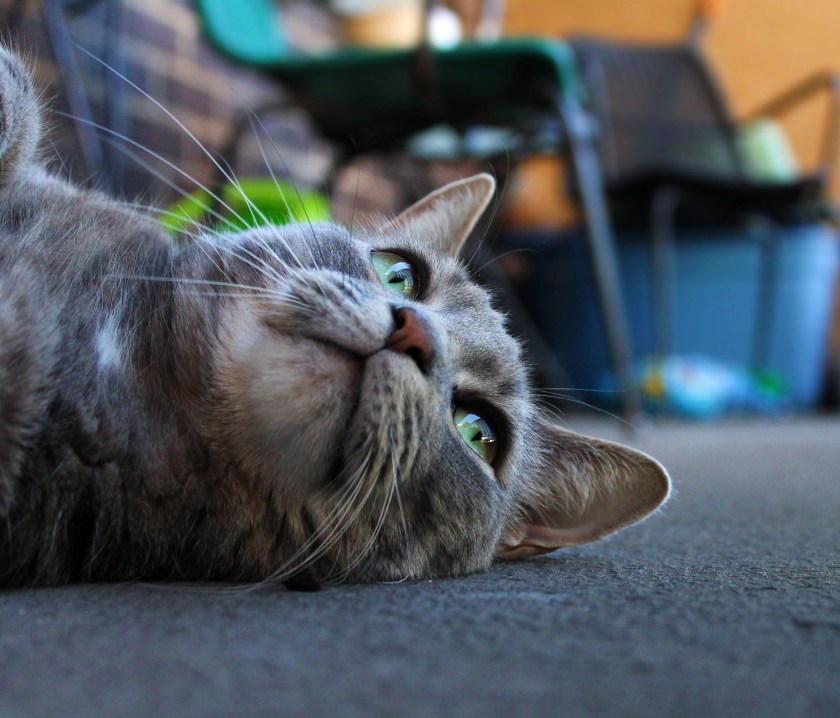
Years later he still makes the same sound, but when I move to intervene, he immediately flops onto his side and splays his limbs out, a move that says “Hah! I wasn’t gonna do what you thought I was gonna do, and you can’t pick me up!”
He did it to me three times last night and my attempt to dissuade him in a Serious Voice failed spectacularly when I saw Bud flash his “I’m Just An Innocent Widdle Kitty” face at me and broke down laughing.
One of my favorite things about Bud is how he makes me laugh with his antics. The little dude is clever.
What are your favorite things about your cats?
“I’m just a widdle kitty. Totally innocent. Totally didn’t knock a bag of chips all over the floor and pretend I had nothing to do with it.”







 Pain In The Bud