A Texas cat’s epic trek home covered 228 miles, and no one’s sure how she did it.
Despite the current golden age of feline cognition studies and a growing body of research that shows cats have genuine affection for their humans, people still think of the little fluffballs as aloof, antisocial and ambivalent.
Old stereotypes about cats die hard, but maybe this latest story will finally give people pause: A cat named Gray C. made an epic, 228-mile journey back to a Texas town after she was ‘rehomed’ a week earlier.
Vikki and Eugene Braun told KTBC, a Fox affiliate in Austin, that they brought Gray C. and their other cat, Sissy, to a friend’s ranch in Terrell, about 35 miles east of Dallas. Both were outdoor cats, they said.
“We thought because they weren’t ‘pet’ cats, they wanted to live outside, we thought, well, maybe they’d rather live in the barn,” Eugene told the Fox affiliate.
The next day, their friend from the ranch in Terrell phoned to tell them the cats were gone. A week later, Vikki Braun was shocked when she came home and found Gray C. inside, helping herself to some food.
“I thought one of the neighbor’s cats had got in through the doggie door and that’s never happened, but I picked it up and I was like, this is Gray C.!” Vikki Braun said.
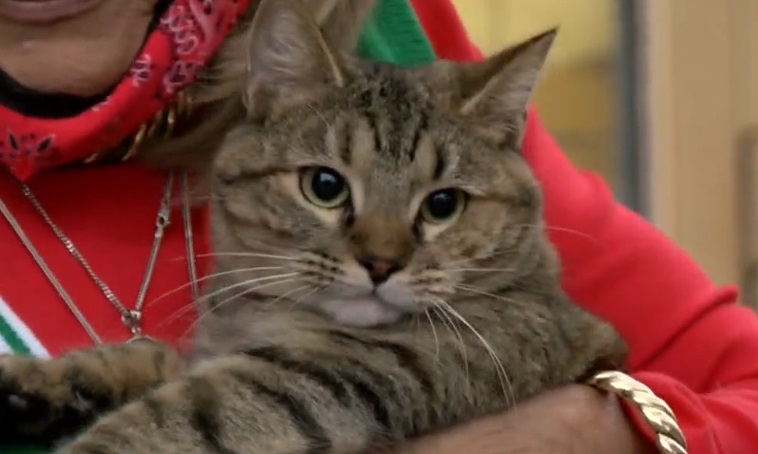
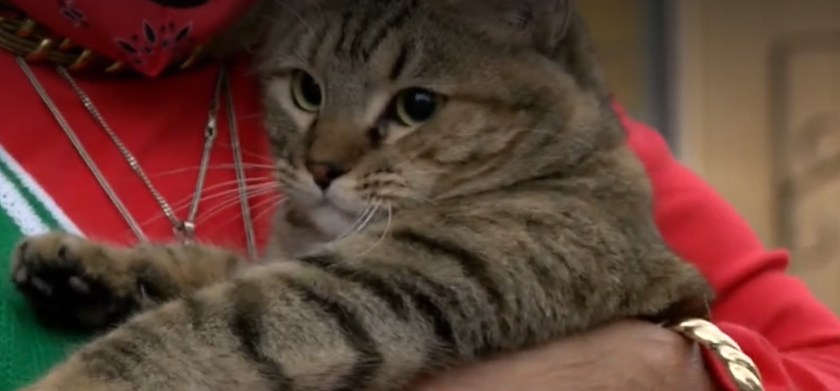
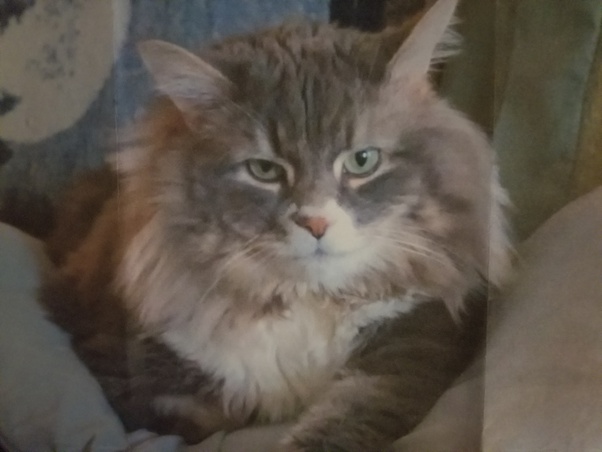
Gray C. is held by Vikki Braun after her long trek back to Burnet, Texas.
That was about three weeks ago. The Brauns say they don’t know what happened to Sissy. Hopefully she shows up unhurt.
No one is sure how Gray C. managed to cover so much distance in a little more than a weeks’ time. It seems unlikely a cat could cover more than 32 miles in a day. The little felines are considerably faster than humans but like all felids, they’re built for shorter bursts of intense activity and require lots of rest.
“That’s a lot of miles per day, you know, but I’m sure she probably didn’t stop. She just kept on going,” Eugene Braun said.
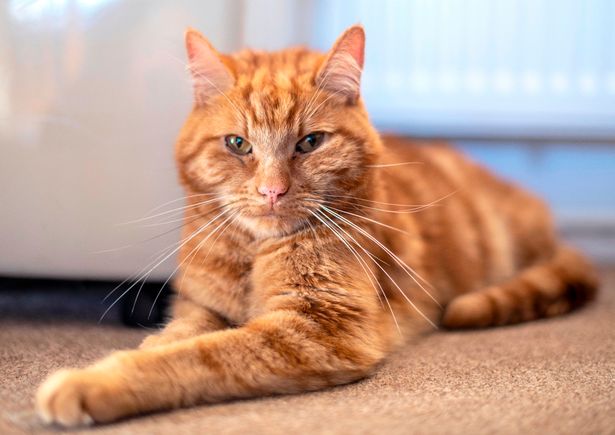
Garfield walked 40 miles back to his owners in London in June 2020.
Gray C’s story mirrors the story of Garfield, an orange tabby who walked 40 miles back home this summer after his owners gave him away. It took Garfield considerably longer to get home as he navigated London and its crowded suburbs, but his determination struck a chord with his people, who reconsidered their decision and kept him after his journey.
“This cat has not always been feral. It had known the warm spot on the rug in front of the fireplace. But on a summer’s day someone left the door open. The cat, not knowing any dark thing, leapt away from love.”
I stumbled into this on Twitter, and it’s a reminder that amazing things can still exist in this cesspit we call the internet.
Teacher Kate Clanchy writes: “What animal is your heart? Is one of my favourite poetry questions. But I’ve never had an answer like this.” She’s referring to this poem by one of her students, 17-year-old Kyla Pereles:
“My heart is a cockroach caught in the mouth of an alley cat.
This cat has not always been feral. It had known the warm spot on the rug in front of the fireplace. But on a summer’s day someone left the door open.
The cat, not knowing any dark thing, leapt away from love. (My heart leaves open cans of sardines for the alley cat. Every runaway full of regret deserves to be fed.)
The cat makes a bed of missing pet posters the wind tore down.
And the cat is hissing at shadows in its sleep.
And the cat is shivering in its matted fur.
And the cat is meowing at the restaurant backdoor.
A waiter, who is also my heart, leaves the back door open so the cat can be warm for the rest of his shift.
But the cat is feral. The owner of the restaurant shoves him back into the snow with a broom.
The cat sleeps until the snow reminds it of the rug. Small things seem sadder when they are alone.
So the cockroach does not mind being in the jaw of something just as lonely.
A little girl follows the paw prints that made a snow angel around the cat. Despite the cockroach in its mouth and its matted fur, she picks it up.
And the cat, who knows of dark things now, spends summer in the lap of the little girl, who is also my heart.”
Kyla’s got a hell of a career ahead of her if she chooses to pursue writing.
Merlin the cat died on Dec. 9. This is what his life was like.
Merlin was born during 2007’s storm season in the Carolinas, and it was a hurricane that took him from his mom and siblings.
“He was found all alone in rubble and ruin,” his human mom, Meg Ferra, recalled. “Rescue picked him up but mom and litter mates were nowhere to be found, and Merlin was inconsolable. He was not yet weaned.”
Merlin’s kittenhood and first few years were chaotic, cruel and marked by repeated disappointment: The little guy, then called Shadow, was cycled through seven shelters and two families who adopted him, only to bring him back to the shelter system like a defective toy.
He was traumatized by his early experiences, shy and fearful, the kind of cat who huddled miserably in the back of the cage while more outgoing kitties found their forever homes.
His last stop — and last chance — was a kill shelter in New Jersey. The shy grey tabby with tufts of epic white-and-grey fur may have sensed his time was running out and uncharacteristically reached out to a couple that wandered into the shelter one day.
Merlin getting some fresh air. Credit: Meg Ferra.
“Merlin put his rather large paw out and grabbed my husband’s shoulder — a feat in itself since three bullies kept pushing him into the corner and making him sit in his food,” Ferra said. “He was malnourished, skinny, oily, messy and sad.”
Ferra hesitated. Long-haired cats usually mean lots of shedding on clothes, carpets and couches. A cat with such a complicated history would present challenges as well.
“Once my husband held him, well, my thoughts of avoiding lots of hair went out the window,” she said.
The Ferras brought Shadow home and renamed him Merlin, a name befitting such a regal feline. They were surprised to discover he didn’t shed much despite his great tufts of wild fur. A subsequent DNA test identified him as a Siberian forest cat, an ancient, accidental breed that developed its characteristics naturally because it lived in isolation from other cat populations, deep within the Russian tundra.
Siberians have quite a few unique qualities. They have three fur layers — guard, awn and down hair — and rival Maine Coons in their floofiness, but their fur is easy to maintain and resistant to matting. They moult twice a year. Their moulting phases are milder than similarly-floofy cats, and their fur has lower levels of the allergen Fel-d1.
Good boy: A collage of Merlin’s moments. Credit: Meg Ferra
Merlin was fearful and shy in his new home, and it became clear that he was not going to soften any time soon. He’d flinch, hinting at past traumas: “You couldn’t raise a hairbrush near him, or hold your hand over his head to caress him.”
“It took five years to break through Merlin’s wall of anger and fear when we brought him home,” Ferra said. “We played it low key, never loud, pushy, punishing, forceful or insulting. By insulting I mean with Merlin, you don’t make deals! Deals always hurt his feelings.”
One day, Ferra was trying to get Merlin to play with one of his toys when he lashed out at her.
“He tore up my forearm. I was dripping blood from wrist to elbow. I didn’t move. He didn’t move. His eyes were black orbs. I could see the wheels spinning. ‘Will she hit me? Yell? Throw me? Send me away?’
“I exhaled slowly and in my calmest demeanor said to him: ‘Merlin, what are you still so angry about? Frightened about? Don’t you know by now no one is going to hurt you here? It’s been five years and you’re safe, honey. You’re home, nothing will ever harm you again. They’d have to go through your family, daddy and me. You’re not alone, my love.’ And damned if his pupils didn’t recede. He let out a little whimper and his whole body relaxed.”
Ferra with Merlin. Credit: Meg Ferra
From there, Ferra said, “it’s been belly kisses and raspberries,” but Merlin “was not a cuddler.”
“But like clockwork every week he would approach me, tap my leg and stare up at me. Not too mushy, but as if to say ‘I want a hug now!’ I ate up those two minutes. I’d pick him up and simulate his lost mom’s cheek rubs, which he loved and craved.”
Merlin developed health problems. In particular, his hips and neck began to bother him. Those are side effects typical of his breed, which has longer back legs that make Siberians powerful jumpers. He began suffering from hyperthyroidism and arthritis in his later years.
At seven years old, Merlin fought off a bout of pneumonia. But when he came down with it in early December, he didn’t have the strength to fight it off.
Ferra and her husband, Joe, stayed up with their beloved cat for almost 48 hours, monitoring him. Her husband even put off his dialysis to stay with the little guy.
But by Tuesday, when Merlin could no longer lift his head, Ferra knew it was the end. Merlin was euthanized on the morning of Dec. 9 at the veterinarian’s office. He was 13 years old.
The Wizard of Fuzz: Merlin was a Siberian, a naturally-occurring breed known for its epic coat. Credit: Meg Ferra
The typical symptoms of grief set in: Ferra kept looking for the little furball, momentarily forgetting he was gone. She left his food bowl and his water fountain untouched. Her life suddenly had a vacuum in it.
That this happened now in the midst of a pandemic, as the death and infection rates skyrocket, lock-downs begin anew and the prospect of a dark winter casts a gloom over life, makes Merlin’s absence especially challenging. The Ferras’ children are adults, and their house is now quiet. Merlin’s presence mitigated the isolation and dreariness of life in a pandemic, as cats and dogs have done for millions of Americans this year.
For Joe, even his treatments remind him of his cat: Merlin would stand guard when Joe settled in for dialysis, remaining for the length of the treatment.
Ferra said she and her husband are considering adopting litter mates or inseparable friends. They feel Merlin would want them to provide a home to new cats.
“Joe has asked me how long I need until we open our home and hearts to a bonded pair. My husband can’t stand the emptiness. I just need a little more time. But with COVID and and the overflowing shelters I feel even Merlin wouldn’t want me to wait too long.”
Special thanks to Meg for talking to us about Merlin despite her fresh grief at losing the special little guy. We wish Meg and Joe the best this holiday season, and when they open their home to new kitties who need some love and a place to call their own.
A male Siberian forest cat. Siberians have thick coats, but they don’t produce as much allergens as most other breeds. Credit: Wikimedia Commons
Istanbul is famous for its cats. We spoke to Basak Bugay, an Istanbul native and cat lover who cares for strays in her neighborhood.
It wouldn’t be hyperbole to call Istanbul a city for cats.
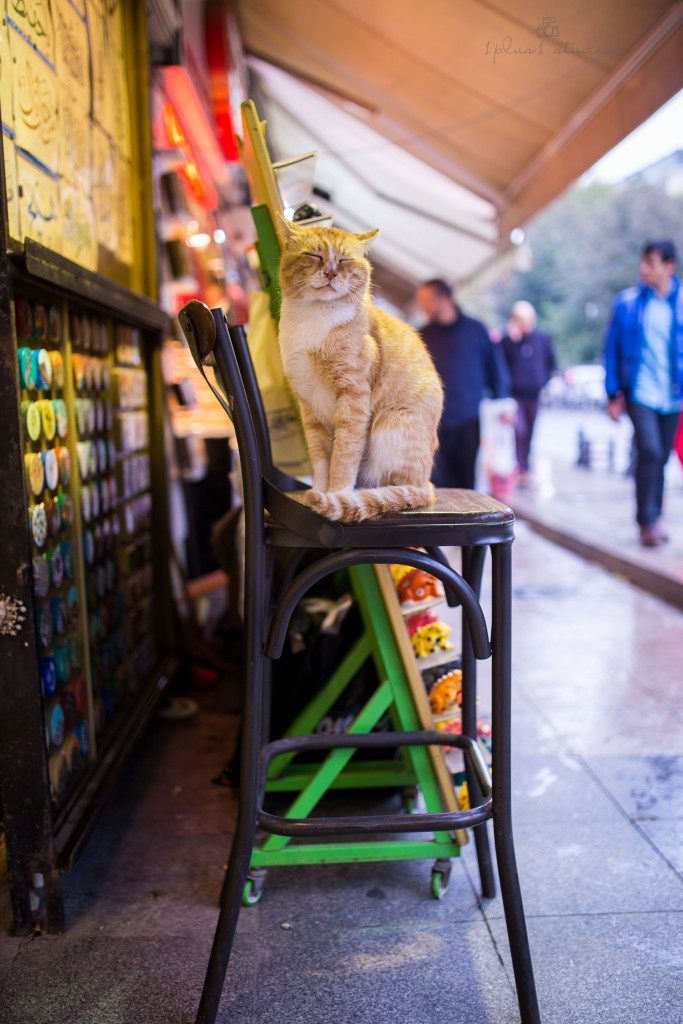
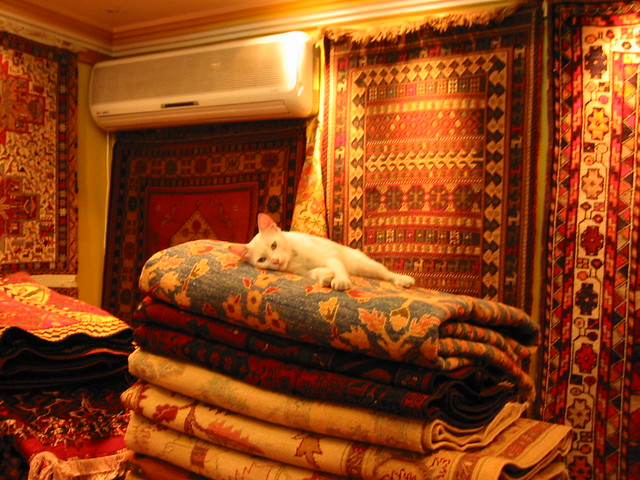
Felines are everywhere in this metropolis of 16 million, from the beloved — and famous — cats of the Hagia Sophia, to the shop cats lazing away their afternoons in bookstores and cafes, to neighborhood strays who enjoy the protection and care of entire communities.
Europe’s largest city is an example to the rest of the world, a vision of what life looks like when virtually everyone respects animals and pitches in to care for them.
We were fortunate enough to catch up with Başak Bugay, an Istanbul native who loves cats and cares for a small pride of strays in addition to her own beloved cat.
Thanks for joining us, Başak! Can you tell us a little bit about you, what you do for a living and whether you’ve got cats of your own?
I’m a 41-year-old visual artist living and working in Istanbul. Though I was born here, like the majority of Istanbulites, I have my roots in different regions of Anatolia. It’s not really easy to survive as an artist in Turkey, but that is the path I chose.
I live with [my cat] Minnosh in our home! I am so grateful for her presence and feel blessed to be chosen by her. She is one of the kindest souls I have ever met and yet a great inspiration as a survivor. It may sound funny but somehow she reminds me of my beloved grandmother who was a very strong woman… Minnosh (Turkish for “little darling”) came into my life years ago when she was a stray. She would spend the day at my studio and would leave with me at the end of the day.
Sometimes, especially during cold winters, she would follow me to my apartment and spend the night there. Strays are usually very anxious if they don’t have access to go out and it is not easy (in my opinion also not fair) to force them to stay inside. So she was not into being a house cat until the day she had a car accident. She suffered a broken leg and tail. After several surgeries at the vet, I took her home. It’s been 3 years now and she shows no more interest in going outside. She is 11 or 12 years old, having a happy, peaceful retirement at home.
For readers who may not be aware of Istanbul and the special place cats have there, can you tell us a little bit about the city and its relationship with cats?
It has always been a cat city and it is even more today. Istanbul is a big metropolis of more than 16 million inhabitants. As someone who was born and grew up in Istanbul, there are some quarters even I’ve never visited.
The life, culture and social habits vary from neighborhood to neighborhood; whether those neighborhoods are upper or lower class, secular or conservative, strays are everywhere and people take care of them.
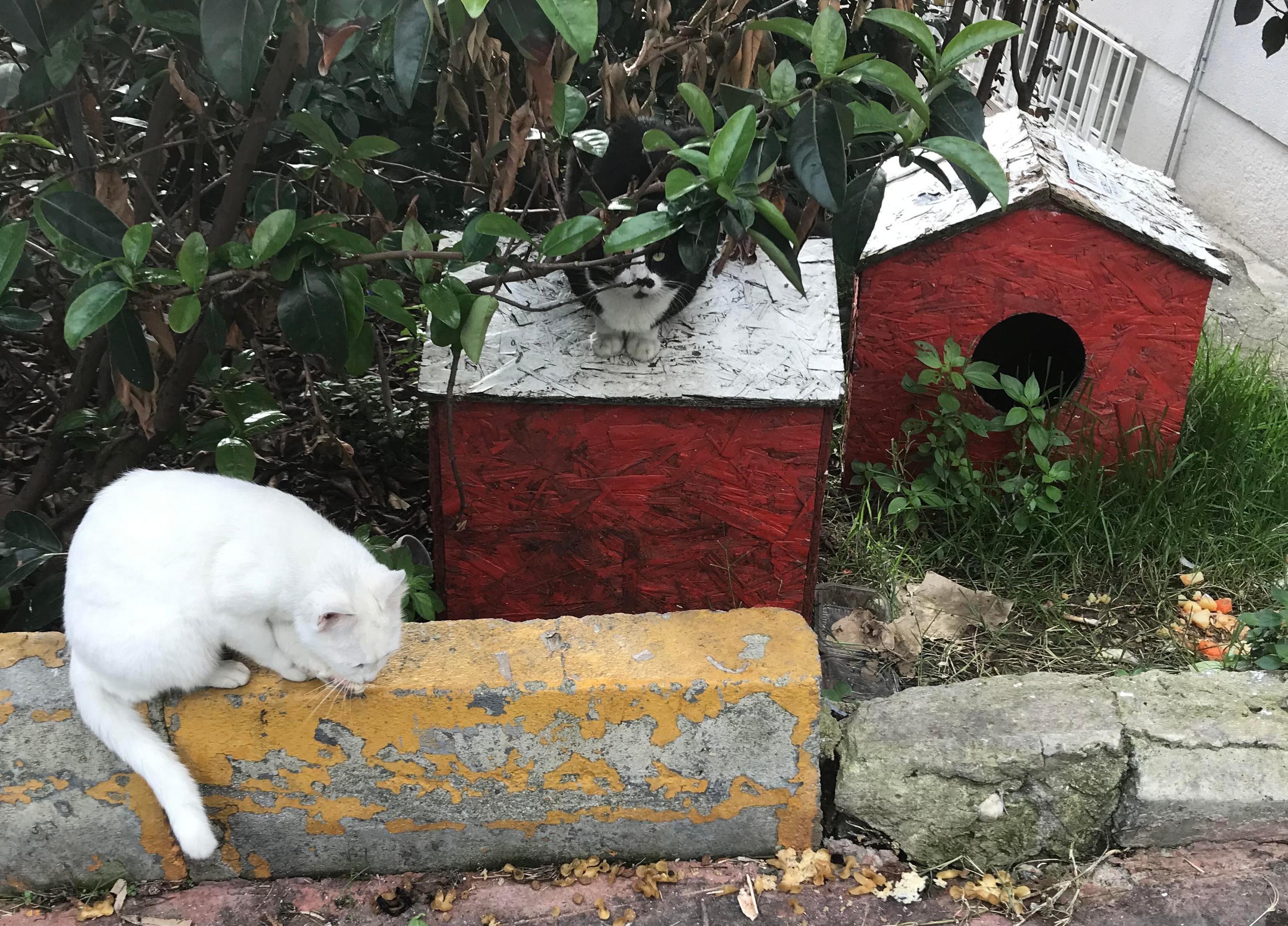
Street cats hang out near shelters built for them by people in the neighborhood. Credit: Başak Bugay
For the last few years almost all shops, markets, cafes and even shopping malls or hotels have started to put food cans and shelters in front of their door and some even host them inside. As a good example, a few years ago during snowy winter days, a fashion store opened its doors to stray cats and dogs for them to pass the cold nights inside. Best advertisement ever!
People in Istanbul have the common manner to take care of the animals, punish the ones who treat them badly and reward those who do good things. In my quarter you may see several cat houses and some of them are made by real estate agencies with their logo on the top! In addition, local authorities have special units for strays: They have a 24/7 emergency service, they do sterilization and bring them back to their neighborhood, they vaccinate stray dogs and replace cat/dog houses on the streets. It’s not all rainbows and flowers, but I think things are improving.
Is caring for cats an unwritten rule among the people of Istanbul? Is it embedded in the culture?
Not only the cats but also the dogs and the birds. Although it varies from region to region, it looks like this has been part of our culture for a long time. An important element of Ottoman architecture, for example, is bird shelters on building facades.
A restored bird shelter built on the facade of an Ottoman-era building.
Beginning in the 20th century the city was famous for its dogs. Sultan Mahmud II, who could be considered as a dictator of his time, initiated some strict restrictions, in an attempt to westernize the country and institute so-called civilization reforms. One of his decrees was to deport a thousand stray dogs to an isolated island off Istanbul. Despite being a totalitarian dictator, Mahmud II bent to the will of the people who wanted the dogs back, so they were brought back.
People usually say that the love for cats among Turkish people finds its roots in Islam, but it cannot be the only reason, because dogs who are considered “dirty” according to religion are well protected too. Recently the municipality of Konya, which is the most conservative city of Turkey, started a new program to rehabilitate dogs and place them in new homes, with a monthly stipend for caretaking expenses.
With regard to cats, it is said that the story of cats’ domestication had started in Anatolia as the most ancient land where agriculture was developed. That could be another reason why we are a whale for the cats. However I was surprised to see the absence of cats in the east of Turkey; there were really very few even in Van which is famous for its cats. Istanbul and probably the west coast of Turkey has the majority of the cat population in the whole country.
Recently there was a viral video of a man pushing a cart through the street in Istanbul when he came upon a cat drinking from rainwater collected in a puddle in the street. The man waited patiently for the cat to finish drinking, then went on his way. Is that a common scene there? Have you seen any simple acts of kindness toward cats?
Although there are some people who aren’t so nice to cats, yes, this kind of kindness is common and I see it all the time, not only in Istanbul but almost all around in Turkey. There is this story about prophet Mohammed: he wanted to get up but a cat was sleeping on the sleeve of his cardigan. Instead of waking the cat up, he cut his sleeve off. That kind of story might have a cultural impact and influence the behavior of Muslims.
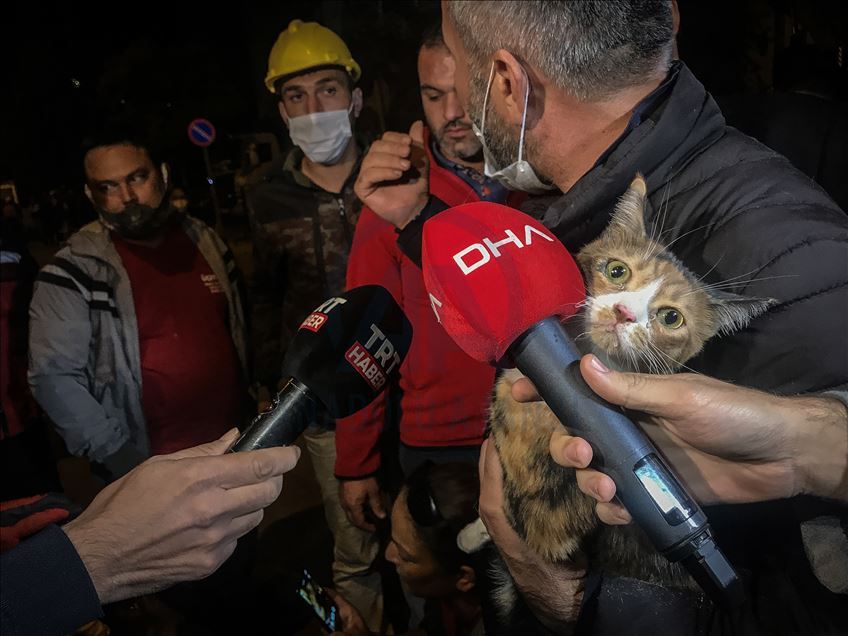
A few weeks ago Izmir (a city of 4.3 million on Turkey’s Aegean coast) had a terrible earthquake, which caused around 100 dead and 1,000 wounded. Rescue teams worked hard to save the animals as much as they did for people. They kept the rescued cats in a shelter, looked for their humans or tried to find new homes for them.
A rescue worker in Izmir holds a cat who was rescued from the rubble more than 30 hours after the 6.6-magnitude earthquake. /Hurriyet Daily News
You care for three friendly-looking cats who clearly know and trust you. How’d you get to know them and earn their trust? Do they just hang out at your home?
It is my studio, actually. I have a direct entry from the street so it allows me to be closer to the strays in the neighborhood. I knew their mother and would feed her too. They were all wild, and wouldn’t let me get closer or touch them. Once their mother abandoned them, they didn’t leave the area and I kept feeding them.
Sometimes I’d leave the door open and they’d come in. That’s how they eventually understood that I was harmless. One of them vanished; probably someone in the neighborhood adopted her. One shows no sign of interest in bonding with me. He is very distant but at least doesn’t run away when I go closer. However the other starts to let me pet him and enjoys it very much. I call him Osman.
Those of us living outside Turkey have seen photos of cats casually walking wherever they please: Entering office buildings, shops, homes, government offices. Do cats have free reign in Istanbul? Does anyone ever stop them from going where they please?
Well of course there must be some places they cannot go in but if it’s a private business, such as a restaurant or a shop, the owners would fear to get on the wrong side of people if they don’t get along with the cats. So even if they don’t like it, it’s kind of a must for such a place to welcome the strays.
On second thought, yes, I think they are welcomed almost everywhere. You would see them sitting, lying, sleeping in very awkward places and nobody would disturb them. I don’t know if you have seen the video of the cat messing with the Istanbul Symphony Orchestra players and stayed on the stage during the concert.
Although people of Turkey are quite polarized in terms of almost everything, when it is about animals, they unite and show a common reaction. At least no one objects when it comes to fighting for animal rights.
To be honest I couldn’t live in a city where the cats are absent. I feel very isolated and alone when I go out of Turkey, especially in European cities.
Since there are so many street cats in Istanbul — an estimated 125,000 — what about house cats? Is it common for the people of Istanbul to keep cats as house pets? Are those cats kept indoors or do they wander the streets too?
It is more common now than the past to have pets in the house and they are mostly cats rather than dogs. The old generation also had the culture to take care of the animals, but only if they were out of the house. Whereas many of them lived in stand-alone houses with gardens, most of us now live in apartments. Unfortunately, it is not possible for a house cat to go in and out [of an apartment]. I, for example, know only one house cat who goes around in my neighborhood.
Why do you love cats?
I grew up as an only child and was quite introverted. This is probably why I have always been passionate about bonding and getting to know the animals, although my parents were old fashioned and wouldn’t allow me to adopt one.
We would spend the summer holidays on an island of Istanbul, where our house was in the heart of the forest and surrounded by feral cats. I would chase them all day long but most wouldn’t allow me to get closer. My passion for observing their behaviors made me admire them. I probably understand and know cats better than I do humans. In my opinion they are the strongest animals in terms of evolution with their ability to adapt to humanity without compromising their nature.
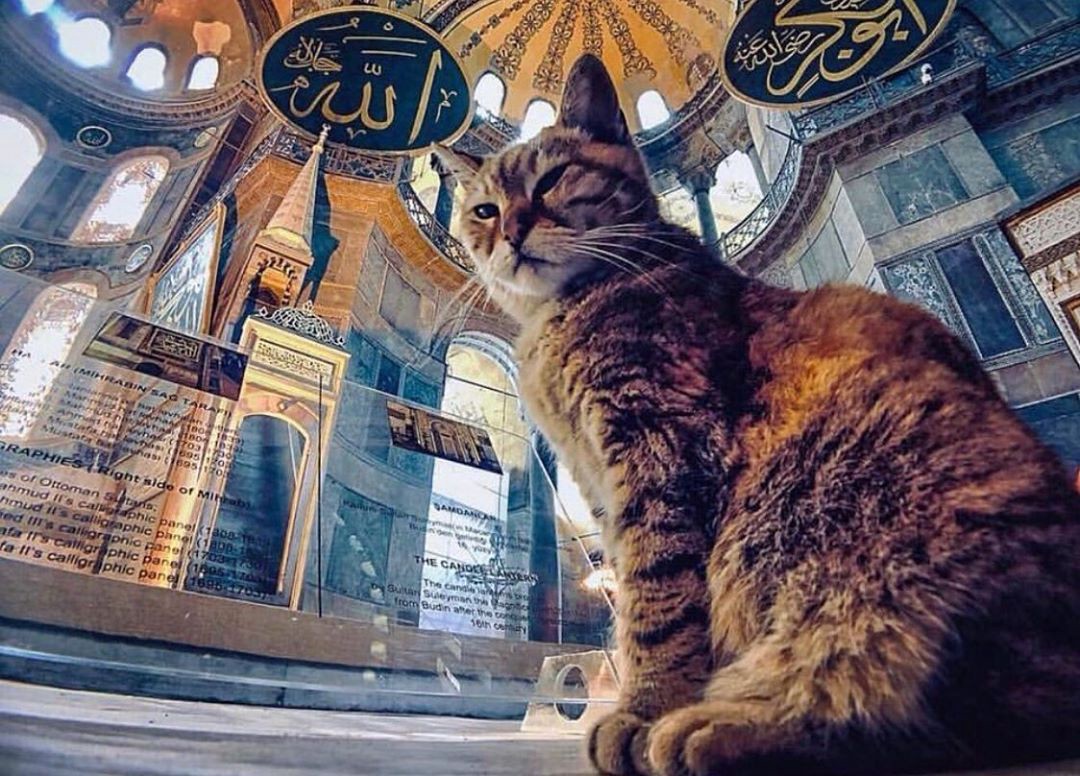
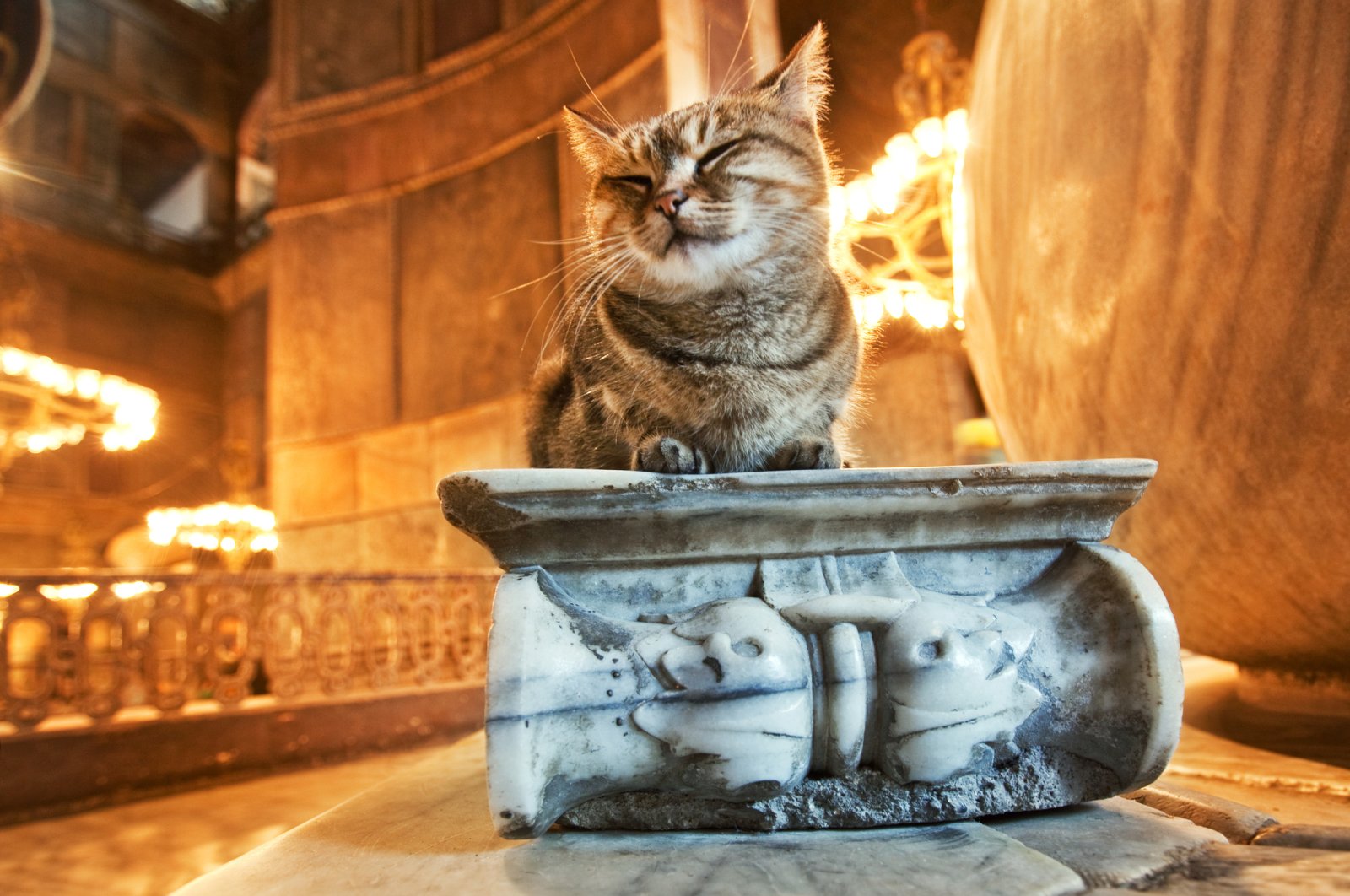
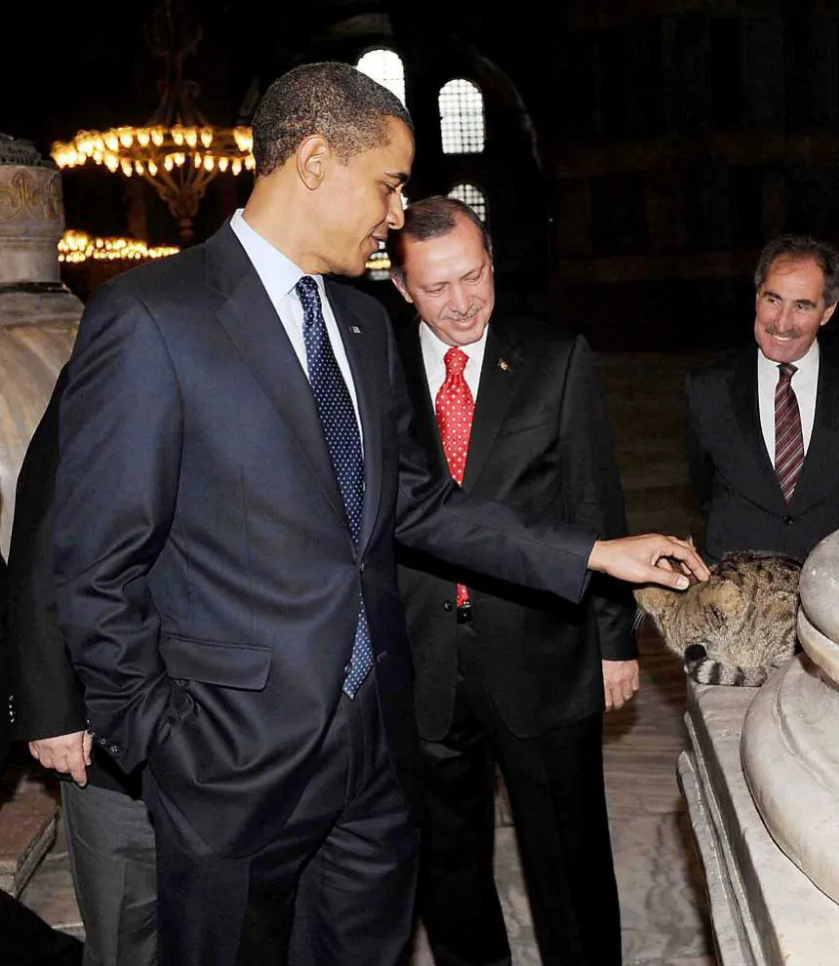
The late Gli, most famous resident cat of the Hagia Sophia. Gli was a magnet for tourists, the subject of thousands of photos, and was famously petted by former U.S. President Barack Obama during his state visit to Turkey.
Former President Barack Obama pets Gli.
And finally, is there anything I didn’t ask, but should have? Is there anything you’d like to tell our readers about you, your city or the cats there?
I mostly talked about the good sides of it, but that doesn’t mean everything is perfect. The biggest problem is, we still don’t have a proper animal rights law in Turkey. Animal abusers or killers exist and they don’t get sentenced for their crime but only pay a small account of money.
If the animal has an owner, it’s considered as damage to property and has a more strict penalty. This has to change immediately. Also there are some epidemics among stray cats such as Coronavirus and feline HIV, which are very hard to treat. The good thing is the vets are usually very helpful. Some do voluntary service or work for a considerable discount. Yet no animal would be left alone in case of an accident or a disease, at least not in my neighborhood.
Thanks to Başak for taking the time to answer our questions, and in a foreign language, no less. I only speak two: English and Buddinese, and the latter isn’t so much a language as it’s a set of 283 different ways to say, “Feed me!” Here in the US, we could learn a lot from the people of Istanbul, their love of cats and their community effort to care for them.
Local papers are calling the mystery cat the Canterbury Panther.
A New Zealand man says he filmed a “panther” after taking blurry footage of a house cat.
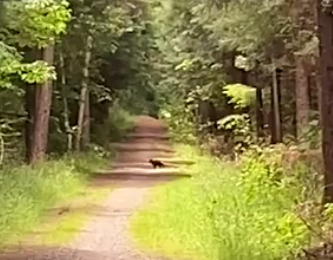
Kyle Mulinder does his best Steve Irwin impression with a breathless “Look at that thing! Amazing!” while zooming in on what looks an awful lot like a domestic cat.
Mulinder continues to provide commentary and generously estimates the cat at “four foot high” as it dashes off a dirt road into a wooded area in New Zealand’s Hanmer Springs Heritage Forest.
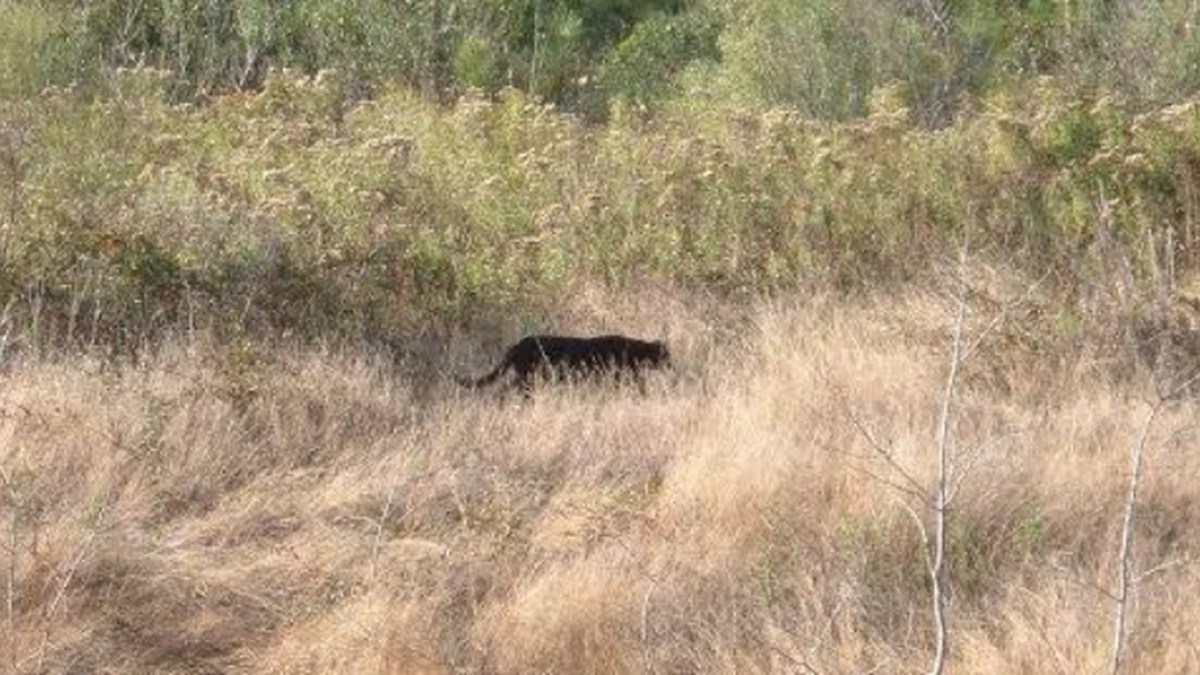
Here’s a screenshot of the cat. I wasn’t able to embed the video, so you’ll have to visit the New Zealand Herald to watch it.
A handful of New Zealanders have said they’ve seen a large cat since at least this summer, long enough for the local press to dub the cat the Canterbury Panther. Various reports identify the cat as grey, tawny or black.
Mulinder, who calls himself Bare Kiwi online, demonstrated a flair for the dramatic while telling his tale to the Herald.
“It was about 50 metres away, strolling in the other direction but it sat down, turned and looked into my soul,” Mulinder said. “It was a very emotional experience. I was fearing for my life.”
(Insert terrifying Buddy joke here.)
Yolanda van Heezik, a zoologist at New Zealand’s Otago University, said the chances of a big cat on the loose are “extremely unlikely.”
Aside from the lack of convincing footage of the Canterbury Panther, there aren’t any obvious signs of a mountain lion, jaguar or leopard, van Heezik said. Those signs could include scratches from large claws high up in trees, widespread scent-marking and the trail of prey that would be left by a large carnivore.
“No one’s ever caught one, no one’s ever got really good evidence that they are something different from just a large feral cat,” she said earlier this month. “And there’s also a complete lack of evidence that is indirect like if you had a really big cat like that you would expect there to be more stock kills, for example, but we don’t really have that evidence either.”
Aside from the cat’s small size, there are other obvious reasons why it’s unlikely to be a panther. The word panther can refer to a cougar, also known as a mountain lion or puma. It can also refer to a jaguar or a leopard.
None of those cats are found on New Zealand: Pumas and jaguars are native to the Americas, while leopards exist in Africa and parts of Asia.
Of course it’s possible someone purchased a big cat from the illegal wildlife market and the animal escaped or was let go, but those cases are rare and big cats tend to be the “toys” of the ultra-wealthy. Local authorities have ruled out the possibility of a large cat escaping from any nearby zoo or wildlife facility, according to the Herald.



 Pain In The Bud