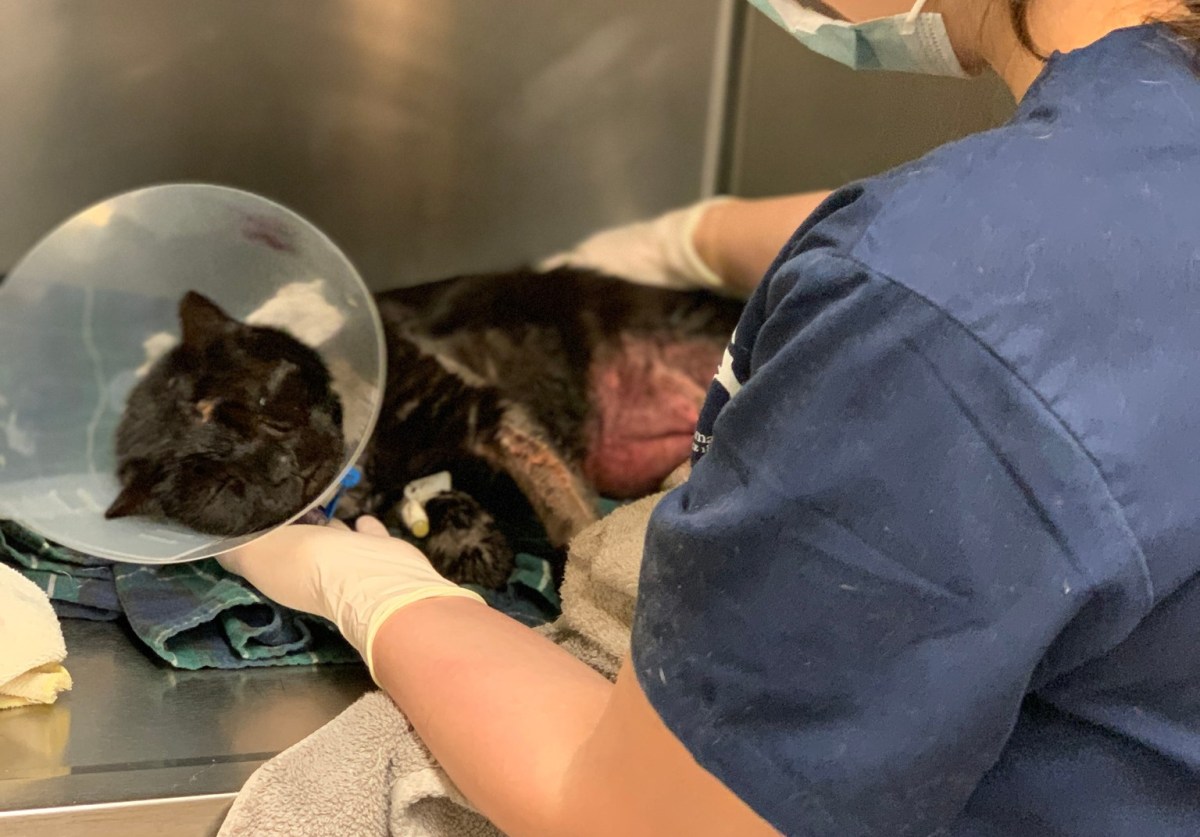
While the surveillance footage appeared to show a pair of men siccing pitbulls on a semi-stray cat named Buddy, the suspects are 17 and 12 years old respectively, according to the SPCA.
Investigators were able to ID the pair after getting leads from the public, and on Friday the 17-year-old came in accompanied by a parent to surrender himself to authorities. The 12-year-old has agreed to turn himself in today, March 26, according to the local NBC affiliate.
Authorities said they’ll charge the pair with animal fighting, aggravated animal cruelty and conspiracy for the unprovoked attack, in which they encouraged their dogs to hurt the much smaller cat. The first two charges are felonies.
However, there are caveats. Because the suspects qualify for youthful offender status, they cannot be tried as adults and may be able to wipe the convictions from their records in the future. Such deals are at the discretion of judges, and typically involve the completion of certain programs and require that the offenders stay out of trouble for a set time period after conviction.
Because of that, their names will be sealed in court records. Youthful offender deals are usually reserved for first-time offenders. It’s not clear if the teenagers in this case have priors, and it will be up to the judge to decide the terms of their sentencing if they are convicted or agree to plead to the charges.
The SPCA has taken custody of the dogs, although their fate remains unclear. Hopefully they can be rehabilitated and adopted by experienced owners.
There’s been an outpouring of support for Buddy, with well-wishers across the world donating tens of thousands of dollars toward his veterinary care and related costs, Pennsylvania SPCA’s Julie Klim said.
“While we certainly see a lot of bad as we fight to end animal cruelty, we also see how much good there is, especially in a case like this, from all corners of the globe,” Klim said. “We will do everything humanly and medically possible to ensure Buddy’s future will be a bright one.”
In the meantime, Buddy still clings to life. He remains in critical condition, according to the SPCA, but veterinarians are “hopeful” he’ll pull through. Here’s a video of the little fighter trying to comfort himself by making biscuits on a soft blanket at a veterinary hospital:
Welcome, new readers! This blog is about a different Buddy the Cat, but we also cover news about felines, animal welfare, the pet industry and other cat-centric topics, in addition to frequent humor posts about our benevolent, furry overlords. Buddy the Cat from New York is pulling for Buddy the Cat from Philadelphia, and hopes his fellow Buddy makes a full recovery before finding a loving family and forever home.
An experimental new drug offers hope for cats infected with FIPV, which is almost always fatal.
Anae Evangelista was reeling from the deaths of two close friends when she saw Parsnip in a local shelter’s online post.
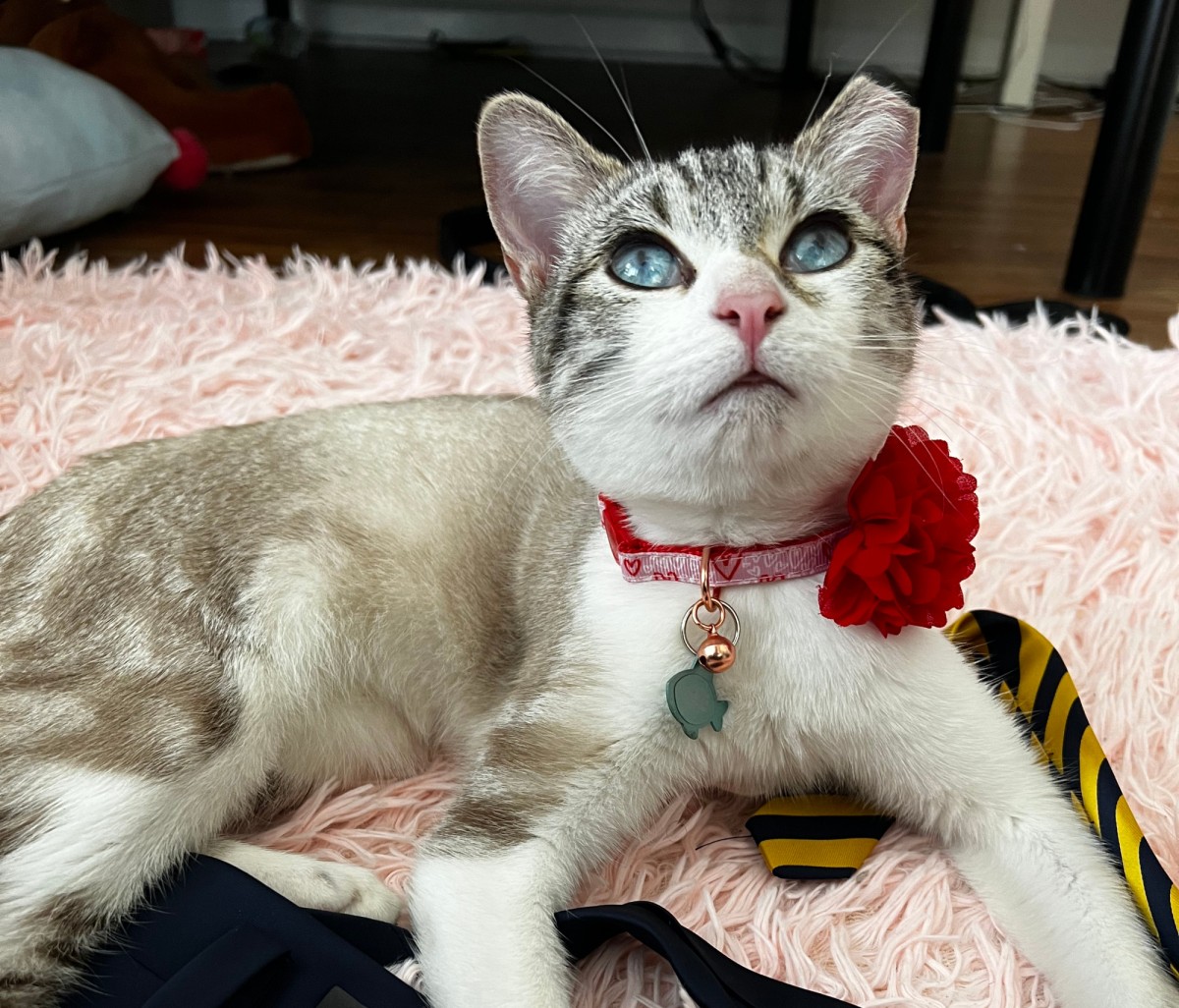
The 21-year-old college student had been thinking of getting a cat for weeks after accompanying a friend to a local shelter. After checking the shelter’s adoptable pets again, she fell in love with an adorable tabby with a clipped ear and sky blue eyes and immediately made plans to see her in San Diego.
Parsnip took to Evangelista immediately.
“She was so affectionate, pushing her head into my hand for pets, and I knew she was the one,” Evangelista told PITB.
Although many cats take days or weeks to adjust to their forever homes, Parsnip “strutted into my apartment as if she owned it from day one, zooming all over the place [with] enough energy to bounce off the walls,” Evangelista said.
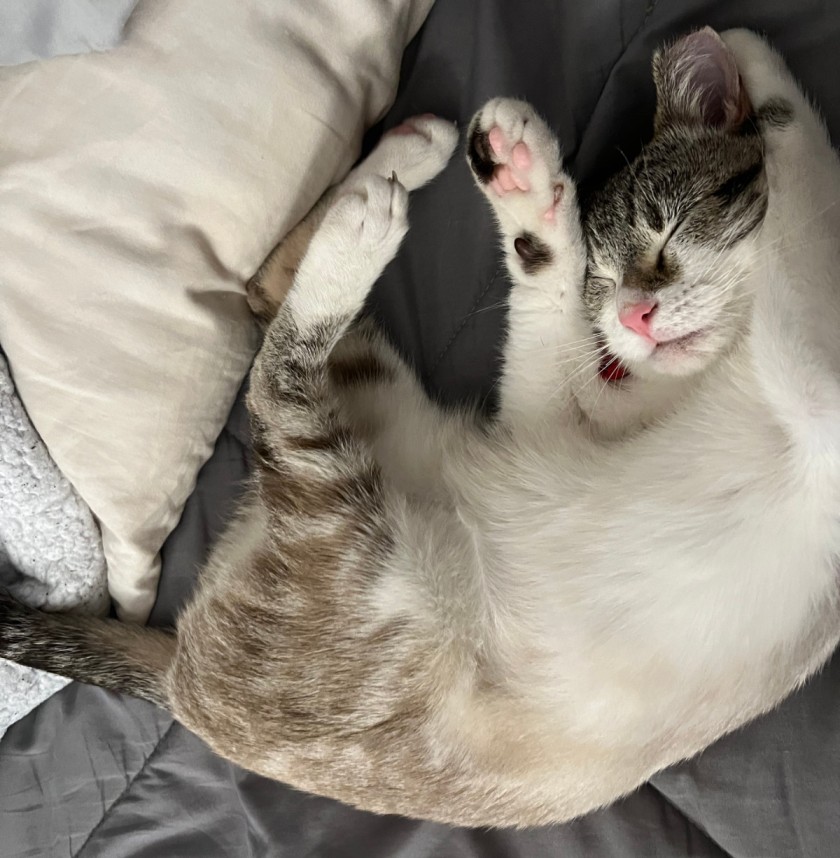
Parsnip enjoys a snooze with toe beans on display.
Although she had a rough start to life and was rescued from a hoarding situation, Parsnip was friendly, affectionate and warmed quickly to her new home. As human and kitten became fast friends, Parsnip’s presence was an immediate boost to Evangelista’s mental health.
‘She’s been my rock,” she said, “and although she can’t talk, I feel as if she’s constantly encouraging me to stay strong.”
But after about six weeks Parsnip’s energy level took a distressing dive. She was weak, slept a lot and wouldn’t eat much. A vet visit didn’t yield any answers, and the next day Parsnip displayed more telltale signs of a seriously sick cat — she stopped eating and drinking entirely, and began eliminating outside of her litter box.
After consulting another veterinarian, Evangelista finally had an answer. Little Parsnip was suffering from Feline infectious peritonitis, a more virulent strain of feline coronavirus that infects white blood cells resulting in dangerous inflammation, per the Cornell Feline Health Center.
“An intense inflammatory reaction to FIPV occurs around vessels in the tissues where these infected cells locate, often in the abdomen, kidney, or brain,” according to Cornell. “It is this interaction between the body’s own immune system and the virus that is responsible for the development of FIP.”
The disease is “usually progressive and almost always fatal without therapy.”
But there’s hope for Parsnip: With the help of her veterinarian and an online group for people whose cats have FIPV, Evangelista was able to get her kitty accepted for experimental treatment with GS-441524, a nucleoside analogue antiviral drug that has proven effective at treating all types of FIP in several trials in recent years. (It’s been so effective, in fact, that Chinese pharmaceutical manufacturers have been supplying GS-441524 on the black market to cat caretakers who haven’t been able to get their cats into trials.)
Since starting the treatment, Parsnip’s responded well: She’s eating again, the swelling has been in retreat, and she’s once again interested in play time, exploring and other things cats love to do. She’s even able to hop up on the couch again.
That’s a far cry from her condition just three weeks ago when she had a 105-degree fever, no interest in things around her and couldn’t get up under her own power.
The 84-day treatment, subsequent vet visits, monitoring and blood work is expensive: Evangelista estimates it’ll cost her about $5,000 in total. She’s looking to raise half that amount via a GoFundMe. It’s a huge expense, especially for a college student, but for Evangelista, spending the money is without question.
“She’s been my foundation and she deserves the world,” she said, “so I want to give her the chance to live to see it.”
Hes doing what cats do best: Following the red dot.
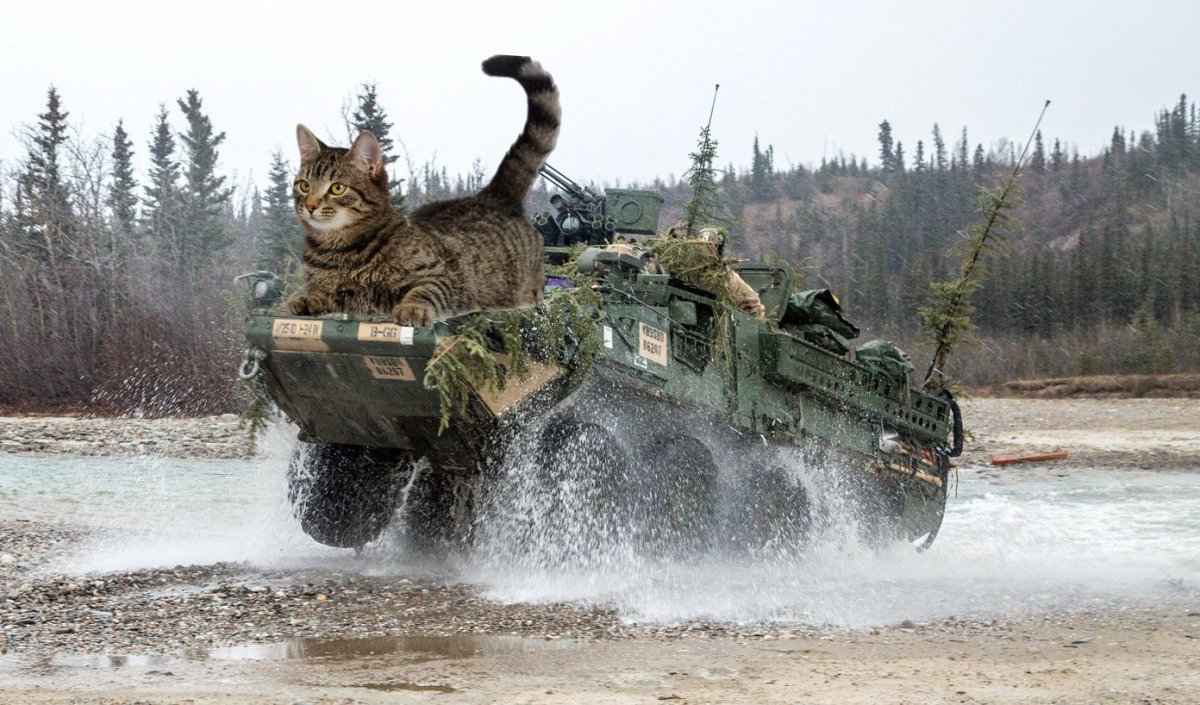
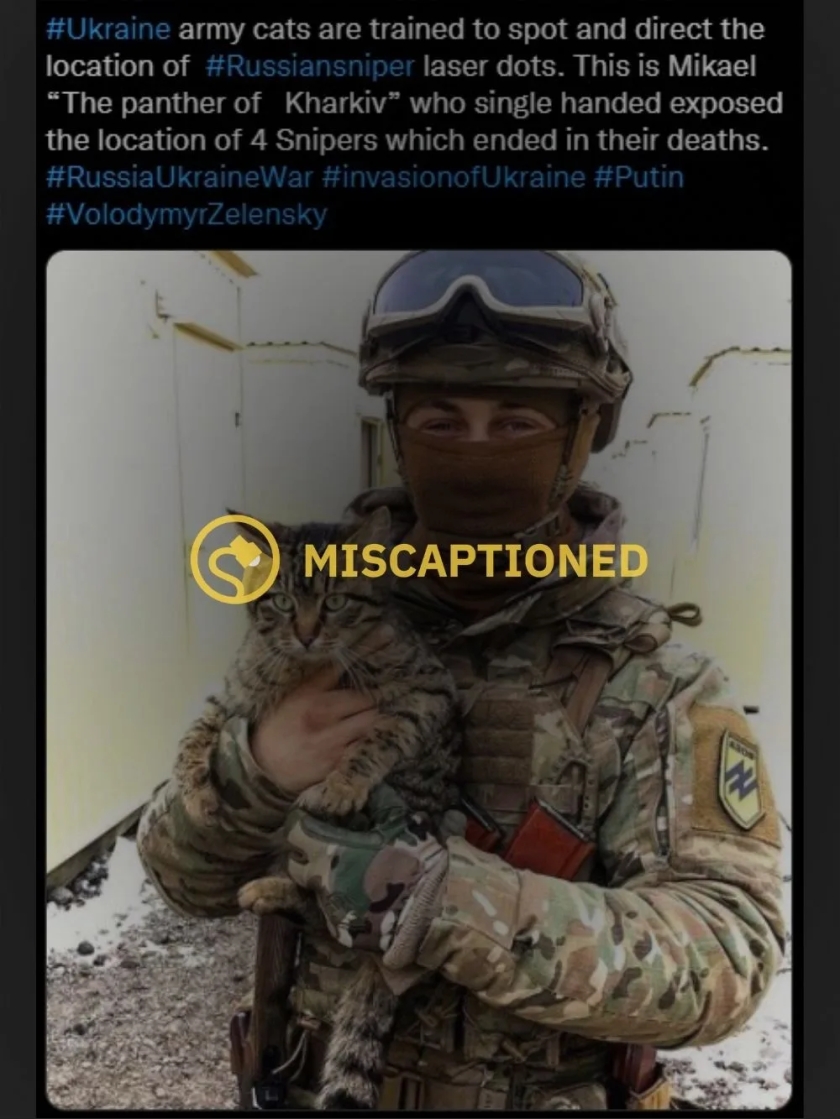
According to the legend of the “Panther of Kharkiv,” a vengeful house cat has been using his superior feline vision to spot the telltale red laser dots from sniper scopes and warn Ukrainian soldiers they’re targets before snipers can get off a shot.
I imagine it goes something like this:
“Dude, there’s a red dot on your face.”
“You said that 42 times in the last hour.”
“Well, it’s true. Give me my treat as a reward, otherwise I might forget to inform you next time.”
“If I find out you’re lying…”
“Treat, now! Thanks…Mmmm, that’s good. Oh look, there’s another red dot on your head! Quick, take cover and give me another snack!”
Either that or kitty is just launching himself at Ukrainian foreheads, chasing the ever elusive red dot.
Of course you don’t need us to tell you this viral social media story is nonsense, do you?
Mmmmm, Elmer’s!
Hundreds of thousands of people have proven themselves more credulous, and continue to share the Panther of Kharkiv posts on Twitter, Facebook, Instagram, Youtube, TikTok and other platforms despite warnings that the story isn’t true. The accompanying photo, while real, is from 2018.
“Complete garbage,” is how Liam Collins, a West Point faculty member and former defense advisor to Ukraine, put it.
Psy-ops have long been a part of war, from Alexander the Great’s armies leaving giant-size helmets and breastplates in the ruins of conquered cities to seed tales of impossible huge — and unbeatable — Greek invaders, to a CIA-devised plan to drop condoms on Soviet territory.
“Condoms?!?” you ask. “How exactly do condoms help a war effort?”
Because they were intentionally manufactured in ludicrously huge sizes marked “Medium” and “Small” with “MADE IN USA” prominently stamped on the packaging, which would be left for the enemy to discover and, the thinking went, to kill their morale. (There are also reports that US psyops left footlong condoms on the Ho Chi Minh trail in Vietnam, leading terrified Vietcong to hide their women.)
And, famously, US Army psyops drove around in up-armored Humvees during 2004’s bloody battle of Fallujah, blasting the South Park creators’ “America, F— Yeah!” from military sound systems as Marines engaged insurgent forces.
The point is to raise friendly morale, destroy enemy morale, or both, and it makes perfect sense that psyops would move into the digital domain in a war in which cyber warfare has become a major part of the hostilities.
The Panther of Kharkiv, like tall tales of wars past, collapses under scrutiny.
As Snopes correctly notes, snipers don’t actually use little red laser dots. Not only would they be counter-productive at the distances snipers work, when things like atmospheric conditions and wind speed come into play, but using lasers would alert the enemy that they’re being targeted and give away the location of the sniper(s).
The entire point of a sniper is to take out targets over long distances without giving themselves away. They’re not equipped for routine firefights, and the last thing they want is to be stuck somewhere relying on a sidearm while riflemen flank them. That’s asking to get killed.
The second absurdity is the idea that cats can be reliably trained to do anything of military value. The CIA already tried that in the 1960s with Project Acoustic Kitty, when they outfitted cats with listening devices and released them in the vicinity of Soviet targets in an attempt to eavesdrop on their conversations.
Twenty million dollars, a few years and several failed attempts later, the CIA concluded training cats as spies was “not practical.” The problem, of course, is that you can train cats all you want, and maybe the cats even have the best intentions, but then…Oh hai is that a bird? Is that a bird? Yes, it is! I’m chasing the bird! Wait, birdie! Oooh, what’s this on the ground? A bag with a half-eaten burger? How delicious! …
Cats are easily distracted, easily bored, driven to do their own thing, and not really open to suggestions when it comes to telling them where they should walk or lounge.
The Panther of Kharkiv joins The Ghost of Kyiv as a creation of social media, wish-fulfillment figures of legend for the age of information. The latter has been earning praise as a supposed ace fighter pilot who has been terrorizing Russian Su-35 pilots from the cockpit of a Soviet-era MiG-29.
A surprisingly realistic video of the legendary pilot has been making the rounds on social media, but the footage is actually from Digital Combat Simulator (DCS) World, a game made by developers so obsessive that they even model things like the effect of recoil from mounted guns on aircraft operation.
In the viral video, a Su-35 screams overhead as two Ukranians chatter in the background. A shaky camera tracks the jet until a missile fired from out of the frame blasts it to pieces. The MiG-29 follows a millisecond later, dipping its wings in a celebratory gesture as one of the observers says “Oh shit!”
When a simulator looks like this, it’s easier to understand how people could mistake out-of-context, long-range footage for the real thing:
Now if you put a cat in that footage, wearing goggles and flying wing, people would know it’s fake. On second thought, maybe they wouldn’t.
As cat thefts increase on both sides of the pond, a UK woman’s security cameras caught a pair of thieves trying to stuff a neighbor’s cat into a plastic bin under cover of darkness. The cats are later sold online.
A week after a brazen thief stole a Portland family’s cat off their front porch, a pair of cat thieves were caught on security footage snatching a cat from a residential street in the UK.
The latter is not an isolated incident. A group of amateur sleuths, comprised of people whose cats were stolen and others concerned about the spate of thefts, found several of the missing cats listed for sale on a UK pet classifieds site, Pets4Homes.co.uk.
The latest cat-napping happened in East Birmingham, where home security cameras captured footage of a man and a woman creeping along a residential street shortly before 4 am, armed with cat treats, milk and a plastic bin and quietly searching for neighborhood felines.
East Birmingham’s Charlene Jones told the UK Sun that she was woken up by her dogs, who alerted her to intruders on her property.
“I didn’t notice anything until the dogs started barking, and I looked out the window and caught them in the act,” Jones said. “It all happened around 20 to four in the morning, at this point she was just putting the cat into the bin. I opened the window and the cat escaped.”
In this still from Jones’ security cameras, the cat thieves are seen with the treats, milk and plastic bin they were using to capture neighborhood kitties.
An angry Jones, whose own cat was stolen three weeks ago, confronted the thieves, who claimed they were working for a local animal welfare charity and were trapping strays.
“I went out and spoke to them and she started reeling off all these charity numbers and claiming she worked for them,” Jones said.
When Jones later reviewed the footage she recognized the cat, who belongs to a neighbor a few doors down the street.
“I feel angry,” Jones told the paper. “I have done my own research, she has been selling cats for eight months.”
Jodie Smith of Solihull, a town of about 123,000 about 18 miles from Birmingham, said her family’s cat, Arlo, was stolen in January. A friend later spotted Arlo on Pets4Homes, but the Smiths weren’t able to recover him.
“It’s awful, this is my daughter’s cat,” Smith said. “My daughter can’t go to bed with cuddles from her fur baby. She is absolutely gutted.”
Arlo was listed on Pets4Homes but the family was unable to recover him.
Pet thefts on both sides of the Atlantic have been on the rise since the beginning of the Coronavirus pandemic in 2020. As entire countries went into lockdown, demand for companion animals skyrocketed, leaving many shelters bare and breeders sold out.
Criminals saw an opportunity and began stealing pets, mostly dogs at first, from yards, homes and kennels, prompting the owner of one lost pet site to dub 2020 “the worst year ever” for dog thefts, according to the BBC.
With exotic cat breeds commanding large amounts of money on the open market, from a few hundred dollars for breeds like Persians to $20,000 for Savannah cats, opportunistic thieves began targeting felines as well. “Moggies,” cats of indeterminate origin or no particular breed, aren’t exempt either. Some may be stolen because thieves mistake them for exotics, while other thieves apparently find it worth their time to snatch cats that can net them $100 or more on sites like Craigslist and Pets4Homes.
In the UK, cat thefts have increased threefold within the last five years, a trend accelerated by the pandemic and the resulting scarcity of cats, especially those with breed pedigree. Police rarely recover the stolen pets, and authorities say some people are targeted after sharing photos and video of their pets online.
Stealing cats is especially easy in the UK, where the majority of people allow their cats to roam free outdoors and the idea of keeping cats strictly indoors is seen as cruel or improper, even though felis catus are domesticated animals and don’t have a “natural habitat.”
In the Portland case, no one has come forward with any solid information in the theft of Kiki the cat despite two relatively clear shots of the suspect’s face and extended footage of her approaching and taking the cat from the Autar family’s front porch on Feb. 20. Like the UK catnappings, the Portland suspect seemed motivated by profit: The family said their cameras also caught the woman checking for open car doors, and the way she grabbed and held the cat — holding him at arm’s length, dangerously carrying him by the scruff of his neck — indicated she saw him as an object, not a living creature.
Karina Autar told PITB on March 1 that her family hasn’t given up hope.
“We are all just getting by, we are coping by putting in all our energy [into finding] him,” she said.
The thief was caught snatching KiKi off his family’s front porch on Feb. 20.
In the UK, Jones is not the only person to confront the cat thieves. Amy Buckley, 29, told The Sun that the woman seen in Jones’ footage also told her she was an employee of an animal welfare organization.
“She came to mine around January, claiming she worked for the PDSA and that they’d had a report about a large number of stray cats in the area,” Buckley told the paper.
She said she was immediately suspicious because PDSA (People’s Dispensary for Sick Animals) is a charity run by veterinarians that provides care, not TNR or general trapping services.
PDSA confirmed the woman does not work for the organization, while local police told the paper they had taken several reports from people whose cats had been stolen and were investigating the thefts. Meanwhile, an RSPCA spokesperson urged caretakers to have their cats microchipped.
In the meantime the victims are trying their best to locate their stolen furry family members, but they’re also angry at the pain the thieves have caused families and children.
“There are other families going through the same heartbreak,” Smith said. “For a lady to have some money in her pocket, she is destroying little children.”
After their home was destroyed in an all-consuming fire, a Colorado family thought they’d gotten some good news when police found their cat and brought her to the local Humane Society.
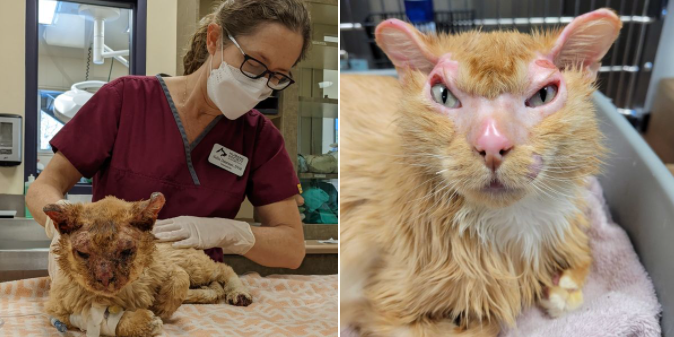
The Conejo family visited their beloved Pumpkin at the veterinary clinic where she was recovering from her burns and were eager to bring her home until a veterinary tech realized there’d been a mistake: Pumpkin is female, but the heavily burned and convalescing orange tabby was male.
Now the parents — who were not home when the fire ripped through their neighborhood and couldn’t retrieve either of their cats or their belongings — have to tell their two young kids that it was a case of mistaken identity, and they still don’t know what happened to Pumpkin and their other cat, Justin.
Boots suffered burns on his face and right front leg.
In what is now officially the worst fire in Colorado history, almost 1,000 homes were destroyed and more than 100 others damaged, leaving tens of thousands of people homeless with many of them still searching for their missing cats and dogs two months later.
The Dec. 30 blaze ripped across three suburban towns between Denver and Boulder, consuming entire housing divisions, strip malls and stand-alone buildings. Authorities still haven’t said how the fire started, playing their cards close to the vest as they await laboratory tests and analysis from forensic fire investigators.
A search warrant executed on the compound of a nearby cult and a viral video that showed a barn burning on the group’s property, reportedly at the time firefighters were notified of the initial fire, have drawn attention and speculation from locals. But authorities say they’re looking at every possibility, from a possible lightning strike to an electrical fire and even the possibility that one of the nearby abandoned coal mines could have spontaneously ignited.
While the Conejo family did not get the news they wanted, things had a happy ending for the male tabby they thought was their Pumpkin.
The cat, an eight-year-old named Boots, had an emotional reunion with his human on Feb. 22 courtesy of the Humane Society of Boulder Valley.
“Hi, sweetie,” she said, hugging Boots tight in a video posted to the Humane Society’s Facebook page.
Our heartfelt condolences to those who have lost beloved family pets. We've updated the frequently asked questions (FAQs) online which might help provide help/direction. Info here about the Humane Society locations offering free cremation services. Visit: https://t.co/T8s63YL1HNpic.twitter.com/3sxn781WJF
Some neighbors, who were inexplicably but mercifully spared by the fire, were counting their blessings but said they felt guilt as well.
Tracy and Jason Granucci were vacationing in Mexico’s Cabo San Lucas when their phones began blowing up with incoming alerts and texts from concerned friends.
Tracy Granucci immediately texted Carol, her cat-sitter: “I don’t care about the house,” she wrote in the text. “Obviously Peanut is all I care about.”
Routes to their street were blocked off and neither Carol nor animal rescue volunteers were able to get to the Granucci home, but when they returned they saw their home was still standing, unscathed despite the destruction of four nearby houses. Peanut, their 16-year-old tortoiseshell, was fine.
“The feelings I’ve had about being in our home and looking out at our neighbors and our community is definitely … survivor’s guilt,” Tracy Granucci told the local PBS news affiliate. “All you want to do is you want to help everybody.”
Camden Hall was at work when the fire raged through his neighborhood and was terrified that his cat, Merlin, was in its path.
When his landlord called to tell him the house had burned down, Hall said he felt “like someone had just ripped my soul out.”
Luck was on Merlin’s side. A neighbor heard distressed meows coming from one of the few homes that were still standing and found the little guy on the porch, badly burned but still alive. Hall reunited with Merlin at a local veterinary clinic.
Merlin was badly burned and lost most of his fur.
Merlin before he was hurt.
The ordeal isn’t over for Merlin, however. His injuries were much worse than were realized, and he’s got several procedures and a long road to recovery ahead of him. A GoFundMe started by a friend of Hall will cover the veterinary expenses and help Hall get back on his feet.
Merlin is now doing a little better and has grown some fur back.







 Pain In The Bud