Nursed Back To Health, Rescue Kitten Becomes Garfeldian Superstar

Natalia Zhdanova heard the cries of a kitten in her backyard and found a sick, malnourished baby cat who was barely a week old. She nursed him back to health, and now he’s flourishing.

Meet Fedya, Instragram’s newest feline star.

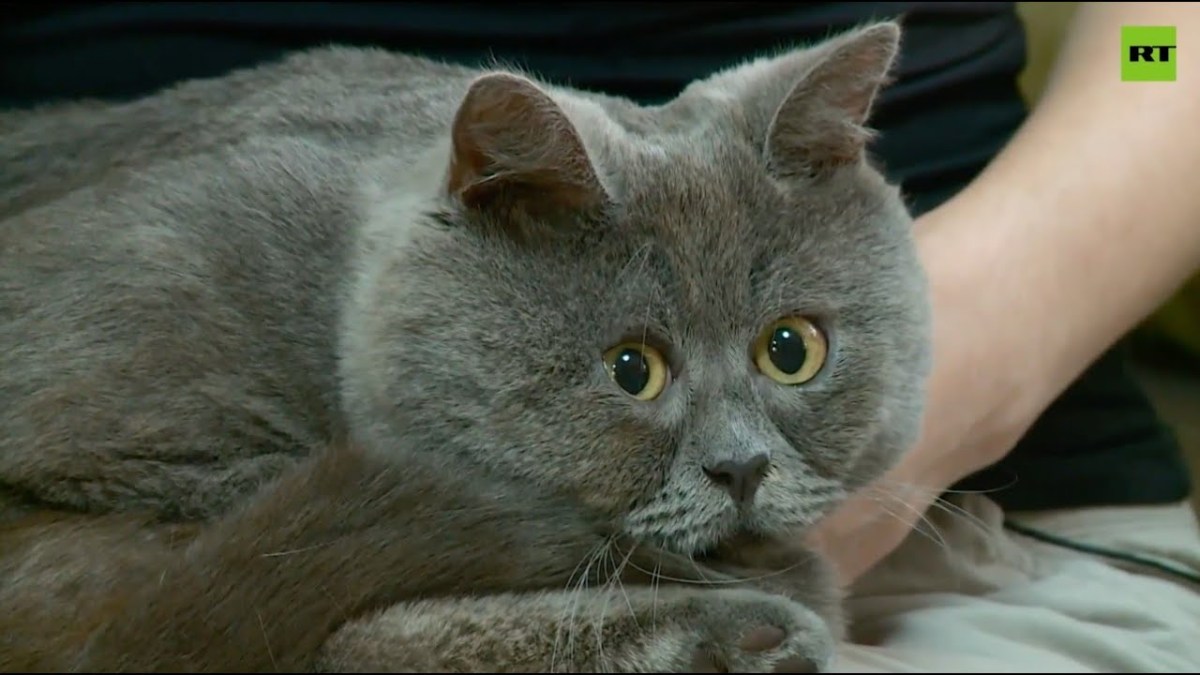
The playful cat with a permanently surprised look on his face was just a week old when he was separated from his mom last year. Natalia Zhdanova heard his cries and found him alone, hungry and sick in her backyard in Rostov, Russia.

With help from her neighbor’s cat, Handsome, Zhdanova nursed Fedya back to health, and now the little guy is up to a healthy weight and thriving at 18 months old.

“He was very weak and was dying,” Zhdanova told the UK’s SWNS wire. “Handsome cleaned and licked Fedya and became like a father figure to him.”

The two cats are now “the best of friends,” and Zhdanova said Fedya “purrs very loudly” for her and Handsome.

“He is a very sweet, gentle, playful, and intelligent cat,” she said.

You can see more photos and videos of Kedya on Instagram @fedja_kot, where he’s accumulated more than 36,000 followers.

Meet Tux, A Cat So Dapper He’s Always In Formal Wear

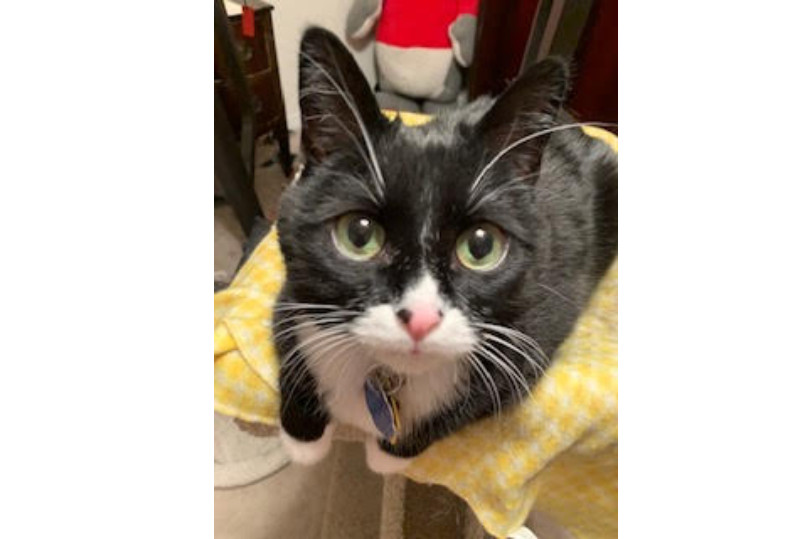
Meet Tux the cat!

Cat name: Tux, a tuxedo (duh!)

Cat’s age: 8

Cat’s human servant: “Two slow humans”

Tux’s origin story:

Reader Julie wasn’t always a cat person.

“Never had a cat or wanted a cat before,” she said. “I believed the myth that they were cold and selfish animals.”

When her teenage son came back home one day with a kitten rescued from a “sketchy” house in a friend’s neighborhood, Julie didn’t want to let him keep the baby cat.

“I regret to say now that at the time I insisted that he go to the Humane Society,” July told PITB. “Two challenging teenagers and two elderly dogs with health problems were enough to handle.”

But Tux was special and needed a good family who would show him love. The kitten was the sole survivor of a cat family that was asphyxiated in plastic food containers, presumably by the home’s occupants, who left in a hurry one day.

There was one survivor mewing from the attic. The theory is that Tux’s mom was trying to protect her babies and got him to safety before she ran out of time and cruel humans ended her life.

Julie’s son named the cute kitten, and her daughter kept the little guy in her room. But she had a busy schedule between school and work, and Julie was the only one home most of the time thanks to a job that allows her to work from home.

“Even though I didn’t initially want a cat, I checked on him often hiding in her room and he started to let me pet him,” she said. “Eventually he started following me around, and soon hung out with me. [My daughter] was mad that he chose me and said that I stole him from her!”

Tux worked his feline magic, and Julie quickly became a cat person. His presence turned out to be a blessing for the family when their dogs died within six months of each other.

These days he rules the home like his own kingdom by keeping watch atop his tree house, stealing plastic bottle caps to play with, knocking things over (he’d get along great with Buddy!) and, of course, “scolding us when he perceives that we have slacked off with servant duties!”

“I never could have imagined the great love from Tux over the years,” Julie said. “He seems to understand so much of what goes on and he is my feline child! Yes, I might be a crazy cat lady now! He is smart and funny and so loving. As long as the humans know their place!”

 

Real Cats vs AI-Generated Cats II: Which Kitties Were Real?

AI can create photorealistic images of cats as well as humans.

After a few days of patiently waiting, we finally have a winner in our unofficial contest from earlier this week.

Reader Romulo Pietrangeli got it right: None of the cats pictured in our April 13 post are real felines.

All nine images were created by the machine learning algorithm that powers the site This Cat Does Not Exist, a riff on the original This Person Does Not Exist, a site that uses generative adversarial networks (GANS) to create stunningly realistic images of people on the fly.

(Above: All six images above are computer-generated using the same technology behind ThisCatDoesNotExist.)

Phillip Wang, the 33-year-old software engineer behind both sites (and a few others using the same tech and concept), explained to Inverse in an earlier interview why he created ThisPersonDoesNotExist.

“I’m basically at the point in my life where I’m going to concede that super-intelligence will be real and I need to devote my remaining life to [it],” Wang said. “The reaction speaks to how much people are in the dark about A.I. and its potential.”

Because the internet is ruled by cats, it was only a matter of time before a feline-generating version of the human-creating algorithm was brought online.

(Above: More artificially-generated cats. Artefacts in the images can sometimes give away the fact that they’re fake, such as the third image in the second row, where part of the cat’s fur is transparent.)

A CNN article from 2019 explains how GAN technology works:

In order to generate such images, StyleGAN makes use of a machine-learning method known as a GAN, or generative adversarial network. GANs consist of two neural networks — which are algorithms modeled on the neurons in a brain — facing off against each other to produce real-looking images of everything from human faces to impressionist paintings. One of the neural networks generates images (of, say, a woman’s face), while the other tries to determine whether that image is a fake or a real face.

Wang, who said his software “dreams up a new face every two seconds,” told CNN he hoped his creations would spark conversation and get people to think critically about what they see in front of them. It looks like he’s achieved his goal.

Christopher Schmidt, a Google engineer who used the same technology to create fake home and rental interiors, agreed.

“Maybe we should all just think an extra couple of seconds before assuming something is real,” Schmidt told CNN.

Pietrangeli, for his part, says he can tell the difference: “All of the animal images,” he wrote, “lacked ‘aura.'”

Can You Tell The Real Cats From The Computer-Generated Kitties?

How can you tell a rel cat from a computer generated cat?

There’s a new tool that uses algorithmic artificial intelligence to create random images of cats, and the results are virtually indistinguishable from the real thing.

Can you tell which cats are real and which ones are computer-generated? (Kindly share your answers in the comments, numbering them from left to right. The person with the best score gets bragging rights!)

We’ll follow up with the answers after everyone’s had a day to make their guesses or informed choices, as it were.

The algorithm was created by a process called machine learning, which you’ve probably heard at some point even if you haven’t sought out information about artificial intelligence. 

In simple terms, machine learning means the creators fed massive amounts of data — millions of photos of cats — to the software algorithm. The algorithm analyzes the data and learns how patterns in the data create accurate images of felines.

Crucially, the algorithm never learns what a cat actually is. It doesn’t know a cat is an animal in the real world. It doesn’t know what the real world is, and it doesn’t know what animals are. All it knows is that data, organized a certain way, produces images that look like the photos it’s been fed.

That’s a key difference because, while we have made huge strides with machine learning, that’s not the kind of artificial intelligence the Elon Musks of the world freak out about when they smoke pot and watch The Matrix. We’ll never have to worry about our cat-generating algorithms rising up and eliminating humanity. 🙂

Artificial general intelligence — or AGI — is the potentially dangerous form of AI, but that’s a whole other piece of business: It involves recreating consciousness and the mind on a machine substrate.

We can’t even define consciousness and we know shockingly little about how the brain works, so that’s not happening any time soon. And even if we could it off, there’s a growing body of evidence supporting the concept of embodied cognition. That’s the idea that the mind cannot be separate from the brain, and the brain cannot be separate from the body, as well as a recognition that everything from pain signals to gut flora has an effect on our cognitive routines.

The bottom line: “AI” can get pretty good at making pictures of cats, but it’s not taking over the world any time soon.