I see you are a cat of taste and culture. Join us in our effort to practice prolific laziness!
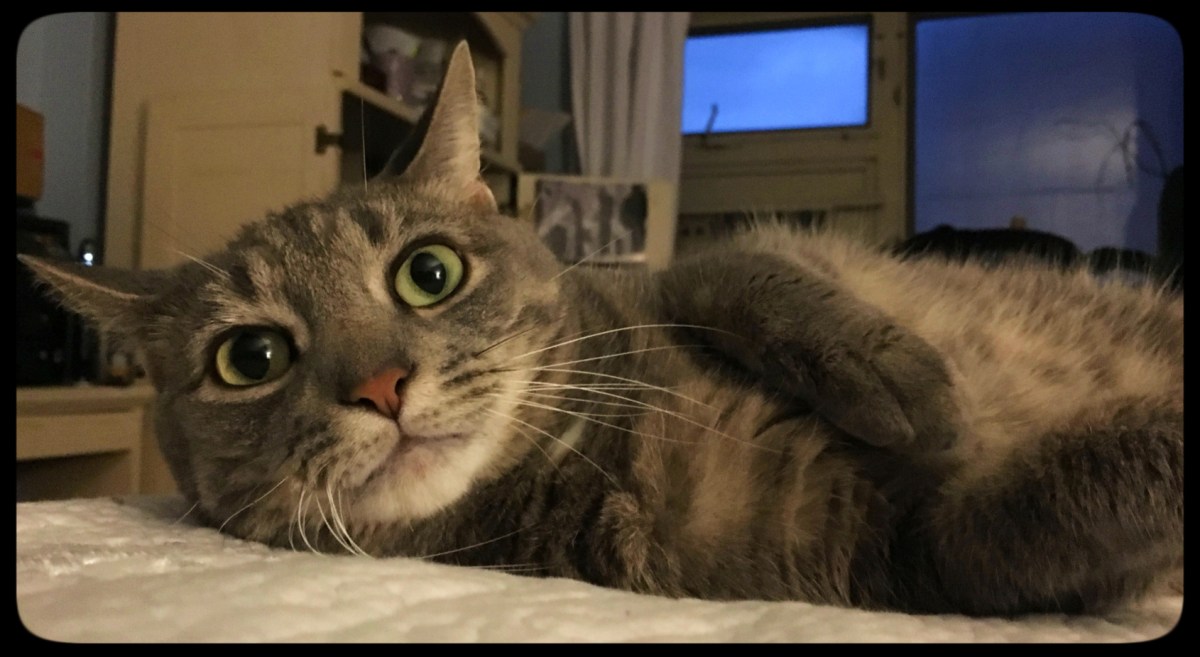
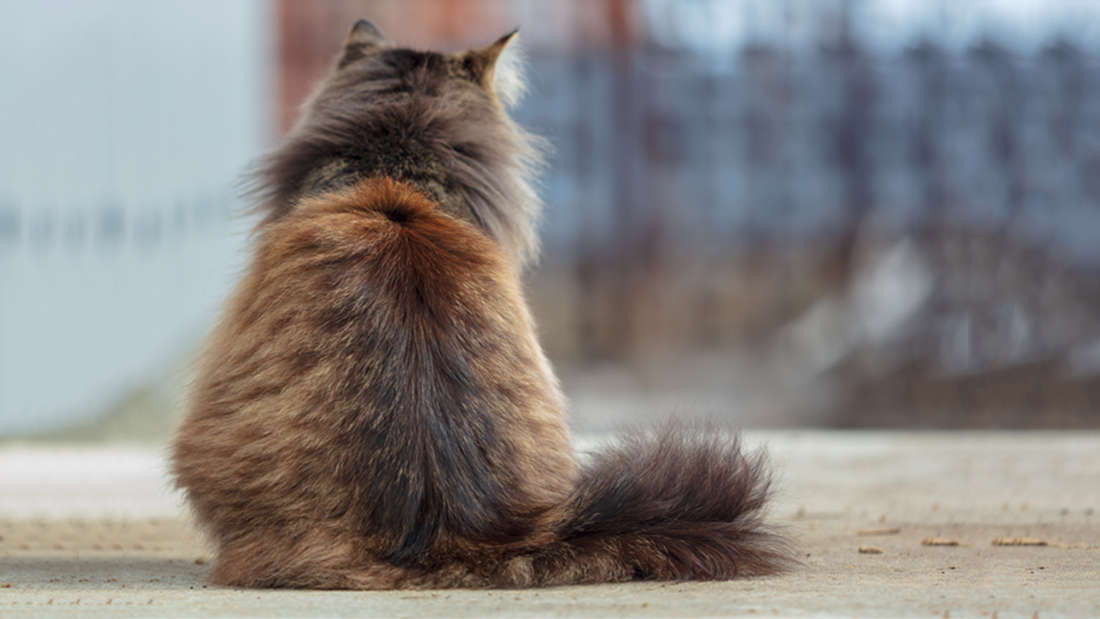
There’s this thing Buddy does when he’s been napping on my legs or in my lap and he wants to get down.
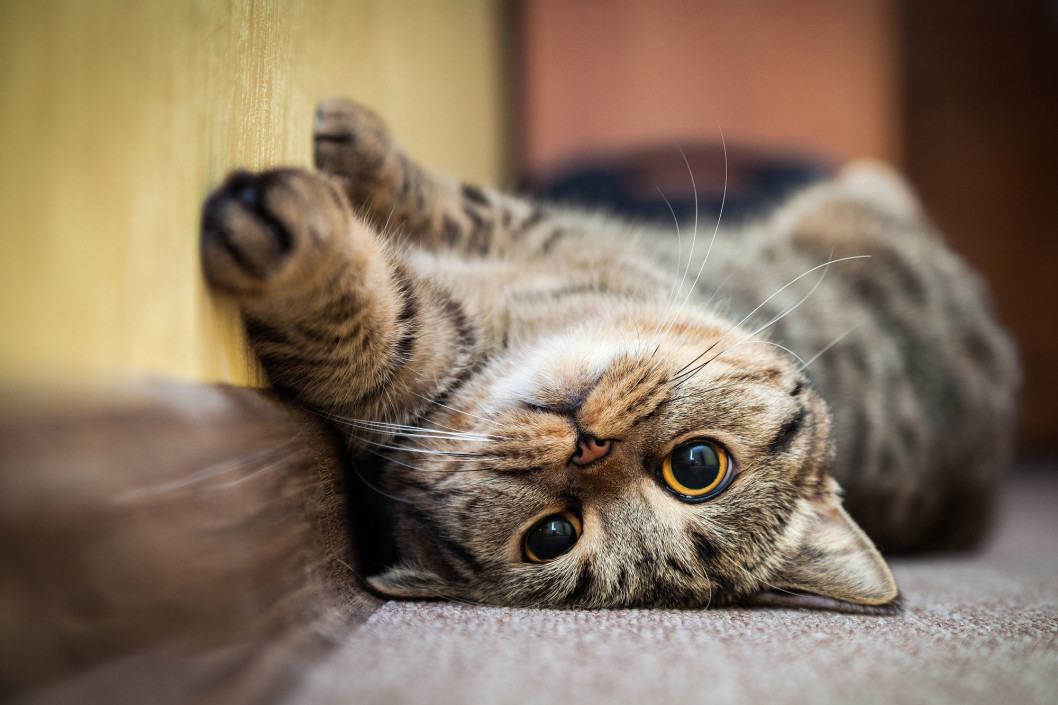
Whereas the vast majority of living creatures would simply stand up and hop off, Buddy doesn’t bother with that. He yawns, stretches and shifts his weight forward until he’s hanging off me, then allows himself to sag into a ponderous drop, letting gravity do all the work as he practically oozes onto the floor. He’s like water taking the path of least resistance, committing absolutely no energy to the “effort” of moving.
The sequence is complete when he plops down on the floor like sentient slime — paradoxically furry yet gelatinous — then finally picks himself up to pad toward his bowl, his litterbox or the kitchen, where he’ll stand yowling in three second intervals until I give him a snack just to get him to shut up.
It’s horribly manipulative behavior, and I shouldn’t reward it, but sometimes I do because damn, he’s really, really good at being annoying when he wants to be.
If there were an Olympics for being lazy and annoying, Buddy would be its Michael Phelps, pioneering spectacular new ways to do things without expending a single millicalorie more than is absolutely necessary.
And yet, like all cats, he’ll randomly decide it’s time to release all that hoarded energy at once, trilling an enthusiastic “BRRRRUPPP!” before rocketing around the house, ricocheting like a bullet in a sensory deprivation chamber.
Of course I wouldn’t have it any other way. These quirks are part of Buddy, just like his kitten voice, his unintentionally hilarious behavior and his big heart.
We salute you, dear Buddy, for elevating laziness into an art form.
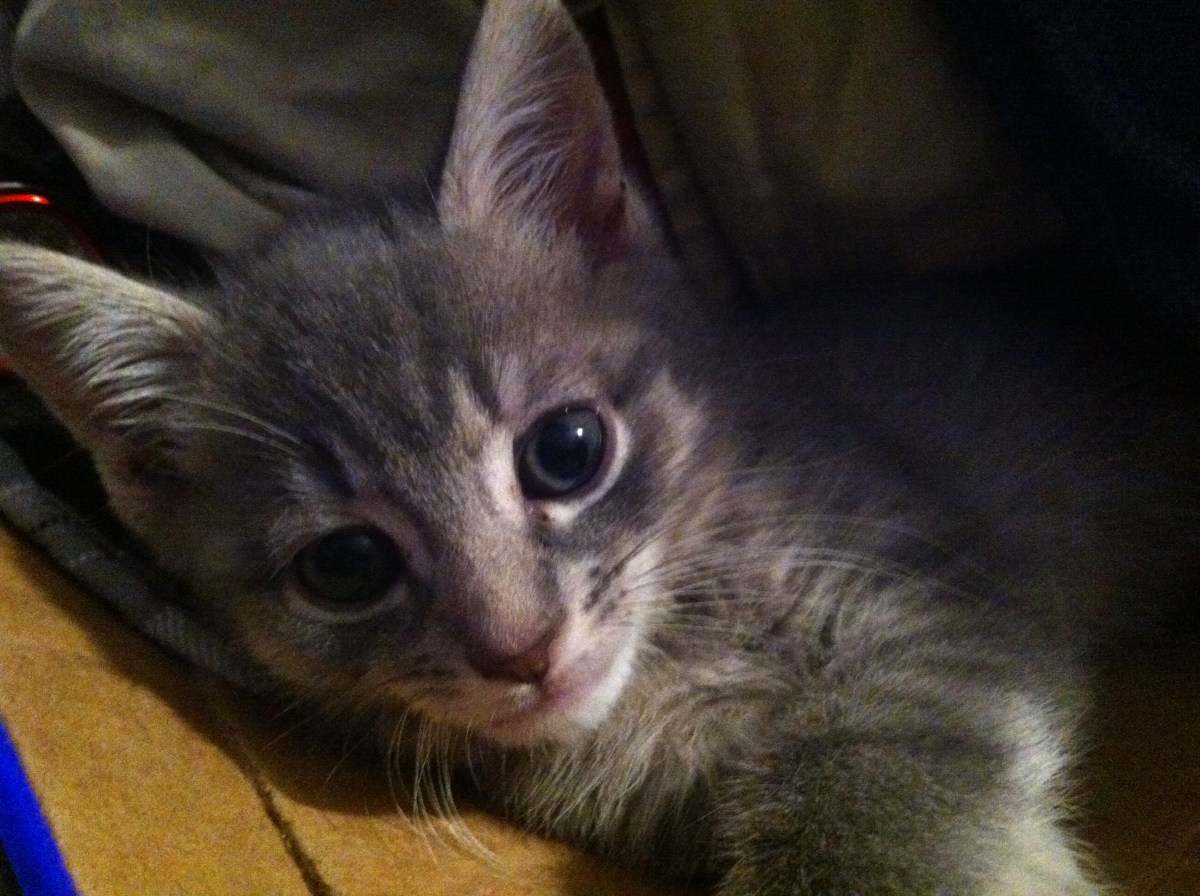
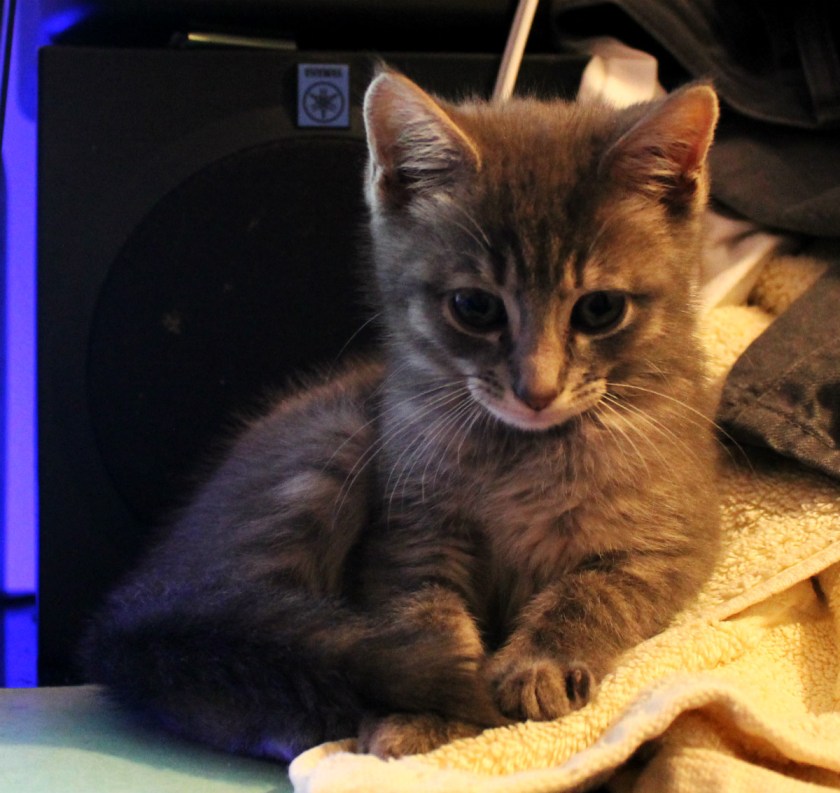
A look back at a 2014 article from our archives when Buddy was just an innocent little kitten.
From the archives: June 17, 2014
NEW YORK — Buddy the Kitten celebrated another successful ambush on Tuesday after violently rousing his human from sleep, sources said.
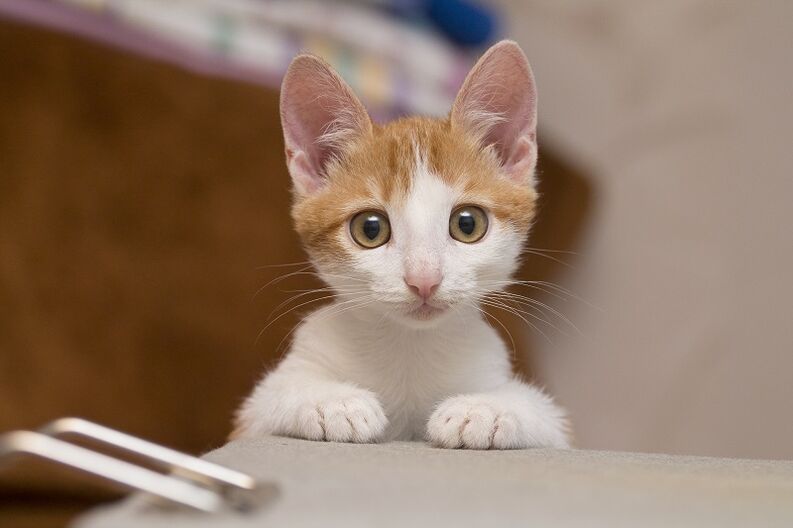
The 14-week-old gray tabby howled with delight after climbing up onto the bed and launching himself at his human’s face, landing belly-first with a delightful THWAP! as the big stupid human screamed and bolted upright.
Buddy the Kitten promptly retreated to a dark corner of the bedroom, shaking his butt and trilling with joyful anticipation until he heard his human, Big Buddy, begin to snore again.
With a battle cry of “Rrrrrrrrrrr!” the 4.5-lb kitten chomped down on the human’s exposed foot, which was fortuitously left uncovered by the protective blanket when Big Buddy shifted during his sleep.
“Shit!” the human howled, recoiling from the kitten’s shark teeth and claws. “Let me sleep, you little jerk, or I’m selling you to Szechuan Garden II!”
At press time Buddy the Kitten was planning an elaborate new attack involving a makeshift trebuchet and a water balloon, and said he was unconcerned about his human’s threats to sell him to the local Chinese restaurant: “I am a good boy!”
He would likely leave that attack for the following night, the playful kitten said.
“I has to purr in the morning so my human thinks I’m just a sweet little kitten and feeds me turkeys,” Buddy the Kitten said. “Then I make war again! Muahahaha!”
“I’m just a cute widdle kitten! I didn’t mean to attack you, I swears.”
A recently-neutered cat gets an assist from his kitty friend.
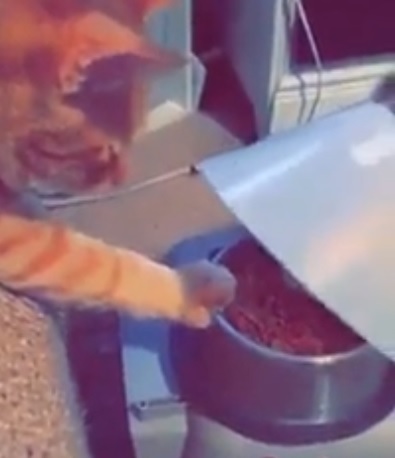
Moofie the cat, who was just neutered, couldn’t get to his food bowl because of the Elizabethan collar which was placed around his neck to stop him from aggravating the incision.
Cat parent Brianna K. Leroux placed Moofie’s bowl on top of his cat carrier, but that caused another problem: The bowl would fall off the carrier as Moofie ate.
Moofie’s best feline buddy, Simba, came to the rescue. In the video below, you can see Simba holding Moofie’s bowl so the on-the-mend little guy can eat in peace:
Common misconceptions can impact the way owners bond with their kitties.
We’ve all heart the familiar knocks on our feline friends: They’re aloof, selfish animals who are indifferent to their humans as long as their bowls are filled with food and they’ve got a warm place to sleep for 16 hours a day.
NPR hosts took a look at those stereotypes in their new segment, Animal Slander, in which they take “common phrases and stereotypes about animals — blind as a bat, memory of a goldfish — and figure out how much truth there is to them, or if they’re really just slanderous to these animals.”
Emily Kwong and Maddie Sofia of Shortwave — NPR’s daily science podcast — host the series, taking a look at a different animal in each segment.
“We can at least set the record straight on some potential slander that cats endure,” Sofia said, “such as cat are aloof, especially compared to dogs, that they love food more than they love us, and the idea that cats love people who don’t love cats.”
The feline mind has been a mystery to scientists for a long time. Credit: Shutterstock
Kwong and Sofia spoke to Kristyn Vitale, an animal behaviorist from Oregon State University. If Vitale’s name looks familiar to you it’s because we’ve talked about her work before on Pain In The Bud. Along with researchers at Sophia University in Tokyo, Vitale’s team at OSU has been putting out most of the headline-making cat research in recent years.
They were responsible for the much-talked-about study showing cats relate to their owners the same way human children relate to their parents in uncertain situations. They were also the authors of a study that found cats prefer affection from humans more than food.
The former validated the feelings of many cat servants by confirming the similarities between the parent-child and caretaker-animal dynamics. In other words, we’re surrogate parents to our cats.
“It was very interesting to find just how closely those numbers match what we’ve seen in dogs and humans,” Vitale said. “The majority of both dogs and human children are securely attached, and that’s anywhere from about 60 to 65 percent of the population, which is exactly what we found with cats.”
It wasn’t so long ago that scientists had apparently given up on cats, concluding they’re too uncooperative to serve as research subjects.
“I can assure you it’s easier to work with fish than cats,” comparative psychologist Christian Agrillo told Slate in 2014. “It’s incredible.”
Cats “freaked out” when taken from their homes to a lab for studies, Agrillo said, and most weren’t interested in the test.
“Very often, they didn’t participate in the experiment or they walked in the wrong direction,” Agrillo said at the time. “It was really difficult to have a good trial each day.”
“Be cooperative? What’s in it for me?” Credit: Shutterstock
The teams at Oregon State and Tokyo’s Sophia University have worked around those issues by designing studies that focus on feline reactions rather than scenarios that required them to take certain actions. That method may not yield results in the sort of comparative psychology studies scientists like Agrillo design, but it’s given researchers a window into the feline mind.
Stereotypes about cats can dissuade scientists from studying them, Vitale said, which is why it’s important to debunk them.
The stereotypes “do bother me because some of these ideas are why the field of cat cognition has been stagnant for a long time,” she said. “A lot of these expectations shape the work that people want to do, and if we say cats are aloof and untrainable, well, then they can’t learn to how engage in cognitive testing. But in our lab we’re showing cats can be trained just as readily as dogs.”
Likewise, stereotypes can negatively impact the way owners treat their feline friends. That’s something we’ve talked about before: While dogs warm quickly to people, earning the love and trust of a cat takes effort. The better you treat a cat, the tighter your bond becomes.
“If people don’t think they can bond with their cat, or engage in a lot of these interactions, why even try?” Vitale asked. “And if we don’t try with our cats, that’s going to produce a very different individual than we see with dogs.”
As for the NPR hosts, they concluded cats have indeed been unfairly maligned.
“The next time someone says ‘I love this cat so much because it acts like a dog,'” Kwong said, “lovingly tell them ‘No, this cat acts like a cat.'”
A handful of people on Twitter found the study “problematic” and called for its removal.
Last Monday, the academic journal Biological Conservation published a “controversial” study about cats.
It didn’t last a week.
The journal quietly took the paper offline after it was buried in a heap of scorn and hysteria from that fount of good vibes, Twitter.
People whose profiles are appended with tags like “she/her” and “he/him” outlined why the paper is “problematic,” providing an afternoon’s worth of fresh outrage for the grievance enthusiasts.
The study, by a research team from China’s Nanjing University, has two main conclusions: The more women living on a college campus, the more stray and feral cats live there too. Additionally, the team surveyed men and women about their interactions with strays — with responses indicating women are more likely to care for them — and followed a handful of men and women to watch their interactions with cats.
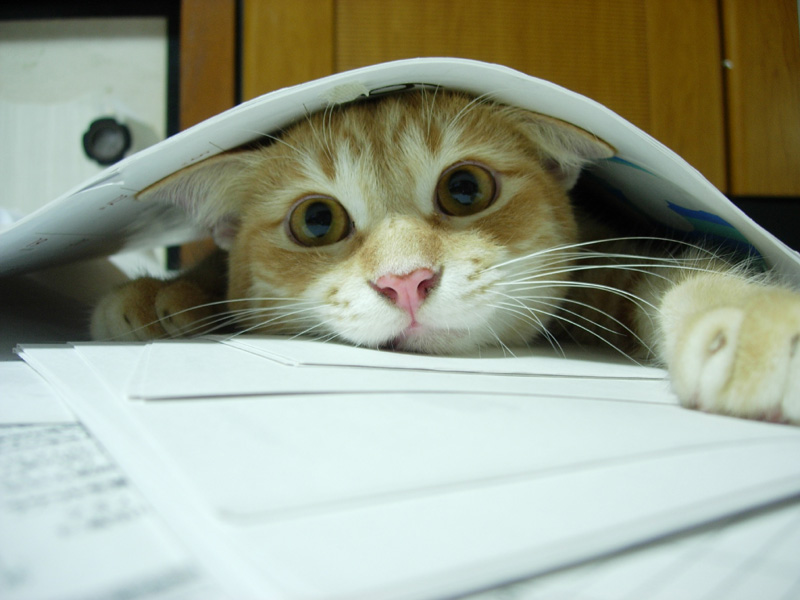
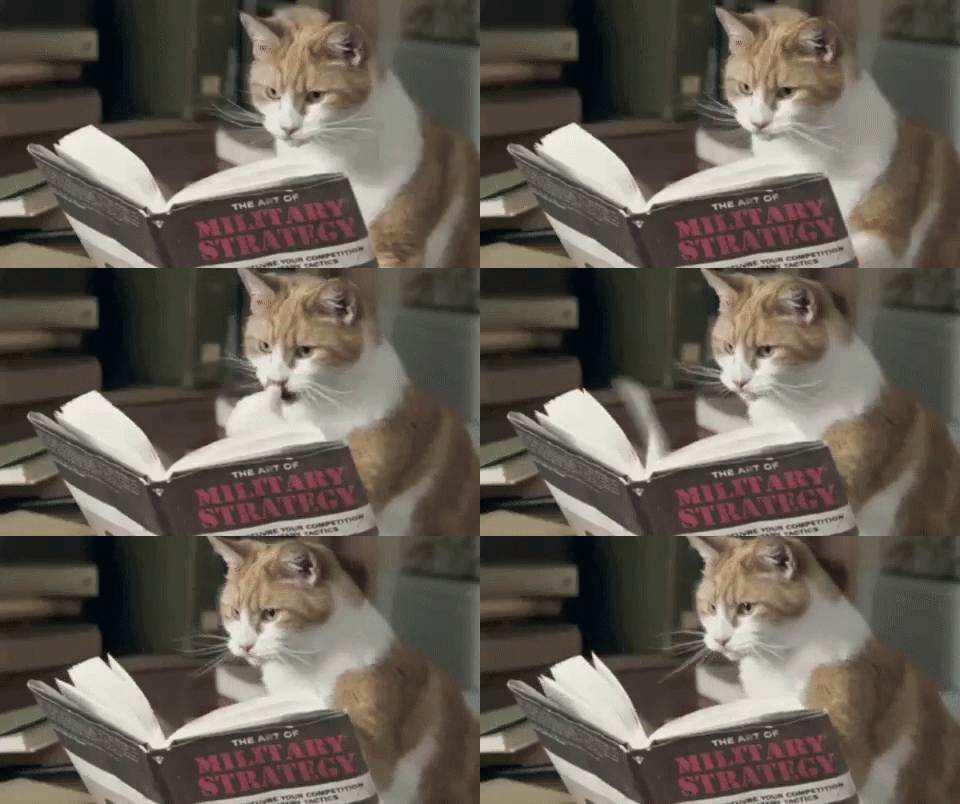
“Study? Yes, I like to study…how to bend humans to my will so they feed me more delicious yums!”
Is it ground-breaking science? No. Do the results prove women are better caretakers of cats than men? Nope. Did the authors perhaps overextend themselves by mixing up correlation and causation? Probably.
But it’s still research, and studies should not be buried or banished from peer-reviewed journals because a handful of malcontents on Twitter cry sexism. Some aspects of the paper, like the small sample of observed interactions, are thin. But the authors did look at 30 universities, a healthy sample size as far as institutions go.
If follow-up studies indicate that women are indeed more likely to care for cats, so what?
Is reality sexist? Do we need to protect people from even the most mildly controversial things?
As a man who loves cats, I don’t doubt that most caretakers are women. I see the anecdotal proof among the ranks of rescue volunteers. I see it in my readership here — aside from the Extraordinary League of Cat Dads, some 85 percent of this blog’s readers are female.
And that’s perfectly fine!
I would like to see more men warm to the idea of adopting and caring for cats, but the fact that women in general seem to have more empathy for them isn’t sexist. It doesn’t mean every woman loves cats any more than it means all men don’t.
Pain In The Bud’s readership is overwhelmingly female, but most of our traffic isn’t from women — it’s from female cats who find Buddy devilishly handsome!
Some readers know I have a background in journalism and spent almost 15 years of my career as a reporter and editor. One thing that appalls me as a journalist is the routine practice of quoting tweets in lieu of speaking to people face to face or picking up the phone and asking questions.
Platforms like Twitter thrive on negativity. Whether 140 or 280 characters, Twitter’s bite-size messages may be good for people who have the attention span of gnats, but they don’t exactly foster productive or nuanced discussion. Perhaps most important of all, people are more likely to say negative things online than they are in a human-to-human conversation, and too often handfuls of loudly-complaining people are mistaken for a majority.
Studies show negative tweets are far more likely to spread than positive or neutral messages, which skews public perception. They also show Twitter opinions are not representative of the general public, in part because most of Twitter’s power users come from similar backgrounds and share world views.
To put it bluntly, Twitter is full of roving bands of grievance artists constantly on the lookout for new things to shit on, and we should stop assigning so much importance to what we think are the prevailing sentiments on social media platforms.
Academic journals are peer-reviewed. Taking the vetting responsibility away from experts and giving it to a few unhappy people on social media is not a smart way to present research.
The study authors’ peers will poke holes in their work if the holes indeed exist, and that’s part of what peer review is for. Not to bury research, but to encourage scientists to rethink it, refine it and try again.


 Pain In The Bud