The Washington Wizards’ Jordan Poole loves cats, and he’s showing his fellow NBA players what awesome little buddies they can be.
Jordan Poole finds it difficult to leave the Falls Church, Va., animal shelter where he volunteers.
He likes the staff and fellow volunteers, but most of all he hates leaving while knowing the cats he’s interacted with still need homes.
“Every time I come, it’s: ‘Let me leave with all of them! Give me 14 of them right now!’” he joked to the Washington Post’s Candace Buckner, who calls him “the lead crusader of the Secret Society of NBA Cat Dads.”
Some aren’t so secret: teammate Tristan Vukcevic recently adopted a cat after Poole converted him to the dark side, and a coy Poole says he “may have” convinced NBA superstar Stephen Curry to adopt a feline friend.
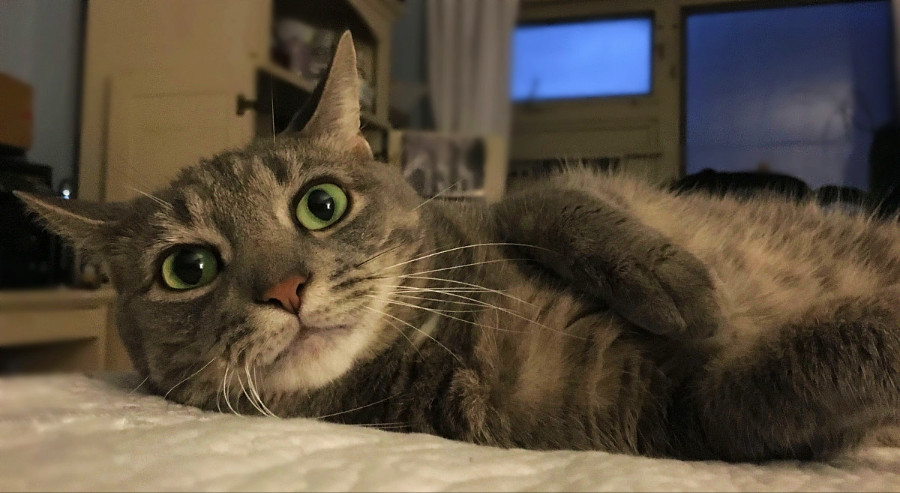
Poole with one of his tabby cats, brothers he adopted together from a California shelter when he was with the Golden State Warriors. Credit: Jordan Poole/Instagram
In a 2022 profile in The Athletic, Poole’s mother Monet says her son adopted his first cat when he was in high school.
“And when I tell you he fell in love with cats,” she said. “He loves his cats. … And he’s got some pretty cats too.”
When Poole was drafted by the Golden State Warriors in 2019, his cat stayed with his mom back in Michigan because she wouldn’t have adjusted well to the move to the west coast, as well as an empty apartment when Poole was on road trips with the team. Later that year, the then-rookie adopted brother cats who had been abandoned by their former owner.
Since he was traded to the Washington Wizards, Poole has volunteered at a Virginia shelter.
His enthusiasm is one reason why he’s been able to get teammate and friends interested in adopting. The NBA has other notable cat dads, including twins Brook and Robin Lopez, whose cats hilariously can’t stand each other. But Poole takes it to another level.
“A lot of guys are dog people, but just the energy [and] the way I talk about [cats], the pictures and videos and stuff that I show them, it just gives them a little bit more interest,” Poole told the Post. “So I give them a different perspective. Maybe they’re not as much maintenance, but they’re still a really dope companion and friend to have. You don’t have to really take them out three or four times a day. You can still get your rest. Normally [my peers] like to explore it. I’ve had a lot of friends and teammates who are also cat people.”
Former Knicks center Robin Lopez, pictured with his cat Edward, says his brother’s cat is sneaky and evil for attacking Edward: “The second I lay eyes on him, he’ll act like, ‘I’m a cherub. I’m innocent.’ I’m not buying it.”
The 25-year-old Poole is averaging 20.3 points, 4.8 assists, 3.1 rebounds and 1.5 steals per game this season while shooting an excellent .391 on three-point attempts. The 6’4″ guard spent his first four seasons with Golden State before he was traded to Washington.
People who frequent cat cafes say they feel relaxed among the little ones. Hundreds of thousands of felines find their forever homes via cafes in the US, which are typically integrated with local shelter and rescue networks.
You may have noticed that most journalists don’t actually interview anyone these days, and the majority of “news” stories are either rewrites or lazily-assembled, 300-word virtual birdcage liners about which celebrity or influencer is “clapping back” at haters for “throwing shade” at them, with quotes directly copied and pasted from X or Instagram.
It’s cheap, easy content — far cheaper than funding war correspondents or impactful investigative journalism — and it doesn’t require reporters to leave their desks, speak to sources on the phone, or even fact-check what they’re writing.
“Well, they said it” is good enough for modern newsrooms, which is why we can’t have a national story or a disaster like the wildfires without waves of misinformation getting amplified by press and influencers alike. And the executives of the handful of remaining news companies wonder why trust in media is at historically low levels.
So these days, a veterinarian warning about laser toys via a TikTok video is considered international news. Nina Downing, a veterinarian with UK pet charity PDSA, took to the social media platform to warn about “laser pointer syndrome,” which she says can result in obsessive compulsive behavior in cats and dogs.
Our furry friends can become frustrated that they never actually capture the elusive red dot, according to proponents of the theory, and too much laser pointer play can result in a pet who barks at shadows or tries to tackle anything that moves.
“Cats have a hunting sequence to follow which is replicated in play, however if it doesn’t come to a successful capture at the end, this can cause them to become really agitated,” Downing warns.
Credit: WIkimedia Commons
Happily, Buddy is impervious to this alleged syndrome because he doesn’t actually have a “hunting sequence.” Born indoors, he’s known nothing but warmth and comfort, and food is something that’s served to him on a precise schedule, not something that needs hunting.
Accordingly, when we play with wand toys, Bud’s version of a “kill” is to grab the plush toy or feathers while dancing around on his back paws. He bobbles the toy while he dances, lets it go and resets the game.
The concept of a kill bite is completely alien to him, and apparently not even his feline instincts are enough to tell him there’s another step to “winning” the game. Still, I tell him he’s a good boy and a fierce little tiger because we can’t have fragile egos getting bruised.
That said, if you find lasers are one of the few reliable ways to get your kitty moving, it’s probably a good idea to wind down by switching to a wand toy. Let the little one simulate a kill, get a few rabbit kicks in and feel like a champ. There’s little or no research supporting the concept of laser pointer syndrome, but it still couldn’t hurt to give your feline overlord something tangible to “kill” at the end of a play session.
Cat cafes are more popular than ever in the US
USA Today has a story today about the apparent ubiquity of cat cafes in the US, and how they’re changing things for the better, for felines as well as people.
Using data from Yelp, the newspaper found there were 200 cat cafes, give or take, across the country at the end of 2024, up from about 75 in 2020.
“When we started, people weren’t quite sure what they were, there was a lot of explaining how they worked and what they were,” said Laura Konawalik, owner of a chain of three cafes featuring felines in North Carolina. “Nowadays people come in knowing the general concept.”
The same data shows searches for strings like “cat cafes near me” have increased 78,700% between February of 2020 and February of 2024, USA Today reported.
Patrons playing with cats at a cafe in Osaka, Japan. Credit: Wikimedia Commons
While cafes in some other countries are populated by felines owned by the proprietors, most cat cafes in the US are integrated with their local shelter and rescue networks, so patrons can adopt if they fall in love with the little ones they meet while having a cup of coffee or tea.
That means some of the oldest cat cafes in the country have facilitated thousands of adoptions and continue to find forever homes for their animals.
About 330,000 cats were euthanized in the US in 2023, the most recent year for which complete statistics are available, according to Shelter Animals Count, a national database that keeps track of shelter intakes and cat/dog euthanasia figures. Data for the first half of 2024 showed a decrease from the previous year’s numbers, but numbers from the latter half aren’t available yet.
Jet Taylor, a regular at Konawalik’s Mac Tabby cafes, says he keeps coming back to destress and feel calm.
“I would be willing to bet,” he said, “you could put a heart rate monitor on me and when I’m sitting there petting a cat, my heart rate goes down.”
More Americans say they can’t afford to keep their cats because of inflation, leading to an increase in surrendered and dumped cats in some places.
More than 110 years ago, American geneticist Clarence Cook Little developed a theory explaining why some cats have orange coloring and some don’t.
Now Little has been proven correct thanks to the work of separate teams in Japan and the US, which discovered the mechanism that leads to orange coloring, including fully ginger felines as well as calicos and tortoiseshells.
The explanation may be a bit too heavy on genetics for some readers, but essentially the researchers found the specific gene that leads to the growth or orange fur. They’ve known about the gene for a long time, but didn’t realize the totality of its function. Its official name is ARHGAP36, but for the sake of simplicity, scientists are calling it “the orange gene.”
“The orange gene has a known role in hair follicle development, but scientists didn’t previously know it is also involved in pigment production,” a team of geneticists and biotechnologists wrote in The Conversation, a science publication. “This means that a new pathway for pigment production has been discovered, opening the way for exciting and important research into a basic biological process.”
In partially orange cats like calicos and tortoiseshells, the blotches of color are the result of imperfect gene copies and a secondary pigment-related gene switching “on and off.” Credit: Mehmet Guzel/Pexels
Ginger cats are usually male, but the pigmant can also appear in female cats due to an error in gene copying which deletes one segment of the orange pigment-producing genetic code.
That’s why calicos and tortoiseshells have orange blotches or mixed orange fur. “[T]he orange gene is persistently switched on in orange areas but is mostly switched off in non-orange areas of a cat’s coat,” the authors wrote.
Are there more strays in 2024?
Time magazine has a story examining the problem of stray cats in America’s urban and suburban population centers, why it’s happening, and what can be done about it.
First, might as well get this out of the way: We don’t know if there are “more” cats. The claim that there are more relies on anecdotes, and there’s no hard data to back that up. You have to be highly motivated to invest the time and money into a proper census like the D.C. Cat Count, and it’s an understatement to say most towns and cities are either not willing to do that, or don’t have the resources.
What we do know is there may be more cats in certain areas, with individual shelters in some places reporting record numbers of surrenders and cats scooped up by animal control.
Rescuers say people who can’t afford food, supplies and veterinary care are surrendering or dumping their cats in larger numbers than in years past. Credit: Dou011fu Tunce/Pexels
The story quotes rescuers who say they’ve seen more surrendered pets, as well as data from Shelter Animals Count, which tallies self-reported information from shelters and rescues. The latter says 32 percent of cats taken in were owner surrenders in 2024, compared to 30.5 percent in 2019.
“It’s a combination of people surrendering their pets and people not adopting because they’re not sure they can take on the financial commitment,” Animal Care Centers of NYC’s Katy Hansen told Time.
Rescuers say that’s reflected in their experiences trapping the felines, who are friendly and acclimated to humans.
The people surrendering their pets cite inflation, not only impacting the cost of essentials like food and litter, but also more expensive veterinary care.
The story additionally includes this eye-popping detail:
“At Veterinary Care Group, a private equity-owned practice in Brooklyn, the cost of spaying or neutering a cat has soared to $850 per animal. By contrast, at the nonprofit veterinary clinic Zweigart recently founded in Brooklyn, the cost of spaying or neutering a cat is $225 and a mid-sized dog is $300.”
The lesson here: Steer well clear of veterinary clinics that aren’t vet-owned or are obtuse about their ownership. Private equity groups don’t buy clinics out of love for animals.
The cost of spay/neuter procedures ranges dramatically at different veterinary practices. Credit: Tima Miroshnichenko/Pexels
As for solutions to local spikes in stray populations, the story doesn’t offer any. It mentions TNR (trap, neuter, return) but only in the context of a lawsuit against the San Diego Humane Society for its neuter/vaccination program.
That said, there probably isn’t a one-size-fits-all technique. What works for a small town won’t necessarily work in a city, and there are dozens of factors that could influence the prevalence of stray cats and colonies. Still, city councils and town boards don’t need to reinvent the wheel. Chances are if they look, they’ll find a municipality similar to their own where locals have successfully stabilized feline populations.
As for the Buddies, I’d live in my car before giving Bud up. He wouldn’t be thrilled about that situation, and we’d have to head south because the winters here are brutal, but as long as Bud has his servant, he’s good.
A previous version of this post incorrectly described cat chromosomes. The story has been updated to remove the error.
In a tragedy for the baseball world, the hated Dodgers defeated the beloved Yankees in the World Series. Buddy the Cat is NOT happy about the outcome.
Freddie Freeman, Dodgers first baseman, infuriating hit-celebrator, and Yankee killer, has adopted a kitten.
The evil Freeman has named his new kitten Champ, in a not very subtle nod to his team winning the World Series with a game five victory over the Bronx Bombers on Oct. 30.
“Freddie Freeman thinks he can buy his way into my good graces by adopting a cat, and a gray tabby, no less,” Buddy the Cat, president-elect of the Americats, told reporters. “Well, I have news for you, Tom Brokaw — you’re still on my poop list!”
Freeman with Champ. Credit: Freddie Freeman/Instagram
Buddy cited the considerable distress Freeman’s five home runs and 12 RBI caused Buddy’s human, including the “despicable” game one walk-off grand slam that shocked the Yankees. He also blasted Freeman for “doing a stupid little dance” every time the Dodger reached base.
But most of all, Buddy said, he blamed Freeman for cutting short the celebratory treats he enjoyed at every previous stage of the playoffs, when the Yankees were on a roll en route to the World Series.
“In the American League Division series against the Kansas City Royals, snacks rained down from the heavens as the Yankees took the series 3-1,” he said. “In the American League Championship Series, I feasted like a viking in Valhalla as the Yankees crushed the Cleveland Indians.”
But tragically, the silver tabby said, there was only one game in the World Series that merited celebration at Casa de Buddy.
“One measly game!” Buddy raged. “So no, you’re not on my good side, Freeman!”
Freeman should be kicked out of the league just for doing this dance on the bases, Buddy said.
Asked about Freeman’s teammate, Shohei Ohtani, and his dog, Decoy, Buddy claimed the canine “lives by my forbearance alone, and it would be a shame if he found his home raided by Feline Bureau of Investigation (FBI) agents.”
A Virginia man created National Black Cat Appreciation Day, a celebration of melanistic house panthers, in honor of his late sister, who loved her 20-year-old black cat named Sinbad.
Happy National Black Cat Appreciation Day!
A few years after the death of his 33-year-old sister, June, Wayne Morris wanted to do something in her honor. June adored her black cat, Sinbad, who died at 20 years old, just two months after she passed.
So the Virginia man teamed up with Rikki’s Refuge, a sanctuary where he volunteered, and created National Black Cat Appreciation Day in 2011. Morris chose the day of June’s passing, August 17, in her memory, and that first year marked it by holding a fundraiser for Rikki’s Refuge.
Morris was delighted by black cats as well. He often posted about Norman and Batman, his own melanistic miniature panthers, advocated for the adoption of black felines, and painted whimsical scenes of cats, which were auctioned to raise money for Rikki’s.
Morris often posted about his cats, including Batman, seen here. Credit: Wayne Morris
Wayne Morris founded National Black Cat Day.
Morris also liked to show off his other black cat, Norman. Credit: Wayne Morris
Morris painted scenes involving black cats, which were auctioned off to raise money for feline rescues. Credit: Wayne Morris
Batman. Credit: Wayne Morris
(Above, clockwise from top left: Batman, Wayne Morris, Norman, Batman again, and one of Morris’s paintings.)
Wayne Morris died in 2022, but the day he founded has continued to grow in popularity. In the 14 years since its inaugural celebration, National Black Cat Appreciation Day has spread via fundraisers for shelters across the country, as well as sites within the online catosphere, like this one.
Morris was motivated beyond honoring his sister and raising money for his favorite rescue. Black cats — also affectionately known as voids — have suffered unfortunate reputational damage over the centuries.
Melanistic felines are actually considered good luck in Japan, China and most of Asia, where they can be found in temples and their likenesses are used as maneki neko, the ubiquitous “lucky cats” in homes and businesses. (Black maneki neko are said to ward off evil spirits, diseases and people with bad intentions, while the golden cat statues are associated with wealth and the white neko are thought to bring good health.)
But in much of the western world they’re associated with bad luck, “evil” forces in folklore, and they’ve been invoked in outbursts of moral panic over things like witchcraft.
Big cats can be voids too, like this stunning black jaguar in Scotland’s Edinburgh Zoo. Credit: Wikimedia Commons
A black cat — or a statue of one — was said to be involved in Satanic rituals in Spain by Konrad van Marburg, an inquisitor known for his brutal zealotry. While the effect of that accusation has been exaggerated for years in internet discussions and posts (Pope Gregory IX’s papal bull dealt with a small area of Germany and did not declare that black cats were Satanic), it naturally comes up in superstitions about the animals.
A 2020 study of 8,000 adoptions found black cats were less likely to be adopted and more likely to be euthanized. That study and others found there was “scant evidence” for the dramatic margins suggested by anecdotal accounts circulating online and in some publications, but confirmed the problem is real. Research also suggests that negative perceptions of black cats isn’t correlated to religious preferences, but is tied to general belief in the supernatural.
Interestingly, additional research has hinted at a decidedly more modern and petty reason people may hesitate to adopt black cats: they think voids are more difficult to photograph, which is an issue for people who want to show their pets off online. (We’ve written about that particular hang-up before, and noted it’s possible to take beautiful photographs of voids by being mindful of factors like lighting and contrast between fur color and the background.)
Regardless, the combined effect of the superstitions and negative associations has harmed black-coated felines, and National Black Cat Appreciation Day is also an attempt to push back and show people that black cats are just, well, cats.