Our usually-brave (lol) hero didn’t take well to feline-centric tunes.
In case you didn’t know, music written specifically for cats is a thing.
I’d heard about it a while back, and the project seemed impressive: “Music for Cats” composer David Teie is a soloist with the National Symphony Orchestra, and he worked with animal behaviorists and veterinarians to come up with kitty-soothing sound textures and test the music’s efficacy on cats visiting the veterinarian.
A 2019 study in the Journal of Feline Medicine and Surgery concluded “Music for Cats” could help our furry friends relax and ease their stress. Keeping in mind an earlier study that suggested cats prefer “feline-centric sounds,” Teie incorporated audio of events cats associate with happy times, like kittens suckling milk from their mothers.
Using Buddy as my test subject, I went to Youtube, selected the track Cozmo’s Air from “Music for Cats” and sat back, expecting Bud to start nodding his furry head at any moment.
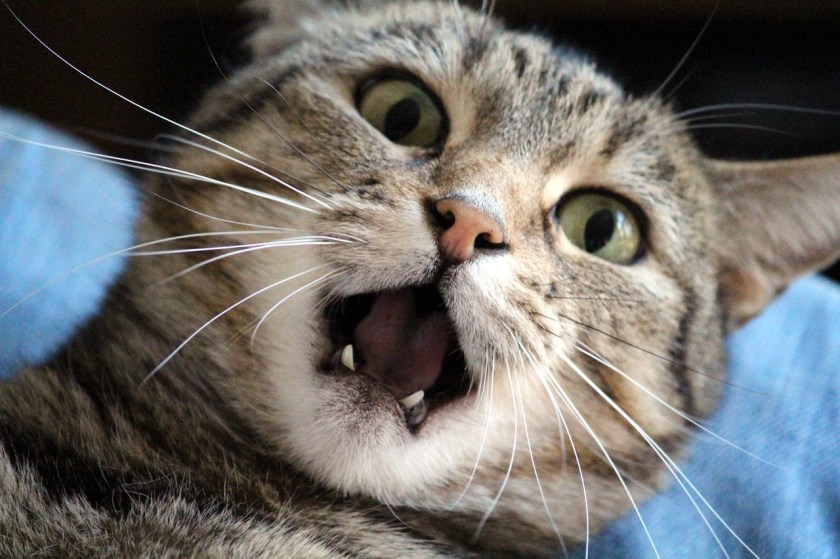
Instead his ears pricked up, did their radar-dish swivel toward the speakers, and his eyes went wide. As the song gained volume and intensity, Bud’s ears and whiskers snapped back and he let out a clearly anxious “yerrrrrrrrrrppp!” I tried to calm him down, to no avail, and a second track didn’t improve things.
He wasn’t having it.
This pretty much sums up Buddy’s reaction to cat music. Credit: Creative Commons
Teie’s cat music is back in the news with the release of the Kickstarter-backed Music for Cats 2, and there are quite a few imitators on Youtube hawking their own supposedly cat-soothing musical efforts. (Though your cat might think she’s in Guantanamo Bay if you subject her to six-hour videos of “cat lullabies.”)
Should I test some of the new music on Buddy to see if he responds more favorably? And for our fellow readers and cat servants, have you played any of this stuff for your cats? If you have, how’d it work out?
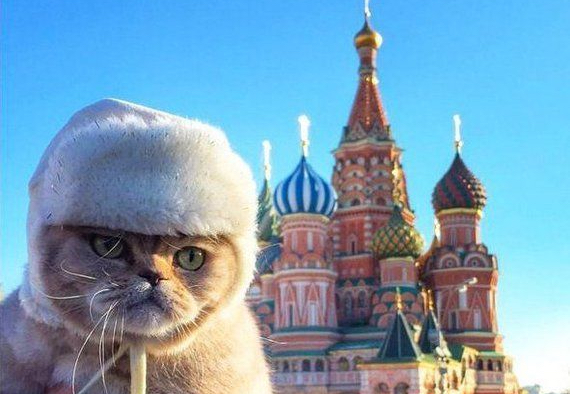
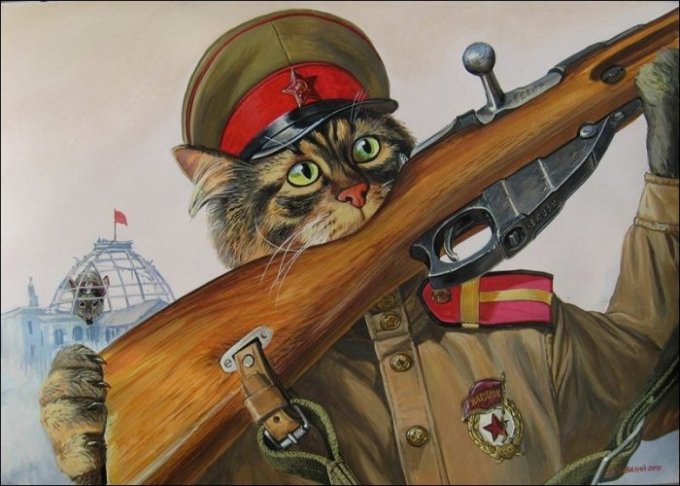
Russian propagandists are behind an effort to discredit the heroic American cat.
A shadowy group of Russians are behind a complex and nefarious plot to discredit Buddy, sources allege.
The Russian operatives were behind the recent Time magazine snub in which Buddy was ludicrously excluded from a top 10 cat list, several cats with knowledge of the operation meowed on condition of anonymity.
Deep-cover Russian agents have also worked to sully Buddy’s reputation as a heroic American feline by seeding social media with anti-Buddesian sentiment and viral content.
One Youtube video purports to show Buddy running terrified from a vacuum, but a spokesman for Buddy said the Russians used a similar-looking silver tabby to film the fabricated incident.
“The Buddy double was convincing, but anyone can see for themselves the cat in the video isn’t muscular enough to pass for His Grace,” spokesman Purrcy Pressman told reporters. “Vladimew Pootin and the Russians are underestimating the intelligence of the everycat if they think kitties will believe Buddy would run from a vacuum.”
Allegations of Russian involvement weren’t a surprise to feline officials, who blame the KGB (Kitty Gaslighting Bureau) for most of the salacious rumors circulating in the feline world over the past five years.
Those same KGB agents were responsible for tabloid stories that alleged Streetcat Bob’s name was found in a little black book when the FBI — Feline Bureau of Investigators — raided a purrstitution ring in November, sources say.
“These Russians are dangerous,” National Security Adviser Saul Berenson said. “Just look at what they did to Carrie Meowthison, one of our best agents. Buddy would do well to keep a low profile for the time being.”
Yvgeny Groomov, a spokesman for the Russian embassy, denied the allegations, but nonetheless said the KGB was in possession of kompromat that could destroy the reputations of famous American felines.
“Buddy is like small child, he is insignificant to Motherland,” Groomov said. “Real story is about how Americans are always using Russia as scapecat for all things going wrong. We say to the Americans, thank you for allowing us live in your heads free of rent.”
“The failing Time magazine didn’t even put me on their top 10 cats list. If they did, maybe they would sell more copies! Sad!” Buddy tweeted after the story was published.
Others expressed their outrage at Time’s snub.
”Time magazine has proven itself irrelevant by failing to include the handsomest tabby in America, and quite possibly the world,” gossip meower Pawrez Hilton wrote. “Do they realize thousands of kittens have posters of Buddy on their walls? He’s absolutely dreamy.”
“No Buddy? Absurd!” Meower user @SexyCalico24 commented. “I mean, have you seen his muscles? RAWR!”
Time’s editors were forced to backtrack after a deluge of angry phone calls and emails, along with a hundreds-strong protest outside the magazine’s Manhattan headquarters.
“It was a grave oversight on our part to exclude Buddy from our list, and we apologize,” the magazine’s editors wrote in a statement. “We know it will take time to win back the trust of our readers, but we hope to make it up to them with a 24-page photo spread of Buddy in our April issue.”
Claws Woodward, a purrfessor of feline journalism at the Harvard School for Cat Studies, said the embarrassing oversight is a sign that Time magazine is out of touch with kittens and young cats.
“Buddy is an action hero, like Snacky Chan or Ahnold Schwarzenmeower,” Woodward said. “With his movie star good looks and his rippling muscles, he clearly should have been on that list. I mean, ‘Jealous Cat’? Real Housewives meme cat? Come on! You don’t put Z-listers ahead of one of the most treasured cats of our generation.”
Still, not everyone was convinced Buddy should have made the list. Pop singer Taylor Swift was among those who clapped back at Buddy for his vanity.
“Buddy who?” Swift tweeted, throwing shade at the Budster. “If any cats should be on that list, my kitties should occupy all ten spots. I’m going to write a song about how they were cheated. Let me finish!”
A new video purports to show a cat speaking fully formed sentence in English. People are buying it.
A new, internet-breaking viral video appears to capture a cat speaking English, prompting a wave of speculation about whether cats are basically furry parrots when it comes to talent for mimicry.
The TikTok clip features a voice saying “Hello” and “Are you coming?” followed by an amused narrator turning the camera on his cat and incredulously asking “What did you just say?”
The video’s viral success has led to a net-wide conversation about animal cognition, and whether cats in particular understand far more than they let on.
“And this is a proof that animals can talk,” one TikTok user commented, summing up much of the online reaction to the clip.
It should be noted the handful of times cats have been recorded producing vaguely human-sounding speech, the sounds were stress vocalizations from terrified or anxious cats.
That’s what’s happening in the famous “Oh long Johnson, oh don piano!” video, in which a stressed out tuxedo vocalizes a few phrases before proceeding with more gibberish. To people who aren’t familiar with cats the video may seem funny, but those of us who care for the little tigers can recognize the signs of extreme agitation.
Here’s the “Oh long Johnson” video:
And here’s the new “Hello!”/“Are you coming?” video:
The viral TikTok video is a whole different ballgame: The words are well-formed, the sound is clear, and the phrase makes sense.
Unfortunately, it’s not real.
First I’ll point out the obvious: The cat is off-camera when it “speaks” because painstakingly editing video to make its mouth move in sync is a much more difficult task than dubbing in a vocal file.
Secondly, a careful listening with headphones makes it clear the “Hello” and “Are you coming?” are not from the same source as the meow, and the directional mix isn’t right. The sound should be distorted and should be directional if it’s coming from a cat in the next room, to the right of the person recording the scene on a smartphone.
This was an audio cut and paste job without much attention paid to detail. The video’s creator didn’t bother panning the clip.
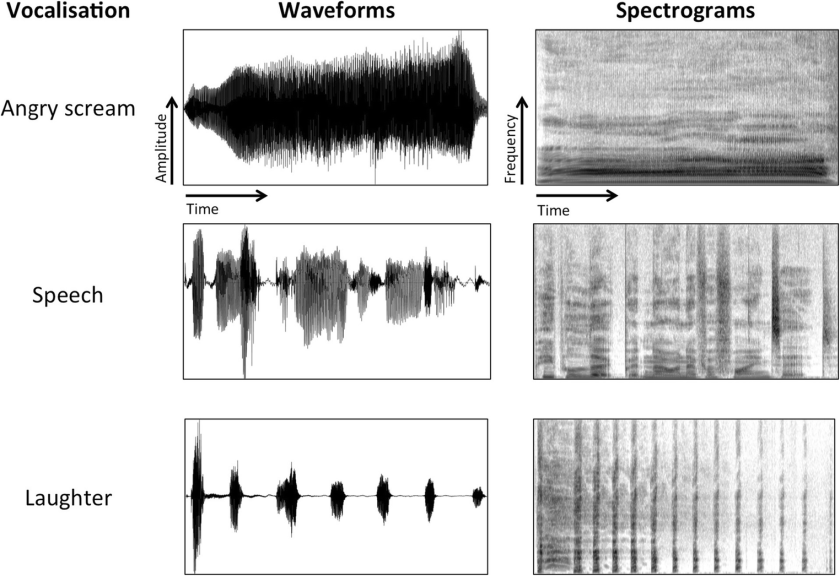
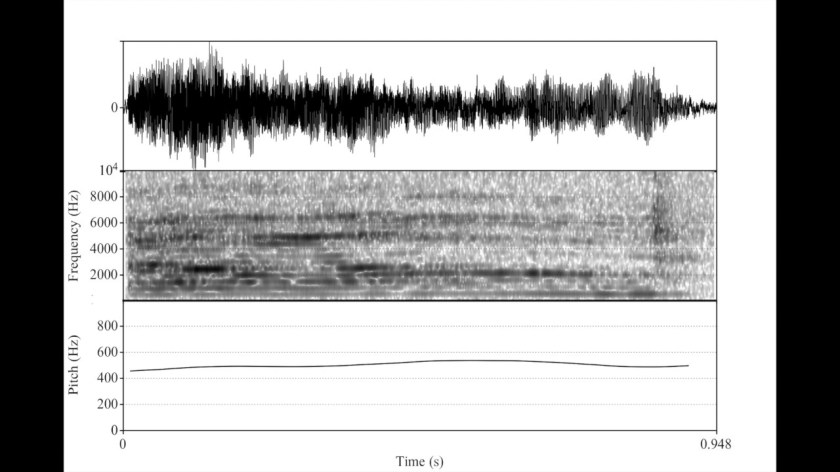
But perhaps most damning of all, the sound looks wrong. I isolated clips of the cat “speaking” in a wave editor — an old copy of the ultra-reliable Cool Edit Pro — and compared them to various samples of cat meows pulled from the Internet and sampled from Buddy himself.
When visualized in an audio editor, “the waveform of speech is complex and variable, reflecting the variety of vowels and consonants that are used and the dynamic nature of speech articulation.”
In other words, you can see the stops and starts of human speech and the articulations of different sounds reflected in how the audio appears visually. This is because we have fine motor control over our vocal apparatus, something animals lack. (A 2016 Princeton study determined macaques, for example, have the necessary vocal anatomy to mimic human speech, but they don’t have the “brain circuitry” to form the precise articulations.)
Cat vocalizations, on the other hand, lack those markers. Additionally, at higher resolutions you can see patterns indicative of rhythmic sounds in samples of cat vocalizations, not unlike isolated drum tracks in a studio recording.
This is because feline meows often have embedded purrs, and trills are naturally quantized. They’re rhythmic sounds. If you’ve ever had a purring cat laying on your chest, this will be familiar to you: You can hear the percussive sound, which persists while the cat is exhaling and inhaling.
A domestic cat’s meow in waveform. Notice the lack of transients, pauses and variation, which would be indicative of human speech patterns.
Solicitation purrs and even basic meows have similar qualities. It’s a well-known fact that cats communicate with each other via body language — tail, eyes, ears, posture — and scent. Adult cats rarely vocalize to each other, so when they meow to us it’s because they recognize that we don’t “speak” tail or whisker, and they’re trying to communicate with us in a form we understand.
But cats are like macaques — they do not possess the brain circuitry to form the precise articulations necessary for human speech.
As primates, macaques have similarly-formed mouths, tongues, teeth and lips. Cats do not, which presents another set of problems when imagining them mimicking human speech. Think of “t” sounds, both the hard t and the soft “th” — they require us to rest our tongues against our upper front teeth or the roof of our mouths.
Cats don’t have substantial front teeth. They’re more like little shredders.
Likewise, to speak the phrase “Are you coming?” requires fine motor control to form the hard “c” sound. It involves precise control of air flow from the throat to the mouth and subtle placement of the tongue
Although the idea of talking pets may be appealing to generations that grew up on Disney movies and other media featuring anthropomorphized animals, the truth is they do talk to us in their own ways. The least we can do, as the supposedly more intelligent species, is to meet them halfway.
The authorities are closing in on Buddy and his catnip empire!
UNITED STATES DISTRICT COURT FOR THE SOUTHERN DISTRICT OF NEW YORK
Manhattan Division
UNITED STATES OF AMERICA v. Buddy the Cat, defendant
February 2020
INDICTMENT
THE GRAND JURY CHARGES THAT:
COUNT ONE
19 USC § 741D (Unauthorized Distribution of Schedule I Catnip)
The defendant and other relevant persons
1. Between or on about April 22, 2014 and January 1, 2020, defendant BUDDY THE CAT (“Buddy”) operated a vast interstate operation dedicated to the cultivation, packaging, distribution and sale of Nepeta Cataria, commonly known as CATNIP, and by the street names “The Nip,” “Feline Piff,” and “Meowijuana,” as well as Actinidia polygama, commonly known as SILVER VINE.
2. While overseeing his criminal organization, defendant Buddy the Cat headquartered his operation out of a New York apartment, entrusting his lieutenants Nipsy Rock, Socks the Evil Killah, Chairman Meow and Pawblo Escobar with the sale and wholesale distribution of catnip and silver vine, both Schedule I nipcotics according to the United States Drug Enforcement Agency (DEA).
3. During his tenure as the east coast’s primary “Niplord,” Buddy the Cat did engage in a ruthless campaign of violence and intimidation in order to claim territory (“corners,” “stoops” and “blocks”) for himself and his criminal organization.
COUNT TWO
23 USD § 892b (Criminal Endangerment of a Kitten)
4. Buddy the Cat, aided by his capitans, lieutenants and soldiers, did participate in the recruitment of kittens younger than six months of age for the purpose of serving as runners for “The Nip” and as lookouts to provide advance warning of the presence of law enforcement. The young kittens were recruited with promises of a glamorous lifestyle, compensation in the form of Temptations treats, and “street credibility.”
COUNT THREE
USD 113a § 046 (Feliny catslaughter in the first degree)
5. Buddy the Cat and his aforementioned lieutenants participated in the ruthless and diabolical elimination of rivals and potential “snitches,” among them Fat Tony Catsonova, consigliere of the Il Nipolino catnip cartel, Felix “Heisenpaw” White, chief chemist for the Los Angeles-based Los Gatos criminal gang, and “Meowvelous” Mikey Mike, a show cat who moonlighted as a dealer specializing in high-grade silver vine.
COUNT FOUR
USD 562a § 215 (Conspiracy to transport catnip across state lines)
6. On or about Oct 12, 2016, defendant Buddy the Cat and Nipsy Rock were observed by a federal agent discussing the shipment of 4,000 lbs of premium Meowijuana, with a street value of approximately $200,000 USD, from a grow warehouse in California to the operation’s Nip Distribution Center in Newark, NJ. In addition, defendants Chairman Meow and Pico de Gato were overheard planning the ambush and robbery of a silver vine shipment intended for a Los Gatos stash house in Houston, Texas.
The Substantive Violation
Defendant Buddy the Cat did willfully participate in the manufacture, distribution and sale of Schedule I nipcotics, the termination of rival Niplords, a protracted series of turf wars and a permanent campaign of disruption and terror aimed at his rivals in the illegal catnip trade.
Have you seen Buddy the Cat? Federal authorities have announced a $10,000 reward for information leading to the successful capture and conviction of the notorious niplord.



 Pain In The Bud