The palm oil and logging industries have killed so many orangutan mothers, there are now more than a dozen major orangutan orphanages in Borneo and Sumatra. The pressure on orangutans, with whom we share 97% of our DNA, shows no signs of abating.
Orangutans are critically endangered, and the biggest threat to their continued existence comes from the agricultural sector, which has razed 55 percent of the species’ habitat in recent decades.
Jarang, a baby orangutan born in 2023. Credit: Blackpool Zoo
Logging companies clearing irreplaceable, old-growth jungle to claim more land for palm oil plantations have no compunction when it comes to flattening jungles despite the presence of orangutans hiding in the trees. The loggers often shoot the large apes on sight, leaving terrified, traumatized babies still clinging to their dead mothers, or taking them to sell as pets.
Of those left to die, the lucky babies are rescued before they starve and are brought to one of the many orangutan orphanages in Borneo and Sumatra, where they attend “school” to learn how to do everything from climb to forage. It takes at least eight years to teach them how to survive on their own, which is about the time it takes orangutan mothers to do the same job in the wild.
The unlucky babies end up as local pets, sold off to entertainment troupes or shipped off to places like Dubai, where wealthy clients will pay a premium for them.
Caretakers must start by teaching rescued orphans the most basic things, like how to climb and move through the jungle Credit: Borneo Orangutan Survival FoundationLogos, an orphaned baby orangutan who was rescued in 2023 by the Jakarta Animal Aid Network (JAAN) Credit: International Animal Welfare Fund (IAWF)Baby Galaksi (Indonesian for galaxy), was found wandering the jungle without his mother in 2021 by a villager in Borneo. He’s now in a “school” that teaches orphaned orangutans how to do everything from evading predators to discerning edible fruit from harmful and poisonous varieties. Credit: Samboja Lestari Orangutan Rehabilitation Centre
So what is palm oil, and why are countries in Asia bulldozing ancient jungles and forests to clear room and make more plantations?
Per the WWF:
“Palm oil has been and continues to be a major driver of deforestation of some of the world’s most biodiverse forests, destroying the habitat of already endangered species like the Orangutan, pygmy elephant and Sumatran rhino. This forest loss coupled with conversion of carbon rich peat soils are throwing out millions of tonnes of greenhouse gases into the atmosphere and contributing to climate change. There also remains some exploitation of workers and child labour. These are serious issues that the whole palm oil sector needs to step up to address because it doesn’t have to be this way.
…
Palm oil is in nearly everything – it’s in close to 50% of the packaged products we find in supermarkets, everything from pizza, doughnuts and chocolate, to deodorant, shampoo, toothpaste and lipstick.”
Palm oil is in constant demand, and it’s an easy to grow, incredibly efficient crop. Indonesia and Malaysia, the only two countries in the world where orangutans exist, produce 85 percent of the world’s palm oil.
Images of orangutan babies in wheelbarrows are common on social media, but usually stripped of context. Orphanages use the wheelbarrows to bring infants and toddlers to and from “school” every day. Credit: International Animal RescueAsoka was found crying in the jungle by a fisherman in Borneo. He was brought to an orphanage in Borneo. Credit: International Animal Rescue’s rehabilitation Centre in Ketapang, West Kalimantan
We share 97 percent of our DNA with orangutans, making the species our second-closest cousins from a genetic standpoint. Some studies claim orangutans are our closest relatives based on our phenotypical similarities.
Orphaned orangutans attending “school” to learn how to survive in the wild. Credit: Borneo Orangutan Survival FoundationA baby at an orangutan orphanage is fed by a caretaker. Credit: Borneo Orangutan Survival Foundation
Want to read more and learn how to help?
Here are some links to get you started. PITB is a big fan of the Jakarta Animal Aid Network, which successfully pushed Jakarta’s municipal government to ban the incredibly cruel “topeng monyet” monkey street shows:
Service animals and emotional support animals are not the same thing.
A Quiet Place: Day One stars Lupita Nyong’o as Samira, a terminally ill woman, and Joseph Quinn as her nurse, Eric.
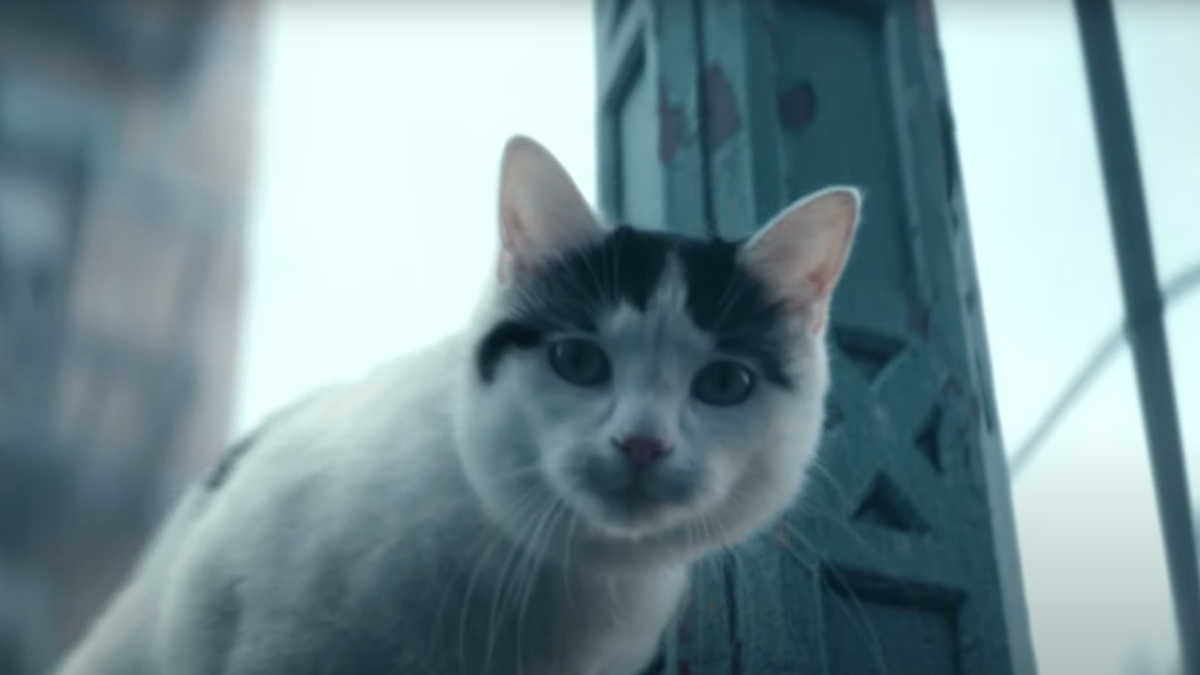
But it’s the third main cast member — a feline named Frodo — who’s been hailed as the surprise star of the film, which one reviewer called “a love letter to cat owners.”
Nyong’o’s Sam has been given the equivalent of a death sentence with her aggressive cancer diagnosis, but when the nightmarish creatures who play the antagonists of the Quiet Place franchise arrive, Sam fights for her life with her trusty “service cat” by her side.
“You can’t have a cat in here,” the clerk at a bodega tells Sam early in the film, before she fixes him with a no-nonsense stare and flatly declares: “He’s a service cat.”
The adorable Frodo, co-star of A Quiet Place: Day One.
You’ve probably heard stories or seen photos of people trying to take other animals into places they’d normally never be allowed. In 2019, a woman decided to push the boundaries by taking a miniature horse onto a domestic flight, forcing passengers to share extremely limited space with the olfactorily potent, skittish animal. She even scolded social media users who didn’t get the horse’s pronouns “correct.” (They’re she/her, by the way. We’re not making this up.)
The woman, who says she needs the horse because she suffers from PTSD, told Omaha, Nebraska’s KMTV that the managers of a grocery store allegedly violated her rights by asking her to leave rather than allow her to march a horse through a place where people buy food and its operators are required to follow Department of Health rules.
“I was treated so poorly and the manager’s responses when I followed up were poor,” she said. “They are going to be hearing from the Department of Justice and I’m definitely going to be pursuing legal means as well.”
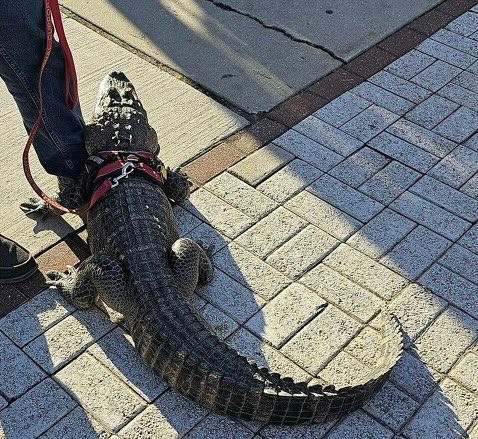
In 2023, a man tried to take a “service alligator” to a Phillies game at Citizens Bank Park. Stadium security weren’t buying it and he was turned away, but not before other fans snapped photos of the attempt. In Nevada, a man who had his USDA license revoked for “multiple violations of the Animal Welfare Act” argued that authorities couldn’t confiscate his 10 tigers because he claimed they are emotional support animals.
“My doctor has written that she feels that the tigers are beneficial to my psychological well-being and so therefore I got what the law requires,” Karl Mitchell told KTNV, an ABC affiliate in Las Vegas.
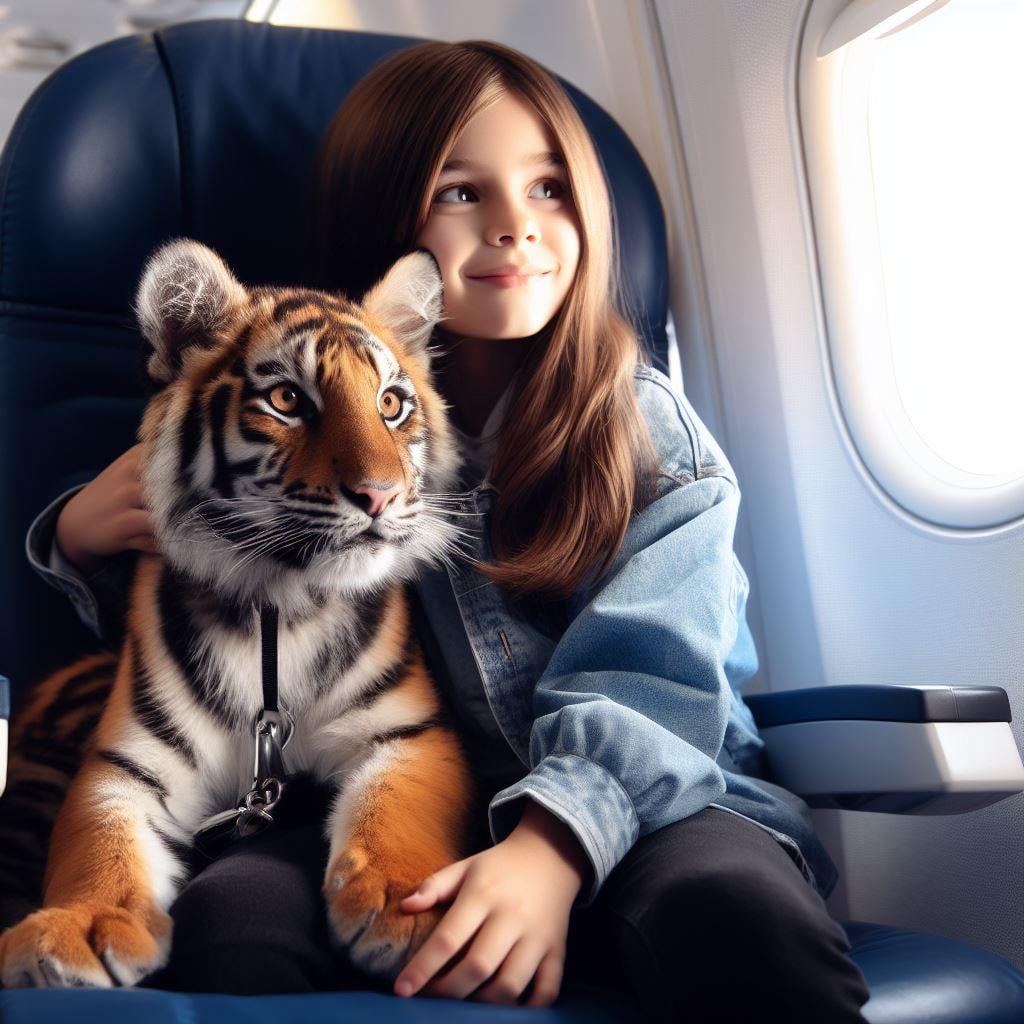
An emotional support tiger depicted in a Reddit photoshop contest for the most ridiculous “service animals.” Maybe some ambitious dreamer will cook up a service elephant or an emotional support bison.
Since then the FAA and Department of Transportation have issued new rules clarifying emotional support horses, peacocks, flying squirrels, parrots and other animals are not allowed on planes, prompting one flight attendant to quip that “The days of Noah’s Ark in the sky are over.”
That, however, has not put a dent in the confusion over what constitutes a service animal versus an emotional support animal, and what rights people have when it comes to bring their furry (or scaly, or feathered) friends into public and private spaces.
Although we’re happy to see Nyong’o in her first lead role since 2019’s freaky horror thriller Us, unfortunately A Quiet Place: Day One is almost certain to contribute to that confusion with its fictional “service cat” character.
A service animal and an emotional support animal are not the same thing
First, there’s an important distinction between a service animal and an emotional support animal.
Service animals can only be dogs or miniature horses, and must be trained. People who depend on service animals can train them themselves, but the animal must meet specific needs, like guiding the blind or vision-impaired.
Emotional support animals, by contrast, are not trained, certified or “official” in any capacity. Anyone can adopt or buy an animal and call it an “emotional support animal.”
A Phillies fan’s “emotional support alligator.” The stadium turned him and his carnivorous apex predator companion down. Credit: Howard Eskin/X
Unfortunately due to the confusion involving service animals vs ESAs, predatory sites have popped up online promising to “officially register” ESAs for a fee.
In addition to charging for something that doesn’t exist, the proprietors of those sites also tell people they can take their “officially registered” support animals into places normally off limits to pets, like stores and restaurants. Some sites offer consultations with alleged mental health professionals who will “diagnose” customers remotely and write letters on the customer’s behalf.
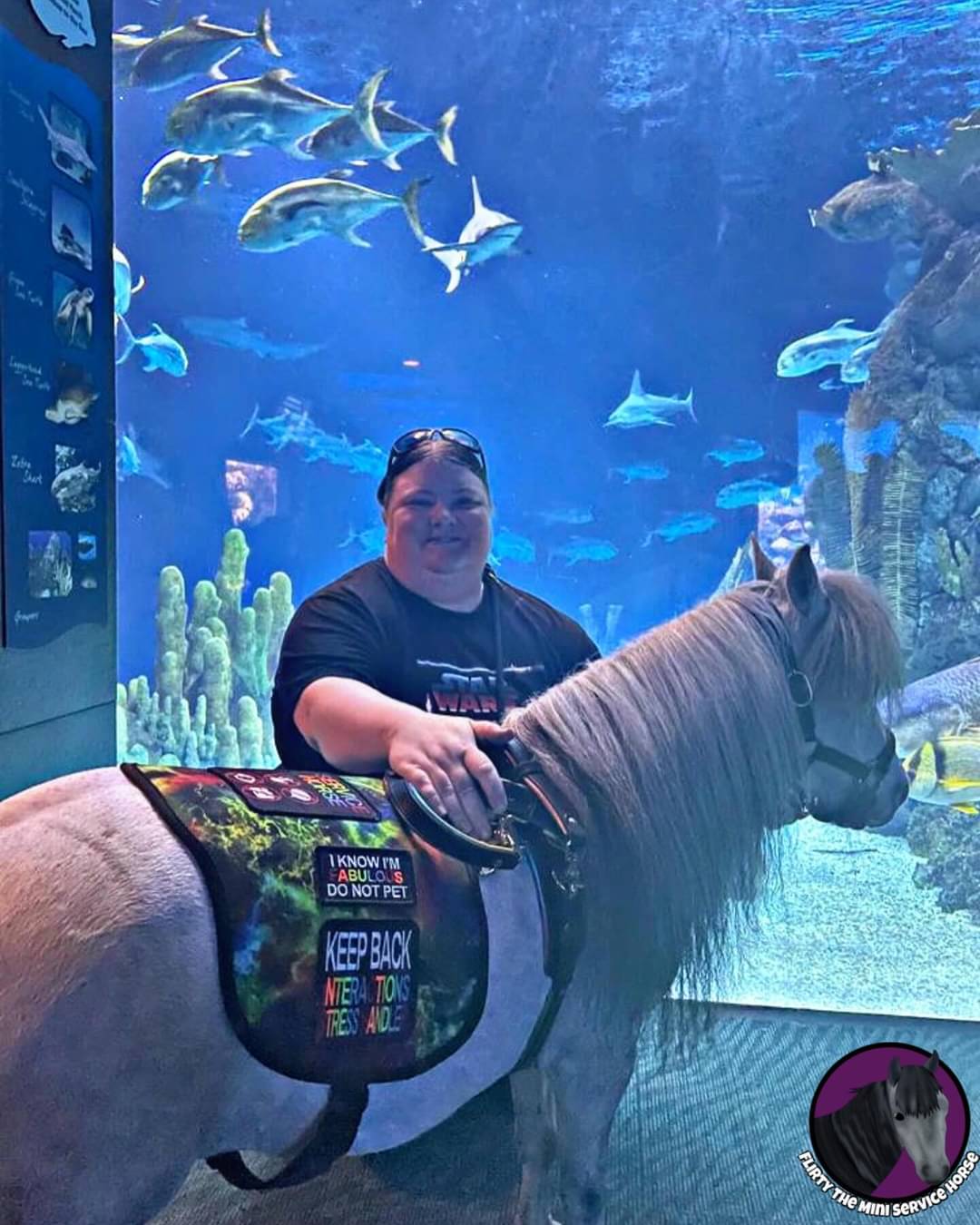
Abrea Hensley with her miniature horse, Flirty, in an aquarium. Hensley’s social media accounts document all the places she goes with the animal.
Those sites operate similar to the numerous “buy a star” sites that claim celestial objects can be officially owned. Like their emotional support animal “registry” counterparts, the star sale sites offer official-looking paperwork, but they’re selling something that can’t legally be sold, and the certificates are legally and practically meaningless.
Buying a “certification” won’t make your cat a service feline, and contrary to how they’re portrayed in the movie, calling a pet an emotional support animal does not allow you to bring it anywhere you like.
For legal purposes, there’s only one perk to be had by claiming an emotional support animal: under the Fair Housing Act, landlords generally cannot refuse tenants who have emotional support animals. The act specifies that allowing emotional support animals is limited by “reasonable accommodations.” That means a dog or a cat is okay, but you can’t keep an animal that poses a danger to your neighbors, negatively impacts their quality of life, or requires the landlord to make major and costly alterations.
The general trend in recent years has involved curbing the limits of emotional support animals, a trend that appears likely to continue as more people abuse the privilege, burdening other members of the public by insisting they must silently endure the inconvenience, potential allergic reactions, sanitary concerns and practical problems caused by bringing animals into spaces that are not designed to accommodate them.
While we’re certainly sympathetic to pet owners — this blog wouldn’t exist if we were not — the fact is that the more people abuse societal boundaries with emotional support animals, the more difficult it makes things for people who have legitimate service dogs and rely on them to navigate life and maintain their independence.
Note: This post has been updated to further distinguish between service animals and emotional support animals. An earlier version contained a paragraph with potentially confusing phrasing.
h/t Susan Mercurio for pointing out that emotional support animals are coveted by the Fair Housing Act
With much of the US already sweltering under a summer heat dome, architectural engineers warn most American buildings aren’t designed for extreme temperatures, while energy experts warn of more rolling blackouts.
A family in Mission Viejo, Calif., heard a series of loud crashes at their back door, then reviewed their doorbell camera footage to find a determined coyote had been trying to attack their cat.
The footage shows the coyote repeatedly throwing itself at the screen door, which might have buckled if there hadn’t been a baby gate reinforcing it.
“We ended up putting a baby gate up to keep the cats inside,” homeowner Cindy Stalnaker told KABC. “That ended up being what prevented the coyote from getting inside the house because that’s what he was banging into repeatedly.”
Coyotes weigh about 30 to 35 pounds and will attack potential prey smaller than they are, which includes pets as well as young children.
The canids aren’t usually keen on approaching human homes, but in many places they’ve run out of room to roam as towns and cities clear more wild land for new developments. Less habitat means less prey, which can also lead the animals to scavenge and hunt on the fringes of residential and urban neighborhoods.
Stalnaker said she was grateful the baby gate held, but she’s looking into a more stable and permanent solution to keep her cats safe from coyotes.
What if air conditioning isn’t enough?
Human activity isn’t just driving wild animals to extinction, it’s killing them off with temperature extremes, and a Tuesday story from The Guardian provides a bleak look at how our present situation threatens human life as well: Buildings in most US cities aren’t built to mitigate excess heat, air conditioners weren’t designed to keep on chugging indefinitely with temperatures around 100 degrees, and power grids can’t keep up with the demand when millions of AC units are drawing power simultaneously.
At the same time, summers keep getting hotter and there’s no reprieve in sight.
Legal or not, New Yorkers turn to fire hydrants to get relief during heat waves. Credit: NYC Office of Emergency Management
While the heat has major ramifications for animals and sea life, it’s also directly endangering human life now:
“Some experts have begun to warn of the looming threat of a “Heat Katrina” – a mass-casualty heat event. A study published last year that modeled heatwave-related blackouts in different cities showed that a two-day blackout in Phoenix could lead to the deaths of more than 12,000 people.”
An architectural engineer tells the newspaper that temperatures have spiked so much in recent summers that cooling “systems that we sold 10 years ago are not able to keep up with the weather we have.”
The result for people in America’s hottest cities is that even AC doesn’t provide relief.
In the meantime we’re likely to see more headlines about rolling blackouts, punishing energy bills and people dying in their homes, scientists say. Fusion power and significant leaps in battery technology can’t come soon enough.
By unlocking the mysteries of how sperm whales communicate and demonstrating their impressive cognitive abilities, researchers hope to get people invested in the fate of these endangered animals.
Sperm whales are chatty.
Their language is markedly different from the deep cetacean moans associated with other whales, taking the form of Morse code-like clicks that boom through the ocean in a decibel range almost twice that of jet engines.
And while we’ve long known animals like monkeys assign specific meaning to short vocalizations varying from alarm calls to affirmations of social rank, sperm whale conversations can endure for an hour or more, with participants exchanging complex strings of clicks that vary depending on context, environment and even which pod family is speaking.
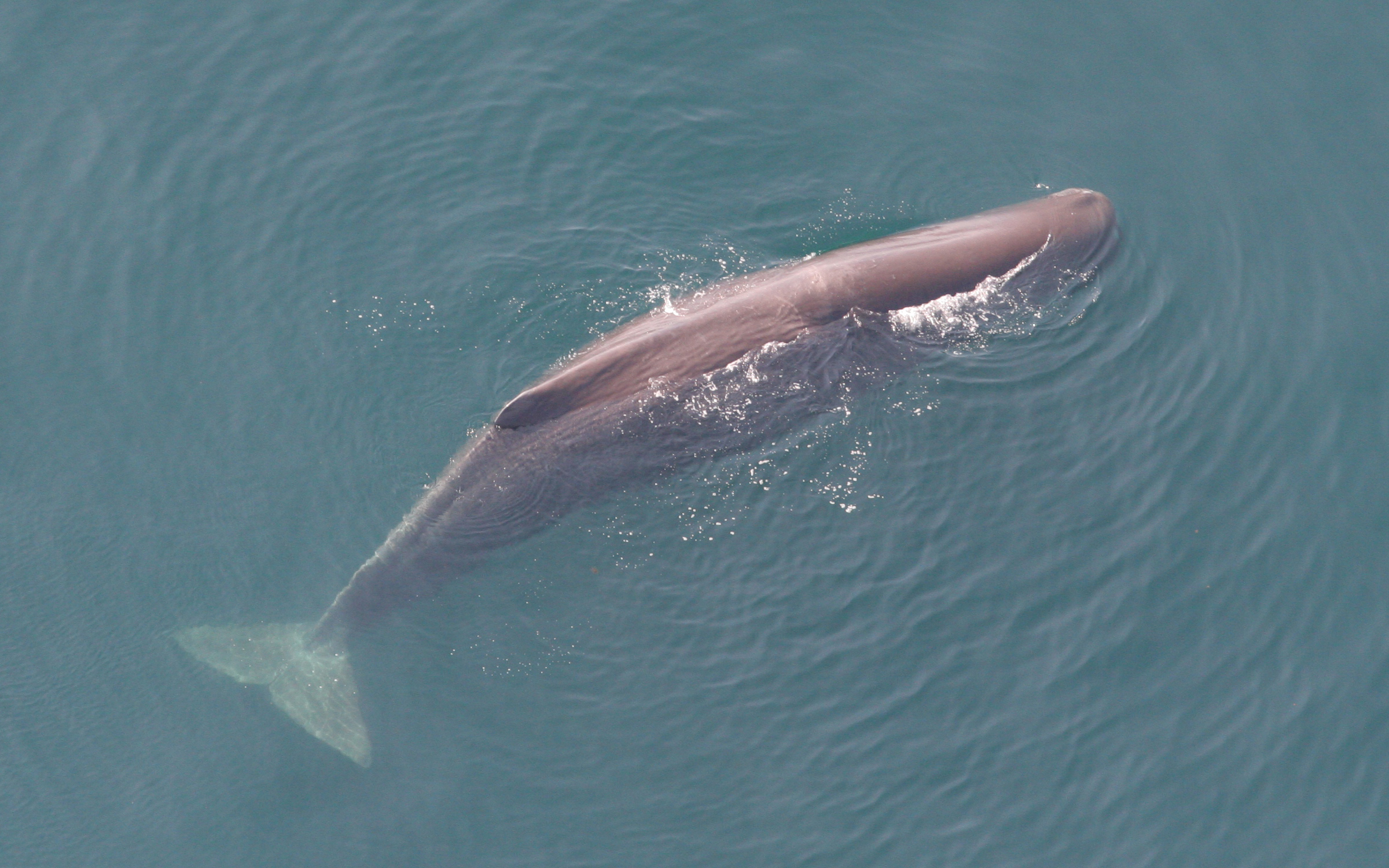
An aerial view of a sperm whale near the ocean surface. Credit: Wikimedia Commons
While artificial intelligence has been maligned over the past few years as people grapple with its rapid progress and potential for abuse, it remains the best tool we have for teasing out patterns that our human minds can’t discern, especially from large quantities of data.
With more than 9,000 recordings of sperm whales, Project CETI — Cetacean Translation Initiative, a non-profit effort to decode and translate sperm whale communication — had precisely the kind of huge data cache that AI excels at analyzing.
By feeding the recordings into specially trained machine learning algorithms, the research team was able to identify a wealth of new language patterns. While human languages are composed of quantized morphemes — prefixes, suffixes and root words — whale communication is broken down into sequences of clicks and pauses called “codas.”
Like Morse code, codas make a distinction between short clicks and long clicks. Sperm whales also vary the tempo of the clicks, which could represent inflection, “dialects” or concepts completely alien to the human mind.
“Some of what they’re doing might be totally different from our way of communicating and we’re probably never going to be able to fully grasp those differences,” Oregon State postdoctoral marine researcher Taylor Hersh told NPR.
A sperm whale fluke visible above the surface of the ocean. Credit: Wikimedia Commons
Researchers believe the “inter-click intervals” — akin to ghost notes in music — may be as significant as the clicks themselves. Importantly, while human ears were able to identify and catalog some of the codas, the machine learning algorithms found many that human analysis missed.
That’s not surprising considering sperm whales — the loudest animals on Earth, capable of generating sounds up to 230 dB — took a much different evolutionary course and, as ocean-dwelling creatures weighing up to 90,000 pounds (40,800 kg) likely have a radically different sensorium compared to humans.
The comparisons to music go further than ghost notes.
“This study shows that coda types are not arbitrary, but rather that they form a newly discovered combinatorial coding system in which the musical concepts of rubato and ornamentation combine with two categorical, context-independent features known as rhythm and tempo, by analogy to musical terminology,” CETI’s team wrote on May 7 while unveiling the most recent study.
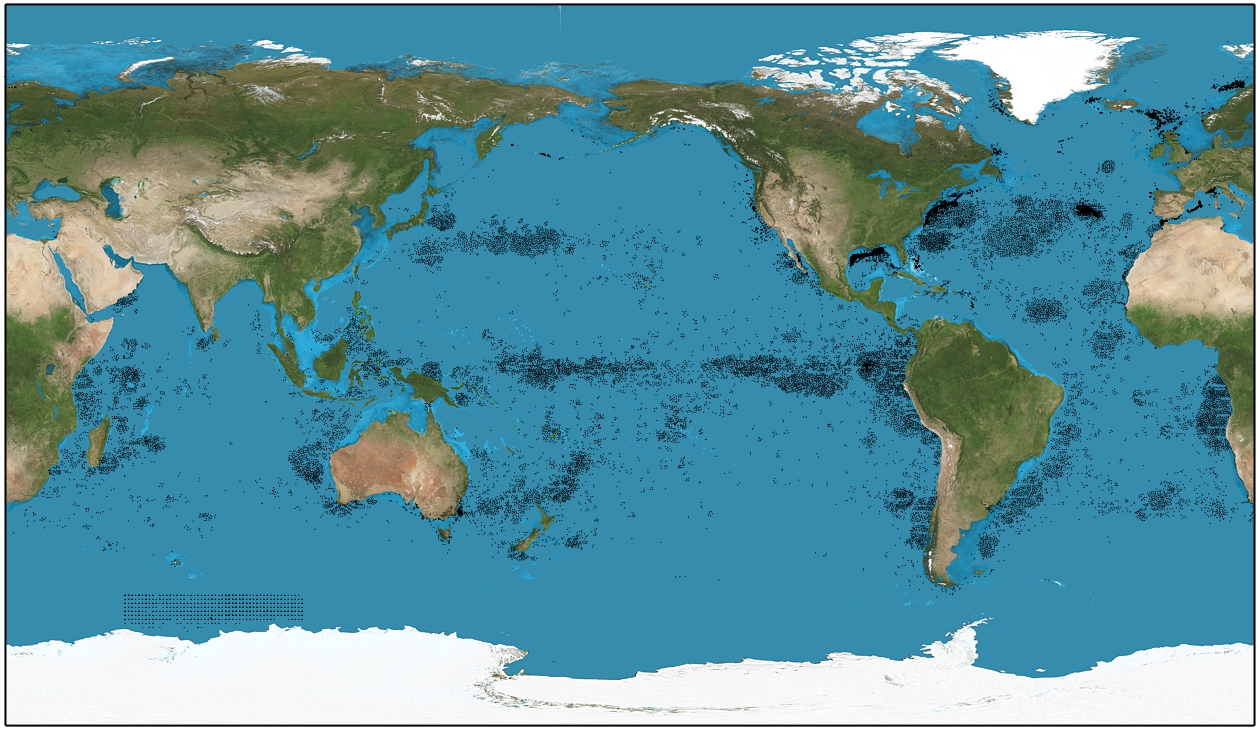
Sperm whale distribution based on human sightings. Sperm whales freely travel the oceans except in cold, ice-packed environs. Credit: Wikimedia Commons
While people have used many abilities to mark the dividing line between humans and animals over the years — including the ability to use tools, experience emotions, and demonstrate self-awareness — human capacity for authentic language with syntax and context-dependent meaning was one of the stalwarts, standing the test of time as new research toppled the other dividers by showing animals do indeed use tools, experience rich emotions and have complex inner mental lives.
With this research, scientists are assembling a “sperm whale phonetic alphabet” that will make it easier to discern and catalog whale codas.
To be clear, there’s still a lot of work ahead before scientists can prove sperm whale codas are comparable to human definitions of language, but whether they strictly meet that definition may not matter. After all, it’s clear the clicks and pauses of whale codas are imbued with meaning, even if it remains elusive to us for the moment.
Indeed, “sperm whale communication has both contextual and combinatorial structure not previously observed in whale communication,” the team wrote.
Proving sperm whale codas are tantamount to human language isn’t the goal anyway. The team has two overriding priorities — decode the meanings behind the codas, and get the wider public invested in the fate of these endangered animals by showing they’re not so different from us.
“Our results show there is much more complexity than previously believed,” MIT AI lab director Daniela Rus told NPR, “and this is challenging the current state of the art or state of beliefs about the animal world.”
Flaco the Eurasian Eagle Owl has become a New York celebrity since he escaped his enclosure at the Central Park Zoo early in 2023.
He’s been spotted flying through the concrete canyons of midtown, perched on fire escapes on the upper east side and ridding New York of its vermin — but he’s not your friendly neighborhood Spiderman.
He’s Flaco the Eurasian eagle-owl and New Yorkers have been rooting for him ever since he escaped from a small enclosure in Central Park Zoo and decided the entire park and its environs would be his domain.
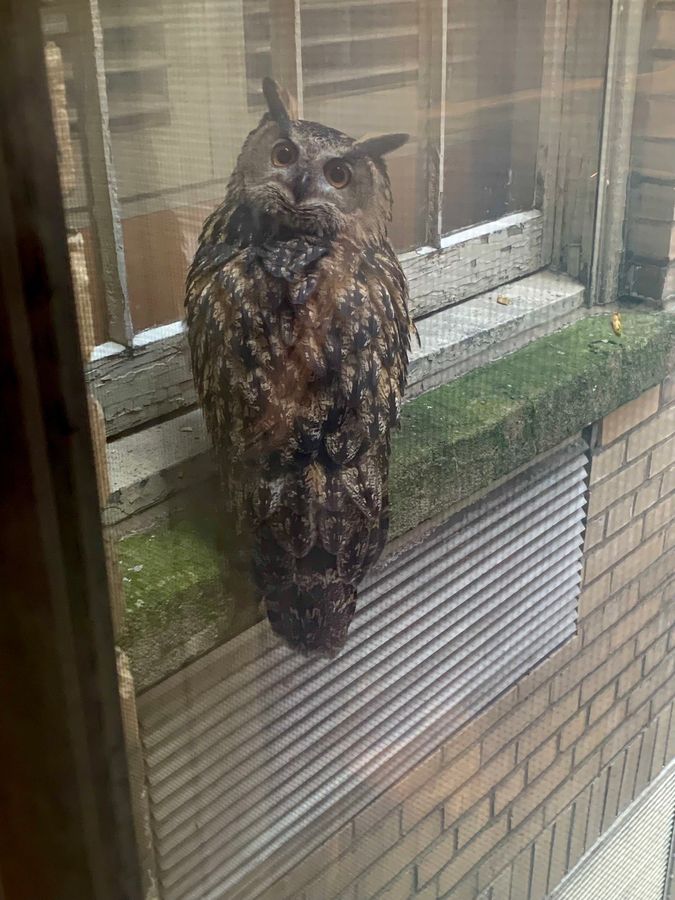
Since then, Flaco has evaded capture, put aside concerns that he’d be able to survive in the big city and shocked the hell out of New Yorkers who have seen the curious little guy’s face pressed against the glass of their apartment windows, watching them intently.
“I audibly gasped,” 24-year-old Matt Sweeney told the Wall Street Journal after he realized something or someone was watching him through the window of his upper west side apartment.
“It absolutely scared the you-know-what out of me,” 31-year-old actress Reilly Richardson told the paper after she woke up one morning to find the peeping predator watching her from outside. “It’s New York City. It’s the last thing you expect to see.”
Flaco escaped Central Park Zoo in February after his enclosure, where he lived for 12 years, had been “vandalized,” according to zoo staff. It turns out someone sliced an opening in the mesh, giving Flaco an out which he quickly took advantage of.
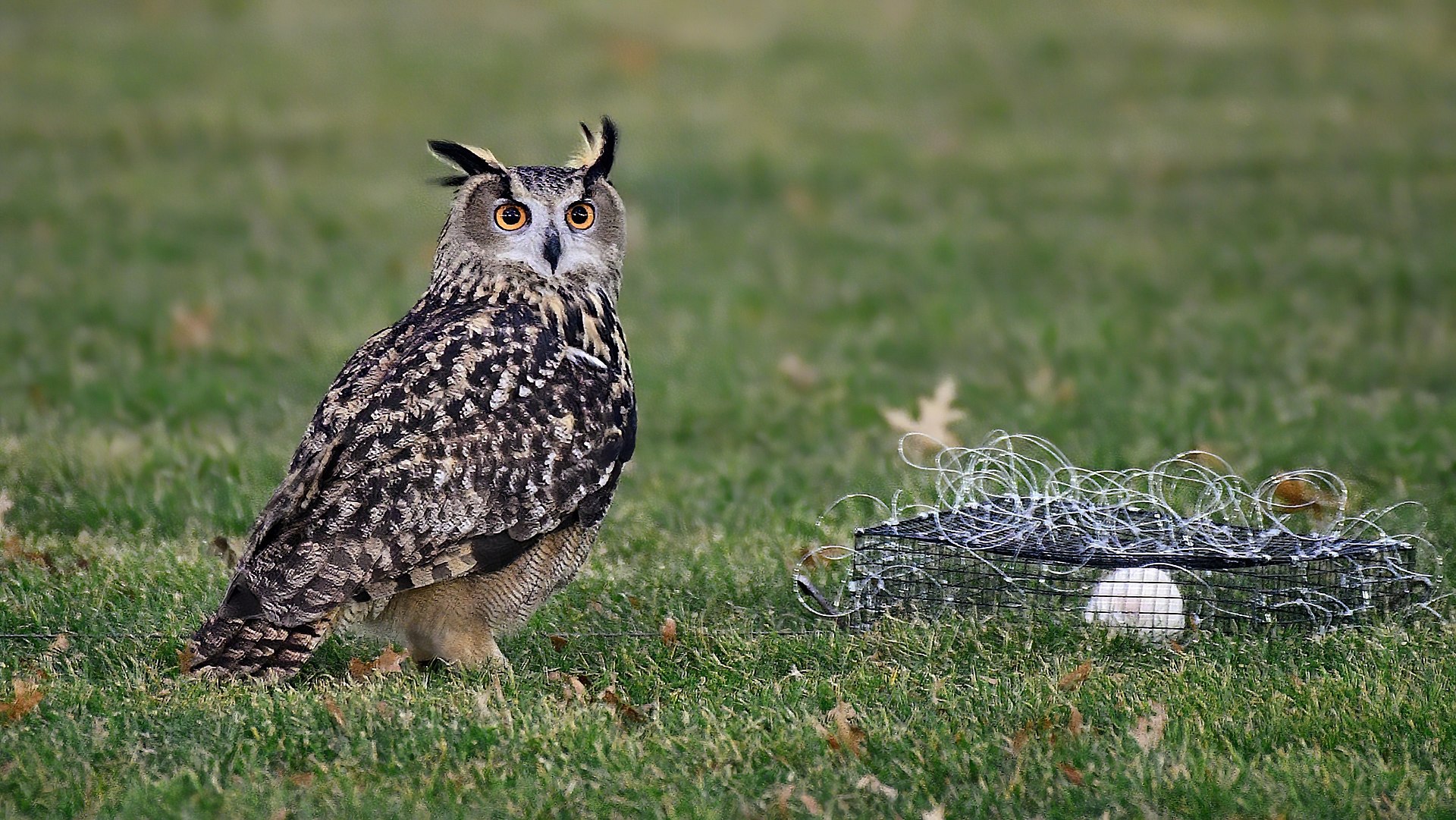
For the next few months zookeepers chased him around Central Park, trying to lure him back with food and the recorded sounds of other owls, but Flaco wasn’t having it. In the meantime he became a celebrity, New York’s version of the famous mountain lion P-22, with crowds of birders and curious onlookers assembling to watch and photograph him.
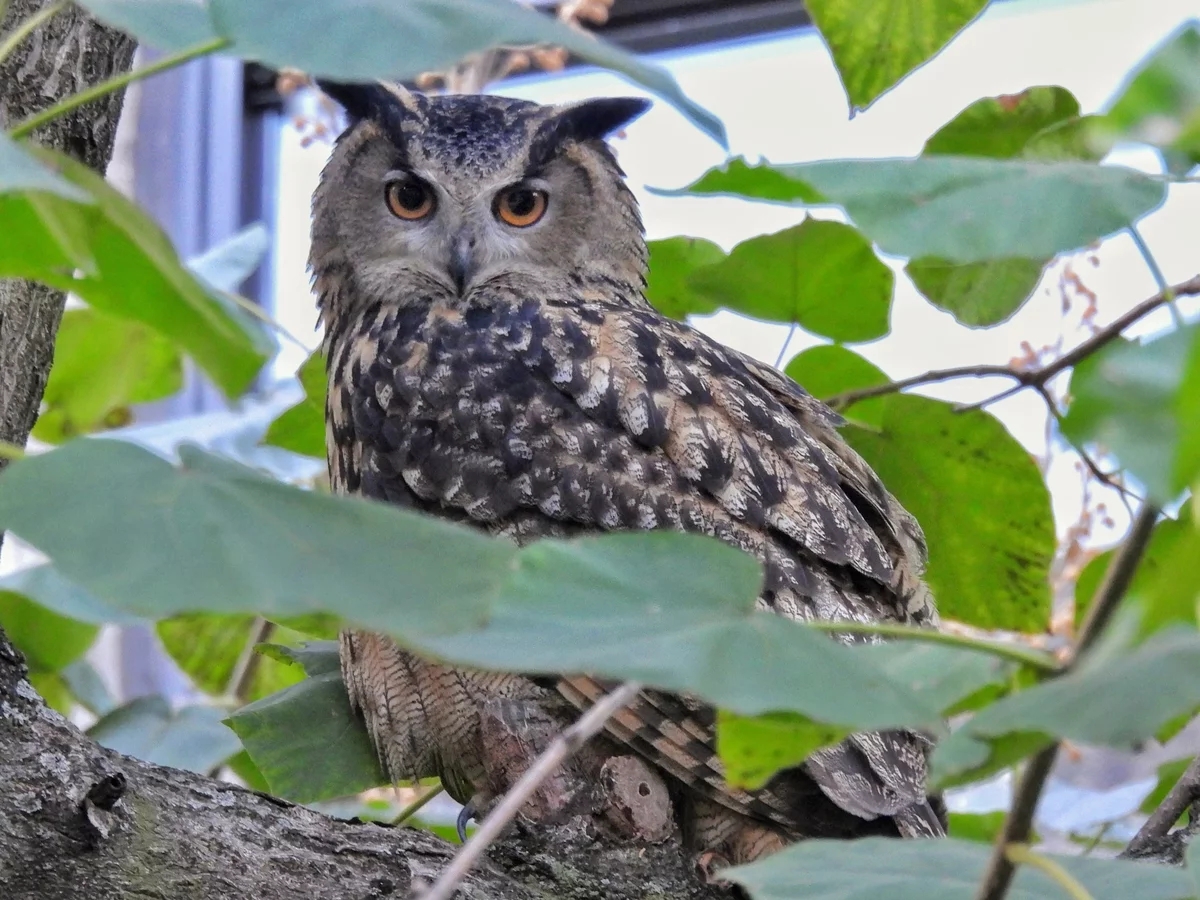
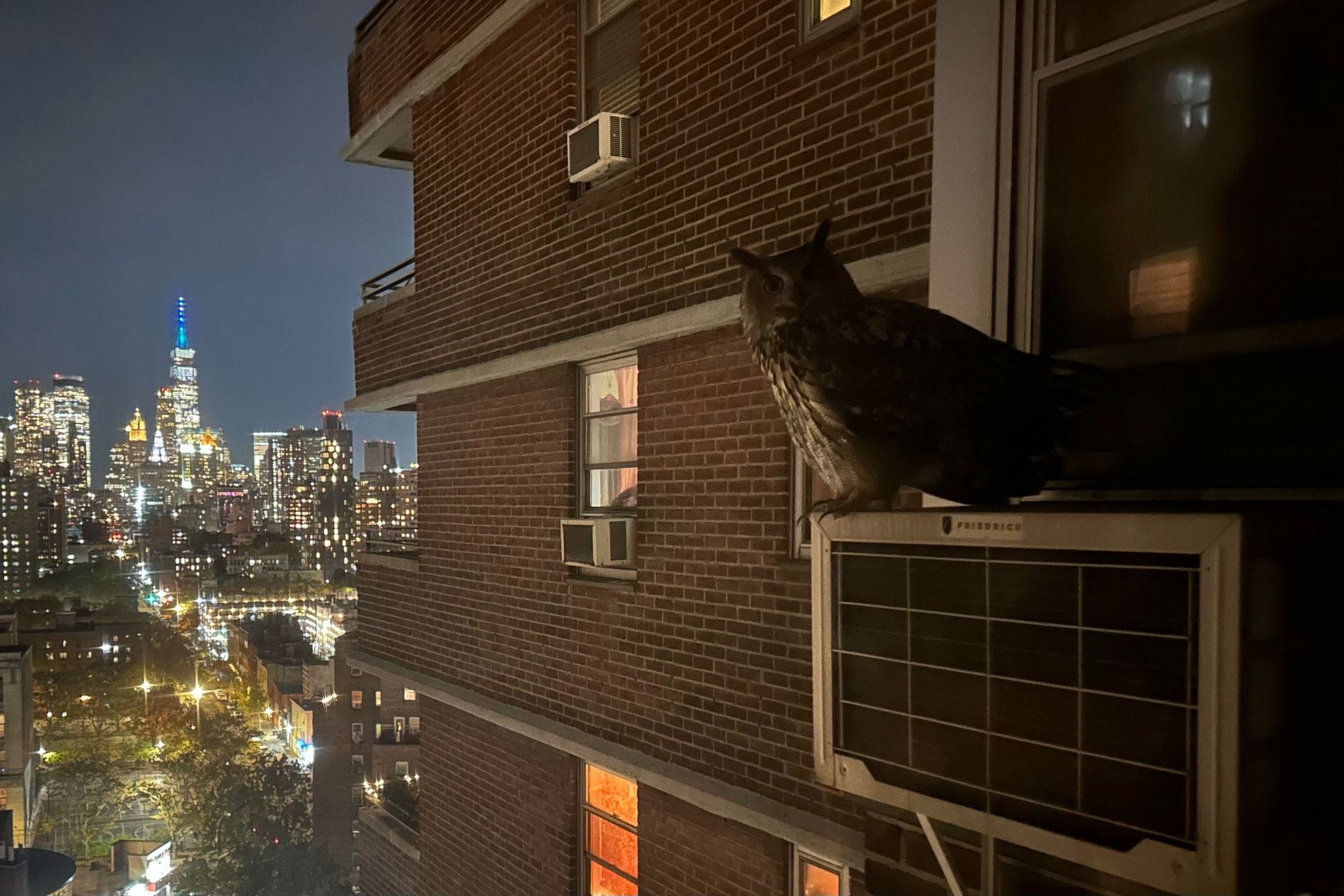
Credit: New Yorker Robin Herbst-Paparne, who spotted Flaco outside her apartment. Via WSJ
Social media accounts tracking the raptor’s movements sprung up online, and all the attention became too much. Even though zookeepers gave up on returning him to his enclosure, Flaco apparently decided he was done being watched and became the watcher.
Since then he’s popped up all over Manhattan, delighting New Yorkers and giving others a scare as they noticed the two-foot owl tracking them from a fire escape or a window perch. In early November he left the comfy confines of Central Park — possibly spurred by the crowds and commotion of the annual NYC Marathon — and began exploring the city proper, popping up in random places each day.
Initially people were worried Flaco, who had spent his entire life in captivity, wouldn’t be able to feed himself. The owl quickly put those concerns to rest as he proved adept at feasting on New York’s abundant rodents, earning himself the nickname “New York’s Rat Czar” at a time when Mayor Eric Adams has declared war on the vermin.
Experts are divided on why Flaco is spending so much time watching people. As the only known Eurasian eagle owl living “wild” in North America, the little guy may be looking for a mate. They say he won’t find one of his species, but he could find an unpaired female of another species if he’s lucky.
Others say Flaco, who was raised by humans and isn’t afraid of our species, may believe a human could be his mate. That’s another way his predicament mirrors that of P-22, who settled in Los Angeles’ Griffith Park and became a local celebrity, but was cut off from potential mates by busy highways and miles of human-inhabited land.
Nan Knighton, whose apartment faces Central Park, snapped this shot of Flaco outside her apartment.
Regardless, people in New York are enchanted by the unusual resident and delighted to see him. Nan Knighton, who took the above photo (via WSJ) told the paper she had an intense encounter with Flaco. After realizing a pair of intense eyes were tracking her inside her home, she made friends with the curious owl:
He stuck around for three hours.
“I talked to him,” says Knighton, recalling telling Flaco he’s beautiful and gorgeous, and that she couldn’t believe she was speaking to an owl. When she walked into another room, Flaco’s head swiveled to follow her.
Flaco stayed quiet until Knighton got within 6 inches of his face. “He just let out this little tiny hiss,” she says. “It was kind of like, ‘OK, I like you, but I don’t want to be beak to beak.’”
She turned her back to the owl to write something down. When she looked back, Flaco was gone.
Flaco proved too smart for zookeepers who tried to entice him with traps like the one above. Credit: Wikimedia Commons







 Pain In The Bud