Nevada, who looks like she’s Buddy’s sister, really wants a human and a home.
And from the looks of it, she’s ready to leave.
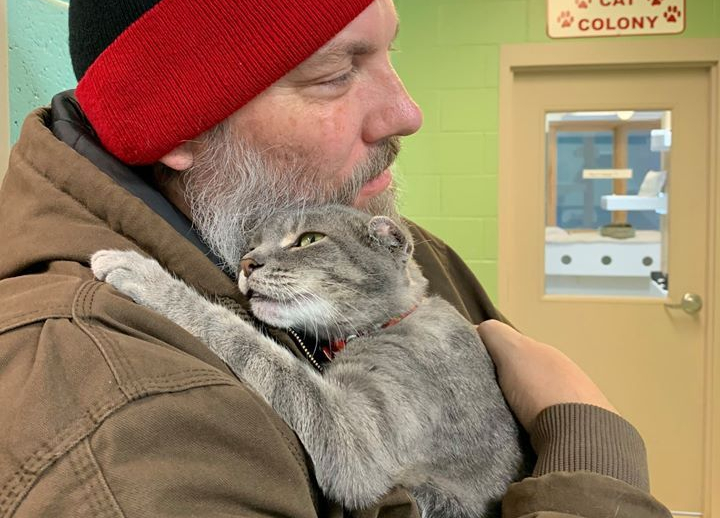
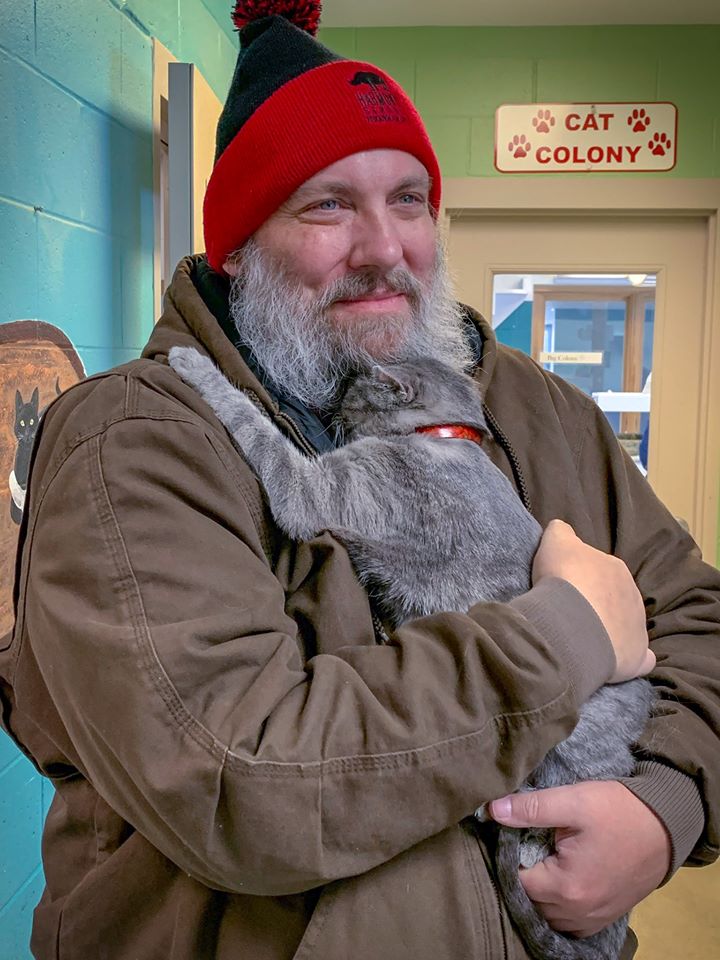
The green-eyed silver tabby gave Bloomington, Ind., police dispatcher Matt Smith a big hug when he visited the city’s Animal Care and Control department to help photograph an adoption drive this week.
Nevada is five years old, just like Buddy, and she looks like she could be his sister. If you’re in Indiana and you’re looking to adopt a cat, check out the shelter’s Facebook page. Her adoption fee has been reduced to $20 during the drive.
Here’s hoping little Nevada finds a great human and a comfy home.
Police dispatcher Matt Smith and Nevada, who has been waiting for a human and a home. Credit: Bloomington Police Department
What’s wrong with the above picture? Anyone who knows anything about my species will recognize immediately that the collar is on the wrong person. The “cat” should be leading the human around, although a collar isn’t strictly necessary for humans — usually a few stern meows are enough to get the message across.
Kat Lyons (come on!) fastens a tail to her behind, wears a pair of kitty ears on her head, and for some reason completes the look with a Catholic school girl skirt, because apparently my species dresses like Catholic school girls. (Plaid tabbies, anyone?)
In the accompanying video, Ms. Lyons climbs up onto a dinner table and awkwardly laps at a bowl of milk with her tongue.
”People are like ‘Oh, you’re not really a cat,’ and I’m like ‘I feel like I really am, though,’” Lyons told a documentary crew from Barcroft.
So what do I really think about all of this? I say, “Stop appropriating my culture!”
Licking your own butt, pooping in a box and sleeping 16 hours a day are traditions that have a long history among my people, and outsiders simply cannot understand the subtle cultural nuances of such behavior.
For example, screaming bloody murder when dinner is 45 seconds late is a tradition that has deep roots going back millennia to the days of the First Kittehs, and shitting on things is the time-honored way of registering displeasure.
It’s one thing to say “Stop! I don’t like what you’re doing!” and quite another to build a monument of fecal matter on your human’s pillow as a means of expressing deep dissatisfaction.
A cultural appropriator appropriating my species’ well-known affinity for boxes. An outrage!
But if Ms. Lyons really wants to be a cat, she must pass the Trial of the Tabbies, and prove herself by catching and eating a delicious raw mouse.
She must possess the ability to groom herself, and she must demonstrate she can’t open cans anymore.
That’s a human superpower, and if Kat Lyons wants to be a real cat, she must forfeit her ability to perform such sorcery and meow for dinner like the rest of us.
You’ve got a dilemma, one that has tormented many a vegan before you.
While you’ve joined the ranks of the enlightened and meat-free, you also have a cat…and your cat eats meat.
Your vegan side urges you to put kitty on a strict plant-based kibble regimen. Your rational side reminds you she depends on you and cutting meat from her diet will seriously harm her.
“I will murder you for this, human!”
Cats may be obligate carnivores, but how can you admonish the meat-eating savages of humankind when your four-legged friend gobbles down chicken and turkey flesh every day?
Fear not, vegan friends, for a genuine solution is upon us! I present to you Buddy’s Old-Fashioned Meat-Based Vegan Cat Food. It’s vegan with meat added, meaning kitty gets all the nutrients she needs for a healthy, happy life while you get to tell everyone that you AND your cat are vegans.
After all, what is the purpose of veganism if you can’t tell everyone you meet that you’re a vegan?
Buddy’s Old-Fashioned Meat-Based Vegan Cat Food, available wherever fine cat foods are sold.
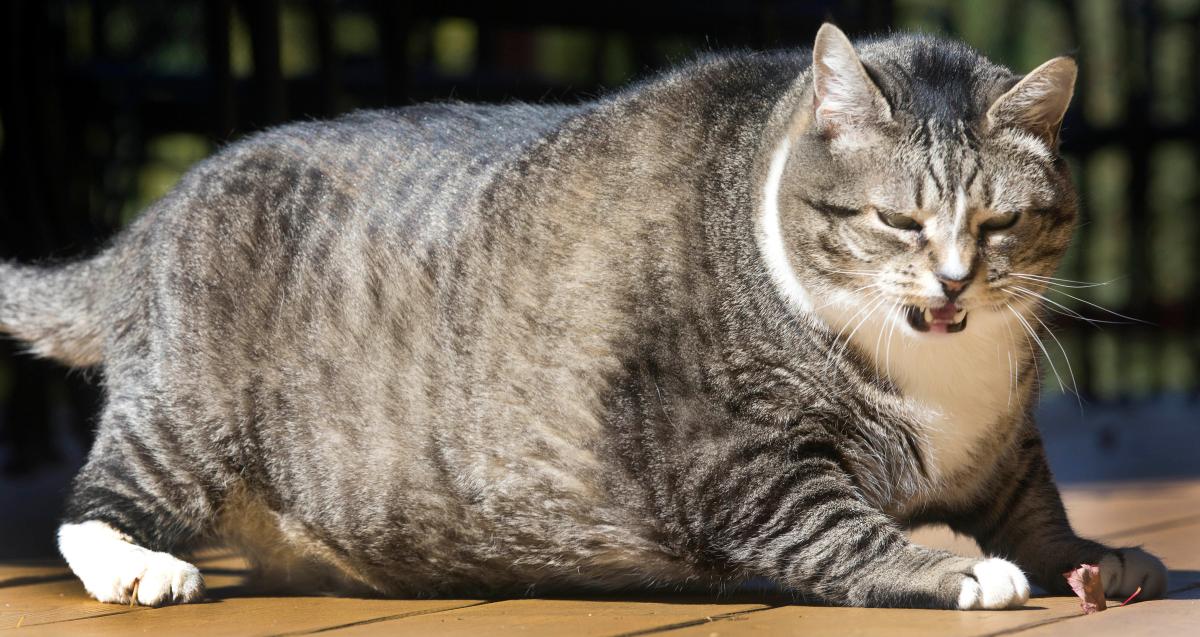
The subject of fat cats has come up quite a bit lately here on Pain In The Bud.
First we wrote about Barsik, the 40-pound chonkster who requires a stroller for transport because he’s too big for a carrier. On Thursday we blogged about Mikhail Galin, who hatched an elaborate plan to board his 22-pound tabby on a flight after Russian Airlines told him his feline was too fat to fly. And we’ve been following the struggles of Cinder, a 25-pound kitty who really hates treadmills.
Much to his chagrin, Buddy is in on the action too: I’ve cut back on his treats and portion size more as a preventive measure. He’s not fat, but he’s not as ripped as he thinks he is either.
So how do we deal with the feline obesity crisis? We asked Julia Lewis, DVM, who knows a thing or two about cats: Dr. Lewis graduated from UC Davis School of Veterinary Medicine, the nation’s top veterinary school, and has 25 years’ experience working with shelters, universities and most recently in public health, where she provides wellness care to pets of the homeless on the west coast.
This interview has been lightly edited for length and clarity.
Pain In The Bud:A new study says more than half of all US pet cats are overweight or obese. Why are so many cats so chonky?
Dr. Lewis:We Americans like everything big: cars, houses, and unfortunately pets. Too many people equate food with love for themselves as well as their kids and pets. Yet another reason for people to have a family veterinarian that they trust is to have someone objectively tell them if their pets are in the healthy size range.
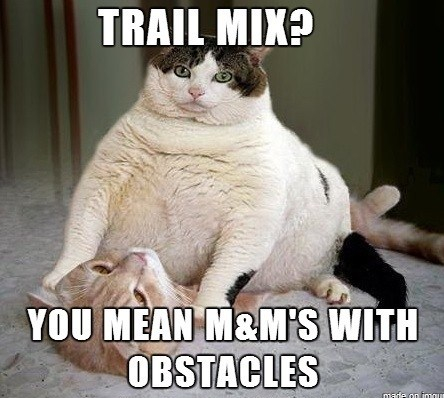
Meme imitates life.
PITB:How do cat owners react when you broach the subject?
Dr. Lewis:I’m glad I’m not in private practice. I feel uncomfortable telling people their pets are overweight because I happen to pack too many extra pounds myself. I’m nervous that when I tell pet owners their pets should lose weight, the owners will think to themselves that I should practice what I preach. (Although I try really hard to keep my own pets in decent weight so that I can practice what I preach from a professional perspective). However, when I have told people their pets can stand to lose some weight, I try to do it with humor so that the owners realize that I’m not making a judgement about them. Descriptions I’ve used to broach the subject include the pets appear Rubenesque. (One used by a particularly flamboyant resident that I had when I was a student.) I’ve also used roly-poly and fluffy. When the weight is in the severely large range, I have used round as a descriptor. Mostly, owners who realize their pets may have a problem really only want advice and that’s what I try to do for them, like I did for you when you wanted to put Buddy on calorie restriction. I also try to understand that it’s hard to lose weight, for oneself as well as their loved ones, whether two-legged or four.
PITB:What about cat owners? What’s the best way for those of us who aren’t veterinarians to determine if our cats are heavier than their ideal weight?
Dr. Lewis:Body condition is very subjective. Pets come in all sizes. This is especially true for dogs since there are such diverse breeds. Think about the extreme size and weight differences between a Chihuahua or Yorkie compared to a Great Dane or a Mastiff. Cats do have breeds, but for the most part there the size difference isn’t as extreme. Yet cats come in petite, average, and large frames. It’s not unusual for certain breeds like oriental short hairs to average only about 6 to 8 pounds and breeds like the Main Coon to average in the teens up to 25 pounds.
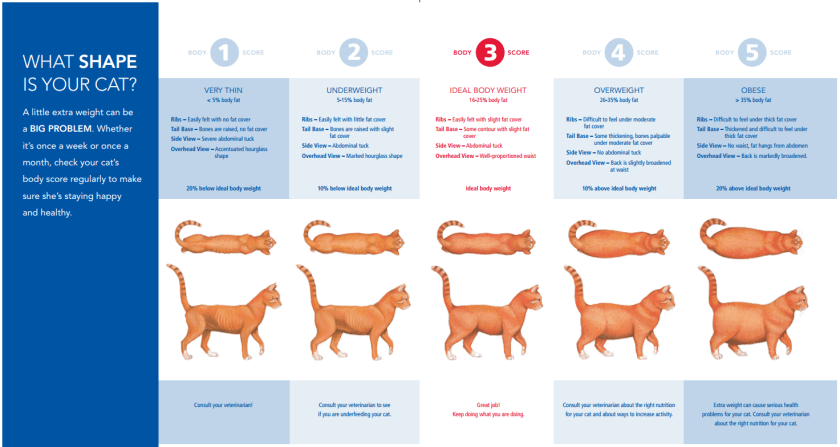
While healthy weights vary according to breed and size, the eye test is a good way to gauge your cat’s fitness.
That’s why it’s important to have an objective determination of body condition. Use of the body condition scoring charts puts everyone on the same page when describing a pet’s body condition.
PITB:What about fur? Does the eye test work for long-haired and extra fluffy cats?
Dr. Lewis: Beyond having a chart, owners need to be trained on how to assess their pet’s body to compare to the chart beyond just a visual measurement. Fur can interfere with accurate visual assessments of how much fat a pet may be carrying. Pet owners should have their veterinarian show them how to feel (palpate) their pets to determine how much padding beyond the fur their pets have.
PITB:Okay, so let’s say we’ve committed, we’ve talked to the veterinarian and we have a plan. How should we handle the sometimes incessant meowing and crying from a hungry cat? After all, we wouldn’t be their servants if they weren’t so persuasive.
Dr. Lewis:Dealing with pets that show their displeasure in not eating whenever and whatever they want is difficult. I have my own pets so I can really empathize. My dogs are pretty good about only eating when they’re fed but my cat is another story. But as hard as it is, ignoring them does work. I don’t react to my cat when he starts screaming. I’ve certainly not given in to him by giving him food. So, he doesn’t usually bother to yowl at me when he thinks he should be fed. My husband does give in and when my cat sees my husband, he gets incredibly vocal and demanding. So we’ve each trained the cat to give us very different behaviors. In an effort to get my cat to stop being so demanding, I’ve trained him to dance for his food. He now knows that even when we get up to feed him, he still can’t just dive right into the food, he has to do some spins. I tend to make him spin more than my husband, and that’s another reason he isn’t quite as insistent about making me feed him. One thing my cat is really good about is that he doesn’t get physical with us when he wants food. He’s just loud. If a cat does tend to get physical, owner may have to engage them in a vigorous play session before feeding to dissipate some of that pent-up frustration and energy.
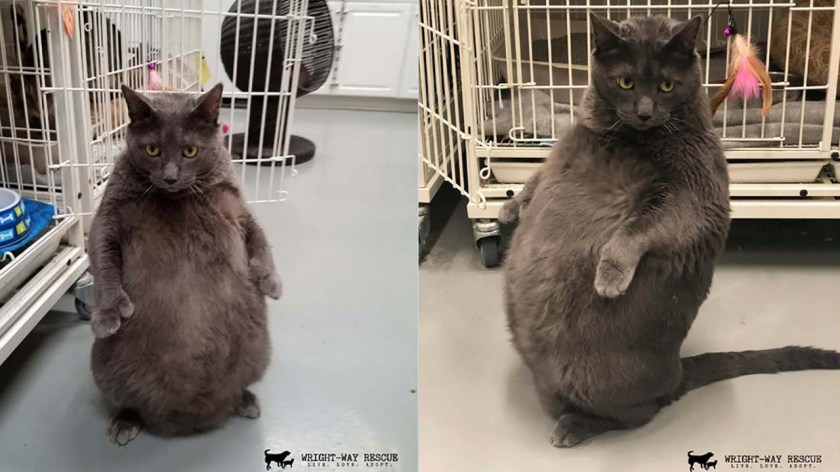
Bruno, a Russian Blue from Chicago, came into the shelter at a hefty 25 pounds. The quirky cat, who sometimes walks on his hind legs only, was adopted by a couple who put him on a diet. (Source: ABC7NY)
We’d like to thank Julia for taking the time to answer our questions and provide expert advice on a tough subject. Buddy, however, would not like to thank Julia for being complicit in the Great Treat Famine of 2019. He considers it a crime to come between a cat and his snacks.
Has your cat struggled to keep the pounds off? Tell us about it in the comments!
Russian inmates have been using cats as couriers for drugs like hash and heroin.
Apparently some criminals in Russia avoid jail sentences and are sent instead to penal colonies, which are closed compounds resembling Laconian communes instead of prison blocks.
And apparently using cats to smuggle drugs into penal colonies is a favorite pastime among the Russkies — every few months a new story hits the headlines, detailing doomed drug delivery operations using kitties as couriers.
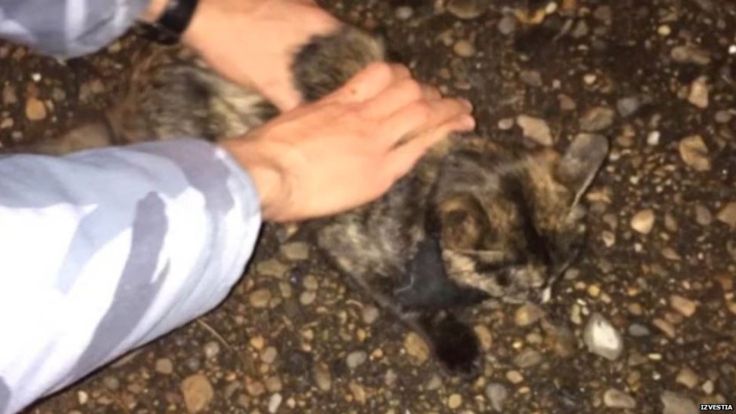
The latest comes to us courtesy of Tatarstan, where an inmate’s non-incarcerated confederates withheld food from a cat for a few days, then slipped hash in a hidden sleeve in kitty’s collar before setting him loose near the penal colony.
The hungry cat headed toward the compound where an inmate was presumably waiting with pungent chow to lure his unsuspecting mule. But guards realized there was something odd about the cat, and after a short chase around the grounds they were able to corner the purrpetrator, according to the BBC.
Here’s the sneaky tortoiseshell immediately after penal colony guards intercepted him in late October. He doesn’t look happy that he’s been caught and he’s missed some meals:
Can we get some Friskies for this guy already?
Meanwhile in the city of Novomoskovsk a case against a local inmate is on the brink of collapse after the cat who allegedly delivered drugs to him managed to escape from custody.
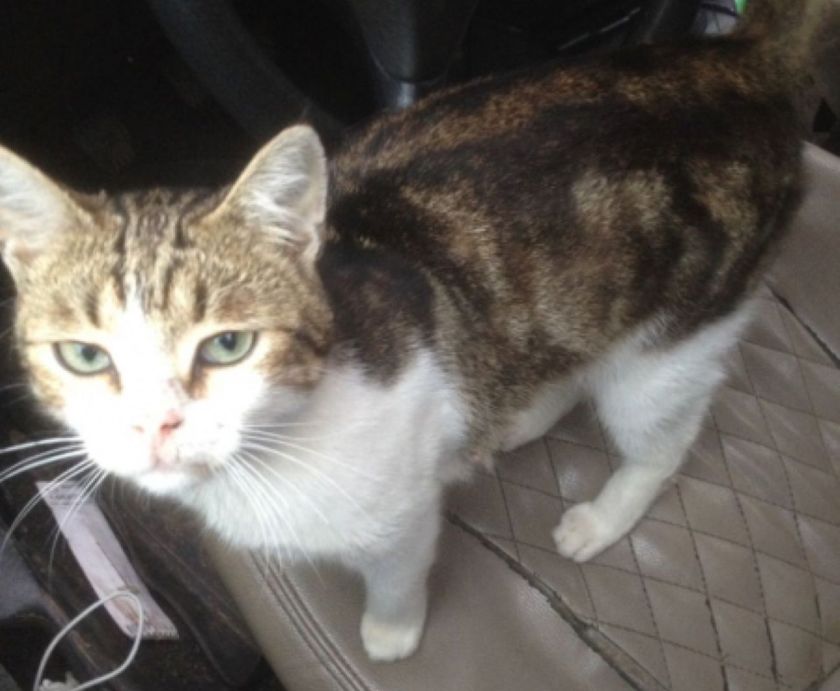
The slippery kitty was allegedly an accomplished mule when authorities nabbed him and found heroin in his collar. Three witnesses told prosecutors the tabby was a reliable enough courier that his owner, Eduard Dolgintsev, took regular drug orders for other inmates, per Russian media reports.
WANTED: Dmitry the Deliverator, on charges of delivering smack to Russian inmates and talking smack to Russian prosecutors
The defense isn’t buying it.
Dolgintsev’s attorney told Russian newspapers he wanted to run experiments to see if the cat really would make reliable runs to and from the penal colony, hoping to demonstrate to the court that the idea was more fanciful than feasible.
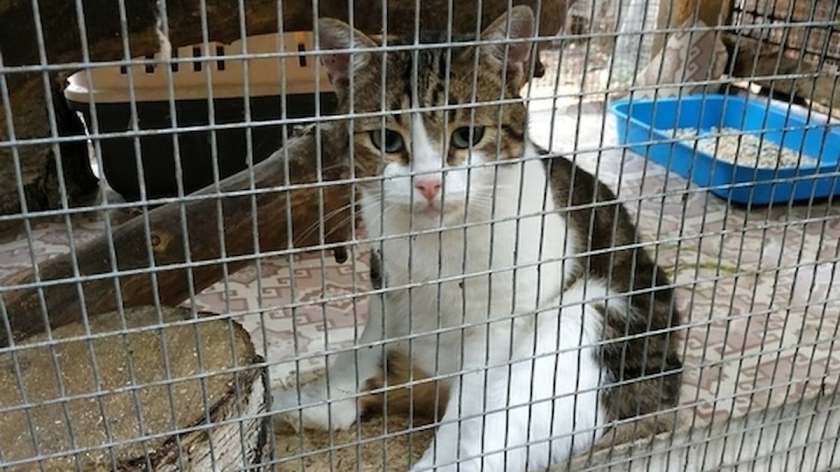
The cat, who was considered evidence in the case, was kept in a “secure location” in a petting zoo facility, but when Dolgintsev’s attorney went there to check on the feline he was told it had slipped custody earlier, when staff let it out of the enclosure to get exercise and two dogs began creating commotion.
With the kitty’s dramatic escape, the case against the inmate looks shaky. A Russian legal expert told Kommersant.ru that the case would be dismissed unless “proof was previously obtained that the cat really did serve as an instrument in the crime.” Proof like lab test results showing traces of heroin on the his fur, for instance.
In the meantime, a very interested Buddy is wondering if the same method could be used to smuggle catnip and silvervine into The Big House, aka Animal Control…
This photo shows the Houdini of Novomoskovsk before he hightailed it out of his holding pen.







 Pain In The Bud