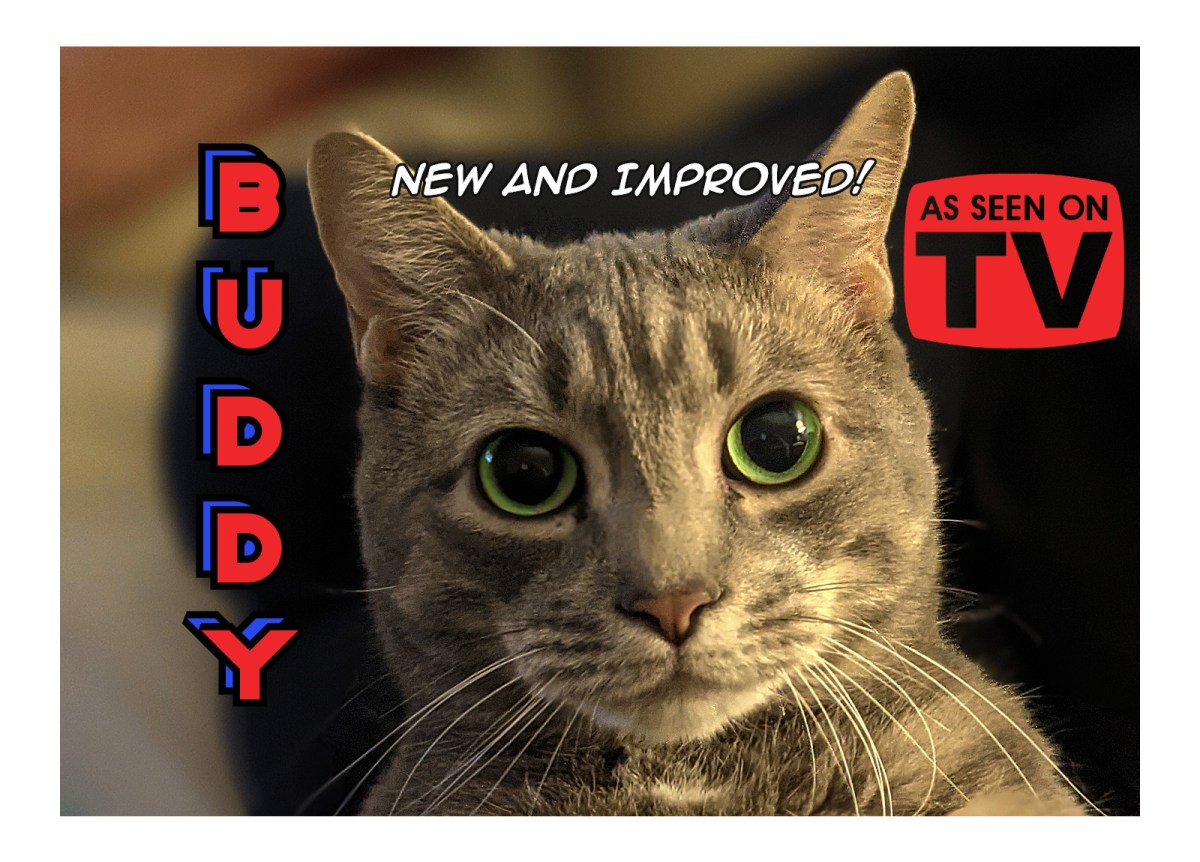
Thanks to our patented Silky Smooth™ technology, your new Buddy’s fur will feel velvety and softer than ever when you pet him!
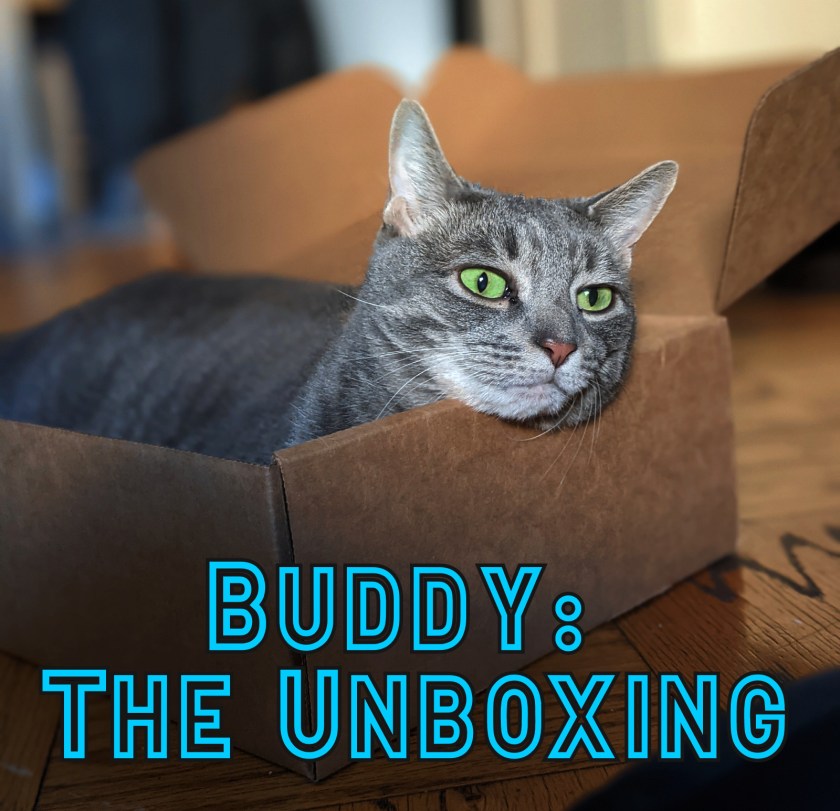
A very special package came in the mail today:
FRAGILE: “Hmmm. Must be Italian.”
Amazon gave me free shipping on my brand new Buddy, which is supposed to be a vast improvement on the original first-generation Buddy. This Buddy is “more delightful than ever,” according to the marketing materials:
“The amazing Buddy 2.0 is 15 percent cuter, 0.003 percent more brave, and is better than ever at impressing your friends with his vast knowledge of poultry and useless trivia! Thanks to our patented Silky Smooth™ technology, your new Buddy’s fur will feel velvety and softer than ever when you pet him! IMPORTANT: Do not feed Temptations to your new Buddy. Doing so will void your product warranty.”
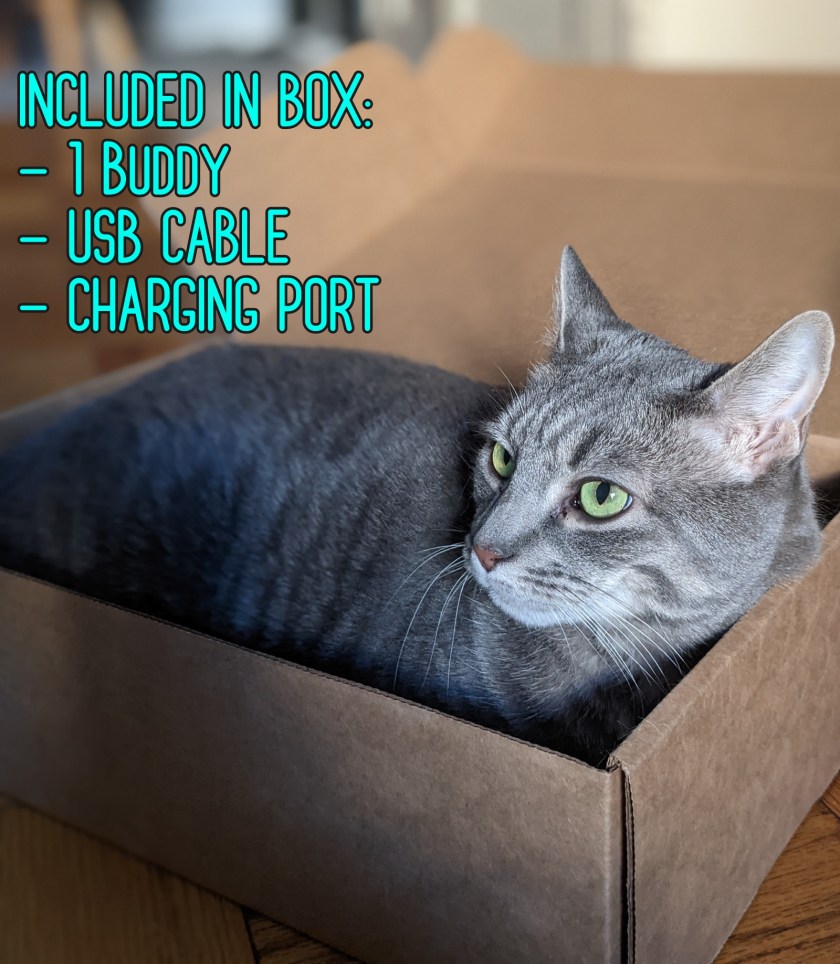
This model must be plugged in 12 to 16 hours a day to recharge. Indicator lights (his eyes) will glow when fully charged.
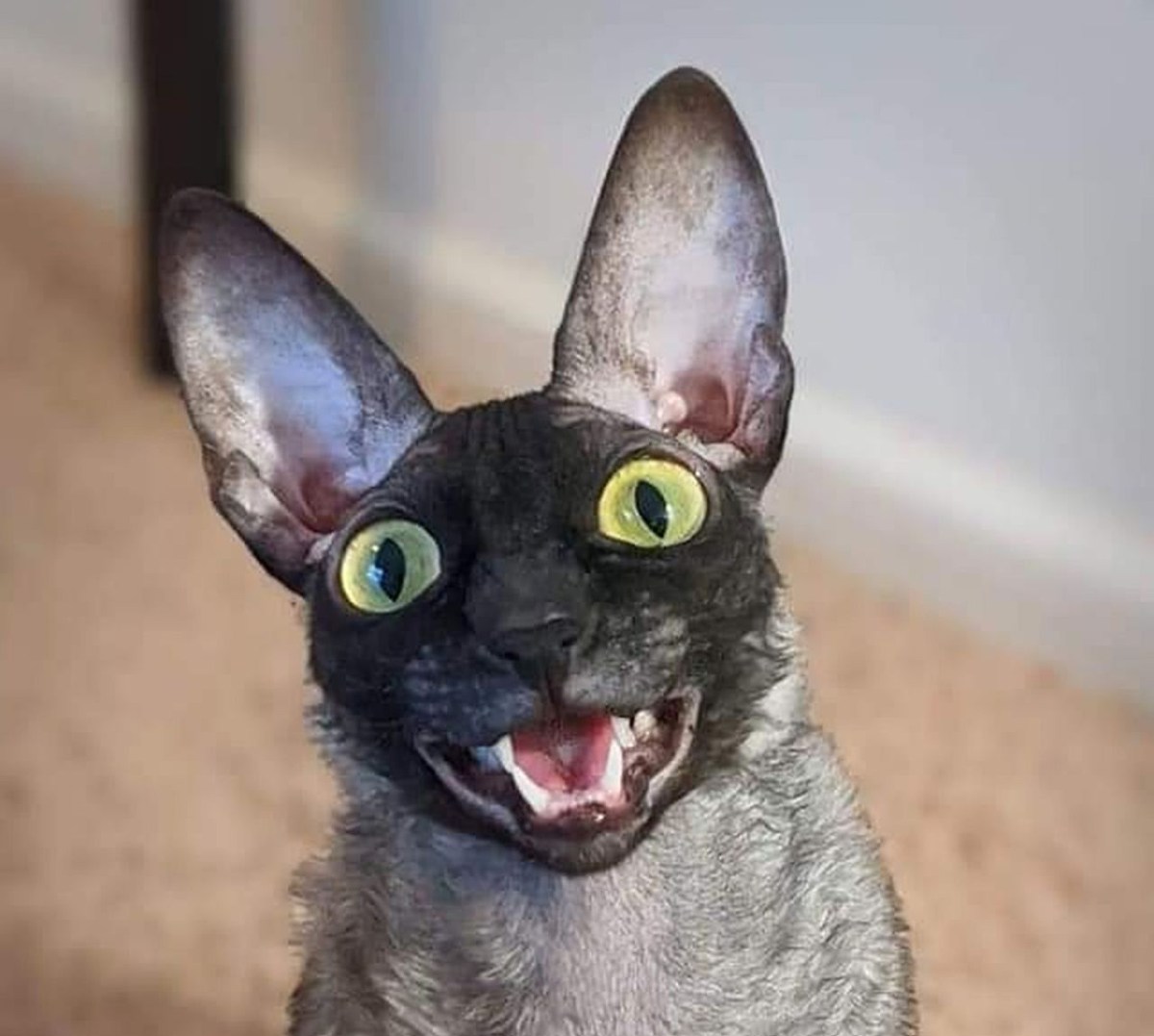
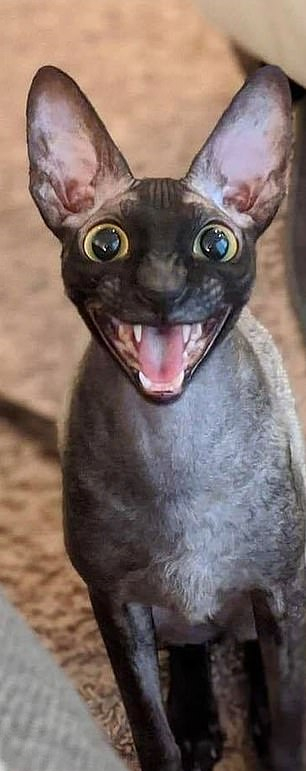
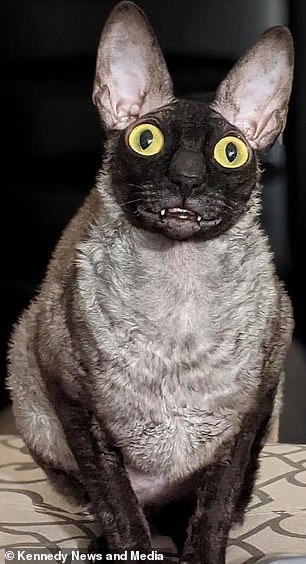
A Cornish Rex named Pixel is turning heads with his unusual features and bizarre-looking expressions.
Meet Pixel the cat, whose dread visage is so terrifying it prompted Buddy to run screaming and hide behind the TV:
Pixel the cat.
Buddy isn’t the only one to recoil in horror after seeing photos of the two-year-old Cornish Rex.
“All the time people say ‘this is the creepiest cat I’ve ever seen’, ‘my sleep paralysis demon has come to life’ and if they saw him in the middle of the night they’d have a heart attack and it would scare them to death,” said Alyson Kalhagen, Pixel’s human. “People say all the time that he’s a ‘demon cat’ who ‘must be possessed’ and that the devil’s taken control of him. It’s kind of a recurring theme.
“I think it’s pretty funny because I usually just say ‘imagine coming face to face when you’re trying to scoop the litter box.'”
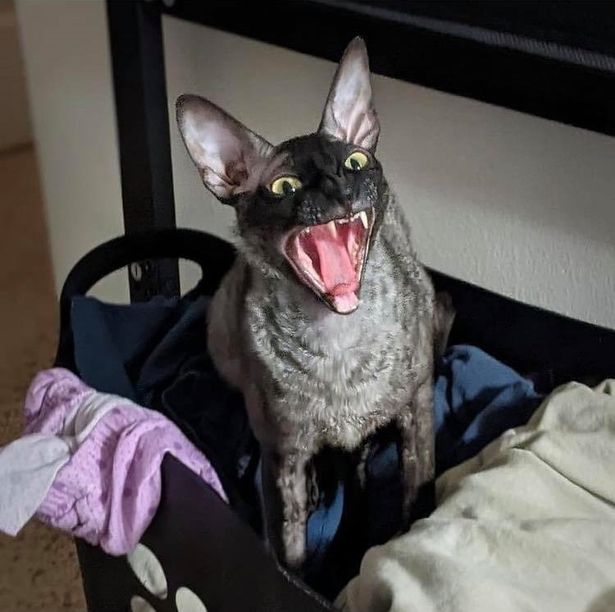
“I will eat your soul…if you don’t give me treats!’
Kalhagen even heard from a self-described exorcist after she began posting photos of her wide-eyed feline, who favors making weird faces that accentuate his freakiness.
The “exorcist” suggested caging Pixel and praying over him, cautioning that the cat was possessed by an entity.
It probably goes without saying, but for the benefit of our readers who aren’t familiar with Catholic belief and customs, exorcists are longtime priests who must complete a great deal of instruction — on top of the usual nine years of education including a post-graduate theology degree — before they can become exorcists. It’s not a job you can seek out or volunteer for, and exorcists are rarely publicly identified.
So it’s a safe bet to say the person who contacted Kalhagen is a self-proclaimed exorcist at best. Still, the person’s conviction that the cat is possessed is amusing:
Pixel, who has a thousand adoring fans on Instagram, is having the last laugh:
“All those who defy my demands for snacks will perish in the searing flames of my eldritch wrath!”“Is he…is he gone? You sure?”
A company offers DNA tests for cats, similar to the ancestry tests offered to people. What can you learn about your cat?
Ever wonder about your cat’s parentage, breed and potential health problems? A mail-in DNA test for cats promises to fill you in on the details.
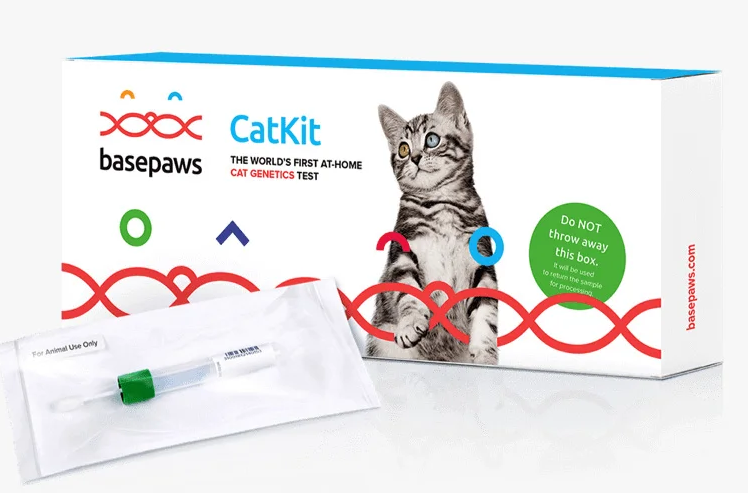
Basepaws, a Los Angeles company, offers a kit not much different from the human mail-in DNA tests: You swab the inside of your cat’s mouth for a few seconds, secure it according to the provided instructions, and mail it to the company, which processes the results.
The basepaws kit.
In four to six weeks you’re notified that your cat’s results are ready, and you’ll get a report with a breakdown of genetic identity, associated breeds and potential health issues to watch out for.
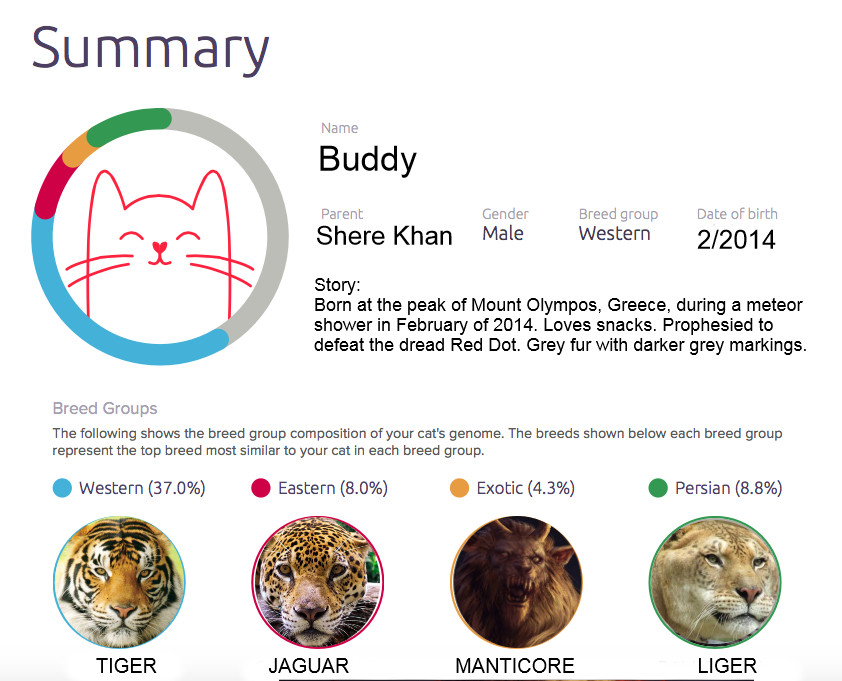
This presents a problem for me, of course. Buddy thinks he’s descended from a long line of legendary warrior felids. I took a regular Q-tip, made a big show of swabbing his cheek for his DNA, and told him I was mailing it away for analysis.
Then I cooked this up:
Buddy’s fake results.
You’ll notice the results don’t come close to adding up to 100 percent. The company’s founder says that’s because the more people test their cats, the more accurate the results will be, with fewer unknowns as the overall database expands.
Each cat’s report is updated indefinitely as the company continues to test. Checking back over subsequent months and years will yield updated information on your cat, the company says.
All jokes aside, it would be interesting to find out more about the Budster’s background. All I know is that his mom was an indoor cat who wasn’t spayed. She went into heat, she got out, she came back and the rest is history.
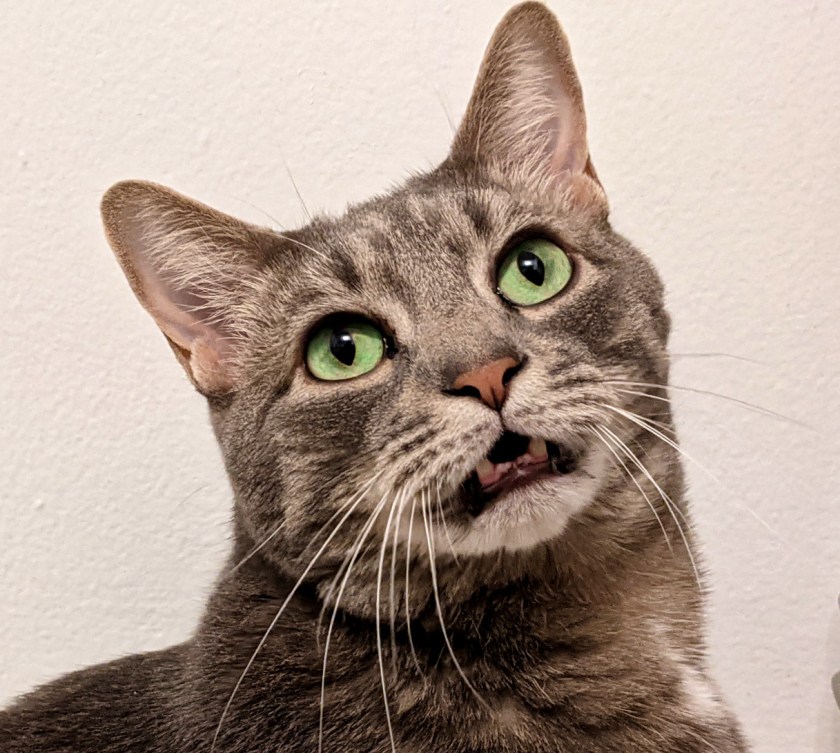
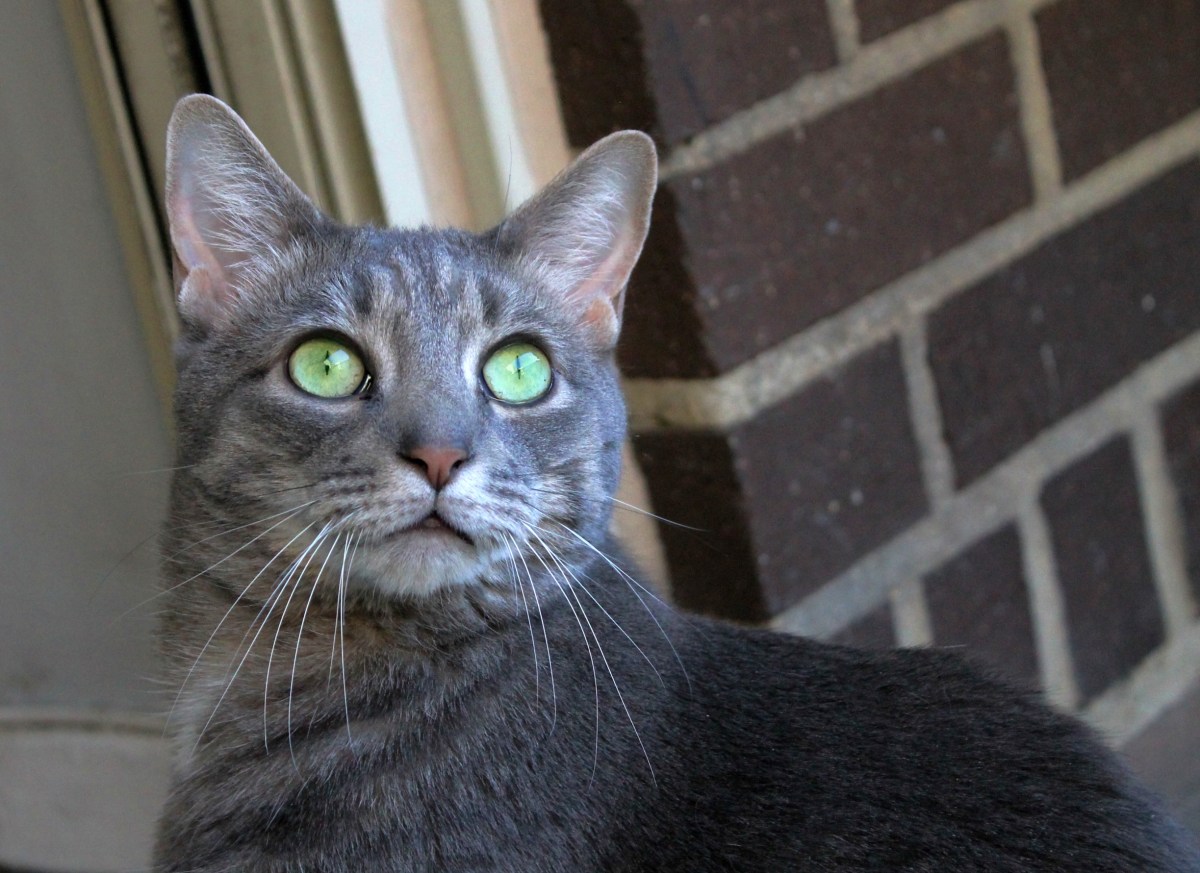
Because he’s a big talker, I’ve always wondered if Bud might have a bit of Siamese or one of the other chattier breeds in him. His coat is pretty short, extremely soft and all grey/dark grey in a tabby pattern, except for a single white tuft on his chest.
Interestingly, most of his tabby stripes are unbroken, a trait usually seen in hybrid cats.
He’s comically incapable of certain things, but almost frighteningly intelligent in other respects, and he wears his emotions on his sleeve…er, paw? Maybe there really are secrets to unlock in his DNA.
Cat DNA analysis is in its infancy
On the downside, Basepaws DNA tests don’t come cheap — with two packages priced at $129 and $99 — and, as a review in Wired notes, cat ancestry reports are always going to be more vague than reports on human or dog DNA.
That’s because the practice of dog breeding is a lot older and more common than creating pedigree cat lines, and most cats are not a specific breed. Unlike dogs — whose roles range from hunting and shepherding to assisting the blind and pulling sleds — cats have always had one job, and occasionally two. Kill rodents and snuggle with their humans, cuddly killers that they are.
Historically humans haven’t felt a compelling need to interfere with cat procreation. The last century or so has been an exception, but breeds still represent a small minority of cats.
If you’ve had your cat’s DNA analyzed, we’d love to hear from you about your experience.
Now if you’ll excuse me, I’ve got to tell a certain Tiger-Manticore-Jaguar about his impressive felid lineage.
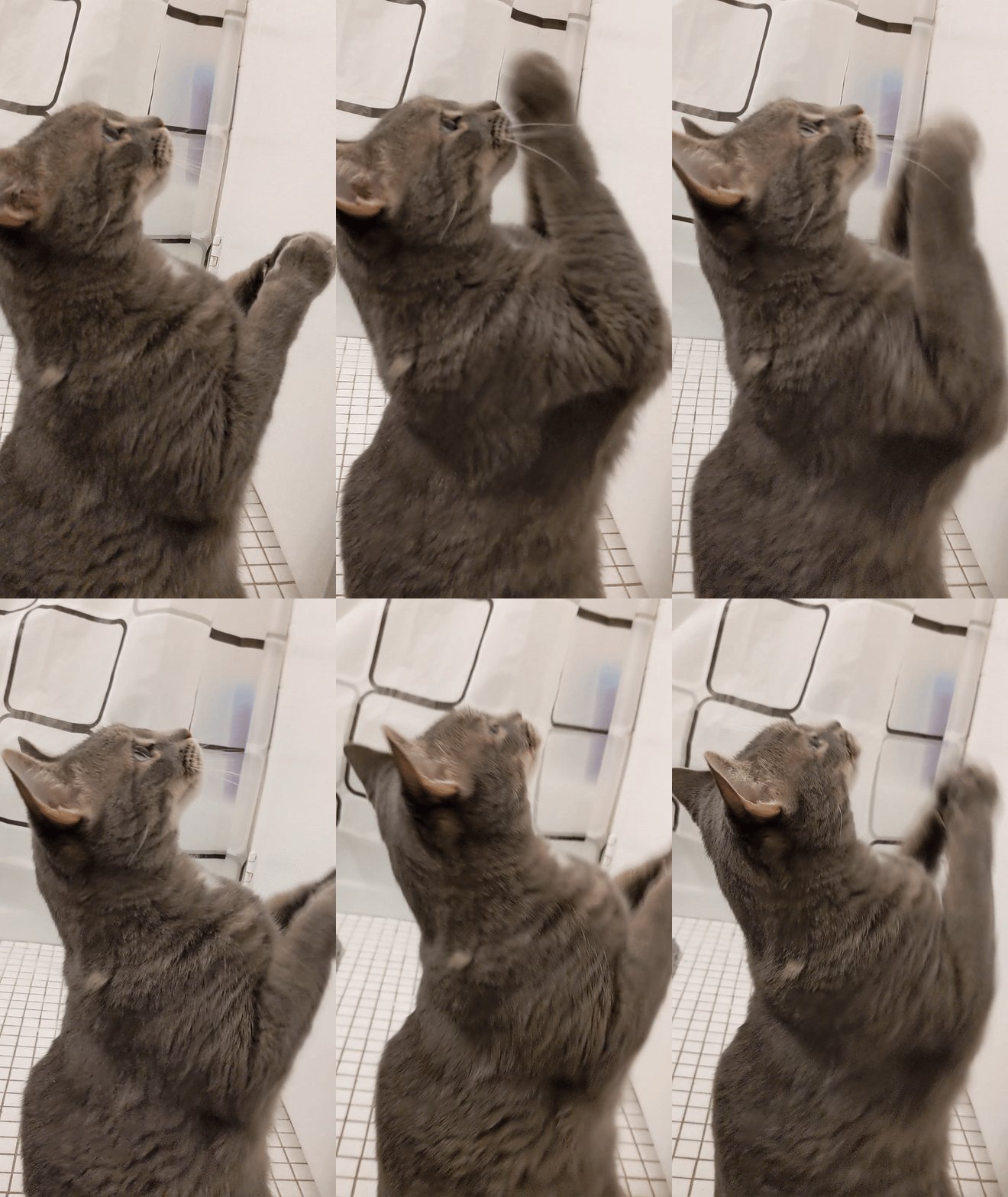
An odd, unexplained cat behavior caught on video. Why do cats make this gesture?
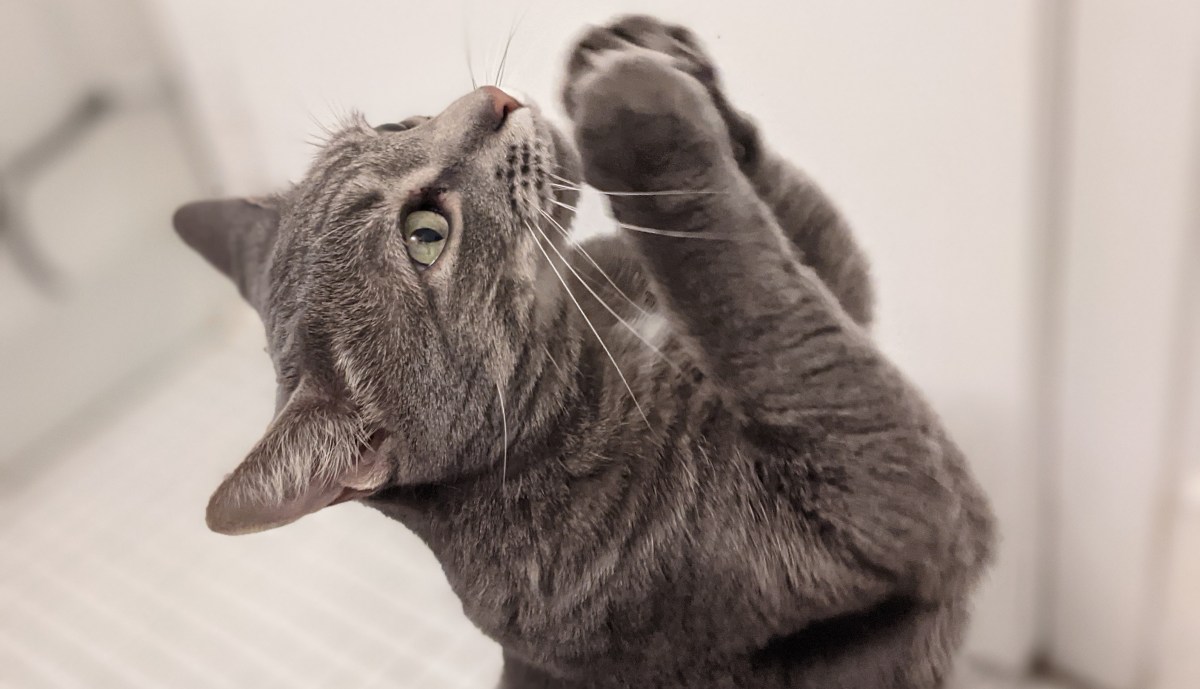
I managed to film a brief clip of Buddy enthusiastically “praying.”
This gesture is also called cat pleading or begging in various corners of the interwebs, but as far as I can tell it really doesn’t have anything to do with asking or pleading. I’ve seen my cat do the same motion while he doesn’t think anyone else is around, while he’s at the window looking at birds, and at other random times.
The gesture is so random that this is the first time I’ve managed to get a decent clip of it. Usually by the time I’ve got my phone pointed at His Grace and begun recording, he’s finished his “prayers.”
I have no clue what it means or why some cats do it. All I know is that it’s a fairly rare thing. Perhaps a cat behaviorist somewhere could offer some insight.
“Dear Lord, provide me with turkey.”
Also:Happy Adoptaversary to Holly B, Retro Dee’s cute furball. Holly is named after Buddy Holly, so she’s a little buddy too, and she’s been with Dee for two years now. We wish Holly good health and many more years with her loving human, Dee.
Holly getting some Z’s in a uniquely feline way. Credit: RetroDee
A new study shows cats will take food from anyone, even people who refuse to help the cats’ owners with a problem.
Taking studies designed for children and dogs and applying them to cats has been all the rage lately after a series of studies yielded new insights about the way cats bond with their humans.
Earlier studies showed cats, like kids and dogs, look to their humans for reassurance in strange situations and derive comfort from the latter’s presence. Likewise, they’re less confident if they’re forced to face unknown situations without the “security blanket” of their big buddies nearby.
Now a research team in Kyoto has taken another study designed for dogs — known as the “helpful stranger” study — and placed cats in the same situation to find out how they react.
A new study shows cats don’t discriminate when it comes to who’s giving them food.
Both humans and dogs show a preference for what researchers call “prosocial individuals.” In plain language, it means they pay attention to the way strangers treat the people they care about. A dog who sees a stranger respond negatively to its caretaker will avoid the stranger, even if the latter is waving a delicious treat.
In the study, cats watch their owners try to open a box while two strangers are present:
“[C]ats watched as their owner first tried unsuccessfully to open a transparent container to take out an object, and then requested help from a person sitting nearby. In the Helper condition, this second person (helper) helped the owner to open the container, whereas in the Non-Helper condition the actor refused to help, turning away instead. A third, passive (neutral) person sat on the other side of the owner in both conditions.
After the interaction, the actor and the neutral person each offered a piece of food to the cat, and we recorded which person the cat took food from. Cats completed four trials and showed neither a preference for the helper nor avoidance of the non-helper.”
At first glance it looks like cats really don’t care if a person is helpful or friendly toward their “owners.” If a person is offering them yums, why shouldn’t they take them?
That sounds like exactly the sort of thing cats would do, but the research team says we should hold off on judging our food-loving feline friends. It may be that cats simply don’t understand that the stranger(s) aren’t being helpful. After all, if your cat sees you struggling with a package, does she offer to help?
If it is true, it’s not necessarily cats’ fault: We’ve long known they aren’t as well-attuned to human social cues as dogs are, a fact that can be attributed to their route to domestication. There simply wasn’t any reason to carefully breed cats to pick up on those cues, as we did historically with dogs, because cats were already wildly successful at their primary job, which was rodent extermination. Taking on cuddle and companionship duties didn’t happen until later when people began to value the little ones for more than their sharp claws and teeth.
“We consider that cats might not possess the same social evaluation abilities as dogs, at least in this situation, because unlike the latter, they have not been selected to cooperate with humans,” the scientists wrote.
The research team says the results are suggestive, but more studies should be done before drawing any real conclusions about our furry friends. Knowing cats often get a bad rep due to stereotypes and misunderstandings, we agree.



 Pain In The Bud