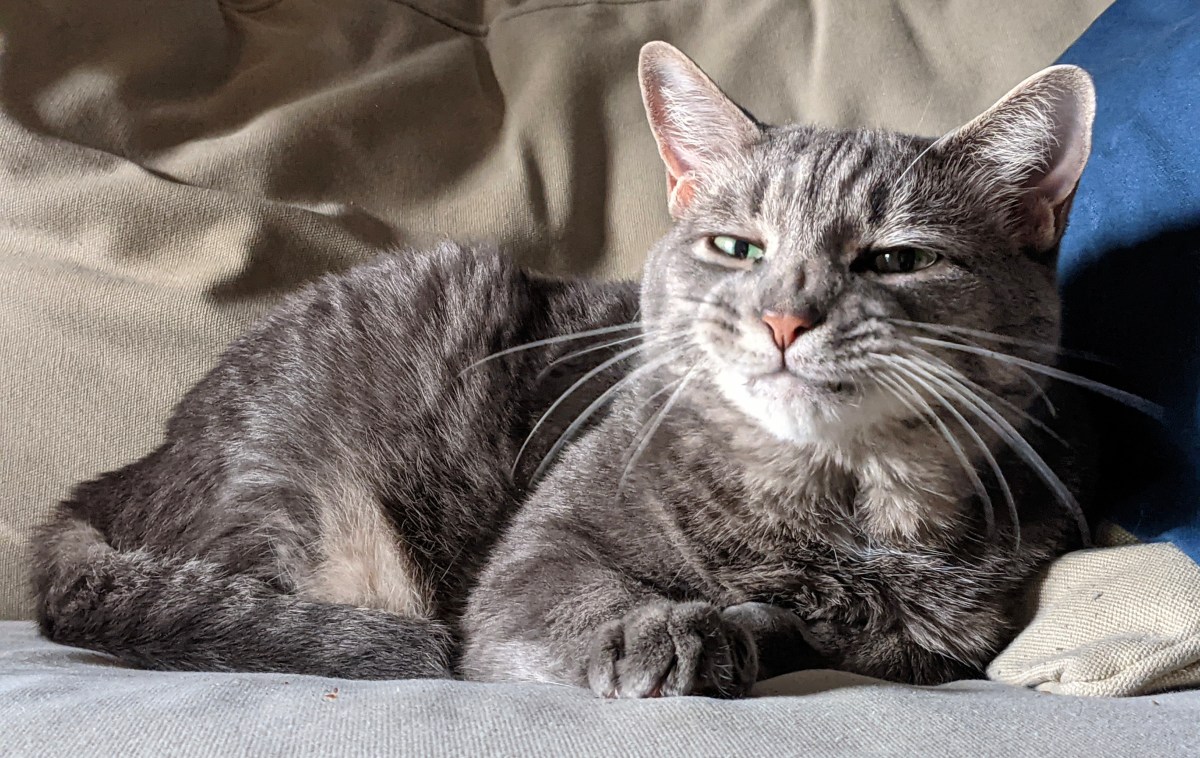
Buddy uses his powers of deduction to reveal a disturbing truth: Big Buddy is making plans to go away, and he’s not bringing Buddy.
A special message from Buddy:
There is treason in the air, dear readers! I can smell it, just as surely as I can smell an open tin of catnip from three rooms away.
There has been increased laundry activity, hushed talk of a place called North Carolina, and the suspiciously early decommissioning of the Christmas tree.
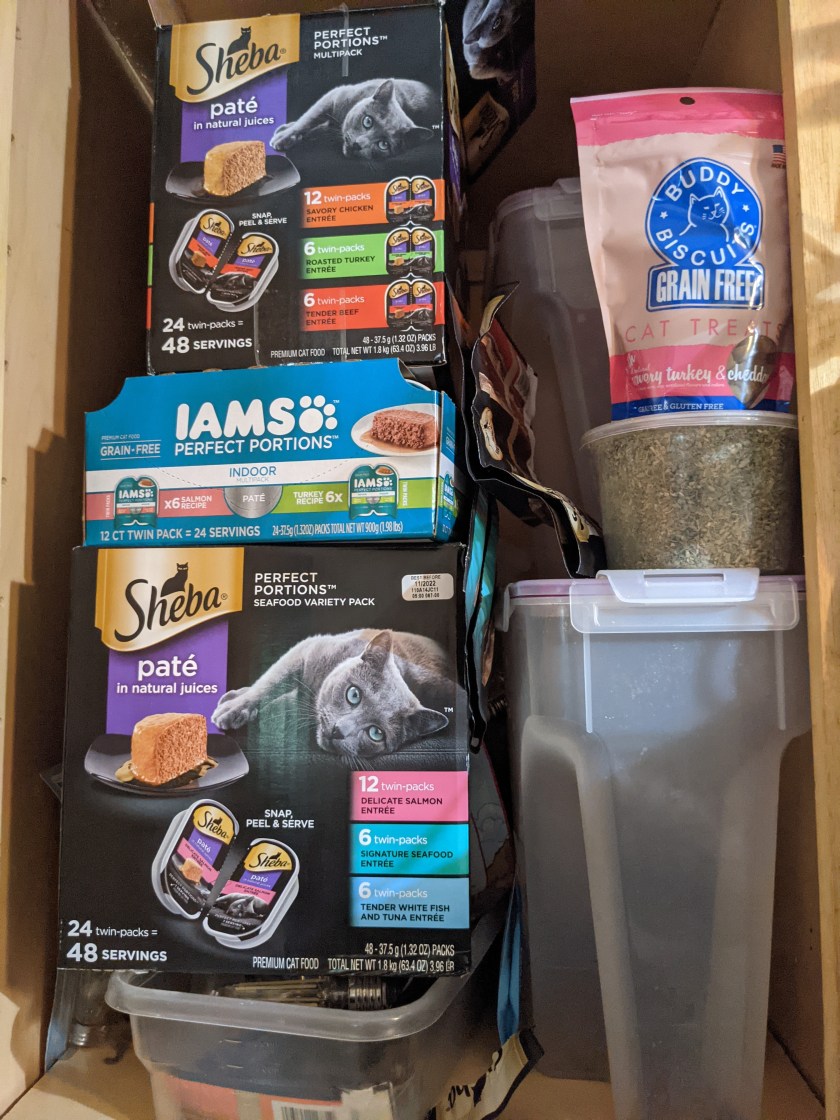
My food has been inventoried and a portion of it set aside. I am not very good at math, but it appears to be at least four or fivedays’ worth of perfect portions wet food in addition to kibble.
Most distressing of all, Big Buddy has changed into the same shirt three nights in a row: The very shirt he leaves on the bed when he goes away, believing his scent will comfort me. (Perhaps it does for less sophisticated creatures like dogs. Oh, to be so simple-minded!)
I know based on past experience that someone will enter my realm daily to feed me and give me fresh water. I also know it’s likely going to be the nice lady who used to play with me after feeding me…until I attacked her the last time she was my cat sitter.
It seemed like the right move at the time, but I regret it now. She will probably feed me and run out. 😦
What I’d like to know is: What did I do to deserve this betrayal? Shouldn’t I go with Big Buddy to this mysterious place called the Outer Banks? And what makes the Outer Banks so special, anyway? The low interest rates? The free checking accounts? A cool vault with one of those big, heavy doors you see in movies?
I guess it’s not all bad. I’ve only been sleeping 13 hours a night lately, so some down time will allow me to catch up on my beauty rest.
Also, the entire place could do with a thorough scent-marking, and not having a human around means there won’t be any complaining about it.
But who will I sleep on? Who will give me snacks when I meow for them? Who will tell me I’m a good boy and scratch my head?
Buddy would like to wish all of PITB’s readers a Merry Christmas and happy holidays!
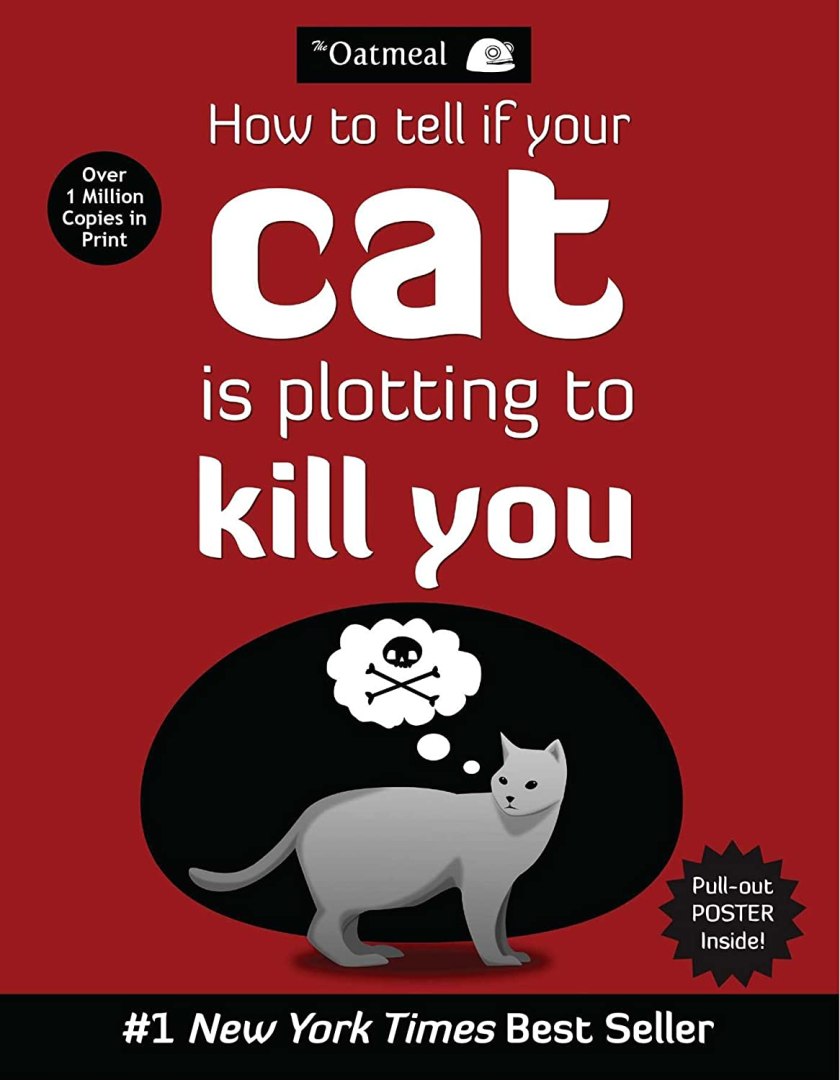
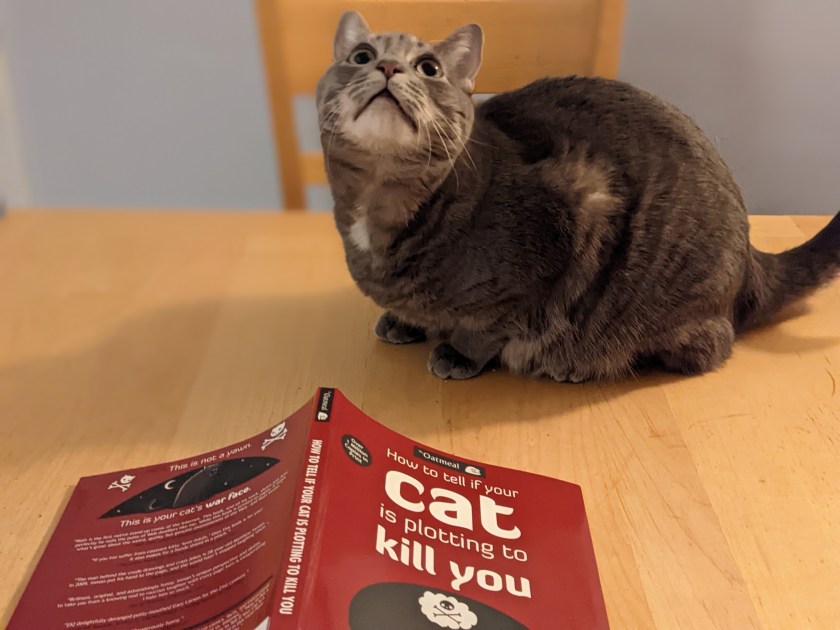
The Good Boy surprised me with a gift this year, which I unwrapped eagerly:
Buddy is such a good boy! And how thoughtful! He really is the best cat! Forget anything I ever said about him being annoying, picky or demanding.
He is a perfect little guy and any flaws I thought I saw in him were obviously my flaws projected onto him. I see that now. When he shrieks at me for breakfast while I’m asleep, the fault is mine for not anticipating his hunger and not getting up to feed him.
I mentioned how handsome and charming he is, right? Please don’t kill me!
I am very lucky to be Buddy’s human servant and vow to do a better job in all areas in 2022.
Thank you!
Buddy and I would like to thank our readers, who indulge our absurd sense of humor and massage Buddy’s ego.
We’ve gotten lots of feedback, which we always appreciate, from our regular commenters as well as people who have reached out privately with kind words, requests, brutal criticisms and marriage proposals for Buddy.
We hope all of you have a wonderful Christmas and/or holiday celebration with your families, and that Santa brings you something awesome!
“She’s not showing you her baby because it’s a cat. A feline! A house pet!”
I’m just going to present this here without comment, because nothing I can say can possibly make this any better than it is. If you’re unfamiliar with the original saga of breastfeeding cats at 40,000 feet, read our previous post here.
Buddy’s got a lot of problems with you people, and you’re gonna hear about it!
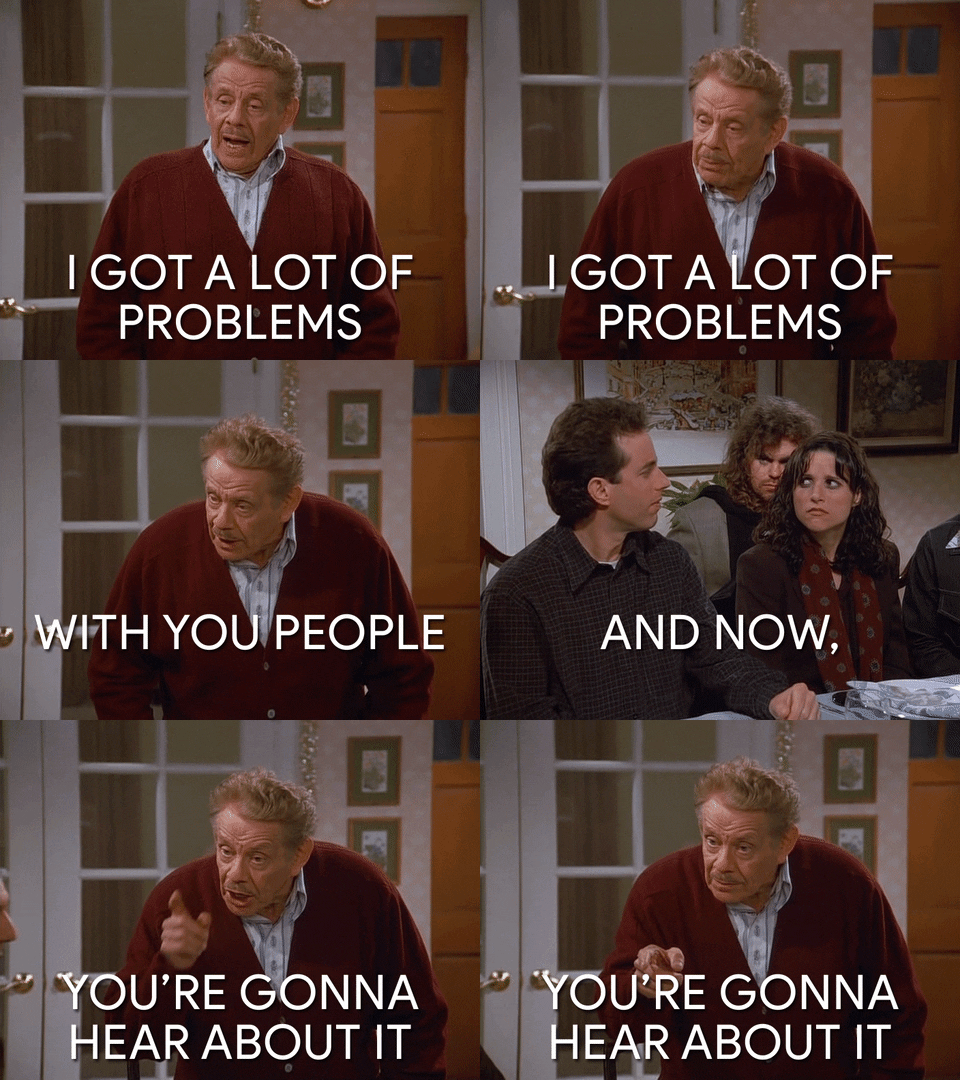
“I’ve got a lot of problems with you people, and you’re gonna hear about it!”
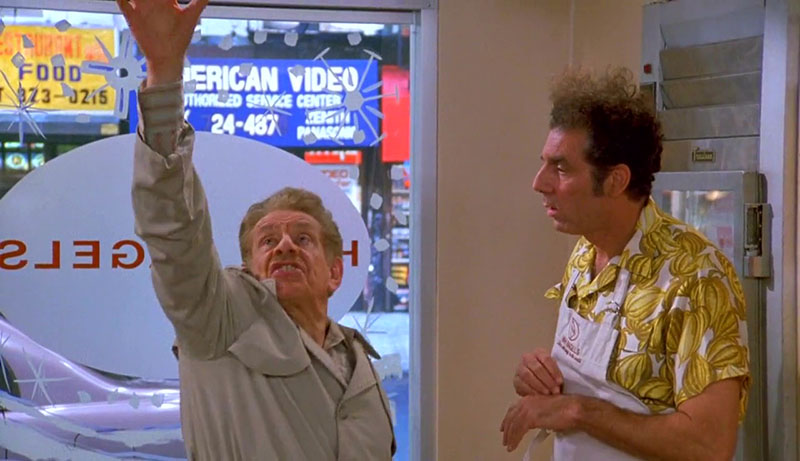
Those words have begun the tradition of Festivus, from its inception in the household of Frank and Estelle Costanza in the 1960s to the Festivian celebrations that have spread to all corners of the globe since the holiday was popularized in a 1997 episode of Seinfeld. (The Library of Congress even has a page about it.)
Festivus is celebrated today, December 23.
As Frank Costanza once explained to Cosmo Kramer:
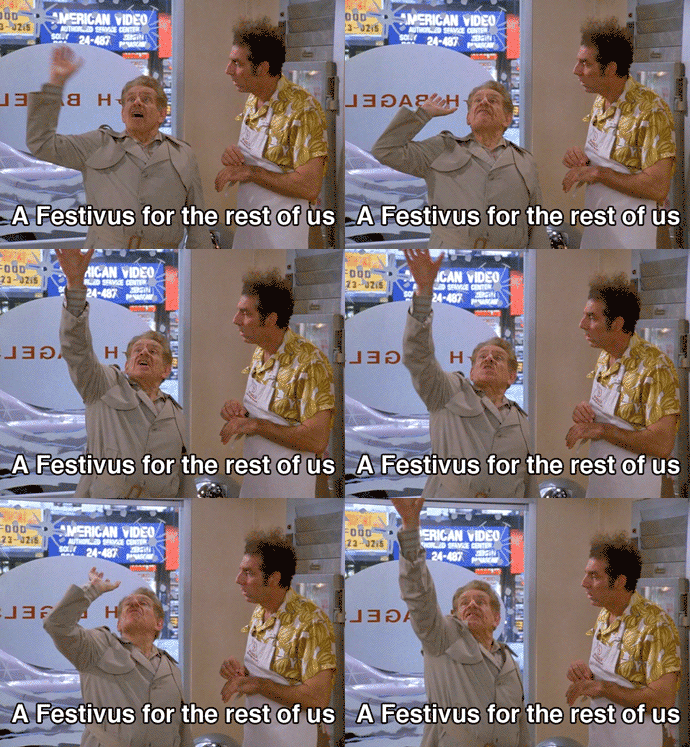
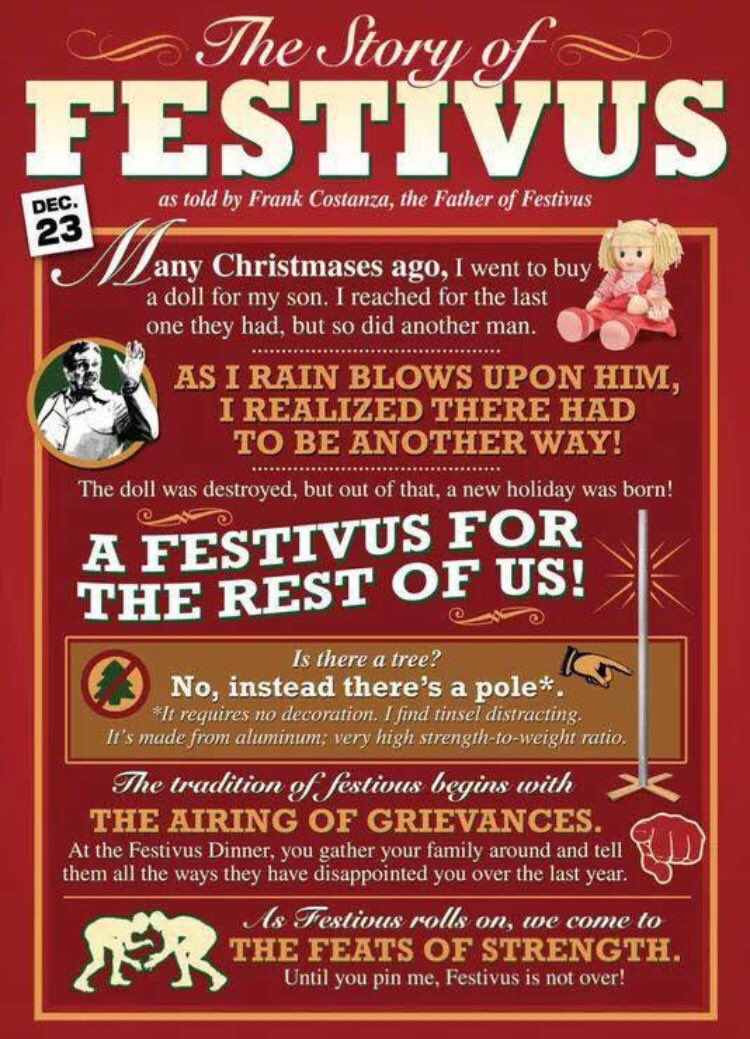
Frank: Many Christmases ago, I went to buy a doll for my son. I reached for the last one they had, but so did another man. As I rained blows upon him, I realized there had to be another way. Kramer: What happened to the doll? Frank: It was destroyed. But out of that a new holiday was born. A Festivus for the rest of us! Kramer: That must have been some kind of doll. Frank: She was.
Traditional Festivus celebrations begin with family and friends sitting down at the dinner table, but instead of saying grace and expressing thanks for the meal, the presence of loved ones and health, there’s an Airing of Grievances. In the words of Frank: “At the Festivus dinner, you gather your family around, and tell them all the ways they have disappointed you over the past year!”
In the spirit of tradition, we turn to Buddy to kick off our Festivian festivities:
The Airing of Grievances
Buddy: ‘Thank you. I’ve got a lot of problems with you people, and now you’re gonna hear about it!
Big Buddy! This is, what, the fourth Christmas in a row that I’ve asked for a Roomba? And yet if I went and snooped through your little stash of Christmas presents, would I find a Roomba? I don’t think so!
And that’s not even the worst part. You let me go without turkey for four weeks this year! Four weeks! Oh I know the excuses. ‘There’s a shortage! The country has big time logistical issues. There aren’t enough truck drivers. Transport ships are sitting off shore, waiting to dock. Store shelves are bare.’ You know what? None of those things are my problem! How could you let me go without turkey for so long?
PITB readers! I got a lot of problems with you people too, and you’re gonna hear about them! How could you allow Big Buddy to write so many posts about other cats and other things? This is my blog. The topic is supposed to be Buddy. Yet you all “lol” and “roflmao” when he writes stories about other cats. Unacceptable! And you made fun of my roar, calling it a kitten meow! I’ll have you know I strike fear into the hearts of cats and dogs alike with my roar!’
The Festivus Pole
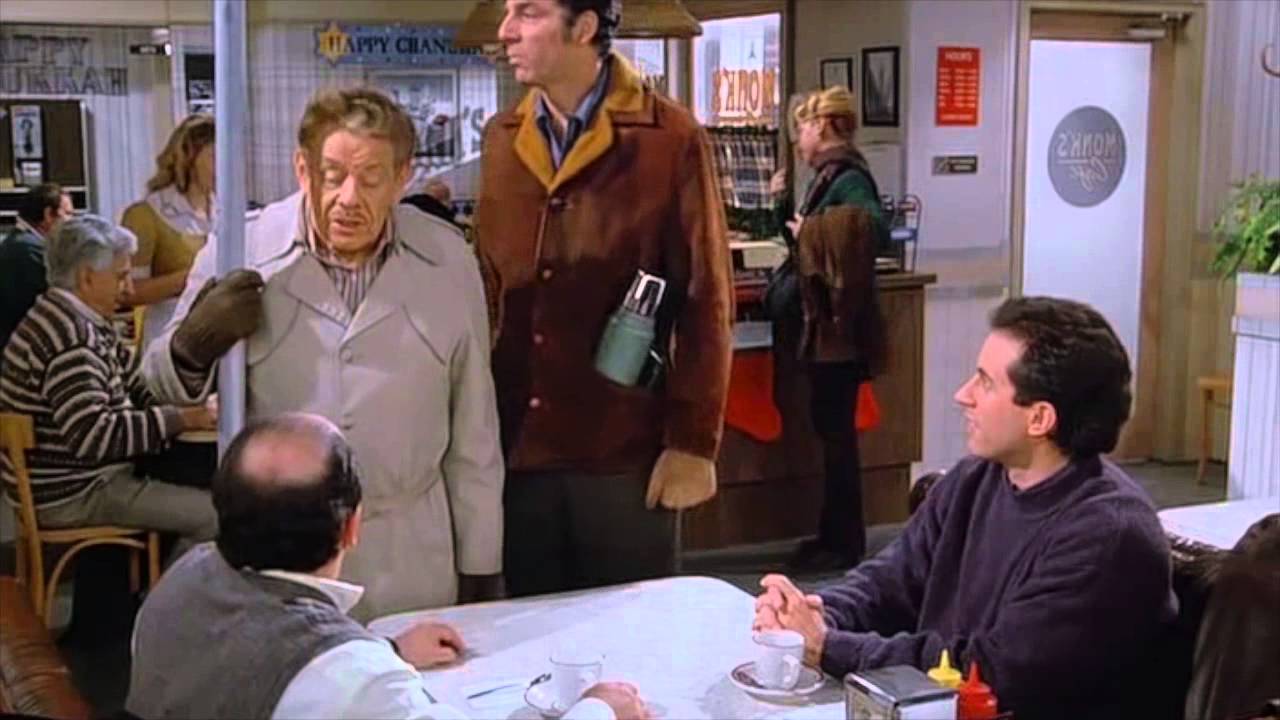
Frank Costanza, pictured with Cosmo Kramer, holds the Festivus Pole as he informs his son George and Jerry Seinfeld of the upcoming Festivus dinner.
Unlike the gaudy decorations of Christmas, the quintessential Festivus decoration is a simple aluminum pole with a high strength-to-weight ratio. It must not be embellished. Said Frank Costanza: “I find tinsel distracting.”
Festivus poles are wonderful decorations for households with cats. Your cat will love attacking it and knocking it over. For even more fun, wrap sisal rope around the pole to provide your cat with another vertical scratcher.
The Feats of Strength
After the traditional Festivus meal and Airing of Grievances comes the denouement of the holiday: The Feats of Strength. Festivus is not officially over until the head of the household is pinned in a wrestling match.
According to FestivusWeb, to avoid injury it’s acceptable — even encouraged — to celebrate with lower-stakes feats of strength, including arm wrestling, board games, a dance off or beer pong.
Buddy has never been defeated in the Feats of Strength, which means Festivus never really ends here. Few guests are willing to put themselves on the wrong end of Buddy’s claws.
Festivus Gift-Giving
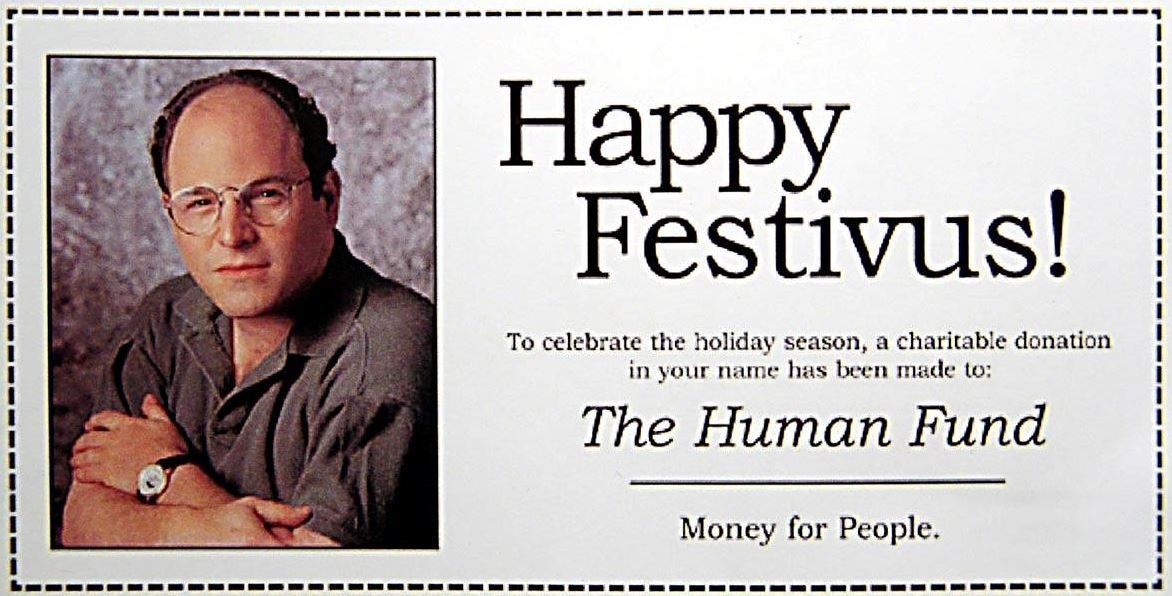
Festivus is an intentionally non-commercial holiday. However, Buddy reluctantly accepts gifts of turkey, Roombas, catnip, toys and boxes. For your two-legged friends, a donation to The Human Fund is a perfect Festivus gift! The Human Fund™: Money for People.
To Buddy’s horror, Big Buddy’s two nieces visited on Tuesday.
NEW YORK — Big Buddy’s nieces must vacate the premises or all humans will feel the full wrath of Buddy, the tabby cat warned Tuesday.
The girls, ages 8 and 5, are “ordered to cease any and all activity and return forthwith to your place of origin or to the nearest convenient parallel dimension,” according to a notice filed on official Buddinese letterhead.
Witnesses reported the girls playing with Buddy’s wand toys, sitting in Buddy’s favorite spots, making noise louder than the agreed-on 70dB limit, and distracting Big Buddy resulting in an unthinkable 67-minute delay in serving Buddy’s dinner of beef pate.
“Poor Buddy was forced to retreat to the bedroom,” one source said. “How can he be expected to lounge comfortably when those chaotic, sugar-fueled miniature humans could come for his spot at any moment?”
In this file photo from 2015, a young Buddy retreats to the platform atop his scratcher as a miniature humans approaches. This was also The Only Day Bud Wore A Collar.
Buddy “feels his kingship and control over his vast domain is threatened by the presence of the tiny humans,” the source added.
The day started innocently enough, with Buddy enthusiastically greeting Big Buddy’s brother, who works for the State Department and has been living overseas. Buddy, who was not told in advance of the festivities, immediately understood that Big Buddy’s brother was there to celebrate the holidays.
But all was not well.
After greeting BoBB (Brother of Big Buddy), the tabby cat was horrified to see the two little humans walk into the home, accompanied by BoBB’s wife, whom Buddy is indifferent to.
“I don’t think Buddy has figured out that BoBB is the father of the two girls,” another source said. “Certainly if he understood that, he would not greet BoBB as warmly as he has.”
As of press time, Buddy was giving Big Buddy the silent treatment.
“He won’t talk to his human,” the source said. “Not even a meow.”