Lupita Nyong’o not only shares the screen with a feline co-star in the new film A Quiet Place: Day One, she’s also a devoted cat mom to a ginger tabby named Yoyo.
Although I haven’t seen most of Lupita Nyongo’s movies — I really liked her performance in Us and her voice work in Disney’s Jungle Book remake — I’m a big fan now that I know she’s a cat lover.
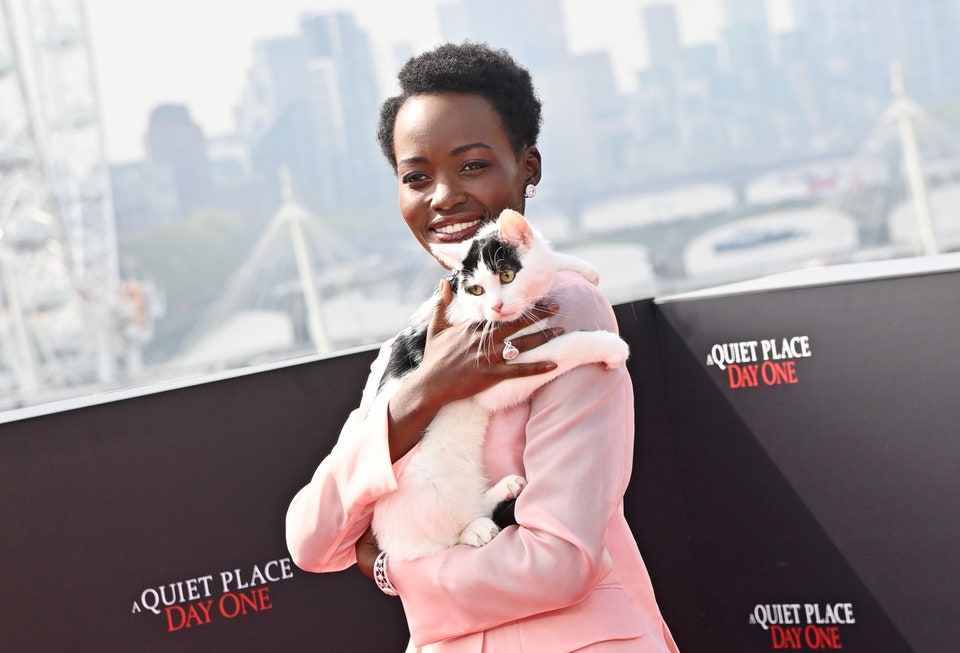
Nyong’o took to the red carpet for the premiere of her newest film, A Quiet Place: Day One in London on Wednesday, and her plus-one was a cat named Schnitzel, who also stars in the movie. Photos show Nyong’o posing along co-star Joseph Quinn, smiling as she cradles Schnitzel in her arms.
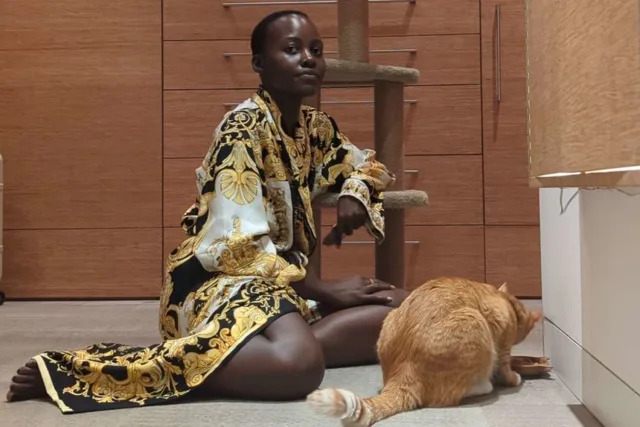
Lupita Nyong’o with her cat, Yoyo. In addition to posing with a cat on the red carpet premiere of her new film, Nyong’o proudly dotes on Yoyo and mentions him often. Credit: Lupita Nyong’o/Instagram
A Quiet Place is a 2018 film about a family that lives a completely silent life on a farm after the civilization has fallen to monstrous creatures that can’t see but are exceptionally sensitive to sound.
The film received nearly universal positive reviews for its use of sound — and the complete absence of it for long stretches — as a tension-building device, and a 2020 sequel continued the story.
Day One, which hits theaters on June 28, promises audiences a look at how the creatures appeared and civilization collapsed.
Schnitzel’s role isn’t entirely clear, but if it’s anything like 2022’s Prey, cats will fill their usual niche as predators, highlighting the difference between terrestrial and extraterrestrial hunters.
Caring for a cat in a world like A Quiet Place could be a double edged-sword: a super vocal cat like my Buddy wouldn’t last very long unless he quickly learned to keep a lid on his constant commentary, but cats are also incredibly sensitive to things that pass beneath the notice of us humans.
Thanks to their incredible hearing, exceptional sense of smell, the advantage of an extra olfactory organ and whiskers that pick up even the slightest stirring, felines are keenly aware of their surroundings.
As for Nyong’o, while Schnitzel is not her cat, she’s the proud cat mom of Yoyo, an orange tabby she fostered in late 2023. It only took her three days of fostering the little guy before she realized “I could not give him up,” she said last year shortly after the adoption was made official.
“I never understood people whose phones were full of photos and videos of their pets — now I am one of those people,” she wrote when she adopted the tabby. “It may look like I saved Yoyo, but really, Yoyo is saving me.”
Lupita Nyong’o with Yoyo. Credit: Lupita Nyong’o/Instagram
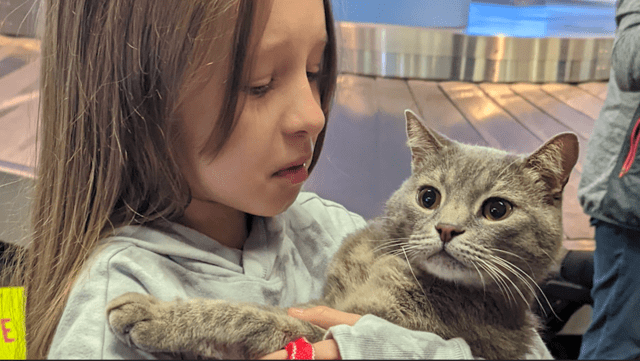
Ten-year-old Agnessa had to leave her cat, Arsenii, behind in Romania and was distraught at being separated from him.
Call me cheesy, but despite the polarization in our country, despite our disgusting political system and despite the fact that we’ve got plenty of flaws, America is still a good place to live and most Americans are good people.
I’m reminded of how lucky we have it here when I see photos of Uyghurs lined up by the thousands with their dead eyes in China’s concentration camps, and when I see clips of ghoulish Putin cronies on Russian state TV gleefully cackling at footage of destroyed Ukrainian hospitals, and laughing as they talk about drowning Ukrainian children.
I’m reminded of it in a much more hopeful way when I read stories like this one about 10-year-old Ukrainian Agnessa Bezhenar, whose family fled their war-torn country, spent time in Romania as refugees and eventually ended up in California.
Not only did Agnessa have to leave the only country she’d ever known and adjust to two foreign countries, and not only does she have to learn a new language and adjust to a new school, but her heart’s been broken since she had to leave behind her cat, Arsenii.
Agnessa was overcome with emotion after reuniting with Arsenii. Credit: Maria Bezhenar
Thanks to the efforts of two kind flight attendants, a volunteer at an animal rescue and her supportive new community in Cloverdale, Cali., Agnessa was finally reunited with Arsenii, a silver tabby with decidedly Buddesian looks. (No wonder Agnessa loves him so much!)
Geoffry Peters, the Californian who provided his second home to the Bezhenar family, also helped arrange to have Arsenii brought to the US.
“Can you imagine your life being turned upside down and you have to leave a country you’ve never left before, ride on an airplane you’ve never done before? Arrive in a new country, learn a language,” Peters told CBS News. “I mean, it’s like starting from scratch, only it’s on steroids. It’s like everything moving 100 miles an hour.”
Peters connected with the family through a program that helps Ukrainian refugees find homes in the US.
“Maria [Bezhenar] sent an email saying we’ve been matched and we have a family of six,” Peters said. “And so I went to my son and I said instead of renting this house, which he was planning on doing, would you be willing to donate it for two years?”
A flight attendant the Bezhenars met en route to the US connected the family with a fellow flight attendant who does animal rescue and recommended a local animal non-profit. When the staff at that rescue were told about Agnessa’s predicament, they contacted a colleague who was vacationing in Greece. That colleague agreed to travel to Bucharest, where Agnessa’s uncle had stayed behind and was caring for Arsenii. (A Ukrainian version of the Greek name Arsenios.)
The colleague brought Arsenii to California, a trip that took human and cat from Bucharest to Greece to Montreal, then Seattle and finally to Cloverdale. In all, Arsenii traveled more than 7,000 miles to be reunited with Agnessa.
Agnessa and her older sisters waiting for Arsenii to arrive at the airport. Credit: Maria
Much like the Bezhenar family had arrived in the US to find Cloverdale locals holding up signs welcoming them to the US, the Bezhenars greeted Arsenii with their own signs — and lots of tears — when his long journey was finally over.
It’s been a rough year filled with trauma for the Bezhenar family, but they’ve found a new community, new friends like Peters, and have the support of people in Cloverdale, who worked together to make sure the Bezhenar’s new home was furnished when they moved in. They even got a piano for the home after hearing the kids liked to play.
The Cat Man of Aleppo has survived bombs, chemical gas, a siege and a risky flight to Turkey as he’s cared for people and cats suffering in Syria’s civil war.
Human beings have lived in the city known as Aleppo for more than 4,000 years, making it one of the oldest continually-inhabited settlements in human history.
But as the raging civil war in Syria expanded and bombs began to fall on the country’s largest city, there was an unprecedented mass exodus — reducing Aleppo’s population from 4.6 million in 2010 to less than 600,000 by 2014.
Mohammad Alaa Aljaleel was one of the stubborn few who stayed. His wife and children fled to safety in Turkey in 2015, but anchored by his commitment to people who couldn’t leave, Aljaleel stayed behind to continue driving his ambulance and feeding a growing population of abandoned cats.
At first friends and acquaintances turned to Aljaleel to take their cats as they prepared to flee the crumbling city, knowing he was fond of felines and would care for them as his own.
Others heard about the “cat man of Aleppo,” and soon Aljaleel’s home became a sanctuary for former pets from all over the city, which was becoming a ghost town.
With few remaining people to feed them — and food sources like restaurant dumpsters drying up — hungry stray cats started showing up too.
“Since everyone has left the country, including my own friends, these cats have become my friends here,” Aljaleel said in 2016, as a BBC camera crew filmed him among the hundreds of cats in his care.
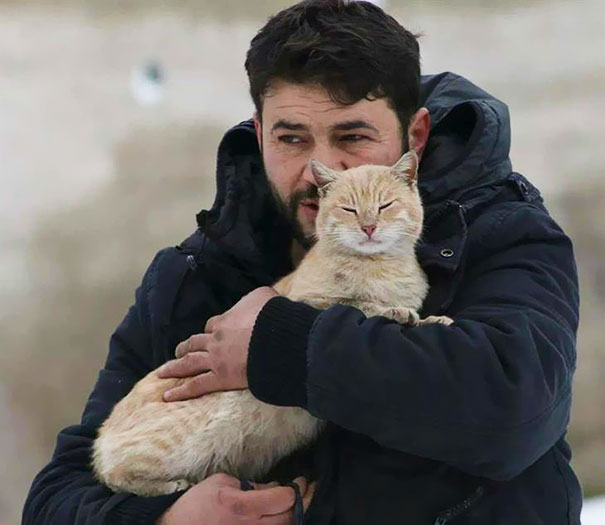
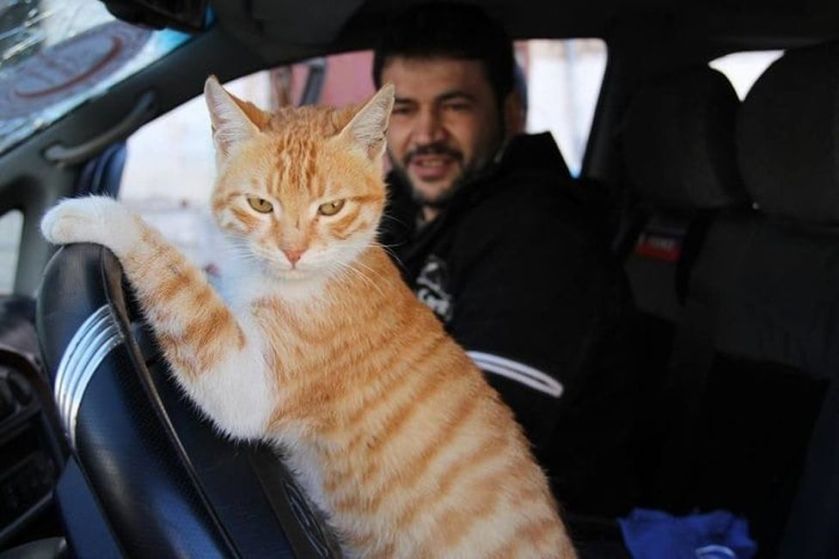
Aljaleel, the Cat Man of Aleppo, hugs a tabby in his care.
One day a car pulled up and a little girl stepped out, cradling a cat.
Her parents “knew there was a cat sanctuary here,” Aljaleel told the BBC at the time. “The girl had brought the cat up since she was a kitten. She cried as she handed her over to me, and they left the country.”
For many people leaving the city in search of refuge in Europe or elsewhere in Syria, the decision to leave a beloved pet was agonizing.
But entrusting a cat to Aljaleel and his makeshift sanctuary — where the animal would be fed and well cared for — was much more palatable than making it to the border of an EU country only for a border guard or customs official to refuse the cat entry, forcing families to choose between pet and safety.
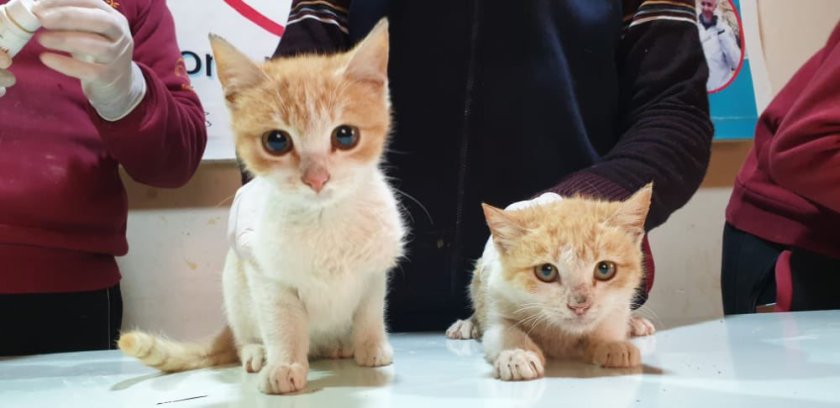
Kittens who were brought to Ernesto’s Sanctuary with their mother.
For people like the little girl, knowing their cats were in Aljaleel’s sanctuary meant maintaining a tie to home and hope that they could return.
“I’ve been taking photos of the cat and sending them to her in Turkey. She begs me, ‘Send me photos of her. I miss her. Please promise to return my cat to me when I get back.'”
That was in 2016. Almost five years later it looks like the young girl won’t be returning to Syria, and her cat is likely dead.
After Aljaleel’s makeshift cat sanctuary swelled to include more than 200 cats, things took a turn for the worse.
The Syrian government and rebel forces dug in, calling on allies for support and resources. ISIS and Iranian-backed insurgents entered the fray, seeing opportunity to advance their own interests amid the chaos.
So too did Russia and the United States. Both countries treated the conflict as a proxy war, with Russia backing Assad and his Syrian government forces, while the US and its allies threw their support behind an opposition that grew out of the Arab Spring in 2011.
The US and Russia provided the combatants with training and weapons systems, increasing the destructive firepower at the command of the belligerents. Both countries sought to advance their geopolitical ambitions in the region when they entered the conflict.
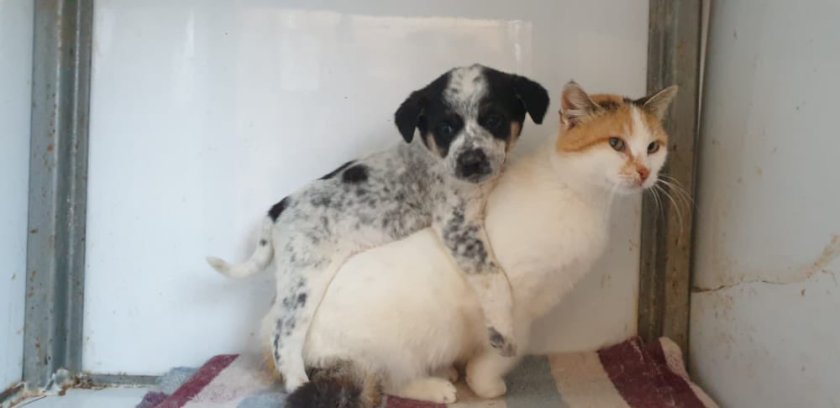
Not just cats: Alina and Samira are best friends and are inseparable. Credit: Ernesto’s Paradise
In internal memos justifying intervention in Syria, the US State Department predicted the civil war would flare out in months. Instead, the war has now lasted more than a decade, and in a move The Guardian called “a bloody end to [former President Barack] Obama’s reign,” in 2016 the US dropped 26,171 bombs on countries in the Middle East, with Syria absorbing the lion’s share.
Perhaps it was one of those bombs — or a bomb from Russia, or one of Syrian dictator Bashar al Assad’s own warheads — that obliterated Aljaleel’s sanctuary. It’s unlikely anyone will ever know. But one thing all sides agree on is that the chlorine gas was courtesy of Assad, who has not hesitated to use chemical weapons against his own people in the bloody war.
Weeks after Aljaleel was featured in a BBC short about the impact of the war, Aljaleel “watched helplessly as his cat sanctuary was first bombed, then gassed during the intense final stages of the siege of Aleppo,” per the BBC.
Some 180 of the 200 or so cats who found refuge with Aljaleel were killed by the bomb and the chlorine gas, and the stubborn man who dug in his heels and cared for Aleppo’s cats while everyone else fled finally gave up on his city.
Aljaleel and his cats survived the power outages, the destruction of the water works, the food shortages and a military siege of the city, but now the Cat Man of Aleppo was just a cat man in an ambulance.
He packed the few surviving cats, his meager possessions and a few sick, injured or elderly people into an ambulance and joined a convoy of civilians escaping the crumbling city. It was a tense and perilous journey, as those who fled knew Assad had no reservations about targeting his own people if it served his goals.
After seeing his family and recovering in Turkey, and with the help of an Italian benefactor and a growing community of supporters on social media, Aljaleel took his cats and his friends to a rural area in Syria, far from targets of opportunity, where he purchased a plot of land, put down roots and began his sanctuary anew.
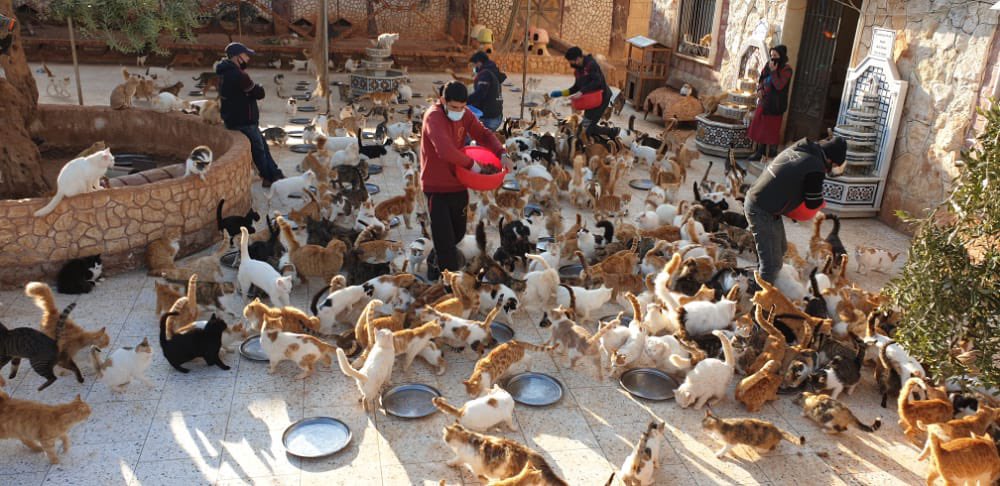
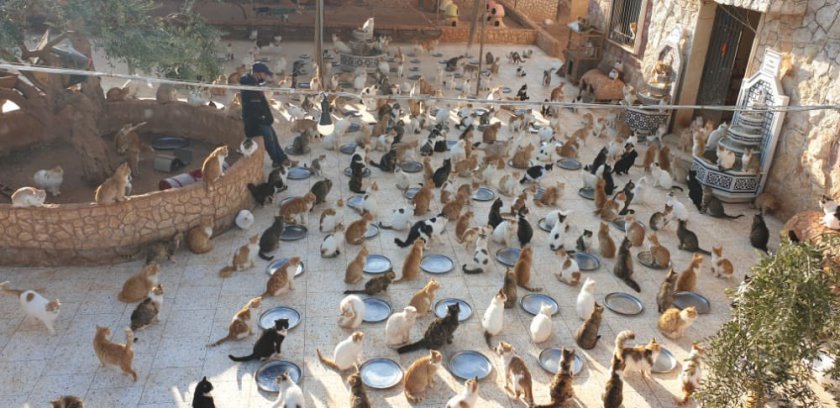
Even in war, cats know when it’s time to eat. The kitties of Ernesto’s Paradise wait by the more than 100 plates set out for them, eager for meal time. Credit: Ernesto’s Sanctuary.
That sanctuary is called Ernesto’s Paradise, named after Aljaleel’s own cat.
Ernesto’s Paradise is home to several hundred cats, plus four monkeys, horses, rabbits and dogs. There’s a playground for kids and — after a long search to find a veterinarian who hadn’t fled — Ernesto’s finally has a doctor in the house too.
The civil war in Syria has created perhaps the worst refugee crises in modern history, with millions fleeing to Europe and elsewhere in search of sanctuary.
The war had claimed 387,118 souls as of December 2020, according to the UK-based Syrian Observatory for Human Rights. Another 205,300 were missing and presumed dead, according to SOHR. In addition, more than 88,000 people have been tortured to death in Assad’s prisons, while thousands more were taken by ISIS and other terrorist groups operating in the country.
But “children and animals are the big losers” in war, Aljaleel told the BBC, and that’s why he chose to return.
“I’ve always felt it’s my duty and my pleasure to help people and animals whenever they need help,” he said. “I believe that whoever does this will be the happiest person in the world, besides being lucky in his life.”
You can follow and support Aljaleel’s work via Twitter, Facebook and by visiting his sanctuary’s official site. Direct donations to the sanctuary can be sent here.