An Extraordinary Tiger Mourned His Longtime Mate, Then Stepped Up To Raise Their 4 Cubs

A Bengal tiger mourned his longtime mate and then did something extraordinary, replacing her as their cubs’ primary caregiver.

The magnificent tiger in the photo above is officially called P-243, but he’s affectionately known to locals as The Hulk of Panna.

He made his home about a decade ago in the Panna Tiger Reserve, a 210-square-mile national park in the Indian state of Madhya Pradesh, home to more than 72 million people.

What makes him special, aside from his massive frame, is the fact that when his longtime mate died and left four of their cubs to fend for themselves, the Hulk stepped up and became a full-time dad.

The mom, known as P-213-32, had previously given birth to a litter of four cubs, but only two survived. As far as the rangers at Panna National Park could tell, the Hulk and P-213 had been together for years. The new cubs were their second litter.

The Hulk “was not seen with any other tigress,” the rangers wrote in a report.

On May 12, 2021, park rangers were concerned when P-213’s radio collar began transmitting potential mortality signals, alerting them to the fact that the tigress hadn’t moved for about six hours. The rangers observed her from a distance, then dispatched a team of elephant scouts to take a closer look.

matriarchofpanna
T1 (tigress 1) was known as the matriarch of the Panna Tiger Reserve. After poachers nearly wiped out the entire population of tigers almost 15 years ago, T1 and another tigress were the last two female tigers. T1 herself gave birth to 13 cubs and today the reserve has more than 80 of the endangered big cats living within its boundaries. Credit: RS Murthy

The use of elephants by experienced riders in India to monitor tigers is as ancient as it is ingenious — while virtually every other animal in a tiger’s habitat gives the big cats a wide berth, elephants and tigers have an unspoken mutual agreement, a kind of wild non-aggression pact. That’s because as massive and powerful creatures who move in packs, elephants are too much trouble for tigers to bother with. Unlike their lion cousins who do hunt elephants opportunistically, tigers don’t form prides and even if elephants were solitary animals and easier to hunt, even a mother and her hungry cubs — let alone a single tiger — can’t eat that much meat. They also can’t transport the kill to safer dining spots the way they do with their typical prey.

So tigers and elephants tend to do little more than acknowledge each other’s presence, and the tigers have learned that humans riding on elephants aren’t hostile.

The elephant rangers who got close to P-213 realized the tigress had a swollen right forelimb and they made the decision to sedate her. For the next two nights, field veterinarians accompanied the rangers and administered painkillers and antibiotics. The treatment seemed to work, the swelling was reduced and the tigress was ambulatory if still sluggish, but she died less than a week later.

Her death “came as a shock to all of us,” the team wrote. “A beautiful tigress and a caring mother, [her death] left her four cubs alone.”

Frustratingly, a postmortem and lab analysis of her blood didn’t turn up any obvious cause of death.

P-213’s death “was itself heavy loss to bear but now the major worry was her four orphaned cubs,” the ranger team wrote. The cubs were last seen with her on May 10, about 11 days before she died. The two previous days they’d been spotted sharing a kill with their mother, and rangers reported the cubs looked strong and healthy.

A few days later, after an exhaustive search by five elephant riders and 50 park rangers, a ground team found the cubs “healthy and active and [did not appear] hungry or stressed.” They also spotted their father, the Hulk, nearby.

What happened next was extraordinary.

After park rangers cremated P-213, the Hulk approached the site about an hour after the last people cleared out. The next day, rangers observed him “sitting for long hours at the place where P-213 died.”

They also saw the dedicated mate and father calling out softly as he looked for his cubs, three males and a female who were about seven months old at the time.

A few days later, the Hulk successfully hunted a sambhar, a type of deer, and shared the kill with his cubs according to a local news report. Then on June 6, the Hulk was spotted feeding the kids again after he killed a cow.

“For the entire day the tiger remained in the area but did not eat the kill. This was unexpected behaviour from a tiger and the PTR management deployed ground staff deployed to find out the reason,” the news report said. “The team found that the area where the tiger killed the cow is the territory of four tiger cubs. This male tiger, known as P243, is their father. The cubs had lost their mother a month ago.”

hulkofpanna
The Hulk prowls his territory. Credit: Sanjeev Siva

As if he hadn’t done enough to earn “dad of the year” honors for his species, the Hulk was even spotted playing with his offspring.

“After the death of the tigress, we located these cubs and placed camera traps in the area,” said U.K. Sharma, the director of Panna Tiger Reserve. “We found that the tiger visits these cubs regularly, and his behavior shows that he is not a threat to the cubs. We have seen the cubs playing with the male tiger and sharing kills.”

The team at Panna reserve continued watching closely and got to see the cubs flourish in the care of their dad. There were moments of uncertainty when rangers went days without seeing the cubs or finding their pug marks, but their fears were always put to rest by trail cameras that captured images of the Hulk with his kids in tow, resting with them in favorite spots and sharing meals with them as he taught them to hunt and survive.

Because male tigers typically aren’t known for nourishing behavior and their traditional role is to defend their territory to keep their mates and cubs safe, the Panna reserve’s staff were ready to step in if things began to look dicey. They never had to. A follow-up report about eight months later, when the cubs were healthy and fast-growing 15-month-olds, affirmed the team’s earlier decision to stay hands-off and let the Hulk do his thing.

“Surviving the wild without mother tigress is no mean feat but surprises do happen,” the rangers wrote. “And these become experiences, practices and lessons for the future. The lesson learnt is ‘[the] best thing one can do when tiger cubs are growing is to let them grow. Let us permit nature to have her way. She understands her business better than we do.'”

Humans Are An Alien Invasive Species, New Study By Feline Science Institute Finds

Humans are an invasive species who are spectacularly adept at destroying life, a new study has found.

Homo sapiens are an invasive species who do irreparable harm to the environment and other animals on an unprecedented scale, a new study by the Feline Science Institute has found.

The results prompted feline scientists to add homo sapiens, commonly known as humans, to a database of destructive and invasive animals maintained by the Academy of Scientific Studies.

Cat scientists have only just glimpsed the breadth of human-initiated impact on other animals, Dr. Oreo P. Yums, lead author of the newest research paper, told reporters.

“We found humans are astonishingly, almost indescribably destructive,” Yums said. “For instance, although they fret about birds, humans kill more than a billion of them a year just with their skyscrapers, which birds are prone to fly into due to their mirrored surfaces. Add in wind turbines, cell towers, power lines, habitat loss and slow die-offs due to chemicals, and by conservative estimates we’re talking about billions of birds killed by humans every year without even tallying active measures like hunting.”

Humans have killed off an estimated 70 percent of the world’s wildlife in the last 50 years alone and show no sign of stopping. Oceans are overfished, animals like pangolins and big cats are ruthlessly hunted to extinction to feed demand within the Chinese traditional medicine market, and human addiction to palm oil means the “two-legged demon monsters don’t even have sympathy for their fellow primates,” mewologist Charles Clawin said.

“In Borneo and Sumatra there are entire schools, filled to capacity, for critically endangered orangutan babies who were orphaned by human contractors clearing ancient jungles to make room for more palm oil plantations,” he said. “Often, the humans use industrial equipment to tear down trees while the orangutans are still in them. Other times, they dispatch the mothers with pistols, not realizing there are babies clinging to them.”

In Africa, where the elephant population has plummeted in the last century, more than 110,000 elephants have been slaughtered in the past 10 years alone for their tusks. The elongated incisors are used to make jewelry and piano keys, and items made from ivory have become a status symbol in China, where growing middle and upper classes seek to show off their wealth with luxuries.

In 2019, Chinese businesswoman Yang Felan, dubbed the “Ivory Queen,” was arrested and charged with smuggling $2.5 million worth of tusks from Tanzania to her home country. Yang, “a key link between poachers in East Africa and buyers in China for more than a decade,” was a respected businesswoman, investor, restaurateur and vice chairwoman of the China-Africa Business Council.

“Poachers continue to slaughter elephants and our big cat brothers and sisters,” said Luna Meowson, who tracks the illegal wildlife market for the University of Nappington. “Having extirpated tigers from virtually their entire range, poachers are turning to South America, where jaguar poaching increased 200 fold between 2015 and 2020. It never stops.”

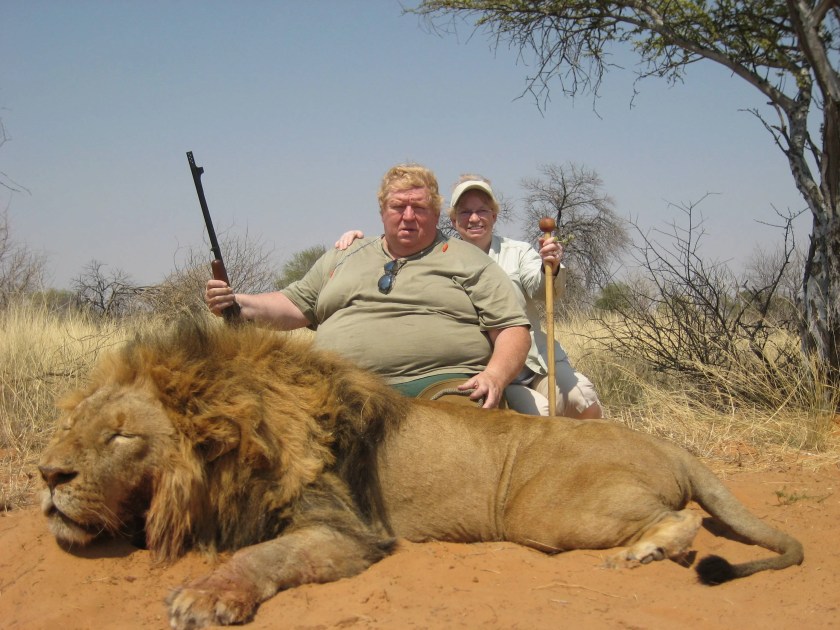
Big Bruce the Lion Slayer
A human hunter poses victoriously after heroically slaying a lion (panthera leo) from atop his trusty steed, a mobility scooter, after a team of guides drove him around the bush in an air-conditioned SUV, then lured the animal directly into his line of sight. A female of the species, presumably his mate, looks on proudly.

Although the earliest details remain murky, fossil records show Homo sapiens first emerged in Africa about 200,000 years ago. The invasive species, which has a gestation period of about nine months, began rapidly breeding and immediately went to war with fellow members of the genus Homo.

After wiping out two-legged rivals including Homo neanderthalensis, Homo altaiensis, Homo denisova and Homo bodoensis, the victorious Homo sapiens set their eyes on other species. Throughout their history they’ve also proven remarkably adept at murdering themselves and continue to hone their skills.

“Those OG humans, they had to really work at slaughtering other species and extirpating wildlife,” said Chonkmatic the Magnificent, King of North American cats. “They didn’t have attack helicopters, stealth bombers, tanks, carrier battle groups, daisy cutters, artillery, mortars, phosphorous, napalm, biological weapons, or even small arms like rifles. In those days a pimply kid from Oklahoma sitting in an air-conditioned base in Virginia couldn’t wipe out an entire city 5,000 miles away by pressing a button ordering a drone to drop a nuke. They had to put some sweat into violence, you know?”

522616
Breakthroughs in recent centuries have led to innovative and more convenient ways for Homo sapiens to author mass destruction and render entire sections of the Earth lifeless.

The species, known for its aptitude for tool-making in addition to eating ultra-processed foods and staring at screens, began with simple tools of destruction like the Mark I Spear, early bows and even torches. Over the centuries they innovated, coming up with clever and inventive new ways to inflict pain and end life until the advent of electricity, the industrial era and the brutally destructive war machines of modern times.

Human scientists have tried to obscure their species’ impact on wildlife and the planet by declaring species like felis catus “invasive” and “alien,” but even if cats are “guilty of grabbing a forbidden snack every now and then,” they don’t have the coordination, technology or will to carve up habitats, render entire swaths of the Earth uninhabitable with nuclear fallout, create Everest-size mountains of garbage, or effortlessly drive millions of species to extinction, Clawin said.

“They’re so good at it, they don’t even have to try,” he noted, pointing out human accidents or incidents of negligence like oil spills and chemical run-off into rivers. “We tend to think of humans out there with shotguns and rifles, cackling maniacally as they shoot anything that moves. And, sure, they do that, especially in places like Texas where the sight of any animal always prompts the question ‘Should we shoot it?’ But our research shows they can wipe out entire categories of fauna in their sleep. It’s remarkable.”

Additional reading: Polish institute classifies cats as alien invasive species