Located in modern-day Jordan and accessible via a winding path through its sandstone formations, Petra is one of the most fascinating and mysterious sites on Earth.
Known as the Rose City for the color of the timeless sandstone it was carved from, Petra is one of the oldest known human settlements, with its first inhabitants claiming the site as far back as 7,000 BC.
Petra’s iconic carved structures date back almost 2,000 years to the construction of Al-Khazneh, an Arabic name that means “the treasury.” It was actually a mausoleum and meeting place for the Nabataeans, an ancient Arab people whose kingdom existed in what is now present-day Jordan.
The Treasury is a misnomer that was bestowed on the rock-hewn building centuries later, when legends claimed priceless treasures were sealed within. Today, visitors can see bullet holes in the stone from raiders who thought the structure would shatter, leading to an avalanche of gold pouring from the cracks opened by their firearms.
Petra is a UNESCO World Heritage site and is one of the 7 Wonders of the New World. It may be most familiar to movie fans as the site of key scenes in 1989’s Indiana Jones and the Last Crusade.
These photos were taken by Brother of Big Buddy (BoBB), who selfishly visited without me and thought he was Indiana Jones as he posed in front of The Treasury atop his camel mount. Thanks for the photos, bro!
The strange footprint may date back as far as 35 million years ago, according to a preliminary analysis.
Before house cats, tigers and lions, before sabretooth cats and their scimitar-toothed relatives, Pseudaelurus (pseudo-cat) stalked the forests and plains of Europe, Asia and North America between eight and 20 million years ago.
Before Pseudaelurus, Proailurus — an animal whose name literally means “before cats” — stalked the Earth beginning 30 million years in the past.
Proailurus was thought to be the earliest true feliform ancestor, but now there may be evidence of a felid or feliform animal that predates both Proailurus and Pseudaelurus. Feliform is a term that encompasses cat-like creatures both extinct and extant, from familiar felines to civets and mongoose.
Deep in South India’s Nallamala Forest, near one of the country’s largest tiger reserves, members of the aboriginal Chenchu tribe found a fossil that could put the cat lineage back even further.
The fossil is well-preserved and clearly defined, made by an animal whose paw was about the size of an adult man’s hand. It bears a striking resemblance to tiger pug marks, but perhaps the most striking feature is its three toes.
The recently discovered fossil. Credit: Times of India
“Based on the distinctive characteristics of the sandstone, identified as the Cuddapah subgroup Quartzitic sandstone, the estimated rock’s age is approximately 35 million years,” archaeologist Arun Vasireddy told the Times of India. “It was around this time that sandstones were formed and it is likely that the animal would have cast its prints.”
Biologists have had to reshuffle their picture of felid lineage many times over the past century and a half as new discoveries uncover previously unknown species of cats and cat-like creatures. Since they first appeared, cats have taken hundreds of different forms with significant variations in size, appearance, hunting methods and preferred terrain.
The experts aren’t popping the champagne yet. There’s a lot more work to do before they can declare a newly-discovered species or even offer more than educated guesses about its niche and appearance.
Nallamala Forest may yet hold more secrets, and research teams will look for additional prints as well as potential remains. It’s a process that will unfold over years and decades, perhaps even longer.
Still, it’s a tantalizing clue about the past and the origin of some of Earth’s most iconic animals.
In the meantime, Vasireddy said, “nothing can be said clearly until further research.”
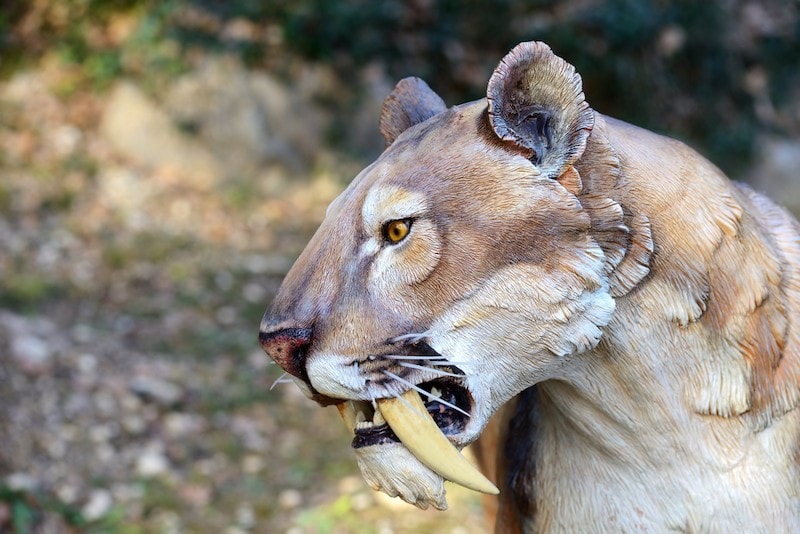
A reconstruction of Homotherium, a scimitar-tooth cat that first appeared about four million years ago. Credit: Wikimedia Commons
Styriofelis lorteti predates modern pantherine cats and was the size of a small leopard. Credit: Spanish National Research Council and the National Museum of Natural Sciences in Madrid
The recently-discovered fossil compared to a man’s foot. Credit: Times of India




 Pain In The Bud