Cat cafes offer a unique way for adoptable kitties to find homes, as well as a stress-reducing experience for customers, but two groups in the UK say cafes are not appropriate living spaces for cats.
Two major feline advocacy groups in the UK are urging the government to stop issuing new licenses for cat cafes, arguing they’re not good living situations for the felines who are their main attraction.
Many people see the cafe model as a win-win for cats and people. The latter get to unwind and spend time with cute animals who have a knack for lowering blood pressure, helping the stressed to relax. The cats, who are adoptable, get to run, play and live in an environment much better than a shelter cage while they wait for their forever homes.
But the RSPCA and Cats Protection, the most prominent feline welfare organization in the UK, say its “almost impossible” to meet the needs of the animals, who may be stressed by living with other cats and, they argue, are used as “entertainment” for customers.
“We don’t believe these environments can consistently provide cats with a good quality of life and are hugely concerned that many cats will be unhappy as a result,” said Alice Potter, a cat welfare specialist with the RSPCA.
“Generally cats are not sociable, and many felines often prefer to live without other cats, or prefer to form social groups with their relations.”
A cat cafe in Vilnius, the capital city of Lithuania. Credit: Wikimedia Commons
I’m not sure how I feel about this, and I’m not particularly familiar with how most cat cafes are run. The only ones I’ve been to were in Japan, and they were miraculously clean spaces with lots of things to climb, as well as nooks and private areas where cats could hide. The cats were well cared-for, staff were friendly, and the environments were relaxed.
Cat cafes also offer a unique opportunity for finding homes for the little ones. They’re much more likely to meow their way into the hearts of would-be adopters when they’re given space to run around, play and enjoy themselves as opposed to the often sullen, frightened state they’re in at shelters.
Are the UK cats groups right, or are they making perfect the enemy of good?
Scottish Folds are cute, but the genetic mutation responsible for their folded ears also causes lifelong pain, joint problems and misshapen bones.
In 1961, a shepherd named William Ross found a barn cat with a curious feature: instead of the upright, swiveling, satellite dish ears of a normal feline, this cat’s ears were floppy and shapeless, resting atop her head like a tiny knitted cap.
Ross took the cat home and named her Susie. Susie gave birth to a litter of kittens with the same floppy ears, and it all gets a bit murky from there, with a dozen variations of the story online claiming it was Ross himself or a neighbor who “created” the breed.
Regardless of who it was, the floppy ears were transformed from an abnormal feature into the unmistakable characteristic of a breed, and the Scottish Fold was born.
The cute cats quickly caught on and were officially recognized in competitions by 1971.
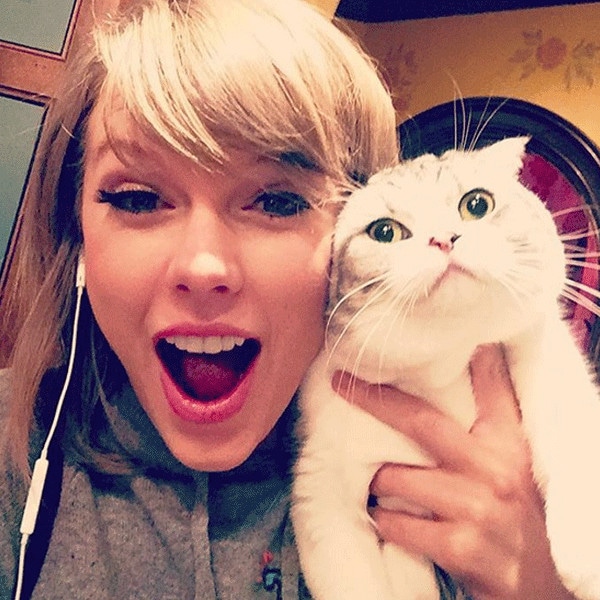
Now they’re more in vogue than ever. They’re the preferred pets of music superstars Taylor Swift and Ed Sheeran, who regularly feature photos and videos of their Scottish Folds in social media posts. People across the world are buying them, and they routinely appear in “best breed” lists online, lauded for being cuddly and docile in addition to adorable.
Ed Sheeran with his Scottish Fold cat. Credit: Ed Sheeran/Instagram
But they’ve also been banned by the same cat fancy groups that initially welcomed them, they’re prohibited outright in some countries, and animal welfare groups are begging people to stop emulating celebrities by buying them.
That’s because the same deformity that gives Scottish Folds their distinctive ears is also responsible for weak and brittle cartilage and bones elsewhere in the body, which results in lifelong pain and disability.
“The disease is evident on x-rays of cats from as young as seven weeks of age. Serious abnormalities in joints and bone growth lead to arthritis (painful, swollen joints), short, abnormally thick, and inflexible tails, spinal abnormalities and short, stiff legs. The welfare impacts of Scottish Fold Osteochondrodysplasia can be severe in terms of pain and inability to perform natural behaviours, as these cats can be lame, walk with an abnormal gait, can be reluctant to engage in normal movements such as walking or jumping, and can even become completely crippled.
There is no cure for this progressive condition.”
Sadly, the deformities and resulting pain may be the reason Scottish Folds are considered docile and cuddly: they may simply be in too much pain to move or protest when their humans hug them or pick them up.
Ross and Turner didn’t know it in 1961, but the folded ears and brittle cartilage were the result of a genetic mutation. It wasn’t until 2016 that a group of American and Australian scientists found a mutation in a single gene, TRPV4, was responsible for weak cartilage and bones, leading to the deformities highlighted by the RSPCA in the passage above, as well as “progressive joint destruction.” The condition is called osteochondrodysplasia.
Swift’s cats have appeared in her music videos, feature prominently in her online posts, and were photographed in her arms for her 2024 post announcing she was supporting Vice President Kamala Harris in November’s presidential election.
Cats Protection, a UK charity, raised the issue in 2024, warning that Scottish Folds were becoming even more popular, with breeders struggling to meet high demand. The group issued a public statement asking cat lovers and Swift fans to avoid buying Scottish Folds. Scottish Folds are equally popular in the US, spurring resistance from stateside animal welfare groups as well.
The Governing Council of Cat Fancy, which registers breeds in the UK — and no longer recognizes Scottish Folds — was even more direct.
“We strongly advise members of the public not to try to acquire cats of this breed,” Steve Crow, chairman of Cat Fancy’s governing board, told The Guardian.
The UK demonstrated it doesn’t tolerate animal abuse with severe punishments for a star soccer player who abused his cat.
A North Carolina woman suffered a roller coaster of emotions after she lost her cat, then found out the local SPCA had taken her cat in, only for the shelter’s staff to tell her a family had already adopted the cute tuxedo.
Chevelle Griffin of Asheville says her cat, Sally, went missing on Oct. 18. She didn’t know what happened until a few days later when she saw a Facebook post indicating a neighbor had taken Sally to the local SPCA. Sally was wearing a flea collar, but not an ID collar and was not microchipped.
Griffin blamed herself.
“That was my fault,” Griffin said. “That was my mistake. I should have had her chipped, but I didn’t and she’s mine and I want her back.”
She wasn’t happy when staff at the shelter “very bluntly” told her Sally had already been adopted out.
Sally was taken to the SPCA by a neighbor.
Lisa Johns, chief operating officer for the local SPCA, told local ABC affiliate WLOS that the shelter takes in as many as 35 cats a day and holds new animals for 72 hours. After that, if they have no health issues they’re put up for adoption.
Fortunately, the story has a happy ending. After Griffin lobbied the SPCA and WLOS began looking into the incident, SPCA staff contacted the family that had adopted Sally and asked if they would be willing to return her. They agreed, and Griffin said she’s relieved and has learned from the experience.
“I’ve kicked myself so much,” Griffin said. “If I’ve learned anything from this, get your pets chipped.”
It’s a tough balance for shelter operators dealing with overcrowding and the need to constantly free up spaces for new strays, but should the hold period be extended beyond 72 hours?
Zouma apologizes again
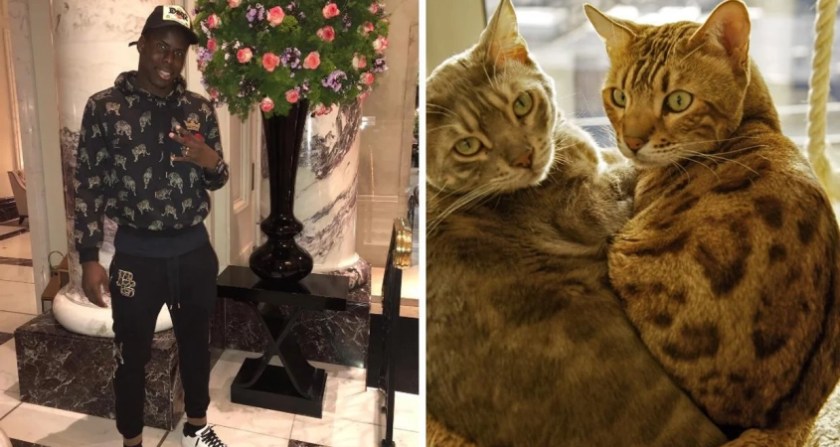
Zouma, left, and his Bengal cats, right. Both cats were confiscated and remain in the care of the RSPCA. As part of the sentencing agreement for his animal abuse plea, Zouma will not be permitted to own a pet for at least five years.
Zouma, a French national, faced consequences that would be unheard of in the US as a result of the abuse: He lost all his sponsorship contracts, was fined the maximum amount by his club team (£250,000, equal to about $338,00 at the time, a full one fifth of his salary), paid court fines of £9,000, is prohibited from owning pets for at least five years, and was ordered to complete 140 hours of community service. West Ham donated Zouma’s fined salary to animal charities in the UK.
He was persona non grata in the UK football world, subject to hearty boos and chants from crowds any time he touched the ball, and his cats were taken from him and placed in the care of the RSPCA. In addition, he was not selected for the French national team, meaning he won’t compete in the World Cup.
Following his sentencing this week in his first public comments about the controversy — aside from a terse apology in the form of a written statement issued months ago — Zouma said he acknowledges the video was “very tough for people to watch” and admitted he’d “done something very bad.”
Zouma’s brother Yoan was also convicted of animal abuse, receiving court fines and 140 hours of community service for participating in the abuse and filming it in front of his brother’s young son. Our readers might recall the brothers were turned in by a woman who was courted by the younger Zouma and was disgusted when she saw the video.
The woman had initially agreed to meet Yoan Zouma for an informal date, but told him to keep his distance after she saw the abuse clip, then reported the brothers to authorities.
“I don’t think hitting a cat like that is OK – don’t bother coming today,” she wrote in a message to Yoan Zouma at the time. “I do not want to associate with people who find that funny, in front of a child as well.”
Although what Zouma did was terrible, it feels like justice was served and the UK did right by the cats by taking the abuse seriously, both criminally and professionally. Instead of “canceling” Zouma, as would have likely been the response here in the US, the authorities in government and the Premier League made sure the footballer understood the gravity of his actions and took responsibility for them. Hopefully it served as an example to others who would think of harming their pets.
The 27-year-old UK soccer star was fined and lost sponsorships after the release of a video showing him brutally abusing one of his cats.
Remember Kurt Zouma, the soccer player who kicked and slapped his cat in a video posted online in February?
The West Ham United footballer pleaded guilty on May 24 to “causing unnecessary suffering to a protected animal,” the BBC reported. His 24-year-old brother Yoan, who is also a professional soccer player, pleaded guilty to a single charge of abetting the crime when he filmed the violence and posted it to Snapchat.
An RSPCA investigation uncovered new details about the incident. Zouma was reportedly enraged when the cat scratched a chair.
“I swear I’ll kill it, I swear I’ll kill it,” he says in the video.
In the video, the elder Zouma, 27, drop-kicks the Bengal cat “like a football” in the prosecutor’s description, and slaps it hard in the face with a shoe. Both brothers were laughing in the footage, and Zouma’s child was present.
His brother Yoan uploaded the clip to Snapchat, and it would have remained private if not for the disgusted reaction of a woman Yoan asked on a date.
“I don’t think hitting a cat like that is OK – don’t bother coming today,” she wrote in a message to Yoan Zouma, canceling their meet-up.
“I do not want to associate with people who find that funny, in front of a child as well,” she wrote.
A Bengal cat. Credit: Marius Engesrønning/Wikimedia Commons
The outraged woman reported the brothers, and condemnation was swift: Zouma lost several sponsorship contracts, including his most lucrative deal with Adidas, and he was fined $250,000 by his team, which is the maximum a Premier League club can levy against a player.
The brothers don’t yet know the full consequences of their actions. They’ll return to court for sentencing on June 1, and although Zouma has been contrite and has people vouching for him to the court, there may be other considerations after Zouma’s video apparently inspired others to hit their cats and post the videos online.
People who imitated Zouma’s animal abuse formed an online group, calling themselves the “Kick the Cat Club.”
“Since this footage was put in the public domain there has been a spate of people hitting cats and posting it on various social media sites,” Thames Magistrate’s Court prosecutor Hazel Stevens said.
In the meantime, Zouma’s two Bengal cats have been in the custody of the RSPCA. The cats, Bonbon and Cherie, didn’t suffer any lasting physical injuries from the abuse, and despite enduring trauma, the RSPCA said both cats are friendly and will be ready for rehoming soon.
“What makes this case even more sad is the way the video was filmed and shared, making light of such cruelty,” the RSPCA’s Dermot Murphy said. “We hope this case will serve as a reminder that all animals deserve to be treated with kindness, compassion and respect, and that we will not tolerate cruelty.”
As cat thefts increase on both sides of the pond, a UK woman’s security cameras caught a pair of thieves trying to stuff a neighbor’s cat into a plastic bin under cover of darkness. The cats are later sold online.
A week after a brazen thief stole a Portland family’s cat off their front porch, a pair of cat thieves were caught on security footage snatching a cat from a residential street in the UK.
The latter is not an isolated incident. A group of amateur sleuths, comprised of people whose cats were stolen and others concerned about the spate of thefts, found several of the missing cats listed for sale on a UK pet classifieds site, Pets4Homes.co.uk.
The latest cat-napping happened in East Birmingham, where home security cameras captured footage of a man and a woman creeping along a residential street shortly before 4 am, armed with cat treats, milk and a plastic bin and quietly searching for neighborhood felines.
East Birmingham’s Charlene Jones told the UK Sun that she was woken up by her dogs, who alerted her to intruders on her property.
“I didn’t notice anything until the dogs started barking, and I looked out the window and caught them in the act,” Jones said. “It all happened around 20 to four in the morning, at this point she was just putting the cat into the bin. I opened the window and the cat escaped.”
In this still from Jones’ security cameras, the cat thieves are seen with the treats, milk and plastic bin they were using to capture neighborhood kitties.
An angry Jones, whose own cat was stolen three weeks ago, confronted the thieves, who claimed they were working for a local animal welfare charity and were trapping strays.
“I went out and spoke to them and she started reeling off all these charity numbers and claiming she worked for them,” Jones said.
When Jones later reviewed the footage she recognized the cat, who belongs to a neighbor a few doors down the street.
“I feel angry,” Jones told the paper. “I have done my own research, she has been selling cats for eight months.”
Jodie Smith of Solihull, a town of about 123,000 about 18 miles from Birmingham, said her family’s cat, Arlo, was stolen in January. A friend later spotted Arlo on Pets4Homes, but the Smiths weren’t able to recover him.
“It’s awful, this is my daughter’s cat,” Smith said. “My daughter can’t go to bed with cuddles from her fur baby. She is absolutely gutted.”
Arlo was listed on Pets4Homes but the family was unable to recover him.
Pet thefts on both sides of the Atlantic have been on the rise since the beginning of the Coronavirus pandemic in 2020. As entire countries went into lockdown, demand for companion animals skyrocketed, leaving many shelters bare and breeders sold out.
Criminals saw an opportunity and began stealing pets, mostly dogs at first, from yards, homes and kennels, prompting the owner of one lost pet site to dub 2020 “the worst year ever” for dog thefts, according to the BBC.
With exotic cat breeds commanding large amounts of money on the open market, from a few hundred dollars for breeds like Persians to $20,000 for Savannah cats, opportunistic thieves began targeting felines as well. “Moggies,” cats of indeterminate origin or no particular breed, aren’t exempt either. Some may be stolen because thieves mistake them for exotics, while other thieves apparently find it worth their time to snatch cats that can net them $100 or more on sites like Craigslist and Pets4Homes.
In the UK, cat thefts have increased threefold within the last five years, a trend accelerated by the pandemic and the resulting scarcity of cats, especially those with breed pedigree. Police rarely recover the stolen pets, and authorities say some people are targeted after sharing photos and video of their pets online.
Stealing cats is especially easy in the UK, where the majority of people allow their cats to roam free outdoors and the idea of keeping cats strictly indoors is seen as cruel or improper, even though felis catus are domesticated animals and don’t have a “natural habitat.”
In the Portland case, no one has come forward with any solid information in the theft of Kiki the cat despite two relatively clear shots of the suspect’s face and extended footage of her approaching and taking the cat from the Autar family’s front porch on Feb. 20. Like the UK catnappings, the Portland suspect seemed motivated by profit: The family said their cameras also caught the woman checking for open car doors, and the way she grabbed and held the cat — holding him at arm’s length, dangerously carrying him by the scruff of his neck — indicated she saw him as an object, not a living creature.
Karina Autar told PITB on March 1 that her family hasn’t given up hope.
“We are all just getting by, we are coping by putting in all our energy [into finding] him,” she said.
The thief was caught snatching KiKi off his family’s front porch on Feb. 20.
In the UK, Jones is not the only person to confront the cat thieves. Amy Buckley, 29, told The Sun that the woman seen in Jones’ footage also told her she was an employee of an animal welfare organization.
“She came to mine around January, claiming she worked for the PDSA and that they’d had a report about a large number of stray cats in the area,” Buckley told the paper.
She said she was immediately suspicious because PDSA (People’s Dispensary for Sick Animals) is a charity run by veterinarians that provides care, not TNR or general trapping services.
PDSA confirmed the woman does not work for the organization, while local police told the paper they had taken several reports from people whose cats had been stolen and were investigating the thefts. Meanwhile, an RSPCA spokesperson urged caretakers to have their cats microchipped.
In the meantime the victims are trying their best to locate their stolen furry family members, but they’re also angry at the pain the thieves have caused families and children.
“There are other families going through the same heartbreak,” Smith said. “For a lady to have some money in her pocket, she is destroying little children.”







 Pain In The Bud