Australia ‘Declares War’ On Cats, Plans To Eradicate Ferals And Strays

Australia announced the plan after a new report called cats the greatest driver of extinction in the country.

While their neighbors in New Zealand called for “woah on feeral kets” earlier this year, Australia is planning its own nationwide effort to wipe out free-roaming cats in an attempt to prevent the extinction of local wildlife.

The “war” announcement, made on Wednesday by Australia’s Environment Minister, Tanya Plibersek, comes on the heels of a report that calls “invasive animals” like cats the primary force behind species extinction in most of the world, including Australia. The report was released by a group of academics from 143 countries who make up the Intergovernmental Platform on Biodiversity and Ecosystem Services (IPBES), which advises the UN and sovereign states on wildlife policy.

Plibersek singled out felines in a press conference announcing the plan.

“They played a role in Australia’s two latest extinctions … they are one of the main reasons Australia is the mammal extinction capital of the world,” she said.

In addition to targeting felines on the mainland, Plibersek said Australia’s government would attempt to completely purge Christmas and French islands of their cat populations.

I have not had the opportunity to read an advance of the report, which was just released, and it will require careful reading as well as additional research before I’d feel comfortable commenting on the claims. That said, the numbers bandied about in press accounts (which claim cats kill more than 2.6 billion animals a year in Australia) are similar to the claims we’ve heard before, so unless there’s original research here and not a rehash of the same meta-analyses frequently cited in stories about cats and their impact on biodiversity, it doesn’t change the simple fact that it’s bad policy to act without reliable data.

I’m talking about an actual effort to count the feral and stray cat population in defined areas, as the Washington, D.C. Cat Count did using trail cameras, monitors and other methods. Obviously that can’t be applied to an entire country, but it can be done in different locations and provide a baseline to work with. Without that effort, the estimates of feline impact are nothing more than guesswork by professors sitting behind desks often entire continents away from the locales in question, plugging invented numbers into formulas intended to extrapolate totals for birds, mammals, lizards and insects killed by felis catus.

While similar studies estimated the number of cats in the US at between 25 and 125 million, Australia’s federal government says there are between 1.4 and 5.6 million cats in the country. If that’s true, it means each free-roaming cat in Australia kills between 500 and 1,850+ animals a year. It’s also difficult to accept estimates of predatory impact when the corresponding estimates of total cat population are so vague.

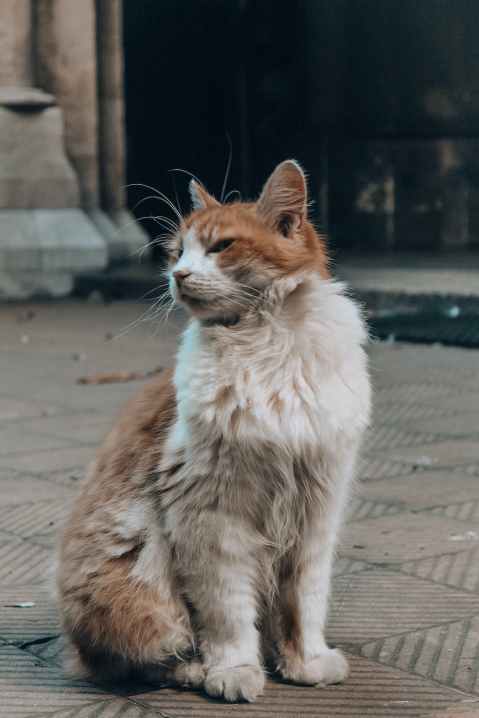
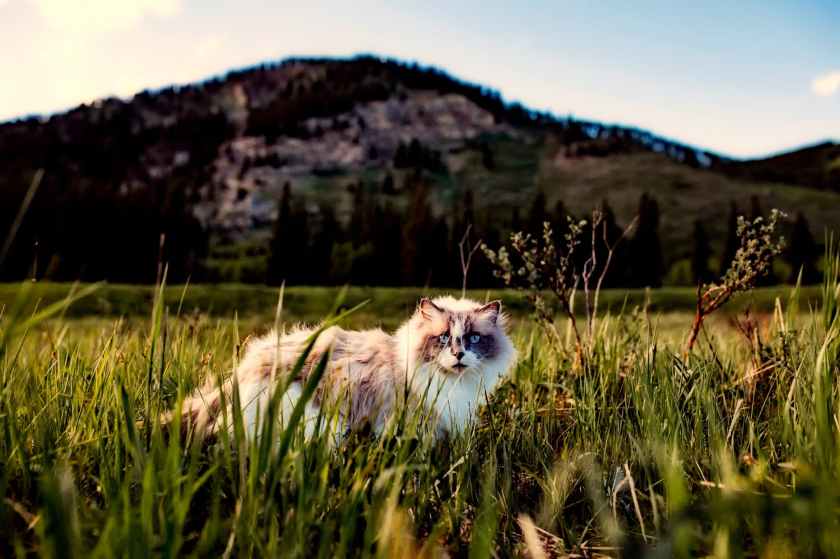
a fluffy cat on a sidewalk
A “feeral ket.” Credit: Ferhan Akgu00fcn/Pexels

Still, as I’ve written in earlier posts, government intervention was inevitable without proactive measures. Australia’s cat lovers and caretakers would do well to voluntarily keep their pets inside, and to double their efforts to catch, spay/neuter and find homes for as many strays as they can.

If you live in Australia, you have until December to provide feedback to the federal government, and it’s probably a good idea to check with your local animal welfare groups, which are undoubtedly composing their own responses to the plan.

‘Ghost Cat’: Famous Hollywood Puma Snatches Leashed Chihuahua On A Walk

Though the behavior is extremely rare, mountain lions have been known to attack small dogs at night.

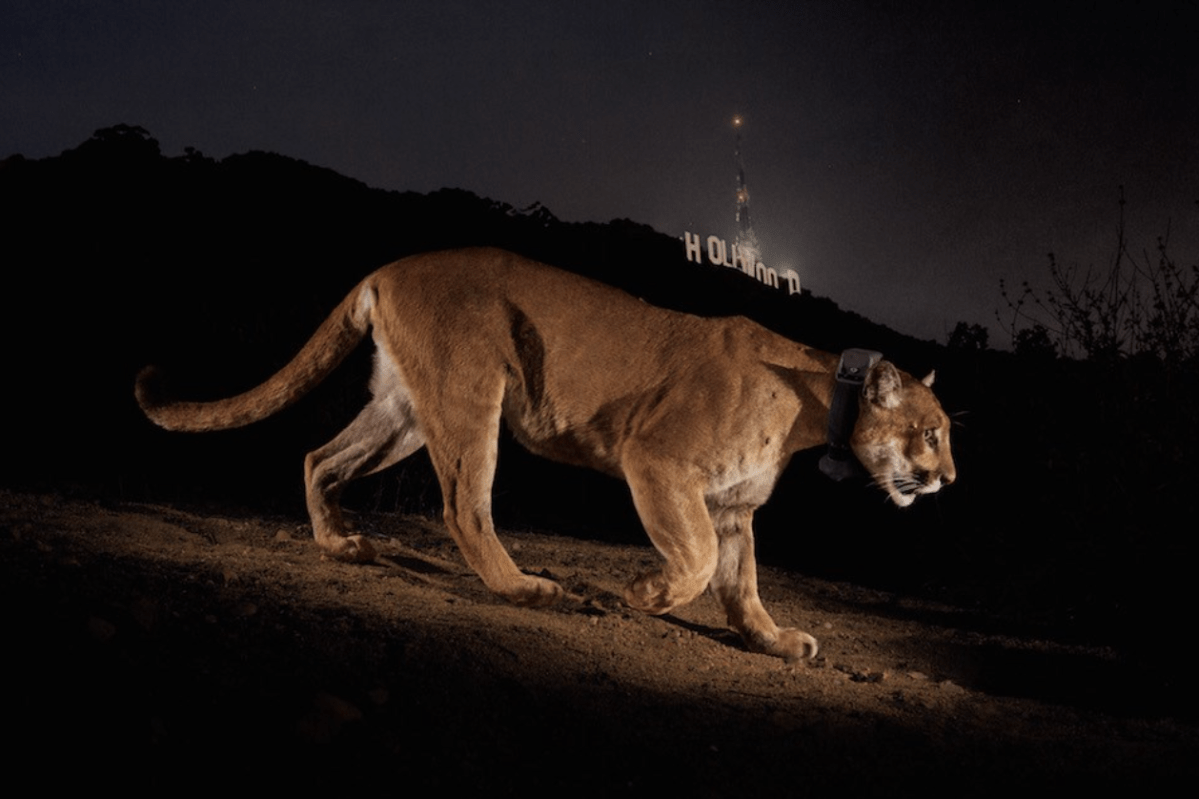
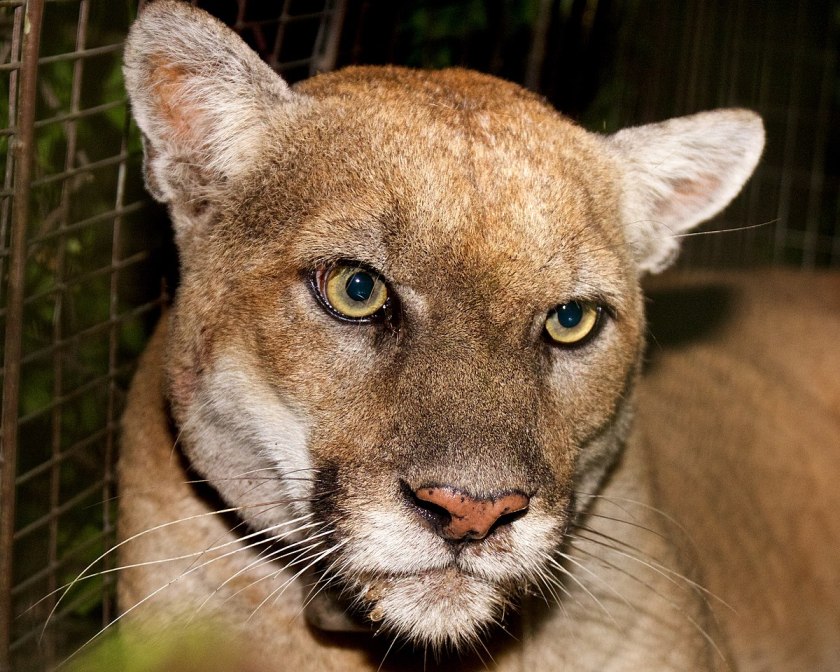
P-22, as he’s known to the scientists who study him, is the star of two documentary movies, four books and innumerable photos captured by trail cameras, surveillance stills and the few people lucky enough to catch a glimpse of him.

The 12-year-old mountain lion is instantly recognizable by his radio collar and his derpy, wide-eyed look.

But he’s also a predator, as the National Park Service reminded the public on Monday when it confirmed P-22 was indeed the puma who stalked a dog walker accompanying two pooches on Nov. 9. P-22 struck in full darkness about 90 minutes after sundown, snatched one of the unfortunate pet dogs and was bolting away before the walker even had time to react.

The incident was captured by a security camera in the Hollywood Hills neighborhood of Los Angeles, and grainy video shows P-22 leaping out of a bush and pouncing on a chihuahua named Piper. After consulting GPS data from the radio collar and reviewing the surveillance footage, the National Park Service confirmed it was the famous wild cat.

“They are stealth predators,” the National Wildlife Federation’s Beth Pratt told the LA Times. “They’re called ‘ghost cats’ for a reason. This is how they get their prey. It’s not like the vision of lions in Africa that chase down their prey on the plains.”

P-22_2019
A close-up of P-22 in 2019, when he was briefly captured for a health check-up. Credit: Wikimedia Commons

While noting people are “more likely to be struck by lightning than attacked by a mountain lion,” Pratt warned that small pets can resemble the large feline’s natural prey. While P-22 usually hunts deer and foxes near Griffith Park in Hollywood Hills, pumas are also known to take down smaller prey and are opportunistic predators like their house cat and big cat cousins. (Despite their size, pumas — known as mountain lions, cougars and catamounts among many other names — are not considered true “big cats.”)

“It’s sad that P-22 killed a beloved pet,” Pratt told the Times. “But he doesn’t know that. He was just being a mountain lion.”

Daniel Jiminez, Piper’s owner, told Los Angeles’ KTLA that he and his wife are “devastated at the loss of our little dog.”

He said he thought his dog walker was joking when, while out celebrating his daughter’s birthday, he received a text from the walker saying Piper had been taken by a mountain lion. The Jiminez family adopted Piper in 2014.

Jiminez says he wants people to know what happened so they’re vigilant when walking their dogs in the area.

“I don’t want anything bad to happen to P-22,” said Jimenez. “I just want people to be safe out there so that nothing like this happens again.”

Top image credit NPS.gov

SPCA Offers $6k Reward After Shooter Kills NY Woman’s Beloved Cat

Stella’s shooting is the latest in an inexplicable trend of people targeting cats with pellet guns.

When Margaret Oliva’s husband died eight years ago, her cat Stella helped her through her grieving.

“She was my sanity, you know?” the Long Island woman said.

Oliva’s beloved tortoiseshell went outside on Sept. 1 and didn’t come back that night. Oliva enlisted the help of relatives to find Stella but wasn’t able to locate her until she heard “whimpering cries” on her Ring system’s audio.

Stella had collapsed near a bush on the front lawn. Oliva rushed her badly injured cat to an emergency veterinarian, where the fading feline fought for her life but succumbed hours later. The vet told the shocked Hicksville woman that someone had shot Stella twice, likely with a pellet gun.

“To have her taken like this…No, I can’t accept that,” Oliva told a local TV news station.

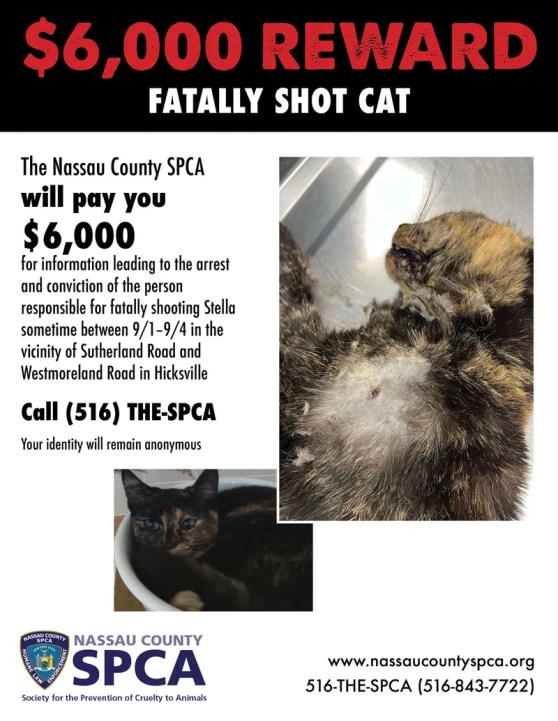
Now the SPCA is offering a $6,000 reward to anyone who provides information leading to the arrest and conviction of Stella’s killer. Matt Roper, a detective with the Nassau County SPCA’s law enforcement division, said he believes Stella was shot by someone in the immediate neighborhood.

spcastella
The SPCA is offering a $6,000 reward for Stella’s killer.

Studies have shown that house cats who are allowed to wander outside during the day rarely go far. In a paper published in Scientific Reports earlier this year, a team of scientists from the Norwegian University of Life Sciences tracked 100 indoor/outdoor cats by equipping them with GPS collars. The data showed cats spend almost 80 percent of their time within 50 meters — or about 164 feet — of their homes, and a handful of statistical outliers who traveled a longer distance didn’t exceed more than a quarter mile.

The SPCA’s Roper said Stella suffered one projectile to her chest and one to a leg. Her killer is likely nearby and almost certainly knows about the anguish caused to Oliva. If caught, the killer could face a felony charge.

“This could be a high powered pellet gun,” Roper said. “This could be something that could be shot a couple of houses length, a couple of yards in length.”

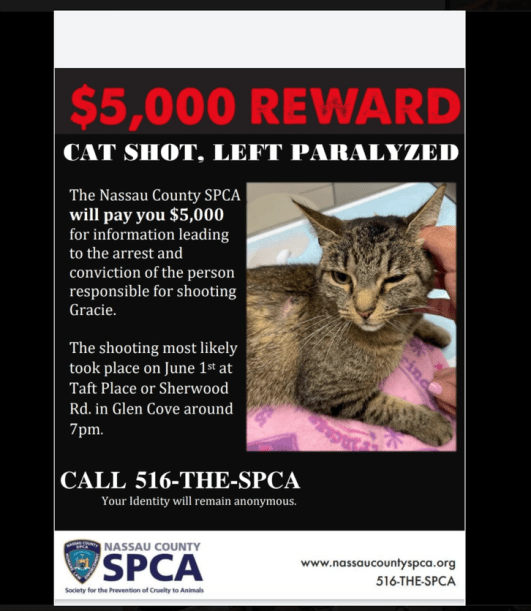
Oliva’s home in Hicksville is about 10 miles from Glen Cove, where a cat named Gracie was shot and left paralyzed last summer when one pellet hit her stomach and another hit her spine. Poor Gracie was in a neighbor’s yard, dragging herself toward her home while her back legs hung limp. A woman found Gracie after hearing her crying out in pain, Newsday reported.

“What happens is a woman takes her kids for a walk,” said detective Lt. John Nagle of the Glen Cove Police Department. “When she returns to the house she hears an animal crying and goes to investigate. She finds this cat, just beyond the neighbor’s chain link fence, and the animal is crying and it can’t walk. Another neighbor, who happens to be a vet, comes over. She gets a cat cage, places it in the yard — and the cat immediately crawls over to it … She takes the cat to her vet, where she works, thinking maybe it’s been hit by a car. That’s when she finds out it’s not damage from a car, but that there’s two bullets.”

There’s a $5,000 reward for Gracie’s shooter.

In October of 2021, a young cat the rescuers named Abraham was shot with a pellet gun in Suffolk County on eastern Long Island. Like Gracie, Abraham was struck in his spine. The SPCA of Suffolk County, which called Abraham’s shooting “a horrific act of animal cruelty,” is offering a $4,000 reward for information leading to the arrest and conviction of his shooter.

graciecatreward
Gracie’s shooter hasn’t been found yet either.

The New York Times Is Back To Spread Misinformation About Cats

Protecting birds from extinction will take a lot more than passing laws requiring people to keep their cats indoors.

Prompted by the recent news that Polish scientists have added cats to a list of invasive alien species, the New York Times ran an enterprise story on Tuesday titled “The Outdoor Cat: Neighborhood Mascot Or Menace?”

I’m highly critical of print media stories on animals because I’ve been a journalist for almost my entire career, and I know when a reporter has done her homework and when she hasn’t. Unfortunately it looks like Maria Cramer, author of the Times story, hasn’t.

Her story identifies the stray cats of Istanbul as “ferals,” cites bunk studies — including meta-analyses based on suspect data — and misrepresents a biologist’s solutions “to adopt feral cats, have them spayed or neutered and domesticate them.”

Doubtless the biologist understands cats are domesticated, but Cramer apparently does not, and her story misrepresents the domestication process.

Individual animals can’t be domesticated. Only species can. It’s a long, agonizingly slow process that involves changes at the genetic level that occur over many generations. Domestication accounts for physical changes (dogs developing floppy ears while their wolf ancestors have rigid ears, for example) and temperamental ones. A hallmark of domestication is the adjustment to coexisting with humans.

agriculture animal beautiful cat
Photo by Pixabay on Pexels.com

In other words, if cats were wild animals it would take hundreds of years to fully domesticate them, and I’m sure no one’s suggesting we wait hundreds of years to solve the free-ranging cat problem.

Ferals can be “tamed,” but the majority of cats living in proximity to humans are strays, not ferals. The difference? Strays are socialized to humans and will live among us, while ferals are not and will not. Strays can be captured and adopted. In most cases ferals can’t, and the best we can hope for is that they become barn cats.

To her credit, Cramer does make efforts to balance the story and quotes the Royal Society for the Protection of Birds in the U.K., which places the majority of the blame squarely at the feet of humans, noting “the decline in bird populations has been caused primarily by man-made problems such as climate change, pollution and agricultural management.”

Even our structures kill billions of birds a year. That’s the estimated toll just from the mirrored surfaces of skyscrapers, and no one’s suggesting we stop building skyscrapers.

Indeed, Saudi Crown Prince Mohammed bin Salman al Saud (MBS), the de facto ruler of Saudi Araba, has been busy commissioning science fiction city designs when he’s not murdering journalists critical of his policies. The design he’s chosen for his ultra-ambitious future city, which he hopes will rival the pyramids in terms of lasting monuments to humanity’s greatness, is a 100-mile-long mirrored megacity called Neom, which is Arabic for “Dystopian Bird Hell.” (Okay, we made that up. Couldn’t resist.)

Take a look:

The point is, of the many factors driving bird extinction, humans are responsible for the majority of them, and if we want to save birds we have to do more than bring cats inside. Additionally, sloppy research portraying cats as the primary reason for bird extinction has resulted in cruel policies, like Australia’s effort to kill two million cats by air-dropping poisoned sausages across the country.

This blog has always taken the position that keeping cats indoors is the smart play, and it’s win-win: It protects cats from the many dangers of the outdoors (predators like coyotes and mountain lions, fights with other neighborhood cats, diseases, intentional harm at the hands of disturbed humans, getting run over by vehicles), ensures they’re not killing small animals, and placates conservationists.

At the same time, we don’t demonize people who allow their cats to roam free, and we recognize attitudes vary widely in different countries. Indeed, as the Times notes, 81 percent of pet cats are kept indoors in the US, while 74 percent of cat caretakers allow their pets to roam in the U.K.

We have readers and friends in the U.K., and we wouldn’t dream of telling them what to do, or suggest they’re bad people for letting their cats out.

Ultimately, tackling the problem depends on getting a real baseline, which Washington, D.C. did with its Cat Count. The organizers of that multi-year effort brought together cat lovers, bird lovers, conservationists and scientists to get the job done, and it’s already paying off with new insights that will help shape effective policies. To help others, they’ve created a toolkit explaining in detail how they conducted their feline census and how to implement it elsewhere.

Every community would do well — and do right by cats and birds — by following D.C.’s lead.

Humans Are An Alien Invasive Species, New Study By Feline Science Institute Finds

Humans are an invasive species who are spectacularly adept at destroying life, a new study has found.

Homo sapiens are an invasive species who do irreparable harm to the environment and other animals on an unprecedented scale, a new study by the Feline Science Institute has found.

The results prompted feline scientists to add homo sapiens, commonly known as humans, to a database of destructive and invasive animals maintained by the Academy of Scientific Studies.

Cat scientists have only just glimpsed the breadth of human-initiated impact on other animals, Dr. Oreo P. Yums, lead author of the newest research paper, told reporters.

“We found humans are astonishingly, almost indescribably destructive,” Yums said. “For instance, although they fret about birds, humans kill more than a billion of them a year just with their skyscrapers, which birds are prone to fly into due to their mirrored surfaces. Add in wind turbines, cell towers, power lines, habitat loss and slow die-offs due to chemicals, and by conservative estimates we’re talking about billions of birds killed by humans every year without even tallying active measures like hunting.”

Humans have killed off an estimated 70 percent of the world’s wildlife in the last 50 years alone and show no sign of stopping. Oceans are overfished, animals like pangolins and big cats are ruthlessly hunted to extinction to feed demand within the Chinese traditional medicine market, and human addiction to palm oil means the “two-legged demon monsters don’t even have sympathy for their fellow primates,” mewologist Charles Clawin said.

“In Borneo and Sumatra there are entire schools, filled to capacity, for critically endangered orangutan babies who were orphaned by human contractors clearing ancient jungles to make room for more palm oil plantations,” he said. “Often, the humans use industrial equipment to tear down trees while the orangutans are still in them. Other times, they dispatch the mothers with pistols, not realizing there are babies clinging to them.”

In Africa, where the elephant population has plummeted in the last century, more than 110,000 elephants have been slaughtered in the past 10 years alone for their tusks. The elongated incisors are used to make jewelry and piano keys, and items made from ivory have become a status symbol in China, where growing middle and upper classes seek to show off their wealth with luxuries.

In 2019, Chinese businesswoman Yang Felan, dubbed the “Ivory Queen,” was arrested and charged with smuggling $2.5 million worth of tusks from Tanzania to her home country. Yang, “a key link between poachers in East Africa and buyers in China for more than a decade,” was a respected businesswoman, investor, restaurateur and vice chairwoman of the China-Africa Business Council.

“Poachers continue to slaughter elephants and our big cat brothers and sisters,” said Luna Meowson, who tracks the illegal wildlife market for the University of Nappington. “Having extirpated tigers from virtually their entire range, poachers are turning to South America, where jaguar poaching increased 200 fold between 2015 and 2020. It never stops.”

Big Bruce the Lion Slayer
A human hunter poses victoriously after heroically slaying a lion (panthera leo) from atop his trusty steed, a mobility scooter, after a team of guides drove him around the bush in an air-conditioned SUV, then lured the animal directly into his line of sight. A female of the species, presumably his mate, looks on proudly.

Although the earliest details remain murky, fossil records show Homo sapiens first emerged in Africa about 200,000 years ago. The invasive species, which has a gestation period of about nine months, began rapidly breeding and immediately went to war with fellow members of the genus Homo.

After wiping out two-legged rivals including Homo neanderthalensis, Homo altaiensis, Homo denisova and Homo bodoensis, the victorious Homo sapiens set their eyes on other species. Throughout their history they’ve also proven remarkably adept at murdering themselves and continue to hone their skills.

“Those OG humans, they had to really work at slaughtering other species and extirpating wildlife,” said Chonkmatic the Magnificent, King of North American cats. “They didn’t have attack helicopters, stealth bombers, tanks, carrier battle groups, daisy cutters, artillery, mortars, phosphorous, napalm, biological weapons, or even small arms like rifles. In those days a pimply kid from Oklahoma sitting in an air-conditioned base in Virginia couldn’t wipe out an entire city 5,000 miles away by pressing a button ordering a drone to drop a nuke. They had to put some sweat into violence, you know?”

522616
Breakthroughs in recent centuries have led to innovative and more convenient ways for Homo sapiens to author mass destruction and render entire sections of the Earth lifeless.

The species, known for its aptitude for tool-making in addition to eating ultra-processed foods and staring at screens, began with simple tools of destruction like the Mark I Spear, early bows and even torches. Over the centuries they innovated, coming up with clever and inventive new ways to inflict pain and end life until the advent of electricity, the industrial era and the brutally destructive war machines of modern times.

Human scientists have tried to obscure their species’ impact on wildlife and the planet by declaring species like felis catus “invasive” and “alien,” but even if cats are “guilty of grabbing a forbidden snack every now and then,” they don’t have the coordination, technology or will to carve up habitats, render entire swaths of the Earth uninhabitable with nuclear fallout, create Everest-size mountains of garbage, or effortlessly drive millions of species to extinction, Clawin said.

“They’re so good at it, they don’t even have to try,” he noted, pointing out human accidents or incidents of negligence like oil spills and chemical run-off into rivers. “We tend to think of humans out there with shotguns and rifles, cackling maniacally as they shoot anything that moves. And, sure, they do that, especially in places like Texas where the sight of any animal always prompts the question ‘Should we shoot it?’ But our research shows they can wipe out entire categories of fauna in their sleep. It’s remarkable.”

Additional reading: Polish institute classifies cats as alien invasive species