A Quiet Place Day One: Are ‘Service Cats’ A Real Thing?

Service animals and emotional support animals are not the same thing.

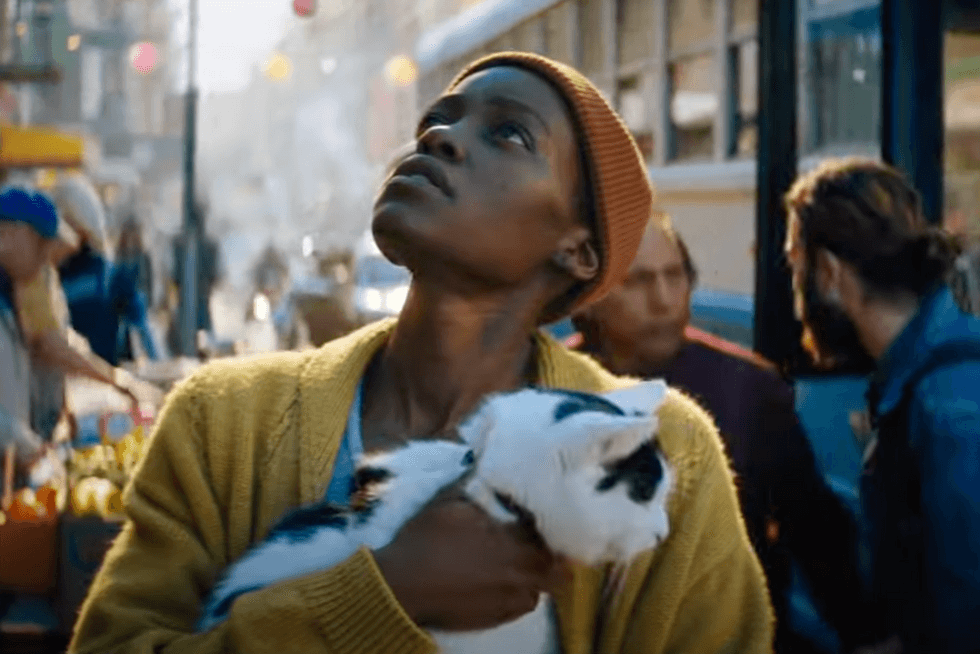
A Quiet Place: Day One stars Lupita Nyong’o as Samira, a terminally ill woman, and Joseph Quinn as her nurse, Eric.

But it’s the third main cast member — a feline named Frodo — who’s been hailed as the surprise star of the film, which one reviewer called “a love letter to cat owners.”

Nyong’o’s Sam has been given the equivalent of a death sentence with her aggressive cancer diagnosis, but when the nightmarish creatures who play the antagonists of the Quiet Place franchise arrive, Sam fights for her life with her trusty “service cat” by her side.

“You can’t have a cat in here,” the clerk at a bodega tells Sam early in the film, before she fixes him with a no-nonsense stare and flatly declares: “He’s a service cat.”
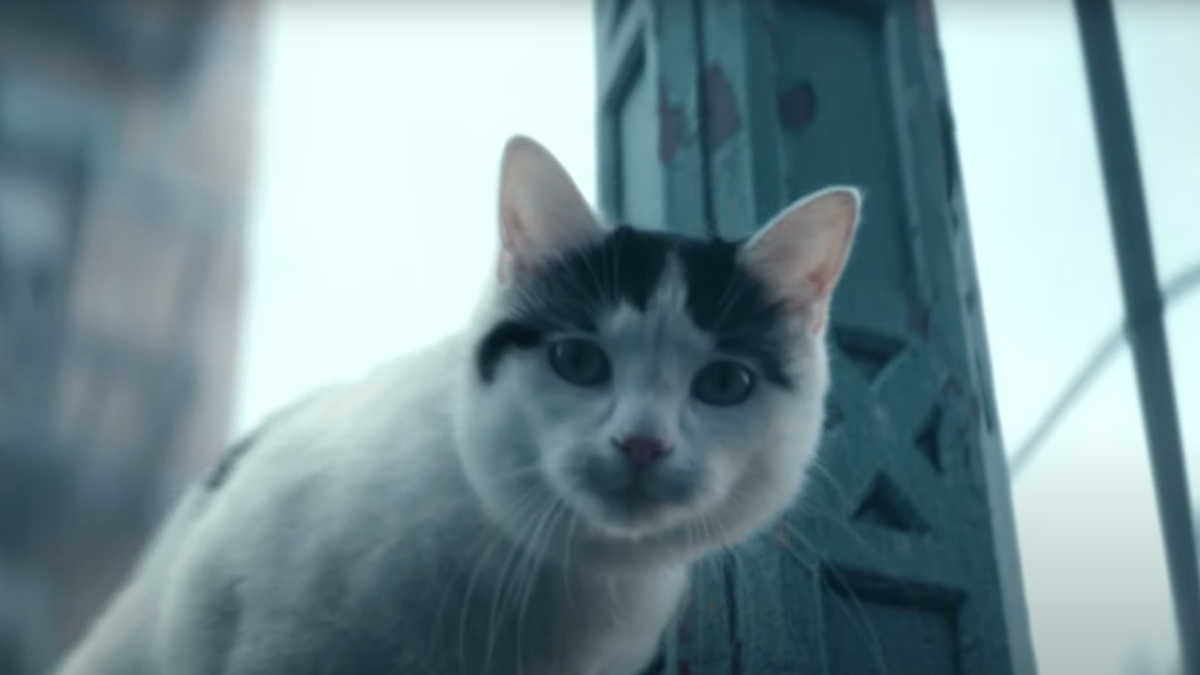
Frodo the Cat
The adorable Frodo, co-star of A Quiet Place: Day One.

Service cats: Fact or fiction?

So are service cats a real thing?

Unfortunately, no. In the US, only dogs and miniature horses can be registered as service animals, and that’s by law. The latter are more rare, but horses labeled emotional support animals are no more official than an emotional support llama.

You’ve probably heard stories or seen photos of people trying to take other animals into places they’d normally never be allowed. In 2019, a woman decided to push the boundaries by taking a miniature horse onto a domestic flight, forcing passengers to share extremely limited space with the olfactorily potent, skittish animal. She even scolded social media users who didn’t get the horse’s pronouns “correct.” (They’re she/her, by the way. We’re not making this up.)

https://x.com/barstoolsports/status/1167440007956746240

https://x.com/tsturk8/status/1167472085918240768

The woman, who says she needs the horse because she suffers from PTSD, told Omaha, Nebraska’s KMTV that the managers of a grocery store allegedly violated her rights by asking her to leave rather than allow her to march a horse through a place where people buy food and its operators are required to follow Department of Health rules.

“I was treated so poorly and the manager’s responses when I followed up were poor,” she said. “They are going to be hearing from the Department of Justice and I’m definitely going to be pursuing legal means as well.”

In 2023, a man tried to take a “service alligator” to a Phillies game at Citizens Bank Park. Stadium security weren’t buying it and he was turned away, but not before other fans snapped photos of the attempt. In Nevada, a man who had his USDA license revoked for “multiple violations of the Animal Welfare Act” argued that authorities couldn’t confiscate his 10 tigers because he claimed they are emotional support animals.

“My doctor has written that she feels that the tigers are beneficial to my psychological well-being and so therefore I got what the law requires,” Karl Mitchell told KTNV, an ABC affiliate in Las Vegas.
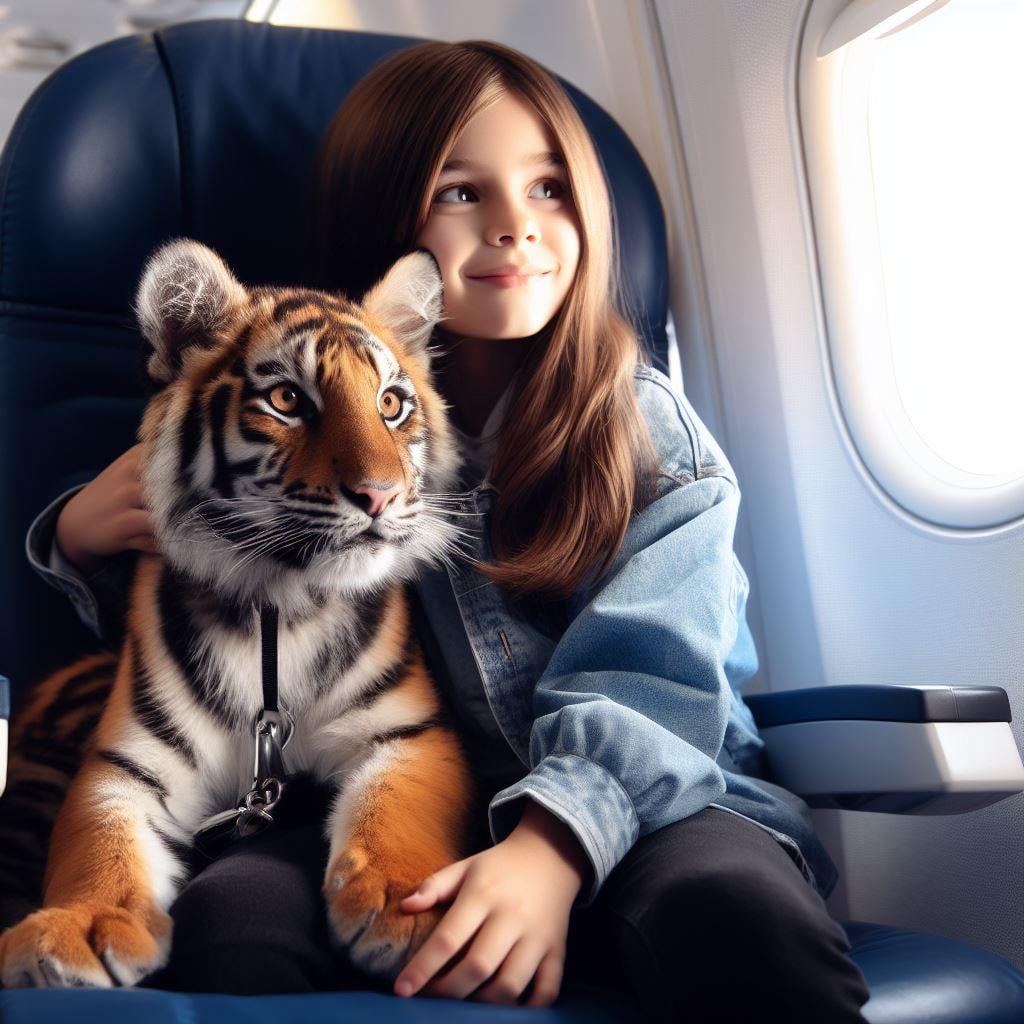
Emotional support tiger
An emotional support tiger depicted in a Reddit photoshop contest for the most ridiculous “service animals.” Maybe some ambitious dreamer will cook up a service elephant or an emotional support bison.

Since then the FAA and Department of Transportation have issued new rules clarifying emotional support horses, peacocks, flying squirrels, parrots and other animals are not allowed on planes, prompting one flight attendant to quip that “The days of Noah’s Ark in the sky are over.”

That, however, has not put a dent in the confusion over what constitutes a service animal versus an emotional support animal, and what rights people have when it comes to bring their furry (or scaly, or feathered) friends into public and private spaces.

Although we’re happy to see Nyong’o in her first lead role since 2019’s freaky horror thriller Us, unfortunately A Quiet Place: Day One is almost certain to contribute to that confusion with its fictional “service cat” character.

A service animal and an emotional support animal are not the same thing

First, there’s an important distinction between a service animal and an emotional support animal.

Service animals can only be dogs or miniature horses, and must be trained. People who depend on service animals can train them themselves, but the animal must meet specific needs, like guiding the blind or vision-impaired.

Emotional support animals, by contrast, are not trained, certified or “official” in any capacity. Anyone can adopt or buy an animal and call it an “emotional support animal.”
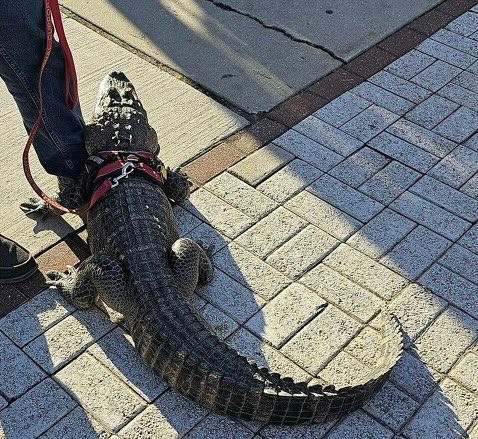
Emotional support alligator
A Phillies fan’s “emotional support alligator.” The stadium turned him and his carnivorous apex predator companion down. Credit: Howard Eskin/X

Unfortunately due to the confusion involving service animals vs ESAs, predatory sites have popped up online promising to “officially register” ESAs for a fee.

In addition to charging for something that doesn’t exist, the proprietors of those sites also tell people they can take their “officially registered” support animals into places normally off limits to pets, like stores and restaurants. Some sites offer consultations with alleged mental health professionals who will “diagnose” customers remotely and write letters on the customer’s behalf.
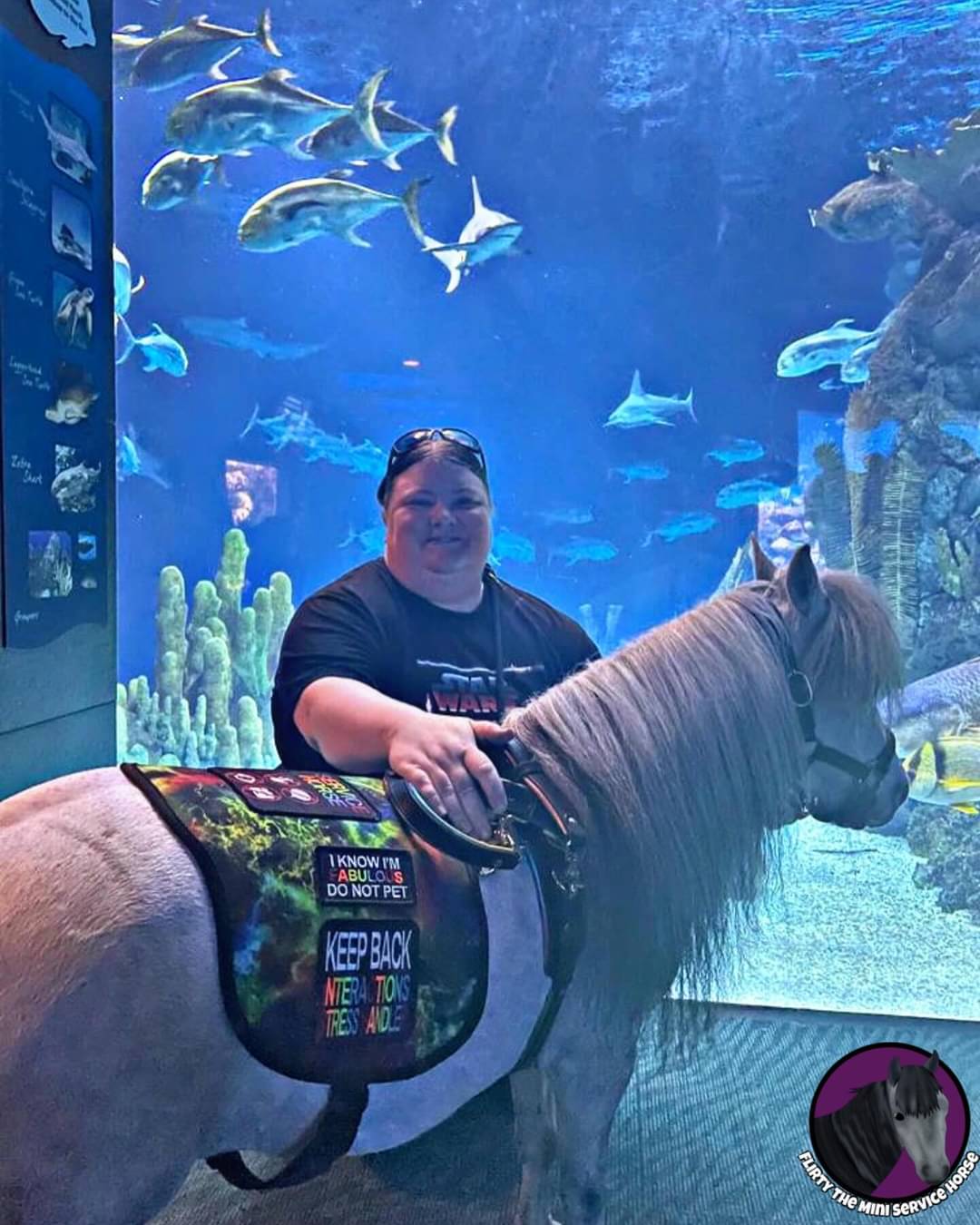
Abrea Hensley with miniature horse
Abrea Hensley with her miniature horse, Flirty, in an aquarium. Hensley’s social media accounts document all the places she goes with the animal.

Those sites operate similar to the numerous “buy a star” sites that claim celestial objects can be officially owned. Like their emotional support animal “registry” counterparts, the star sale sites offer official-looking paperwork, but they’re selling something that can’t legally be sold, and the certificates are legally and practically meaningless.

Buying a “certification” won’t make your cat a service feline, and contrary to how they’re portrayed in the movie, calling a pet an emotional support animal does not allow you to bring it anywhere you like.

For legal purposes, there’s only one perk to be had by claiming an emotional support animal: under the Fair Housing Act, landlords generally cannot refuse tenants who have emotional support animals. The act specifies that allowing emotional support animals is limited by “reasonable accommodations.” That means a dog or a cat is okay, but you can’t keep an animal that poses a danger to your neighbors, negatively impacts their quality of life, or requires the landlord to make major and costly alterations.

The general trend in recent years has involved curbing the limits of emotional support animals, a trend that appears likely to continue as more people abuse the privilege, burdening other members of the public by insisting they must silently endure the inconvenience, potential allergic reactions, sanitary concerns and practical problems caused by bringing animals into spaces that are not designed to accommodate them.

While we’re certainly sympathetic to pet owners — this blog wouldn’t exist if we were not — the fact is that the more people abuse societal boundaries with emotional support animals, the more difficult it makes things for people who have legitimate service dogs and rely on them to navigate life and maintain their independence.

Note: This post has been updated to further distinguish between service animals and emotional support animals. An earlier version contained a paragraph with potentially confusing phrasing.

h/t Susan Mercurio for pointing out that emotional support animals are coveted by the Fair Housing Act

The Result Of Birder Fearmongering: 50 Cats Likely Poisoned, 26 Dead In Texas

The kittens died “foaming at the mouth, throwing up bright green.” Acts of vigilantism against cats are happening more frequently as junk science about their hunting habits spreads via news reports.

Cat rescuer Erica Messina was trapping stray kittens to get them out of the cold and into homes before winter, hoping the young cats would have better lives.

Instead, they died horribly shortly after she successfully trapped them from a lakeside colony in October.

“All of the 13 kittens that I had all passed the same way,” Messina told KBTV, a Fox affiliate in Beaumont, Texas. “They were foaming at the mouth, they were throwing up bright green and peeing bright green.”

Two weeks later, per KBTV, a dozen adult cats from the same colony died the same way the kittens did, “some with chemical burns on their noses.”

“I was upset. I was at work when I found out and I came out here and started asking people, you know, what the problem was,” Messina told the station. “I got no answers.”

Like others who have cared for large colonies of strays who were killed by overzealous birders, Messina says she now has PTSD as she’s trying to save the lives of the remaining cats. She’s managed to catch all but four of them with the help of other local cat lovers and rescue organizations.

They’re getting no help from the authorities. Police referred Messina to Beaumont Animal Care, who told her they can’t help unless she can prove the cats were intentionally harmed. Not only are they putting the burden of proof on the victims in this case, but the victims can’t speak for themselves.

‘A bird-watcher’s paradise’

The colony lived in Collier’s Ferry Park, a lakeside park that also borders marshes where migratory birds spend time alongside native species. Indeed, Beaumont, a coastal Texas city of 115,000, markets itself, and Collier’s Ferry Park in particular, as a prime bird-watching spot.

Colliers Ferry Park
Collier’s Ferry Park in Beaumont, Texas, where 25 cats were killed in an alleged poisoning. Credit: National Parks Service

A 2013 story in the local newspaper, the Beaumont Enterprise, detailed how local officials and business owners were promoting the park as a bird-watching paradise, noting that “[b]irders in particular are a lucrative market” driving tourism in the city. The story explains how the park is ideal for birds and those who like to watch them, details prized species found there — including herons, the least grebe and cinnamon teal — and includes input from a zoologist with a focus on birds, along with a local businessman who leads guided bird tours on the lake.

Collier’s Ferry Park is also listed on a site for “birding hotspots” while Texas Monthly calls it “one of the country’s best bird-watching spots.”

It is precisely the sort of place misguided bird watchers, driven to rage by widespread junk science blaming cats for declines in bird population, tend to dispense what they believe is vigilante justice. It stretches credulity to imagine anyone but a self-styled conservationist who blames cats for bird extinctions would risk a criminal conviction to poison a colony of cats, especially in a well-known hotspot for bird watchers.

Junk science blames cats for declining bird populations

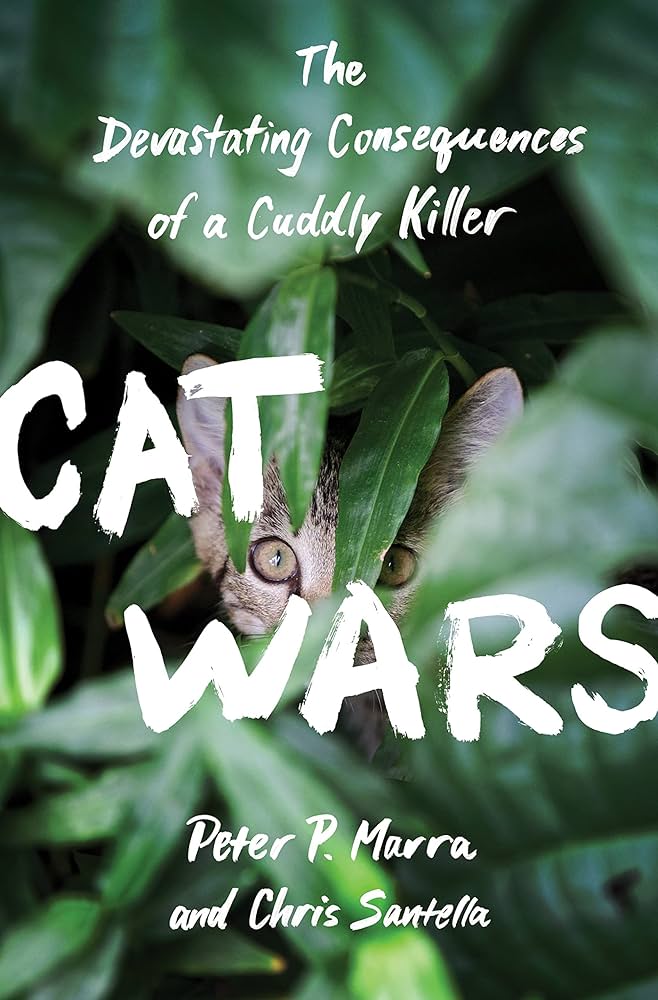
We’ve written our share about the disingenuous and agenda-driven activism that passes for research, most of it published by Peter Marra, a Georgetown avian ecologist who also authored the book Cat Wars: The Devastating Consequences Of A Cuddly Killer. The book advocates a “war” on cats and says they must be extirpated “by any means necessary” to protect birds and small mammals.

It does not, notably, put the blame on human activity, including but not limited to habitat destruction, the widespread use of harmful pesticides, wind farms, sky scrapers and all the other man-made structures, chemicals and machines that have contributed to a 70 percent decline in wildlife in the last 50 years.

catwars2

But don’t take our word for it. Vox Felina calls Marra “a post-truth pioneer” who has claimed cats “kill more birds than actually exist,” while Alley Cat Allies echoes our own criticism by pointing out that Marra’s studies are composites of “a variety of unrelated, older studies” which his team uses to concoct “a highly speculative conclusion that suits the researchers’ seemingly desperate anti-cat agenda.”

“This speculative research is highly dangerous—it is being used by opponents of outdoor cats and Trap-Neuter-Return (including the authors) to further an agenda to kill more cats and roll back
decades of progress on TNR. And it is being spread unchecked by the media.”

In an NPR piece criticizing the studies blaming cats, Barbara J. King shares many of our own criticisms, chiefly that Marra and company have done no original research, relying instead on older studies, most of which have nothing to do with feline predatory habits, and none of which actually measure bird deaths from cats. King also notes, as we have, that it’s impossible to arrive at anything resembling a precise figure for feline ecological impact when Marra et al admit they don’t know how many free-ranging cats there are in the US, offering a uselessly wide estimated of between 20 and 120 million.

She also points out that the research team conducted “statistical perturbations” to massage the data into something fitting their agenda, which is activism, not science.

The researchers are guilty of “violating basic tenets of scientific reasoning when making their claims about outdoor cats,” bioethicist and research scientist William Lynn wrote.

“Advocates of a war against cats have carved out a predetermined conclusion,” Lynn noted, “then backfilled their assertions by cherry picking an accumulation of case studies.”

The war on cats

Across the world, people are using these studies and those of Marra’s acolytes to justify cruel cat-culling programs, like the recently-canceled cat hunt that would have rewarded children for shooting felines in New Zealand, and Australia’s widely-condemned mass culling that used poisoned sausages to kill millions of cats.

Stories of stray and feral cat poisonings in the US abound. Here at PITB we wrote a series of stories exposing how a government biologist in California took it upon himself to hunt cats under the cover of night, killing them with a shotgun and later celebrating in emails to colleagues, calling the dead cats’ bodies “party favors.”

Indeed, one of Marra’s own proteges, Nico Arcilla — formerly Nico Dauphine — went vigilante. Arcilla, who shares author credits with Marra on studies claiming free-ranging cats kill billions of birds, was a working for the Smithsonian National Zoo in Washington, D.C., when she was convicted in 2011 of attempted animal cruelty. The managers of a local colony, suspicious after strange substances began appearing in the feeders they’d set up for the strays, set up cameras which caught Arcilla placing poison on the food left out for the cats.

Back in Beaumont, Texas, a familiar story plays out: people who manage cat colonies out of love for the animals are working with local rescues, pooling together limited resources to save the remaining strays and hoping for justice.

“It’s terrible, you know? There are some people that just hate cats,” said Vyki Derrick, president of local rescue Friends of Ferals. “The rescuers have been trying to pull them out of the colony and it’s just sad that people want to interfere with that when the problem, ‘problem’ is being taken care of.”

Header image credit: Pexels

George Santos Allegedly Stole $3,000 From Veteran Whose Dog Needed Life-Saving Surgery

The congressional clown show continues, but it’s not funny anymore — it’s just sad.

The George Santos story just keeps getting worse.

My first reaction to the initial New York Times story outing newly-elected New York congressman George Santos as a serial fabulist was surprise, then sadness because I knew his election was in large part made possible by the death of local news. If there’d been competent local media still operating in the area, Santos’ campaign would have ended as suddenly as it started in a flurry of revelatory news coverage, and Santos himself would have been a footnote, a political oddity and embarrassment to the local GOP.

Then for one glorious moment I thought maybe Santos was a performance artist, that we’d find out George Santos is the alias of some comedian or media provocateur whose congressional run was designed from the start to show that politics has become so polarized, so divorced from issues and hitched to ideological loyalties that even a widely disliked grifter — with no roots in the community and a completely fabricated resume — could win simply because he said the right things, pushed the right buttons and kissed the right behinds.

Alas, no Dax Herrera or Ari Shaffir came forward to claim credit for inventing the George Santos persona.

And it just kept getting worse. There were the stories about pending criminal charges for using stolen checks in Santos’ native (?) Brazil, former roommates who saw Santos on TV wearing expensive clothes he’d allegedly stolen from them, and Santos working as the director of a company under investigation for running an alleged Ponzi scheme.

osthoffsapphire1
Sapphire, veteran Rich Osthoff’s service dog.

The latest story might be the most infuriating: Santos is accused of stealing $3,000 from a homeless, PTSD-suffering veteran whose beloved service dog needed life-saving surgery.

Rich Osthoff, who was living on the streets at the time, needed money to pay for veterinary surgery to remove a large and life-threatening tumor from his service dog, Sapphire. Osthoff says Sapphire was his lifeline during difficult times and he was desperate to get her the surgery she needed.

In 2016 a well-meaning vet tech and another veteran connected Osthoff with Santos, who claimed he ran a charity called Friends of Pets United and could help. At the time, Santos was going by the name Anthony Devolder.

Santos set up a GoFundMe drive for Osthoff and Sapphire, raised $3,000 with a tear-jerker of a plea, then basically ghosted Osthoff and his veteran friend Michael Boll, founder of New Jersey Veterans Network. After fobbing them off with a series of excuses, he stopped responding to their calls and vanished with the proceeds.

“It diminished my faith in humanity,” Osthoff said of the experience.

Santos denied the accusation.

“Fake,” Santos texted news startup Semafor on Wednesday. “No clue who this is.”

osthoffsapphire
Osthoff with Sapphire.

But dozens of other people besides Osthoff, Boll and the vet tech were involved and confirmed Santos’ role in the fundraiser, there are publicly visible tweets from 2016 linking to it — and crediting “Anthony Devolder” for running it — and GoFundMe acknowledged the existence of the drive.

In addition, news reports have confirmed Friends of Pets United, Santos’ “charity,” was never registered as a non-profit. Santos also defrauded an animal rescue group in New Jersey when he pocketed the proceeds from a 2017 fundraiser he ran on behalf of the organization, according to dozens of media reports. Santos was terse in his response to the accusations from Osthoff and Boll, but he was eager to talk about his non-existent pet charity during his campaign, when he claimed Friends of Pets United “saved” more than 2,500 cats and dogs over a four-year span and trapped and neutered more than 3,000 cats.

Santos’ lies are so numerous and so outrageous it’s difficult to keep track of them, and it’s doubtful he remembers all of them.

He claimed his mother worked at a financial firm at the World Trade Center and died in the 9/11 attacks, but Fatima Devolder left the US for Brazil in 1999 and never returned. She also never worked in finance. He claimed four of his employees died in the 2016 Pulse Nightclub shooting that claimed 49 lives. Santos never had any employees, his company didn’t exist, and he didn’t know anyone who died at the nightclub. He claimed ownership over an impressive and burgeoning real estate empire, but never owned any properties and owes more than $40,000 in back rent on a Queens apartment he shared with his sister for years. (His sister was also the recipient of a $30,000 FEMA handout and contributed a hefty $5,000 to his campaign, but still owes tens of thousands in back rent on the apartment, reports say.)

Rep._George_Santos_Official_Portrait_(cropped)
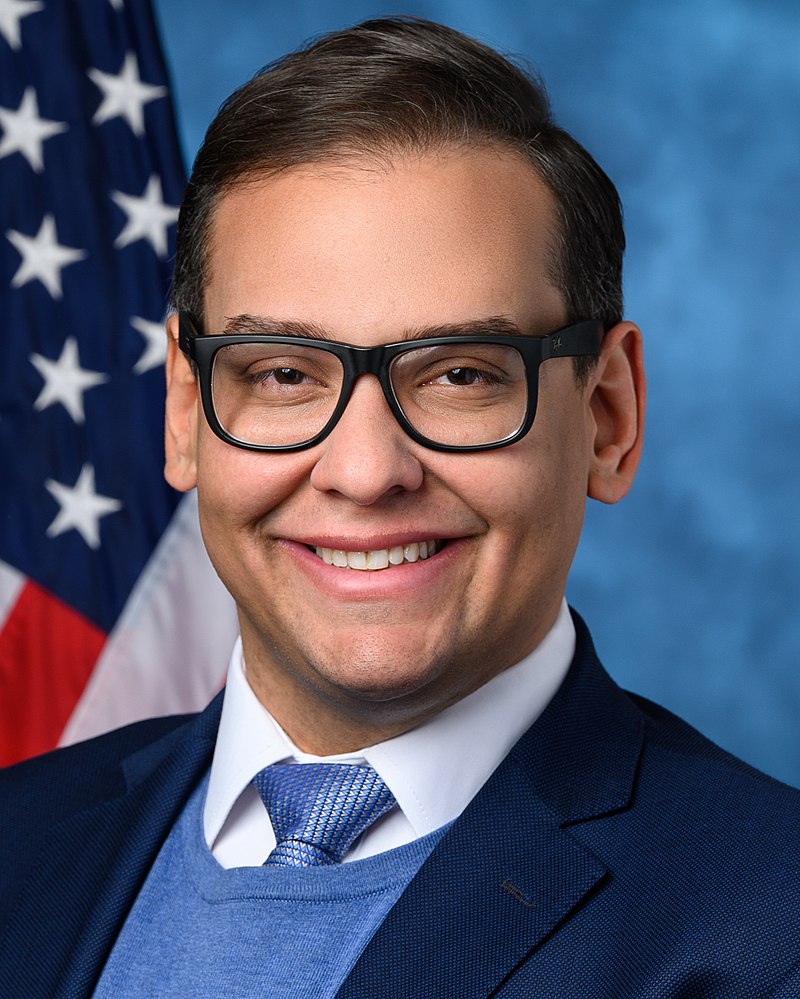
George Santos has refused to resign from congress despite calls from his own constituents, other lawmakers, figures in his own party and media commentators demanding his exit. Credit: Official congressional portrait

There are too many lies to list here, too much insanity to digest in one sitting, and it’s probably not good for the blood pressure to dwell on this weasel of a man allowing a homeless veteran’s service dog to die while pocketing the money raised for her surgery.

But we’re not done yet. We still don’t know how Santos bolstered his campaign with $750,000 of his own money, or where that cash came from. It’s not even clear if Santos is his real name, or if he’s actually a U.S. citizen, with some reports — like a New York Times story from last week — suggesting he may have married his former wife for citizenship.

While New York Republicans have been among the loudest voices to condemn Santos and demand he resign or be removed from congress, national party leaders haven’t made any moves to get rid of him — and have actually given him committee assignments — because they believe they need his vote in a slimmer-than-anticipated congressional majority.

As the lies keep piling up, the biggest question is: How long will this farce be allowed to drag on?