Were Cats Really Domesticated By The Egyptian Cult Of Bastet?

While the sensational claims have spawned headlines around the world, a closer examination raises more questions.

According to dozens of articles, a pair of new studies throws doubt on the commonly-held view that cats self-domesticated 10,000 years ago by helping themselves to rodents invading human grain stores.

The conventional wisdom for some time has been that house cats are the domesticated ancestors of felis sylvestris lybica, the African wildcat. Their genomes are nearly identical, it’s often difficult even for experts to tell the species apart, and they’re much more tolerant toward humans than the comparatively hostile felis sylvestris, the European wildcat.

But two new papers are raising eyebrows for their fantastic claims that feline domestication was actually human-driven and began about 5,000 years ago in Egypt.

Specifically, the papers claim cats were sacrificed en masse by the cult of Bastet, an Egyptian feline goddess, guiding the species toward domestication in a way that doesn’t quite make sense with what we know of evolution.
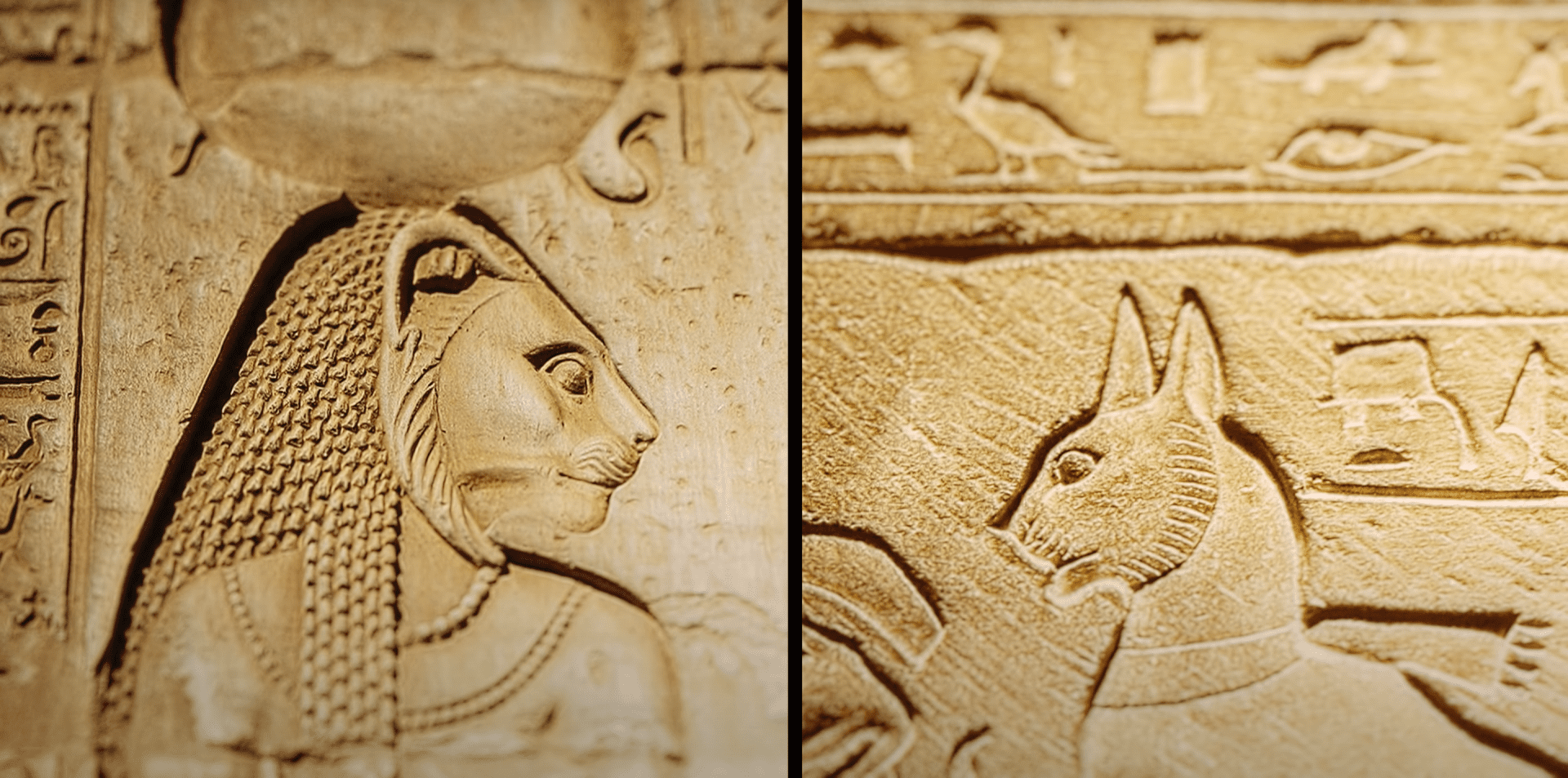
Bastet was originally depicted with the head of a lion, but the imagery around her evolved as she became a more prominent deity in the Egyptian pantheon. Later glyphs depicted her with the head of a domestic cat or African wildcat.

There are two main elements to the new claim:

  1. The earliest grave in which a cat was buried with a human was dated to about 10,000 years ago, and was found in Europe. But an analysis of the cat’s remains indicate it had DNA somewhere between a wild cat and a domestic feline. That, the authors claim, throws into doubt the idea that cats drifted into human settlements, drawn by the presence of rodents.
  2. If domestication was closer to 5,000 years ago, that would coincide with the rise of the cult of Bastet, the Egyptian cat goddess, around 2,800 BC.

Instead of the feel-good, fortuitous sequence of events the scientific community has accepted as the likely genesis of our furry friends, the authors of the new papers claim aggressive and fearful traits were essentially murdered out of the feline population by Bastet cultists who sacrificed cats in large numbers and mummified their corpses.

Neither paper has been peer-reviewed yet, and experts on ancient Egypt, genetics and archeology have already begun pushing back.

The new timeline, they say, doesn’t quite add up, with cat mummies found throughout different periods in Egyptian history, not just during the height of Bastet’s popularity in the Egyptian pantheon. Bastet’s popularity came approximately 700 years later than the authors claim the sacrifices began, and early imagery of the felid goddess depicts her with a lion head. It wasn’t until later centuries that Bastet was represented with the features of a domestic cat.
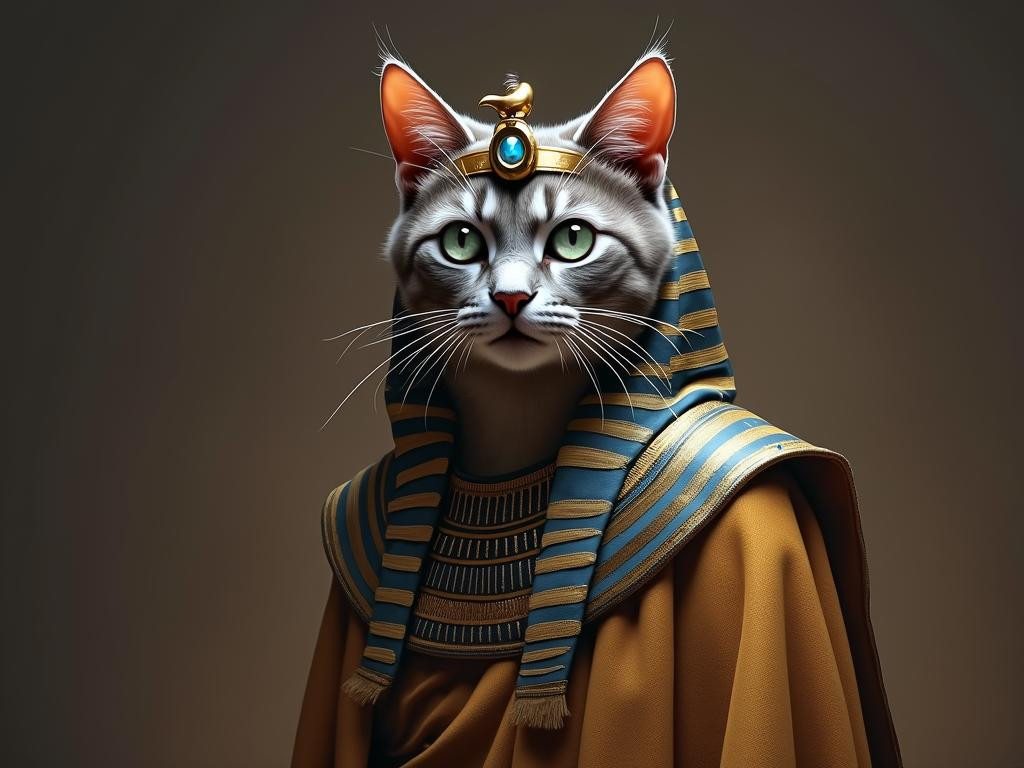
The powerful Pharaoh Budhotep I, considered an apocryphal king by some, sent a fleet of ships to the Americas to bring back turkey, according to legend. Credit: The Royal Buddinese Archaeological Society

Separate from timeline concerns is the lack of historical evidence. Cats were revered in ancient Egypt, and while there are an abundance of cat mummies — as well as the mummified remains of many other animals — that does not mean the cats were ritually sacrificed.

Indeed, archaeological, hieroglyphic and anthropological evidence all show cats enjoyed elevated status in the Egypt of deep antiquity, long before the nation became a vassal state of the Greeks, then the Romans.

Cats were associated with magic, the divine and royalty, and cats who were the favored pets of Egyptian elites were given elaborate burials. Like Ta-miu, Prince Thutmose’s cat who is known for her grand sarcophagus decorated with images of felines and prayer glyphs meant to guide her to the afterlife.

Cats were sacred companions to the Egyptians

When cats are found buried with humans, the more common explanation is that those cats were the pets and companions of those humans. If the authors of the two new papers want to prove their claim that cats were ritually sacrificed by the tens of thousands — slaughter on a scale that would influence evolution — they’ve got a lot more work ahead of them. (And the burden of proof rests squarely with them, as the originators of the claim.)

Not only does their research attempt to change the origin stories of kitties to an ignominious tale of human barbarity, if we take their assertions at face value, we’re talking about a case of “domestication by slaughter.”

While it may be true that the earliest evidence of companion cats outside of North Africa revealed hybrid DNA, that doesn’t cast doubt on the commonly-accepted view of feline domestication, it strengthens it. Domestication is a process that takes hundreds of years if not more, and it occurs on a species level, so it makes perfect sense that cats found in burial sites from early civilization would be hybrids of domestic and wild. Those felines were of a generation undergoing domestication, but not quite there yet.
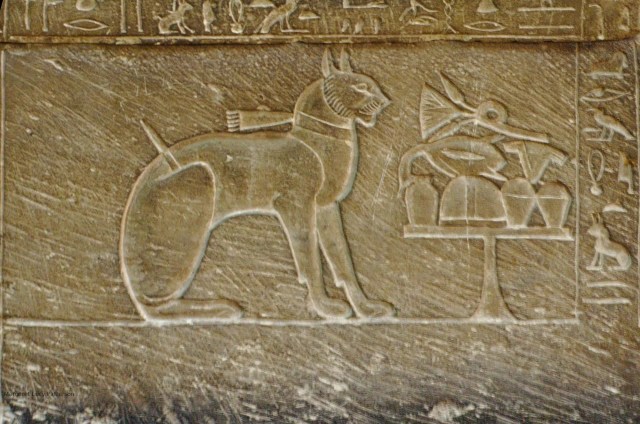
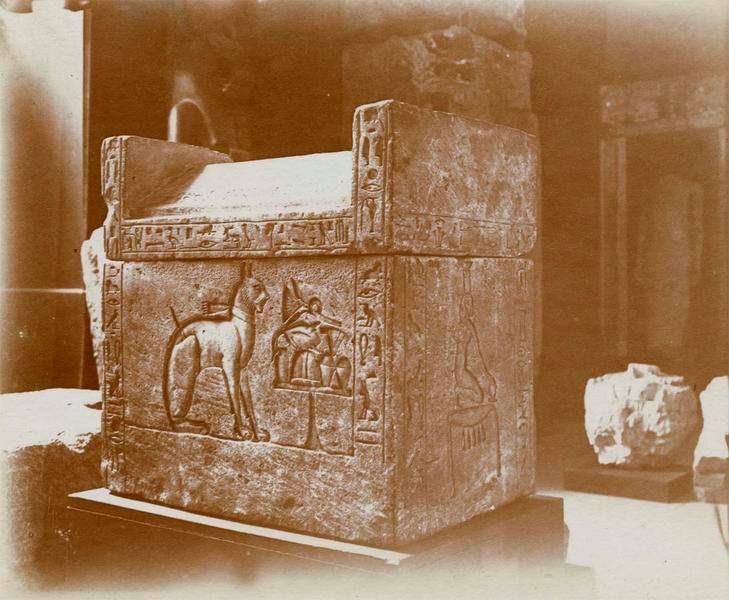
A detail from the sarcophagus of Ta-miu, Prince Thutmose’s beloved cat.
Ta-miu, Prince Thutmose’s beloved cat, was buried in an elaborately decorated sarcophagus with glyphs and offerings meant to guide her to the afterlife. Thutmose, son of Amenhotep III and Queen Tiye, lived in the 14th century BC.

Killing off docile cats?

Which brings us to another significant problem with the claim: if the ancient worshipers of Bastet were selecting the most docile and easiest-to-handle wildcats for their sacrifice rituals, as claimed, then they would be influencing evolution in the other direction.

In other words, they’d be killing off the cats who have a genetic predisposition toward friendliness, meaning those cats would not reproduce and would not pass their traits down. It would have the opposite effect of what the papers claim.

So despite the credulous stories circulating in the press and on social media, take the assertion with a grain of salt. Something tells me it won’t survive peer review, and this will be a footnote about a wrong turn in the search for more information on the domestication of our furry buddies.
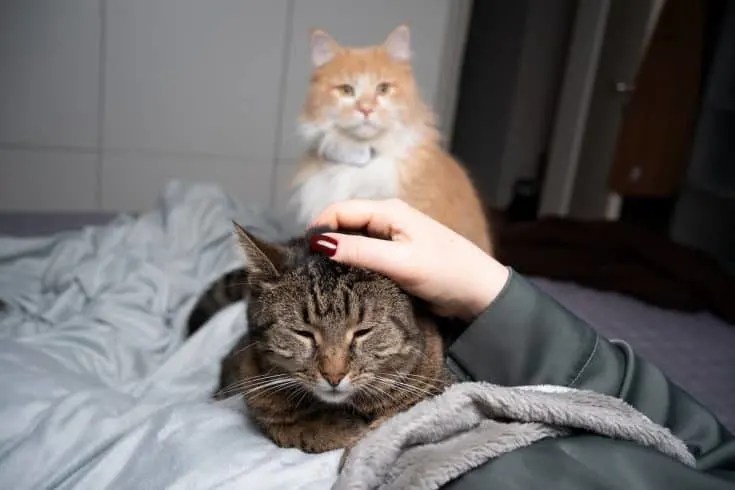
Cats would like human civilization to return to the good old days.

Can Cats Feel Jealousy?

While the answer is obvious to cat servants, proving feline jealousy in a study is a different ballgame entirely.

Bud isn’t fond of my smartphone.

Like many other humans I spend too much time looking at the damn thing, and that’s not good even though I have the excuse that I use my phone as a reader and my presence on social media ranges from extremely limited to nonexistent.

When His Grace has decided I’ve looked at the screen long enough and it’s Buddy Time, he’ll pad up and slap the phone out of my hands, or if I’m laying down he’ll climb on top of me, nudge the phone out of the way and sit on my chest so he has my full attention.

“No glowing rectangle!” he’s saying. “It’s Buddy Time! Now scratch my chin and rub the top of my head as I purr!”

Naturally I comply, and before long Buddy is leaning in, pressing the top of his head against my forehead, which is his way of saying: “I love you, slow dumb human! You have many flaws and you don’t give me enough snacks, but you’re my Big Buddy!”

Of course, intuitively knowing Buddy is jealous of — or annoyed by — my phone is different than proving it in a well-designed, repeatable experiment.

Psychology Today’s Jessica Wu writes about just such an effort by a team of researchers out of Japan.

Before I offer my criticism of the study, let me first say I have respect for the team at Kyoto University. They’re one of a handful of research teams around the world that routinely produce studies into cat behavior and cognition, and it’s clear that they view it as an important and crucial area of research. That’s significant, because even though we’ve seen something of a renaissance in cat-related studies over the past half-decade or so, many scientists still think cats are nearly impossible to work with.

The team at Kyoto also understands the territorial nature of cats makes it difficult to study them in a lab environment, so they go the extra mile and enlist people who are willing to let them into their homes to study their little tigers.

That’s what the Kyoto team did for their 2020 study on jealousy, splitting their research between typical homes and cat cafes. (Fifty two cats in total participated.) All the cats observed in the study had been living in their homes or cafes for at least six months.

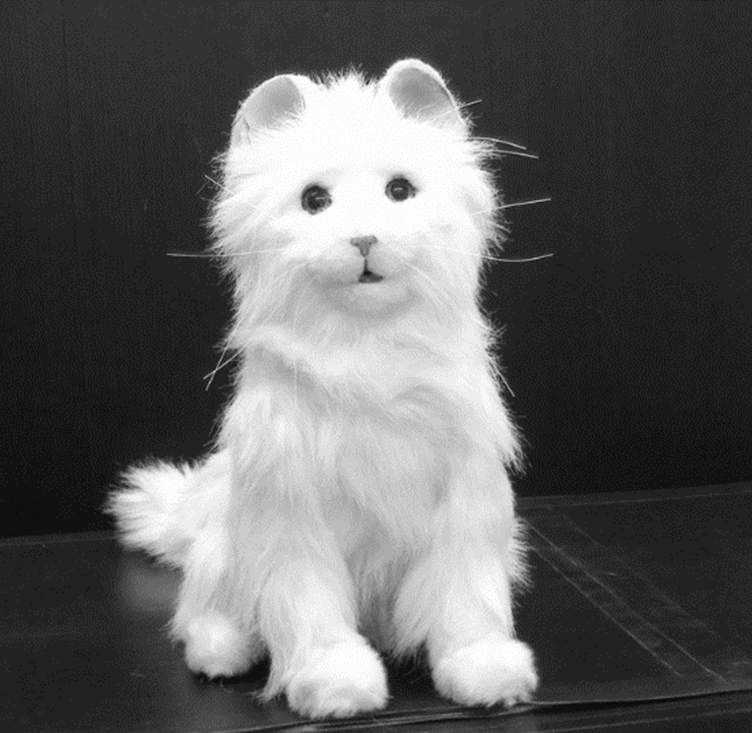
Researchers took a method that’s been used to study human babies and dogs, and adapted it for felines. They brought in a plush cat and a pillow with a corresponding color and texture.

https://youtu.be/VSSt-YtZo58

Then they asked the participants to spend time petting the plush cat and the pillow in front of their furry overlords while team members carefully watched the kitties for their reaction. Each experiment was then repeated with a stranger petting the plush and the pillow to gauge whether cats behaved differently when observing someone they aren’t emotionally attached to.

The team found the cats “reacted more intensely” to the plush cats than the pillows, but there wasn’t any marked difference in how they reacted when they watched their humans versus strangers.

Crucially, the cats didn’t show signs that they were upset, like human babies have in such experiments, and they didn’t try to physically separate their humans from the plushies, as many dogs did in their version of the experiment.

jealous-cat
“How dare you hand out yums and not include me!” Credit: icanhazcheezburger

The results indicate cats didn’t express jealousy in the experiment, but the Kyoto team are pros, noting that it’s just one study with one approach.

“We consider the existence of some cognitive bases for jealousy to emerge in cats, and the potential effect of cats’ living environment on the nature of their attachment to their owner,” they wrote. “More ecologically valid procedures are required for further study of these issues.”

It’s my non-expert, non-scientific opinion that researchers would get better results using actual cats instead of proxies. That introduces a new set of problems and an experiment involving rival cats won’t be easy, but science isn’t supposed to be easy, and if we really want to understand how cats think, we have to get as close as possible to mimicking real circumstances.

Plush Cat in Kyoto study
The plush cat used in the Kyoto study. Perhaps the cats involved in the research felt the humans were insulting their intelligence. Credit: Kyoto University

It would also help to expand the scope of the experiment. How much can researchers really glean from a fleeting interaction? Jealousy isn’t something that just bubbles up and disappears. It happens within an emotional context. It’s a secondary emotion that sprouts from elements of primary emotions like fear, anger and confusion.

Scientists are very careful about anthropomorphizing animals, for obvious reasons, but sometimes they’re guilty of over-correcting as well and denying the obvious, which is why the prevailing scientific opinion for almost half a century, until 1959, was that animals don’t have emotions or cognition.

In the meantime, Buddy will continue to make sure Buddy Time is equal to, or greater than, glowing rectangle time.