You’re Allowed To Be Angry About A Dead Cat In Russia

The outrage over the death of a pet cat may be the best barometer of Russia’s national mood as its disastrous war on Ukraine enters its third year.

For the past two years I’ve had a lurid hobby. I’ve been watching translated clips from the bizarre world of Russian state TV, where Vladimir Putin’s pet propagandists tell the Russian people what to think.

There’s ringleader Vladimir Solovyov, a guy who dresses like the admiral of a galactic fleet of military starships and is prone to wild mood swings. Depending on when you catch Solovyov he could be cackling maniacally at the prospect of nuking London or crying into his microphone as he laments the loss of his overseas bank accounts and his boss’s slipping grip on power.

There’s Margarita Simonyan, the 43-year-old head of RT (Russia Today) and rumored alcoholic who, strangely, is even-keeled compared to Star Admiral Solovyov.

Then there are the second-tier propagandists: Olga Skabeeva, the “Iron Doll of Putin TV” who matter-of-factly endorses horrific war crimes, and men like Anton Krasovsky, who famously fantasized about drowning Ukrainian children in the Tysa River, a tributary of the Danube, his desk rising three inches as he excitedly repeated “Just drown those children, drown them!” Apparently he forgot he was on television and said the quiet part out loud, forcing his boss (Simonyan) to grudgingly condemn his words.

Simonyan and Solovyov
Margarita Simonyan, left, and Vladimir Solovyov, right, are two of Russia’s most famous pro-Putin propagandists. Credit: Russian state TV

Solovyov, Simonyan and the others looked like a bunch of investors celebrating the sale of a billion-dollar company during the opening phases of the war in early 2022, giddily playing footage of Russian missiles taking out Ukrainian apartment buildings and artillery flattening hospitals.

Their rhetoric was extra-dimensional at the time: they spoke often of a glorious New World Order with Russia at its head and all of humanity united under Putin’s tiny feet, where people would undoubtedly conclude that life under Russian masters is better than any over-hyped concept of freedom.

When Russia faltered and Ukraine began stringing together victories with the help of western weapons and real-time intelligence from the US and UK, the tone of Putin’s propagandists grew bitter. Their body language mirrored their frustration. Solovyov began a tradition of threatening to nuke a different country every day, for “crimes” like acknowledging the reality of Russia’s military incompetence or calling for peace.

To date, Solovyov’s threatened to nuke the UK, France, Spain, Germany, Italy, Japan, Finland, Sweden and the US, and that’s just off the top of my head. He especially hates the British for reasons that aren’t entirely clear, but he regularly makes it clear that it’s only through Putin’s benevolence that cities like London and Paris continue to exist.

He’s also extremely fond of Tucker Carlson: he plays clips from Carlson’s show on X regularly, offered him a job after the American was fired by Fox News, and has declared him the greatest journalist in the western world.

In Putin Russia, cat feed you!

I thought of that motley crew of Putinious jackwagons this week as I read about the Russian public’s horrified response to an incident on a train.

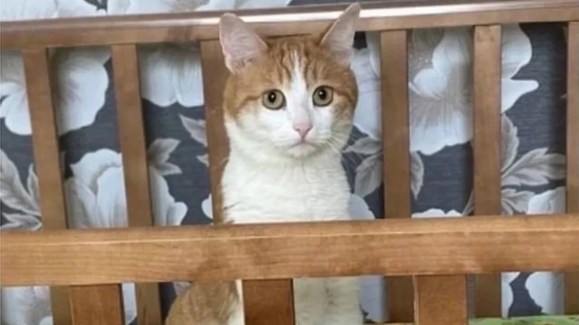
A couple was traveling on a Russian Railways train to St. Petersburg when their beloved cat, Twix, escaped his carrier. The frightened ginger tabby just kept running until he was scooped up by a female conductor, who unceremoniously tossed him into the snow in Russia’s frigid Kirov Oblast. Temperatures regularly dip into the single digits and below zero in the winters there.

On Jan. 20, after a search joined by hundreds of people, little Twix’s body was found in the snow about a half mile from the train tracks. The feline, who was used to safety and warmth, suffered multiple animal bites and died either from his wounds or the temperature.
twixcat
Twix the cat in a photo from his family that was reposted to a Russian Telegram channel.

To say Russians are furious is an understatement.

Twix’s fate has been the talk of Russian social media platforms for days. Surveillance camera footage of the conductor tossing the tabby ignited a new level of rage. As of Wednesday more than 300,000 Russians had signed a petition calling for the firing of the conductor, whose name hasn’t been released by the state-owned passenger railroad company. A second petition goes further, calling for criminal prosecution, and has 100,000 signatures in just a few days.

Public outrage about the fate of Twix just might be the first authentic sentiment to reach Russian media in years.

In an unusual move, the government acquiesced — partly — to the public’s demands and pulled the conductor from duty pending an investigation. They’ve also acknowledged that Twix’s humans had properly purchased a pass for him and were riding in a car designated for passengers with pets. In the future, they’ve vowed, conductors won’t toss animals from trains.

Russia is a famously cat-loving country. Felines comprise more than 64 percent of all pets kept by Russians, and more than half of all Russian households have pet cats. They’re considerably more popular than dogs in the nation of 143 million.

Cats are popular in Russian folklore, where traditions say the furry ones have the power to ward off evil, and they’re a much more convenient pet for the millions who live in Soviet-era apartment blocks in cities like Moscow and St. Petersburg.

Still, this feels like something more.

Russians haven’t had an easy two years thanks to Putin’s disastrous “special military operation.” They can face years in prison simply for calling for peace with Ukraine. Unless they’re part of the nation’s elite or have connections among them, men can’t leave the country because the military needs more warm bodies. The country’s economy is in shambles as the government pumps more money into the war and international sanctions have taken their toll.

russiantankloot
A Russian tank laden with loot, including a toilet, rolls past the ruins of residential buildings in Popasna, a city in eastern Ukraine.

The government has canceled or downplayed annual military celebrations so the public won’t be reminded of the war’s costs. Russia is on pace to lose an astonishing 500,000 men in two years of combat, according to the UK’s Ministry of Defense, and Putin has tried to stem the anger of the country’s mothers by staging several meetings with actresses posing as the moms of Russia’s war dead, events which have been heavily covered by state press.

Russians can’t oppose the war they’re dying in. They can’t mourn their dead fathers, sons, brothers and husbands, not by revealing their real emotions.

Quality of life has further degraded in a country where tens of millions don’t even have indoor plumbing, which is why there have been so many clips of Russian soldiers stealing toilets, washing machines and other appliances from Ukrainian homes. The prospect of being pulled off the street, sent for two weeks’ worth of rudimentary training and deployed as cannon fodder hangs heavy over the heads of Russian men and their families, especially ethnic minorities and the poor.

But Twix? They can mourn him. They can get angry about what happened to him. The furious public sentiment regarding his death wasn’t manufactured by Solovyov and company. State TV didn’t spark the backlash, it was forced to acknowledge it.

I’m neither a Russophile nor an expert on that often difficult-to-understand country, but I’d bet all my rubles that those dueling petitions say more about the Russian mood than any opinion poll to come out of Russia since 2022, and definitely more than the words of anyone allowed to express an opinion on Russian TV.

RIP Twix.

Laika And Felicette: The First Dog And Cat In Space Were Sacrificed For Human Ambition

Mankind’s achievements in space came at the expense of dogs, cats and non-human primates, who were sent into orbit during the early days of the space race.

I’ve been watching Apple TV’s exceptional show, For All Mankind, which dramatizes the space race of the 1960s and beyond in a sort of alternate history where the Soviets, not Americans, first lay boots on the lunar regolith.

That loss lights a fire underneath the behinds of the people at NASA and convinces American politicians that the space race is the ultimate measure of our civilization. In real life, American ingenuity and the creativity fostered by a free society allowed the US to leap ahead and “win” the space race. Space missions were already becoming routine by the time the drama of Apollo 13 briefly rekindled public interest.

Then the Soviet space program faded, the competition turned one-sided, and without an arch-enemy to show up, American politicians pulled back NASA’s funding to a fraction of what it once was, where it remains today. That’s why the rise of the private space industry — Elon Musks’s Space X, Jeff Bezos’ Blue Origin, etc — will almost certainly be our ticket to Mars.

But in For All Mankind, NASA remains the budgetary behemoth and source of prestige it was in the 60s and 70s, leading to the development of a permanent moon base, lunar mining operations and a planned mission to the red planet.

There’s a quiet moment in the second season when a Soviet cosmonaut, visiting the US as part of a peacekeeping mission, shares a drink in a dive bar with an American astronaut.

“Do you like dog?” the cosmonaut asks.

“Dogs?” the astronaut replies. “Of course. Who doesn’t like dogs?”

The Soviet shakes his head.

“No, dog,” he tells her. “Laika.”

Laika was the first dog in space, or more accurately, the first dog the Soviets acknowledged sending into space. (The Soviets didn’t acknowledge their failures, and we can only guess at the number of lost cosmonauts and animals officially denied by the Russians, drifting in space for eternity or disintegrated in atmospheric re-entry.)

Laika
Laika, also nicknamed Muttnick, wanted to please the humans who had taken her in, and didn’t understand that her trip would be one way. (Historical photo)

The moment turns somber as the cosmonaut recalls the Moscow street dog who was selected because she was docile, fearless and could handle the incredible noise and g-forces of a rocket launch.

“I held her in my arms,” the cosmonaut tells his American counterpart, taking a sip of his Jack Daniel’s. “For only one or two minutes on the launchpad.”

Then he leans in and tells her the truth: Laika didn’t triumphantly orbit the Earth for seven days in 1957 as the Soviet Union told the world. She didn’t endure the mission.

She perished, alone and afraid, just hours after launch when her capsule overheated.

The Soviets never designed the Sputnik 2, Laika’s ship, to return to Earth safely. Her death was predetermined.

We laud astronauts and cosmonauts, the brave men and women who willingly strap themselves into tiny capsules attached to cylinders of rocket fuel the size of skyscrapers and depart this Earth via brute force, knowing something could go wrong and their lives could end before they realize what’s happening. We should admire them. Their accomplishments are all the more impressive when you consider the fact that the combined processing power of every computer at NASA’s disposal in the 1960s was but a fraction of what we each hold in our hands these days when we use our smartphones.

Those first astronauts and cosmonauts were extraordinarily brave — but only up to a point.

Unwilling to risk human lives in the early days of space exploration, space programs used dogs, cats and later monkeys and apes, strapping them into confined spaces, wiring their brains with electrodes for telemetry data, poring over the information they gleaned about their heart rates, blood pressure and breathing as they left our home planet.

The sad eyes of a stray dog, separated from everyone she loved, were the first to behold Earth from space. A few years later the eyes of a French street cat took in the same view before humans did.

Felicette
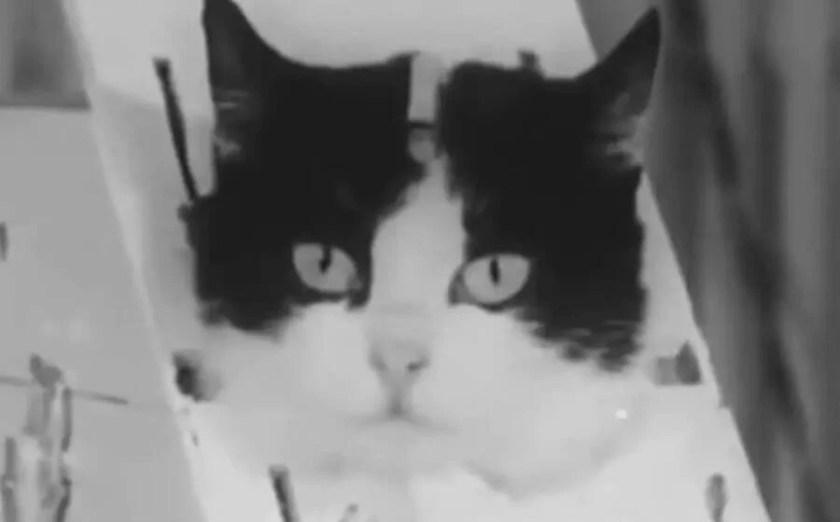
Felicette couldn’t move when she was placed into the capsule that took her to space and back.

Felicette, the tuxedo cat who was launched into space by the French on Oct. 18, 1963, didn’t even have a name until the French recovered her capsule and took her back for examination.

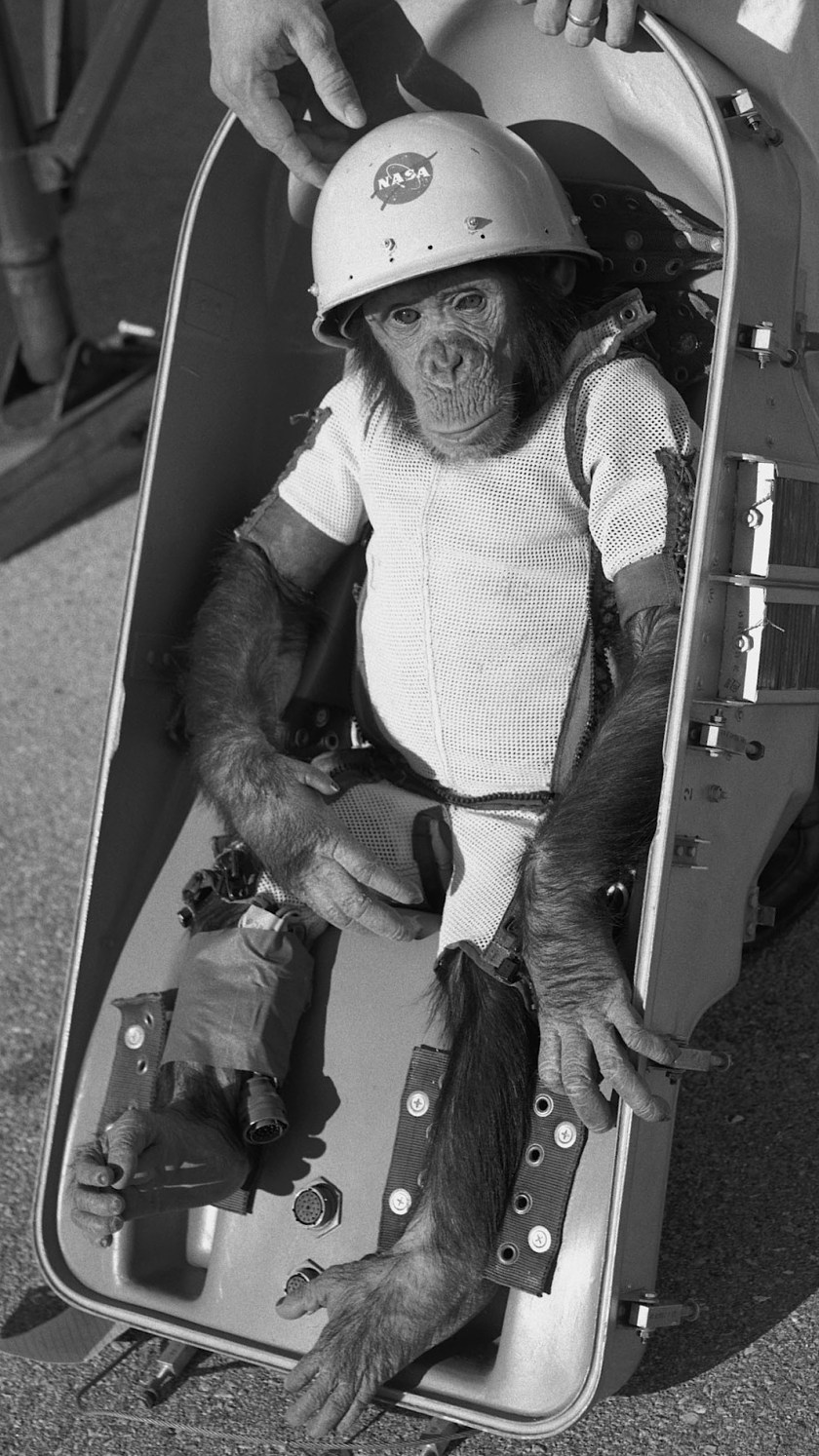
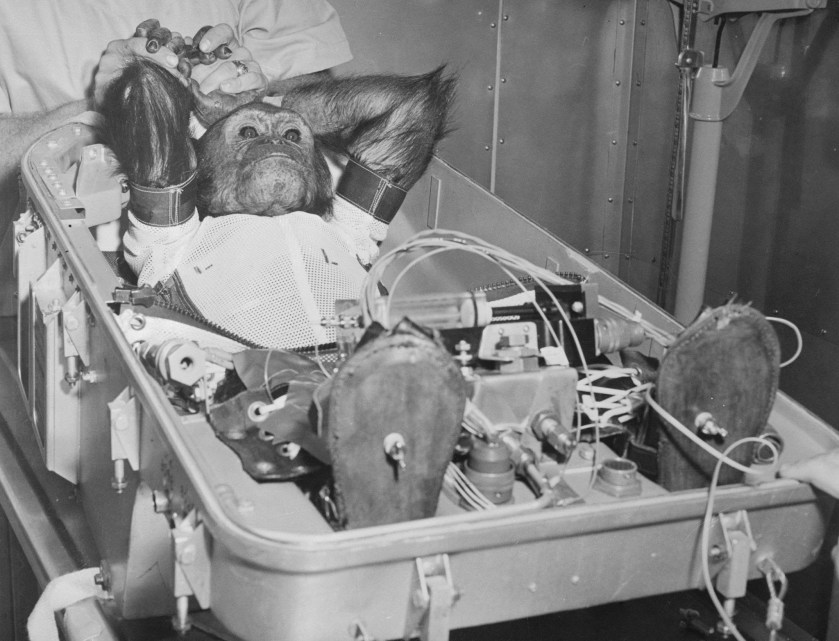
The scientists and engineers in charge of the launch didn’t want to humanize her if she didn’t make it, which was a common practice in space programs. (Ham, the chimpanzee sent into space by NASA in January of 1961, was known as No. 65 until his successful recovery. NASA was worried that a name would make him more sympathetic and lead to bad press if the chimpanzee died during the mission.)

Ham_the_chimp_(cropped)
Ham the chimpanzee was little more than a baby. Credit: NASA archives

Despite Felicette’s endurance and successful return, French scientists repaid her bravery by euthanizing her a month later so they could study her brain and learn more about the effects of spaceflight on mammalian biology.

Felicette, like Laika and Ham, was never given a choice. Those animals, with their child-like mental capacity, endured their missions out of a desire to please their human caretakers as much as any natural stoicism they may have possessed.

Would we do the same thing today? Will we repeat those experiments as we set our eyes on Mars?

Consider that the moon is a three day trip, and it’s close enough to Earth’s magnetic field to protect living beings from radiation. Mars is at least a seven month trip if the orbital conditions are right, and there will be no protection from radiation aside from what can be built into the craft. Take that trip without adequate protection and you’re guaranteed to get cancer.

It’s easy to say we wouldn’t make animals our test subjects for a Mars journey, and NASA now has decades of data on the effects of space and zero gravity thanks to the International Space Station.

And yet Neuralink, another company owned by Elon Musk, currently uses monkeys to test its brain interface technology, which allows the primates to operate computers with their thoughts. Those monkeys are forced to endure radical surgery to implant microchips in their brains. The teams working on the technology say suffering by those animals will be worth it as people with paralysis are able to do things with their thoughts and regain a measure of independence, increasing their quality of life.

Likewise, it will probably be an animal, or animals, who will be the test subjects on board craft that first venture beyond the Earth’s protective magnetosphere. Scientists and engineers will do their best to create a vessel that shields its occupants from harmful radiation, but they won’t know how successful they’ve been until the test subjects are returned to Earth and their dosimeters have been examined.

Will an astronaut volunteer for that kind of mission, knowing the “reward” could be a drastically shortened life?

To hear Musk and futurists tell it, pushing toward Mars is not just a matter of exploration or aspiration, but is necessary for the survival of our species. Earth becoming uninhabitable, they say, is an eventuality, not an if.

Others point out it’s much easier and wiser to pour our resources into preserving the paradise we do have, and the creatures who live in it, rather than banking on a miserable future existence on Mars where society will have to live underground and gravity, at 0.375 that of Earth, will change the human form in just a few generations.

To put it bluntly, while Musk and futurists look at life on Mars through the rose-colored glasses of science fiction fans, in reality living there is going to thoroughly suck.

If people do live on Mars they’ll never venture outside without a suit, never feel the sun on their skin, never swim in an ocean. They’ll never have another backyard barbecue, watch fireworks light up the sky on the fourth of July, or fall asleep to the gentle rain and crickets of warm summer nights. They’ll never hear birdsong or have the opportunity to see iconic animals like elephants and lions. Every gulp of air will be recycled, every glass of water will have passed through the kidneys of others. There will never be snow. Circadian rhythms will be untethered from the cycle that governed human biology for the 200,000 years our species has existed.

And while there could be a future — if you want to call it that — for people on Mars, there won’t be a future there for the rest of the living creatures on Earth.

As a lifelong fan of science fiction who devours SF novels, counts films like Alien and Bladerunner among my favorites, and is fascinated by shows like For All Mankind, The Peripheral and Star Trek, I understand the appeal of space and the indomitable human spirit that drives us to new frontiers. I just hope we can balance that with respect for the Earth and the animals we share it with. Let’s hope there is never another Laika, Felicette or Ham.

Correction: For All Mankind is the name of the Apple TV series about an alternate history space race. The first reference to the show’s name was incorrect in an earlier version of this story.

felicette-container
A close-up of Felicette’s face. Credit: French government archives
Ham the Space Chimp reaches for his apple reward after his space mission.
Ham the Space Chimp waits for his apple reward. Credit: NASA archives