A Cruel, Emotionally Manipulative New Scam Targets Cat Owners

“I had to leave work because I was a wreck, fully believing my cat was on the verge of life and death. It’s cruel that people do this,” one victim said.

Two weeks after his beloved cat vanished, Justin Hills received a phone call that simultaneously gave him hope and filled him with dread.

The man on the line spoke with practiced professionalism and told him that his cat, Little Wayne Shorter, had been found badly injured after he was hit by a car.

Little Wayne urgently needed surgery, said the man who identified himself as a staffer with Seattle Animal Shelter. Veterinarians were ready to begin surgery if Hills gave them the go-ahead and sent $2,800 via Venmo.

“The back of my head is screaming, ‘This is a scam. This is a scam.’ But at the same time, because it’s such an emotional pull, I’m thinking, even if there’s only a 10% chance that this is real, you know, I want to go ahead with it,” Hills told Seattle’s WKIRO.

Little Wayne Shorter

“The guy was rehearsed, was smooth. He sounded like, you know, an experienced person,” Hills said. “They had done some research on me before they called. You know, they knew my name. They knew my cat’s name, you know, the address and all this.”

When Hills called his bank, they warned him it was a scam. Hills said he’s glad he didn’t send the money but also devastated his cat is still missing — and that he was given false hope by someone trying to manipulate him in his desperation to be reunited with Little Wayne.

He’s not alone. In a post to Facebook group for missing pets in King County this week, Seattleite Harris Alex described a call from a person who claimed to work for Seattle Animal Shelter.

“They said someone found my cat, Binx, and that he had been hit by a car. They told me if I didn’t pay for surgery, he would die or be paralyzed within the next hour,” Alex wrote.

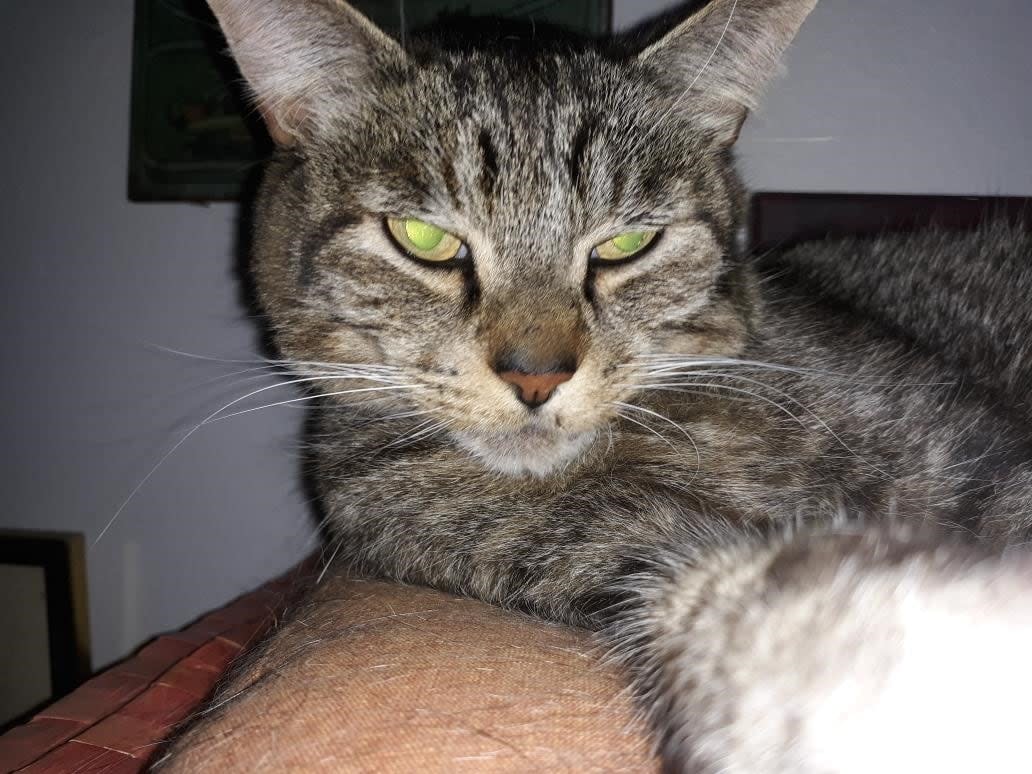
A caller said Binx, above, was seriously injured and needed urgent — and expensive — veterinary care.

Alex grew suspicious when the caller asked for a payment via Venmo, Paypal or Chime.

“I called the shelter to confirm they do not have him,” Alex wrote. “I had to leave work because I was a wreck, fully believing my cat was on the verge of life and death. It’s cruel that people do this. Be careful out there.”

Staff at Seattle Animal Shelter, which is run by the city, are aware of the scam and have gotten several calls from people asking if the shelter has their cats after being in contact with the impersonators.

“We would never ask somebody over the phone to make a payment,” said Don Baxter, manager of field services at the hospital. “We’re going to get that pet to a veterinarian and get it care and treatment, and then we’ll work out how to get the pet back to the owner after that.”

The lost/injured pet scam isn’t limited to Seattle, and the perpetrators will often switch to targets in another city if too many people become aware of their efforts, only to pop back up again later. The scam’s combination of social engineering and emotional urgency encourages victims to act quickly without giving the situation too much thought.

Experts advise people to keep their cool despite their hopes or fears, and demand proof that the person has the animal:

“This is one of the more difficult scams to deal with emotionally. If someone really has your pet, they should be able to at the very least send photos. Most people should be able to do a video call.

In general, scammers will pressure you to send money in advance. They will often make lots of excuses for not being able to provide proof they have your pet or meet in person.”

This general category of scam isn’t new, but social media has enabled scammers to believably pose as shelter staff using information pulled from the victim’s own lost pet posts and profiles, the FBI notes. The bureau also warns of several variations on the scheme.

Binx

The people running the con find their victims by scanning local missing pet groups on sites like Facebook and Reddit. They gather names and descriptive details, spin a narrative that shocks their intended victims, and create a sense of urgency by saying the cat will die if there’s any delay in performing surgery.

That’s what happened to Susan Burgess, who’d posted about her 15-year-old tabby cat, Linus, going missing. The caller said Linus was hurt and he needed to confirm her name, but Burgess realized he would have known it if he’d scanned Linus’ microchip.

She gave the scammer a piece of her mind before hanging up on him.

“On the off chance that you do have my cat, I hope that you are able to show some compassion and do the right thing,” she told the caller. “But I’m pretty sure that you don’t, and what you’re doing is very cruel.”


PSA: Speaking of scammy behavior, I can’t control the ads that are shown on PITB, but if you’re seeing ads for an amazing-looking, ultra-realistic toy rabbit presented as a great Easter gift, don’t fall for it. Here’s a video revealing what you’ll actually get from the deceptive seller:
For The First Time, American Vets Can Prescribe FIP Meds For Cats

People whose cats are infected with FIP can now get a legal prescription and buy it from a US pharmacy. A full course of treatment will cost a few hundred dollars instead of the thousands charged on the illegal market.

Starting on June 1, people whose cats are infected with deadly Feline Infectious Peritonitis won’t have to shell out thousands of dollars to shady middlemen importing the cure from China.

FIP is a virtual death sentence for cats, but there’s a drug — GS-441524 — that has a cure rate somewhere around 90 percent, a Godsend for people whose beloved felines are afflicted with the virus.

Previously the only way to get it was through predatory online middlemen who charged exorbitant sums, but thanks to a partnership between UK pharmaceutical company Bova Group and New Jersey-based compounding pharmacy Stokes, the FIP cure will be available legally in the US.

The legal version of the drug will come in a tuna-flavored tablet format and customers can expect to pay a few hundred dollars for a full treatment instead of between $5,000 and $15,000 some paid for the FIP treatment from importers.

A US company invented the drug and held the rights, so it seemed like bringing it to market for cat caretakers would be a no-brainer. Unfortunately, GS-441524 is similar to COVID drug Remdesivir so the company was worried if they submitted the FIP cure to the FDA for approval and the FDA did not grant it, the denial could lead the agency to revoke its approval of Remdesivir due to its molecular similarity.

As a result, innumerable people whose cats were suffering with FIP turned to groups like Facebook’s FIP Warriors to help them obtain GS-441524 illegally. The drug was manufactured by facilities in China, sold to middlemen in the US and Europe, then marked up by eye-watering amounts for sale to people with sick cats.

jupiterpitbtopimg
Jupiter, a British shorthair, was diagnosed with FIP. His human, a young professional from London, paid almost $10,000 for FIP treatment obtained through middlemen.

Last year the feds announced they’d exposed a GS-441524 smuggling ring, alleging a woman from Texas and another from Oregon had made almost $10 million from selling the FIP treatment to panicked cat lovers.

GS-441524 importers knew their customers were desperate to save their beloved feline friends so they’d be willing to pay the extraordinary mark-up — and pay they did.

Here at PITB we’ve interviewed and written about several people whose cats were diagnosed with FIP. One of them, a student, spent her entire savings on GS-441524 obtained through the Facebook group and relied on help from generous donors to raise the rest. Another, a young professional in London, paid even more, spending £7,500 (about $9,400 at the time) on the medication alone, not including vet visits.

A Texas woman whose cat, Seth, was diagnosed with FIP said the middlemen — and women — said the sellers “saw our desperate situation and took advantage of us.”

“It was a very stressful time for us, and every time we needed to refill, they charged us more,” she told PITB. “They knew we couldn’t say no.”

For readers interested in more details about GS-441524, Stokes pharmacy has a resource page that breaks down pricing, shipment times, availability and more.

Parsnip, the cat pictured at the top, and Jupiter, the British shorthair pictured within the story, were both cured after taking full courses of GS-441524.

Texas Pols Secretly Plot Cat Slaughter: ‘The More The Public Knows, The Uglier It Gets’

Another day, another abhorrent plan to kill cats.

Unaware they were being recorded, elected leaders in a small Texas city let their imaginations run wild in a closed-door meeting about dealing with feral cat colonies.

One proposed mass poisoning to take out as many as 50 cats at a time. Another, perhaps fancying himself a mafia hit man, envisioned taking care of the city’s cat “problem” execution-style with a “.22 round to the back of the head.”

A third proposed dumping the bodies of the dead cats in an area the city already uses to dispose of unwanted animals.

“We have a location on this property that’s called deer heaven,” the committee member told colleagues at the Nov. 6 meeting. “I’m sure it could be kitty cat heaven too.”

Now the city council and wildlife advisory council of Granite Shoals, a city of about 5,100 in central Texas, are trying to explain themselves to an infuriated public, the local Humane Society and their own police, who rebuked them in a public statement that asserted their plans are illegal.

State and local laws “do not allow any cruelty to animals, including feral cats in our community,” police chief John Ortis wrote in a letter to the public.

The Hill Country Humane Society took the extraordinary step of “terminating its relationship” with the city, calling the committee’s plans “blatantly unethical and illegal” in a statement posted on Facebook.

“This recording reveals that not only was there an attempt to develop a plan to inhumanely shoot captured cats and dispose of their carcasses, but there was open discussion between members of the committee and the City Manager about the need to conceal such activities from the general public,” the Humane Society wrote.

Staff at the Humane Society said they’ll still take in stray cats from the city, but they’ve ended their official partnership.

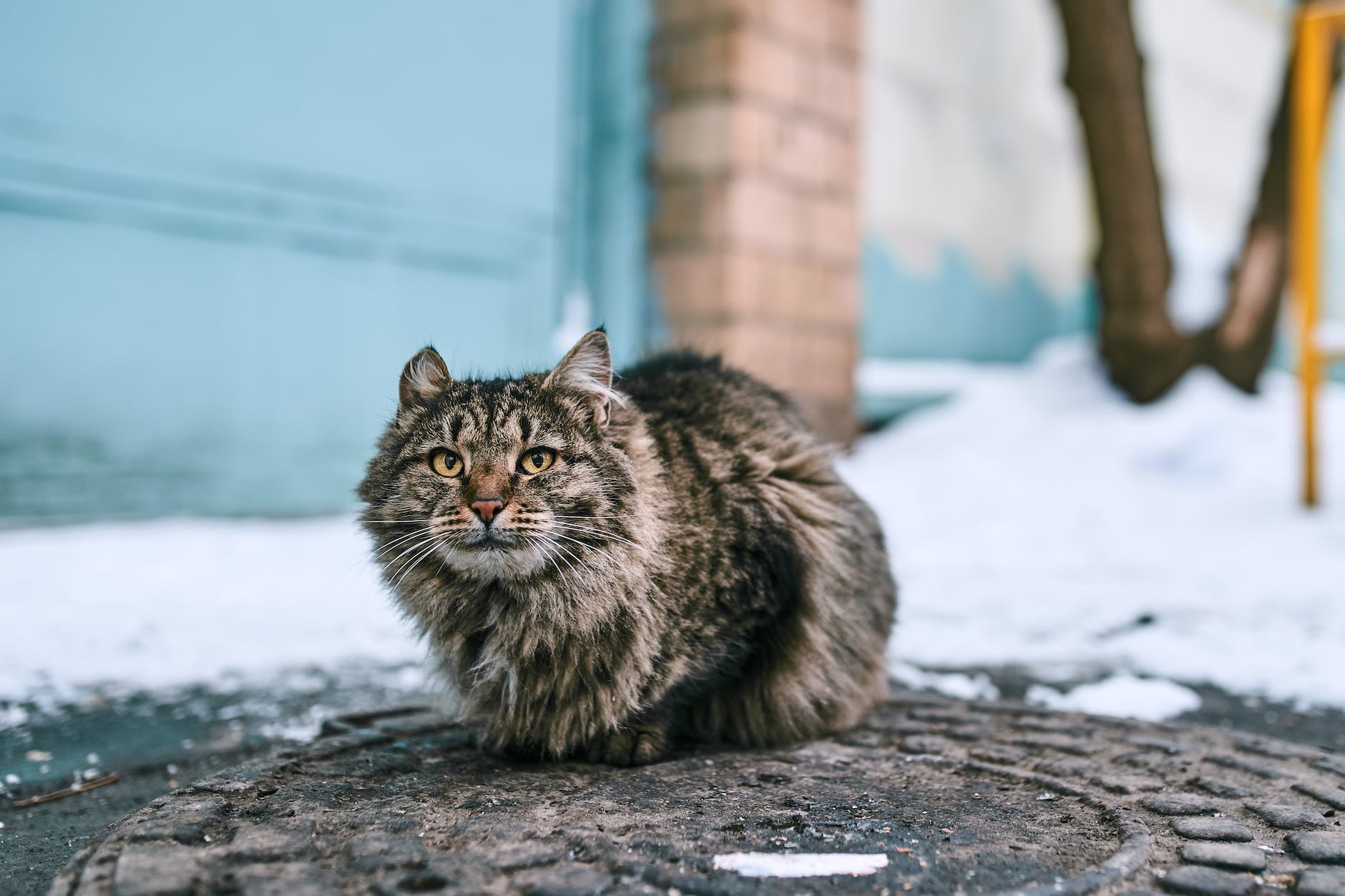
A stray cat. Credit: Aleksandr Nadyojin/Pexels

Todd Holland, the committee chair, denied that his members wanted to keep details of their plans from the public and told local newspaper the Daily Trib that the committee was merely trying to work out the “intricate details” of how to handle a population of about 400 cats. It’s not clear how the city arrived at that number, and there’s been no mention of an official effort to get an accurate tally.

“It’s not like we’re a bunch of cowboys running wild,” Holland said.

But in the recording, committee members clearly discussed hiding details from the public, and the Daily Trib noted that the committee used the word “remove” interchangeably with “euthanize” in written materials detailing the plan, perhaps to soften the language or obscure the fact that the proposed solution was to kill the cats.

Granite Shoals Mayor Ron Munos called the recording “disturbing” and said the committee’s plan will not be put into practice.

“The city is not doing this,” he told the Daily Trib. “We’re not going out and killing cats.”

Here at PITB we feel like a broken record regularly referring back to the junk studies blaming cats for killing billions of birds annually, but the reason we do is because those studies have real-life consequences.

Ill-advised, unethical and illegal plans to eradicate stray cats wouldn’t be explored at municipal and county levels if elected leaders weren’t told that trap, neuter, return (TNR) programs do not work and that outdoor cats pose the most significant thread to local wildlife.

Likewise, we wouldn’t hear about schools sponsoring cat hunts for children or so-called conservationists gunning down entire stray colonies if a small but vocal group of ostensible scientists weren’t routinely publishing dubious studies making improbable and unsupportable claims about feline predatory impact.

In plain terms there’s been a concerted effort to paint domestic cats as dangerous, ruthless killing machines, the media hasn’t treated the claims with skepticism, and the result is a whole lot of cruelty and misery inflicted on innocent animals.

City councils, wildlife biologists, park rangers and others are not armed with the facts when they rely on those studies, and the result is bad policy and decision-making.

Stories like this one out of Texas have become more frequent over the past few years, and we suspect things will get a lot worse for cats without injecting some much-needed sanity and evidence-based solutions to counter the tidal wave of misinformation.

Stray Walks 5 Miles In One Day To Get Back ‘Home’ After He’s Given Away

Max didn’t like his new “home” in a barn in Amish country and returned to the man who first showed him kindness.

Brad Bennett said Max the stray was in a bad way when he showed up.

The young cat was malnourished, missing patches of fur and was suffering from infections when Bennett saw him on the property of a western Pennsylvania home where he works as a personal caretaker, first via trail cameras set up to catch images of local wildlife, then in person.

The orange tabby cat was drawn by stale cat food Bennett had thrown out, but he was extremely cautious. He hissed at Bennett the first time the 58-year-old approached him and tried to attack him.

Bennett, who thinks Max may have been abused in the past, earned the stray’s trust and was eventually able to deworm him and give him flea and tick medication, he told local newspaper the Tribune-Democrat.

“I started feeding him and working with him,” Bennett told the paper. “Three months later, [he] was on my lap with me on the swing.”

maxthecat
Max the cat. Credit: Bill Bennett

Bennett, who has two cats of his own, said he couldn’t afford to keep Max because he was “tapped out” by thousands of dollars in veterinary bills, but he knew the little guy needed a home before winter so he made arrangements to take him to a nearby Amish farm which was in need of a mouser.

Max clearly wasn’t taken with the farm because he walked five miles and crossed a major interstate (376) to get back to the home where Bennett works — in one day.

“I kept having feelings of guilt about sending [him] off, not knowing what was going to happen,” Bennett said. “Part of me was kind of excited to see him.”

Bennett knew he couldn’t send Max back to the farm. After he wrote a Facebook post about Max’s situation, Jill Powell, a volunteer with Homeless Cat Management in Pittsburgh, drove about an hour from Pittsburgh to pick Max up. He’ll stay with a foster family until Powell and her organization can find him a forever home.

Whoever opens their home to him will find a grateful cat who knows what it’s like to struggle on his own.

“I was able to hold him, he meows and he reaches for petting,” Powell said. “He seems very sweet.”

Found Frozen To The Ground In Record Storm, Michigan Cat Is Recovering At Clinic

After a close brush with death during the severe winter storm over the holidays, a former stray cat is recovering and will get a forever home.

Elliot the cat was near death when Kelli Vanderlaan found him literally frozen to the concrete in the early morning hours of Dec. 26, during one of the coldest, most severe storms to sweep the US in decades.

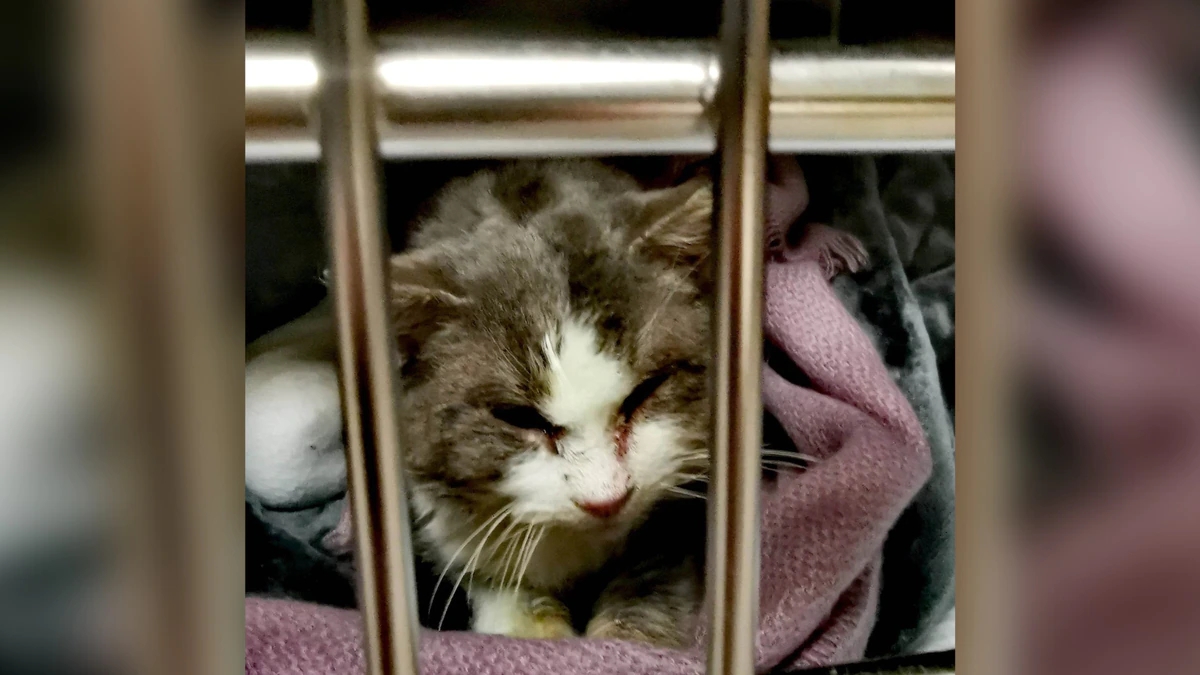
Initially unsure whether the white and gray stray was still alive, as his eyes were frozen shut, Vanderlaan wriggled him free and took him to the Big Lake Community Animal Clinic in Muskegon, Michigan. Although barely able to move and unable to vocalize, Elliot seemed to be grateful for the car’s heat.

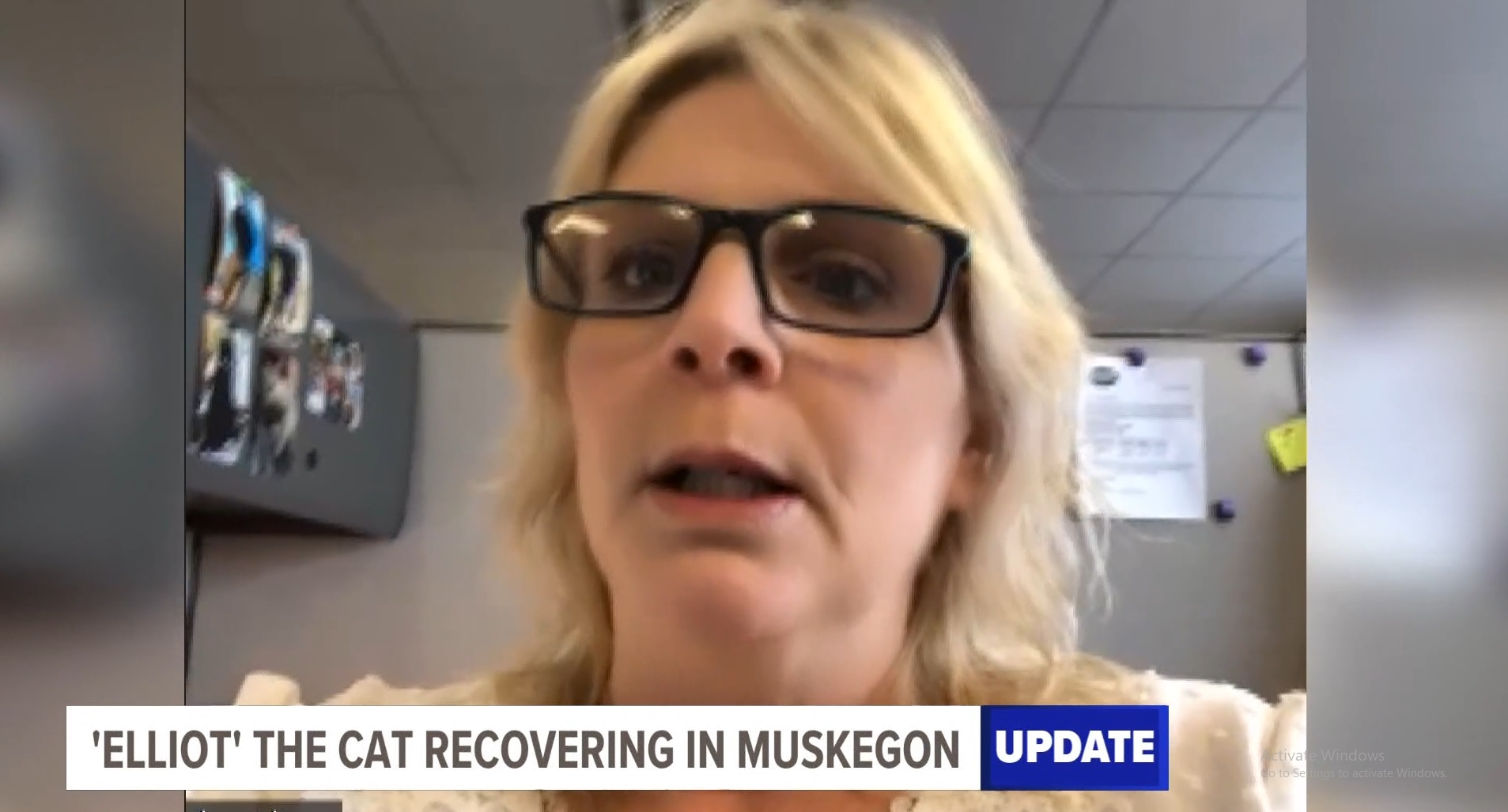
“You could tell that he was obviously frozen, so he needed warmth and touch and everything, I think he was pretty happy when I got him into the truck,” Vanderlaan told the local ABC affiliate, WZZM.

Elliot the Cat
Staff at Big Lake Community Animal Clinic have been nursing Elliot the Cat back to health. Credit: WZZM

Once Vanderlaan and the stray arrived at Big Lake, staff there immediately began gently raising the little guy’s temperature, wrapping him in warm blankets and giving him fluids.

“We weren’t sure what he’s been through,” said Alexis Robertson, executive director of the local Humane Society. “He’s definitely been out there for a while trying to take care of himself, just trying to survive, but it was at a critical point where he was ready to pass.”

After giving Elliot a veterinary exam, cleaning his eyes and making sure he was snug, the staff at Big Lake Community Animal Clinic monitored him closely overnight. His organs had been dangerously close to shutting down when he was brought in, and he still wasn’t out of the woods yet.

Elliot, who was named after the storm that swept the region over the holidays, has continued to improve in the days since. He’s since been able to stand on his own and has regained his appetite, the clinic’s staff wrote on Facebook.

“We are so happy to say he is doing much better and was monitored during the night,” staffers wrote. “He reaches out his paw to the vet tech that has been caring for him overnight, showing her just how happy he is that he is being helped. He still has a long way to go, but we won’t give up.”

Elliot, who was described as an “older” cat who’s been fending for himself, will come out of the ordeal with his life much improved. After surviving the storm — which plunged temperatures well into the single digits, set record lows across much of the midwest and claimed the lives of at least 56 people across the country — Elliot will be put up for adoption, and the clinic has already received inquiries from people who want to open their home to the little survivor. If his will to live and his gratitude toward his rescuers are any indication, the little guy has a lot of love to give.

“It’s the most heartfelt feeling in the world to see this cat come from basically nothing and being vocal and happy to be touched and fed, it’s just an amazing thing to watch,” Leah Wetmore, the clinic’s manager, told WZZM.

elliotcat_save
Kelli Vanderlaan was the Good Samaritan who saved Elliot’s live. Credit: WZZM