What’s The Real Reason Cats Love Boxes?

It’s about more than just having a cozy place to sit.

Buddy is not overly obsessed with boxes.

I think that’s because he feels safe here, he’s got plenty of places to hide if he wants, and he’s got a big cat tunnel with four ways in or out. He doesn’t need another little space to crawl into.

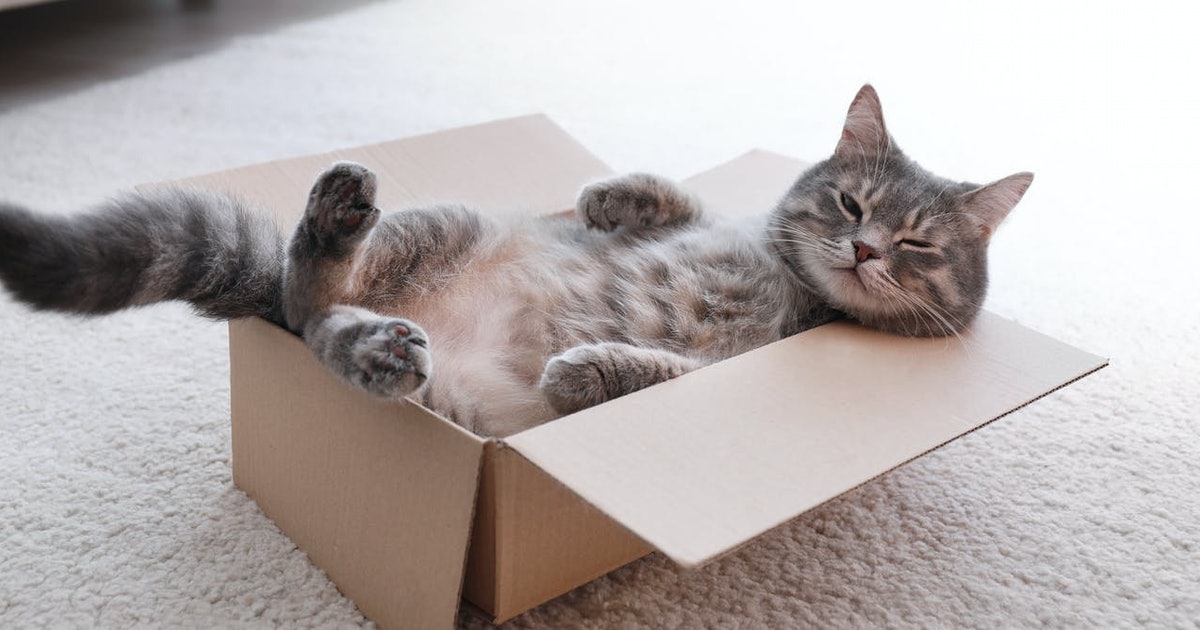
Still, like any cat, the little dude likes a good box. When he gets to play with a new box he likes to sniff it, rub against it once or twice, then jump inside and determine if it’s comfortable. Then he gets serious, looks around, and slowly sinks down below the top of the box…

…and remains there for a few seconds before cautiously raising his head and looking around. Usually this is accompanied by a delighted trill, and I get the strong sense that he thinks he’s invisible to anyone outside the box while he has the advantage of seeing them.

“You cannot see Buddy, but Buddy sees you!”

Does he ambush me from the box? Does a bear crap in the woods?

There isn’t an abundance of research into why cats love boxes so much, but the existing data combined with what we know about the feline mind strongly suggests that, first and foremost, boxes have a strong psychological effect. They make cats feel secure and well-protected.

Anyone familiar with cats knows the little furballs like to wedge themselves into hideaways, scurry under tables and hide in laundry baskets. The behavior starts in kittenhood when they’re tiny enough to crawl into shoes and sneakers.

In 2021, animal cognition grad student Gabriella Smith conducted a study in which she found cats will happily sit in Kanizsa contours with the same enthusiasm they have for boxes.

Kanizsa contours are two-dimensional. The participants created them by using tape and paper to make the shapes on the floor. They’re not even proper boxes, just the illusory suggestion of boxes or general square shapes. That doesn’t seem to matter to cats:

Of course pieces of tape or paper on the floor do not afford any real protection, so the feline affinity for boxes seems to be more about feeling protected.

Since cats are territorial, it could be that they also like clear boundaries around their personal space.

The key here seems to be having the boundary without blocking access, as cats are notoriously not cool with closed doors or being confined. If they want to spend an hour in a tiny space and it’s their idea, they’re fine with it, but they don’t like to be restricted by when they can come and go.

Notably, this isn’t behavior limited to felis catus. So far there doesn’t seem to be any exception to the box-loving rule among felines and felids of any species. Tigers, lions, jaguars, leopards, snow leopards and pumas seem just as fond of them as their smaller cousins, as you can see in this video from Big Cat Rescue:

Boxes are comforting, cozy, fun to explore and make the perfect hiding spots for ambushes. If you’re a cat big or small, what’s not to like?

Sunday Cats: FitBit For Felines, Plus CFA’s Top Breeds For 2021

Now you can track how much time your cat spends exercising, grooming herself and sleeping.

A Japanese company that sells FitBit-like devices for cats released its first data-driven report this week and promises new revelations to come as more people buy the devices for their cats, leading to more data.

The company and its device are both called Catlog. To mark “Cat Day” in Japan, which falls on Feb. 22, researchers at the Shibuya, Tokyo-based firm issued a report saying data shows cats sleep progressively longer as they age, and cats in general sleep longer in winter.

Yeah. Not exactly a whopper.

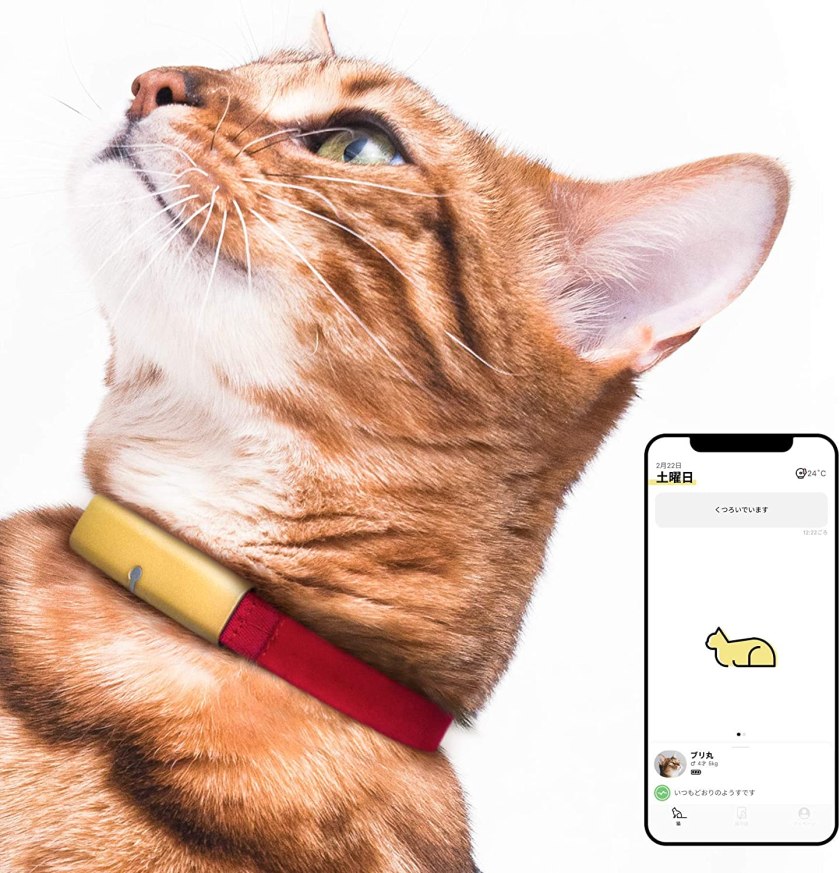
Still, it’s one thing to know something anecdotally and another to prove it, and there are tantalizing possibilities as more kitties are equipped with Catlog. The collar-like device uses “biologging” technology to record and sort data on things like eating, drinking, sleeping, grooming and exercise. The data is relayed to caretakers via a mobile app and added to the information coming from every other Catlog, giving the research team behind the app hard data for cats across all ages and breeds.

The Catlog has received Japan’s Good Design Award, a sought-after mark of excellence among Japanese products.

Catlog
Catlog looks like a regular collar with an unobtrusive device attached.

Unfortunately Buddy won’t be contributing to that data even if Catlog pushes into the US market. Little dude won’t tolerate a collar at all and is not shy about loudly, repeatedly, incessantly communicating when he doesn’t like something. 🙁

Most Popular Cat Breeds of 2021, According to CFA

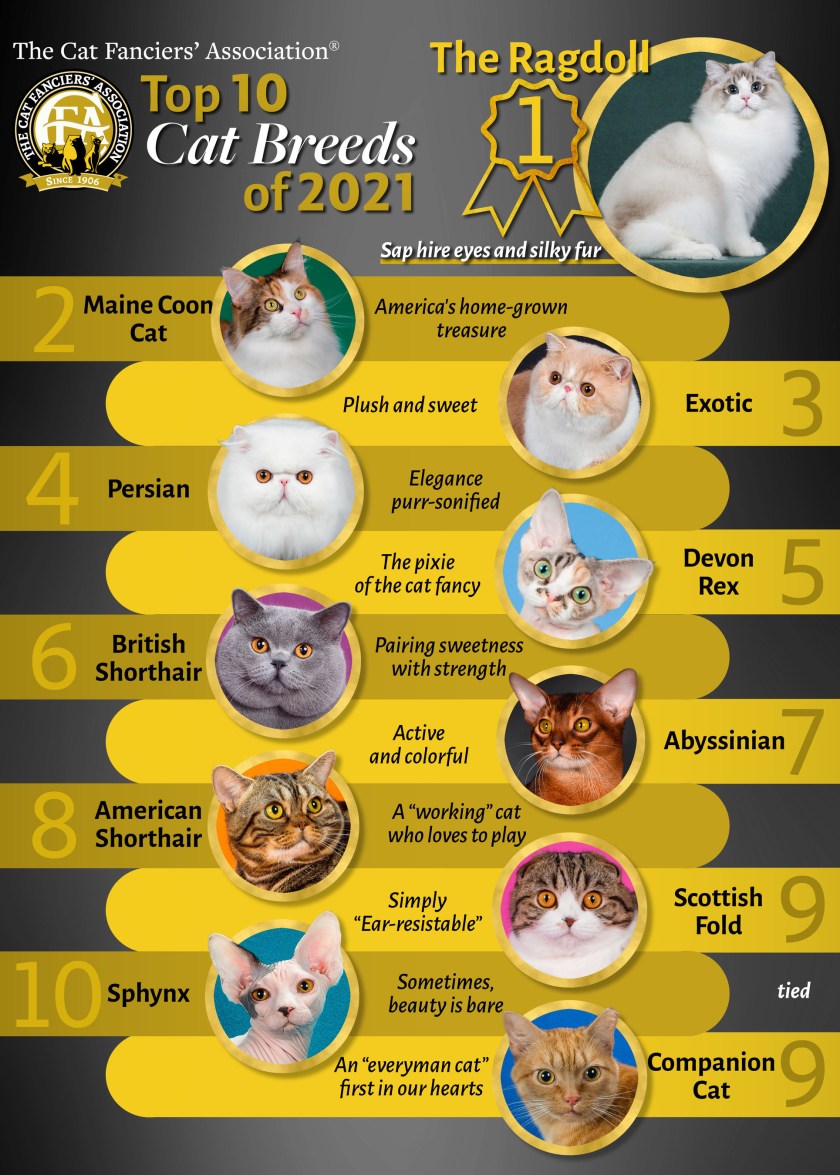
The Cat Fanciers’ Association has released its annual list of the most popular cat breeds. While the CFA recognizes 45 breeds and registers “non-pedigreed” cats as well, the list is based only on CFA registered cats. That means it provides a good snapshot of which breeds are trendy, but it’s not a definitive most popular breeds list.

Cats without a particular breed still account for the vast majority of all pet felines, but among people who registered their cats with CFA, Ragdolls were the most popular in 2021, followed by gentle giant Maine Coones and exotic shorthairs. (Note that this list does not include the fearsome and elusive Buddinese Tiger.)

2021-breeds-with-CC
The world’s largest registry of pedigreed cats has again determined the world’s most popular cat breeds, based on registrations. This year’s Top 10 list reflects the increasing popularity of certain breeds. However, registrations of ALL cats have increased substantially, reflecting the growing popularity of pet cats since the beginning of the pandemic.

Can Cats Feel Jealousy?

While the answer is obvious to cat servants, proving feline jealousy in a study is a different ballgame entirely.

Bud isn’t fond of my smartphone.

Like many other humans I spend too much time looking at the damn thing, and that’s not good even though I have the excuse that I use my phone as a reader and my presence on social media ranges from extremely limited to nonexistent.

When His Grace has decided I’ve looked at the screen long enough and it’s Buddy Time, he’ll pad up and slap the phone out of my hands, or if I’m laying down he’ll climb on top of me, nudge the phone out of the way and sit on my chest so he has my full attention.

“No glowing rectangle!” he’s saying. “It’s Buddy Time! Now scratch my chin and rub the top of my head as I purr!”

Naturally I comply, and before long Buddy is leaning in, pressing the top of his head against my forehead, which is his way of saying: “I love you, slow dumb human! You have many flaws and you don’t give me enough snacks, but you’re my Big Buddy!”

Of course, intuitively knowing Buddy is jealous of — or annoyed by — my phone is different than proving it in a well-designed, repeatable experiment.

Psychology Today’s Jessica Wu writes about just such an effort by a team of researchers out of Japan.

Before I offer my criticism of the study, let me first say I have respect for the team at Kyoto University. They’re one of a handful of research teams around the world that routinely produce studies into cat behavior and cognition, and it’s clear that they view it as an important and crucial area of research. That’s significant, because even though we’ve seen something of a renaissance in cat-related studies over the past half-decade or so, many scientists still think cats are nearly impossible to work with.

The team at Kyoto also understands the territorial nature of cats makes it difficult to study them in a lab environment, so they go the extra mile and enlist people who are willing to let them into their homes to study their little tigers.

That’s what the Kyoto team did for their 2020 study on jealousy, splitting their research between typical homes and cat cafes. (Fifty two cats in total participated.) All the cats observed in the study had been living in their homes or cafes for at least six months.

Researchers took a method that’s been used to study human babies and dogs, and adapted it for felines. They brought in a plush cat and a pillow with a corresponding color and texture.

https://youtu.be/VSSt-YtZo58

Then they asked the participants to spend time petting the plush cat and the pillow in front of their furry overlords while team members carefully watched the kitties for their reaction. Each experiment was then repeated with a stranger petting the plush and the pillow to gauge whether cats behaved differently when observing someone they aren’t emotionally attached to.

The team found the cats “reacted more intensely” to the plush cats than the pillows, but there wasn’t any marked difference in how they reacted when they watched their humans versus strangers.

Crucially, the cats didn’t show signs that they were upset, like human babies have in such experiments, and they didn’t try to physically separate their humans from the plushies, as many dogs did in their version of the experiment.

jealous-cat
“How dare you hand out yums and not include me!” Credit: icanhazcheezburger

The results indicate cats didn’t express jealousy in the experiment, but the Kyoto team are pros, noting that it’s just one study with one approach.

“We consider the existence of some cognitive bases for jealousy to emerge in cats, and the potential effect of cats’ living environment on the nature of their attachment to their owner,” they wrote. “More ecologically valid procedures are required for further study of these issues.”

It’s my non-expert, non-scientific opinion that researchers would get better results using actual cats instead of proxies. That introduces a new set of problems and an experiment involving rival cats won’t be easy, but science isn’t supposed to be easy, and if we really want to understand how cats think, we have to get as close as possible to mimicking real circumstances.

Plush Cat in Kyoto study
The plush cat used in the Kyoto study. Perhaps the cats involved in the research felt the humans were insulting their intelligence. Credit: Kyoto University

It would also help to expand the scope of the experiment. How much can researchers really glean from a fleeting interaction? Jealousy isn’t something that just bubbles up and disappears. It happens within an emotional context. It’s a secondary emotion that sprouts from elements of primary emotions like fear, anger and confusion.

Scientists are very careful about anthropomorphizing animals, for obvious reasons, but sometimes they’re guilty of over-correcting as well and denying the obvious, which is why the prevailing scientific opinion for almost half a century, until 1959, was that animals don’t have emotions or cognition.

In the meantime, Buddy will continue to make sure Buddy Time is equal to, or greater than, glowing rectangle time.

Cats Know Where We Are Even If It Seems Like They’re Not Paying Attention

New research offers more evidence that despite their poker faces, cats do care about where their humans are and what they’re doing.

A new study from Japan found cats keep track of their humans even when they’re not looking at them.

A research team from the University of Kyoto conducted the experiments in a cat cafe and in individual cats’ homes. Each cat was placed in a room without their humans. Then the researchers tested the way felines reacted to hearing their people calling their names from outside the room, followed by their reactions to hearing them inside via speakers.

When the cats heard their humans calling them from inside the room the furballs were surprised, expressing their confusion with ear twitches, whisker movement and uncertain body language.

On the other hand, when cats heard “non-social stimuli” — scientist-speak for sounds other than familiar people calling to them — they didn’t react to changes in the location and direction.

Some people might shrug and wonder what the fuss is about, but the experiment actually confirms a great deal about feline intelligence. It’s a test of what scientists call “socio-spatial cognition,” meaning cats form a mental map of things that are important to them, and nothing’s more important to a house cat than the person who provides food, security and affection.

That’s significant because it’s confirmation that cats understand object permanence, and that they are more than capable of abstract thought. Abstract thought — the ability to picture and think about something mentally, without having to see it — is hugely important in intelligence, allowing everything from creativity to understanding that other animals and people have their own points of view. For context, it takes about two years for human children to develop rudimentary abstract thinking skills.

Cats “may be thinking about many things,” Saho Takagi, the study’s lead author, told CNN.

“This study shows that cats can mentally map their location based on their owner’s voice,” Takagi said, per The Guardian. “[It suggests] that cats have the ability to picture the invisible in their minds. Cats have a more profound mind than is thought.”

Things like object permanence and spatial awareness were necessary for cats to thrive as hunters for the millions of years they’ve existed on Earth.

The results aren’t surprising from an evolutionary perspective, biologist Roger Tabor said.

“That awareness of movement – tracking things they cannot see – is critical to a cat’s survival,” Tabor told The Guardian.

“A lot of what a cat has to interpret in its territory is an awareness of where other cats are. It is also important for hunting: how could a cat catch a field vole moving around beneath the grass if it couldn’t use clues, such as the occasional rustle, to see in its mind’s eye, where they are? A cat’s owner is extremely significant in its life as a source of food and security, so where we are is very important.”

The study is also another piece of evidence showing cats are just as aware of — and concerned about — their people as dogs are, even though the conventional wisdom says they don’t care most of the time. That has implications for the way people bond with their cats, and the decisions we make about caring for them — like, for instance, how long we’re willing to leave them on their own while planning a trip.

“This is a great example of elevating our expectation of the cat a little bit,” cat behavior consultant Ingrid Johnson told CNN, “and realizing that they do have the capability of having that bond in that relationship where they actually will take comfort in their people.”

Ever Wondered How Many Surfaces Your Cat’s Butt Touches? A Kid Has The Answer

Cats are well known for grooming themselves, but are they as clean as we think?

I remember the first time I saw my brother’s dog drag his posterior across the living room carpet.

The friendly little good boy, a terrier-Chihuahua mix, had just returned from a walk with my brother. He hopped up onto the couch, then down, leaning back into an odd-for-a-dog sitting position.

Then, with his little back legs spread, he used his front paws to drag his butt across the carpet with a heavy exhale, the canine equivalent of an “Oh yeah!” sigh of relief.

I know there are many feline behaviors that gross out dog loyalists, but thank God we don’t have to watch our kitties use carpets and area rugs as butt-scratchers.

Cats have more dignity than that. Cats are legendarily fastidious animals.

Or are they?

Kaeden, an enterprising sixth-grader from Florida, set out to “tackle the challenging task of answering the internet’s most burning question, drum roll please,” his mother, Kerry Griffin, wrote on Facebook. “Does your cat’s butthole really touch all the surfaces in your home?”

He would go on to present his findings and methodology at his school’s science fair.

Kerry has a doctorate in animal behavior with a concentration in feline behavior that she says she “never used.” She put it to good use for the project, helping her son come up with a plan: They’d use non-toxic lipstick and apply it to the cats’ “bum-bums.” Then they’d place each cat on a sheet of paper and run through commands.

“Both cats have been trained since kittenhood with a variety of commands. They also know how to high-five, spin around, and speak,” Kerry wrote. “They were compensated with lots of praise, pets and their favorite treats, and the lipstick was removed with a baby wipe once we collected our data in just under 10 minutes.”

They tested each cat on soft surfaces, like carpet and bedding, and on hard surfaces like tiled floors. If the cat left lipstick residue on the sheet of paper, it was counted as positive contact.

The results?

“Long and medium haired cat’s buttholes made NO contact with soft or hard surfaces at all,” Kerry wrote. “Short haired cats made NO contact on hard surfaces. But we did see evidence of a slight smear on the soft bedding surface.”

So there you have it. If your cats are long- or medium-hair, congratulations. Now if you’ll excuse me, I’ve got to have a little chat with the short-haired Buddy…catbuttproject