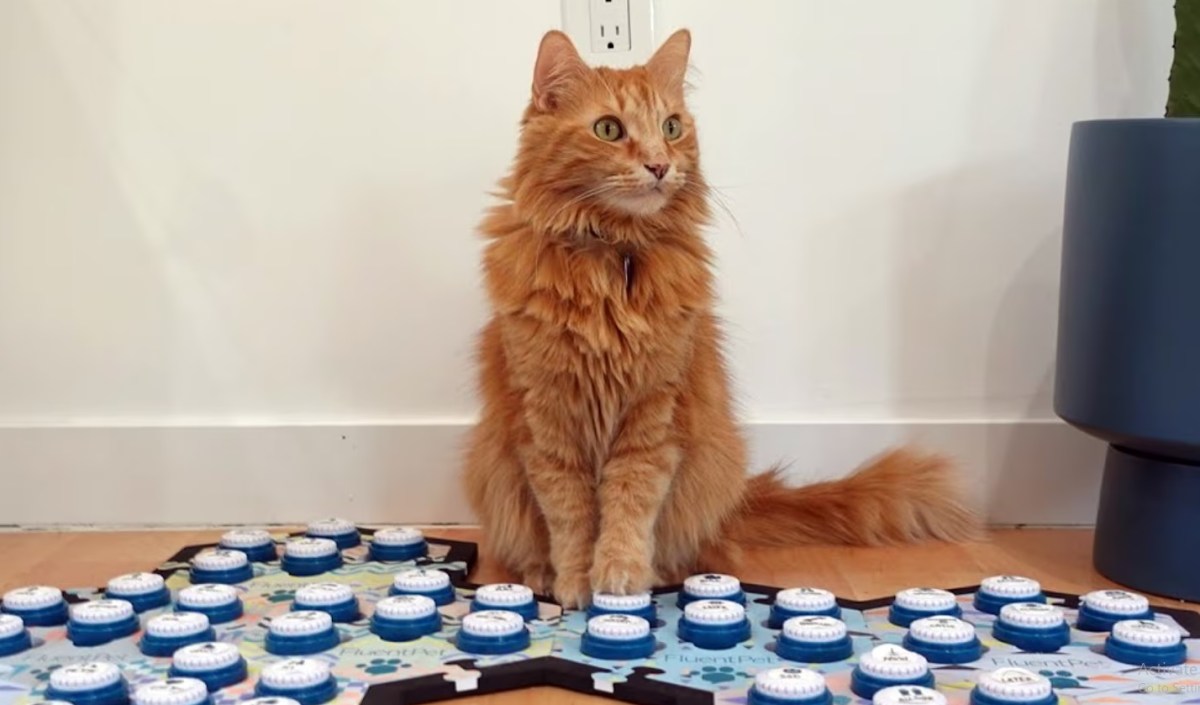
The Latest Influencer Trend Puts Unfair Expectations On Felines

Cats aren’t equipped to use human language and there’s nothing wrong with that. Our feline friends already go to great lengths to communicate in ways we can comprehend. The least we can do is meet them halfway.

I would love it if my cat could talk to me.

Sure, he never shuts up, but if he could speak English I’d know why he meows at the same spot at the same time every morning, or what he wants on the occasions when he’s still meowing insistently at me despite the fact that his bowls are full, his box is clean, he’s had his play time, and every possible need and want of his — that I can fathom — has been met.

Most of all, I’d really like to know he understands I’ll be back soon when I go away for a few days, and my (mostly ignored) pleas for him not to attack his long-suffering, way-too-kind sitter.

Alas, Bud cannot speak. No non-human animal has ever demonstrated even basic proficiency in human language. People will point to examples like Koko the Gorilla and Nim Chimpsky, but there’s a reason why funding dried up for that kind of experiment.

It doesn’t work. It never did.

The scientists who end up taking on dual roles as researchers and parents to the animals invariably serve as interpreters, get too close to their subjects and swear that a gorilla pounding shiny buttons for “food tree food submarine” means the ape wants to have a picnic next to the ocean, or “car fly house car star” means she wants to ride a Tesla Roadster to Mars and start a colony with Elon Musk.

koko

Koko, Nim, Chantek and the other apes who were the subjects of decades-long attempts to humanize them — and teach them language in the process — were ultimately not much different than Clever Hans the horse, who was reading subconscious nonverbal cues from his owner and convinced tens of thousands of people that he could do math and understand spoken language.

Hans had scores of experts fooled until the German psychologist Oskar Pfungst figured out how the horse was coming up with the correct answers.

Regardless of which famous example we’re talking about, no animal has ever mastered syntax, and the best that could be said of their proficiency with language, or lack of it, is that they learned they’d get attention and food when they pounded on a talking board or approximated a word in sign language.

Even if non-human primates were able to learn a handful of words by frequently reinforced association with an object, there has never been any evidence that they are actually using the words as language rather than simply understanding “Pushing the button that makes this sound means I get a treat!” (And yes, there is a profound difference. The former reveals the presence of cognitive processes while the latter is a conditioned response.)

Despite decades of intense effort, no animal has ever demonstrated the ability to use human language. At best an animal bangs on a few buttons and people are left to speculate on the intent. Maybe Fluffy likes the way a certain word sounds. Maybe it’s just fun to hammer on buttons the way it’s fun to pop bubble wrap. Most likely, these cats and dogs know that using a talking board is a guaranteed way to get attention, a treat and a head scratch from their caretakers.

Influencers and their talking boards

TikTok, which spawns inane trends with the reliability of an atomic clock, has provided a platform for people who insist their cats and dogs can talk. Using “talking boards” — elaborate set-ups in which words are assigned to their own buttons — they “teach” their cats how to express themselves in English and provide proof in the form of heavily edited, out-of-context clips that require the same sort of creative interpretation pioneered by Penny Patterson, Koko’s caretaker.

billiecattalk
Seriously?

I just watched a video in which a woman claims her cat, named after Justin Bieber, was describing an encounter with a coyote by stomping on buttons for “stranger,” “Justin,” “Mike,” and “stranger.”

The woman says she thought Justin was asleep at the time, but now she believes the orange tabby saw the coyote outside and was still stressing about it well into the next day.

While she’s repeating Justin’s “words” back to him, two of her other cats come by and step all over the talking board. I guess whatever they had to say wasn’t important.

Justin’s talking board has 42 buttons, which stresses credulity well beyond the breaking point. More than half of the buttons are used for abstract concepts.

@speaking_of_cats

⚠️TRADE OFFER⚠️ Jackson recieves a brushing, Mom recieves 10 I Love You’s #fluentpet #talkingdog #talkingcat #cat #catsoftiktok #catlover #cattok

♬ original sound – Jackson the Cat

But forget all that for a moment and ask yourself how our own efforts to decode the meow have been going.

Despite our status as intelligent, sapient animals, despite the powerful AI algorithms at our disposal, despite the benefit of being able to digitally record and analyze every utterance, we haven’t come close to a reliable method for interpreting feline vocalizations.

Likewise with dolphins, whale song, corvid calls and the sounds made by other animals at the top of the cognition pyramid.

Mostly, we’re learning we’ve underestimated the complexity of our non-human companions’ inner lives, especially when it comes to the kind of multi-modal communication humans also engage in, but only subconsciously. We say what we want with our mouths, while our eyes, facial expressions and body language say what we’re actually thinking.

Likewise, the meow is an unnatural way for cats to communicate, and it contains only a fraction of the information cats are putting out there. It’s just that we can’t reliably read feline facial expressions, let alone tail, whisker and posture. (Studies have shown most of us, even when we live with cats, don’t get measurably better at this. In fact, we’re often no better than people with limited feline experience, but we think we’re better.)

Putting the burden on our furry friends

If we can’t crack a simple and limited system of vocalizations, aren’t we putting unrealistic expectations on cats? The average person has a vocabulary of tens of thousands of words, yet somehow we expect cats can latch on to an arbitrary number of them, approximate mastery of syntax that has eluded even our closest cousins, and bridge a cognition gap we haven’t been able to bridge ourselves.

It’s all too much.

There’s a simple truth at the heart of this: Cats did not evolve to speak or parse human language, and that’s perfectly fine.

The little ones already meet us more than halfway because they understand we are hopelessly incompetent at reading tail, whisker or body language, and they understand we communicate with vocalizations.

By forgoing their natural methods of communication in favor of ours, cats are already taking on most of the burden in interspecies communication. Asking them to do more than that, to learn many dozens of words and the rudimentary rules of language, seems like laziness, wishful thinking or insanity on our part. Pretending that certain cats are successful is an exercise in the same kind of cynical opportunism that fuels every other desperate attempt by people trying to turn their pets into influencers. People do it because the reward is money and attention.

catboard

Worse, it contributes to the spread of misinformation. TikTok’s talking board videos routinely net millions of views, converting a credulous audience into an army of true believers who are convinced that, with just a little effort, their feline pal can shoot the shit with them.

If people want to construct elaborate talking boards in their homes and pretend their cats are expressing themselves in English, who am I to object? It’s not the smartest use of time, but have at it. What I won’t do is participate in the delusion that felines are a few buttons away from being able conversation partners, nor will I pretend these efforts have any relationship to science.

So to the journalists who keep writing credulous stories about these supposedly talking animals: please familiarize yourself with the example of Clever Hans, and please, I beg you to stop promoting these videos as if they’re anything more than wishful thinking. You are doing your readers a disservice for the sake of a few clicks.


Note: Jackson Galaxy isn’t a fan either, saying he’s “got some serious problems” with the talking board trend. Calling it “problematic,” he points out that cats are not only partially domesticated and the only animal species in history to take that step without human prompting, but humans have never selectively bred cats for specific behaviors or to bring out intelligence traits as we have with canines. (Think of sheep dogs or retrievers, who are the products of thousands of years of breeding for well-defined tasks.) There simply hasn’t been a need to breed cats for behavioral traits since the thing humans traditionally valued most about them — their ability to reliably eradicate rodents and protect human foodstuffs — is innate. No one had to teach cats how to hunt or breed them for the task. It’s only in the last two hundred years or so that certain human societies began breeding cats, and they did so for aesthetic attributes like coat patterns. Galaxy also notes that animals do not express emotions the same way humans do. Like monkeys, who “smile” when they’re terrified, felines express joy, anger and fear with their tails, whiskers, ears and body language. It’s not in their nature to tell us they’re happy or scared by padding up to a contraption and hammering on a button.

Top image of “Justin Bieber” the cat credit Sarah Baker.
Cat Brains Age Like Ours, Research Shows

Lifelong changes in the brains of felines more closely resemble aging in human brains. Studying cognition and cognitive decline in cats could help us better understand brain aging in general, scientists say.

For almost the entire history of modern science, rodents have served as a stand-in for humans in research into everything from metabolism to autoimmune responses.

They’ve even been the go-to for studies examining cognitive decline, diseases and neural mechanisms.

But now research shows there’s a better model closer to home. It turns out cat brains more closely resemble human brains in many respects, particularly in terms of aging and its effect on our mental faculties.

From Nature:

“As cats age, their brains show signs of atrophy and cognitive decline that more closely resemble the deterioration seen in ageing humans than do the changes in the brains of ageing mice, according to findings presented last month at the Lake Conference on Comparative and Evolutionary Neurobiology near Seattle, Washington.

The results are part of a large project, called Translating Time, that compares brain development across more than 150 mammal species, and is now expanding to include data on ageing. The hope is that the data will aid researchers trying to crack the causes of age-related diseases, particularly conditions that affect the brain, such as Alzheimer’s disease.”

One drawback to using mice is they simply don’t live long enough for their brains to deteriorate in ways many human and non-human animals do, scientists told Nature. They also have species-specific mechanisms that ward off certain degenerative diseases, including Alzheimer’s.

Not only do cats live longer, but their brain development and decline mirrors our own on a shorter time scale, scientists say. Tracking brain changes in cats is also more helpful than doing the same with dogs, who have been radically changed by breeding. Felines are mostly left to mate as they please, meaning they’re closer to their natural form, allowing for more useful data.

a cute cat lying on the couch
Credit: Pranjall Kuma/Pexels

Looking to our furry friends makes sense anecdotally as well. Every cat lover has seen the unfortunate confusion and forgetfulness that can afflict senior cats. Older cats tend to sleep a lot more, which is significant for a species notorious for its extravagant snoozing habits.

Thankfully, efforts like the Catage Project do not result in more cats being used in laboratory experiments. Researchers draw their data from veterinary records, brain scans and blood samples.

When asked about how his species could help humans better understand things like cognitive diseases and decline because of their similarity to humans, Buddy the Cat declared the research “fake news.”

“Where’s my bumblebee toy?” Buddy asked. “Did you hide my bumblebee toy? I’ve been looking everywhere for it!”

When told the toy was right were it’s supposed to be, in his toy basket, the 10-year-old tabby grew irritated.

“Fake news!” he meowed. “You put it back there just to mess with me. I’m onto your games! Now where did I put my favorite milk bottle cap?”

Study: Humans Aren’t Great At Judging Feline Moods, But We Can Improve

People who were asked to identify feline moods based only on audio of meows fared the worst in the study.

A new study suggests people misinterpret their cats’ moods often, but offers an easy fix.

A group of researchers from Paris Nanterre University split participants into three groups: one that was shown soundless video and images of cats, a second group that heard audio-only recordings of feline vocalizations, and a third group that had the benefit of video and sound.

Participants from the first two groups misinterpreted feline moods as much as 28 percent of the time, the study found, but people who had the benefit of seeing and hearing cats correctly identified their mental state almost 92 percent of the time.

The study also yielded another insight: people are much better at accurately assessing positive moods than they are at spotting an upset or antagonistic cat.

cute cat with blue eyes
Credit: Sami Aksu/Pexels

The findings indicate we’re better off giving our cats our full attention than, say, jumping to conclusions about what they want based solely on their vocalizations or the position of their tails. It seems obvious, but how many of us have our eyes on a screen or we’re multitasking when our cats want our attention?

Of 630 people who participated in the research, 166 were professionals in animal-related fields like veterinary medicine and animal behaviorism, while the rest were lay people. There was a major gender imbalance among participants, with 574 women, 51 men and five people who didn’t identify with either gender.

It’s not clear how such an imbalance might skew the results, and it would be nice to see follow-up research evenly split between women and men.

Does Your Cat Know Your Name? Study Says Maybe

If your cat doesn’t know your name, it’s nothing personal. You’re just a human, after all.

I’m pretty sure Buddy does not know my name, and why should he?

He doesn’t hear my name spoken often, and in his mind I’m probably “Big Dumb Benevolent Human And Butler,” or BDBHAB. That’s a mouthful, even in meow, thus the much easier-to-say “Big Buddy.”

But a new study from Japan claims cats “possibly” know the names of their humans.

First, the parameters of the study would have eliminated the Buddies from the start: the research team from Kyoto University enlisted only cats who lived with at least two other felines. This is because they also wanted to find out if cats knew the names of their furry roommates as well.

The 48 cats who participated in the study lived in regular homes or cat cafes. The team played a recording of their human calling the name of one of their buddies, while a monitor showed an image of a cat. Sometimes the names and the images matched, and sometimes they didn’t.

The cats took longer looks at the images when the feline image shown didn’t match the name they heard, which the researchers said was indicative of surprise.

Separately, 26 cats were run through a similar experiment. In that scenario, the researchers played an audio clip of the cat’s human’s name and showed an image of either the human caretaker, or a cat. Like they did with the first experiment, cats looked longer when the images didn’t match the names, expressing apparent puzzlement.

What's your name, dude?
“I’m a Buddy, you’re a Buddy. We’re all Buddies.”

In case you’re wondering, it does seem to matter if a cat grows up in a home rather than a cat cafe. When the name and face matched, researchers called that a “congruent condition.”

“Half of the trials were in a congruent condition where the name and face matched, and half were in an incongruent (mismatch) condition,” they wrote. “Results of Exp.1 showed that household cats paid attention to the monitor for longer in the incongruent condition, suggesting an expectancy violation effect; however, café cats did not.”

The reasons are fairly straightforward. In a home setting, cats almost always interact with their human family members, while felines in cafes interact with different employees on different shifts, and with customers, who might be regulars or strangers. Either way, the cats living in homes are much more likely to hear their own names and the names of their feline roommates.

“The latter probably have more opportunities to observe interactions between the owner and each of the other cohabitating cats, which might facilitate learning of the face–name relationship,” the team wrote.

The Kyoto team pointed out that many wild animals, particularly mammals and birds, make sounds that correspond to animals, objects or abstract ideas. Monkeys and birds, for example, use a range of different calls to communicate to each other when they’ve found food or spotted a predator heading their way.

The stakes are much lower in a home setting, but evolutionary traits can still serve cats and dogs well. One reason pets may be keen to recognize the names of their furry roommates, the research team speculated, is competition. After all, Socks would want to know if Oreo is getting more treats or head scritches.

Study: Cat Brains Have Gotten Smaller

Thankfully for our furry friends, smaller brains don’t necessarily correlate to lower intelligence. It’s more about the complexity of neural connections.

Cats have gotten a good deal out of domestication: They’re safer, warmer and protected from almost all threats. They know where their next meal is coming from, and won’t hesitate to meow our ears off if dinner is late.

But one tradeoff doesn’t immediately appear beneficial: Domestic cats have smaller brains than the species they’ve evolved from, African and Eurasian wildcats.

“[D]omestic cats indeed, have smaller cranial volumes (implying smaller brains) relative to both European wildcats (Felis silvestris) and the wild ancestors of domestic cats, the African wildcats (Felis lybica),” the research team wrote.

Wild cats have the largest brains on average, followed by wild-domestic hybrids and domestic cats with the smallest brains of the three.

That’s another strong indicator that domestication is the determining factor in feline brain size, although the researchers point out that they are comparing domestic cats to current wildcats, and not the ancient population of wildcats from which domestic cats evolved beginning some 10,000 years ago with the dawn of agriculture and permanent human settlements.

Wildcats with friendlier and bolder dispositions were the first to approach human settlements, drawn by the rodents who were themselves feasting on human grain supplies. Humans realized that the cats were taking care of their rodent problems but weren’t interested in eating the grain, and a beautiful partnership was born.

superhandsomebuddy1
“I have a yuge, yuge brain, the best brain. It’s tremendous.”

Smaller brains do not necessarily correlate to lower intelligence, however, and cats aren’t the only species whose brains became smaller after they were domesticated. Dog brains are about 30 percent smaller than the brains of gray wolves, but dogs have adapted spectacularly to living with humans and reading human behavioral cues.

“The dog is successful not because of the size of its whole brain per se, but because domestication has led to subtle brain changes with a stunning result: the ability to live in the world of people,” a Smithsonian Magazine article points out, noting dogs are also adept at getting people to do all sorts of things for them.

If brain size alone resulted in higher levels of intelligence, whales and elephants would rule the Earth.

Instead “the complexity of cellular and molecular organization of neural connections, or synapses, is what truly determines a brain’s computational capacity,” neuroscientist Kendra Lechtenberg wrote.

The researchers weren’t interested in drawing any major conclusions about feline cognition with the study. They’re more interested in the phenomena of “domestication syndrome,” which causes changes both physical (floppy ears, coat color variation, shorter muzzles) and behavioral. (Less aggression, playfulness.)

The jury’s still out on why exactly those traits emerge, but some studies have attributed it to differences in embryonic development. Unlike many other domestic animals, cats don’t look much different than their wild felis lybica and felis sylvestris counterparts.

The cat study was published on Jan. 26 to Royal Science Open Science, a peer-reviewed open-access journal. The research team was comprised of biologists from the University of Vienna and data curators from the National Museum of Scotland.