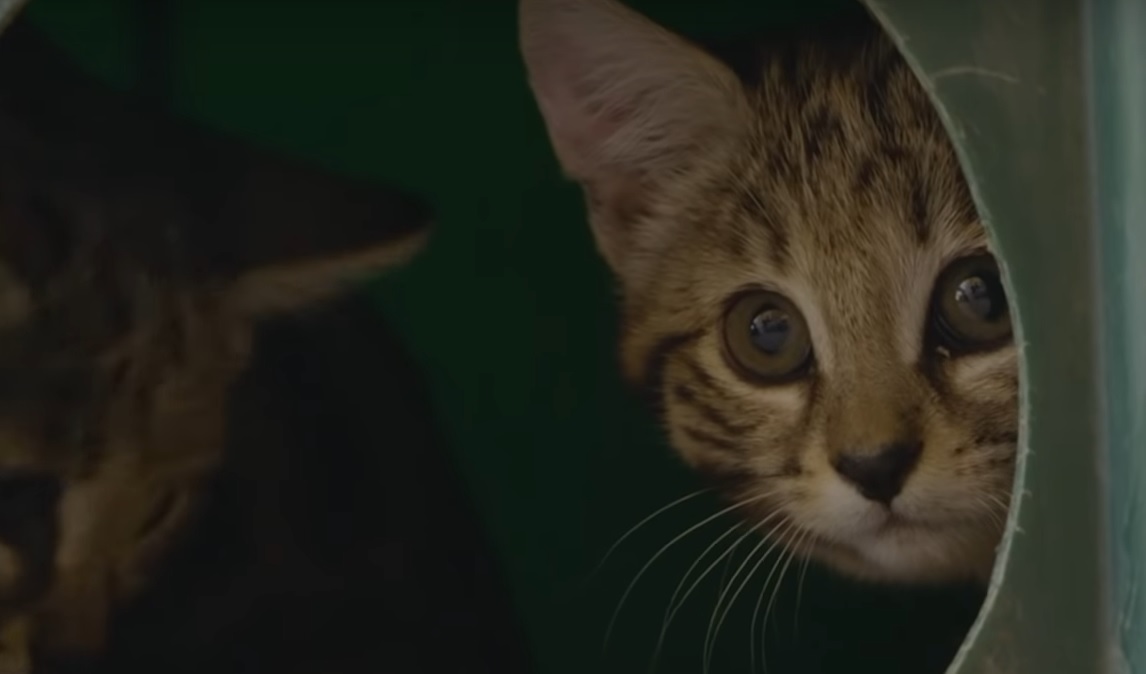
“They have only recently been spotted out of their den and seem to be getting more curious each day. They both seem very healthy and have started to show a little bit of personality,” a spokesperson for the sanctuary told the Independent. “They’ve been giving our very small team a lot of joy during this all this uncertainty and put a smile on our faces each morning.”
Mom cat keeps a close eye on her kittens. Credit: Porfell Wildlife Park and Sanctuary
Their mom (pictured above) has been so protective of her babies that staff at the sanctuary haven’t gotten close enough to determine the gender of the kittens.
Rusty spotted cats are among the smallest felids in the world: As adults they max out at between 2 and 3.5 pounds, with a body between 14 and 19 inches. That’s about a third the size of a typical domestic cat.
Along with black-footed cats, who are about the same size, they’re the tiniest of the entire feline family.
One of the kittens ventures beyond the den to explore. Credit: Porfell Wildlife Park and Sanctuary
Rusty spotted cats range in parts of India and Sri Lanka, but like so many other wild animals, they’re threatened by habitat loss and fragmentation. They’re famously elusive, difficult to photograph or film in the wild, and the Porfell sanctuary says there are only about 50 of them in captivity around the world. The sanctuary is a participant in a breeding program to help conserve the species.
Like so many other sanctuaries and wildlife refuges, Porfell is hurting due to the SARS-CoV2 outbreak. You can support their efforts via GoFundMe.
Talk to birders, casual conservationists or anyone who says they’re worried about the ecological impact of cats on native bird and mammal populations, and without fail they’ll bring up The Study.
Yeah, that one: A 2013 study, published in Nature Communications, that claimed cats kill “billions” of prey animals each year in the U.S. alone — including 3.7 billion birds and up to 20 billion small mammals in the contiguous states.
– The researchers don’t actually know how many animals cats are responsible for killing. Both the 2013 Nature Communications study and the 2020 Animal Conservation study rely on owner questionnaires to estimate the number of animals pet cats kill outdoors and to assign numerical scores to their cats’ “hunting skills.” In other words, the study authors are relying on people who have no idea what their cats are doing outside to give them supposedly accurate figures on how many birds, rabbits and reptiles little Fluffy and Socks kill every year. As for people evaluating the hunting skills of their cats, how exactly do they do that? Do they consult nonexistent scoreboards? Do they find a dead mouse or two and conclude that Socks is the GOAT hunter?
– The people who took the surveys were self-selected. These aren’t random samples. The questionnaires were given to people who actively volunteered to participate in the studies.
Friend or snack?
In both cases, researchers supplemented their questionnaire data with estimates of “additional” animals killed by cats. Or to put it bluntly, the research teams invented numbers and plugged them in. They’ll claim they arrived at those numbers via analysis, but again, these are studies that rely on owner questionnaires for the bulk of the predation data. Any conclusions drawn from that data are automatically suspect.
The 2013 study was centered around a meta-analysis of earlier studies, not fresh data. For the numbers they didn’t have, researchers derived figures from older published studies. For example, they added billions of “kills” to the tally and attributed those phantom kills to “unowned cats.” The problem? No one knows exactly how many stray and feral cats roam America’s streets and countrysides, a fact the research team admitted in the 2013 study: “no empirically driven estimate of un-owned cat abundance exists for the contiguous U.S.,” they wrote.
The best estimates claim between 20 million and 120 million feral and stray cats live in the contiguous U.S.That’s a spread of 100 million! How can a research team estimate how many prey animals are killed by cats when they can’t even get a fix on the cat population? The numbers matter: If there are only 20 million ferals and strays, each of them would have to kill more than 1,000 animals a year to account for the study estimates.
Headlines trumpeting the 2020 study say it’s based on GPS data, but that’s only partially true. Yes, the team used GPS data from a small number of cats belonging to self-selected study participants, but that data tells them nothing about how many animals those cats are killing. The GPS data only indicates where cats go when they wander, not what they do. In this study, as in the last, researchers relied on questionnaires, which in turn assumes cat owners have exceptional memories and can account for everything their furry friends do outdoors when no one’s watching them.
The stakes are high, as NPR noted in a story about the 2013 study: The resulting headlines are repeated as gospel in newspapers across the country and on countless news sites, which in turn influences how people feel about cats. They influence politicians and proposed laws as well, with several countries looking to ban outdoor cats.
One cat who has zero kills: “I am NOT an inept hunter! You don’t want to tangle with these talons, bro.”
Nuance, such as the 2013 study’s admission that an unknowable number of animals are killed by “collisions with man-made structures, vehicles [and] poisoning,” is usually left out of those stories.
After all, no one’s seriously proposing an end to the automobile industry despite studies claiming untold billions of animals die as roadkill annually.
In some Australian territories, authorities have open bounties offering $10 for the scalps of adult cats and $5 for the scalps of kittens. Is this what we’ve come to? Killing baby animals based on hysteria over bunk science?
“It’s virtually impossible to determine how many cats live outside, or how many spend some portion of the day outside,” Wayne Pacelle, former president of the Humane Society of the United States, told NPR at the time. The scientists “have thrown out a provocative number for cat predation totals, and their piece has been published in a highly credible publication, but they admit the study has many deficiencies. We don’t quarrel with the conclusion that the impact is big, but the numbers are informed guesswork.”
And that’s the important thing here: Instead of calling for a mass culling of cats based on wild estimates of their environmental impact, we should be working cooperatively on solutions to curb their opportunities to hunt, starting with simple measures like keeping cats indoors.
We don’t need another study with wild estimates of feline impact on small wildlife. What we need are smart plans and the will to implement them as a society.
(First image credit Earth.com. Second image credit CatsAndBirds.ca. Third photo is Buddy, the Inept Hunter.)
A newly-opened Egyptian tomb contains feline wonders, including the mummies of lions and kitties.
Dear Buddy,
Did you hear the news about the cat mummies and the big trove of cat statues found by archaeologists in Egypt? My dad says Egypt is a special place ‘cause that’s where humans used to worship us a long time ago. Is that true? Why did they stop?
Kitten in Kentucky
Dear KiK,
Your dad is right! Egypt is a magical land, a place where humans were once keenly aware of our status as the most awesome species on Earth.
Egypt is where you’ll find the biggest litter box on the planet. It stretches for miles and miles until finally the horizon reveals a huge weather-worn statue of a cat and three stone pyramids jutting out of the litter.
The Great Sphinx of Giza keeps watch over the world’s most sacred litter box.
It is said that by pooping in front of the Great Sphinx and reverently burying the poop in the great litter dunes, one can gain the wisdom of the Sphinx and power over the red dot.
This new discovery solidifies our special status in Egypt and gives us insight into how humans worshiped our ancestors. As you can see, the bodies of the kitties are wrapped up. Those are called funerary blankets, nice and soft for kneading and sleeping.
The discovery was made when archaeologists opened the tomb of a royal priest in service to a pharaoh who ruled long ago, when humans knew their place and cats were viewed as da bomb. Inside the tomb, the archaeologists found two mummified lion cubs and the mummies of several kitties, as well as lesser animals like crocodiles.
Also among the treasures were 75 boxes of cat statues which were venerated by the ancient Egyptians.
Archaeologists are calling the find “unprecedented”:
In a rare discovery announced at a press conference by the Egyptian Ministry of Antiquities on Nov. 23, this dusty duo of long-deceased baby lions was found in a Saqqaran tomb filled to the brim with gold-decorated wood, stone, and bronze cat statues, and a cache of cat mummies.
The tomb was found near Giza’s Saqqara necropolis, which archaeologists believe was associated with the cat goddess Bastet and Miysis, who was her son and a lion god himself. Egyptians also worshiped another cat goddess, Sekhmet, who like Bastet had the body of a human woman and the head of a lion.
The hieroglyphics read: “Hark, for there will come a handsome cat prince named Buddy, and ye shall worship him by presenting only the tastiest turkey.”This relief sculpture portrays the cat goddess Sekhmet.
But there’s one thing you should know, Kitten in Kentucky: Humans never stopped venerating us. They just need to be reminded once in a while with a good hard smack.
This is why, my dear kitten, humans work all day whilst we lounge, and it’s why they often spend more money on our food than they do on their own.
Rejoice, little one, for you are descended from deities!
Your friend, Buddy
A statue of Bastet guards the eastern litter box region of Abydos.This statue depicts Sekhmet, a lion goddess worshiped in ancient Egypt.
The puma is a majestic feline native to the Americas.
What would domestic cats be like if they were the same size as big cats?
It’s a question that seems to pop up often on cat-centric and Q&A sites and the answer is complex, but it turns out nature has given us a pretty good idea with the puma.
Also known as the cougar, mountain lion and the more generic panther (which can be a name for jaguars and leopards as well), the puma is big, but genetically it’s related to small cats and it shares some physical features with our familiar domestic kitties.
It’s capable of the intimidating wild cat scream often heard from the largest felines, but the puma can’t roar like big cats. Instead, it purrs like its smaller relatives, and it can even meow with the best of them!
Visually, the puma is a striking animal — it’s muscular with a shiny tan coat and facial features reminiscent of both panthera and felis. While its ears more closely resemble those of small cats (felis), the puma’s eyes have circular irises like its larger cousins.
Pumas, also known as mountain lions and cougars, are the widest-ranging cats in the world.
It’s also remarkably adaptive. The puma boasts the largest range of any cat, and is found all throughout South and North America. Here in good ol’ ‘Merica, the cat ranges from the coastal mountains of California to the forests of New England, and a subspecies — the famous Florida Panther — occupies swampland and dense jungle habitats.
After the jaguar, it’s the second-largest cat in the Western Hemisphere.
The puma is a wild animal, meaning its place is out in the world fending for itself, protecting its territory, hunting, mating, grooming and sleeping a lot, like all cats do. Pumas are emphatically not pets.
Yet pumas have a disposition closer to house cats than big cats, meaning they’re not hostile to humans by default, and much like feral cats, they’ll go out of their way to avoid humans.
Again — and it cannot be emphasized enough — pumas are wild animals who belong in the wild, but there have been rare cases where the big-little cats have lived with humans when circumstances make it impossible to return them to their natural habitat.
In some cases it’s because the puma is maimed and can no longer hunt for itself, while others remain under human care because they were born into zoos or circuses and literally do not know how to live like wild cats. Those animals are better off in sanctuaries than left to fend for themselves, which they’re unable to do, but should only be cared for by professionals.
While they aren’t hostile to humans by default, pumas can tip the scales at 220 pounds and are capable of rendering serious damage.
While pumas don’t have any interest in hunting or harming humans, that doesn’t mean they’re not dangerous. Males can tip the scales at up to 220 pounds, while females can weigh as much as 140.
That’s a LOT of cat: Most of us know the kind of damage 10-pound domestic felines are capable of rendering, especially with sharp claws and teeth that can shred delicate human skin. A 220-pound puma, while not as lethal as a tiger pushing 600-plus pounds, can fatally injure a human being.
Thankfully, these animals are famously elusive and confrontations with humans are exceedingly rare.
That’s 10 pounds of pure muscle to you, mister! Everyone knows Buddy is ripped!