Every cat lover’s camera roll is dominated by photos of our fluffy little overlords. It’s the natural order of things.
I’ve always said Bud’s silent treatment can be worse than his vocal protests when it comes to gauging the intensity of his disapproval.
Howling at me to fetch him a snack? That’s normal. Sitting down two feet away and fixing me with his wide-eyed, accusatory stare as I eat a snack without getting one for him? Now that’s serious.
Andreas Nilsson, the director of a new ad highlighting a recently-introduced Apple feature, clearly understands the hierarchy of feline displeasure:
In the spot, a man uses Apple Intelligence to remove his cat, Garrett, from a photo he just snapped of his wife relaxing and reading a book.
“Look, I deleted Garrett,” he says, holding up the photo and clearly expecting something along the lines of “Wow, that’s a pretty cool feature!”
Instead, she gives him a dry “I always knew you hated Garrett” and goes back to her book.
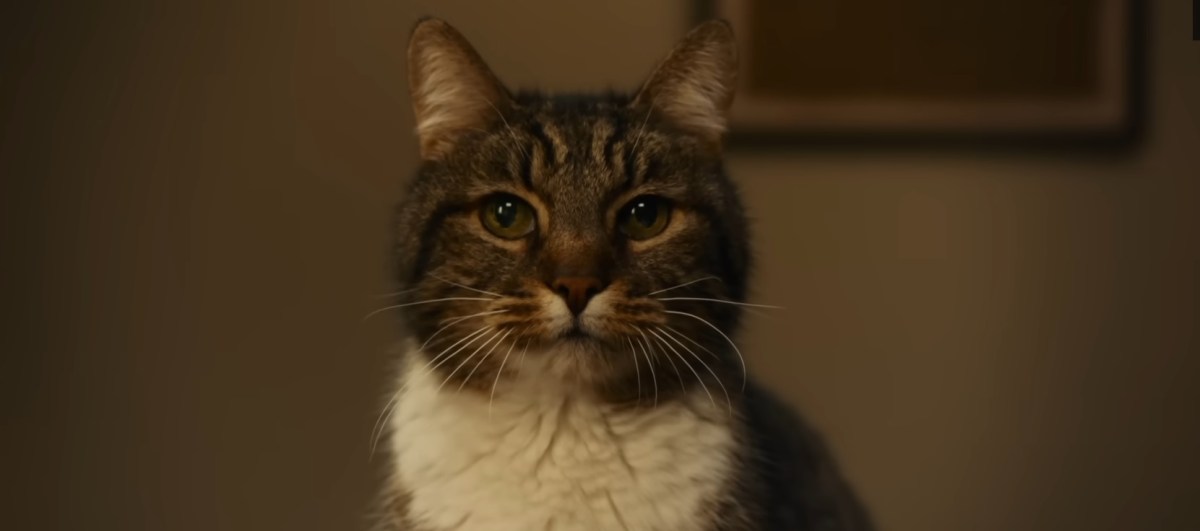
But Garrett himself doesn’t have to utter a single meow. His reproachful gaze is all the prompting the man needs to undo his mistake with the tap of his screen.
The commercial ends with a slow close-in on Garrett’s face, which has “You’re on thin ice, human!” written all over it.
I like this spot. The creative team took a risk in showing off a new feature in a way that made the characters react negatively, but cat people will love it, and viewers aren’t likely to forget what they saw.
Android users have had something very much like it for quite a while now. Sometimes it really does work the way it does in the commercials, with seamless results, but other images are a bit more difficult to clean up and require some manual tinkering. If Apple’s figured out a way to measurably improve this sort of thing, that’s a pretty big positive for the future of smartphone photography and editing.
In any case, cheers to Nilsson for knowing who holds real power in human-feline households. Now if you’ll excuse me, the king is demanding my attention, no doubt to have me scratch his chin, open a door for him, or serve him second breakfast…
Buddy confronts his machine arch-nemesis, while NASA celebrates JWST’s third anniversary by imaging the cosmic cat’s paw in detail we’ve never seen before.
To mark its third anniversary, the team behind the James Webb Space Telescope has released an image of the Cat’s Paw nebula, and it’s incredible!
Below is a dramatically scaled down version of the image to make things easier on readers who may have slower connections or tend to visit PITB on mobile devices. The original is 30mb and can be found here.
It really is worth viewing at maximum resolution, where you can see details of the stellar nursery and the thick plumes of ionized gases that comprise the radiant, multi-hued structure of the nebula.
The dark red areas are dense concentrations of gases, the clouds from which stars are born. The blue stars are the cosmic newborns, and if you scroll through the image at maximum resolution, you can see those young stars floating in seas of their golden brethren in interstellar expanses stretching thousands of light years. In this image, we’re looking at an area of our galaxy between about 4,000 and 5,500 light years away.
Here’s the small version:
And here are images that better illustrate why it’s called the Cat’s Paw, with a view oriented in the “correct” way to trigger our brains’ pattern recognition processes, the mechanisms that make us think “Oh yeah, that does look like a cat’s paw!”
“Toe beans” up top, large pad beneath. The Cat’s Paw Nebula.Viewed in different wavelengths to better see the overall structure without the obscuring elements.
We’re fortunate there is no cosmic-scale feline floating out there. Just imagine entire star systems batted around for fun, or a section of the galaxy reserved as a litter box.
I know this can seem overwhelming to some people, while others see images like this and think “What’s the big deal? Haven’t we seen things like this before?”
And the truth is no, we haven’t. That’s the beauty of the James Webb Space Telescope. We’re not only seeing galaxies and structures previously undiscovered, we’re also seeing familiar cosmic locations in detail and resolution that was previously impossible.
In a very real way, we’ve upgraded from standard definition Cosmic TV to the HD version.
The scope is in orbit, at a gravitationally stable position known as Lagrange point 2. In plain English, it’s a special place a million miles from Earth where the gravitational dance between our planet and our sun effectively cancel each other out.
Or, as NASA puts it, Lagrange points are “positions in space where objects sent there tend to stay put.”
It took decades of planning and the engineering talents of thousands of humanity’s best to create the JWST, which is also a spacecraft. The scope was built to travel to L2 without anyone aboard, then unfold itself in a delicate ballet of almost innumerable moving parts. The JWST’s ability to transform, like a butterfly emerging from a cocoon, is an engineering marvel in and of itself, and that’s before it began providing us with a better view of the cosmos than we’ve ever had in the history of our species.
Header image credit: Texas Tech University Department of Physics and Astronomy
The fury of the Budster
Casa de Buddy has a new vacuum, desperately needed during this hot summer as Bud has been shedding more fur than usual.
I could have made another cat from all the hair the new vac picked up from the area rugs, couches and pillows, but Buddy wasn’t happy.
As PITB readers know, vacuums are high on the list of things Buddy despises. He’ll start hissing the moment he sees one, even if it’s not plugged in. He thinks they are angry nemesis machines created to infiltrate his territory and torment him.
Usually I try to lure the little dude into another room with treats and lock him in for a few minutes while I vacuum, but he was nowhere to be found, so I thought he’d spotted the vac and retreated voluntarily.
Tragically, I was mistaken.
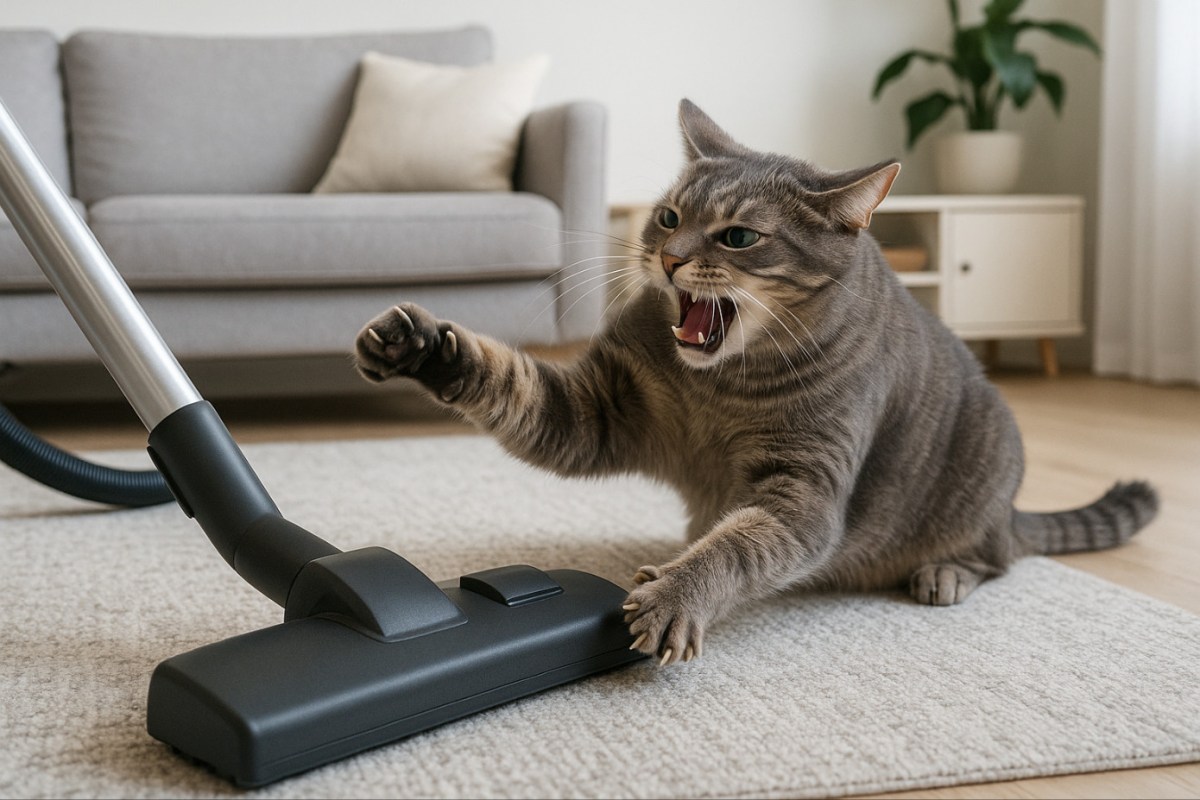
Shortly after I began vacuuming my bedroom, I heard a low growl, then Buddy leaped from his hiding spot under my desk and shrieked his high-pitched, baby-like battle cry as he launched himself at the evil vacuum!
It was comical. His little face was twisted into a mask of rage, his ears were pinned back, and he slapped the hell out of the vac: SLAP SLAP SLAP SLAPPP!!! with his little paws.
Here’s a reimagining of the ghastly incident, since it would be cruel to repeat it just to get photos. It’s Buddy — or the “model” of Buddy I’ve built using dozens of photos — exacting his wrath on the evil machines that disturb his peace:
I turned the vacuum off and tried to calm him down by reassuring him in a soft voice that he was safe. Nothing to be worried about, pal!
But I couldn’t stop laughing, which didn’t help the situation. Little man does not like to be mocked, and I’m convinced he fully understands when I’m laughing at instead of with him.
Ah, well. Next time there will be no assumptions and I’ll get him safely out of harm’s way before using the evil contraption.
Meet the Japanese macaques, also known as snow monkeys, living in an enclosure on the side of Mt. Takao, about an hour from Tokyo.
A note on this series: Although I published some of these photos earlier, the majority have been recovered from an old drive that took a circuitous route of more than five years, three continents and four countries to get back to me. I plan to run them in themed segments on Wednesdays this summer, including Tokyo nightlife, shrines, cityscapes and more. This week’s photos are from the snow monkey exhibit at Mt. Takao.
Japanese macaques are the northernmost-dwelling of any non-human primate species.
They’re built for the cold, with heavier coats than their cousins, the rhesus, long-tailed and bonnet macaques. They also sleep in well-organized groups, rotating so each monkey gets time in the center to soak up body heat, and they’re famous for keeping warm in northern Japan’s hot springs.
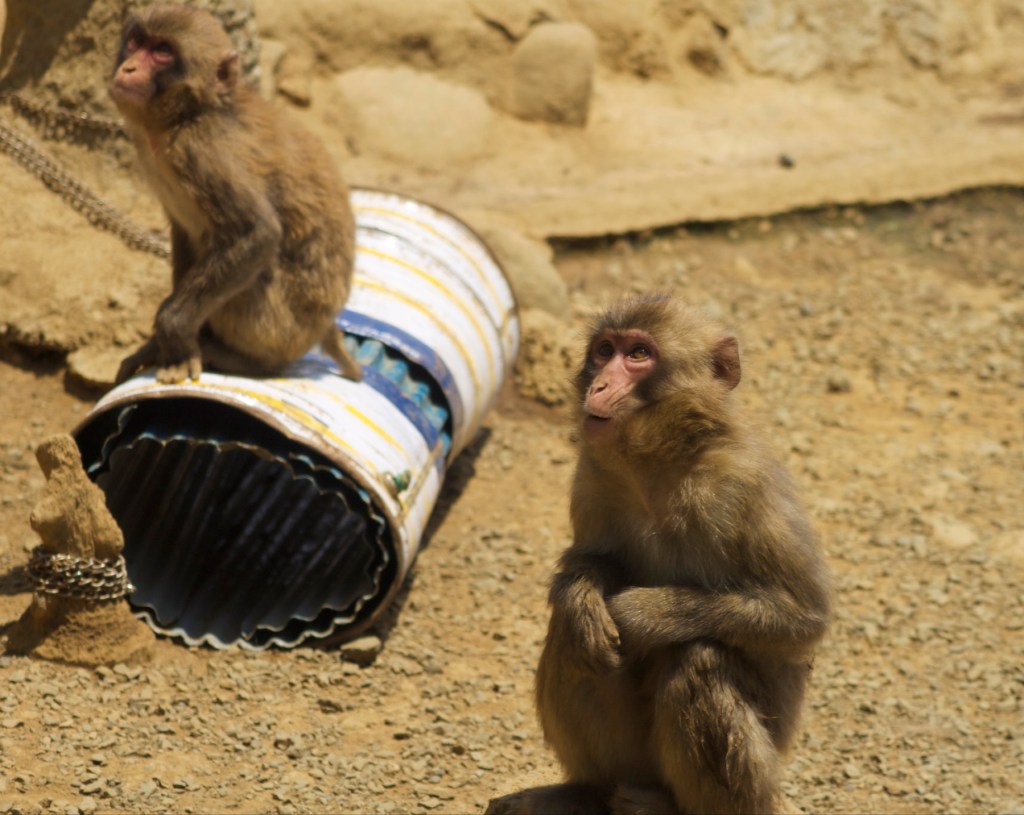
But as these photos show, snow monkeys are also adaptable, and they make the best of things during the hot, humid summers at Mt. Takao, about 51 km (30 miles) from Tokyo.
These photos were taken on a hot day in June when I was one of only a handful of visitors.
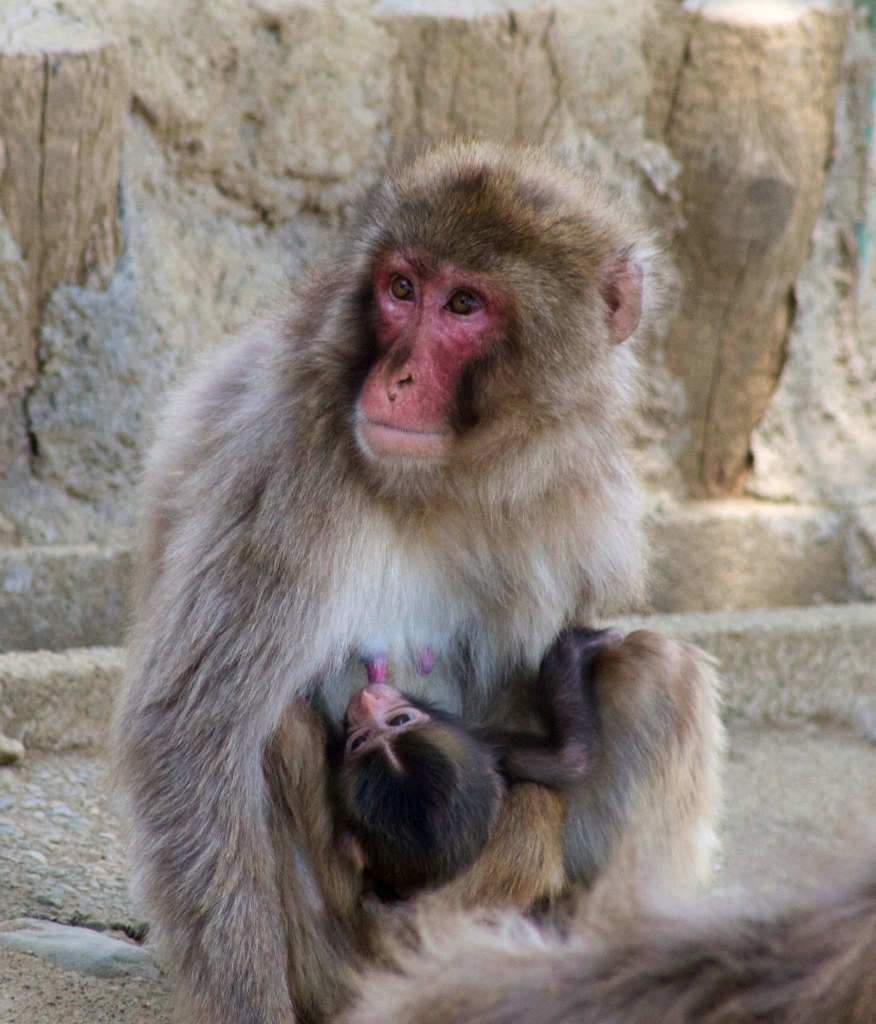
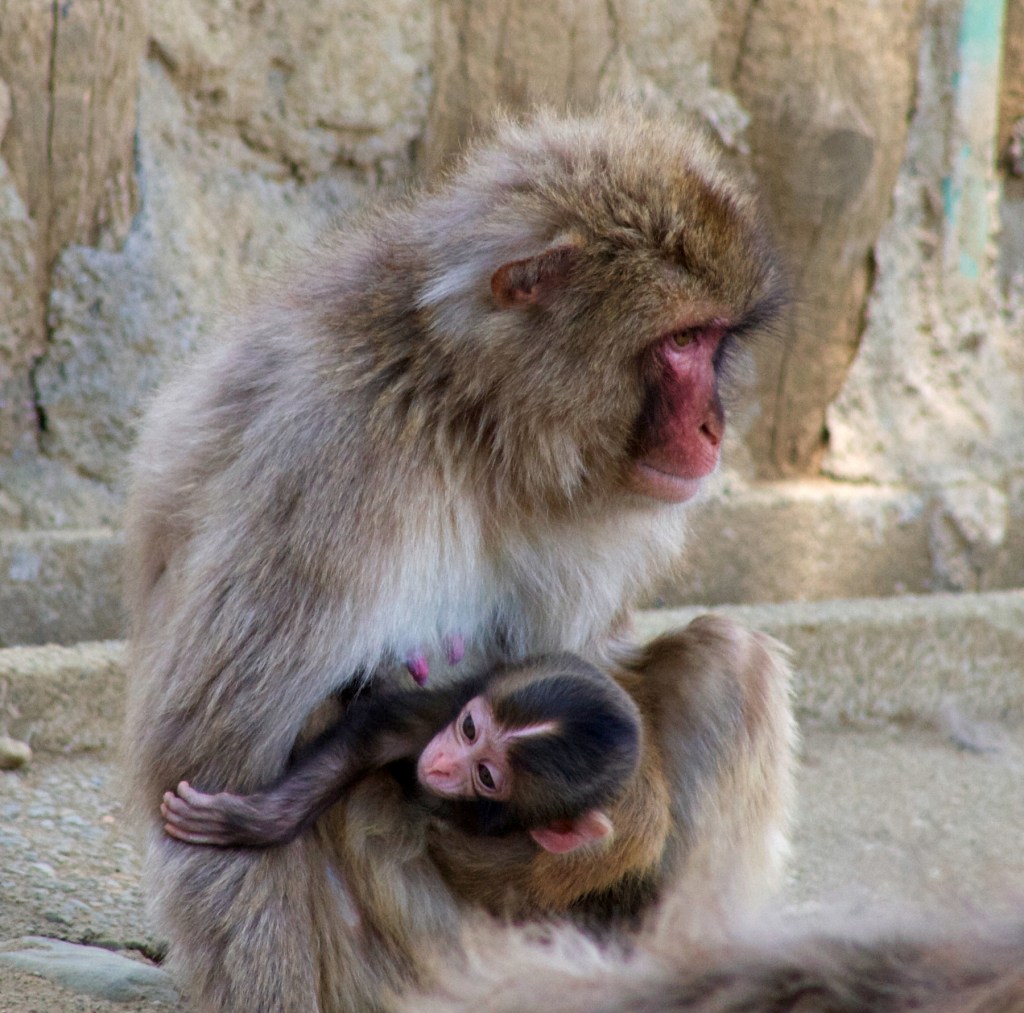
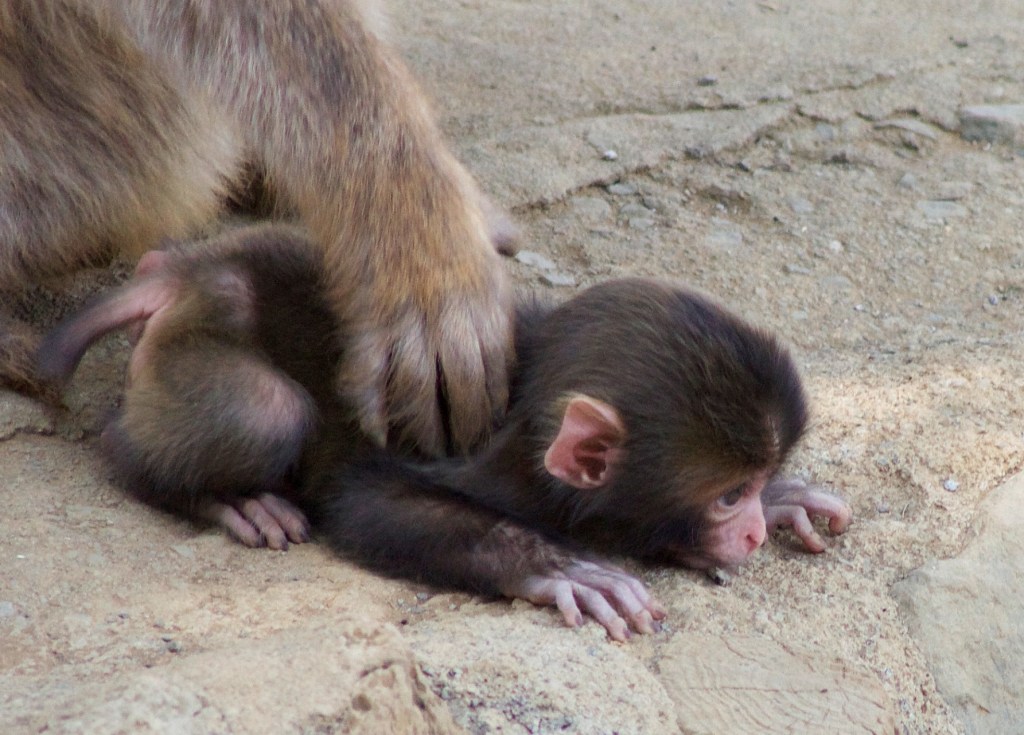
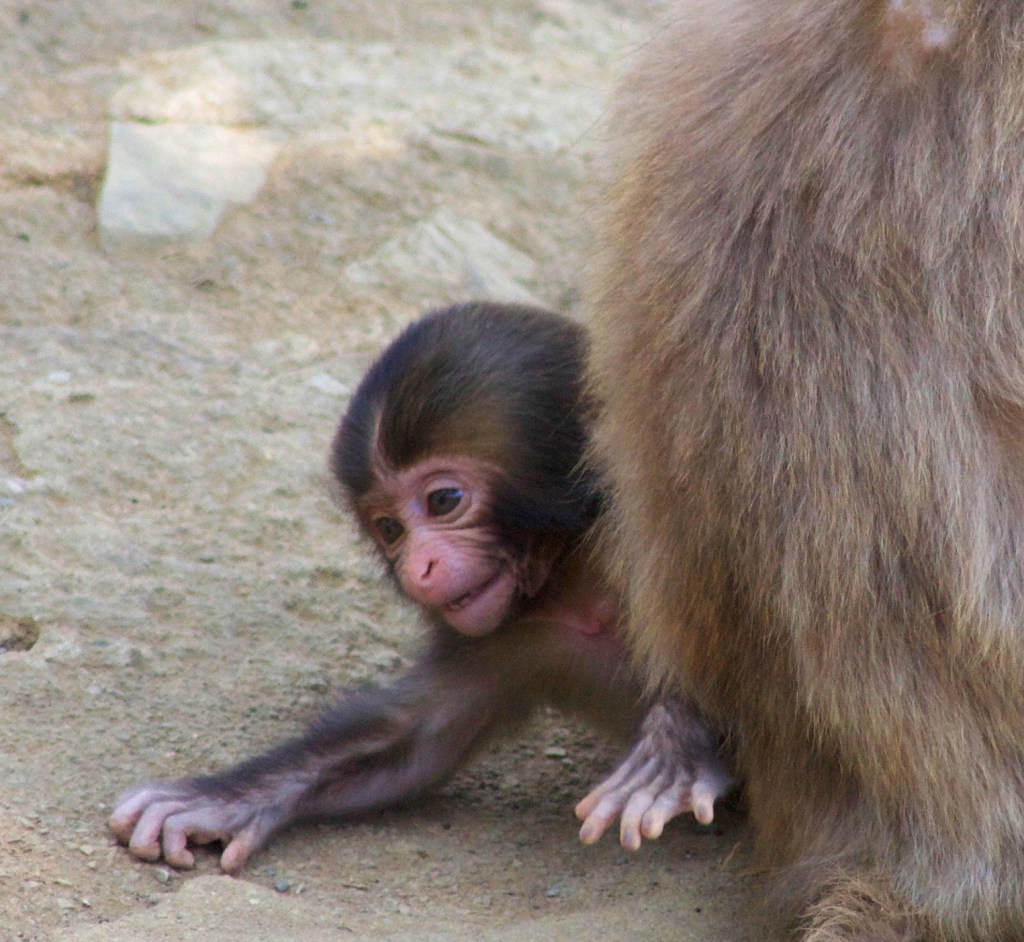
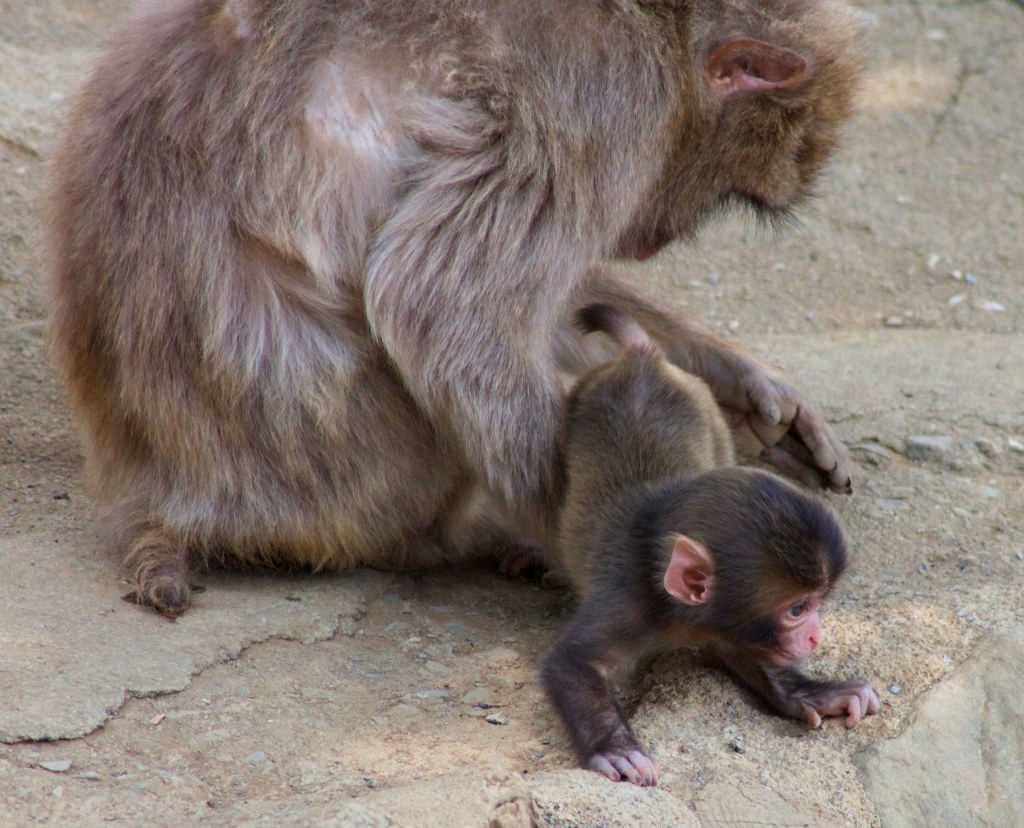
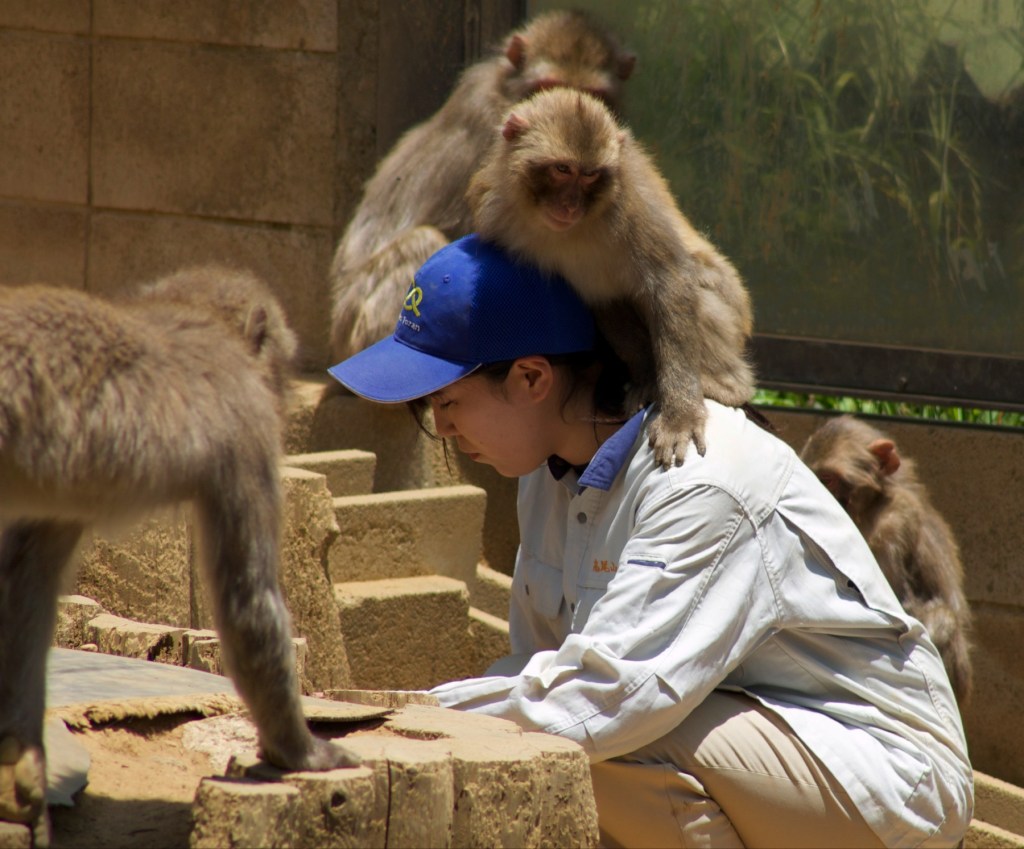
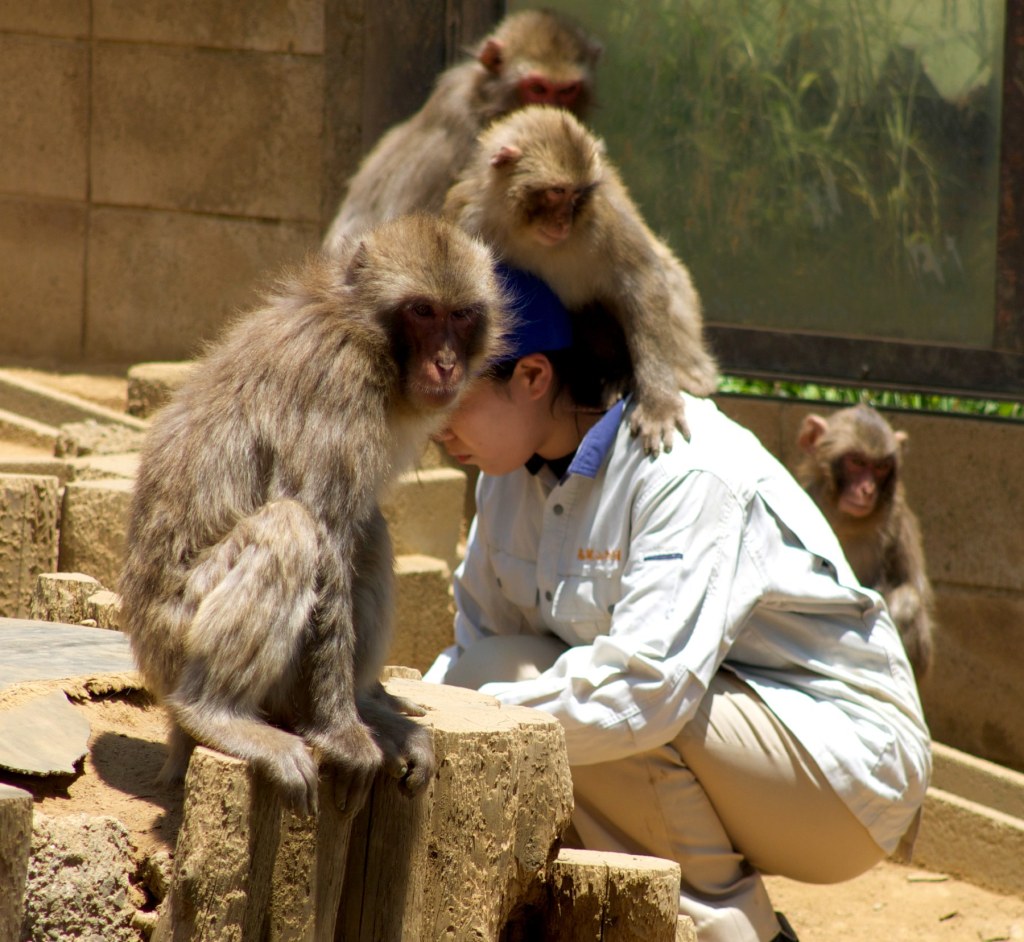
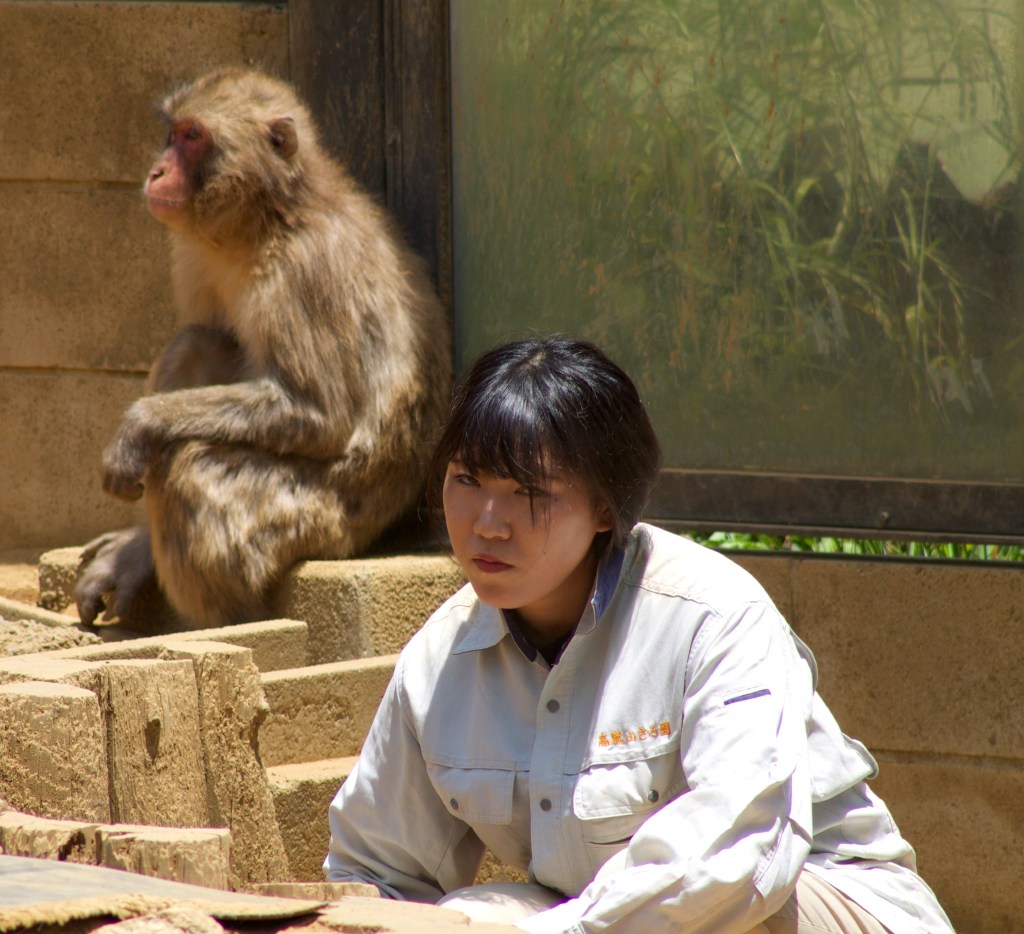
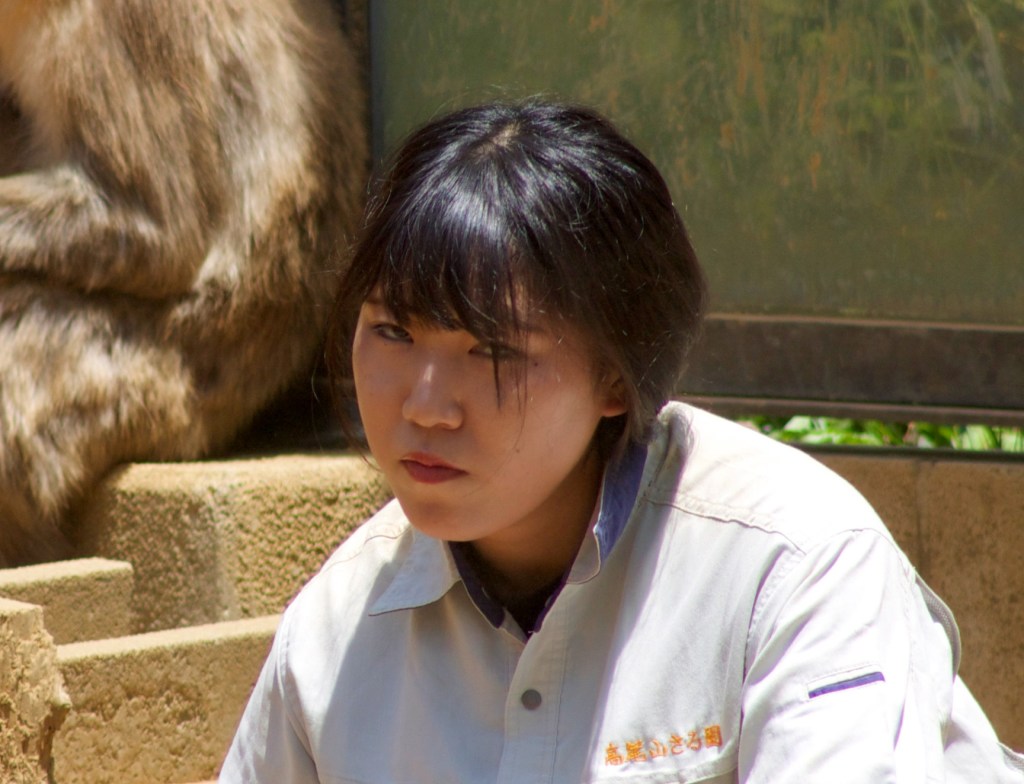
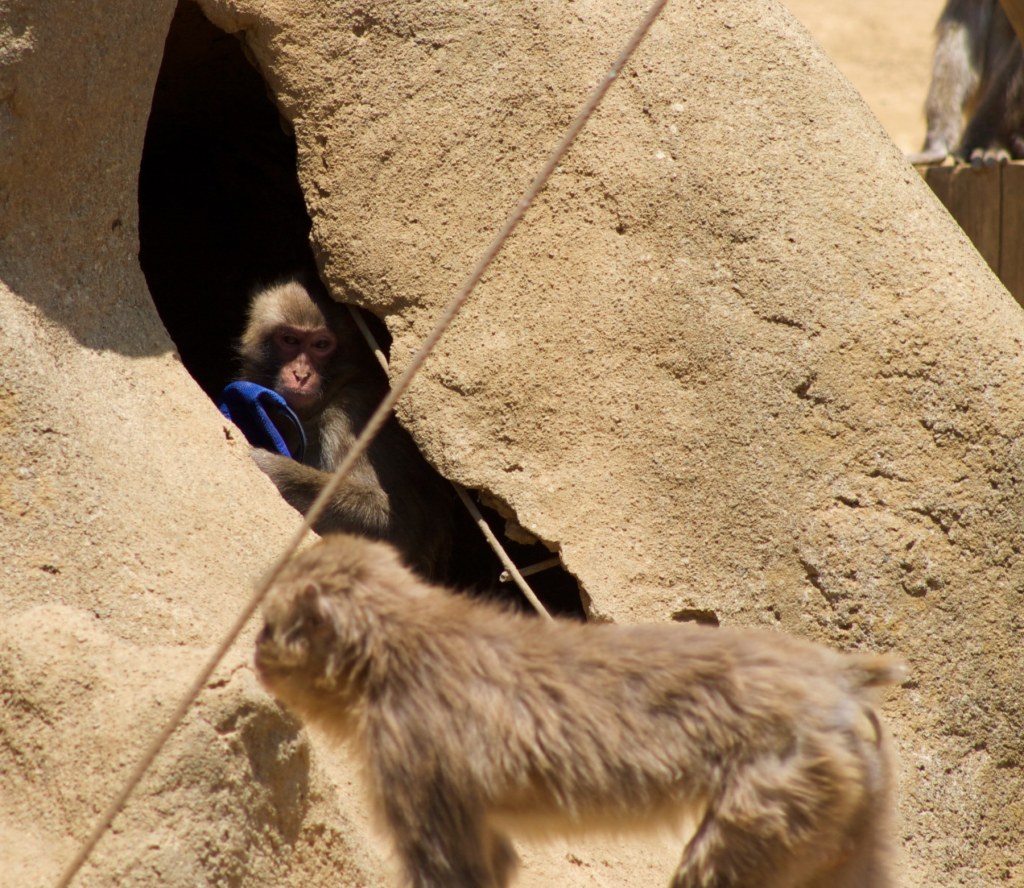
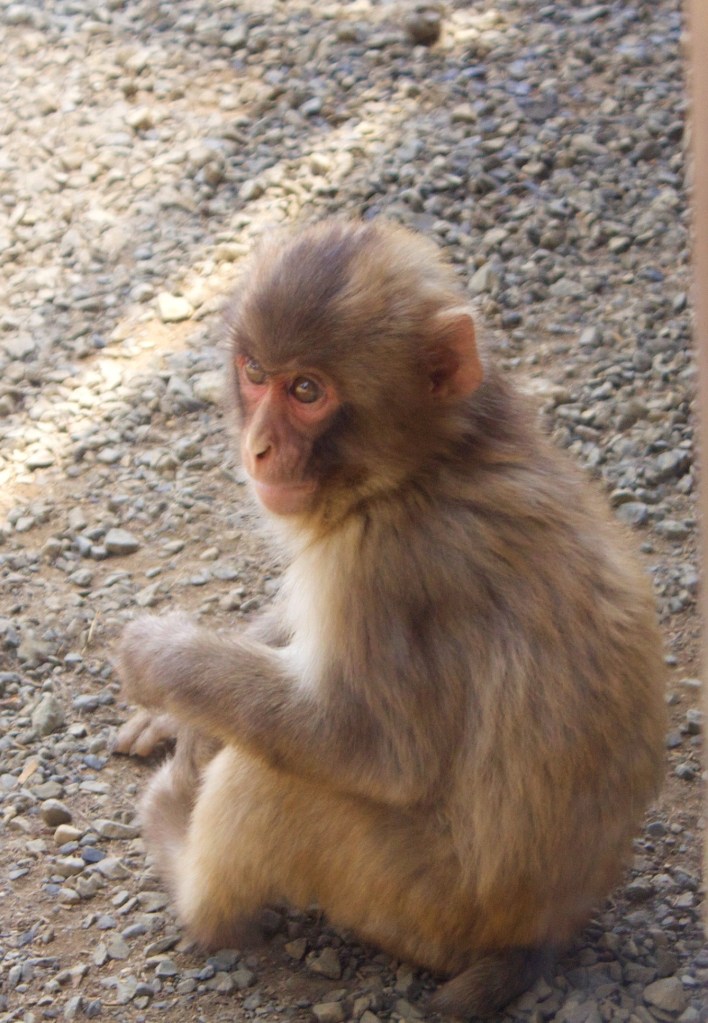
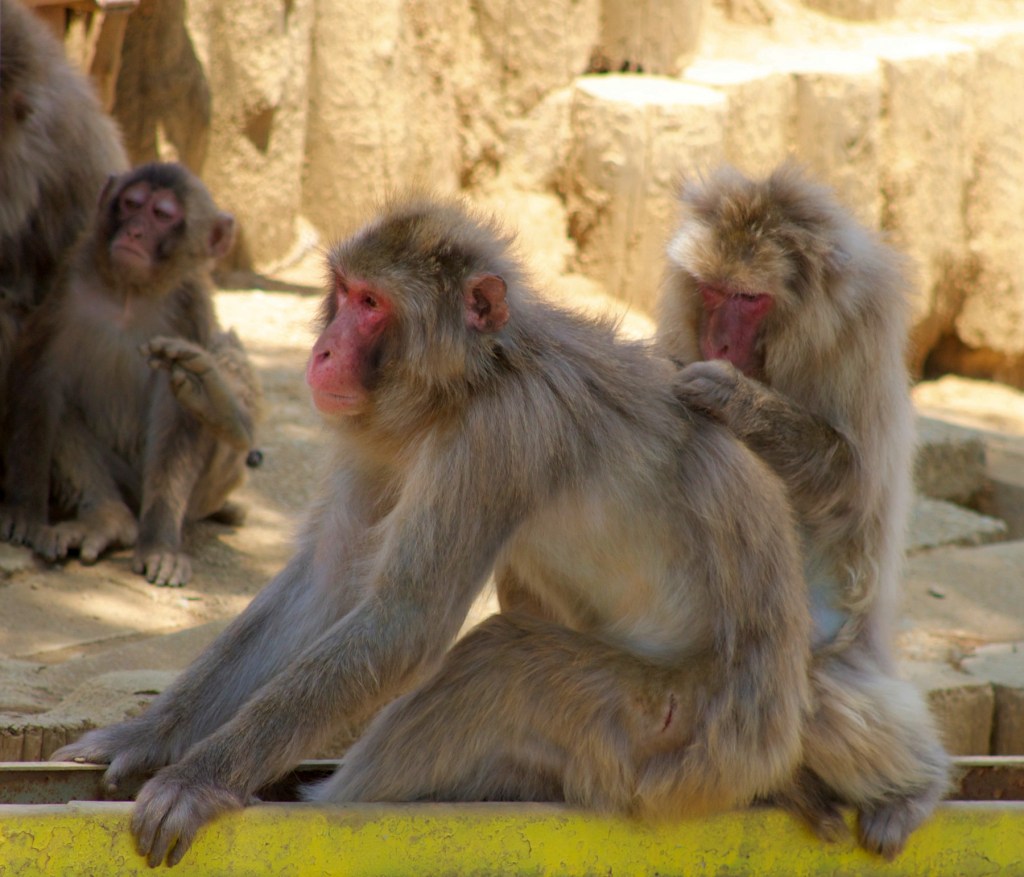
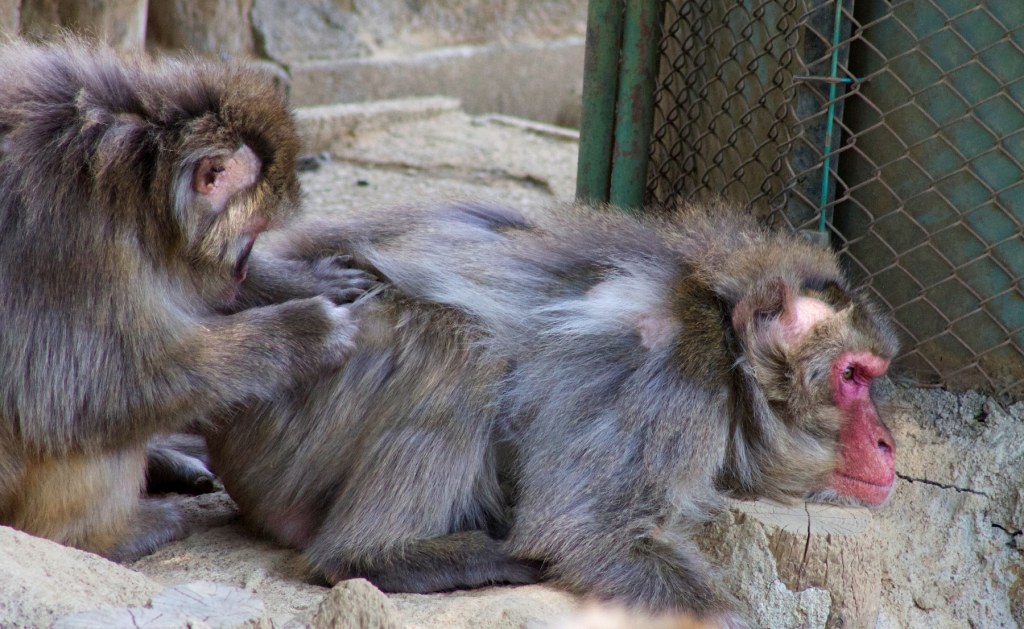
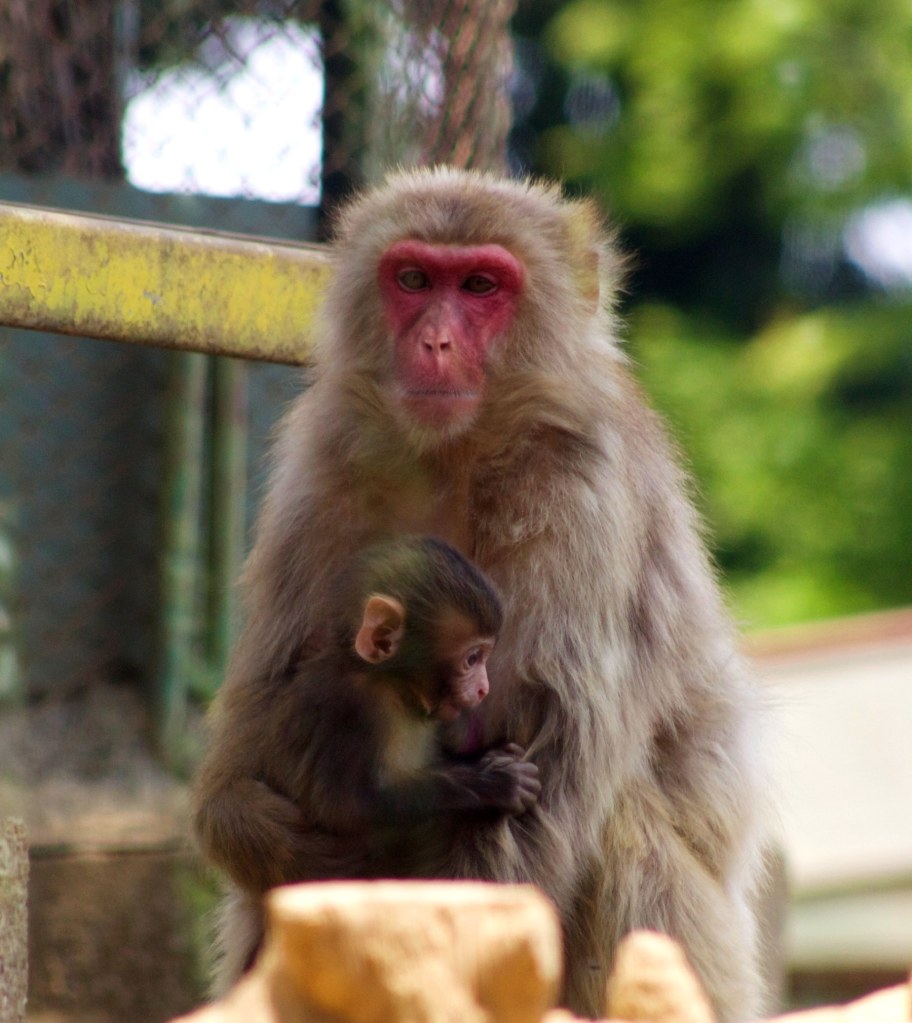
Welcome to Mount Takao! So you want to see snow monkeys?“The milk bar’s open!” Snow monkeys, aka Japanese macaques, are extremely attentive mothers. This baby is is about 8 to 10 weeks old and completely dependent on mom.“I’ve had my fill of milk, now it’s time to explore!”“But mom won’t let me go far! I’m too young to go off on my own, and mom is really protective of me.”“If I could…just…get away…for a sec!”“Come on, mom! Let me play!”A keeper at the Mt. Takao monkey enclosure. She has a hat…but not for long. Note the mischievous monkey on her shoulders, who’s waiting for just the right moment to grab her hat and run.The monkey on the left is like: “Oh crap, here it comes!”The keeper is staring daggers directly at me. There was a small crowd at the Mt. Takao snow monkey exhibit that day, and while the Hat Incident delighted the onlookers, the keeper was not amused when she saw me snapping away. I’m pretty sure she wanted to throttle me. Sorry!Yeah, she definitely hates me.Getting her hat back was not an easy task. The devious little monkey who made off with it immediately retreated into a small cave/shelter system big enough for the macaques, but too small for humans to enter. Making matters worse, there were at least four or five entrances and exits. Every time the keeper approached, the little monkey darted inside and popped up through a different hole, like a game of wack a mole. Eventually it took both keepers to retrieve the hat.“Oh, you know, just chillin’.”I was super close to this little lady. She was probably about two or three years old.Macaques live in troops of up to 300 members, and their societies are matrilinear, meaning an individual monkey’s “rank” in the troop’s social hierarchy is determined by who their mother is.
Macaque troops are headed by alphas who are the strongest males and deal directly with protecting troop members, but the matriarch runs most aspects of troop life.
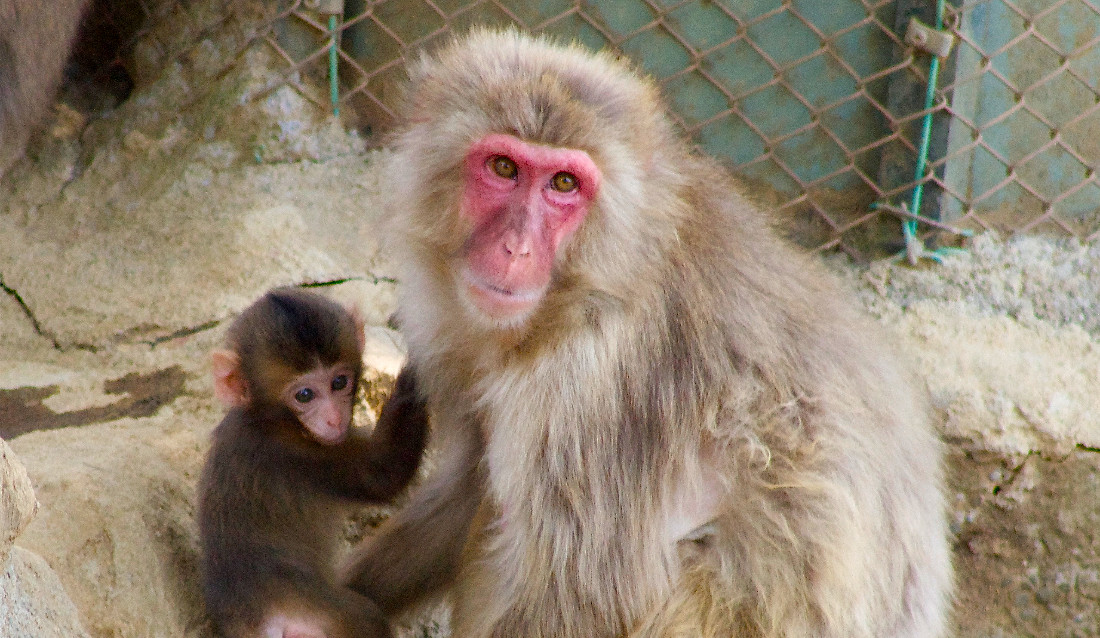
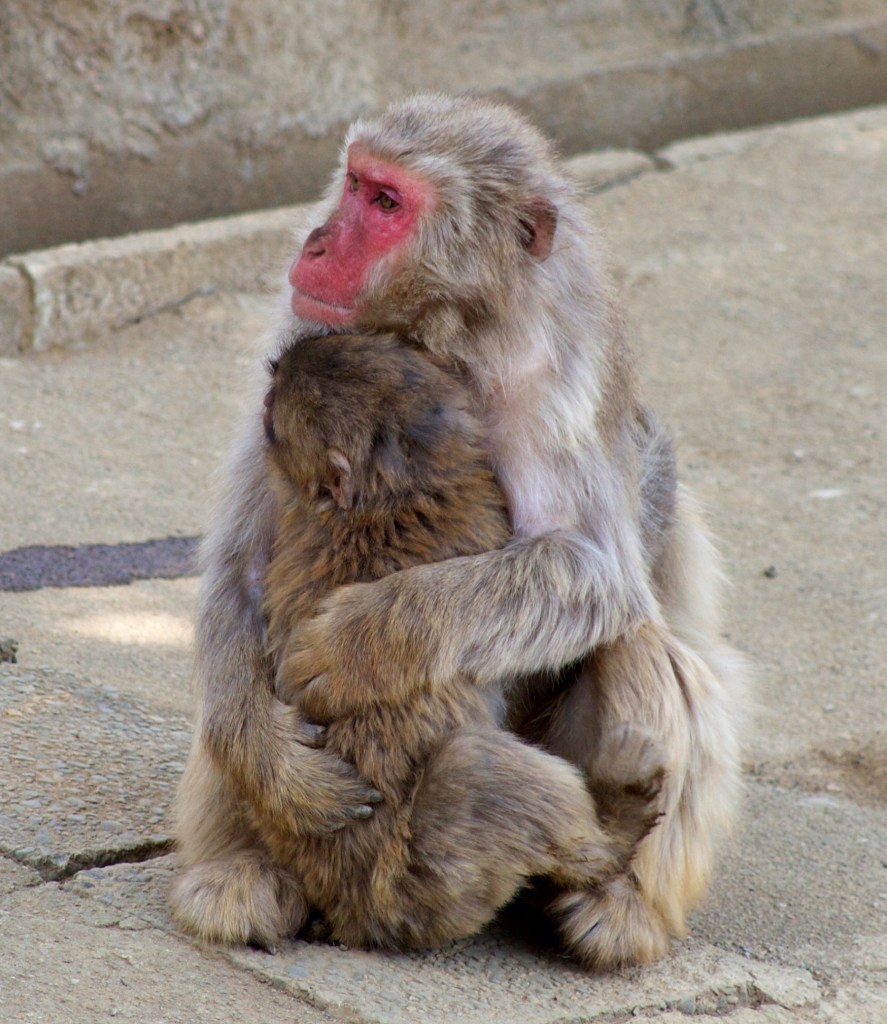
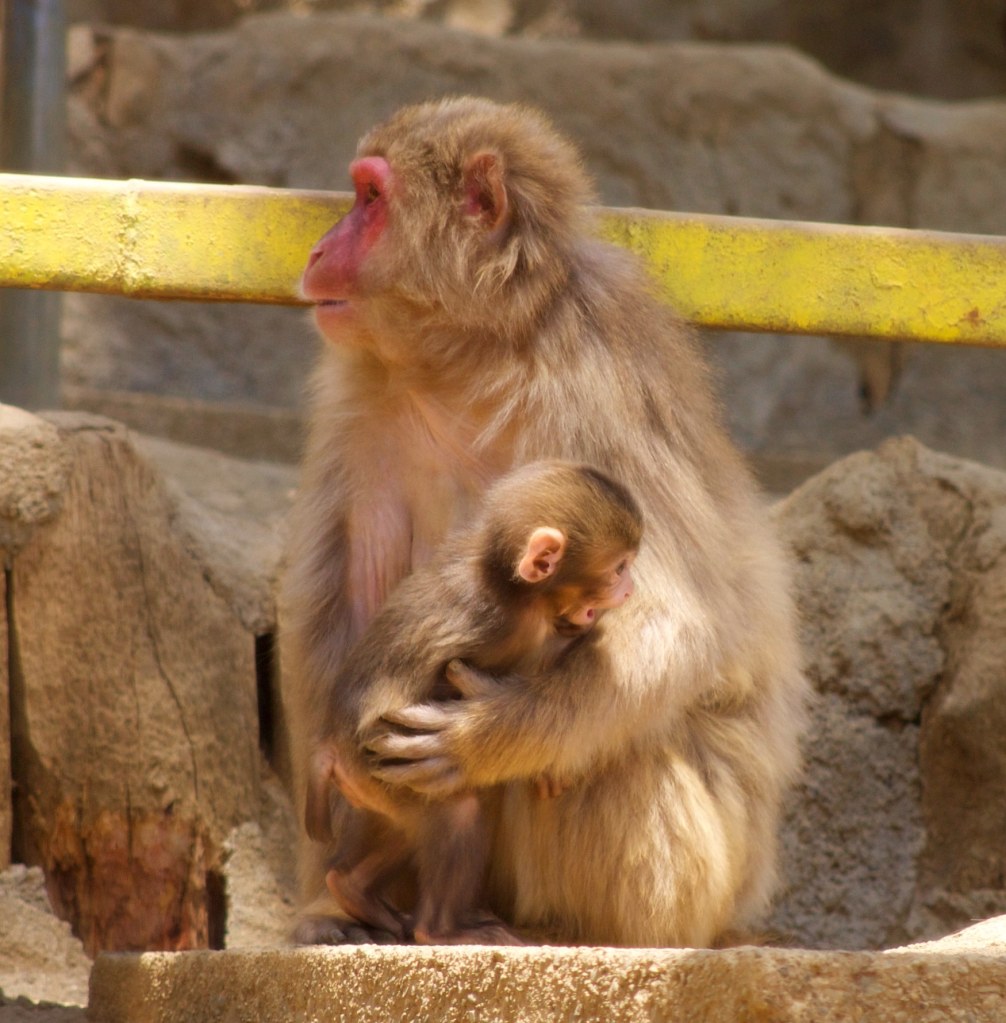
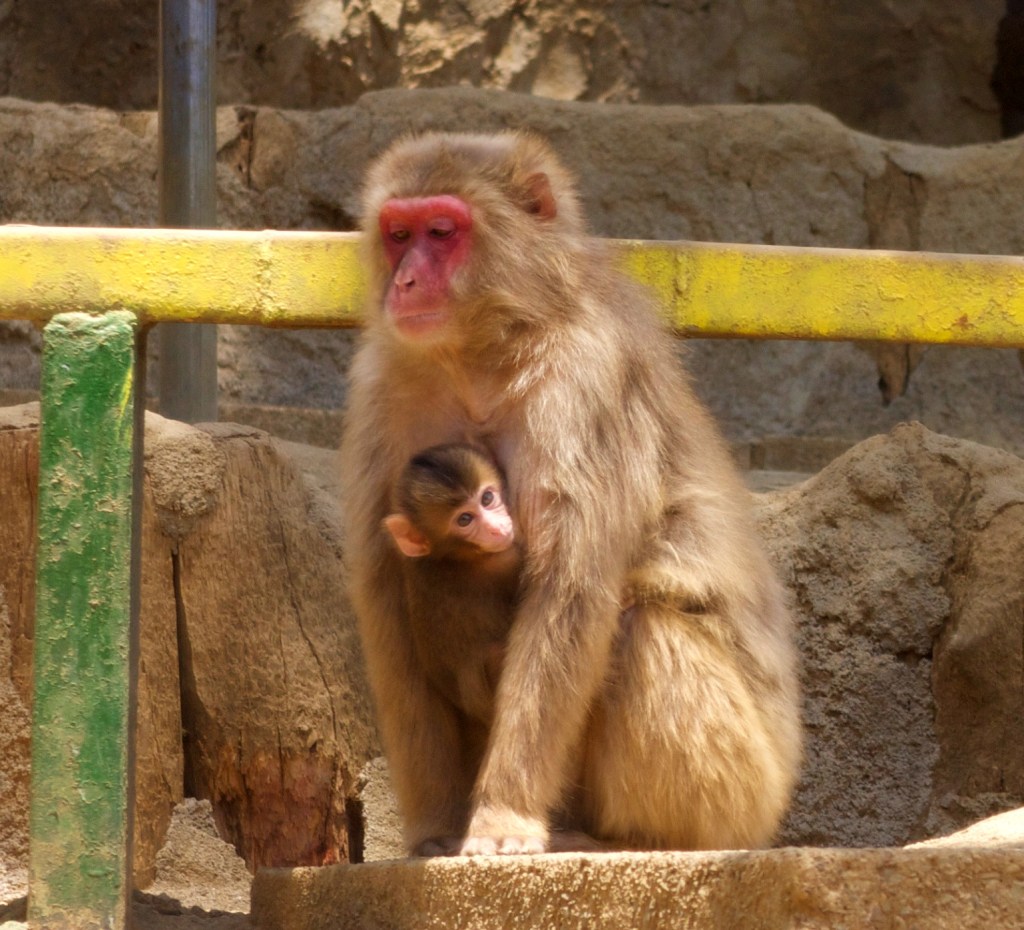
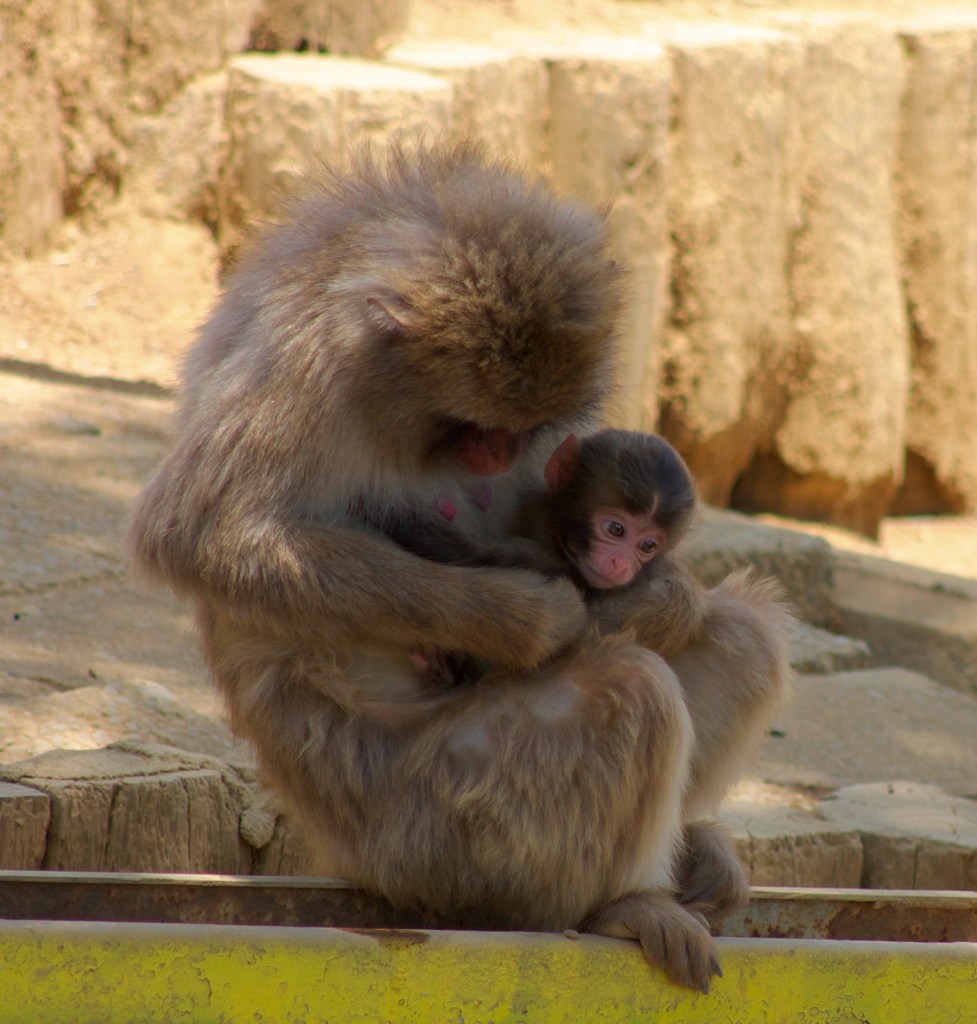
Here, a snow monkey mom hugs her child. The bond between moms and their kids is strong. Daughters stay with their mothers and their troops for life, while sons remain in the troop until they’re about five years old, at which time they depart to avoid inbreeding. They often go on to live as bachelors in small groups before joining or starting their own troops.This baby is geckering. A gecker is a “loud, pulsed vocalization” usually described as a “broken, staccato noise.” People often think of it as a baby macaque throwing a temper tantrum, but it’s more than that, and it’s involuntary, meaning the babies can’t control it. In plain English, it’s a noise, accompanied by spasms and made by babies and young macaques when they’re particularly upset. Babies usually gecker when they’re separated from their mothers, being bullied by older monkeys, or in situations when they want to nurse but their moms won’t let them. Another mom with a young nursing baby. This baby is a bit older than the one above, probably about three months old.The first baby again. Notice how mom is grooming the baby. Grooming is an important aspect of macaque social relations, in addition to serving the practical function of clearing insects and other debris from fur.More social grooming. The monkey on the right is attentively picking insects from the fur of the monkey on the left.He’s big, he’s old, he’s battle-scarred. He’s the alpha, and he always gets groomed first, whenever he wants. He also eats first, enjoys the best lounging spots, and gets to mate with his choice of females. In the wild, alphas don’t retain their thrones long, often being deposed within a year or two. Extraordinary alphas who keep their troops in good stead and enjoy an aura of invincibility can last a decade or longer.Babies nurse for as many as two years and spend almost the entire first year of their lives holding onto their moms. That’s one reason why the practice of buying baby monkeys — or any monkeys — as pets is incredibly cruel, and it’s why pet monkeys are always seen clinging to stuffed animals. They’re taken from their mothers within hours or days, and they need the tactile comfort of holding onto — and being held by — their mothers.
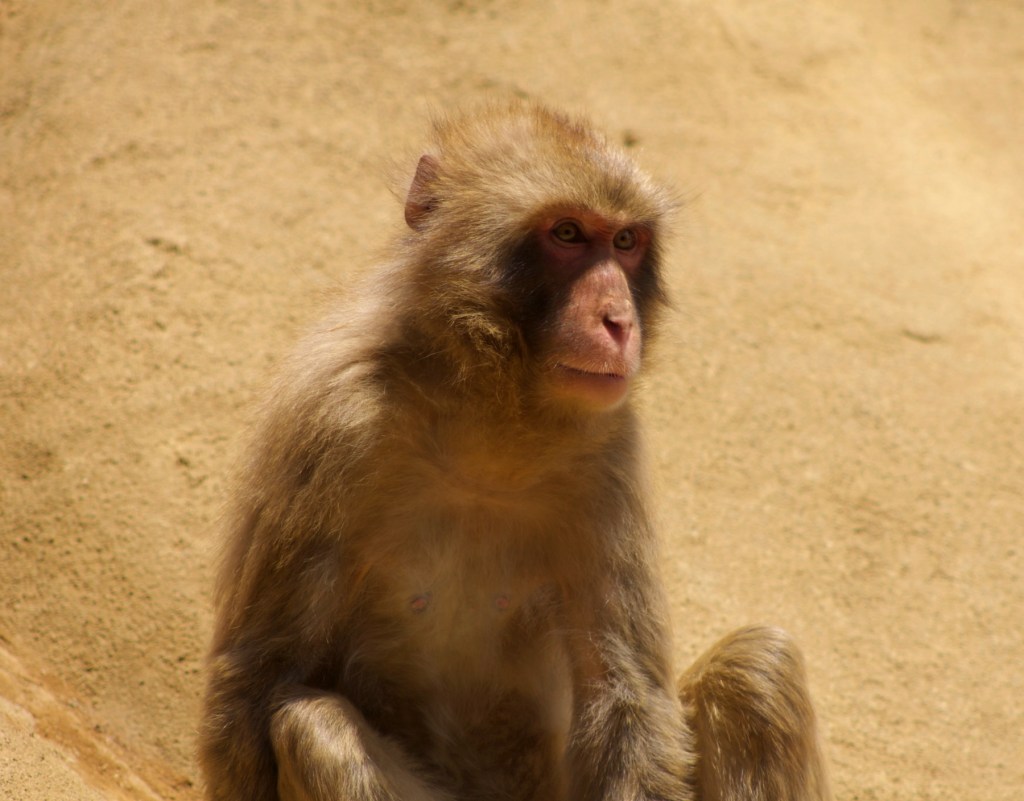
Harry Harlowe’s infamous experiments in the 1960s proved that the physical comfort of being held is crucial to the psychological development of all primates, humans included. If a baby is denied that, the consequences manifest as severe psychological issues later in life.A male member of the troop. It’s not clear if this guy was brought in from another captive troop elsewhere in the country, or if he’s native to the Mt. Takao troop. If it’s the latter, at his age — about four or five years old, give or take — he’ll be expected to soon depart. Young males leave their troops to avoid inbreeding and potential violence as they become stronger and are viewed as potential rivals to the alpha and/or his lieutenants.



 Pain In The Bud