Nekorepa’s homes and apartments are designed with cats in mind.
Proving once again that their country is home to some of the most enthusiastic cat-servants, Japan now has a real estate agency that lists only cat-friendly homes and apartments.
Actually, cat-friendly might be an understatement. Nekorepa Real Estate (neko is Japanese for cat) aims to hook people and their furry buddies up with homes built with cats in mind.
What does that mean? Bathrooms that have built-in cat doors, for example, so renters and homeowners can keep litter boxes there, and presumably put a permanent end to the never-ending feline freak-outs when cats are left out while their humans occupy the throne.
Others have custom-built alcoves in less-trafficked areas where litter boxes can be tucked, with ventilation fans built into the spaces. Almost all of them have an array of perches and comfortable cat-size window spots.
A home earns Nekorepa’s official seal of approval if it meets three criteria, Japan Today reports: “[A]bundant natural sunlight (to facilitate cozy cat naps), floors and walls with scratch-resistant surfaces (so your pet can run and play to its heart’s content), and a design that ensures your furry friend can’t slip out of the apartment and get lost while you’re away from home.”
Click on the images below for larger versions. These are some sweet cat digs:
Pretty much every Nekorepa home has built-in feline-friendly features, like easy-to-reach window perches, plus platforms, bridges and walkways for when cats feel like viewing their kingdoms from above.
It’s worth noting that there’s a legitimate need for a service like this in Japan. Space is at a premium, rental prices are sky high, and it’s not easy to find landlords who allow pets. That’s one reason cat cafes were born in Japan and continue to enjoy success — they cater to people who love cats but can’t have them in their homes.
If you’re living in Tokyo you’ll have the most options, but the company says it’s expanding throughout the country. As for the rest of us, let’s hope a few cat-loving real estate agents read this…
A kitten and his best friend, a puppy, are warming hearts with a video of them showing their love for each other.
Who says cats and dogs have to be enemies?
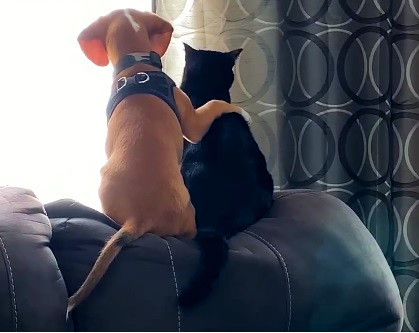
Bo, a 5-month-old Beagle puppy, drapes a paw around his best feline bud, 10-month-old Jasper, in this video showing that cats and dogs getting along is not a sign of the apocalypse, contrary to what Bill Murray said in Ghostbusters all those years ago.
Lisa Plummer of South Bend, Indiana is the pet mom to the adorable duo.
“Bo loves his cat siblings so much,” Plummer wrote, adding the little ones sometimes “drive me crazy with their constant chaos.”
“This sweet moment melted my heart,” she wrote, “and made me want to take back all the bad things I’ve said about them.”
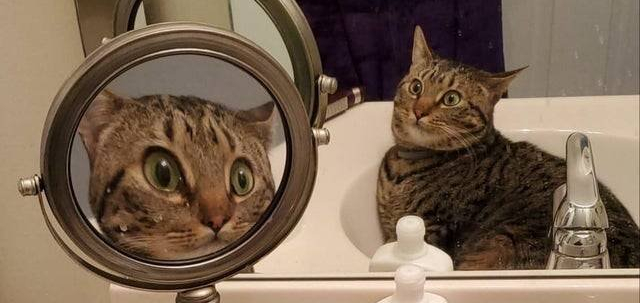
“I saw his reflection in the magnifying mirror and I started laughing hysterically,” Roscoe’s owner said.
Meet Roscoe.
The year-old tabby and his human are enjoying viral fame after the latter snapped this shot of Roscoe catching his reflection in two mirrors at the same time, prompting a hilarious look of shock:
Roscoe catches his reflection in two mirrors. Credit: Katie B.
Roscoe’s human, Katie B, explained how she got the shot.
“I was just going about my business when I looked down and saw his reflection in the magnifying mirror and I started laughing hysterically,” said the 24-year-old PhD student, who lives in Chicago. “It was hilarious, and thankfully I was holding my phone. So I quickly took a picture and sent it to my friends on Snapchat.”
Roscoe’s bewildered look has reignited the debate about feline self-awareness, a topic that still hasn’t been settled by science. It’s a subject we’ve explored here on Pain In The Bud, detailing Buddy’s “long and tumultuous history with mirrors” and his reactions to seeing himself — and me — reflected back at him.
Katie calls Roscoe “a funny little dude” and her “furry best friend.” She’s started an Instagram account for Roscoe where she documents the little guy’s antics for his followers.
“It’s been really fun seeing how much people love it and all the memes and drawings people have done of Roscoe,” Katie told Buzzfeed. “He has brought so much joy into my life, and I’m glad he’s bringing joy to others too!”
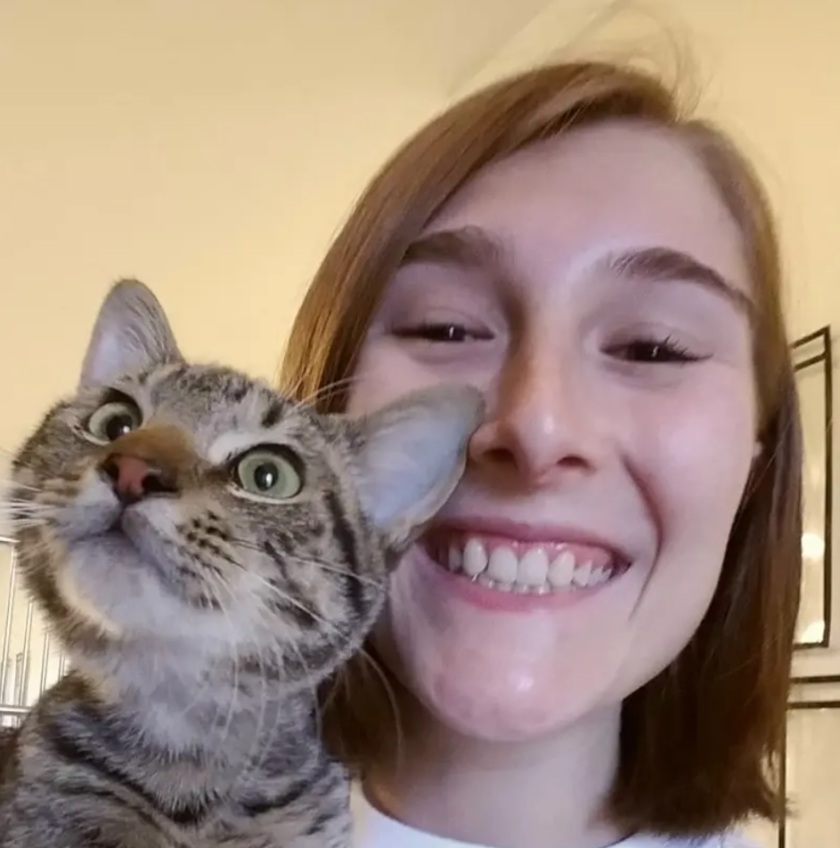
Roscoe and his human servant, Katie B. Credit: Katie BPhotos of Roscoe capture the little guy’s amusing personality. Credit: Katie B
Common misconceptions can impact the way owners bond with their kitties.
We’ve all heart the familiar knocks on our feline friends: They’re aloof, selfish animals who are indifferent to their humans as long as their bowls are filled with food and they’ve got a warm place to sleep for 16 hours a day.
NPR hosts took a look at those stereotypes in their new segment, Animal Slander, in which they take “common phrases and stereotypes about animals — blind as a bat, memory of a goldfish — and figure out how much truth there is to them, or if they’re really just slanderous to these animals.”
Emily Kwong and Maddie Sofia of Shortwave — NPR’s daily science podcast — host the series, taking a look at a different animal in each segment.
“We can at least set the record straight on some potential slander that cats endure,” Sofia said, “such as cat are aloof, especially compared to dogs, that they love food more than they love us, and the idea that cats love people who don’t love cats.”
The feline mind has been a mystery to scientists for a long time. Credit: Shutterstock
Kwong and Sofia spoke to Kristyn Vitale, an animal behaviorist from Oregon State University. If Vitale’s name looks familiar to you it’s because we’ve talked about her work before on Pain In The Bud. Along with researchers at Sophia University in Tokyo, Vitale’s team at OSU has been putting out most of the headline-making cat research in recent years.
They were responsible for the much-talked-about study showing cats relate to their owners the same way human children relate to their parents in uncertain situations. They were also the authors of a study that found cats prefer affection from humans more than food.
The former validated the feelings of many cat servants by confirming the similarities between the parent-child and caretaker-animal dynamics. In other words, we’re surrogate parents to our cats.
“It was very interesting to find just how closely those numbers match what we’ve seen in dogs and humans,” Vitale said. “The majority of both dogs and human children are securely attached, and that’s anywhere from about 60 to 65 percent of the population, which is exactly what we found with cats.”
It wasn’t so long ago that scientists had apparently given up on cats, concluding they’re too uncooperative to serve as research subjects.
“I can assure you it’s easier to work with fish than cats,” comparative psychologist Christian Agrillo told Slate in 2014. “It’s incredible.”
Cats “freaked out” when taken from their homes to a lab for studies, Agrillo said, and most weren’t interested in the test.
“Very often, they didn’t participate in the experiment or they walked in the wrong direction,” Agrillo said at the time. “It was really difficult to have a good trial each day.”
“Be cooperative? What’s in it for me?” Credit: Shutterstock
The teams at Oregon State and Tokyo’s Sophia University have worked around those issues by designing studies that focus on feline reactions rather than scenarios that required them to take certain actions. That method may not yield results in the sort of comparative psychology studies scientists like Agrillo design, but it’s given researchers a window into the feline mind.
Stereotypes about cats can dissuade scientists from studying them, Vitale said, which is why it’s important to debunk them.
The stereotypes “do bother me because some of these ideas are why the field of cat cognition has been stagnant for a long time,” she said. “A lot of these expectations shape the work that people want to do, and if we say cats are aloof and untrainable, well, then they can’t learn to how engage in cognitive testing. But in our lab we’re showing cats can be trained just as readily as dogs.”
Likewise, stereotypes can negatively impact the way owners treat their feline friends. That’s something we’ve talked about before: While dogs warm quickly to people, earning the love and trust of a cat takes effort. The better you treat a cat, the tighter your bond becomes.
“If people don’t think they can bond with their cat, or engage in a lot of these interactions, why even try?” Vitale asked. “And if we don’t try with our cats, that’s going to produce a very different individual than we see with dogs.”
As for the NPR hosts, they concluded cats have indeed been unfairly maligned.
“The next time someone says ‘I love this cat so much because it acts like a dog,'” Kwong said, “lovingly tell them ‘No, this cat acts like a cat.'”
“The failing Time magazine didn’t even put me on their top 10 cats list. If they did, maybe they would sell more copies! Sad!” Buddy tweeted after the story was published.
Others expressed their outrage at Time’s snub.
”Time magazine has proven itself irrelevant by failing to include the handsomest tabby in America, and quite possibly the world,” gossip meower Pawrez Hilton wrote. “Do they realize thousands of kittens have posters of Buddy on their walls? He’s absolutely dreamy.”
“No Buddy? Absurd!” Meower user @SexyCalico24 commented. “I mean, have you seen his muscles? RAWR!”
Time’s editors were forced to backtrack after a deluge of angry phone calls and emails, along with a hundreds-strong protest outside the magazine’s Manhattan headquarters.
“It was a grave oversight on our part to exclude Buddy from our list, and we apologize,” the magazine’s editors wrote in a statement. “We know it will take time to win back the trust of our readers, but we hope to make it up to them with a 24-page photo spread of Buddy in our April issue.”
Claws Woodward, a purrfessor of feline journalism at the Harvard School for Cat Studies, said the embarrassing oversight is a sign that Time magazine is out of touch with kittens and young cats.
“Buddy is an action hero, like Snacky Chan or Ahnold Schwarzenmeower,” Woodward said. “With his movie star good looks and his rippling muscles, he clearly should have been on that list. I mean, ‘Jealous Cat’? Real Housewives meme cat? Come on! You don’t put Z-listers ahead of one of the most treasured cats of our generation.”
Still, not everyone was convinced Buddy should have made the list. Pop singer Taylor Swift was among those who clapped back at Buddy for his vanity.
“Buddy who?” Swift tweeted, throwing shade at the Budster. “If any cats should be on that list, my kitties should occupy all ten spots. I’m going to write a song about how they were cheated. Let me finish!”





 Pain In The Bud