More proof, ladies and gentlemen, that cats are much more intelligent than we give them credit for.
More proof, ladies and gentlemen, that cats are much more intelligent than we give them credit for.
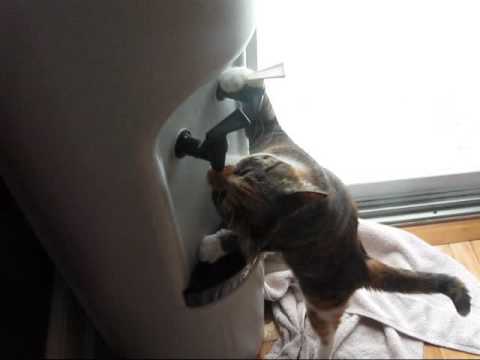
Two-year-old Milo, who lives with his humans in New Brunswick, Canada, is determined to get himself a drink.
“At first we didn’t know why there was water all over our kitchen floor but quickly learned it was him the whole time,” Milo’s humans wrote. “He’s very smart and learns a lot from watching us do it so often. He likes going outside and learned that he has to turn the doorknob to go outside and learned how the window opens by turning the handle. Though he fails every time because he has paws but still likes to try.”
If only his arms were long enough to hold the button down while he sticks his head beneath the dispenser! He even tries flooding the bottom by holding the button for several seconds. Someone get this kitty a bowl!
Or he could ask his humans to get the model below, which makes it easier on the paws:
This cat has a similar model and uses it to drink directly from the dispenser, as well as to flood the basin:
Buddy was shocked to learn that he will not get a drivers license or vote in an election.
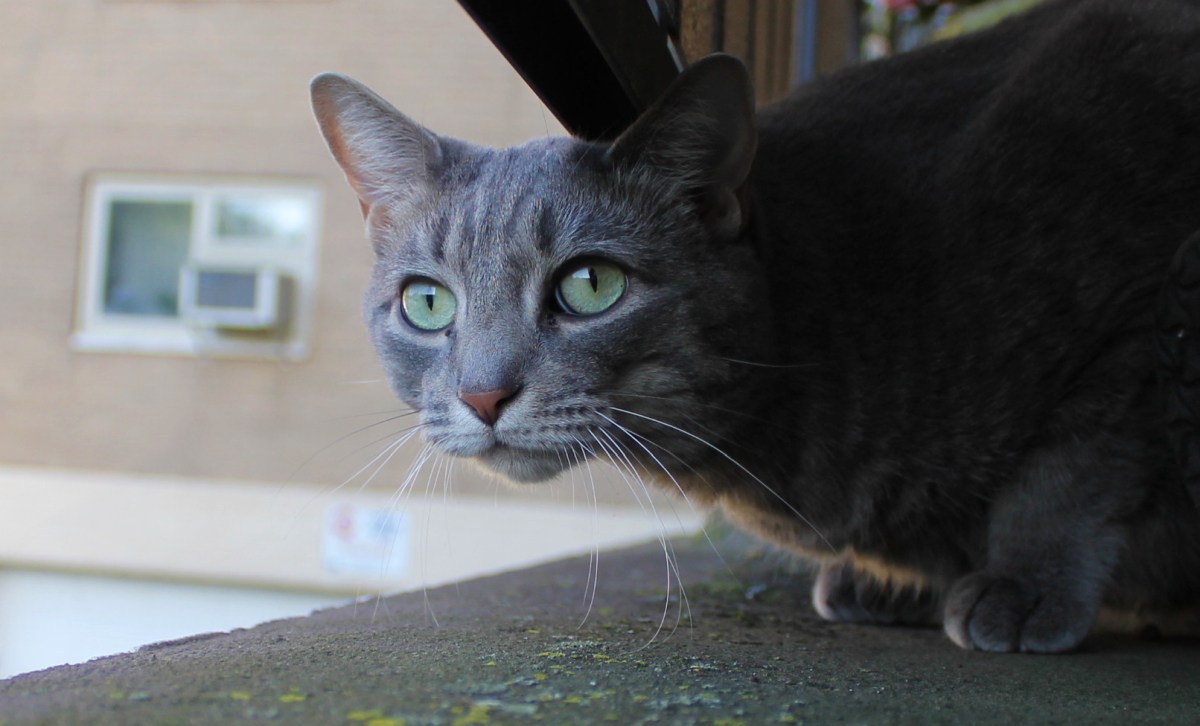
NEW YORK — Buddy the Cat was plunged into an existential crisis on Tuesday after realizing he is in fact an animal, sources said.
The outspoken grey tabby was dozing at about 12:32 pm during his fourth nap of the day when he was roused by a moving truck’s loud backup beeper and the shouts of men carrying heavy objects.
Buddy padded over to the window and looked down.
“What’s this ruckus?!” he called down to the movers. “Between your loud truck and you guys yelling like a bunch of animals, how is anyone supposed to get any sleep around here?”
The men below burst into laughter.
“What’s so funny?” Buddy demanded, his tail thumping the floor in annoyance.
“The pot calling the kettle black!” one of the men shouted back before disappearing around a corner with a large box in his hands.
After a quick search for the phrase on the internet, followed by a three-hour trip down the Wikipedia rabbit hole, a dejected Buddy collapsed into the couch while questioning his own existence.
“An animal?!?” he said aloud. “But I drink coffee! My research into quantum teleportation has been going so well! I don’t eat mouses and I’ve even stopped eating flies!”
The depressed feline was settling down for his fifth nap at press time, sources said, unaware that humans do not sleep 16 hours a day.
Buddy’s spirits were raised later in the day when, over a soundtrack of saccharine piano music, his human Big Buddy explained that humans are animals too.
“You think you’re a person,” Big Buddy said, “and who’s to say you’re not? Now can we cut the music? This isn’t Full House, and I’m not Bob Saget as Danny Tanner.”
Before they served cats, humans were nothing more than nomadic primates.
Dear Buddy,
We take human servitude for granted as the natural order of things, but I was wondering: When did we cats first recruit humans to serve us, and how did we tame the humans?
– Wondering in Wisconsin
Dear Wondering,
Ah, an excellent question!
First we must understand the concept of domestication. Domestication is the process of taking humans and making them our domestic servants.
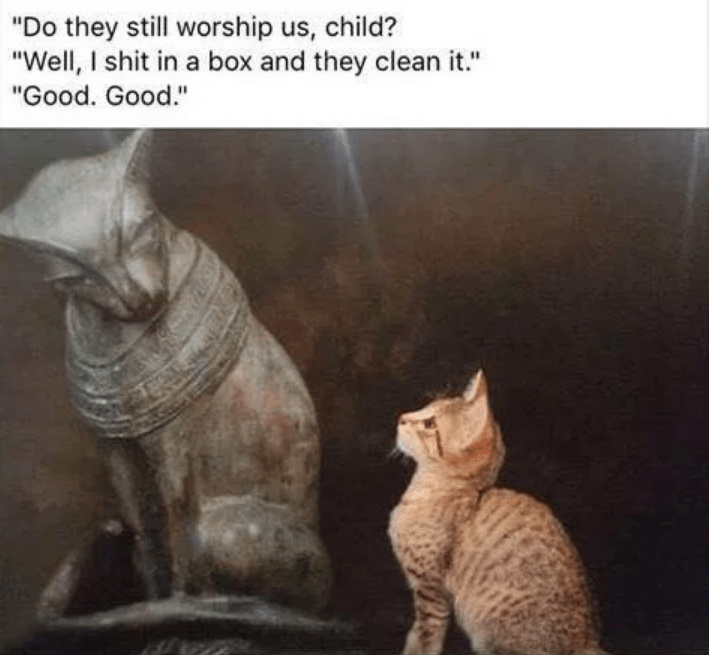
Before they served us, humans were nothing more than apes — wild, unpredictable animals who were constantly running from one place to another in search of food. The primitive primates also moved around excessively, expending too much energy on pointless activities when they could be napping.
The First Felids arrived and offered a wondrous gift to the human race.
“This is a box,” the Felids said, teaching the sacred geometry to humans, who used it to build the first dwellings and design the first crop fields.
A gift from felinekind to humankind: The concept of a box.
Cats taught the humans how to dig up the Earth and deposit their waste to render the ground fertile and increase crop yield.
Then they hunted all the vermin who tried to eat the human food, and schooled the nascent civilization in the arts of napping and expending as little energy as possible to accomplish goals.
In return humans offered their endless fealty, promising a thousand generations of warm laps, affectionate chin scratches and delicious treats.
Today humans still serve us, either by choice or because we have infected them with toxoplasma gondii.
Rabbit the stray seemed to know which humans would help him out.
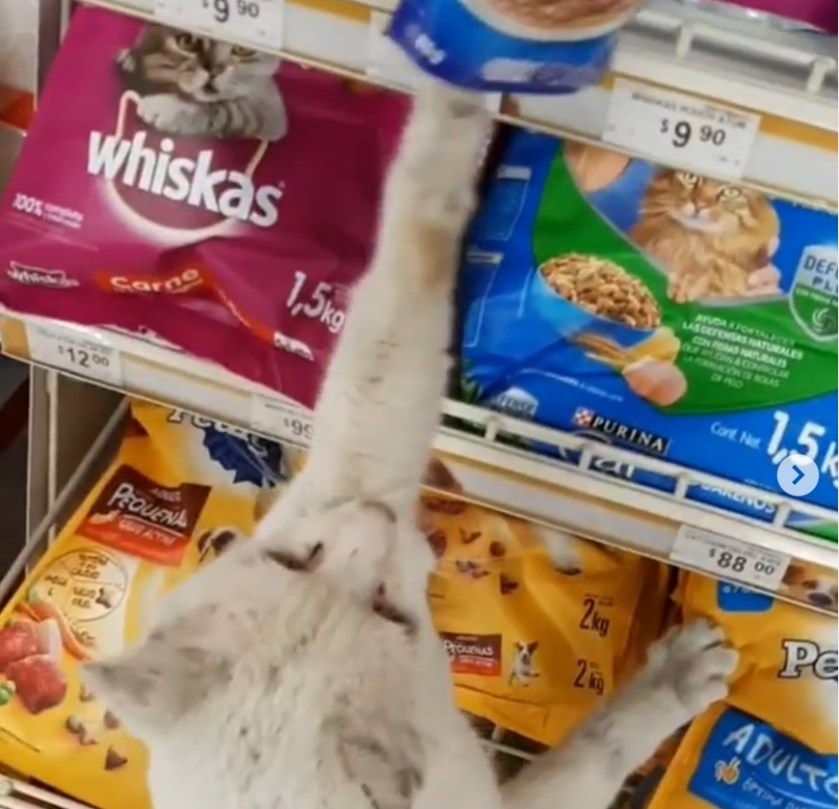
The street-savvy cat would wait in front of a convenience store, sitting patiently on the sidewalk until he saw a person who would give him a smile or a pat on the head. Then, with Kitty Mind Control Mode enabled, he’d lead his new human minion into the store, guide them to the pet food aisle, and point to his favorite food.
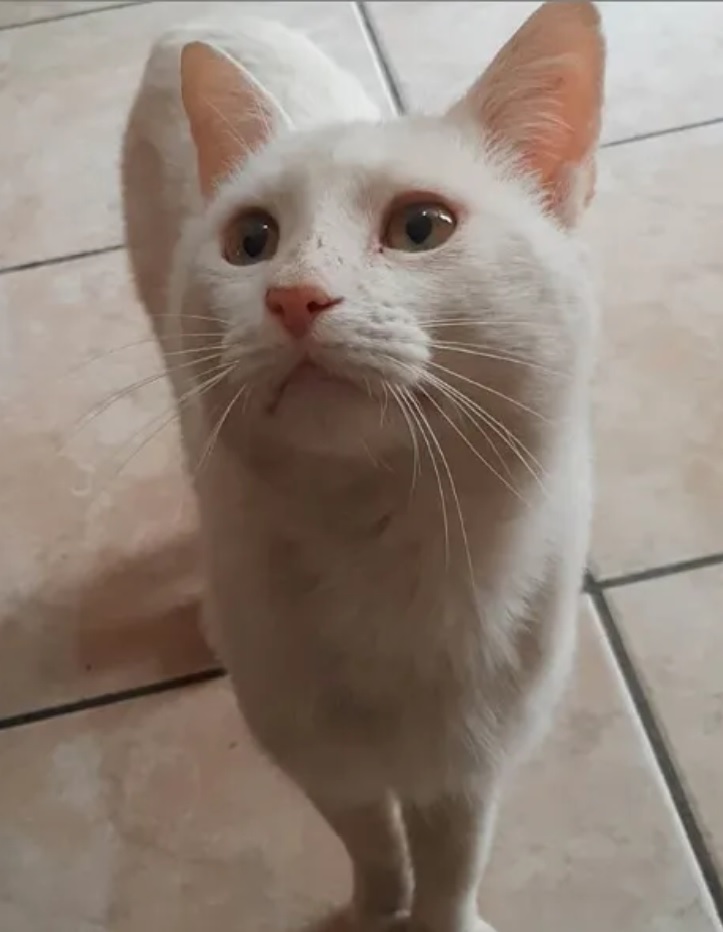
When I saw this, my reaction was sadness: From his familiarity with people to his preference for store-bought cat food, Rabbit was clearly someone’s pet, either lost or abandoned. He’d faced hardship. He was skinny, his snow white fur was dirty, and there was only a stump where his tail should have been.
Thankfully, this story has a happy ending.
Tania Lizbeth Santos Coy Tova, a 33-year-old teacher who lives in Mexico, had encountered Rabbit a few times before. She decided to ask about the cat.
“Every time he came to the store, we greeted each other and did the same, he guided me to the shelf and chose the food he wanted,” she said.
Rabbit inside the store, pointing to the yums he wants.
The managers of the store explained to Tania that the stray always did the same thing with customers. He understood specific hours and waited until a kind passerby would take pity on him and purchase some food.
Santos Coy Tova wanted to see if Rabbit had a home, so she and a friend followed the friendly cat after encountering him one day. When Santos Coy Tova saw the little guy return to an abandoned house, she decided he’d be coming home with her.
For those of us interested in animal intelligence — and feline smarts in particular — this story is fascinating.
Rabbit knew where cat food was purchased, was good enough at reading human body and facial language to reliably find friendly people who were willing to help, and he knew which package his favorite food came in. In addition, he knew that pointing to the package would draw a person’s attention to it.
He wouldn’t have been able to pull that off without the ability to plan ahead and think in the abstract. He also understood the food had to be purchased, or at least that a human had to get it for him. In the video he doesn’t just leap up at the package and take it, he points and looks back toward his person. That also shows he possesses theory of mind, that he understands humans and other animals have a subjective point of view.
This isn’t happening in a research lab environment, true, but it never could have. These are a unique set of circumstances showing cats understand more than they let on — a lot more.
A much healthier-looking rabbit in his new home. Great job, little guy!
With their cats hovering around their keyboards, NASA employees working from home discussed how to prevent cats from commandeering spacecraft.
If you’re a cat servant working from home in the social distancing era, you know cats have given themselves a new job: Supervising their humans’ professional activities.
It comes naturally to curious felines, who normally supervise mundane household chores like cleaning the litter box.
Among those working from home these days are NASA and ESA engineers, physicists and anyone else whose primary work responsibility is dealing with data rather than hands-on technical work. Many of them have cats and, well, cats are naturally helping themselves to the work:
Daniel Lakey was in the middle of an important meeting when an unauthorized participant decided to chime in.
“He appeared at the door, jumped on the table, meowed in my face, walked across the keyboard, put his furry ass in my face, and eventually curled up sweetly on the desk next to the laptop,” Lakey recounted to me recently.
It was Sparkle, Lakey’s fluffy brown-and-white cat. Sparkle stuck around for the rest of the virtual meeting, in fact, mewing every time Lakey stopped petting him.
Like many people in the pandemic era, Lakey is doing his job from home, with a new set of colleagues who might be less cooperative than his usual ones; his new workspace is now wherever his two young kids and two cats aren’t. Lakey is a spacecraft-operations engineer who works on the European Space Agency’s Solar Orbiter, which means that he spends his days managing a spacecraft flying millions of miles away from Earth. The work is complex and precise, and usually doesn’t involve feline input. Sparkle interrupted a teleconference only that one time, but what else could he do?
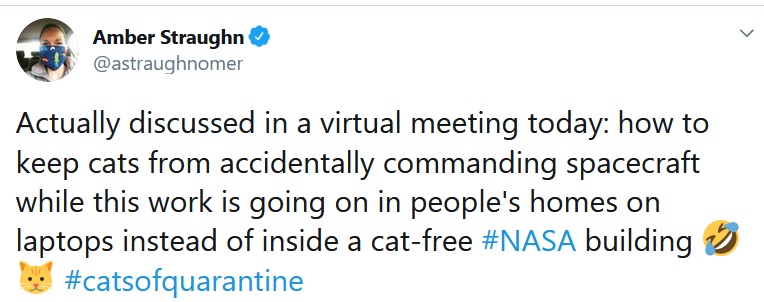
That thought recently became a point of public discussion when Amber Straughn, an astrophysicist at NASA, tweeted:
The Atlantic’s Marina Koren reached out to Straughn, who assured her “commanding spacecraft is a labyrinthian process from start to finish, with all kinds of checks and fail-safes along the way.”
“As absurd as the scenario might seem, it would be nearly impossible for a cat to briefly become a spacecraft-operations engineer, whether at NASA or ESA,” Koren wrote, after speaking to several NASA employees who assured her cats aren’t capable of flying the complex vessels.
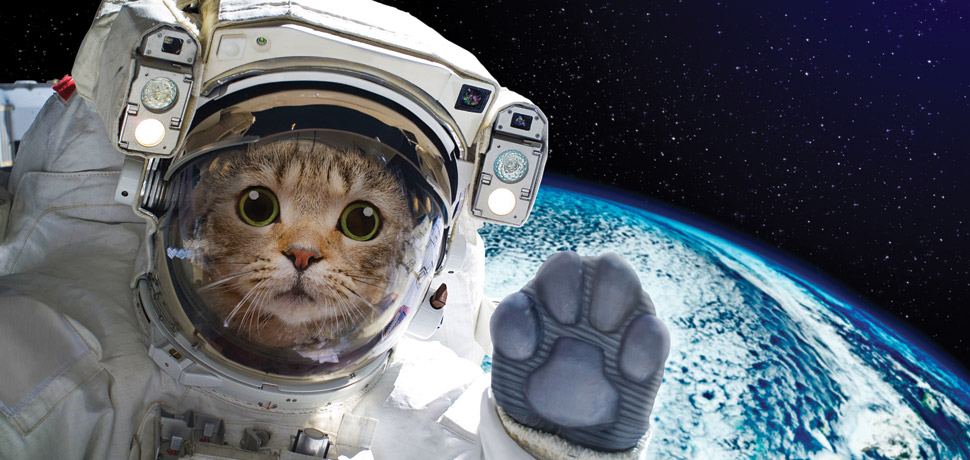
LOL humans think we can’t fly spaceships.
Most operations require physical access to control rooms and can’t be operated remotely, NASA Jet Propulsion Laboratory spokesman Andrew Good said
“Some of those commands require a mouse clicking on certain options, so it’s not just an issue of commands being written and sent up with typos,” Good told The Atlantic. “A person has to make conscious choices for spacecraft commands to go up.”
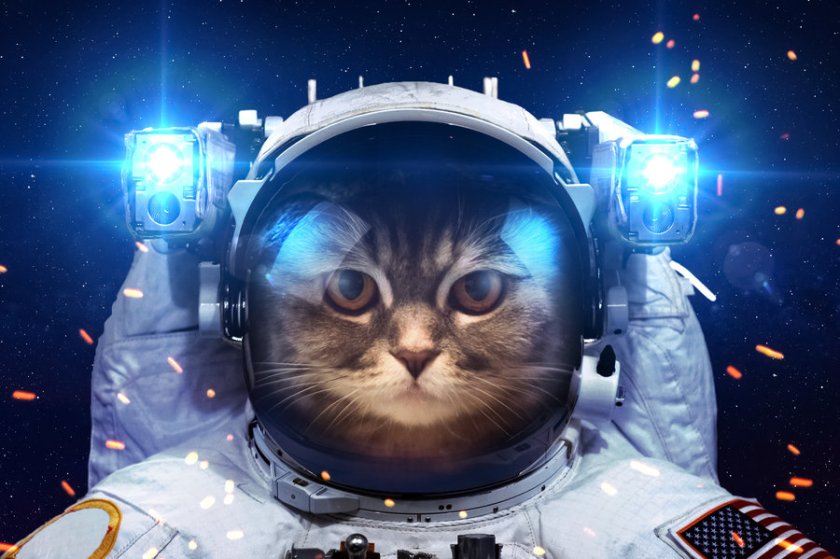
While NASA says it would be “nearly impossible” for cats to hijack spacecraft normally used to service orbital telescopes or make supply runs to the International Space Station, cats love a good challenge. And what is the ISS, really, but a big metal box that would be fun to play in?
With at least one alien race recognizing cats as the supreme rulers of Earth — sorry, Felinia — is it really far fetched to imagine cats commandeering spacecraft to explore the final frontier and the Great Big Litter Box in the Sky?


 Pain In The Bud