Town officials say the step is necessary to protect a ground-nesting songbird native to western Europe.
Elected leaders in Walldorf, Germany, are worried about the crested lark — so much so that they’ve decreed cats must be kept inside, with prohibitively painful fines for anyone whose cat harms one of the birds.
According to the decree, anyone who allows their cat(s) to roam outside from now until August will be fined €500, which is about $527. But if a cat kills or injures one of the European songbirds, Walldorf’s local government will fine the cat’s caretaker up to €50,000, almost $53,000 in USD.
That’s an eye-watering amount of money, especially in light of the fact that the crested lark is listed as a species of “least concern” by the International Union for Conservation of Nature. Experts say humans, not cats, are the biggest threat to the bird.
Officials in Walldorf — a town of about 15,000 people more than 600 kilometers southwest of Berlin — cited the same thoroughly-debunked studies that claim cats kill some 25 billion birds and small mammals annually in the US alone. They say they’re worried because the crested lark nests on the ground, making the birds, their eggs and their chicks particularly vulnerable to predators like domestic cats.
If you’re skeptical that local government officials — a mayor and town councilmen, essentially — are qualified to legislate on matters of conservation, you’re not alone. The decree has been met with pushback from animal rights advocates and feline fans.
“Suddenly preventing cats that are used to going outside from doing so, means immense restrictions and stress for the animals,” German animal welfare group Deutscher Tierschutzbund wrote in a statement. “The negative influence of cats on the population of songbirds is in any case controversial and, to our knowledge, has not yet been proven for the crested lark in Walldorf.”
And that cuts to the heart of the matter, doesn’t it? Like politicians in Australia and parts of the US, Walldorf’s elected leaders aren’t making decisions based on studies or reliable information. They’re taking action based on emotion and deeply flawed meta-analyses that aren’t even applicable to Europe.
We’ve always taken the position here at PITB that cats are much better off indoors. They’re domesticated animals, meaning if they have a “natural habitat” it’s human living rooms. They live much longer, healthier lives indoors and can be happy and fulfilled with a little effort on the part of their humans.
But we also believe decisions impacting living creatures should be based on real information gathered by people who don’t have an agenda. The landmark Washington, D.C. Cat Count is a great example, with birders, conservationists and cat lovers working together to complete an accurate census of domestic felines within city limits.
Now that they’ve established how many cats live in D.C. (about 200,000) and how many are truly feral without anyone caring for them (about 3,000), they can enact sensible solutions that are much more likely to successfully protect wildlife and cats without hysteria, agendas or inhuman proposals like enacting “cat hunting season” (as one US politician proposed), killing millions of cats with poisoned sausages (as Australia has done), or outright gunning cats down, as a rogue conservationist in California’s Bay Area did last year.
Cats are thinking, feeling animals. They deserve better than becoming the victims of human policies based on ignorance.
Armed with real data, there’s a chance to stop horrific policies designed to kill millions of cats who are blamed for driving small wildlife species to extinction.
For the past two decades, a handful of birders and “conservationists” have claimed cats kill as many as 3.7 billion birds and 22.3 billion small animals every year in the US alone.
“They’ve got to taste good,” an Australian scientist who helped develop the sausage formula said. “They are the cat’s last meal.”
Now who’s the serial killer?
Sadly, few people have thought to question the studies that claim jaw-dropping numbers of birds and small mammals are slaughtered by cats every year.
How did the studies arrive at those numbers? Their formula hasn’t varied much from “study” to “study,” and more or less looks like this:
Assemble your data from old studies that have nothing to do with cats preying on wildlife, or hand out questionnaires to a handful of cat owners and ask them how many animals they think their free-roaming cats might kill.
Since you don’t know how many stray, feral and free-roaming cats exist in the US, invent an arbitrary number. Most of these “studies” put the number of cats anywhere between 25 and 125 million, but higher numbers are better because they make for more apocalyptic predictions and generate more credulous headlines.
Completely ignore the primary factors driving avian extinction in the world, which are human-caused: Habitat destruction, habitat defragmentation, wind turbines, pesticides, cars, high tension wires and windows, which are by far the biggest bird-killers.
Attribute all of the above to feral, stray and free-roaming cats.
Take your original “data” and, without making any adjustments for climate, regional variation, migration patterns, other predatory impacts — or anything else, really — simply extrapolate the total number of bird deaths by multiplying your small dataset by the total number of free-roaming cats in the US, which you invented back in Step 2.
Package the entire thing as a rigorous study by Serious Conservationists, write some apocalyptic press releases and hype up your claims in your abstracts, because you know the vast majority of web aggregators and overworked reporters will not have the time to take a deep dive into the text of your study.
Encourage activist groups and lawmakers to push for the mass culling of cats, based on your studies.
Please, don’t take my word for it. Read the text of any of the widely-cited studies that have been reported as gospel in the last 20 years. You’ll be astonished at what passes for rigorous scientific work, and how policies that determine the fates of millions of cats are largely shaped by these studies.
The D.C. Cat Count and the importance of a baseline
But there’s hope: A coalition of groups in Washington, D.C., spent more than three years methodically taking a “census” of that city’s cat population using a variety of methods.
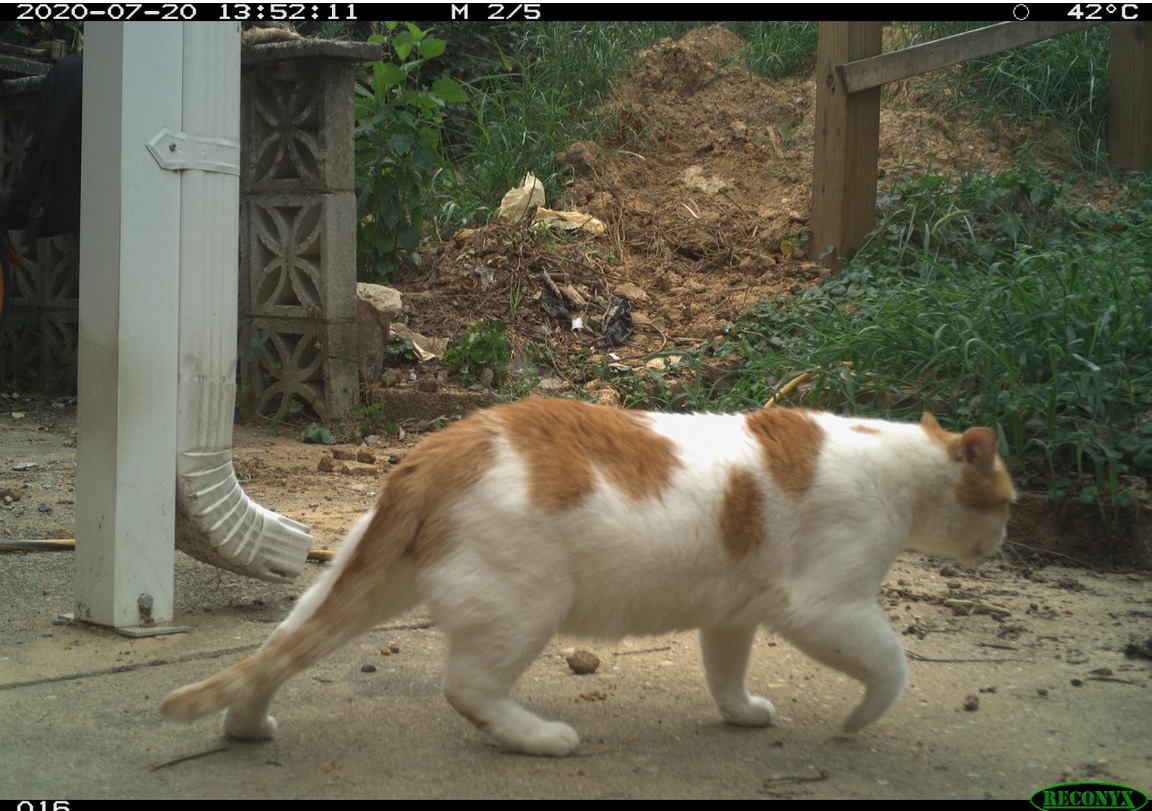
They surveyed thousands of households within the city limits to find out how many cat owners allow their pets to roam free. They set up 1,530 trail cameras in wooded areas, ditches, alleys, alongside streams. The cameras are motion-activated and they produced more than five million images — including more than 1.2 million images of cats and more than four million images of local wildlife. The cameras captured photos of squirrels, coyotes, raccoons, possums, deer and even wild turkeys.
They assembled teams of dozens of volunteers to personally survey areas where cats are known to congregate. Then, when all the data was collected, they spent months sorting the results, carefully keeping tally, sorting duplicate sightings of individual cats and confirming data when necessary.
Credit: Pixabay/Pexels
When all was said and done, after three years, $1.5 million and countless man-hours, the study determined there are some 200,000 cats living in Washington, D.C., and only about 3,000 of them are truly feral, meaning they’re not pets and not part of managed cat colonies.
The team — which brought together conservationists, bird lovers, cat lovers, shelter volunteers and others who would normally oppose each other on cat-related policies — also documented every step to provide a toolkit for other cities and local governments to conduct their own methodical head counts. They don’t have to reinvent the wheel to take D.C.’s admirable lead.
The leaders of the D.C. Cat Count went to all that trouble because they understood that without knowing exactly how many cats they’re dealing with, where they congregate and how they behave, any policies attempting to deal with their potential impact would be flawed and could end up doing more harm than good.
Making informed decisions about managing outdoor cats
Anyone who continues to cite the old, sloppy studies should be reminded, loudly and often, that they have led to years of failed policies, heartbreaking outcomes, enmity between cat lovers and birders, and widespread misunderstanding of how cats behave and the impact they have on wildlife.
Now the next phase begins: Dispensing with the hysteria and finding real, useful ways to minimize the predatory impact of cats on local wildlife populations.
One of the first follow-up studies to bear fruit comes, not coincidentally, from a research team in nearby Fairfax County, Virginia, and yields some surprising revelations about free-roaming cat behavior and impact.
The biggest takeaway: Because free-roaming cats almost always stick to small areas (spanning only 550 feet, or 170 meters), “cats were unlikely to prey on native wildlife, such as songbirds or small mammals, when they were farther than roughly 1,500 feet (500 meters) from a forested area, such as a park or wooded backyard. We also found that when cats were approximately 800 feet (250 meters) or farther from forest edges, they were more likely to prey on rats than on native wildlife.”
That’s it. In other words, small buffer zones are “the difference between a diet that consists exclusively of native species and one without any native prey,” the study’s authors wrote.
“Our findings suggest that focusing efforts on managing cat populations near forested areas may be a more effective conservation strategy than attempting to manage an entire city’s outdoor cat population,” wrote Daniel Herrera and Travis Gallo of George Mason University.
Credit: Phan Vu00f5 Minh Ku1ef3/Pexels
In other words, minimizing the predatory impact of cats is likely a hyper-local affair, and not something that can be effectively managed on a one-size-fits-all city-wide or county-wide basis.
This is just a first step in the right direction, and follow-up studies will yield further insights that will hopefully lead to fine-tuning strategies in managing free-roaming cats.
We still feel keeping cats indoors — for their own safety, as well as the safety of other animals — is the right thing to do, and all the evidence supports that view.
But what these efforts have shown us is that there is a way forward, and it’s not the contentious, divisive and irresponsible work that has guided cat management policy for two decades. It’s not just possible, but necessary, for all sides to work together to find solutions.
Let’s hope more people realize that, and the old “studies” are relegated to the dustbin where they belong.
For the first time ever, a US city has conducted a true cat census using scientifically proven methods, including doing it the hard way — by counting. The project’s authors hope other cities follow their lead.
The last decade has seen something of a renaissance in cat-related research, with insightful studies about feline behavior coming from researchers in the US and Japan.
On the other hand there’s been a glut of research into feline predatory impact and public policy, and the majority of those studies have been deeply flawed. They’re based on suspect data and tainted by the interests of people who are more interested in blaming cats for killing birds than they are in learning about the real impact of domestic felines on local wildlife.
Those studies have all taken extreme shortcuts — using data that was collected for entirely different studies, for example, or handing out questionnaires that at best lead to highly subjective and speculative “data” on how cats affect the environment.
Several widely-cited studies that put the blame on cats for the extirpation of bird species have relied on wild guesses about the cat population in the US, estimating there are between 20 million and 120 million free-roaming domestic cats in the country. If you’re wondering how scientists can offer meaningful conclusions about the impact of cats when even they admit they could be off by 100 million, you’re not alone.
No one had ever actually counted the number of cats in a location, much less come close to a real figure — until now.
When leaders in Washington, D.C., set out to tackle the feral cat problem in their city, they knew they couldn’t effectively deal with the problem unless they knew its scope. They turned to the University of Maryland for help, which led to the D.C. Cat Count, a three-year undertaking to get an accurate census with the help of interested groups like the Humane Society and the Smithsonian.
An image from one of 1,530 motion-activated cameras deployed for the D.C. Cat Count. Credit: D.C. Cat Count
The researchers approached each of their local shelters and rescues for data, then assembled a meticulous household survey to get a handle on how many pet cats live in the city, and how many have access to the outdoors.
Finally — and most critically — they used 1,530 motion-activated cameras, which took a combined 6 million photos in parks, alleys, public spaces, streets and outdoor areas of private residences. They also developed methods for filtering out multiple images of individual cats, as well as other wildlife. And to supplement the data, team members patrolled 337 miles of paths and roads in a “transect count” to verify camera-derived data and collect additional information, like changes in the way local cats move through neighborhoods.
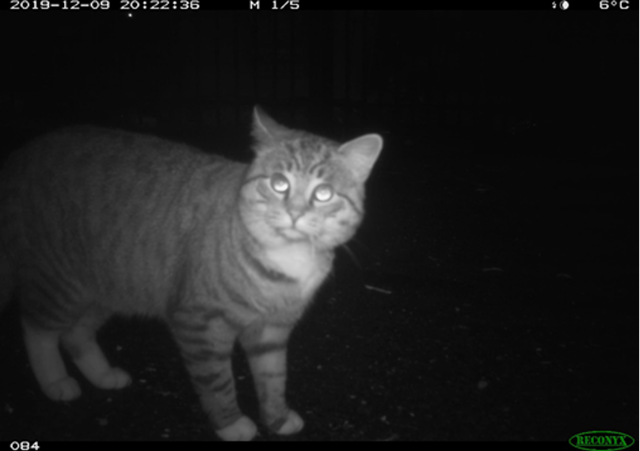
A cat who looks a lot like the Budster was captured in this 2019 photo from a motion-activated camera with night vision. Credit: DC Cat Count
Now that all the data’s been collected and analyzed, the D.C. Cat Count finally has a figure: There are about 200,000 cats in the city, according to the study.
Of those, 98.5 percent — or some 197,000 kitties — are either pets or are under some form of human care and protection, whether they’re just fed by people or they’re given food, outdoor shelter and TNR.
“Some people may look at our estimate and say, oh, well, you know, you’re not 100% certain that it’s exactly 200,000 cats,” Tyler Flockhart, a population ecologist who worked on the count, told DCist. “But what we can say is that we are very confident that the number of cats is about 200,000 in Washington, D.C.”
The study represents the most complete and accurate census of the local cat population in any US city to date, and the team behind it is sharing its methods so other cities can conduct their own accurate counts. (They’ll also need money: While the D.C. Cat Count relied on help from volunteers and local non-profits it was still a huge project involving a large team of pros, and it cost the city $1.5 million.)
By doing things the hard way — and the right way — D.C. is also the first American city to make truly informed choices on how to manage its feline population. No matter what happens from here, one thing’s certain — the city’s leaders will be guided by accurate data and not creating policy based on ignorance and hysteria painting cats as furry little boogeymen.
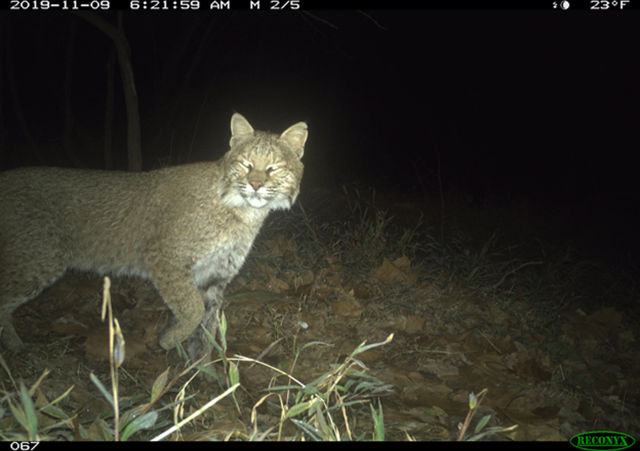
Not all the photos captured images of cats, and not all the felines were little: In this 2019 night image, a bobcat wanders in front of a trail camera. Credit: DC Cat Count
On Brazil’s ‘Island of the Cats,’ hundreds of former pets and ferals face starvation.
In 2012, veterinarian Amélia Oliveira started a program to trap and neuter hundreds of cats who had been abandoned at Ilha Furtada, an island about 20 miles west of Rio de Janeiro.
Known as Ilha dos Gatos — island of the cats — the island was teeming with starving former pets and their feral offspring. Ilha Furtada has no natural source of drinking water, Oliveira said, and cats without hunting skills would quickly starve.
Ilha Furtada became a curiosity for boaters and fishermen, and a sore spot for cat advocates trying to stop people from dumping animals there.
With the help of others, Oliveira began a program to end the misery on what’s been called “Cat Alcatraz”: The group managed to neuter more than 380 cats. Former pets were adopted out to new homes, but the ferals would need to remain on the island, so volunteers began feeding them and bringing fresh water on a regular schedule.
With the cooperation of local authorities, the group put up signage around the island and the coast warning that abandoning pets is illegal and asking people not to interfere with the island cats. There were plans for an official survey to quantify the feline population, an initiative to use cameras to dissuade people from dumping their pets on the island…
…and then came the Coronavirus pandemic.
Whatever gains Oliveira and company made over eight years have now been erased as Brazil — one of the countries hardest hit by the virus — has suffered more than 450,000 deaths officially (and likely much more uncounted) and an economy wrecked by waves of infection and lockdown.
A “feline shantytown” on Ilha Furtada.
Many owners could no longer afford to feed themselves or their cats while others died, leaving their cats at the mercy of relatives and landlords. Once again, people began abandoning their pets on Ilha Furtada.
“If you don’t take them, they’re going out to Island of the Cats,” people would tell shelter operators, a veterinarian told the Washington Post’s Terrence McKoy.
While the feline population of Furtada Island increased, resources dwindled as lockdowns prevented volunteers from delivering food and water as often as they had in the past.
Now the island has “the appearance of a feline shantytown,” dotted with dilapidated and hastily-constructed shelters for its resident felines.
I recommend reading the entire story, one of just a few highlighting the toll the pandemic has taken on pets.
Volunteers from Animal Heart Protectors fill a dispenser with food for cats on Furtada Island, popularly known as “Island of the Cats,” in Mangaratiba, Brazil, Credit: AP/Silvia Izquierdo)
A photo shows why mountain lions are so elusive. Can you find the hidden puma?
This is the real deal, friends. Not a cheesy low-res photo or an intentionally obtuse shot with three pixels of a tail visible.
There’s a cat in this photo — a puma to be exact — and finding it is a good reminder of how awesome these elusive felids are, as well as how well they hide themselves from humans and fellow wildlife alike:
Credit: John Tull, US Fish and Wildlife Service
The photo comes courtesy of the US Fish and Wildlife Services and eagle-eyed photographer John Tull, who spotted the well-hidden cat in rural Washoe County, Nevada.
Mountain lions are the second-largest cats in the Americas behind jaguars, and although they look like lionesses, they pose little danger to humans. About 15 people have died in conflicts with mountain lions over the past 100 years. Dogs, by contrast, kill between 30 and 50 people a year.
Mountain lions are also known as pumas, cougars, catamounts and panthers, among other names. The word “panther” is a nonspecific word for large cats and is often used in association with jaguars and leopards.
Known scientifically as puma concolor, these mysterious cats are more closely related to small cats (felis) than big cats (panthera), and have the distinction of being the largest cats who can meow.