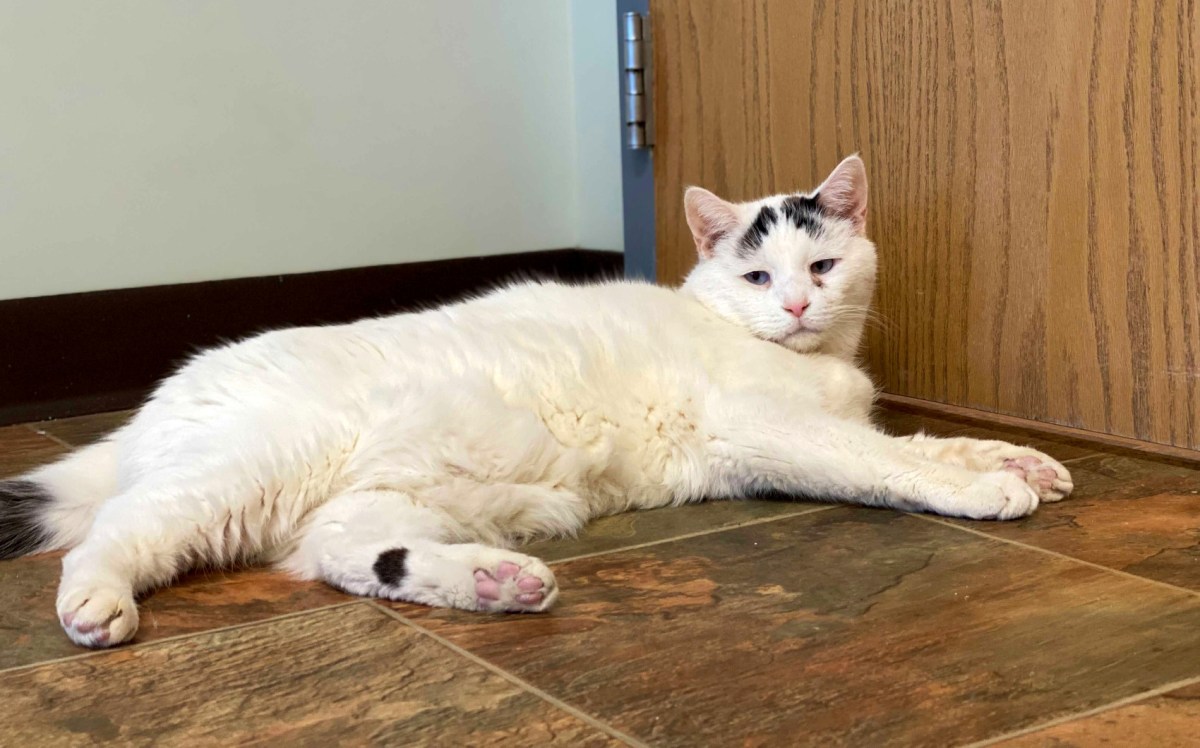
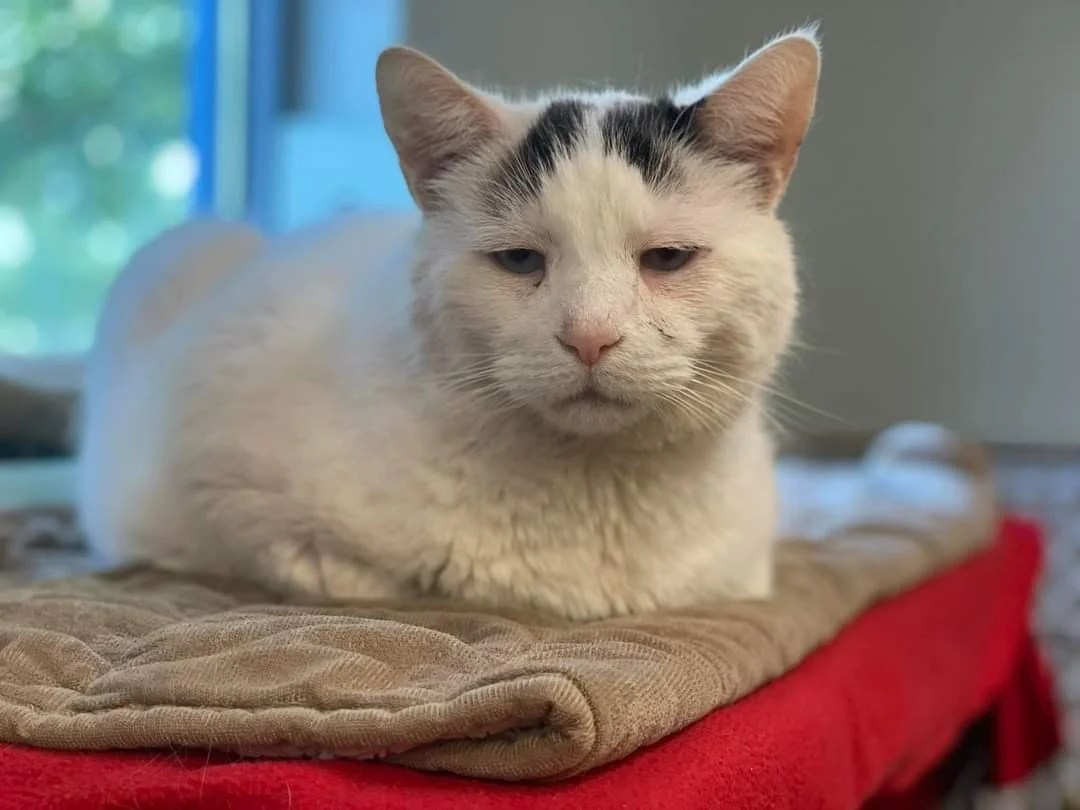
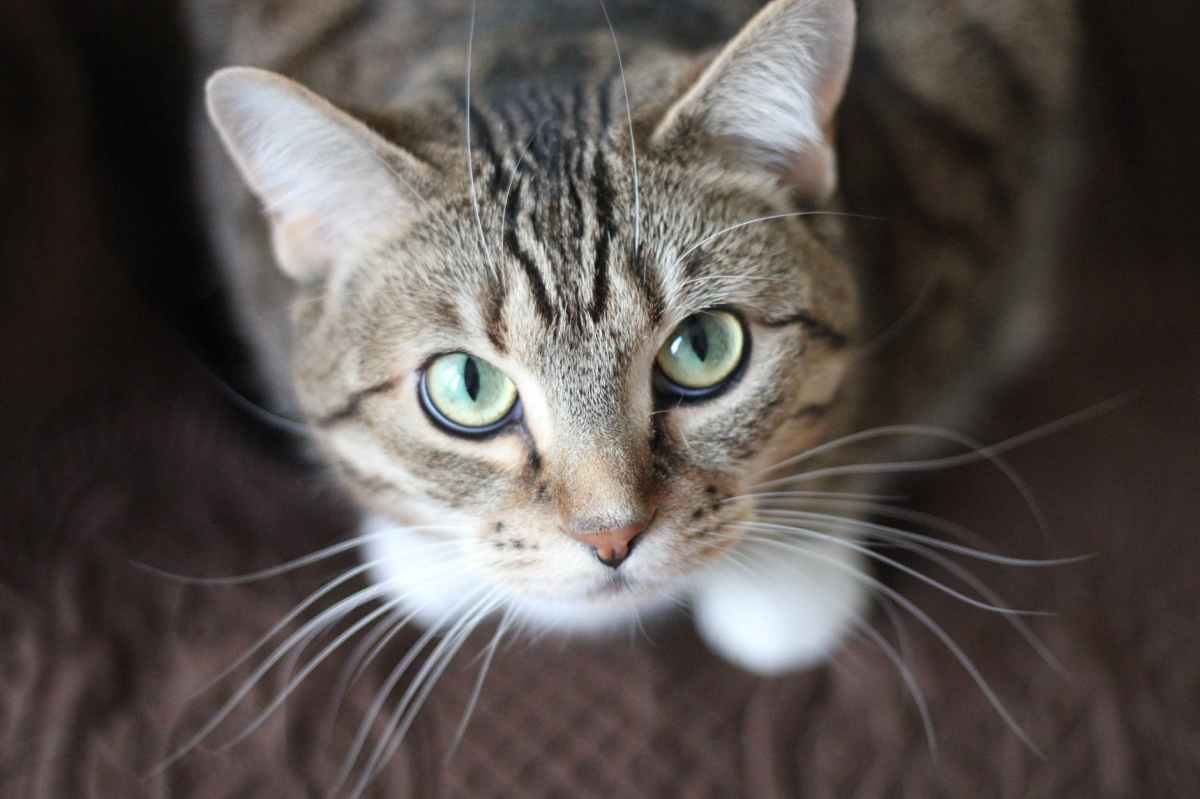
Frankie was surrendered at 13 years old and hasn’t had the easiest time adjusting to shelter life.
Even though I am the honored servant to the king, His Grace Buddy I, I am not immune to adoptable cats who tug at the heartstrings.
Frankie Sad Eyes is one of those cats. Just look at those eyes!
The little guy is 13 years old, and at an age when he should be enjoying a quiet, nap- and treat-filled life as the senior statesman among cats, he’s been surrendered by his people and has landed in a shelter.
Thankfully that shelter is Tabby’s Place, a no-kill, no-cage sanctuary in New Jersey that has a reputation for doing right by its cats. Still, any feline would be shocked by the experience of losing his or her family and ending up in a strange place with unfamiliar people and cats.
Frankie looks sad, and undoubtedly he’s finding it difficult adjusting to life in a sanctuary, but staff at Tabby’s Place say he’s a “joyful” cat with a zest for life.
Alas, I can’t adopt Frankie. Like the King himself, he’s not particularly keen on sharing his throne, so there can be no future where Buddy and Frankie are, well, buddies.
But Frankie, who is described as “a zesty, exuberant sweetheart” who still has kitten-like energy, is looking for a home where he can establish his new and forever kingdom, with a human or humans who will dote on him and see to his every need.
Visit Tabby’s Place to view their adoptable cats, make a donation or just brighten your day.
Buddy, the cat who survived an attack by two dogs, continues to recover in a foster home, where he lives with the emergency vet who cared for him after the attack.
Two Philadelphia minors will head to trial in May after they sicced their dogs on a cat sitting on a porch a month ago.
The juveniles, who are 17 and 12 years old, were walking their dogs in Philadelphia on March 22 when they set them loose on Buddy, a black cat who was cared for by a local family but spent most of his time outside. They shouted encouragement as their dogs mauled Buddy on his family’s porch and Buddy would have been killed if the commotion hadn’t drawn attention from inside.
When one of Buddy’s caretakers stepped outside and tried to stop the dogs, the teens pulled their canines back and fled. They turned themselves in to authorities a few days later after the story went viral and they realized the attack was captured by a doorbell camera system.
They each face felony and misdemeanor charges for animal cruelty, inflicting harm on an animal and other alleged offenses. Since they’re charged as minors the court system is not releasing their names, which is common practice in juvenile cases in most states.
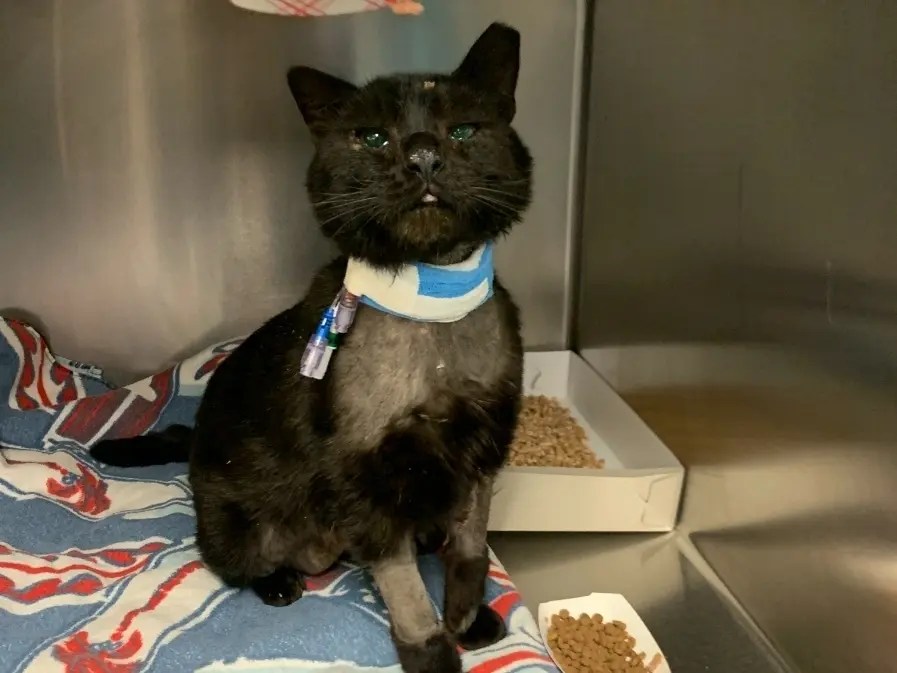
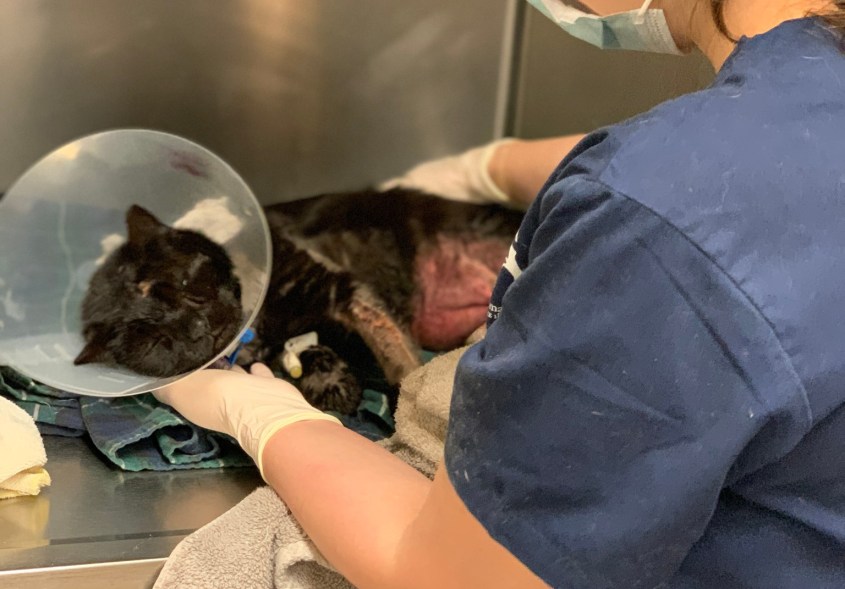
Buddy was so badly injured that veterinarians weren’t sure if he’d make it at first. With a lot of care and love, the little guy pulled through the first few critical days and continued to recover until he was well enough to go to a foster home in early April.
His new caretaker is Katie Venanzi, a veterinarian who specializes in emergency care and operated on him that first day when he was brought in to Blue Pearl Vet Hospital by the Pennsylvania SPCA.
“He was kept secluded in one room initially, but now he has a run of the house and he is doing so well with his foster sibling cat Teddy. His foster parents affectionately say they are the two most awkward cats in Philadelphia, but their relationship is blossoming and we hope it continues that way so that Buddy can officially stay in that home forever,” the SPCA’s Gillian Kocher said. “Hopefully in the coming weeks, we will have some additional details and will let everybody know when we can make an official announcement about Buddy’s adoption, but for now he’s doing wonderfully.”
The reason Buddy was outside in the first place is that, as a stray, he resisted an indoor life when his original family tried to keep him inside.
Venanzi told a local radio station that her and her husband are trying to help Buddy adjust to an indoor life and hope they can adopt him.
“We want to do whatever he needs,” she said. “We understand that he used to live outside. If he is not comfortable living in our house, we are willing to work with other people who are going to give him an opportunity to be in a safe environment but still exposed to the outdoors. We are going to take it day by day and see how he does, but we are really hoping to keep him.”
When Buddy’s story went viral, people around the world responded by making donations to the Pennsylvania SPCA and buying t-shirts with Buddy’s likeness on them, allowing the group to raise thousands. Meanwhile, in a post to social media, the Pennsylvania SPCA noted it had taken in 158 abused animals since Buddy was attacked: “That’s more than five Buddys a day.”
Some of those dogs and cats were shot or stabbed, while others were neglected or starved, Kocher said. Leftover money from Buddy’s surgeries and treatment will be used to help the other abused animals in the SPCA’s care.
A non-profit helps terminally ill and elderly clients find future homes for their beloved cats so they don’t end up in shelters.
Buddy has a dirty little secret: He’s a biter and scratcher.
The little guy has improved dramatically over the past few years and it’s something we actively work on, but he occasionally has his moments when he gets freaked out and indiscriminately lashes out, or gets frustrated and redirects his flood of emotion on the nearest person, which is almost always me.
I love the little dude anyway, I can anticipate his moments of overstimulation or freak-outs, and I know how to calm him down.
But I also know that, if anything were to happen to me and Buddy ended up in the shelter system, he probably wouldn’t make it out. He’s even more likely to lash out in a scary, unfamiliar situation, and cats who bite and scratch are usually deemed unadoptable and put on the express route to the needle.
That’s why I made my relatives promise that, if I get hit by a bus or something, one of them has to adopt Bud, give him a loving home, and treat him as an extension of me.
Not everyone has that luxury, especially the elderly and the terminally ill. That’s why Angela Rafuse, a 27-year-old from Novia Scotia, founded My Grandfather’s Cat.
Rafuse’s grandfather had recently lost his wife of almost 60 years and had his own health problems that demanded urgent attention, but he resisted going to the hospital because he didn’t want to leave his wife’s cat, Mackenzie, alone.
“That cat was all he had left of my grandmother, and he didn’t want Mackenize to end up in a shelter,” Rafuse told People.
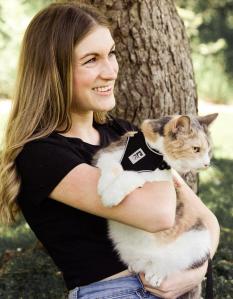
Rafuse with Mackenzie. Credit: My Grandfather’s Cat
When her grandfather passed away in 2019, Rafuse adopted Mackenzie. When she posted a video of the quirky cat to TikTok, the resulting discussion in the comments led to the realization that lots of people have been in similar situations, with relatives whose illnesses were compounded by worry about what will happen to their beloved pets when they’re gone.
“We heard stories from people who had to put their grandparents’ pets into shelters after they passed because there wasn’t a family member to adopt them,” Rafuse told blogTO, a local news site focused on Toronto.
My Grandfather’s Cat works “to keep the animal with their human up until the very last day and provide the comfort of knowing a loving family will adopt their pet when the time comes,” according to the non-profit’s site.
Refuse and volunteers work with people who are terminally ill, seniors who are forced to move into housing situations that don’t allow pets and other situations, and helps them find loving homes for their pets. Knowing their cats and dogs will be taken care of after they’re gone grants peace of mind to people who are already dealing with major life changes or their own mortality.
The group relies entirely on donations and doesn’t charge clients or adopters. My Grandfather’s Cat offers its services to all Canadian regions, and Rafuse said she hopes to expand to the US.
“It is the most rewarding thing in the entire world to be doing this,” she said, “and I know my grandfather would be proud.”
An office employee demanded ‘sensitivity training’ after a co-worker joked about an orange cat’s smarts.
Humane Societies in California and Indiana hope people have it in their hearts to welcome new cats into their homes this holiday season after 110 cats were rescued from two different hoarding situations.
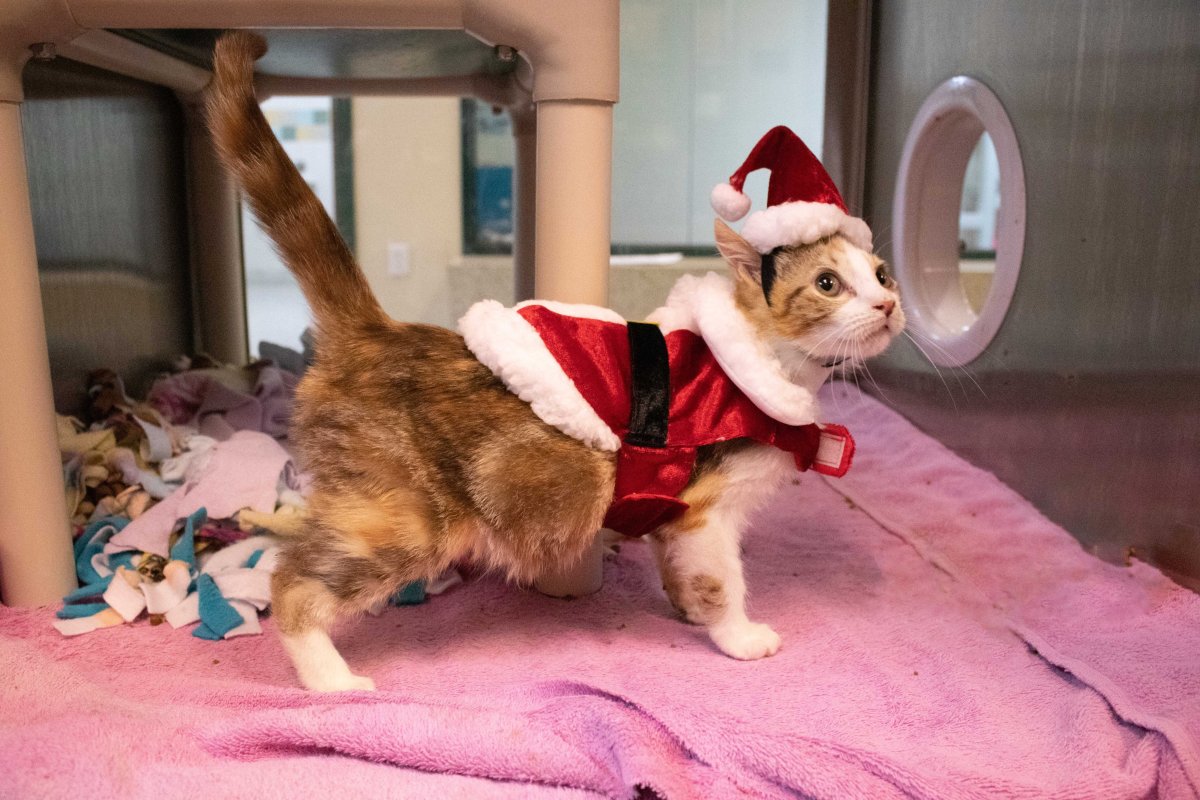
In Pasadena, Calif., the Humane Society rescued 52 cats who were living in a nearby home and in a crawlspace under the house. They’re calling the rescued kitties “Christmas Cats,” have given them names like Jolly, Merry and Jingle, and will offer discounted adoption fees in addition to spaying/neutering and microchipping the kitties before they’re sent to their forever homes.
A ‘Christmas Cat’ rescued from a hoarder in California. Credit: Pasadena Humane Society
A ‘Christmas Cat’ rescued from a hoarder in California. Credit: Pasadena Humane Society
A ‘Christmas Cat’ rescued from a hoarder in California. Credit: Pasadena Humane Society
A ‘Christmas Cat’ rescued from a hoarder in California. Credit: Pasadena Humane Society
Meanwhile, local authorities rescued 58 cats from a hoarding situation in Evansville, Indiana. The kitties were crammed into a single-wide trailer and many of them were in poor health, according to Kendall Paul of the Vanderburgh Humane Society.
“I think it probably started innocently enough, with the person trying to take care of just a couple of cats and then things got out of hand,” Paul said. “Most of these cats are ill with upper respiratory infections, some with more serious issues.”
The organization is calling its holiday cat adoption event “Deck the Paws,” and adopters will be able to choose from “presents” from beneath a Christmas tree, each containing discounts on adoption fees.
“We’re certainly hoping people will step up and help us,” Paul told the Evansville Courier & Press. “If you want to adopt a cat, we have lots here that are ready for new homes.”
Epic Cat Battle: Employee Demands ‘Sensitivity Training’ For Co-Worker Who Joked ‘Orange Cats Are Often Dumb’
A Redditor sought the sage advice of the always-hilarious “Am I The Asshole?” sub-Reddit, explaining her dire situation. She works in an agency with two office cats: Jean, a tortoiseshell, and Jorts, the new cat on the block who is an orange tabby.
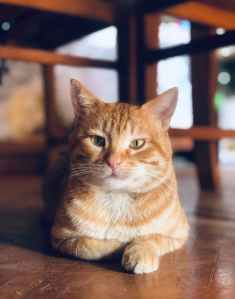
Jorts isn’t the sharpest claw on the paw.
The Redditor explains that Jorts is “kind of a simple guy” who can’t open doors and gets himself locked into rooms and the closet where he and Jean have their food nook. When kitty Jean can’t rescue Jorts (she can open most of the doors in the office, the Redditor wrote), Jorts meows until one of the employees rescues him from his predicament.
A co-worker named Pam decided Jorts should be more independent and “has been spending a lot of time trying to teach Jorts things.”
The Redditor favored a more simple solution and put a doorstop against the closet door so Jorts wouldn’t get himself stuck every time he went for a bite. That angered Pam, who insisted using a doorstop was depriving poor Jorts of a “chance to learn.”
Then Pam went full Karen, drawing up “a series of special learning activities for Jorts, and put the tasks on the whiteboard of daily team tasks.”
“Who you callin’ dumb?” Credit: Nantenaina Andrianjaka/Pexels
The Redditor tried to put the entire thing to rest by installing a cat flap and tried to diffuse the office tension by joking that they couldn’t “expect Jean’s tortoiseshell smarts from orange cat Jorts.”
The joke made Pam “furious”: “She started crying and left the hallway, then sent an email to the group (including volunteers) and went home early. In her email Pam said I was ‘perpetuating ethnic stereotypes by saying orange cats are dumb’ and is demanding a racial sensitivity training before she will return.”
The Redditor followed up with a second post after HR stepped in and — unlike many HR departments — had some level-headed people bring much-needed sanity to the kerfuffle. They told Pam to chill out and to stop assigning “Jorts-related tutoring” tasks to her co-workers. They also told her it was inappropriate to compare a co-worker installing a helpful doorstop to ethnic insensitivity.
During her little chat with HR, Pam also admitted she’d taken the tutoring thing too far:
“Lastly, and this made us both laugh so hard we can’t deal with it in person and will be said via email: Pam admits that she has been putting margarine on Jorts in an attempt to teach him to groom himself better. This may explain the diarrhea problem Jean developed (which required a vet visit).”
Speaking as a fellow redhead, I’m outraged! My people (human and cat alike) have been the butt of jokes for too long, and it’s time we organized a Union of Extraordinary Redheads to promote our shared interests, protect our own, and show the brown- and blonde-headed people of the world that we will not take their ridicule anymore! Jorts will receive his invitation in the mail shortly.
Iranian clerics and lawmakers claim pets are dangerous, but observers say the country’s religious authorities see pets as a threat to conservative Islamic beliefs.
The Prophet Muhammad heard the afternoon call to prayer one day and was about to rise when he realized his favorite cat, Muezza, was sleeping on his sleeve.
Rather than wake the slumbering kitty, Muhammad cut off his sleeve, stroked her fur and headed off to pray.
That story — and accounts of Muezza regularly napping in the lap of Islam’s most sacred prophet as he preached to followers — make Muezza one of the most well-known felines in human history, and form the basis for Islamic teaching regarding cats. Muslims consider cats the cleanest of animals, worthy companions and, thanks to the way the Prophet Muhammad treated Muezza and his other cats during his life, animals worthy of respect and the protection of humans.
Why, then, do hardline Islamic lawmakers in Iran want to ban the keeping of cats as pets, along with other animals?
Animal lovers in the country of 84 million are alarmed after conservative lawmakers introduced a bill, titled “Protection of the Public’s Rights Against Animals,” that would ban people from “importing, raising, assisting in the breeding of, breeding, buying or selling, transporting, driving or walking, and keeping in the home wild, exotic, harmful and dangerous animals.”
The list of “dangerous animals” includes creatures domestic and wild including “crocodiles, turtles, snakes, lizards, cats, mice, rabbits, dogs and other unclean animals as well as monkeys,” according to Agence France Presse.
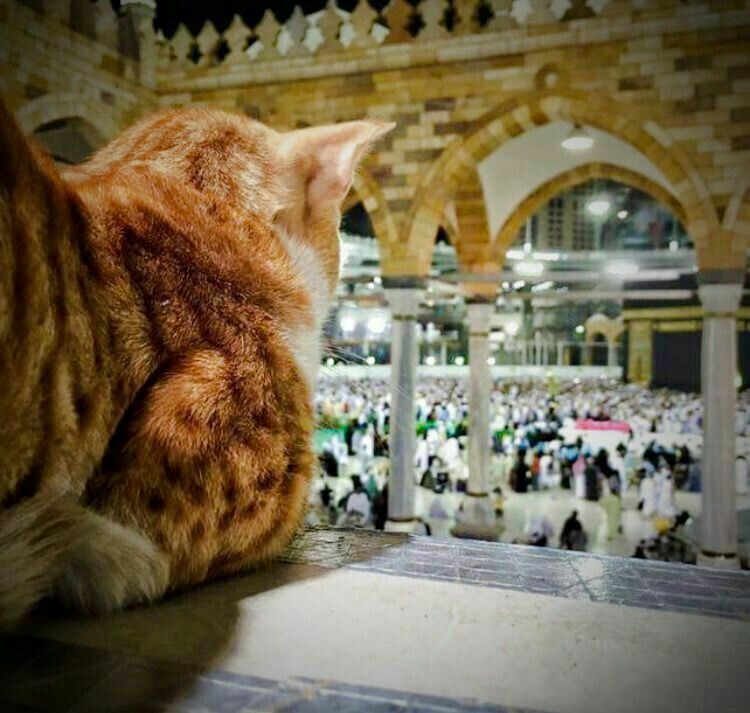
A cat loafs in Saudi Arabia’s Masjid al-Haram in Mecca, just a few hundred feet from the Kabah, the most sacred site in Islam. The fact that cats are allowed in such close proximity to the site reflects the Prophet Muhammad’s devotion to felines. Credit: Wikimedia Commons
Penalties for violating the ban would be steep:
“Offenders would risk a fine equivalent to 10 to 30 times the ‘minimum monthly working wage’ of about $98 or 87 euros and the ‘confiscation’ of the animal,” the report says. If passed, the law would also require landlords to ban pets on their properties.
The proposal has caused an outcry in Iran, where keeping pets has become more popular in recent years, especially because it’s not just one or two politicians introducing a long-shot piece of legislation: At least 75 of Iran’s 290 legislative representatives have already signaled support for the bill.
Officially, Iranian lawmakers who support the pet ban say they’re obligated to act because pets are “dangerous.” Mohammad-Taghi Naghdali, an Iranian MP, told Persian-language news site Didban-e Iran that dogs in particular can “cause nuisance and harm” to people, citing a recent incident in which a dog killed a child in a Tehran public park.
But observers say the real reasons have to do with the Iranian government’s interpretation of Islamic teaching, as well as fear that keeping pets is a western, liberal (in the classic sense) behavior that poses a danger to the Islamic theocracy.
In 2019, dog walking was officially banned in Tehran, and authorities warned residents to keep their pets out of public spaces.
“Police have received permission from the judiciary branch to crack down on people walking dogs in Tehran,” Tehran Police Chief Hossein Rahimi said in late 2019. “Carrying dogs in cars is also banned and if a dog is seen inside the car, police will confront the owner of the dog.”
In 2016, media reports said “officials were showing up at the homes of pet dog owners claiming that they were from a veterinary unit and these dogs needed vaccinations. The dogs were taken away, ostensibly for the purpose of vaccination and were never seen again.”
Dogs are considered “ritually unclean” according to Islamic hadiths, and some majority-Muslim countries, especially theocracies like Saudi Arabia, ban dog ownership completely with very few exceptions, such as seeing eye dogs for the blind.
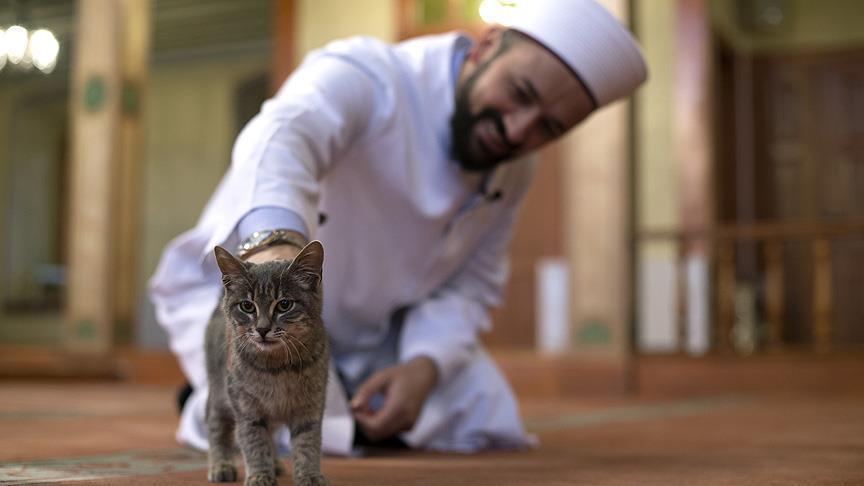
By contrast, cats are widely tolerated and even welcomed into holy sites in most Islamic countries. In Saudi Arabia it’s not uncommon to see cats lounging on the grounds of mosques, while Turkey is famously hospitable to felines, with Istanbul earning an international reputation for its well-treated and ubiquitous street cats. In Turkey, cats are welcome in mosques, shops and homes, and tiny shelters for strays can be found almost everywhere.
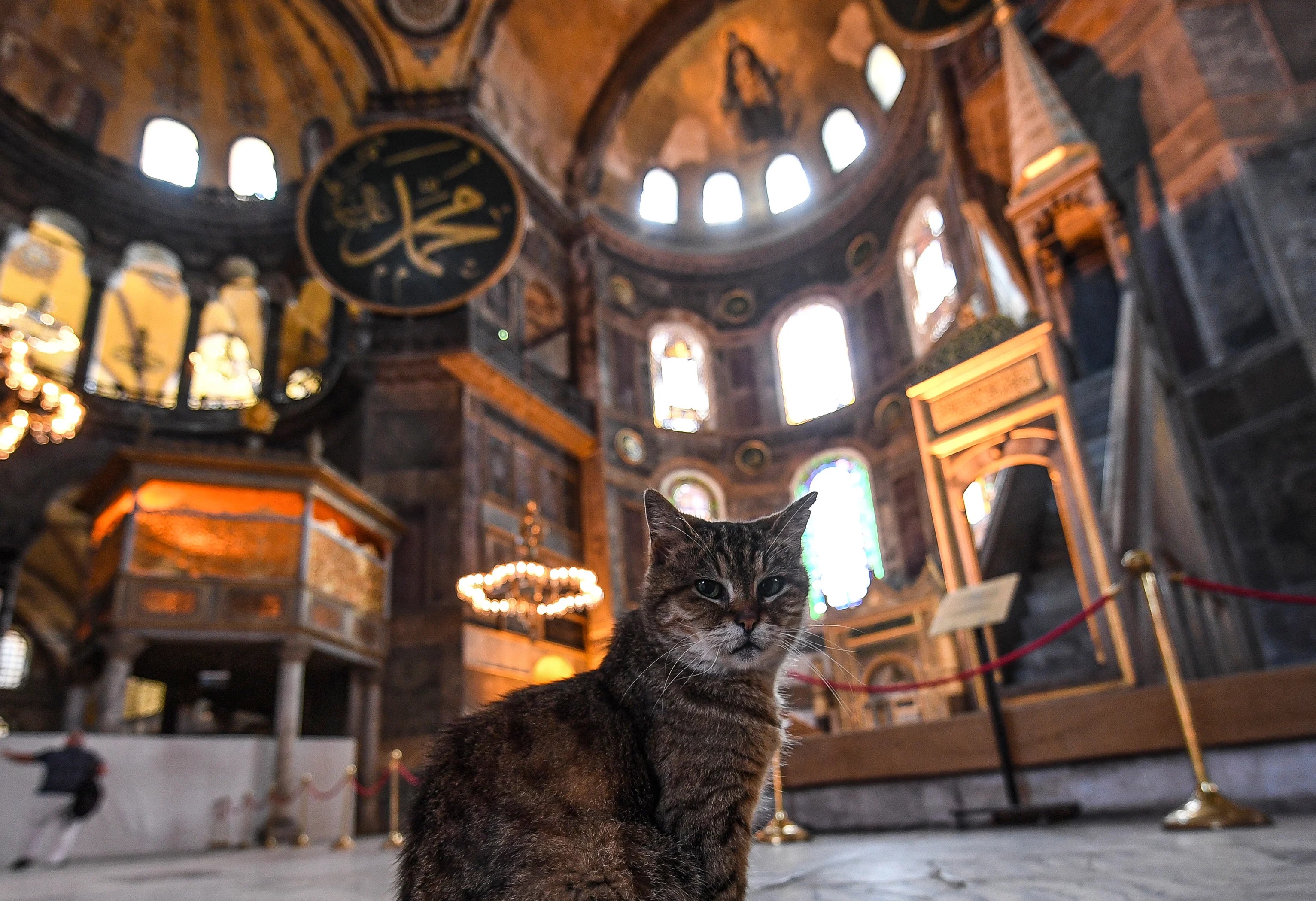
The late Gli, the most famous feline resident of the Hagia Sophia in Istanbul.
The proposed law has not gone over well with the people of Iran, who are often at odds with the country’s theocratic leaders on almost every aspect of social life.
“I have renamed my cat ‘Criminal’ since I heard this proposed law,” one Iranian wrote on Twitter, while journalist Yeganeh Khodami tweeted: “How many times have cats sought to devour you so that you consider them wild, harmful and dangerous?”
A common refrain among animal lovers is that the country’s leadership is once again focusing on something ultimately unimportant and harmful to Iranians instead of working to fix real problems like a depressed economy, widespread droughts and nationwide belt-tightening caused by international sanctions.
“Why should I imprison him at home?” a Tehran woman walking a dog told Agence France-Presse. “The MPs probably assume that young couples today don’t have children because they have a pet dog, but that’s stupid. It’s not the dogs but the economic conditions that don’t allow us to have children.”