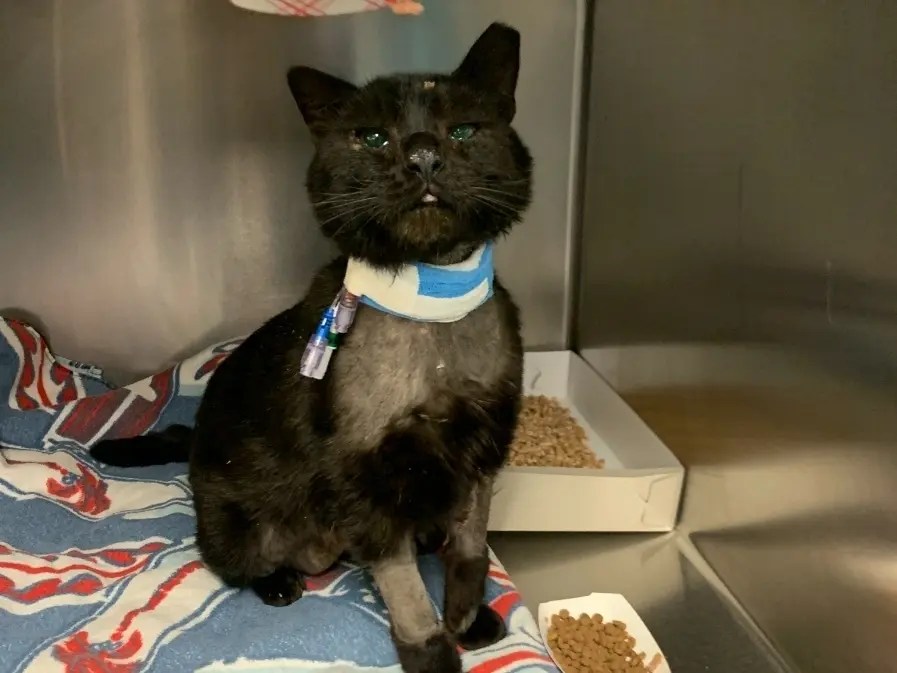
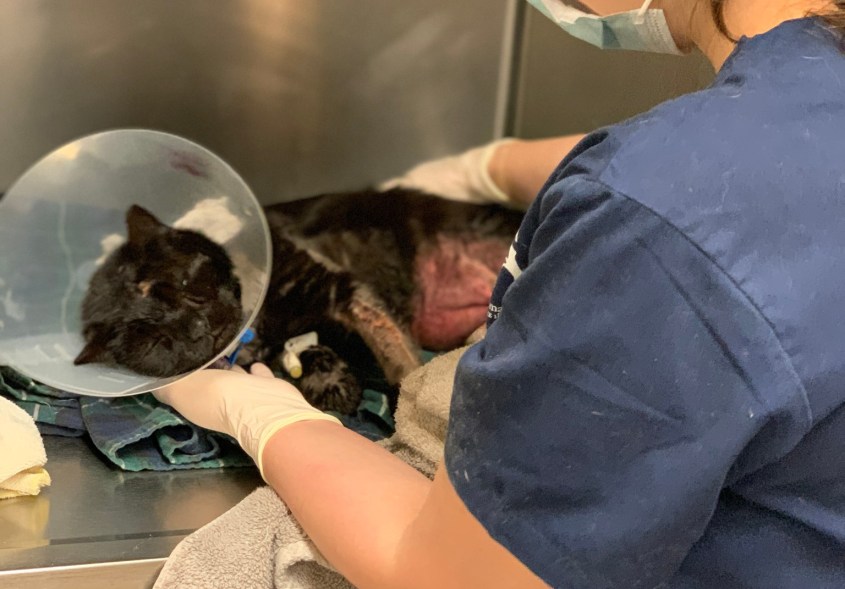
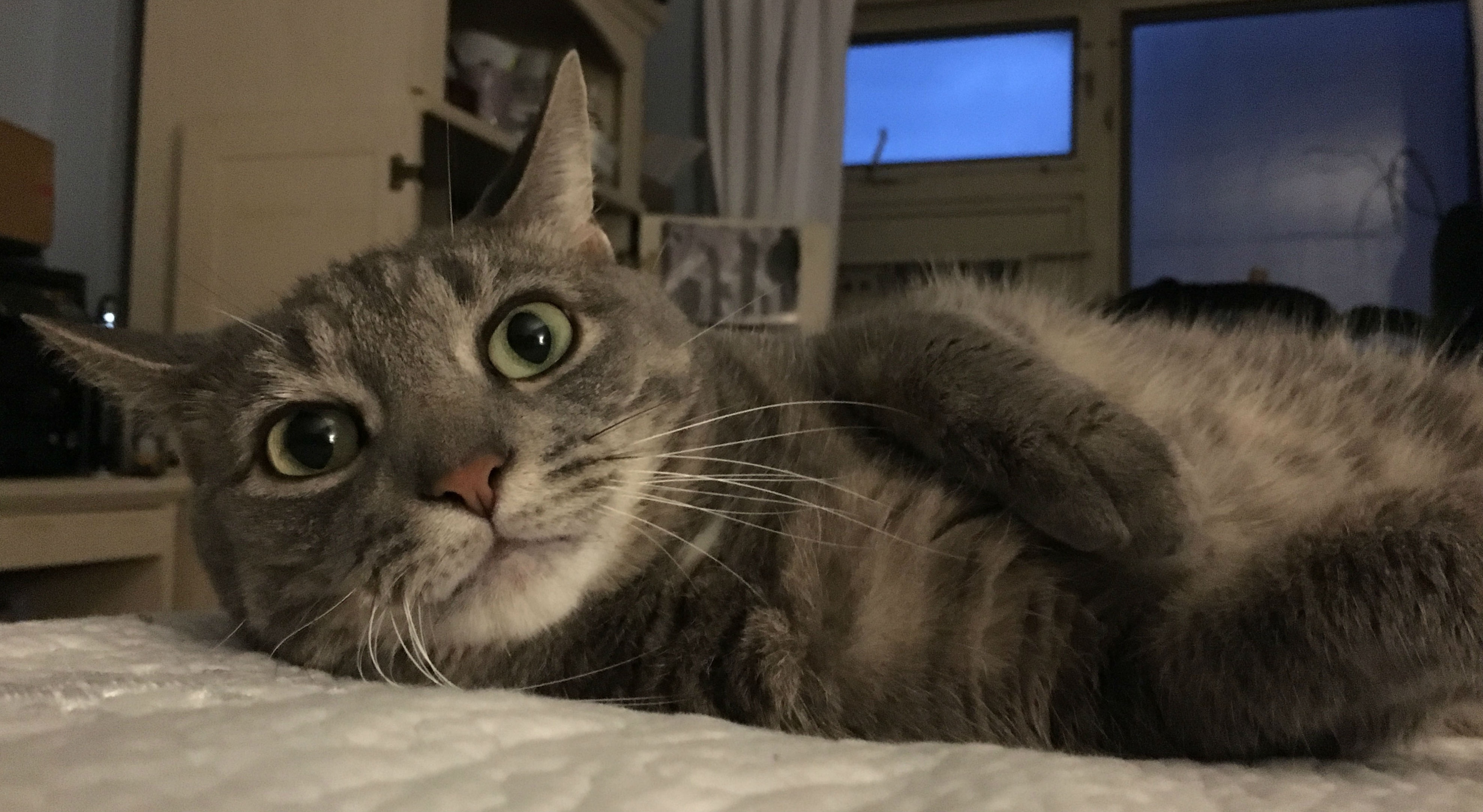
Buddy, the cat who survived an attack by two dogs, continues to recover in a foster home, where he lives with the emergency vet who cared for him after the attack.
Two Philadelphia minors will head to trial in May after they sicced their dogs on a cat sitting on a porch a month ago.
The juveniles, who are 17 and 12 years old, were walking their dogs in Philadelphia on March 22 when they set them loose on Buddy, a black cat who was cared for by a local family but spent most of his time outside. They shouted encouragement as their dogs mauled Buddy on his family’s porch and Buddy would have been killed if the commotion hadn’t drawn attention from inside.
When one of Buddy’s caretakers stepped outside and tried to stop the dogs, the teens pulled their canines back and fled. They turned themselves in to authorities a few days later after the story went viral and they realized the attack was captured by a doorbell camera system.
They each face felony and misdemeanor charges for animal cruelty, inflicting harm on an animal and other alleged offenses. Since they’re charged as minors the court system is not releasing their names, which is common practice in juvenile cases in most states.
Buddy was so badly injured that veterinarians weren’t sure if he’d make it at first. With a lot of care and love, the little guy pulled through the first few critical days and continued to recover until he was well enough to go to a foster home in early April.
His new caretaker is Katie Venanzi, a veterinarian who specializes in emergency care and operated on him that first day when he was brought in to Blue Pearl Vet Hospital by the Pennsylvania SPCA.
“He was kept secluded in one room initially, but now he has a run of the house and he is doing so well with his foster sibling cat Teddy. His foster parents affectionately say they are the two most awkward cats in Philadelphia, but their relationship is blossoming and we hope it continues that way so that Buddy can officially stay in that home forever,” the SPCA’s Gillian Kocher said. “Hopefully in the coming weeks, we will have some additional details and will let everybody know when we can make an official announcement about Buddy’s adoption, but for now he’s doing wonderfully.”
The reason Buddy was outside in the first place is that, as a stray, he resisted an indoor life when his original family tried to keep him inside.
Venanzi told a local radio station that her and her husband are trying to help Buddy adjust to an indoor life and hope they can adopt him.
“We want to do whatever he needs,” she said. “We understand that he used to live outside. If he is not comfortable living in our house, we are willing to work with other people who are going to give him an opportunity to be in a safe environment but still exposed to the outdoors. We are going to take it day by day and see how he does, but we are really hoping to keep him.”
When Buddy’s story went viral, people around the world responded by making donations to the Pennsylvania SPCA and buying t-shirts with Buddy’s likeness on them, allowing the group to raise thousands. Meanwhile, in a post to social media, the Pennsylvania SPCA noted it had taken in 158 abused animals since Buddy was attacked: “That’s more than five Buddys a day.”
Some of those dogs and cats were shot or stabbed, while others were neglected or starved, Kocher said. Leftover money from Buddy’s surgeries and treatment will be used to help the other abused animals in the SPCA’s care.
Two U.S. states have now banned declawing as ‘Merica inches closer to joining the rest of the civilized world in prohibiting the brutal practice.
With a stroke of Gov. Larry Hogan’s pen, Maryland became only the second state to ban declawing, joining New York, which outlawed the practice in 2019. Like New York’s version, the new Maryland law prohibits declawing unless it’s deemed medically necessary.
As most cat lovers know, declawing isn’t the manicure-like operation it sounds like. It’s the totally unnecessary, horrific amputation of a cat’s toes up to the first knuckle.
Declawing inflicts a lifetime of pain on cats, changes feline gait and posture, leads to early arthritis and causes a long list of secondary problems. For example, declawed cats are much more likely to bite because they have no other form of defense when they feel threatened, and they’re also much more likely to stop using litter boxes because it hurts to walk on the sand-like and granule texture of the litter with half-amputated toes.
The fact that so much misery is inflicted on innocent animals to protect furniture is indefensible.
The law goes into effect on Oct. 1, and veterinarians who perform the procedure after that time face fines of $1,000 and disciplinary action by the state veterinary board. We’d have preferred immediate implementation and stiffer penalties to prevent a last-minute rush on declawing appointments and discourage anyone considering breaking the law, but a win is a win, and all the major animal advocacy groups are celebrating, as they should.
Viagen, the only US company to offer cloning services, says the process becomes more popular every year.
The Washington Post has a story today about pet cloning, and thankfully it doesn’t sugar-coat the process.
It does take 10 paragraphs for the story to get to the negatives, but it offers a solid explanation of the cloning process before this quote by Columbia University bioethicist Robert Klitzman:
“People think, ‘Oh, I’ll just press a button and out will come Fido,’ but that’s just not the case. So you may love Fido, but do you really want several animals to die and suffer in order to have the one healthy Fido?”
That’s because even with the advancements made in the 21 years since CC the cat became the first of her kind to be cloned, the process still only has a 20 percent success rate. The other 80 percent of attempts end in still births, animals who die shortly after birth due to genetic defects, or animals who survive but suffer from flaws that make them “unsuitable” for the clients who are paying tens of thousands of dollars to clone their cats and dogs.
A terrifying prospect! (And a massive monthly turkey bill.)
As we’ve noted before, cloning doesn’t actually guarantee that you’ll get animal who looks like the departed pet. Fur color, length and coat patterns are all variable, and temperament is even more of a crapshoot thanks to the many variables in both nature and nurture.
Klitzman puts it in stark terms.
“I can either pay thousands of dollars to create a new pet that’s actually going to have a different history and personality,” he told the Post. “Or maybe I could adopt an animal that would otherwise be killed in a shelter. Those are things that ethically need to be considered.”
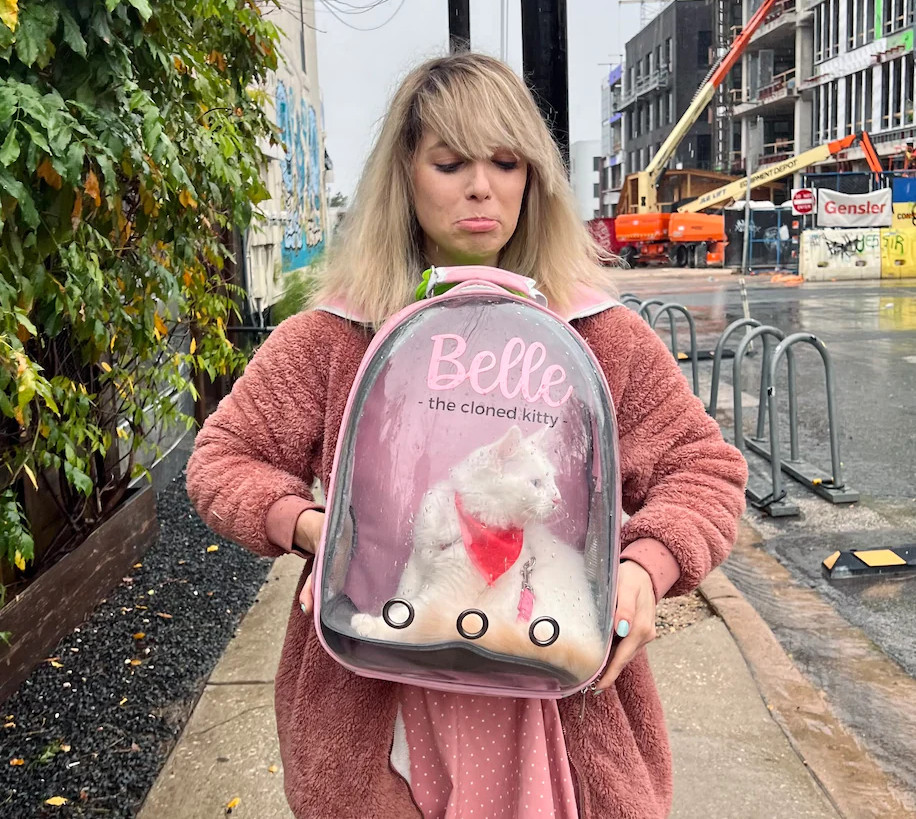
The Post’s article centers on Kelly Anderson and her cat, Belle. If the names sound familiar, that’s because we’ve written about them in earlier posts. Belle was cloned from Anderson’s beloved cat, Chai, and has her looks but not her disposition.
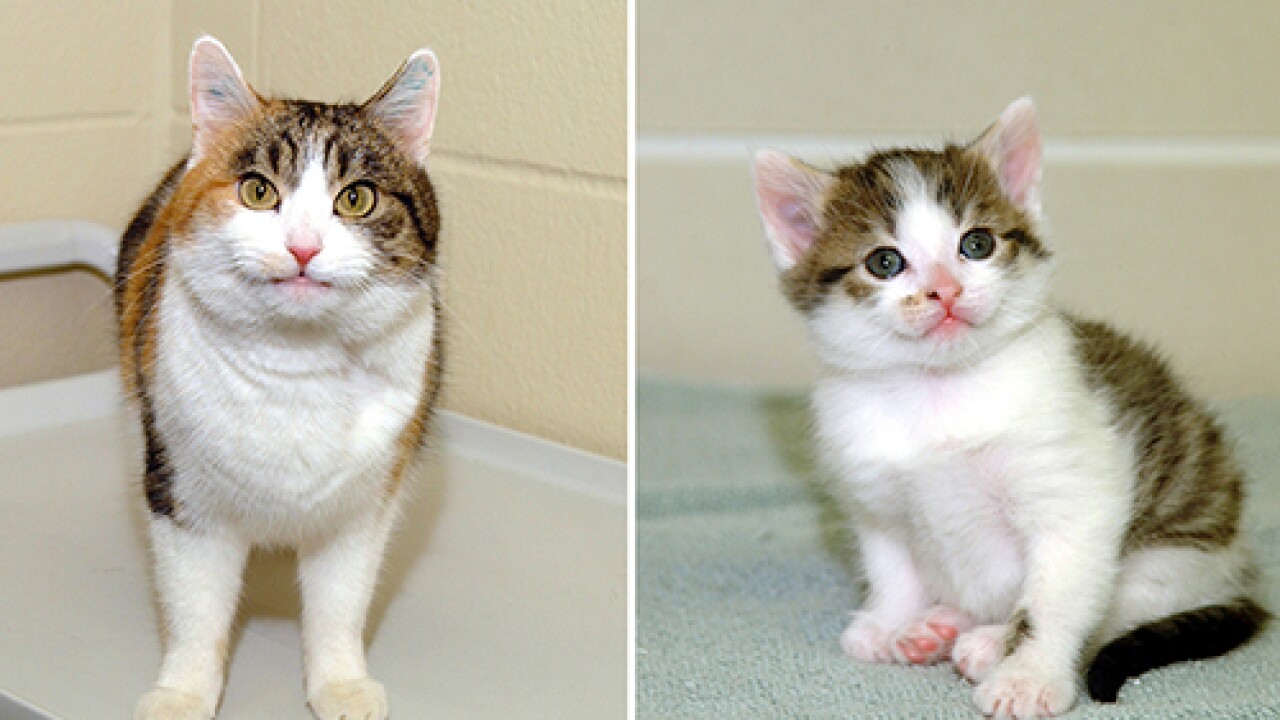
CC was famously different from Rainbow, the cat she was cloned from. While Rainbow had a Calico pattern with tabby stripes on her head, CC had tabby stripes on both her head and her sides. As the BBC noted in 2002, shortly after CC’s birth was announced, the cloned cat’s coat differed from her “mother’s” “because the pattern of colours on multicoloured animals is determined by events in the womb rather than by genes – a reminder that clones may be genetic copies of their parent but are never quite identical.”
Rainbow, left, and her clone, CC, short for CopyCat.
John Mendola, a retired NYPD officer from Staten Island, features in a BBC story posted last week on the increasingly popular cloning option.
Mendola paid $50,000 to have his dog, Princess, cloned. It’s not clear how many unsuccessful attempts were involved — and Texas-based Viagen doesn’t reveal that information — but the successful litter produced two dogs who look like Princess, which Mendola named Princess Ariel and Princess Jasmine. (Dude really loves Disney animation, apparently.)
Viagen charges between $25,000 and $35,000 to clone cats, according to different press reports. Grieving pet parents who haven’t made up their minds can have their late pets’ DNA preserved with the company for $1,600. There’s a short window after death during which viable cells can be harvested, but once they’re stored, they can last years or even decades thanks to cryopreservation methods. In one case, a client decided to clone a dog after storing the DNA for 17 years, Viagen’s Melain Rodriguez told the Post.
Viagen doesn’t disclose figures, but the company said it’s cloning more animals — dogs, cats and horses — every year, and has cloned “hundreds” for clients so far.
Blake Russell, the company’s president, likened cloning to a cat or dog having a littermate separated by time.
“A cloned pet is, simply put, an identical genetic twin,” he said, “separated by years, decades, perhaps centuries.”
Animal welfare groups remain staunchly opposed, not only because of the suffering among cloning failures and surrogate mothers, but also because millions of unwanted cats and dogs are euthanized annually.
“Animals’ personalities, quirks, and very essence simply cannot be replicated,” PETA UK Director Elisa Allen told the BBC. “And when you consider that millions of wonderful, adoptable dogs and cats are languishing in animal shelters every year or dying in terrifying ways after being abandoned, you realise that cloning adds to the homeless-animal overpopulation crisis.”
Looking to break into the profitable hypoallergenic cat market, scientists have turned their efforts to editing cat DNA.
On paper, the promise of “hypoallergenic cats” sounds great.
For the first time, people who love cats but are allergic to the furry little guys would be able to open up their homes to them. More cat lovers and more homes for cats is always a good thing, right?
Maybe not in this case.
The quest to create cats who do not trigger allergies depends on CRISPR gene editing, a method that allows scientists to edit, delete and replace sections of the genome. In this case, Virginia-based biotech company InBio wants to edit the genome of domestic felines to block Fel d 1 (Felis domesticus allergen I), a protein produced in cat saliva and in tiny subdermal exocrine glands, which secrete the protein via the same ducts that allow a cat’s fur to grow out from its skin.
Since cats are fastidious neat freaks and groom themselves constantly, the Fel d 1-carrying saliva is applied to their coats several times a day. When it dries, it contaminates a cat’s living space by flaking off the fur as dander or by shedding.
That’s why people who are allergic to cats can suffer symptoms like sneezing, itching and watery eyes not only from petting them, but also from spending time in homes where cats live.
What does Fel d 1 do, and why do cats need it?
The problem is that no one knows why cats produce Fel d 1 and what purpose it serves. Other proteins, like Fel d 4 found in pheromones and Fel d 2, help cats communicate by scent and prevent certain fluids from leaving the bloodstream, respectively.
Take a look at this quote from Nicole Brackett, a geneticist at InBio: (The emphasis on certain words is ours)
“The gene sequences don’t appear to be that well conserved over the course of evolution, which suggest things about whether or not the gene is essential,” Brackett told BioSpace, a life sciences publication. “An essential gene, one that would be required for survival or viability, generally doesn’t change much over evolution, and we’re seeing change between the exotic and domestic cat that suggests that maybe those sequences are not conserved, and maybe the protein is not essential.”
While we understand scientists have to be circumspect, especially regarding research that breaks new ground, that’s a lot of hedging and a lot of uncertainty. (It’s also not clear if Brackett is comparing domestic feline Fel d 1 levels to wild cats — felis sylvestris and lybica — wild felids in general, or hybrids like Bengals and Savannah cats, which are more commonly called exotics.)
Credit: cottonbro/Pexels
The team members developing the allergen gene edit assume Fel d 1 doesn’t have a critical function because individual domestic cats and other species of felids may produce different quantities of the protein.
But that’s a huge assumption, and it’s also presumptuous to assume we humans would know whether the gene edits have a major impact on felines. After all, we still don’t always know when cats are in pain or the reasons for many of their behaviors, and we don’t know what sort of cascade effect can be triggered by shutting down the production of a protein.
The race to make cats hypoallergenic
Companies see a huge opportunity for profit in the cat allergy alleviation market. Last year, Purina announced to much fanfare the availability of a new kind of cat food the company claimed would drastically reduce allergens after about three weeks of putting kitties on the new grub.
The claims haven’t been independently verified, and most press coverage is either credulous or consists of marketing masquerading as news coverage, like this advertisement from Purina that is presented like a news story in USA Today.
Back when a company called HypoCat announced it had conducted successful trials of a “vaccine” that would “neutralize’ Fel d 1, we spoke with immunologist Kamal Tirumalai, who pointed out that humans making such profound changes to companion animals for the sake of human convenience “passes neither the scientific nor the moral smell test.”
Like others, Tirumalai said she worried about unintended consequences.
“A vaccine given to cats to reduce their allergenicity for humans burdens them unnecessarily when human allergy to cats is primarily a human problem and should have a human solution in the form of reducing people’s cat allergies,” Tirumalai told PITB at the time. “Cats are perfect as they are. Why should they be the ones forced to change in order to be accommodated by a human whose immune system happens to have a problem with one of their proteins? This solution just doesn’t pass the moral smell test.”
HypoCat uses an injection to “induce anti-Fel d 1 antibodies in the cat,” while the CRISPR technique would snip the relevant DNA out entirely.
“Come now, let us not be absurd. Do you really think a designer kitten could be as handsome as I am?” Credit: Big Buddy
So far, Brackett and her colleagues have deleted one of two cat cells that produce Fel d 1 in samples in a petri dish, and have not made any changes to live animals. The experiments yielded a “55 percent knockout rate” for the Fel d 1 allergen, Brackett said, “which we were really happy with.”
Designer kittens: Gattaca for cats
If subsequent attempts are successful and the company sees commercial promise in editing feline genes, the process could be used to create “designer kittens” or to alter the genomes of existing cats. Brackett told Smithsonian magazine that the goal is to accomplish the latter.
But if it turns out the edits don’t work for existing cats, or the designer kitten trend becomes a thing, there’s another major moral concern similar to the objections to cat cloning. If people buy designer kittens, they’re not opening their homes to the millions of cats who need them.
Manipulating feline DNA isn’t a novel idea. A decade ago, a research team spliced genes from jellyfish using a different method to create cats who glow in UV light as part of a study into feline immunodeficiency virus (FIV).
Ultimately it comes down to what we’re willing to do for the sake of our own convenience. At a time when declawing has finally been outlawed in two states and dozens of cities, and people are more conscientious than ever with regard to their pets, do we want to risk their health so we don’t have to pop a few Benadryl?
Cloning still has a disturbingly low success rate, more often than not leading to the birth of sickly animals with fatal defects, or animals who don’t make it to term.
I’d like to call your attention to a paragraph in this CNBC story about Instagram and TikTok influencers cloning their famous pets.
The story begins with an anecdote about Kelly Anderson, a woman from Austin, Texas, whose cat Chai had become Internet Famous:
The white and tan ragdoll had 85,000 followers on Anderson’s Instagram account @adogandacat when she died from complications following a surgery.
“I lost about 20,000 followers on Instagram after Chai passed,” she explained.
Anderson said she sent a sample of Chai’s DNA to the Texas-based pet cloning company ViaGen Pets shortly after she died. It took four years and $25,000 for Anderson to get a successful clone, and now she’s back in business with Chai’s identical genetic clone named Belle, who was born in 2021.
Stop.
Read it again.
Now think about that last bit: Anderson sends the DNA sample to ViaGen, one of two commercial pet cloning operations in the world. (The other is in South Korea.) “It took four years” the article says “to get a successful clone.”
It doesn’t take four years to extract DNA from a viable sample. It doesn’t take four years to implant that DNA in an unfertilized egg, and it sure doesn’t take four years to bring a cloned cat to term.
So what happened in that interregnum between Anderson submitting Chai’s DNA and ViaGen producing “a successful clone”?
A damn horror show, that’s what.
The first cloned dog, an Afghan hound named Snuppy, was “successfully” brought to term and survived after birth in 2005, but only after the South Korean lab implanted more than 1,000 embryos into 123 surrogates.
Things have improved since then, if you can call it improvement: Success rates reached the high single digits by about 2010, and now the most successful labs produce “viable” clones about 20 percent of the time, according to geneticists.
What happens to the other animals?
The cloning industry likes to talk about its victories and present stories about grieving people reunited with their beloved cats and dogs, but cloning companies suddenly go mum when they’re asked about the animals who don’t make it to term, the kittens and puppies who are born with horrific defects, and the many animals put down because they don’t match the customers’ specifications. (Cloning companies don’t talk about the puppies and kittens who don’t physically match the clients’ late pets, but it’s safe to say they wouldn’t be reticent if the “wrong” babies had happy endings.)
Cloning results in “lots of abnormalities and genetic defects–and a significant percent of newborn animals die in the first few days or weeks of life,” geneticist Robert Lanza says.
Or as a paper in the peer-reviewed journal Scienceput it: “In all mammalian species where cloning has been successful, at best a few percent of nuclear transfer embryos develop to term, and of those, many die shortly after birth…. Even apparently healthy survivors may suffer from immune dysfunction or kidney or brain malformation, perhaps contributing to their death at later stages. Most frequently cloned animals that have survived to term are overgrown, a condition referred to as ‘large offspring syndrome.’”
Even when it appears a cloning has been successful, the cloned pets often succumb to ailments caused by congenital defects both in the short term and long term.
By 2008, just three years after the birth of Snuppy, “a total of 3,656 cloned embryos, more than 319 egg ‘donors,’ and 214 surrogate mothers ha[d] been used to produce just five cloned dogs and 11 cloned cats who were able to survive 30 days past birth,” the Humane Society and American Anti-Vivisection Society warned in a report about the trend.
The failed clones aren’t the only ones who suffer. The cloning industry has created “a whole canine underclass that remains largely invisible to us but whose bodies serve as a biological substrate” bioethicist Jessica Pierce wrote in a 2018 op-ed in the New York Times. A similar “underclass” of feline surrogate mothers exists, constantly being impregnated and giving birth to kittens who will mostly suffer brutally short lives.
Kelly Anderson had her cat, Chai, cloned. The result is Belle, left, who looks the same but “is completely different” personality-wise.
Indeed, cloning doesn’t guarantee anything: It doesn’t mean the genetic copy of your pet will have the same coat color, pattern or personality. It does not produce the same animal, nor a real copy of the animal.
Barbra Streisand admitted as much in 2018 when she let slip in an interview that she’d had her late dog cloned, then wrote an op-ed in the New York Times to defend her decision after taking criticism from animal welfare groups. Streisand wanted another dog just like her late Sammie.
“One of the reasons I chose cloning was because I couldn’t find another curly-haired Coton [de Tulear],” Streisand wrote.
Cotons de Tulear usually sell for between $2,000 and $4,000 from breeders. Five puppies were born to a successful litter using Sammie’s DNA. The runt died shortly after birth, while Streisand gave two puppies away to friends and kept two.
Streisand said she’s happy with her decision and thinks of her Sammie every time she looks at the puppies, but says neither of them have Sammie’s disposition.
“You can clone the look of a dog,” she wrote, “but you can’t clone the soul.”
Really what the cloning companies are offering is a replacement built off the same genetic template. The clones are brought to life by crude, Frankensteinesque processes, and opponents say cloning takes away potential homes for lovable cats and dogs who already exist in our shelters.
Then there’s the whole nature versus nurture debate. Doubtless the way a cat or dog is raised will have a significant impact on personality, but a clone with the same DNA, raised precisely the same way as the original, could still have a much different personality.
Cloning opponents argue commercial pet cloning companies are grief vampires in the same way self-proclaimed mediums and psychics are in their willingness to exploit people for profit. The desperate daughter willing to fork over $800 so a vulgar woman with a beehive hairdo can abuse the memory of her father by “connecting” with him in death to discuss trivialities is in an emotionally fragile state, but so is the grieving cat or dog lover reeling from the loss of an animal companion who was closer to them than most humans.
I realize it’s easy to criticize. I can’t even contemplate the eventuality of saying goodbye to Bud, and I haven’t walked a feline companion to the foot of the rainbow bridge yet.
But there is no other Buddy. The idea that I could replace him like getting a new car or a new phone would be an insult to his memory, to his dignity and to his existence as a genuine individual. It’s an insult to our friendship, our bond, our shared experiences. The time he wouldn’t leave my side when I was stricken with Bell’s Palsy and the mother of all headaches, the many times he’s sensed my discomfort and offered comfort in his way, purring and nuzzling, the wonders he’s done for my seasonal affective disorder.
The time he pigged out on closed pistachios and I comforted him as he cried and cried until his tummy was better. The time I forgot he was sleeping on my back, let slip a fart and heard a confused “Mmmmmrrrrrppp?”, prompting me to laugh so hard, tears were streaming down my cheeks.
“Big Buddy lies! I did NOT cry.”
The time he jumped off the balcony as a kitten without thinking of how he’d get back inside, and I realized how much I loved the little guy as I searched for him and tried to bury the thought that I might never see him again.
No. A clone wouldn’t be Buddy, wouldn’t have his friendly nature, his boldness, his kittenish meow or, dare I say it, his singular obsession with turkey.
We can’t honor our little friends by paying large sums of money for a laboratory horror show to create a clone so we can pretend that clone is the pet we miss. But we can honor them by doing for other cats what we did for them, opening our homes and our hearts and making a difference to one animal at a time.
As for me, I’m pretty sure Bud would haunt me for the rest of my days if I cloned him. “That’s my turkey!” ghost Buddy would say. “That’s my toy! That’s my laser laser! That’s MY spot on the couch, that’s MY spot on your lap and your chest! Who is this pretender, and why does he look like me except less handsome and charming? Big Bud, you have some splainin’ to do!”