At long last, a deserving cat finally has a home and humans to love him.
We’d like to offer a special congratulations to the SPCA, two kind-hearted adopters, and especially Plankton the cat for finding a forever home after a long, long wait.
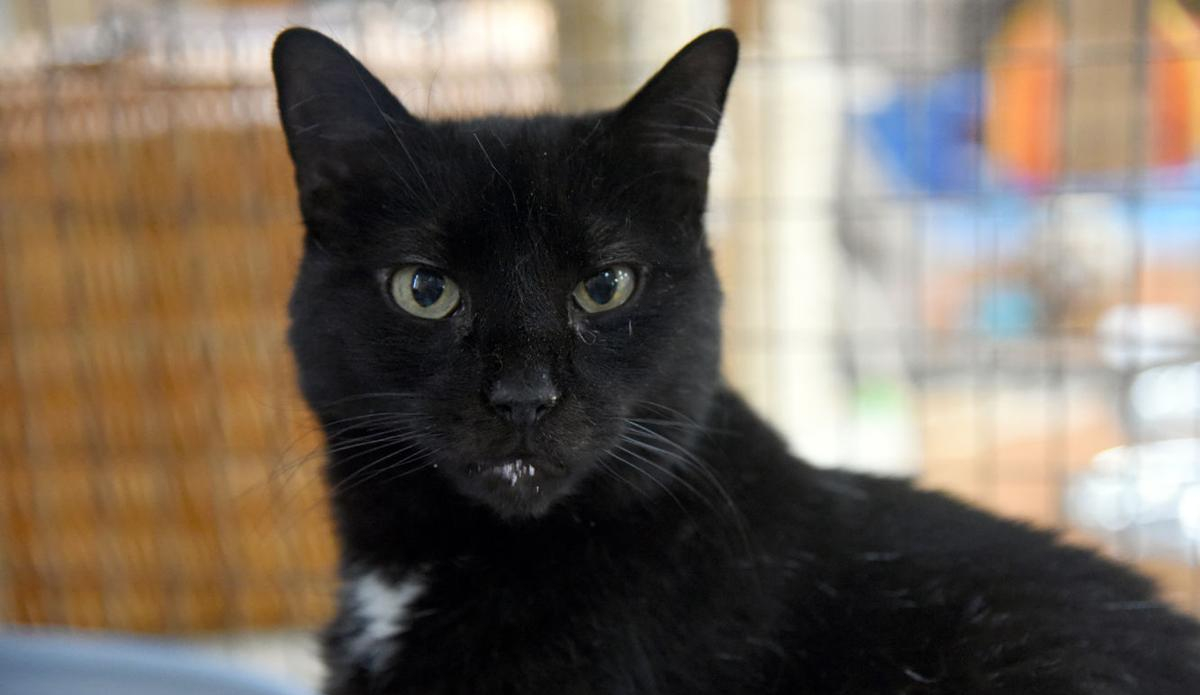
Plankton had a rough start to life: He was one of about 100 kittens and cats rescued from a hoarding situation in a two-bedroom apartment in late 2013 and suffered renal failure. For years, potential pet parents passed up on the handsome black-coated little dude because of his condition, and the thrice-weekly infusion of liquids he needs to stay healthy, even though staff at the shelter say he takes the infusions like a champ.
Ashlee Haughtaling read about Plankton in a Feb. 15 article by the Kingston Daily Freeman, a New York newspaper covering the mostly-rural Ulster County about 75 miles north of New York City.
Haughtaling had a dog who suffered from kidney problems as well, so she knew what caring for Plankton would entail. She reached out to the county SPCA immediately.
“I thought it was so sad that no one was adopting him because he had a medical condition,” she said, per the SPCA. “The fact that he had been there for so long, it really hit home for me. Sick cats need homes, too.”
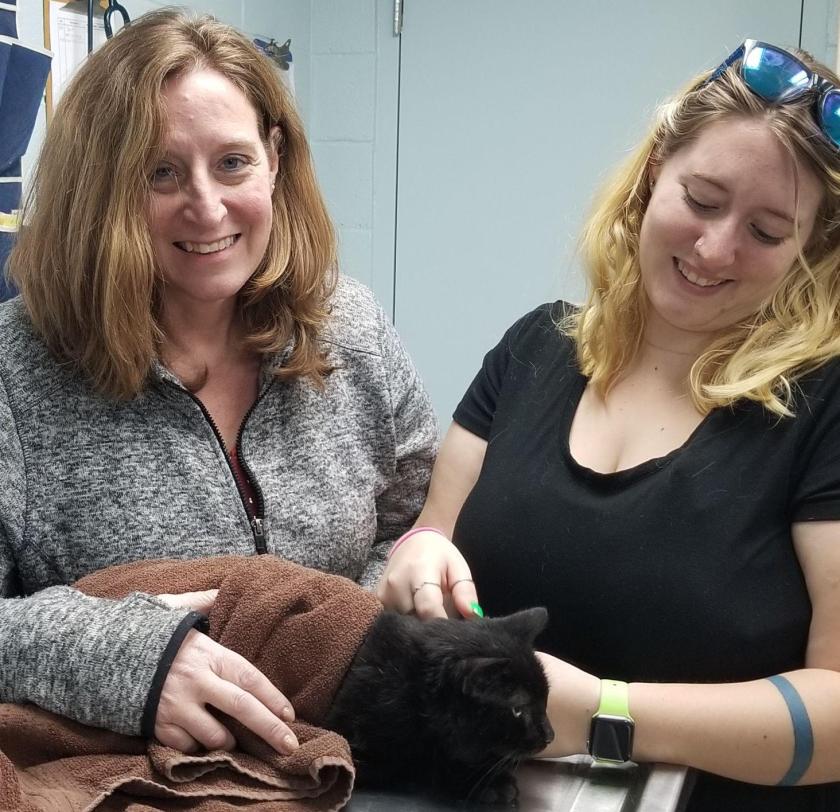
Ashleey and her mother Ann Houghtaling took Plankton home six days later. For the first time, the 6 1/2-year-old cat has a place to call home. He gets along well with other cats, the shelter said, and he’s got a pair of new feline friends, Nutmeg and Boots, in his new home as well.
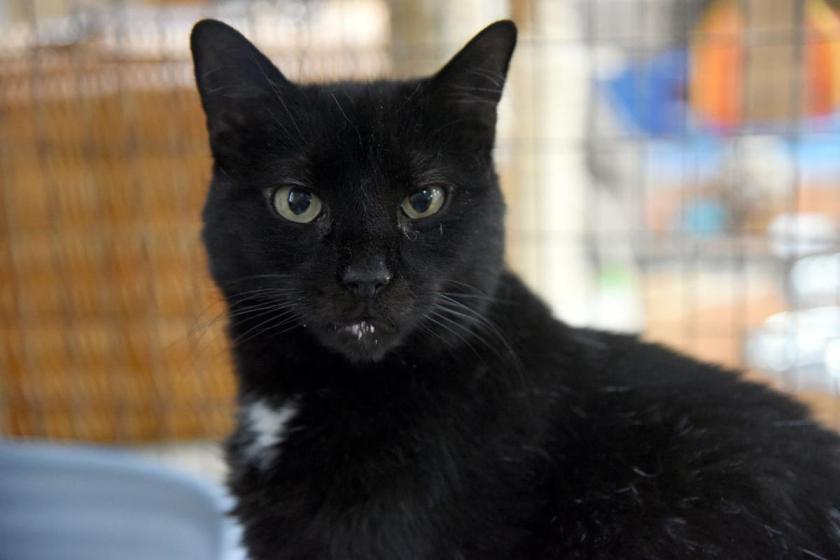
Ann and Ashlee Houghtaling comfort Plankton, the newest member of their family, before bringing him home from a shelter where he’d been staying for 6 1/2 years. Credit: Ulster County SPCA Plankton suffers from kidney problems and must have fluid injections three times a week. Credit: SPCA
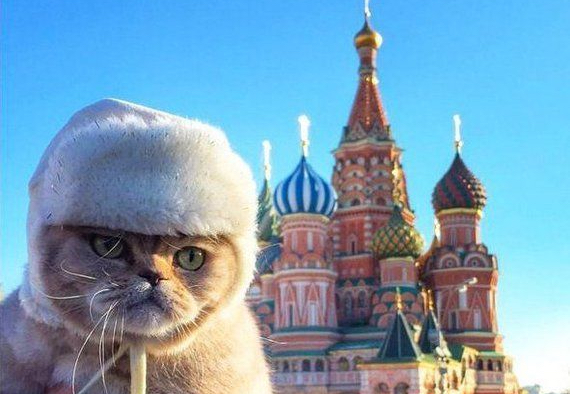
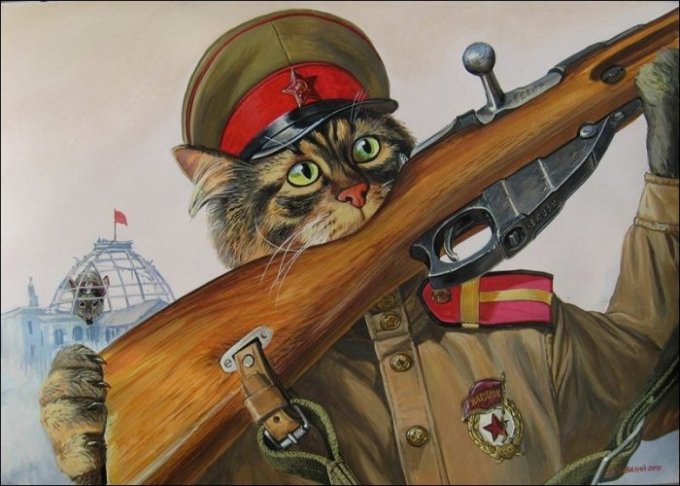
Russian propagandists are behind an effort to discredit the heroic American cat.
A shadowy group of Russians are behind a complex and nefarious plot to discredit Buddy, sources allege.
The Russian operatives were behind the recent Time magazine snub in which Buddy was ludicrously excluded from a top 10 cat list, several cats with knowledge of the operation meowed on condition of anonymity.
Deep-cover Russian agents have also worked to sully Buddy’s reputation as a heroic American feline by seeding social media with anti-Buddesian sentiment and viral content.
One Youtube video purports to show Buddy running terrified from a vacuum, but a spokesman for Buddy said the Russians used a similar-looking silver tabby to film the fabricated incident.
“The Buddy double was convincing, but anyone can see for themselves the cat in the video isn’t muscular enough to pass for His Grace,” spokesman Purrcy Pressman told reporters. “Vladimew Pootin and the Russians are underestimating the intelligence of the everycat if they think kitties will believe Buddy would run from a vacuum.”
Allegations of Russian involvement weren’t a surprise to feline officials, who blame the KGB (Kitty Gaslighting Bureau) for most of the salacious rumors circulating in the feline world over the past five years.
Those same KGB agents were responsible for tabloid stories that alleged Streetcat Bob’s name was found in a little black book when the FBI — Feline Bureau of Investigators — raided a purrstitution ring in November, sources say.
“These Russians are dangerous,” National Security Adviser Saul Berenson said. “Just look at what they did to Carrie Meowthison, one of our best agents. Buddy would do well to keep a low profile for the time being.”
Yvgeny Groomov, a spokesman for the Russian embassy, denied the allegations, but nonetheless said the KGB was in possession of kompromat that could destroy the reputations of famous American felines.
“Buddy is like small child, he is insignificant to Motherland,” Groomov said. “Real story is about how Americans are always using Russia as scapecat for all things going wrong. We say to the Americans, thank you for allowing us live in your heads free of rent.”
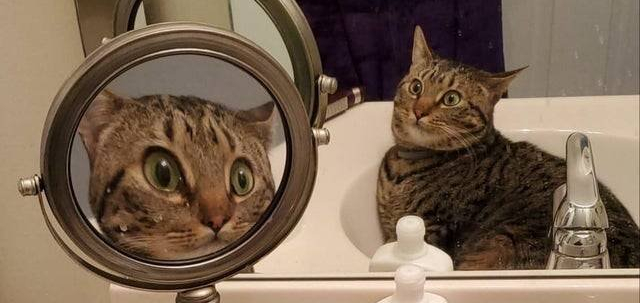
“I saw his reflection in the magnifying mirror and I started laughing hysterically,” Roscoe’s owner said.
Meet Roscoe.
The year-old tabby and his human are enjoying viral fame after the latter snapped this shot of Roscoe catching his reflection in two mirrors at the same time, prompting a hilarious look of shock:
Roscoe catches his reflection in two mirrors. Credit: Katie B.
Roscoe’s human, Katie B, explained how she got the shot.
“I was just going about my business when I looked down and saw his reflection in the magnifying mirror and I started laughing hysterically,” said the 24-year-old PhD student, who lives in Chicago. “It was hilarious, and thankfully I was holding my phone. So I quickly took a picture and sent it to my friends on Snapchat.”
Roscoe’s bewildered look has reignited the debate about feline self-awareness, a topic that still hasn’t been settled by science. It’s a subject we’ve explored here on Pain In The Bud, detailing Buddy’s “long and tumultuous history with mirrors” and his reactions to seeing himself — and me — reflected back at him.
Katie calls Roscoe “a funny little dude” and her “furry best friend.” She’s started an Instagram account for Roscoe where she documents the little guy’s antics for his followers.
“It’s been really fun seeing how much people love it and all the memes and drawings people have done of Roscoe,” Katie told Buzzfeed. “He has brought so much joy into my life, and I’m glad he’s bringing joy to others too!”
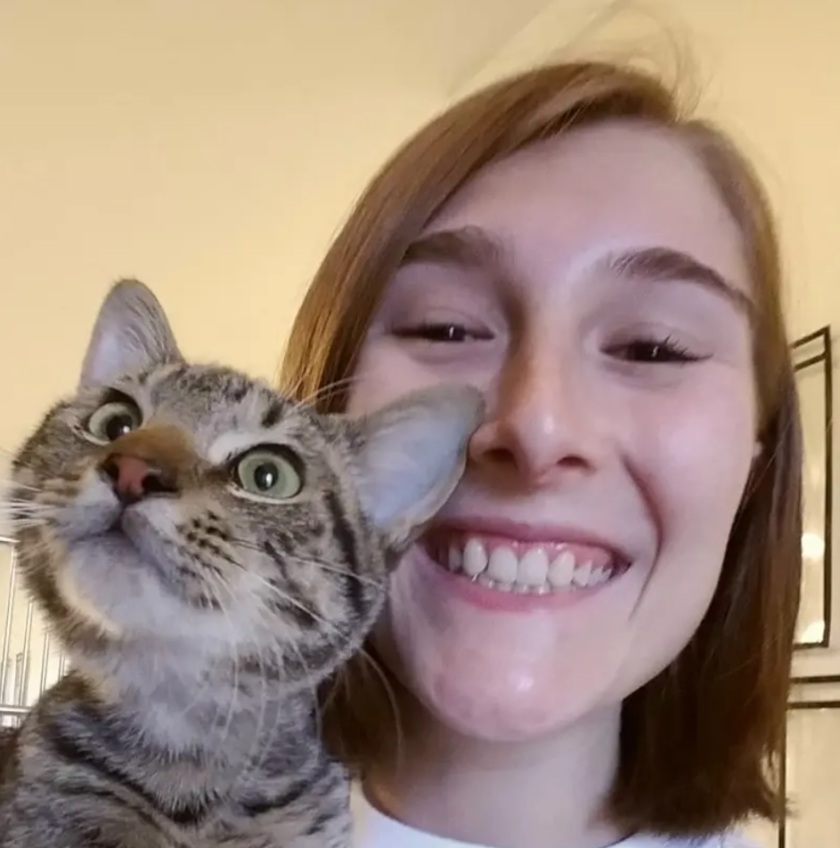
Roscoe and his human servant, Katie B. Credit: Katie BPhotos of Roscoe capture the little guy’s amusing personality. Credit: Katie B
Common misconceptions can impact the way owners bond with their kitties.
We’ve all heart the familiar knocks on our feline friends: They’re aloof, selfish animals who are indifferent to their humans as long as their bowls are filled with food and they’ve got a warm place to sleep for 16 hours a day.
NPR hosts took a look at those stereotypes in their new segment, Animal Slander, in which they take “common phrases and stereotypes about animals — blind as a bat, memory of a goldfish — and figure out how much truth there is to them, or if they’re really just slanderous to these animals.”
Emily Kwong and Maddie Sofia of Shortwave — NPR’s daily science podcast — host the series, taking a look at a different animal in each segment.
“We can at least set the record straight on some potential slander that cats endure,” Sofia said, “such as cat are aloof, especially compared to dogs, that they love food more than they love us, and the idea that cats love people who don’t love cats.”
The feline mind has been a mystery to scientists for a long time. Credit: Shutterstock
Kwong and Sofia spoke to Kristyn Vitale, an animal behaviorist from Oregon State University. If Vitale’s name looks familiar to you it’s because we’ve talked about her work before on Pain In The Bud. Along with researchers at Sophia University in Tokyo, Vitale’s team at OSU has been putting out most of the headline-making cat research in recent years.
They were responsible for the much-talked-about study showing cats relate to their owners the same way human children relate to their parents in uncertain situations. They were also the authors of a study that found cats prefer affection from humans more than food.
The former validated the feelings of many cat servants by confirming the similarities between the parent-child and caretaker-animal dynamics. In other words, we’re surrogate parents to our cats.
“It was very interesting to find just how closely those numbers match what we’ve seen in dogs and humans,” Vitale said. “The majority of both dogs and human children are securely attached, and that’s anywhere from about 60 to 65 percent of the population, which is exactly what we found with cats.”
It wasn’t so long ago that scientists had apparently given up on cats, concluding they’re too uncooperative to serve as research subjects.
“I can assure you it’s easier to work with fish than cats,” comparative psychologist Christian Agrillo told Slate in 2014. “It’s incredible.”
Cats “freaked out” when taken from their homes to a lab for studies, Agrillo said, and most weren’t interested in the test.
“Very often, they didn’t participate in the experiment or they walked in the wrong direction,” Agrillo said at the time. “It was really difficult to have a good trial each day.”
“Be cooperative? What’s in it for me?” Credit: Shutterstock
The teams at Oregon State and Tokyo’s Sophia University have worked around those issues by designing studies that focus on feline reactions rather than scenarios that required them to take certain actions. That method may not yield results in the sort of comparative psychology studies scientists like Agrillo design, but it’s given researchers a window into the feline mind.
Stereotypes about cats can dissuade scientists from studying them, Vitale said, which is why it’s important to debunk them.
The stereotypes “do bother me because some of these ideas are why the field of cat cognition has been stagnant for a long time,” she said. “A lot of these expectations shape the work that people want to do, and if we say cats are aloof and untrainable, well, then they can’t learn to how engage in cognitive testing. But in our lab we’re showing cats can be trained just as readily as dogs.”
Likewise, stereotypes can negatively impact the way owners treat their feline friends. That’s something we’ve talked about before: While dogs warm quickly to people, earning the love and trust of a cat takes effort. The better you treat a cat, the tighter your bond becomes.
“If people don’t think they can bond with their cat, or engage in a lot of these interactions, why even try?” Vitale asked. “And if we don’t try with our cats, that’s going to produce a very different individual than we see with dogs.”
As for the NPR hosts, they concluded cats have indeed been unfairly maligned.
“The next time someone says ‘I love this cat so much because it acts like a dog,'” Kwong said, “lovingly tell them ‘No, this cat acts like a cat.'”
A handful of people on Twitter found the study “problematic” and called for its removal.
Last Monday, the academic journal Biological Conservation published a “controversial” study about cats.
It didn’t last a week.
The journal quietly took the paper offline after it was buried in a heap of scorn and hysteria from that fount of good vibes, Twitter.
People whose profiles are appended with tags like “she/her” and “he/him” outlined why the paper is “problematic,” providing an afternoon’s worth of fresh outrage for the grievance enthusiasts.
The study, by a research team from China’s Nanjing University, has two main conclusions: The more women living on a college campus, the more stray and feral cats live there too. Additionally, the team surveyed men and women about their interactions with strays — with responses indicating women are more likely to care for them — and followed a handful of men and women to watch their interactions with cats.
“Study? Yes, I like to study…how to bend humans to my will so they feed me more delicious yums!”
Is it ground-breaking science? No. Do the results prove women are better caretakers of cats than men? Nope. Did the authors perhaps overextend themselves by mixing up correlation and causation? Probably.
But it’s still research, and studies should not be buried or banished from peer-reviewed journals because a handful of malcontents on Twitter cry sexism. Some aspects of the paper, like the small sample of observed interactions, are thin. But the authors did look at 30 universities, a healthy sample size as far as institutions go.
If follow-up studies indicate that women are indeed more likely to care for cats, so what?
Is reality sexist? Do we need to protect people from even the most mildly controversial things?
As a man who loves cats, I don’t doubt that most caretakers are women. I see the anecdotal proof among the ranks of rescue volunteers. I see it in my readership here — aside from the Extraordinary League of Cat Dads, some 85 percent of this blog’s readers are female.
And that’s perfectly fine!
I would like to see more men warm to the idea of adopting and caring for cats, but the fact that women in general seem to have more empathy for them isn’t sexist. It doesn’t mean every woman loves cats any more than it means all men don’t.
Pain In The Bud’s readership is overwhelmingly female, but most of our traffic isn’t from women — it’s from female cats who find Buddy devilishly handsome!
Some readers know I have a background in journalism and spent almost 15 years of my career as a reporter and editor. One thing that appalls me as a journalist is the routine practice of quoting tweets in lieu of speaking to people face to face or picking up the phone and asking questions.
Platforms like Twitter thrive on negativity. Whether 140 or 280 characters, Twitter’s bite-size messages may be good for people who have the attention span of gnats, but they don’t exactly foster productive or nuanced discussion. Perhaps most important of all, people are more likely to say negative things online than they are in a human-to-human conversation, and too often handfuls of loudly-complaining people are mistaken for a majority.
Studies show negative tweets are far more likely to spread than positive or neutral messages, which skews public perception. They also show Twitter opinions are not representative of the general public, in part because most of Twitter’s power users come from similar backgrounds and share world views.
To put it bluntly, Twitter is full of roving bands of grievance artists constantly on the lookout for new things to shit on, and we should stop assigning so much importance to what we think are the prevailing sentiments on social media platforms.
Academic journals are peer-reviewed. Taking the vetting responsibility away from experts and giving it to a few unhappy people on social media is not a smart way to present research.
The study authors’ peers will poke holes in their work if the holes indeed exist, and that’s part of what peer review is for. Not to bury research, but to encourage scientists to rethink it, refine it and try again.




 Pain In The Bud