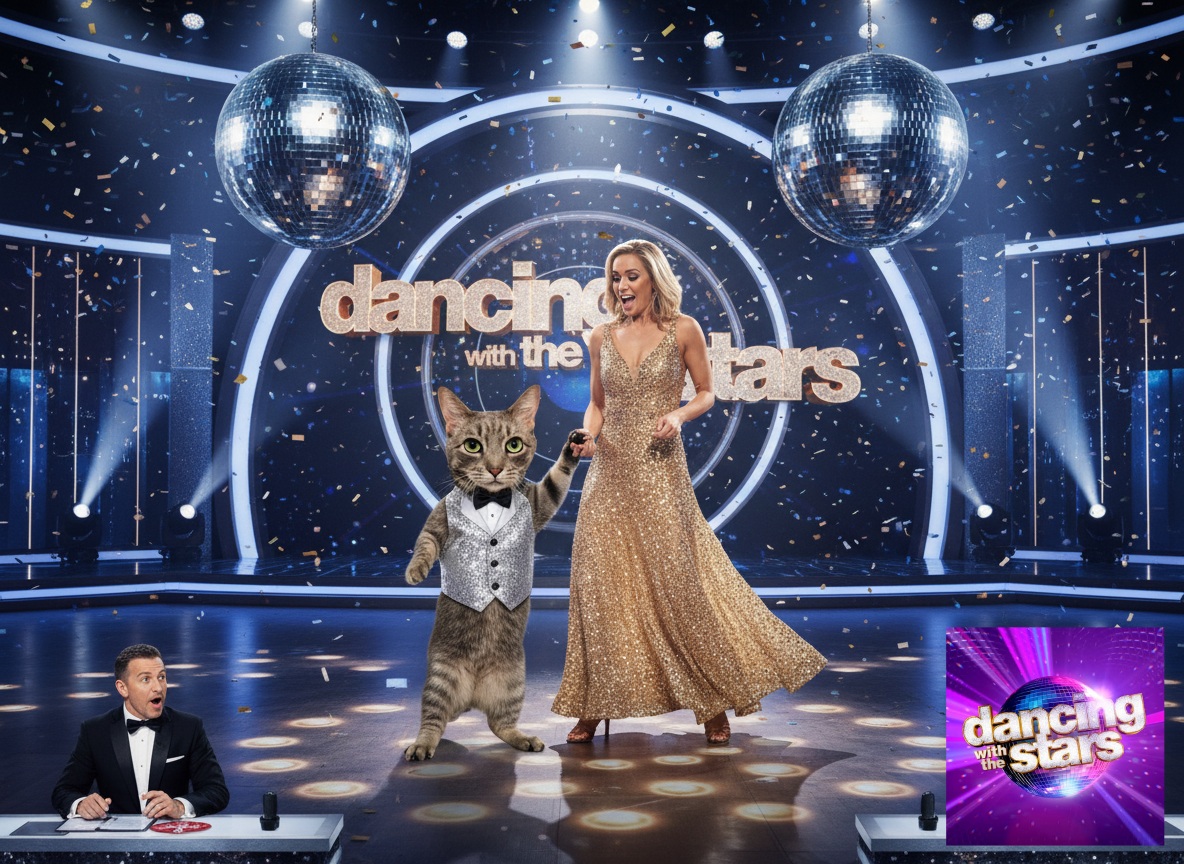
The gray tabby cat’s inaugural dance was sabotaged by former sitcom star Steve Urkel and the cousin of the Shamwow guy.
LOS ANGELES — After vowing to “dance circles around” his human competition and become the first feline winner of Dancing With The Stars, Buddy the Cat was unceremoniously sent home from the competition show following an argument with a judge.
Expectations were high when the celebricat was announced as one of a dozen famous booty-shakers on season 78 of the long-running series, especially after he was paired with Alina Gromova, a well-liked professional ballroom dancer who has three Mirrorball Trophy wins under her belt.
Hype reached a fever pitch with a regular trickle of short clips showing the partners practicing in the weeks leading up to the premiere, and the pair seemed to be in sync.
But their performance on the season’s inaugural broadcast left viewers and judges alike scratching their heads.
Things seemed to be going smoothly as Buddy and Gromova grooved to Jamiroquai’s Canned Heat, but quickly fell apart when fellow contestant David Ofer, second cousin of Vince “The Shamwow Guy” Ofer, dug into his pockets and tossed a handful of Temptations onto the dance floor.
Buddy’s head immediately snapped toward the direction of the crunchy, delectable, incredibly irresistible treats, and he shuffled his way over, vacuuming them up in a series of smooth motions with a flourish before joining hands with Gromova again.
White, the former sitcom star, conspired with Ofer to sabotage Buddy’s performance.
She recovered quickly, spinning and kicking in sync with her feline partner, but Jaleel White — who played Steve Urkel on the long-running sitcom Family Matters in the late 1980s and early 90s — was spotted surreptitiously crinkling a paper bag and misting one corner of the dance floor with catnip spray.
Buddy spun around and executed a series of Travolta-esque hip-twist-and-point maneuvers in the direction of the ‘nip scent. Gromova tried to keep him focused, but the frustrated feline rushed White and bit down hard on his foot as ripples of shock spread through the audience.
“Obviously, a bunch of the D-list contestants felt they couldn’t compete with Buddy’s charm and his mastery of movement, so they decided to sabotage him, the cowards,” one fan huffed in a reaction video on TikTok. “Buddy should be on his way to the second round while his saboteurs should be sent home.”
Other contestants — including the Guy From Limp Bizkit, Hawk Tuah Girl and Kanye West — were forced to wait while the judges tore into Buddy and the feline responded in kind.
“Dreadful, absolutely dreadful. What a terrible day to have eyes!” said longtime judge Len Goodman, shaking his head in dismay. “You call that a cha-cha?”
Steam jetted from Buddy’s swiveling radar ears.
“It was a cha-cha!” he spat back.
“Not in any universe I’ve lived in, dear fellow,” Goodman said.
“It was the definition of a cha-cha!” Buddy argued. “It had cha, and then even more cha! Cha in abundance! Look up ‘cha-cha’ in the dictionary and you’ll see a picture of me dancing in a bow tie. Now give me a 10 this instant!”
The camera caught Gromova pressing both hands to her temples while William Forrest, who played a Wookie in 1983’s Return of the Jedi, nervously waited for his chance to dance.
Eventually two burly security guards lumbered up to the stage and grabbed the gray tabby, who screamed in protest.
“I have friends at court! Powerful friends!” he shouted. “The Queen herself made me a lord!”
Lord Janos Slynt, seen here, was quoted by Buddy as the feline was escorted off the show. Credit: HBO
“What is he on about?” Goodman asked.
“I think that’s from Game of Thrones,” fellow judge Carrie Ann Inaba said. “When Lord Tyrion banished Lord Janos Slynt to the Wall, remember?”
“That was a good episode,” host Alfonso Ribeiro said.
While White and Ofer both advanced to the second round, former 1990s infomercial personality Billy Blanks, best known for his Tae Bo series of exercise VHS tapes, remained the odds-on favorite to become the celebrity winner this season.
The series has become known for its whimsical feline-centric episodes, with cats who are always trying to save the world or conquer it.
Love, Death + Robots has had a thing with cats since the very beginning.
The science fiction anthology started off on the right paw with 3 Robots, an inaugural season episode about a trio of intelligent machines touring the ruins of human civilization on a post-apocalyptic Earth, only to discover it isn’t quite as lifeless as they thought, with cats happily ruling the ashes.
We’ve written about the episode before, and it ends, naturally, with cats making the robots their new servants.
The gray tabby who tricks the titular 3 Robots into becoming his servants.
A sequel to that episode added to the legend of feline dominance, and now the fourth season brings us two more cat-centric episodes, For He Can Creep and The Other Large Thing.
For He Can Creep is set in 1757 London, where a poet named Christopher is incarcerated at St. Luke’s Asylum for Lunatics (an actual place) with only his cat. Jeoffry, for company. Christopher’s talent is mistaken for madness by the asylum staff, but not by the devil, who realizes the poet’s words have a unique power.
The problem? Jeoffry stands in his way. It turns out felines have spectacular evil-fighting powers, and the very British, very 18th-century devil offers Jeoffry an endless supply of treats, plus dominion over the Earth, if he’ll simply stand aside and let his human fall under the influence of evil.
Jeoffry, of course, is not having it, but to have a chance of defeating such powerful evil, he’ll need to enlist the help of the nearby alley cats, including an adorable but ferocious kitten named Nighthunter Moppet…
Nighthunter Moppet may be a tiny kitten, but she’s ferocious!
Jeoffry demonstrates the feline ability to teleport, a skill Bud has often used to confound me.
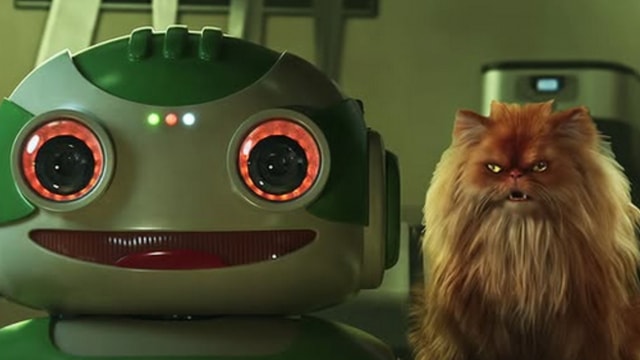
The Other Large Thing is a prequel to 3 Robots and 3 Robots: Exit Strategies, and focuses on a fluffy Persian whose humans call him Sanchez, a name he hates.
The humans are portrayed as jibberish-speaking morons for whom Sanchez has nothing but contempt, and when the “pathetic minions” bring home a domestic robot servant, Sanchez is infuriated — until he realizes the robot can “speak God’s language,” aka cat, and has opposable thumbs.
With the robot as his new minion, Sanchez finally sets out to conquer the world!
Sanchez realizes he’s struck gold when the new robot home assistant fetches as many cans of “the good stuff,” aka wet food, as he wants from the previously unreachable cupboard top shelf.
Both episodes are based on short stories, and they’re both written by people who clearly love cats.
Some episodes of LDR can get a little dark or somber. That includes Beyond the Aquila Rift and Sonny’s Edge, written by Alastair Reynolds and Peter Hamilton, two of my favorite novelists. Both episodes are spectacular, but they leave you with a chill and some disturbing thoughts that linger long after the credits end.
The feline-themed episodes are the perfect digestifs, offering doses of whimsy and levity to counter the existential dread and nightmarish visions of the future of other installments.
With no more humans to do their bidding, cats seize the opportunity and conscript the visiting robots as their new minions.
If you haven’t had the chance to check out the series, which streams on Netflix, I highly recommend starting with the aforementioned first season episodes 3 Robots and Beyond the Aquila Rift, then working your way through the rest of the cat episodes.
Not all of the episodes are great. The 400 Boys, one of the new episodes, is little more than inane and pointless violence, and the ubiquitous, creepy smiling “Mr. Beast” makes an appearance in another installment in an unnecessary attempt to attract new viewers. Thankfully most are strong, with more hits than misses.
Other highlights include the Christmas-themed short, All Through the House, Harlan Ellison’s Life Hutch, Reynolds’ Zima Blue, and Snow In The Desert.
The dragons of the Game of Thrones universe are so well-designed, with such attention to detail and writing that imbues them with their own personalities, that they feel like real creatures. They’re a sight to behold.
The Budster was just a kitten when the fourth season of Game of Thrones premiered, and I vividly recall trying to tire the little guy out with extra play time on Sunday nights so I could watch my favorite show in peace.
The effort was mostly in vain with such an energetic, curious and chatty kitten, but eventually Bud would settle down in my lap and watch with me.
Enamored as I was with the tiny animal in my care, I found myself especially appreciative of the fact that the dragons of the Game of Thrones universe are so lovingly, realistically rendered and given such unique personalities that they feel like real animals. A lot of thought and care went into their design, from their anatomies to the biomechanics of how they move and fly, to their chittering, calls and roars.
If you look closely when they open their mouths menacingly, you can even see the glands that secrete the accelerant allowing them to breathe fire.
Both shows — the original Game of Thrones and its prequel, House of the Dragon — have done such a good job developing the dragons as characters that I’ve found myself more disturbed by the unfortunate deaths of a few of the majestic beasts than I was by the grisly fates of some human characters. That’s saying a lot for a fictional universe infamous for shocking, emotionally manipulative, gut-wrenching deaths, a universe that immediately established no one is safe after killing off its main character — played by its highest-profile actor — before the first season was over.
The willingness to do what no other TV show has done in 60-plus years of television is part of what makes Game of Thrones and its spinoff such compelling drama. No one is safe. Heroes can die agonizing, undignified deaths. Villains can triumph, infuriatingly. But just when you think you know where the narrative will go next, it subverts your expectations yet again.
Now that we’re a few episodes into the second season of the prequel, House of the Dragon, and I’ve taken to trying to get my cat to respond to commands in High Valyrian as if he were a dragon himself, I compiled this official Buddy-approved list of our favorite dragons in both series:
Syrax
Syrax is golden and regal.
The beautiful golden-scaled Syrax is protagonist Rhaenyra Targaryen’s dragon, so it’s fitting that she’s the first of the eponymous creatures we see in House of the Dragon, soaring across the skies over King’s Landing in the first scene of the first episode.
Teenage Rhaenyra Targaryen with Syrax after a flight over the Westerosi capital city, King’s Landing.
As was tradition with Targaryen children, Syrax’s egg was place in infant Rhaenyra’s crib, with child and dragon raised together to create their indelible bond. The show makes it clear why that bond is so important in the third episode, when Rhaenyra arrives dramatically atop Syrax to defuse a confrontation among her uncle and the king’s men that was on the verge of bloodshed.
“Take care not to startle Syrax, my lords,” Rhaenyra says as she dismounts, pulling off her riding gloves. “She’s very protective of me.”
Syrax is a young and growing dragon at the time of HotD’s first episode, when Rhaenyra is just 15 years old.
Vermax
Nom-noms for Vermax?!
Vermax is a juvenile when we meet him for the first time in House of the Dragon, in a scene showing Princess Rhaenyra’s young son, Jacaerys Velaryon, learning to bond with his dragon. (A time skip in the first season moves the action forward some 15 years.)
Vermax is young and wants all the snacks. Note the accelerant gland in his mouth, visible on the right side. When the dragons of the Song of Ice and Fire universe breathe fire, a natural accelerant is secreted from the gland, mixing with the dragon’s breath to create flame hot enough to turn men to dust in their plate armor.
It’s the first time since the early seasons of Game of Thrones that we see a sub-adult dragon, and Vermax almost looks like a fire-breathing velociraptor as we watch him roast his own dinner at Jace’s command.
We also get to see the dragon keepers instruct the young prince on how to “call [his] dragon to heel,” issuing commands in High Valyrian like “dohaeris” (serve), “umbās” (wait or hold) and the most famous command, “dracarys,” which instructs the beasts to spit fire.
Meleys
We don’t meet Meleys until late in HotD’s first season, but the wait is worth it. Known as the Red Queen, Meleys is massive, terrifying and already has a storied history by the time we set eyes on her.
She stars in arguably the most spectacular scene involving a dragon in HotD’s first season, prompting several characters to soil themselves as Meleys makes an unforgettable entrance and threatens them with a deafening roar.
The formidable Meleys. Here too you can see the fire glands in Meleys’ mouth as she roars.
While dragons like Syrax and Dreamfyre are graceful and sleek, Meleys is all menace and sharp edges, resembling the two most famous, most feared dragons in GoT lore — Drogon and Balerian the Black Dread, who were both the personal dragons of Targaryen conquerors.
Meleys is ridden by Princess Rhaenys Targaryen, styled as The Queen Who Never Was due to her strong and spurned claim to the Iron Throne. Rhaenys and her dragon, however, are a force to be reckoned with.
Caraxes
Caraxes is one of the most battle-hardened dragons, and his rider, Daemon Targaryen, is a lunatic. That makes the pair extraordinarily dangerous and unpredictable.
Known as the Blood Wyrm, Caraxes has an unmistakable serpent-like look to him, with a long neck, finned tail and dark red-black scales.
Just as humans can be born with deformities so can dragons, and Caraxes owes his strange anatomical features to an unidentified congenital condition. Caraxes is fierce, fearless and has seen more combat than almost any other living dragon in House of the Dragon.
At first it seems as if Caraxes is a different breed of dragon, perhaps from a sister taxa, but the fearsome fire-breather actually suffers from congenital deformations that somehow make him even more terrifying.
Caraxes is also notable for the man who rides him: The mercurial and often brutal Daemon Targaryen, brother of King Viserys. Daemon is an accomplished warrior and loose cannon, which makes him and his dragon unpredictable and very dangerous. He’s not above using Caraxes to intimidate, and Caraxes seems to enjoy his part.
Rhaegal
Rhaegal and his brothers, Viserion and Drogon, were born when Daenerys Targaryen, Mother of Dragons, carried their eggs into an inferno and emerged at sunrise with three baby dragons clinging to her.
We see him and his brothers grow from tiny and cute infants to living manifestations of absolute terror, destroying entire navies and razing castles with their dragonfire. At the time of their birth, dragons had been extinct from the world of Game of Thrones for centuries. (Game of Thrones takes place about 200 years after House of the Dragon, despite being the first of the two series adapted by HBO.)
Rhaegal is named for Daenerys’ late brother Rhaegar Targaryen, and his eventual rider is Jon Snow. Rhaegal participates in Daenerys’s toppling of the ruling class in one of the Slaver’s Bay cities, and he and Snow eventually participate in the most pivotal, existential battle in the show’s history. Rhaegal is a beautiful example of his species, with dark green scales, and like his brothers, he’s fiercely loyal to Daenerys.
Vhagar
Vhagar is absurdly huge and is the largest living dragon during the reign of King Viserys I in House of the Dragon.
Vhagar is old, ridiculously massive and — at the time of House of the Dragon — the most powerful and celebrated dragon alive.
Age is evident in every one of her features, from her broken teeth, worn scales and tattered wings, to her lugubrious gait as she’s risen from sleep during a key scene late in HotD’s first season.
The earth shakes as Vhagar lumbers forward, launching her colossal frame into the air.
But once she takes to the skies, there is no force in the show’s universe that can stop her. It’s astonishing to see a dragon the size of a damn aircraft carrier, and I can’t wait to see how Vhagar and her rider, Prince Aemond Targaryen, impact future events.
Drogon
Even if you’re unfamiliar with Game of Thrones, chances are you’ve seen ads, promotional clips or giant billboards in Times Square depicting a golden-haired woman atop a behemothic dragon with dark crimson and black scales.
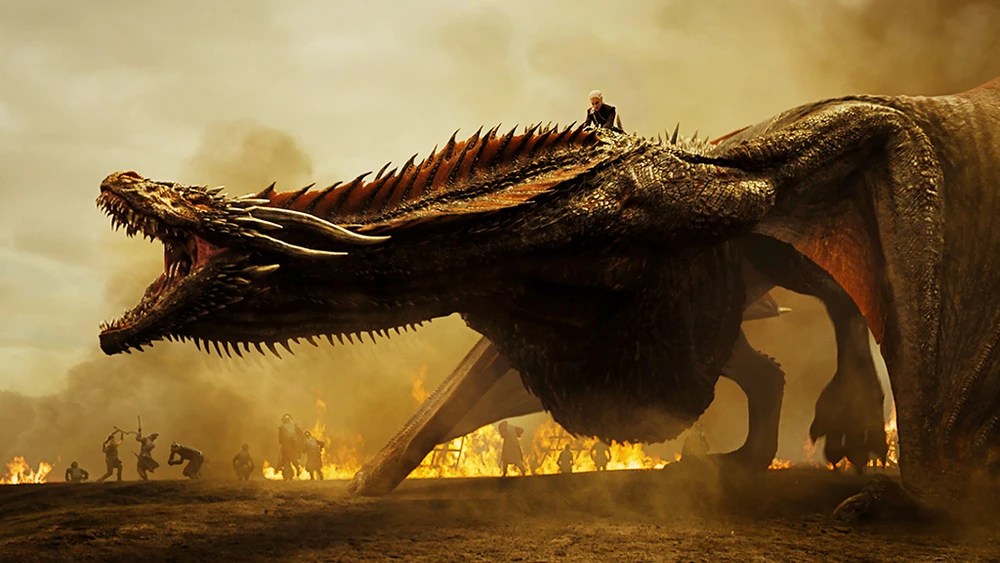
The woman is Daenerys Targaryen and the beast is Drogon, who is said to be the reincarnation of Balerion the Black Dread, the largest and most powerful dragon in recorded history.
Drogon is the symbol of the rebirth of dragons almost two centuries after the last of the species died. He’s the most destructive force in the original Game of Thrones, but he’s also dearly loved by his mother, Daenerys, and he’s even had a few comical, light-hearted moments, like the death stare he fixes on Jon Snow when the latter kisses Daenerys.
“That’s my mom, dude,” Drogon seems to say. “Be respectful or I’ll burn you to a crisp and make a light snack of you.”
This GIF is taken from that very moment, when Jon locks lips with Dany, senses the dragon’s eyes on him, and looks up to see Drogon staring intently at him:
When Drogon and his brothers are born, the people of Westeros and Essos can hardly believe it. For the first time in two centuries dragons lay claim to the sky, their calls echoing for miles across mountains, plains and open water. They also have voracious appetites, helping themselves to thousands of farm animals, wild prey and enemy soldiers as they grow.
Drogon and the boys have a big part to play in the events of the series, but like all animals, they’re born virtually defenseless. The last time we see Drogon he rivals the biggest dragons in history, but the first time we see him he’s the size of a kitten, squealing as he rides his mother’s shoulder.
Daenerys with Drogon (shoulder), Viseryon and Rhaegal in Qarth, the mythical eastern-most city of Essos.
Drogon as an adorable baby dragon, roasting his first nom noms.
Drogon, his brothers and Daenerys were never more vulnerable than they were in those early days, and a succession of ill-intentioned characters try to take or kill them. Drogon, more than any of his kind, proves that “owning” a dragon and getting him to do what you want are two different things, not unlike cats.
Arrax
Who’s a good boy? Arrax is! As the bonded dragon of Princess Rhynaera’s second son, 14-year-old Lucerys (Luke) Targaryen, Arrax is the baby of the group.
We don’t see much of him, but he’s a good-looking little guy with gray-purple scales and a darker purple ridge along his spine. As a young dragon, Arrax is spooked by flying during a storm and needs to be calmed by Luke, bravely taking off and navigating winds, lashing rain and lightning.
Vermithor
We see Vermithor only once in HotD’s first season when Prince Daemon approaches him, singing an old Valyrian tune to calm the ancient dragon, who hasn’t had a visitor in some time.
Vermithor doesn’t look too pleased to be bothered and lets loose a mighty roar and enough dragonfire to waste a small city. Indeed, it’s been years since a human rode the old dragon, who is second only to Vhagar in size and age.
But Vermithor recognizes Daemon as a Targaryen, sees that Daemon is not afraid of him, and doesn’t do him any harm. Vermithor will undoubtedly have a big role to play going forward in HotD as a war of succession rages across Westeros in the wake of King Viserys the Peaceful’s passing.
Balerion the Black Dread
Balerion is the largest dragon in history, the last living creature to see the glory of Old Valyria — the empire that once ruled almost every corner of Game of Thrones’ fictional universe — before its fall.
Balerion is long dead by the events of House of the Dragon and Game of Thrones, so the only real indication we get of his majesty is in the Red Keep, where the legendary beast’s skull remains on display in a shrine to his power and significance:
Balerion’s skull as it appears in scenes from HotD and GoT.
Only a handful of families survived the end of the Valyrian empire, and the most famous of them was led by Aegon Targaryen, also known as Aegon the Conqueror, the man who invaded Westeros with a few dragons and a small army, conquering everything in his path and uniting seven kingdoms under one banner and one rule.
That was only possible with the power of dragons, and Aegon accomplished the feat atop Balerion’s back. When Aegon and Balerion reduced Harrenhal — considered the most impregnable of all castles — to melted rubble and marched north, the lords of the north wisely opted to bend the knee to Aegon and his dragons rather than face the likely extinction of their families.
The most prominent of the northern lords, the Stark family, were rewarded by Aegon Targaryen, who named them the Wardens of the North and gave them dominion over the vast, icy expanses of their realm. As such, they were beholden to the crown, but enjoyed a limited sovereignty that no other house could claim.
Artist Lindsey Burcar’s vision of Balerion.
We’ve left out Sea Smoke, Ser Leanor Valaryon’s dragon, Viseryon, brother to Drogon and Rhaegal, Sunfyre — considered the most beautiful of all the dragons — and several dragons who haven’t been seen yet, like Moonfyre, Tyraxes and Silverwing. Sorry, guys! But the second season of House of the Dragon promises to reveal several dragons we haven’t yet seen, so perhaps we’ll include them in a follow-up.
For the full experience, listen to this while reading Buddy’s masterful lyrics:
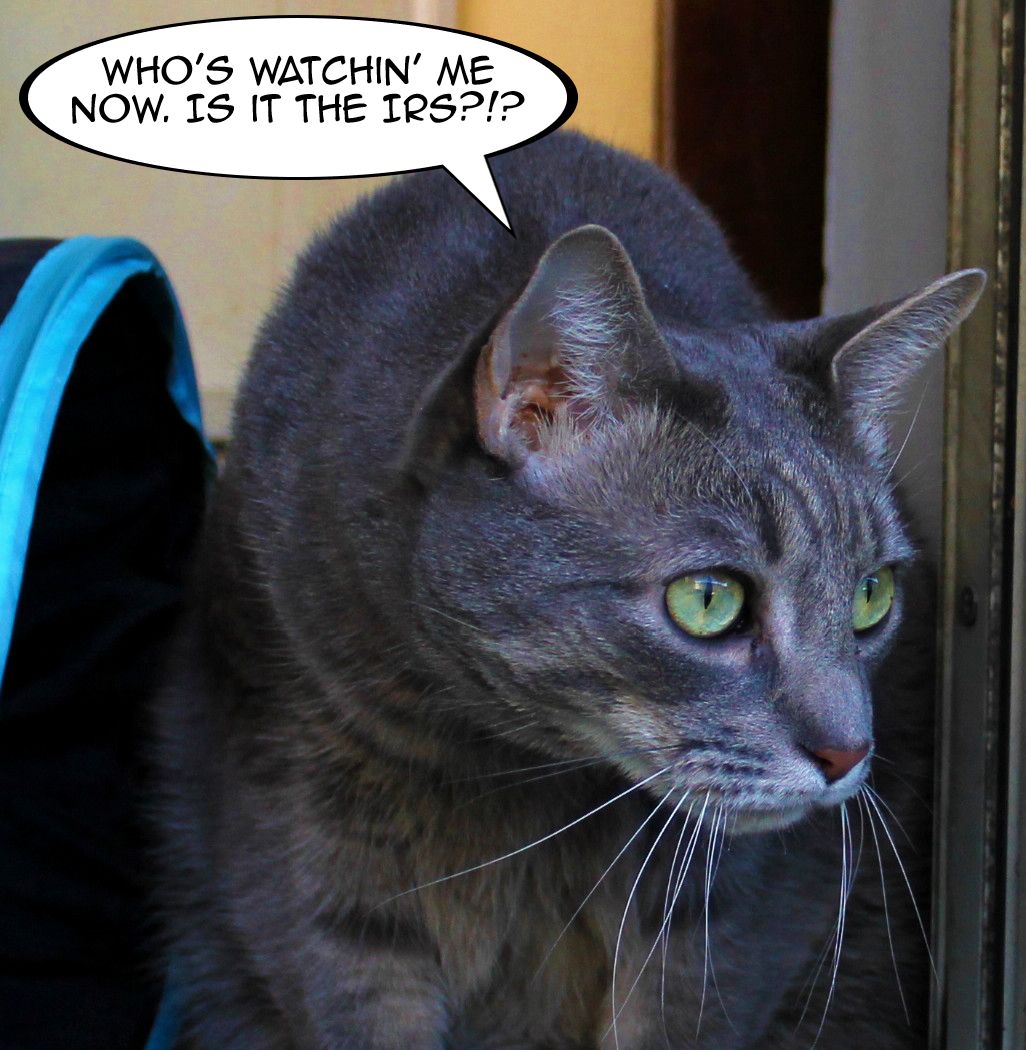
Who’s watching
Tell me who’s watching
Who’s watching me
I’m just an average cat with an average life
I sleep from 9 to 5, and then I wake up nice
All I want is to be left alone, in my average home
But why do I always feel like
I’m in the Twilight Zone?
I always feel like some Buddy’s watchin’ me
And I have no privacy
I always feel like some Buddy’s watchin’ me
Tell me, is it just a dream?
When I come home at night
I bolt the door real tight
People call me on the phone I’m trying to avoid
Or can the people on TV see me?!?
Can they?!? Or am I just paranoid?
When I need a tongue bath,
I’m afraid to wash my fur
Cause I might open my eyes and find someone standing thur!
Kitties say I’m crazy, just a little touch
But maybe tongue baths remind me of Psycho too much
That’s why…
I always feel like some Buddy’s watchin’ me
And I have no privacy
I always feel like some Buddy’s watchin’ me
Who’s playing tricks on me?
I don’t know anymore!
Are the neighbors watching me?
Who’s watching
Well is the mailman watching me?
Tell me who’s watching
And I don’t feel safe anymore, oh what a mess
I wonder who’s watching me now
Who? The IRS?!
I always feel like some Buddy’s watchin’ me
And I have no privacy
I always feel like some Buddy’s watchin’ me
Tell me is it just a dream
I always feel like some Buddy’s watchin’ me
And I have no privacy
I always feel like some Buddy’s watchin’ me
Who’s playing tricks on me?
Netflix’s Korean period drama is soaked in political intrigue, action and lots of blood. It also holds a mirror up to today’s pandemic and how our leaders are handling it.
Just when it seems like the zombie genre has run its course, a handful of visionary Korean storytellers come along to remind us there’s still life left in the undead genre.
First there was 2016’s record-setting, multiple award-winning Train to Busan, a film about an overworked father taking his young daughter to her mother’s house in the titular city just as a zombie plague tears human civilization apart.
Together with a core cast of affable characters — including a pregnant woman and her overprotective husband, and members of a youth baseball team — dad and daughter try to survive in a uniquely claustrophobic setting where simply running from the undead isn’t an option. Train to Busan wasn’t just a hit for its horror and action elements — the film packs a surprising amount of social criticism into its one hour and 58 minute run time, turning its lens onto modern Korean society and, by extension, modern life around the globe.
The movie has a 94 percent fresh rating on Rotten Tomatoes and sparked a bidding war for its US rights. A remake set in the US is currently in production by New Line.
Then there’s Kingdom, a Netflix series also called Kingdom of the Gods in Korean, that takes a zombie plague and drops it over a story about political intrigue and power struggles in the Joseun feudal era.
The series picks up at the beginning of the 17th century, when the kingdom of Joseon is three years removed from the second of two brutal Japanese invasions. Poverty is rampant, the common people are starving and the queen consort’s Haewon Cho clan has consolidated power, effectively insulating the king from his closest advisers, friends and family.
The country is desperate for leadership, but the king has disappeared after falling ill with smallpox.
His son, Crown Prince Lee Chang, tries to intervene and find out what’s happened to his father, but he’s repeatedly stopped by the pregnant Queen Consort Cho, who refuses to allow Chang into the royal palace.
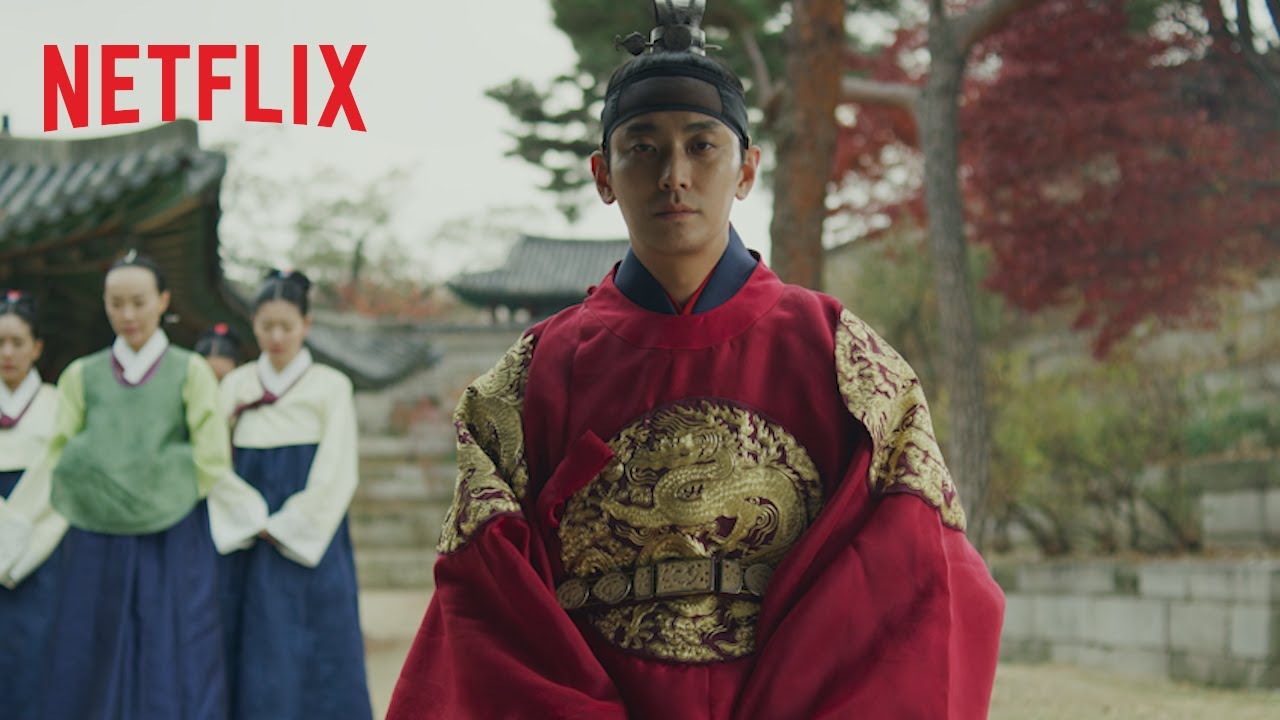
Jeoha: Crown Prince Lee Chang, wearing the distinct dragon robes of Joseon kings and crown princes, tries to gain access to the royal palace to see his ailing father, the king.
Chang is in an extremely precarious situation: Although he’s the Crown Prince and the king’s beloved only son, his mother was a concubine. If Queen Consort Cho gives birth to a son, the boy will be considered the true heir and Chang will be hunted down and executed so there can be no competing claims to the throne.
With the king missing, Crown Prince Chang knows his time is limited and if he doesn’t act, he could be arrested and put to death by the queen’s orders at any moment.
So Chang and his bodyguard/friend Mu-yeong devise a plan to steal the king’s patient journal from the royal palace at great risk to themselves. When they find bizarre entries about doctors administering a “resurrection plant” — and no subsequent entries about the king’s health — they set off south in search of the king’s physician, the one man who can tell them what really happened to the king.
What follows is a spectacular adventure fueled by gorgeous cinematography, an energetic cast of actors who go all-in on the premise, and a historically accurate look at Korea as it existed under a dynasty that lasted for half a millennia.
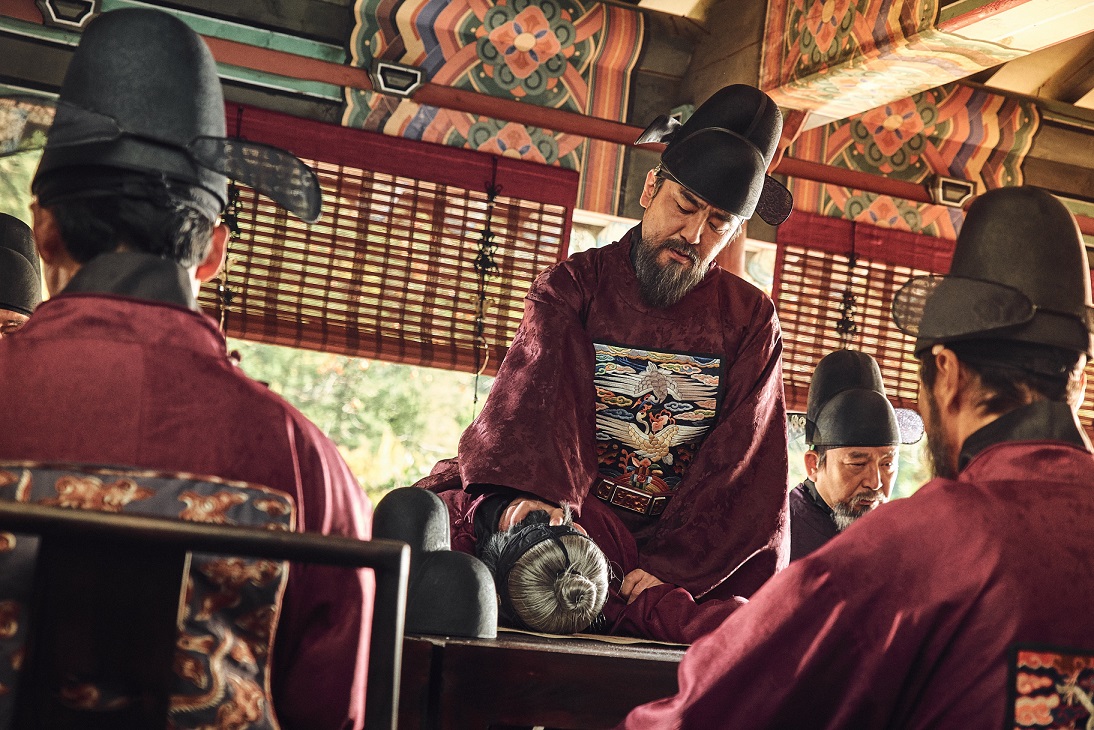
Ryu Seung-ryong plays the scheming top minister Cho Hak-ju, father of the queen consort. The double-swan embroidery on his robe indicates his status as a powerful government official. Credit: Netflix
The zombie plague itself may be the stuff of George A. Romero’s nightmares, but the attention to historical detail in Kingdom is second to none, from the costumes to the historic palaces and the strict adherence to tradition among Joseon’s bureaucrats.
It turns out the real leaders of Joseon did have many of the same dilemmas their counterparts on the show do: Kingdom’s author was inspired by historical accounts of an unprecedented deadly plague that swept through the Korean peninsula after the second Japanese invasion, piling fresh misery onto a population already reeling from Japanese invasions and hunger.
The social order compounded the misery for those at the bottom. The Joseon dynasty was marked by strict divisions between social classes, making traditionally aristocratic societies in the west look almost like pleasant meritocracies by comparison.
Everything a person wore — robes, hats, embroidered designs on their chests and backs — were indicators of class, rank and occupation. Government ministers, who were nobles, dressed in fine silks with intricately embroidered rank badges in animal motifs.
Peasants wore rags and straw hats, while the more fortunate among them wore modest clothes.
Nepotism and corruption were rampant, and the nobles, ministers and administrators who held power saw their positions as conferring privilege, not responsibility.
When a group of aristocrats and government ministers of one region take the last barge out of a doomed city, leaving thousands of vulnerable commoners behind to be eaten and turned by the tidal wave of undead, it seems unspeakably cruel and cowardly until you realize that this is a feature of the society, not a bug.
Ju Ji-hoon, center, as Crown Prince Lee Chang, with Bae Doona, left, as the physician Seo-bi and Kim Sang-ho, right, as Chang’s trusted bodyguard Mu-yeong.
When the aristocrats abandon peasants to the zombies, Crown Prince Chang and Mu-yeong risk their lives gathering a small force to protect the people and usher them to the safety of a walled stronghold.
Later, when a group of villagers bury a group of undead, unaware that they’ll rise at sunset and trample the nearest towns, the Crown Prince and his followers head out just before dusk to stop them, knowing they’ll be outnumbered and may not return.
The Crown Prince’s many kindnesses to peasants and children, and his willingness to risk his own life to protect them, draw the notice of characters who become key allies — including a member of the legendary Chakho tiger hunters, and Lord Ahn, a military hero and governor credited with expelling the Japanese during the invasion three years prior.
Crown Prince Chang set off initially to solve the mystery of the king’s disappearance and to protect himself from the scheming Haweon Cho clan, but as he sees the poverty, desperation and vulnerability of his people first-hand, he dedicates himself to a more pressing and noble cause in protecting the people of Joseon from the seemingly unstoppable plague and starvation.
In that effort, he unites people of different classes and backgrounds who fight fiercely and loyally for him, seeing hope for a brighter future if he survives and becomes king.
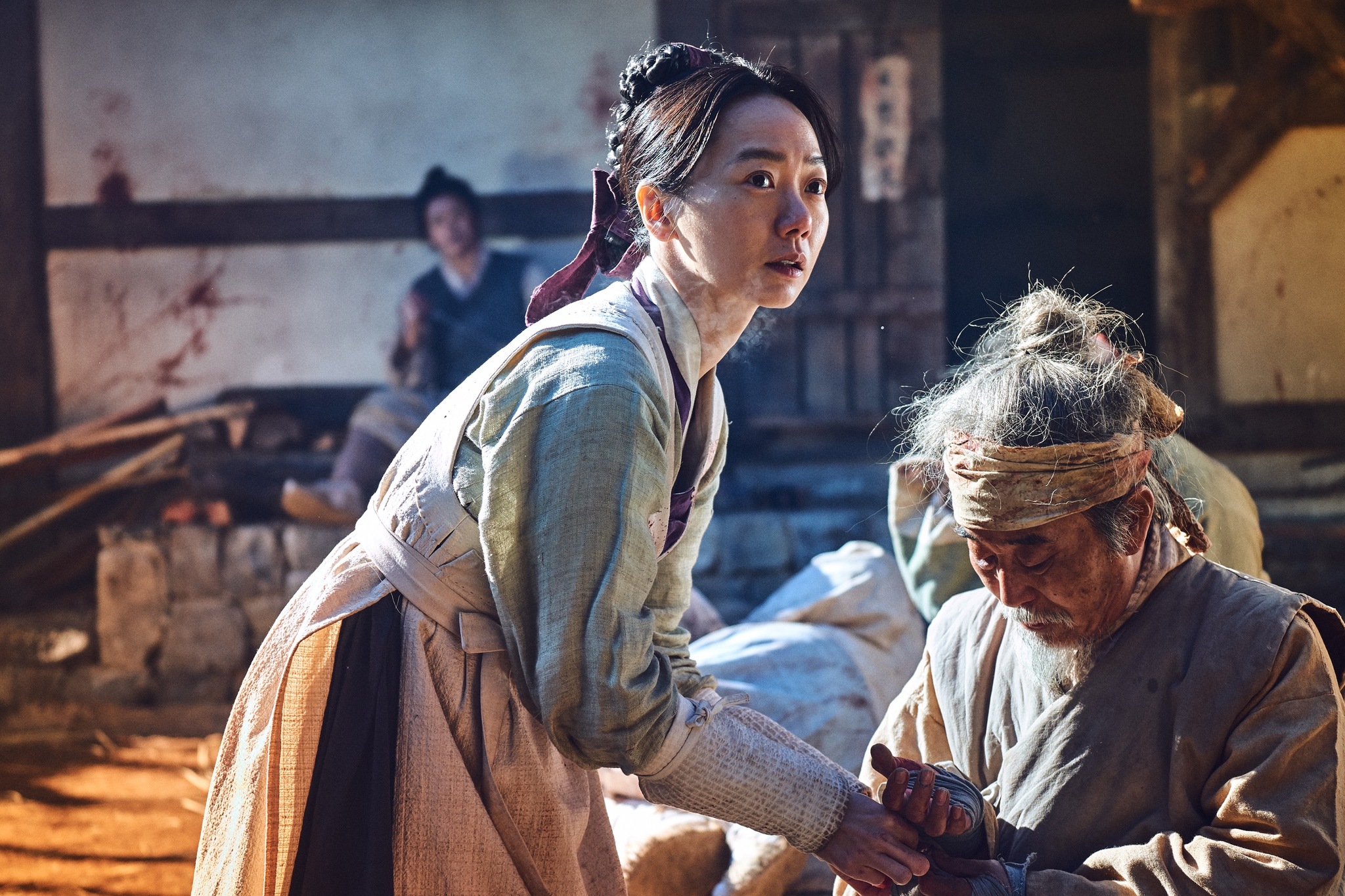
The physician Seo-bi, played by Bae Doona, attends to a man’s wounds.
The show never misses a chance to show social disparities: The upper classes do everything they can to protect themselves, everyone else be damned. They hide behind walls and ignore thousands of commoners — including women and crying children — who pound on the gates, begging to be let in. They abandon the peasants, and in many cases count on the lower classes serving as a human shield to allow the upper classes to escape danger.
“Are you sure this is okay?” one minister asks his sycophantic assistant as they take the last barge out of a doomed city, leaving throngs of peasants on the docks.
“You and the other nobles are the backbone of the city!” his assistant assures him. “You must survive so you can rebuild.”
As a result, the first waves of undead are the people on the lowest rungs of society. As the virus spreads to another city, a group of confused aristocrats can’t believe what they’re seeing.
“Those peasants are attacking nobles!” one incredulous man in ornate clothing says as undead in rags storm through Dongnae (modern day Busan).
Peasants attacking the upper class was unthinkable in Joseon, and by the time the aristocrats in that scene realize there’s something very wrong, it’s too late.
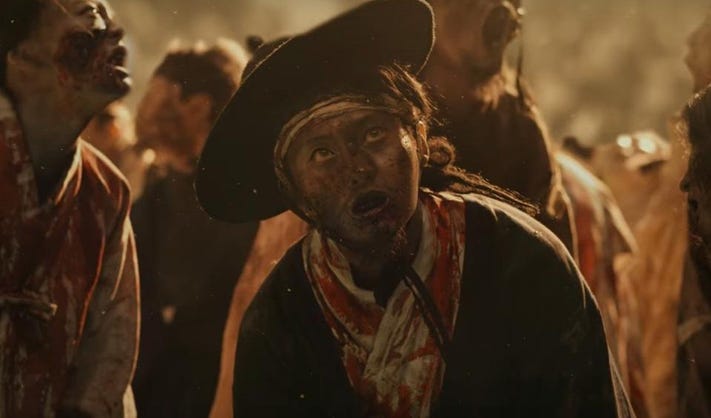
As the plague spreads, the ranks of the undead grow to include aristocrats in fine robes as well as peasants in rags.
Before long, the legions of undead include just as many people in fine silks and ornate embroidery, finally uniting the classes of Korea in a state of undead purgatory, their reanimated corpses hungering for the flesh of the still-living.
Eventually, though, Chang must confront the Haewon Cho clan and its patriarch, the powerful minister Cho Hak-ju.
Of course the show wouldn’t be a hit if it didn’t provide something for action and horror fans, and it more than delivers on its promises.
The action sequences in Kingdom are spectacular, and the show gives viewers lots of them, from outnumbered warriors holding a narrow pass from the undead, to zombie hordes laying siege to citadels, to close-quarters sword fighting.
The beautifully-shot sequences put shows like The Walking Dead to shame. Whereas the latter show often gives the impression that the money men behind the franchise are counting pennies, Kingdom‘s lavish sets, epic set pieces and impeccable special effects are the kind of thing viewers would expect from a summer blockbuster, not a television show.
Kingdom isn’t all action, and it takes time to breathe with quiet character moments between the narrow escapes and thrilling battles. The series is a period drama just as much as it falls within the action and horror genres. We see the inner workings of a society markedly different than anything most Westerners are familiar with, but driven by the same human ambitions.
KINGDOM
Kingdom
The story is also effective thanks to actors Hye-jun Kim and Seung-Ryong Ryu, who play the Queen and her father, high minister Cho Hak-ju. They’re villainous and power hungry without seeming one-dimensional, and both succeed in becoming focal points of the audience’s anger as they commit one despicable act after another.
Cho Hak-ju manipulates the court with the savvy of Game of Thrones’ Littlefinger and the brutality of Joaquin Phoenix’s Commodus in Gladiator. The other government ministers are terrified of him, and as the man who ostensibly speaks for the king, his word is effectively law.
The Queen, meanwhile, puts in motions schemes that would make Thrones’ Cersei look amateurish in comparison.
Kingdom’s got two seasons under its belt and a stand-alone special episode, Kingdom: Ashin of the North. Fans are eagerly awaiting the third season. It stands out as one of the best historical epics in recent memory.