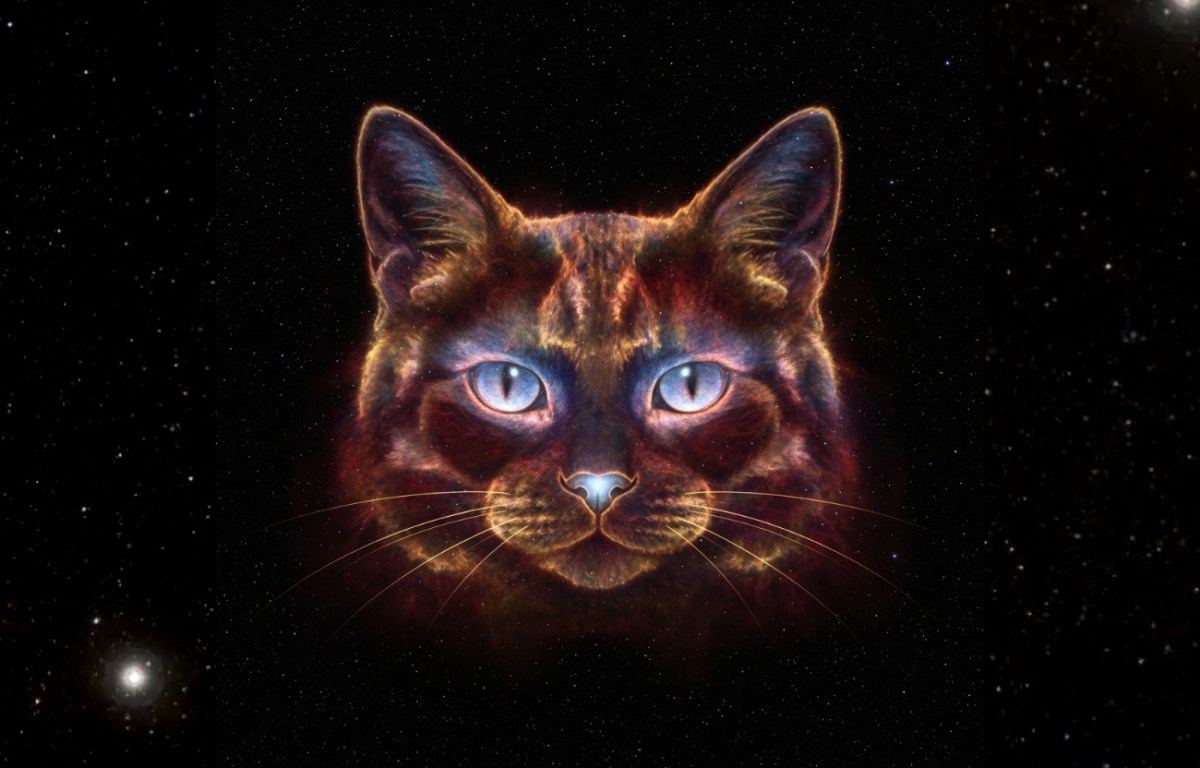
People Think This Nebula Resembles A Smiling Cat, PLUS: What Kind Of Music Soothes Felines?

Your cat’s taste in music may or may not align with your own.

Before we get into today’s cat news, I received an email asking why there hasn’t been much Buddy on the site lately.

Fear not, friends of Buddy! The little guy is down in the Amazon visiting his jaguar pals, but he’ll be home in time for the most important holiday of the year, Turkey day. He wouldn’t miss it for the world!

Buddy with a jaguar buddy in the Amazon, where there’s a special felid conference on new napping techniques.

A smiling cat?!

A story on Space.com says people see a “smiling cat” in images of a nebula, although we’re not so sure.

The nebula in question is Sh2-284, or Sharpless 284. It spans about 150 light years and sits about 15,000 light years from our star system near the edge of the Milky Way, in an outer spiral arm.

From a certain orientation, there may be suggestions of cat-like ears and eyes, although if there is a smile, it’s crooked and deranged-looking. Maybe the cat’s on pain pills from the vet?

There’s an opportunity here, since the nebula doesn’t have a nickname. The Buddy Nebula has a nice ring to it!

Here’s an image from NASA:

This spectacular picture of the Sh2-284 nebula has been captured in great detail by the VLT Survey Telescope at ESO’s Paranal Observatory. Sh2-284 is a star formation region, and at its centre there is a cluster of young stars, dubbed Dolidze 25. The radiation from this cluster is powerful enough to ionise the hydrogen gas in the nebula’s cloud. It is this ionisation that produces its bright orange and red colours. This image is part of the VST Photometric Hα Survey of the Southern Galactic Plane and Bulge, led by Janet Drew at the University of Hertfordshire in the UK.

And here’s an annotated image from astrophotographer Jim Thommes that shows us what we’re looking at and the immediate galactic neighborhood:

In Star Trek there’s always a convenient nebula nearby when the Enterprise — or Voyager, Titan or Discovery — needs to “hide” from some well-armed belligerent, and science fiction in general creates the impression that they’re like space swamps.

In reality nebulas are regions where the interstellar medium — the space between stars — is filled with gas, cosmic dust and inert matter. Some are stellar nurseries — places where stars are “born” — and some are the remnants of dead stars and the planets that orbited them.

They can seem to glow red, orange, green or blue depending on the elements present. Some of them reflect starlight while others are like filters, with the gases and dust lending their color to the nebulae structure.

Cats are pretty well-represented in the cosmos, from a human perspective. From the cat’s paw nebula to the Cheshire Cat galaxies, to the Lynx, Leo and Leo Minor constellations, astronomers have seen cats in the sky for millennia.

Does music help cats relax?

Although the research is limited, some studies have indicated certain genres of music can help our little buddies chill out. And if research into the canine response to music is any indication, we should expect to see more evidence for cats enjoying tunes.

When it comes to what kind of music is most effective, studies point to classical music with a slow tempo, as well as reggae and soft rock “with simple rhythms, slower tempos and no heavy percussion,” according to a new story from the BBC.

Just listening to some meowsic!

A 2016 study looked at the effect of music on 12 female cats who were recovering from spay surgery. The research team played “three different genres of music: classical music (CM), ‘Adagio For Strings (Opus 11)’ by Samuel Barber; pop music (PM), ‘Torn’ by Natalie Imbruglia; and heavy metal (HM), ‘Thunderstruck’ by AC/DC.”

The team measured heart rate, breathing rate and pupil dilation, concluding that classical music was most effective, followed by the Imbruglia song and AC/DC last. (Maybe next time they can slide The Tony Danza Tapdance Extravaganza in there for some extra fun.)

Anecdotally, Bud did not respond well to composer David Teie’s Music for Cats, but he hangs out and nods along to funk, classic 90s New York hip hop, retrowave, nu-disco, reggae and certain kinds of rock, which is almost certainly because he grew up hearing that stuff with me.

So maybe there’s a nature vs nurture element to feline musical preferences, although I wouldn’t hold out hope for cats who enjoy the Tony Danza Tapdance Extravaganza. Some things are best left alone.
Bud Battles A New Vacuum, Plus: Webb Telescope Reveals ‘Toe Bean’ Of Cat’s Paw Nebula

Buddy confronts his machine arch-nemesis, while NASA celebrates JWST’s third anniversary by imaging the cosmic cat’s paw in detail we’ve never seen before.

To mark its third anniversary, the team behind the James Webb Space Telescope has released an image of the Cat’s Paw nebula, and it’s incredible!

Below is a dramatically scaled down version of the image to make things easier on readers who may have slower connections or tend to visit PITB on mobile devices. The original is 30mb and can be found here.

It really is worth viewing at maximum resolution, where you can see details of the stellar nursery and the thick plumes of ionized gases that comprise the radiant, multi-hued structure of the nebula.

The dark red areas are dense concentrations of gases, the clouds from which stars are born. The blue stars are the cosmic newborns, and if you scroll through the image at maximum resolution, you can see those young stars floating in seas of their golden brethren in interstellar expanses stretching thousands of light years. In this image, we’re looking at an area of our galaxy between about 4,000 and 5,500 light years away.

Here’s the small version:

And here are images that better illustrate why it’s called the Cat’s Paw, with a view oriented in the “correct” way to trigger our brains’ pattern recognition processes, the mechanisms that make us think “Oh yeah, that does look like a cat’s paw!”

“Toe beans” up top, large pad beneath. The Cat’s Paw Nebula.
Viewed in different wavelengths to better see the overall structure without the obscuring elements.

We’re fortunate there is no cosmic-scale feline floating out there. Just imagine entire star systems batted around for fun, or a section of the galaxy reserved as a litter box.

I know this can seem overwhelming to some people, while others see images like this and think “What’s the big deal? Haven’t we seen things like this before?”

And the truth is no, we haven’t. That’s the beauty of the James Webb Space Telescope. We’re not only seeing galaxies and structures previously undiscovered, we’re also seeing familiar cosmic locations in detail and resolution that was previously impossible.

In a very real way, we’ve upgraded from standard definition Cosmic TV to the HD version.

The scope is in orbit, at a gravitationally stable position known as Lagrange point 2. In plain English, it’s a special place a million miles from Earth where the gravitational dance between our planet and our sun effectively cancel each other out.

Or, as NASA puts it, Lagrange points are “positions in space where objects sent there tend to stay put.”

It took decades of planning and the engineering talents of thousands of humanity’s best to create the JWST, which is also a spacecraft. The scope was built to travel to L2 without anyone aboard, then unfold itself in a delicate ballet of almost innumerable moving parts. The JWST’s ability to transform, like a butterfly emerging from a cocoon, is an engineering marvel in and of itself, and that’s before it began providing us with a better view of the cosmos than we’ve ever had in the history of our species.

Cheers to the scientists and engineers at NASA, who have repeatedly demonstrated they’re cat-loving people!

Header image credit: Texas Tech University Department of Physics and Astronomy

The fury of the Budster

Casa de Buddy has a new vacuum, desperately needed during this hot summer as Bud has been shedding more fur than usual.

I could have made another cat from all the hair the new vac picked up from the area rugs, couches and pillows, but Buddy wasn’t happy.

As PITB readers know, vacuums are high on the list of things Buddy despises. He’ll start hissing the moment he sees one, even if it’s not plugged in. He thinks they are angry nemesis machines created to infiltrate his territory and torment him.

Usually I try to lure the little dude into another room with treats and lock him in for a few minutes while I vacuum, but he was nowhere to be found, so I thought he’d spotted the vac and retreated voluntarily.

Tragically, I was mistaken.

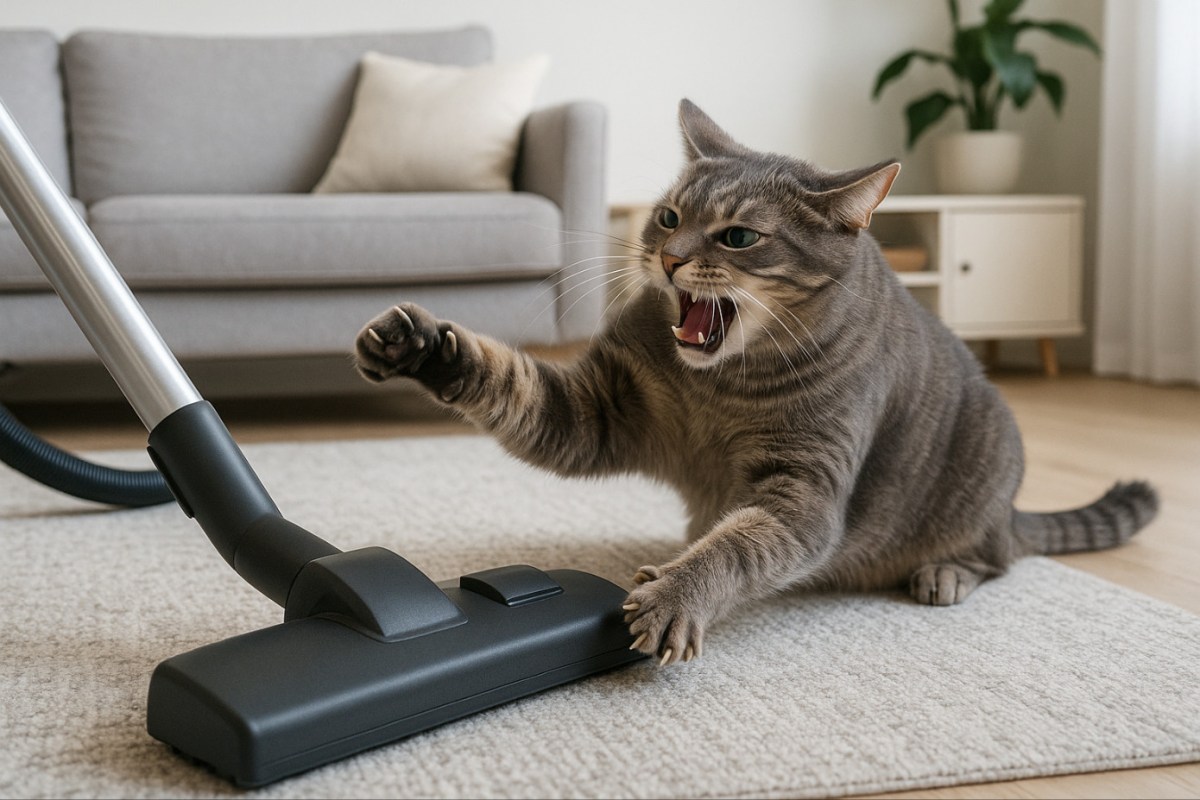
Shortly after I began vacuuming my bedroom, I heard a low growl, then Buddy leaped from his hiding spot under my desk and shrieked his high-pitched, baby-like battle cry as he launched himself at the evil vacuum!

It was comical. His little face was twisted into a mask of rage, his ears were pinned back, and he slapped the hell out of the vac: SLAP SLAP SLAP SLAPPP!!! with his little paws.

Here’s a reimagining of the ghastly incident, since it would be cruel to repeat it just to get photos. It’s Buddy — or the “model” of Buddy I’ve built using dozens of photos — exacting his wrath on the evil machines that disturb his peace:

I turned the vacuum off and tried to calm him down by reassuring him in a soft voice that he was safe. Nothing to be worried about, pal!

But I couldn’t stop laughing, which didn’t help the situation. Little man does not like to be mocked, and I’m convinced he fully understands when I’m laughing at instead of with him.

Ah, well. Next time there will be no assumptions and I’ll get him safely out of harm’s way before using the evil contraption.