Tigers Make A Triumphant Return To Russia’s Far East, Bringing Hope To The Species’ Future

For the first time, humans have successfully returned orphaned tiger cubs to the wild after raising them and training them to hunt.

For more than 50 years, tigers were absent from Russia’s Pri-Amur region.

Sparsely-populated, mountainous and blanketed in forest, the domain borders the heart of the Russian Far East, offering hundreds of thousands of contiguous square miles for the most robust sub-species of Earth’s most magnificent predator.

Here, tigers can roam without fear of conflict with local farmers, or roads that carve up habitat and pose a danger to animals trying to cross. Prey is abundant, and adaptations for surviving in the local terrain are coded into the tigers’ DNA.

Now that scientists have proven for the first time that tigers can be successfully reintroduced into such an environment, big cat advocates imagine Russia’s Far East as a haven for the large felids. It’s a place where tigers can thrive, mate, reproduce and change the outlook for their species, which has dwindled to only 4,000 or so remaining in the wild.

tigers in nature
Credit: Leon Aschemann/Pexels

The project to reintroduce Amur tigers to their native habitat is a cooperative Russian-American endeavor. The team started by building a tiger conservation center in the Amur oblast a decade ago.

The facility is built in a way that orphaned tigers can be raised and taught how to hunt without directly interacting with their human caretakers. That’s a crucial component, because tigers who see humans as potentially friendly or sources of food have drastically reduced chances of surviving in the wild, and are easier marks for poachers.

After 18 months, the cubs are brought to remote locations in Pri-Amur and released. Of the first group of orphan tigers released into the wild, 12 were able to survive on their own.

One gluttonous tiger failed: he crossed over the border into China and began eating domesticated animals, including 13 goats in what researchers called “a single event.”

The fattened tiger then retraced his steps to Pri-Amur, and when he didn’t show fear of humans, the team decided he had to go. They captured him and sent him to a zoo, where he gets all the free meals he wants and contributes to the captive breeding program helping his species maintain genetic diversity.

With 12 out of 13 tiger re-introductions successful, the program provides “a pathway for returning tigers to large parts of Asia where habitat still exists but where tigers have been lost,” said Viatcheslav V. Rozhnov, who leads the reintroduction project.

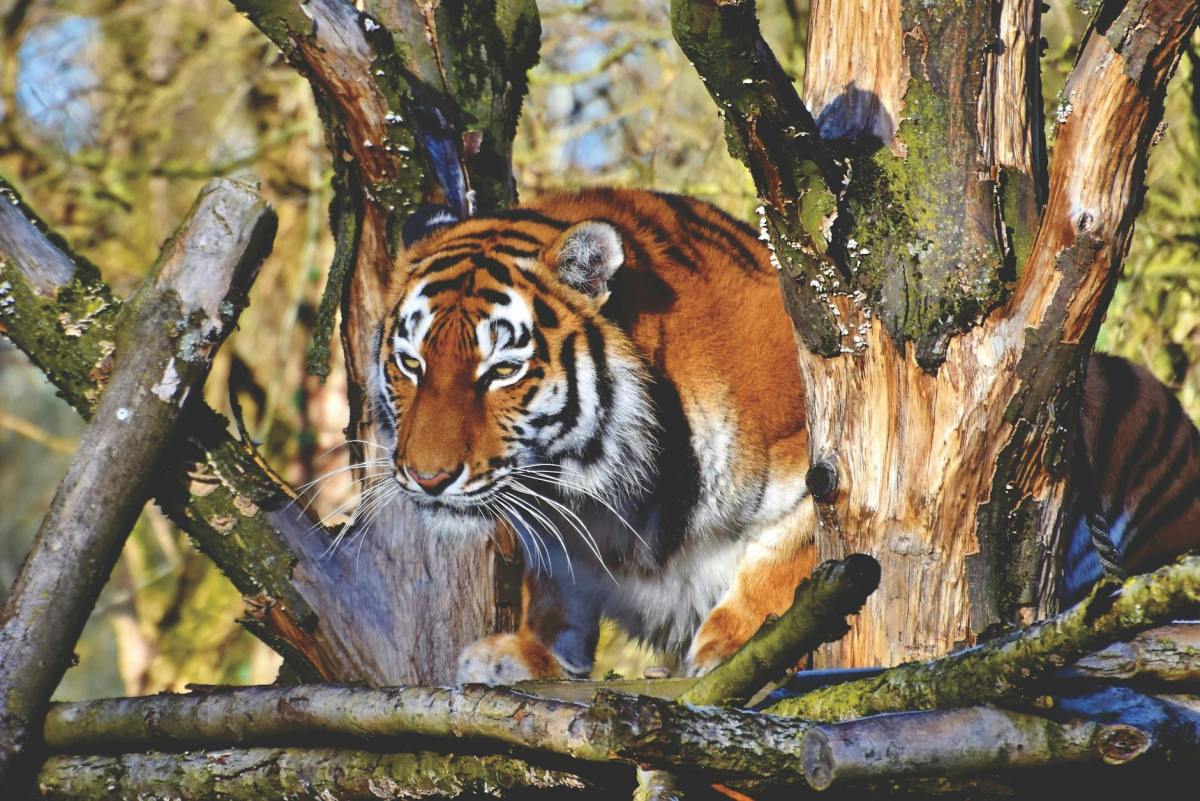
tiger
Amur tigers are the largest cats on Earth. They’ve evolved to survive in regions where winters can be brutally cold and snowy, but they also thrive in spring and summer when the snows melt and prey is abundant. Credit: Pexels

The successful reintroduction has also led to some surprising developments. Two of the cubs, Boris and Svetlaya, were unrelated but were rescued at about the same time and raised in the Russian orphanage for their species.

Using tracking devices they’d placed on the newly-released young tigers, the research team watched as Svetlaya settled into a home range and Boris made a beeline for her, “almost in a straight line,” crossing 200km (120 miles) of terrain to reunite.

The team’s hopes were confirmed six months later, when Svetlaya gave birth to a healthy litter of cubs, the first natural-born tigers to result from the reintroduction project.

Another tigress, Zolushka, also gave birth to a healthy litter when she was reintroduced in an area closer to a still-extant population of Amur tigers. The researchers believe the father was born wild in the region and was not part of the reintroduction program.

The wilderness in Pri-Amur and its environs is so vast, untouched and undesirable to human habitation that it could be home to generations of tigers, securing their future after so many decades of grim news for the iconic big cats.

“The grand vision is that this whole area would be connected,” Luke Hunter, executive director of the Wildlife Conservation Society’s Big Cats Program. “There’s lots of habitat that could be recolonized by tigers.”
The Era of Tiger Pets Is Over, Plus: Influencer Defends Hitting Cat, Says People Are Upset Over ‘Nothing’

Big Cat Rescue will pivot to conservation efforts across the world. Meanwhile, TikTok “influencer” Hasbulla says people are attacking him for “nothing” over a video showing him abusing his cat.

We start with some great news: Big Cat Rescue is shutting down because its services will no longer be needed.

Of course there are still plenty of tigers, lions, jaguars, leopards, pumas, lynx and cheetahs in the non-profit sanctuary’s care, but the passing of the Big Cat Public Safety Act has finally put an end to the cruel, abusive and absurd practice of keeping big cats as pets.

The animals will be moved to Turpentine Creek, an accredited animal sanctuary in Arkansas. Big Cat Rescue will continue to fund their care and will sell its existing land in Florida as it transitions to programs to prevent the extinction of big cat species, almost all of whom are critically endangered.

“We have always said that our goal was to ‘put ourselves out of business,’ meaning that there would be no big cats in need of rescue and no need for the sanctuary to exist,” Big Cat Rescue wrote in a memo released this week. “Supporting our cats in larger enclosures at Turpentine Creek, at much lower cost per cat than we incur by continuing to operate Big Cat Rescue, will free up resources to let us do much more to save big cats in the wild.”

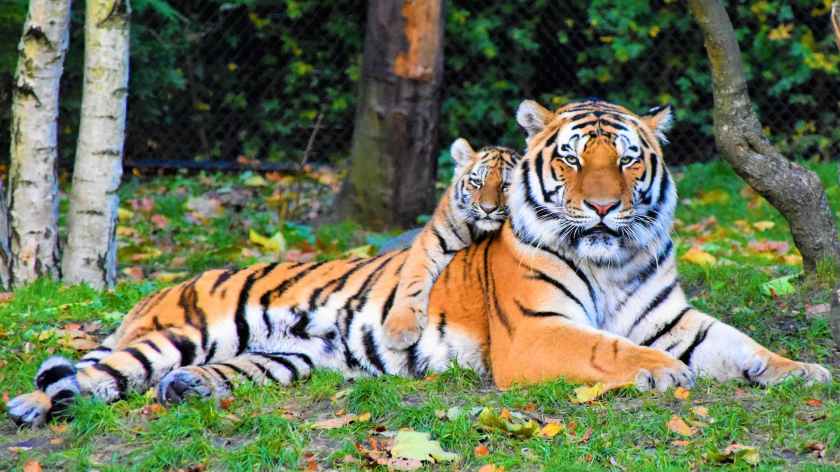
photo of tiger and cub lying down on grass
Credit: Waldemar/Pexels

The Big Cat Public Safety Act has not only made it illegal to own tigers and other wild cats as pets, it also puts an end to the cub-petting business used by roadside zoos, in which cubs are taken from their mothers as infants so the roadside zoos can charge customers to pet the cubs and pose for photographs with them. While big cat “pet owners” are grandfathered in, many have been rescued and there will be no more pets after the current group dies out.

Influencer Hasbulla says people “are attacking me for nothing” over video in which he abuses cat

Hasbulla, the Russian influencer whose videos have been viewed more than 10 billion times on TikTok, says people are making a big deal over “nothing” in response to a video showing him abusing his cat.

Hasbulla 3 169
Hasbulla is 20 years old but has a child-like appearance due to a genetic condition.

The 3’4″ social media “star” is known for frequently talking about “acting like a man” and in addition to being an enthusiastic supporter of Russian President Vladimir Putin and his war in Ukraine (he’s called Putin “a lion” on several occasions), he holds typical Russian views on the way men are “supposed” to act.

Hasbulla said he was merely disciplining his cat for “misbehaving.”

“Those brothers who think that I was beating the cat, pulled the ear, this and that. I pulled the ear gently,” Hasbulla said in a video accompanying a Twitter post. “I know that people are waiting for the moment, if I write something wrong, to just attack me like this. Like, ‘you do this, you do that’. She was misbehaving and I just pulled the ear and that’s it. I love my cat more than you. If I didn’t love the cat, I wouldn’t have it at home. My most lovely animal is a cat. And when she disobeyed, I scolded her a little. And you are attacking me for nothing.”

Of course anyone with common sense knows cats are not capable of “misbehaving” because they have no concept of what behaving means by human standards, and Hasbulla is being dishonest when he claims he was “gently” disciplining the cat.

In the video, which the Russian voluntarily uploaded, he’s seen grabbing the terrified cat by her ear and yanking violently. The cat runs from him and retreats to a cardboard box where she tries to soothe herself, but Hasbulla follows, scolding her in his native language and hitting her several times on her head and body.

Unfortunately there is little concern for animal rights in Hasbulla’s country, so it’s very unlikely he’ll run afoul of any Russian laws, and even less likely that an animal welfare organization will confiscate the abused feline.