A Politician Destroys Her Career By Failing To Read The Room On Animals

Kristi Noem thought she was burnishing her image as America’s tough cowgirl politician by telling the story of how she shot her hunting dog. Instead, she united the country in disgust.

Before a commercial publishing house sends a book off to print — especially a political memoir expected to create buzz and move copies in high volume — dozens of sets of eyes have looked over the manuscript.

The author — in this case the author and ghostwriter — her PR team, consultants, editors, fact-checkers, attorneys and test readers all have eyes on the text as they prepare it for the printers.

Thanks to Politico’s reporting, we now know several of those people — including the ghostwriter, the imprint’s editors and her own advisors — actively discouraged South Dakota Gov. Kristi Noem from including an ugly anecdote about shooting a “problem” dog in her book, but Noem was insistent on using it. She thought the story would burnish her brand and appeal to rural voters, signaling that she’s a salt of the earth type who doesn’t balk at making hard decisions.

That was an epic miscalculation, and as the fallout continues with backlash from Americans across the political spectrum, it shows the days of thoughtless disregard for animals are over in the US, at least as far as public life goes.

Kristi_Noem_(50365679196)
South Dakota Gov. Kristi Noem. Credit: Wikimedia Commons

As most people know by now, Noem wrote about how she shot a 14-month-old dog named Cricket on her family farm for “ruining a hunt” and going after a neighbor’s chickens. Cricket, Noem wrote, was “worthless as a hunting dog” because she got overly excited and went into sensory overload during a pheasant hunt that Noem wanted to be memorable for a group of guests.

“I hated that dog,” she says in the book, via her ghostwriter, before describing how she dragged the excited puppy out of her truck and into a gravel pit, then ended the Cricket’s 14-month-old life with a gunshot to the face.

In a series of disastrous interviews over the past week, Noem has tried to reframe the story as an example of the hateful “fake news” media digging for dirt on her, but not only did the South Dakota governor enthusiastically include the dog-killing story in her new book, she was so confident it would win her points that she used the story as a teaser in social media posts and other marketing for No Going Back. (It’s her second book and follows 2022’s Not My First Rodeo: Lessons from the Heartland. Noem really wants people to think she’s the embodiment of a Yellowstone character, a CrossFitting avatar of the real America.)

Noem thought she’d be hailed as the farm girl hero she wants to be, an image she’s cultivated during a political career that’s taken her from the state house to South Dakota’s lone congressional seat and, in 2019, the governor’s mansion.

noembook
Noem’s book, No Going Back.

I’ve spent my entire life in urban and suburban environs and I’ve essentially taken a Jainist attitude toward animal life. I’ve never hunted an animal and never will, so I’ll defer to longtime South Dakota scribe and hunter Kevin Woster, who thoughtfully writes about the experience of raising hunting dogs and the challenges it involves.

Woster believes Noem put a puppy in situations that would challenge even an experienced hunting dog, says the dog’s “shortcomings” were the fault of her owners, and thinks the dog could have had a long and happy life with a little patience and love. (It’s also worth pointing out that by killing chickens, the dog was doing precisely what Noem trained her to do. It’s not the dog’s fault Noem didn’t differentiate between the types of birds she wanted Cricket to attack.)

Other rural scribes have echoed those sentiments and pointed out that even on farms, being forced to kill an animal is a solemn and personal thing. Even if Noem had justification, it’s one thing to handle a regrettable situation and another thing entirely to choose to celebrate it in a memoir, even using it as a marketing teaser.

Politics is performative, and Noem isn’t alone in that respect. Here in New York our disgraced former governor, Andrew Cuomo, speaks in a heavy New York accent that borders on parody. During the pandemic, he once interrupted Dr. Anthony Fauci to muse about how Fauci was the “Al Pacino of COVID” and Cuomo himself was the Robert DeNiro of the killer virus, then derailed an explainer on safety measures to wax poetic on the Italian bakeries of the Bronx’s Arthur Avenue and “the old neighborhood,” as if Cuomo grew up playing stickball on the street in Brooklyn instead of ping-ponging between New York, D.C. and Albany when his dad was a three-term governor.

George W. Bush, the scion of a generational political family and son of a former president, grew up in Connecticut. But he wanted the American public to see him as a cowboy, so he affected a Texas accent, peppered his speech with folksy-sounding nonsense and famously landed a fighter jet on an aircraft carrier to declare an end to the Iraq War on May 1, 2003, 18 years before the last US combat units left the country.

Politicians put on these costumes because voters respond to them. But the backlash against Noem — who’s now banned from 20 percent of the land in her own state and also in hot water for allegedly inventing anecdotes about North Korean dictator Kim Jong Un, French President Emmanuel Macron and former UN Ambassador Nikki Haley — proves that, like a prince choosing to don a Nazi uniform for Halloween, a politician’s choice of costume says a lot about her judgment and values. In this case even the people of America’s heartland, the voters Noem was condescending to with her book, were horrified by the ambitious governor’s callous disregard for animal life.

The fallout has apparently destroyed any chance that Noem could be chosen as a vice presidential candidate on the Republican ticket, and term limits mean the sun is setting on Noem’s time as a “public servant.” Good riddance.
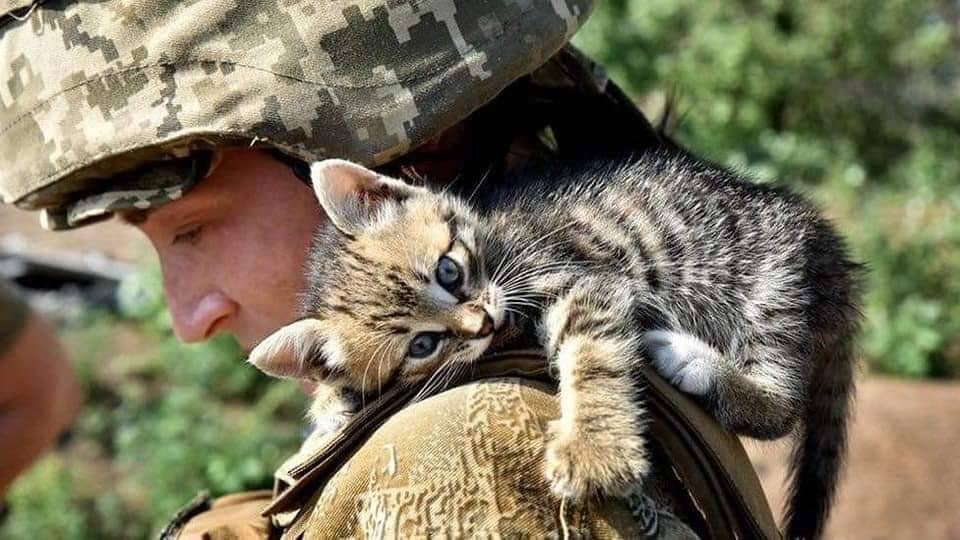
Cats Are Fighting The Ukraine War On The Propaganda Front — And From The Trenches

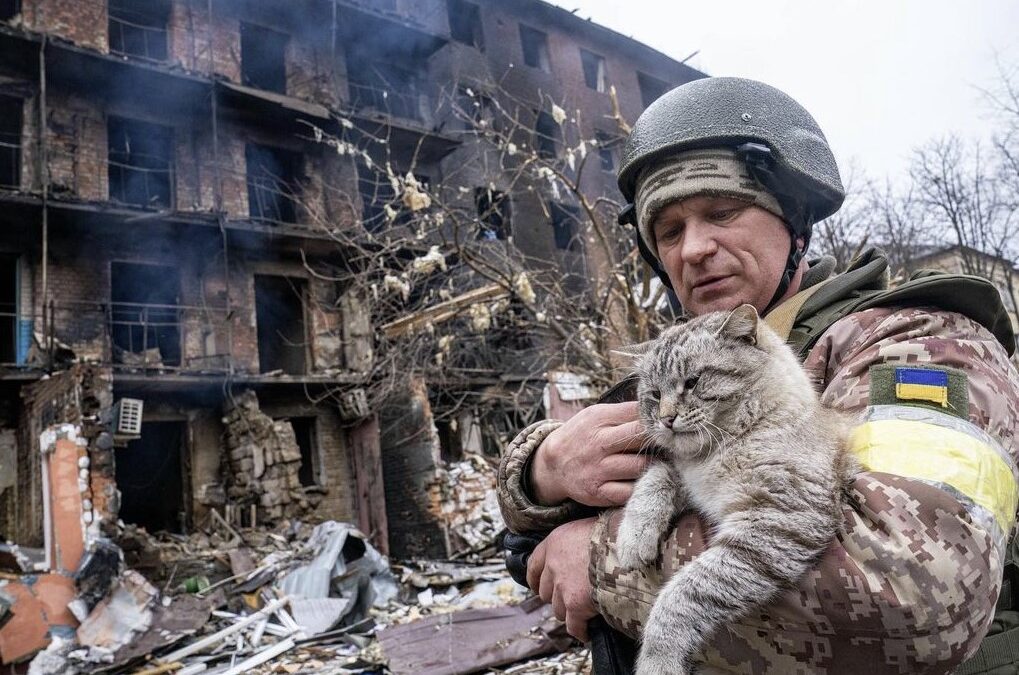
From the military camps where they stop mice from wreaking havoc to social media where they help raise money, Ukraine’s felines are enduring the war alongside their people.

Roman Sinicyn and his men were living in an abandoned house in a destroyed village for a month.

Although each of the Ukrainian soldiers contributed to their survival and fought the Russians, perhaps their biggest hero was Syrsky the Cat.

The fearless feline evicted a rodent infestation in the platoon’s temporary headquarters, hunting the mice mercilessly as his humans engaged in firefights with invading Russians. By day Syrsky made the soldiers’ temporary lodgings livable and by night he soothed their trauma with healing purrs.

The cheese-loving moggie’s moniker is a double-entendre: he’s named for Ukrainian Army Land Forces Commander Oleksandr Syrsky, and for the Ukrainian word for cheese, syr.

A new story from Politico EU details the important role of felines as the costly war enters its third year. Russian missiles, bombs and artillery have flattened villages, sending civilians fleeing and often separating them from their families and their pets.

The bewildered cats and dogs, accustomed to easy lives indoors, are suddenly thrust into a world of death, explosions, mine fields and other horrors.

As the war endured past its early phases, former pets began seeking out humans where they could find them — in military camps and in the rodent-infested trenches where they hunkered down against the constant thunderclaps of Russian artillery.

During peak war season in the summer, Vladimir Putin’s bedraggled military fires up to 20,000 artillery rounds a day according to the Associated Press, with that number dipping to “only” 7,000 per day as the war machine slows in brutally cold Slavic winters.

shaybykcat
Oleksandr Liashuk, a Ukrainian soldier, with his cat Shaybyk. Credit: Oleksandr Liashuk

Just like they did 10,000 years ago when they first domesticated themselves, cats proved their worth by chasing out mice and rats, but this time they didn’t have to convince humans to allow them to stick around. They were welcomed with open arms and hands bearing snacks, serving as hunters and therapy animals to men enduring a living hell.

“When this scared little creature comes to you, seeking protection, how could you say no? We are strong, so we protect weaker beings, who got into the same awful circumstances as we did, just because Russians showed up on our land,” Oleksandr Yabchanka, a Ukrainian medic, told Politico.

It’s amazing how a return to primitive circumstances has so quickly pushed humans back toward reliance on animals who made it possible for our species to survive in the first place.

Without dogs, early hunter-gatherers would have been much worse off on the hunt and their groups would have been much more susceptible to ambush when they slept. Indigenous societies eking out existences on the tundra would have no reliable animals to pull sleds. Without oxen to pull plows, farmers wouldn’t be able to produce enough food for civilization to thrive and grow.

And the people of nascent human settlements, taking the first great leap forward for our species with the invention of agriculture, would have starved out over long winters as mice and rats gnawed away at their food stores — if not for cats, our furry friends.

In 2024 humans can’t live without cats once again. Felines patrol Ukraine’s World War I style bunkers, killing hordes of mice. Mice that otherwise devour MREs, chew through comm link and power wires, damage weapons and make soldiers miserable.

ukrainecat
A Ukrainian soldier with a stray kitten. Credit: Ukraine Ministry of Defense

Some cats become unofficial unit mascots and good luck charms, but many others are claimed by individual soldiers who find normalcy and relief in their company.

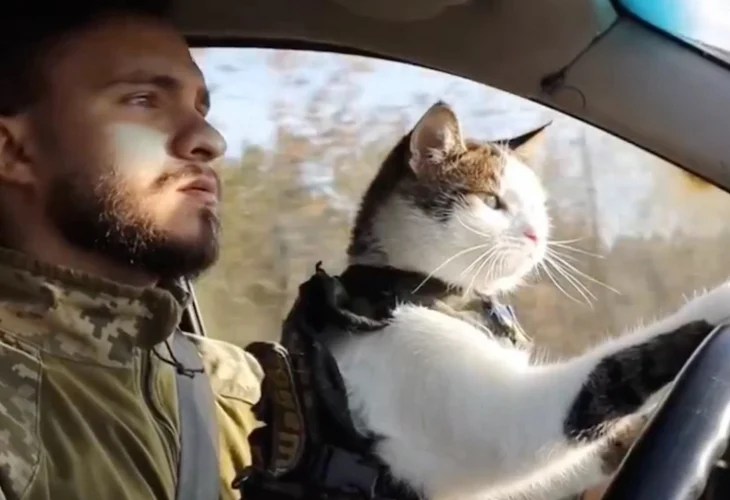
One soldier/cat pair are viral sensations thanks to videos of the alert cat riding along with his human, scanning the terrain ahead. Another story detailed a patrol whose men just avoided an ambush thanks to their company’s cat, who spotted the enemy first and frantically warned that something was wrong.

In that way, cats are serving the propaganda effort as well, helping the public to connect to the men and women defending them.

Military cats have become signals for Ukrainians to rally around, but Russians are doing it too. Russia is a famously cat-loving country, and Putin’s government has latched onto stories about the felines accompanying his men into battle — an effort that Politico notes is meant to humanize Russian soldiers and create the impression that it values them even as it continues to conscript unwilling civilians and ship them to the front line “meat grinders” with a few weeks’ worth of training, meager supplies and minimal ammunition for their rifles.

In that respect, the soldiers of Ukraine and Russia have at least two things in common — they love their feline companions, and they’re enduring hell as well as a high risk of death because of one small man’s delusions of greatness and legacy. Western media tends to ignore the humanity of Russian conscripts, and the pro-Ukrainian side of the internet calls them “orcs,” painting them as the mindless and disposable drones of a bloodthirsty dictator.

But they’re human too, with their own hopes and fears, and mothers back home worrying about them. They don’t want to be there. It seems fanciful to imagine Russians refusing to continue the invasion when Putin has squads behind the front lines with guns pointed at his own men to prevent them from deserting or refusing to fight. But maybe the men in the trenches can come together over shared interest and shared love of cats, and help put an end to three years of misery.