A report commissioned by the Scottish government blames cats for killing 27 million birds annually in the country.
“They may take our lives, but they’ll never take our freedom! Except maybe to keep pet cats.”
Mel Gibson’s iconic pre-battle rallying cry as Braveheart’s William Wallace might have to be amended if some Scottish politicians get their way and restrict the ownership of pet cats.
Cat lovers in Scotland were up in arms this week after several reports in Scottish and UK media said the Scottish National Party — Scotland’s most powerful political party, which controls almost half the seats in its parliament — is looking to ban cats in a bid to protect local wildlife.
They point to a recently released Scottish Animal Welfare Commission (SAWC) report that claims there are some 800,000 outdoor cats roaming the country, and those felines are responsible for 27 million birds every year, in addition to small mammals.
Meanwhile, other Scottish press pushed back on the claim, saying the SNP hasn’t voted to ban cats yet and isn’t really looking to stop people from having pet cats.
A report from the Scottish government recommends restricting cats to indoors, among other measures. Credit: Wikimedia Commons
In addition to a law requiring people to keep their pet cats indoors, the report suggested curfews and, yes, legislation that would forbid people from keeping pet cats if they live in certain places deemed “vulnerable” to feline predatory habits. That means if wildlife biologists identify an endangered bird that nests in an area, for example, people who live there would not be permitted to have pet cats.
However, the report does not call for a general or widespread ban, as some media reports suggested.
The report credited Australia, where several states have enacted strict measures forbidding people from allowing their cats outside, prohibiting them from owning cats in some places, and even embarking on an infamous campaign to kill three million domestic cats by air-dropping sausages laced with a poison that is lethal to felines, but supposedly not harmful to other animals.
That measure preceded several years of “biblical” rodent plagues, with hordes of mice rampaging across entire swaths of the country and causing billions of dollars in damage to residential and commercial property. Cats are, of course, the natural predators of rodents, and domestic cats wouldn’t exist as a species if they weren’t attracted to human settlements where mice and rats feasted on grain reserves.
CreditL Wikimedia Commons
I haven’t had the chance to take a deep dive into the SAWC report yet, so I don’t know precisely how the commission arrived at the numbers it did, or if the research is original. Hopefully I’ll have a follow up on that soon.
While the truth is somewhere in the middle, so is the solution. People who love cats are happy to voluntarily meet certain guidelines, and they should be, because if we’re uncooperative, someone will eventually turn to compulsion through law. Likewise, concern for the welfare of cats and wild animals aren’t mutually exclusive.
In the meantime, Scotland’s government is likely to spend more money studying the problem before acting.
The felines were found deceased near open tins of tuna, and laboratory tests confirmed they’d been poisoned.
In early October, a woman who helps manage a colony of stray cats in South Carolina’s Lowcountry stopped by to feed them and was distraught by what she saw.
Six cats lay dead not far from several open tins of tuna. After the woman called for help and a larger group searched the area, they found the bodies of seven more cats and three opossums, the Berkeley County Sheriff’s Office said.
The cats were spayed/neutered and managed by volunteers from Lowcountry Trap, Neuter and Release Network, meaning their population was controlled and they were routinely monitored and given veterinary care.
Tests showed the cats were poisoned, according to the Professional Veterinary Pathology Services in Columbia and the Michigan State University Veterinary Diagnostic Laboratory.
While police were looking into the poisoning, they got a tip that a local man had been complaining about the cats and claiming they were a nuisance.
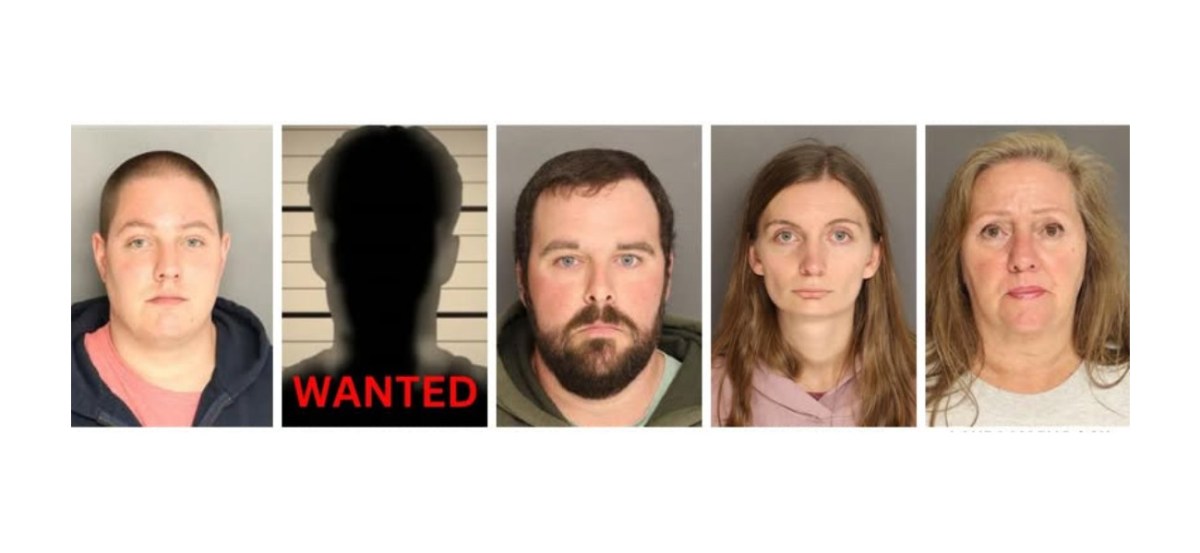
On Thursday, police charged 28-year-old Andrew Dock and 45-year-old Charles Waylon Ulmer with 13 counts of felony ill-treatment to animals with torture and one count of conspiracy. Dock’s wife, Sara Rose Dock, 23, and his mother, Laura Mary Dock, 61, were charged with conspiracy along with Michael Jeffrey Kemmerlin, 30. All five suspects live in or near Summerville, a town about 25 miles northwest of Charleston.
Each felony count is punishable by as many as five years in prison and a $5,000 fine, per South Carolina penal code.
Credit: Berkeley County Sheriff’s Office
Dock was the ringleader of the group, according to police, and enlisted the others to help him poison the cats.
“Anyone that is capable of putting out poison and creating that level of pain and suffering is a concern to me as a human in our community,” Carol Linville, founder of a local nonprofit called Pet Helpers, told Lowcountry news station WCSC. ”That is a dangerous person. If they can do it to a cat, they can do it to a dog or do anything else that they deem they don’t want around.”
Locals involved with colony management and animal rescue praised the Berkeley County Sheriff’s Office for seeing the investigation through and arresting the suspects.
“The fact that the law enforcement took this seriously and really wanted to see justice and really do their due diligence to make sure that justice is really coming for these cats. I am, I’m very grateful,” said Kayte Williams, one of the women who cared for the colony. “Hopefully nothing like this happens again because the public will know if this happens, you will be prosecuted, you will be charged and you are not going to get away with it.”
Andrew and Sara Rose Dock. Credit: Facebook
On his social media accounts, Dock describes himself as a former welding instructor at Horry-Georgetown Technical College originally from Newark, New Jersey.
All five suspects were released after posting bond, according to the Berkeley County Sheriff’s Office. It wasn’t immediately clear if they had retained lawyers, or if they were given return dates for preliminary hearings.
The kittens died “foaming at the mouth, throwing up bright green.” Acts of vigilantism against cats are happening more frequently as junk science about their hunting habits spreads via news reports.
Cat rescuer Erica Messina was trapping stray kittens to get them out of the cold and into homes before winter, hoping the young cats would have better lives.
Instead, they died horribly shortly after she successfully trapped them from a lakeside colony in October.
“All of the 13 kittens that I had all passed the same way,” Messina told KBTV, a Fox affiliate in Beaumont, Texas. “They were foaming at the mouth, they were throwing up bright green and peeing bright green.”
Two weeks later, per KBTV, a dozen adult cats from the same colony died the same way the kittens did, “some with chemical burns on their noses.”
“I was upset. I was at work when I found out and I came out here and started asking people, you know, what the problem was,” Messina told the station. “I got no answers.”
Like others who have cared for large colonies of strays who were killed by overzealous birders, Messina says she now has PTSD as she’s trying to save the lives of the remaining cats. She’s managed to catch all but four of them with the help of other local cat lovers and rescue organizations.
They’re getting no help from the authorities. Police referred Messina to Beaumont Animal Care, who told her they can’t help unless she can prove the cats were intentionally harmed. Not only are they putting the burden of proof on the victims in this case, but the victims can’t speak for themselves.
‘A bird-watcher’s paradise’
The colony lived in Collier’s Ferry Park, a lakeside park that also borders marshes where migratory birds spend time alongside native species. Indeed, Beaumont, a coastal Texas city of 115,000, markets itself, and Collier’s Ferry Park in particular, as a prime bird-watching spot.
Collier’s Ferry Park in Beaumont, Texas, where 25 cats were killed in an alleged poisoning. Credit: National Parks Service
A 2013 story in the local newspaper, the Beaumont Enterprise, detailed how local officials and business owners were promoting the park as a bird-watching paradise, noting that “[b]irders in particular are a lucrative market” driving tourism in the city. The story explains how the park is ideal for birds and those who like to watch them, details prized species found there — including herons, the least grebe and cinnamon teal — and includes input from a zoologist with a focus on birds, along with a local businessman who leads guided bird tours on the lake.
Collier’s Ferry Park is also listed on a site for “birding hotspots” while Texas Monthly calls it “one of the country’s best bird-watching spots.”
It is precisely the sort of place misguided bird watchers, driven to rage by widespread junk science blaming cats for declines in bird population, tend to dispense what they believe is vigilante justice. It stretches credulity to imagine anyone but a self-styled conservationist who blames cats for bird extinctions would risk a criminal conviction to poison a colony of cats, especially in a well-known hotspot for bird watchers.
Junk science blames cats for declining bird populations
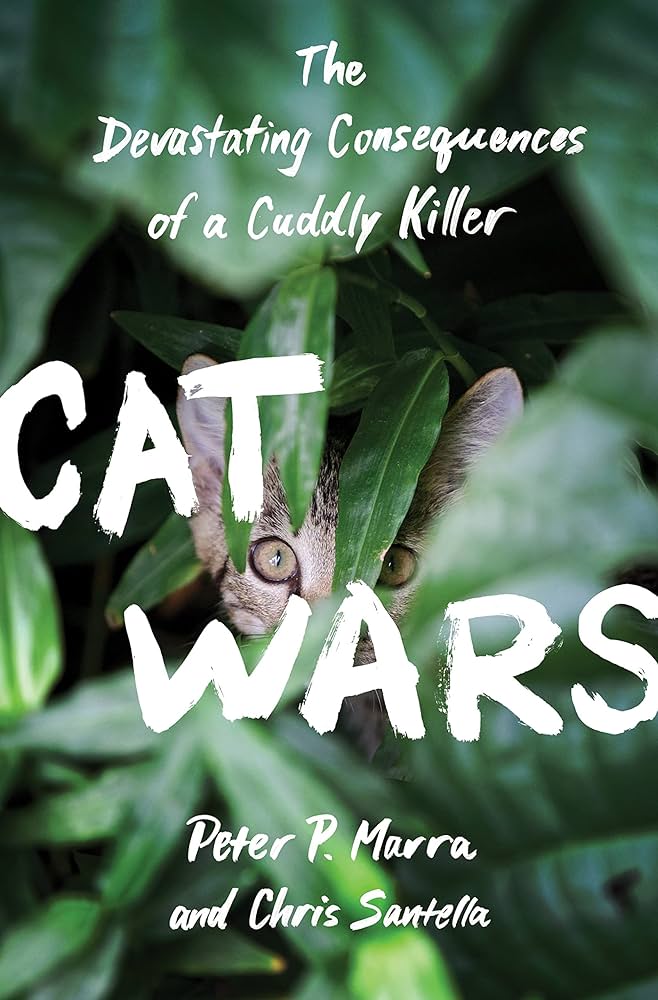
We’ve written our share about the disingenuous and agenda-driven activism that passes for research, most of it published by Peter Marra, a Georgetown avian ecologist who also authored the book Cat Wars: The Devastating Consequences Of A Cuddly Killer. The book advocates a “war” on cats and says they must be extirpated “by any means necessary” to protect birds and small mammals.
It does not, notably, put the blame on human activity, including but not limited to habitat destruction, the widespread use of harmful pesticides, wind farms, sky scrapers and all the other man-made structures, chemicals and machines that have contributed to a 70 percent decline in wildlife in the last 50 years.
But don’t take our word for it. Vox Felina calls Marra “a post-truth pioneer” who has claimed cats “kill more birds than actually exist,” while Alley Cat Allies echoes our own criticism by pointing out that Marra’s studies are composites of “a variety of unrelated, older studies” which his team uses to concoct “a highly speculative conclusion that suits the researchers’ seemingly desperate anti-cat agenda.”
“This speculative research is highly dangerous—it is being used by opponents of outdoor cats and Trap-Neuter-Return (including the authors) to further an agenda to kill more cats and roll back
decades of progress on TNR. And it is being spread unchecked by the media.”
In an NPR piece criticizing the studies blaming cats, Barbara J. King shares many of our own criticisms, chiefly that Marra and company have done no original research, relying instead on older studies, most of which have nothing to do with feline predatory habits, and none of which actually measure bird deaths from cats. King also notes, as we have, that it’s impossible to arrive at anything resembling a precise figure for feline ecological impact when Marra et al admit they don’t know how many free-ranging cats there are in the US, offering a uselessly wide estimated of between 20 and 120 million.
She also points out that the research team conducted “statistical perturbations” to massage the data into something fitting their agenda, which is activism, not science.
The researchers are guilty of “violating basic tenets of scientific reasoning when making their claims about outdoor cats,” bioethicist and research scientist William Lynn wrote.
“Advocates of a war against cats have carved out a predetermined conclusion,” Lynn noted, “then backfilled their assertions by cherry picking an accumulation of case studies.”
The war on cats
Across the world, people are using these studies and those of Marra’s acolytes to justify cruel cat-culling programs, like the recently-canceled cat hunt that would have rewarded children for shooting felines in New Zealand, and Australia’s widely-condemned mass culling that used poisoned sausages to kill millions of cats.
Stories of stray and feral cat poisonings in the US abound. Here at PITB we wrote a series of stories exposing how a government biologist in California took it upon himself to hunt cats under the cover of night, killing them with a shotgun and later celebrating in emails to colleagues, calling the dead cats’ bodies “party favors.”
Indeed, one of Marra’s own proteges, Nico Arcilla — formerly Nico Dauphine — went vigilante. Arcilla, who shares author credits with Marra on studies claiming free-ranging cats kill billions of birds, was a working for the Smithsonian National Zoo in Washington, D.C., when she was convicted in 2011 of attempted animal cruelty. The managers of a local colony, suspicious after strange substances began appearing in the feeders they’d set up for the strays, set up cameras which caught Arcilla placing poison on the food left out for the cats.
Back in Beaumont, Texas, a familiar story plays out: people who manage cat colonies out of love for the animals are working with local rescues, pooling together limited resources to save the remaining strays and hoping for justice.
“It’s terrible, you know? There are some people that just hate cats,” said Vyki Derrick, president of local rescue Friends of Ferals. “The rescuers have been trying to pull them out of the colony and it’s just sad that people want to interfere with that when the problem, ‘problem’ is being taken care of.”






 Pain In The Bud