The German-Russian fake heiress frequented many of the same parties and ran in the same circles as Buddy the Cat.
NEW YORK — Anna Delvey said she was at a low point when she crossed paths with Buddy the Cat at a party one night.
“So many of my friends were so disappointing,” Delvey says. “When people show up to a party looking poor or fat, and they’re not wearing designer clothes, it’s a huge buzzkill.”
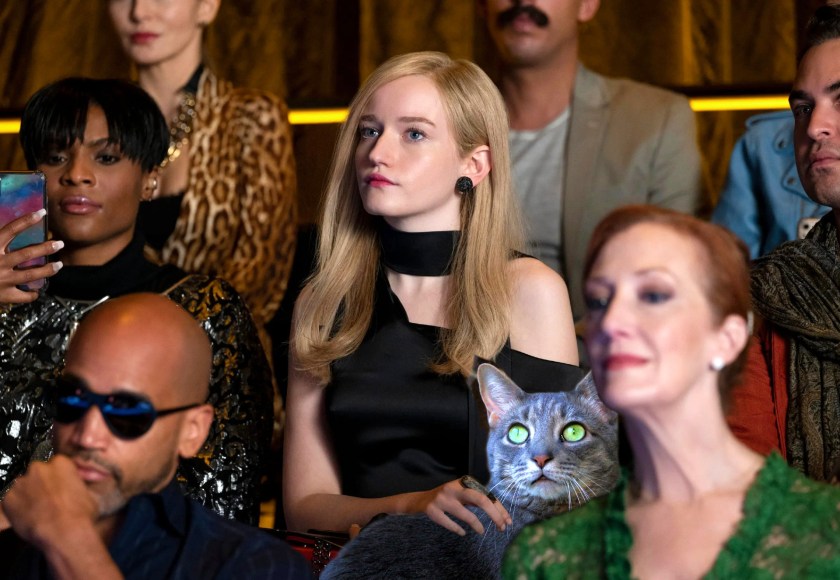
But Buddy, who was a guest of Princess Charlotte Marie Pomeline Casiraghi of Monaco, was clearly someone who understood style and luxury and moved in the exclusive circles Delvey frequented.
“I was like ‘Oh my God, you know [Monegasque designer] Pauline Ducruet?” Delvey recalls. “Buddy had just arrived with Felix [Finch, editor of the Trafalgar Review of Books]. He knew all the right people, was at the best parties and always knew when to leave before unattractive people showed up.”
On the night she met Buddy, Delvey says she was already shaken by a woman who showed up to a film festival afterparty wearing clothes from Target when her group faced another setback: The maître d’ at Dorsia had double booked their reservation, so they were forced to head to Espacé on the upper west side.
“I was on the verge of tears when we arrived at Espacé, since I was positive we wouldn’t get a decent table,” Delvey recalls. “But we did, and relief washed over me in an awesome wave.”
It turned out Buddy knew the maître d’ at Espacé and was able to secure a table by slipping him two crisp $100 bills.
“Friends like that,” Delvey says, “are worth keeping around.”
Delvey, center, with Buddy at New York Fashion Week in 2018. Credit: Netflix
Delvey’s roster of friends was whittled down to just a handful when she was arrested in 2018 and charged with defrauding various luxury hotels, spas, boutique shops and bankers out of more than $300,000. She was also on the verge of securing a $22 million loan from Cavendish Holdings, ostensibly to open a VIP arts club, when authorities caught up with her and charged her with multiple counts of wire fraud, grand larceny and tampering with financial records.
Delvey’s story was immortalized in a 2019 New Yorker piece which went viral and, with the premiere of Netflix’s Inventing Anna miniseries just 10 days ago, millions of people are now privy to almost every sordid detail of Delvey’s long con, in which she presented herself as a fabulously wealthy German heiress sitting on a $60 million trust fund.
The now-convicted former socialite, whose real name is Anna Sorokina, moved in the highest echelons of New York society for more than two years. She quickly made a name for herself after arriving in New York from Paris, where she’d interned at fashion magazine Purple, and soon worked her way into the orbit of celebrities, famous designers and even royalty.
Like Delvey, the source of Buddy’s wealth was shrouded in mystery.
“I think he was some sort of poultry oligarch,” said stylist Ronaldo Chen. “Vast holdings in eastern Europe, turkey farms, wineries and hotels.”
Delvey often took Buddy on her shopping sprees. Friends said she valued the feline’s astute fashion observations. Credit:
Others said he was a Youtuber and vlogger who helped popularize the wildly popular genre of unboxing videos, while some people said he was a tech bro raising venture capital.
“He comes from old money just like Anna does,” said French socialite Marinus. “House Buddeaux is one of the oldest catnip families west of the Seine.”
Episode 11 of the Netflix hit details the now-infamous party 2017 in Budapest at which Delvey is alleged to have made off with more than $150,000 of the Duke of Sandringham’s diamonds and left Buddy with more than $30,000 in hotel charges.
Still, there are apparently no hard feelings between the two.
“Buddy is a genius, bitches,” Delvey told Vogue last summer in a jailhouse interview. “I was surrounded by genius and now I’m here, wearing a horrid jumpsuit, locked up with basic bitches. My cellmate says she’s serving a life sentence for stabbing her cheating boyfriend, and I was like ‘Why are you being so dramatic?'”
Netflix’s Korean period drama is soaked in political intrigue, action and lots of blood. It also holds a mirror up to today’s pandemic and how our leaders are handling it.
Just when it seems like the zombie genre has run its course, a handful of visionary Korean storytellers come along to remind us there’s still life left in the undead genre.
First there was 2016’s record-setting, multiple award-winning Train to Busan, a film about an overworked father taking his young daughter to her mother’s house in the titular city just as a zombie plague tears human civilization apart.
Together with a core cast of affable characters — including a pregnant woman and her overprotective husband, and members of a youth baseball team — dad and daughter try to survive in a uniquely claustrophobic setting where simply running from the undead isn’t an option. Train to Busan wasn’t just a hit for its horror and action elements — the film packs a surprising amount of social criticism into its one hour and 58 minute run time, turning its lens onto modern Korean society and, by extension, modern life around the globe.
The movie has a 94 percent fresh rating on Rotten Tomatoes and sparked a bidding war for its US rights. A remake set in the US is currently in production by New Line.
Then there’s Kingdom, a Netflix series also called Kingdom of the Gods in Korean, that takes a zombie plague and drops it over a story about political intrigue and power struggles in the Joseun feudal era.
The series picks up at the beginning of the 17th century, when the kingdom of Joseon is three years removed from the second of two brutal Japanese invasions. Poverty is rampant, the common people are starving and the queen consort’s Haewon Cho clan has consolidated power, effectively insulating the king from his closest advisers, friends and family.
The country is desperate for leadership, but the king has disappeared after falling ill with smallpox.
His son, Crown Prince Lee Chang, tries to intervene and find out what’s happened to his father, but he’s repeatedly stopped by the pregnant Queen Consort Cho, who refuses to allow Chang into the royal palace.
Jeoha: Crown Prince Lee Chang, wearing the distinct dragon robes of Joseon kings and crown princes, tries to gain access to the royal palace to see his ailing father, the king.
Chang is in an extremely precarious situation: Although he’s the Crown Prince and the king’s beloved only son, his mother was a concubine. If Queen Consort Cho gives birth to a son, the boy will be considered the true heir and Chang will be hunted down and executed so there can be no competing claims to the throne.
With the king missing, Crown Prince Chang knows his time is limited and if he doesn’t act, he could be arrested and put to death by the queen’s orders at any moment.
So Chang and his bodyguard/friend Mu-yeong devise a plan to steal the king’s patient journal from the royal palace at great risk to themselves. When they find bizarre entries about doctors administering a “resurrection plant” — and no subsequent entries about the king’s health — they set off south in search of the king’s physician, the one man who can tell them what really happened to the king.
What follows is a spectacular adventure fueled by gorgeous cinematography, an energetic cast of actors who go all-in on the premise, and a historically accurate look at Korea as it existed under a dynasty that lasted for half a millennia.
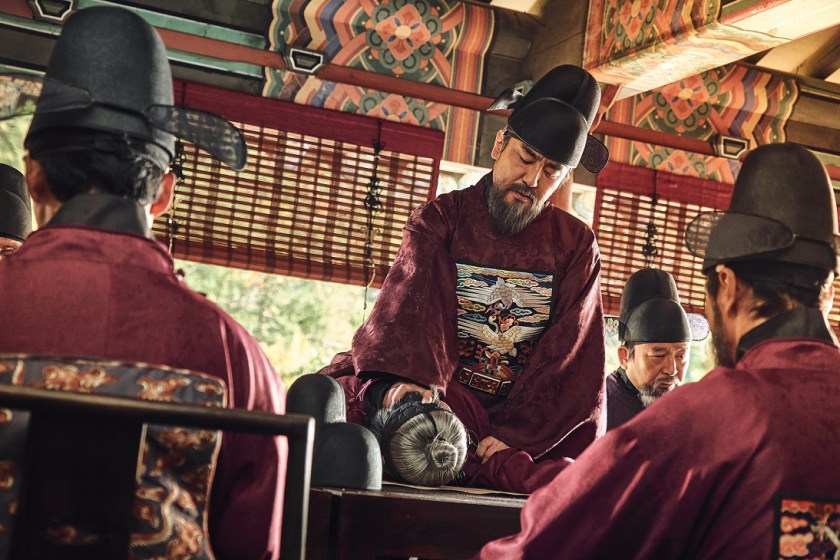
Ryu Seung-ryong plays the scheming top minister Cho Hak-ju, father of the queen consort. The double-swan embroidery on his robe indicates his status as a powerful government official. Credit: Netflix
The zombie plague itself may be the stuff of George A. Romero’s nightmares, but the attention to historical detail in Kingdom is second to none, from the costumes to the historic palaces and the strict adherence to tradition among Joseon’s bureaucrats.
It turns out the real leaders of Joseon did have many of the same dilemmas their counterparts on the show do: Kingdom’s author was inspired by historical accounts of an unprecedented deadly plague that swept through the Korean peninsula after the second Japanese invasion, piling fresh misery onto a population already reeling from Japanese invasions and hunger.
The social order compounded the misery for those at the bottom. The Joseon dynasty was marked by strict divisions between social classes, making traditionally aristocratic societies in the west look almost like pleasant meritocracies by comparison.
Everything a person wore — robes, hats, embroidered designs on their chests and backs — were indicators of class, rank and occupation. Government ministers, who were nobles, dressed in fine silks with intricately embroidered rank badges in animal motifs.
Peasants wore rags and straw hats, while the more fortunate among them wore modest clothes.
Nepotism and corruption were rampant, and the nobles, ministers and administrators who held power saw their positions as conferring privilege, not responsibility.
When a group of aristocrats and government ministers of one region take the last barge out of a doomed city, leaving thousands of vulnerable commoners behind to be eaten and turned by the tidal wave of undead, it seems unspeakably cruel and cowardly until you realize that this is a feature of the society, not a bug.
Ju Ji-hoon, center, as Crown Prince Lee Chang, with Bae Doona, left, as the physician Seo-bi and Kim Sang-ho, right, as Chang’s trusted bodyguard Mu-yeong.
When the aristocrats abandon peasants to the zombies, Crown Prince Chang and Mu-yeong risk their lives gathering a small force to protect the people and usher them to the safety of a walled stronghold.
Later, when a group of villagers bury a group of undead, unaware that they’ll rise at sunset and trample the nearest towns, the Crown Prince and his followers head out just before dusk to stop them, knowing they’ll be outnumbered and may not return.
The Crown Prince’s many kindnesses to peasants and children, and his willingness to risk his own life to protect them, draw the notice of characters who become key allies — including a member of the legendary Chakho tiger hunters, and Lord Ahn, a military hero and governor credited with expelling the Japanese during the invasion three years prior.
Crown Prince Chang set off initially to solve the mystery of the king’s disappearance and to protect himself from the scheming Haweon Cho clan, but as he sees the poverty, desperation and vulnerability of his people first-hand, he dedicates himself to a more pressing and noble cause in protecting the people of Joseon from the seemingly unstoppable plague and starvation.
In that effort, he unites people of different classes and backgrounds who fight fiercely and loyally for him, seeing hope for a brighter future if he survives and becomes king.
The physician Seo-bi, played by Bae Doona, attends to a man’s wounds.
The show never misses a chance to show social disparities: The upper classes do everything they can to protect themselves, everyone else be damned. They hide behind walls and ignore thousands of commoners — including women and crying children — who pound on the gates, begging to be let in. They abandon the peasants, and in many cases count on the lower classes serving as a human shield to allow the upper classes to escape danger.
“Are you sure this is okay?” one minister asks his sycophantic assistant as they take the last barge out of a doomed city, leaving throngs of peasants on the docks.
“You and the other nobles are the backbone of the city!” his assistant assures him. “You must survive so you can rebuild.”
As a result, the first waves of undead are the people on the lowest rungs of society. As the virus spreads to another city, a group of confused aristocrats can’t believe what they’re seeing.
“Those peasants are attacking nobles!” one incredulous man in ornate clothing says as undead in rags storm through Dongnae (modern day Busan).
Peasants attacking the upper class was unthinkable in Joseon, and by the time the aristocrats in that scene realize there’s something very wrong, it’s too late.
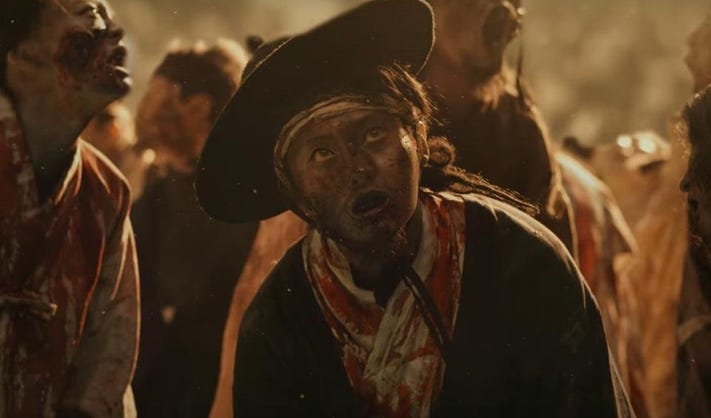
As the plague spreads, the ranks of the undead grow to include aristocrats in fine robes as well as peasants in rags.
Before long, the legions of undead include just as many people in fine silks and ornate embroidery, finally uniting the classes of Korea in a state of undead purgatory, their reanimated corpses hungering for the flesh of the still-living.
Eventually, though, Chang must confront the Haewon Cho clan and its patriarch, the powerful minister Cho Hak-ju.
Of course the show wouldn’t be a hit if it didn’t provide something for action and horror fans, and it more than delivers on its promises.
The action sequences in Kingdom are spectacular, and the show gives viewers lots of them, from outnumbered warriors holding a narrow pass from the undead, to zombie hordes laying siege to citadels, to close-quarters sword fighting.
The beautifully-shot sequences put shows like The Walking Dead to shame. Whereas the latter show often gives the impression that the money men behind the franchise are counting pennies, Kingdom‘s lavish sets, epic set pieces and impeccable special effects are the kind of thing viewers would expect from a summer blockbuster, not a television show.
Kingdom isn’t all action, and it takes time to breathe with quiet character moments between the narrow escapes and thrilling battles. The series is a period drama just as much as it falls within the action and horror genres. We see the inner workings of a society markedly different than anything most Westerners are familiar with, but driven by the same human ambitions.
KINGDOM
Kingdom
The story is also effective thanks to actors Hye-jun Kim and Seung-Ryong Ryu, who play the Queen and her father, high minister Cho Hak-ju. They’re villainous and power hungry without seeming one-dimensional, and both succeed in becoming focal points of the audience’s anger as they commit one despicable act after another.
Cho Hak-ju manipulates the court with the savvy of Game of Thrones’ Littlefinger and the brutality of Joaquin Phoenix’s Commodus in Gladiator. The other government ministers are terrified of him, and as the man who ostensibly speaks for the king, his word is effectively law.
The Queen, meanwhile, puts in motions schemes that would make Thrones’ Cersei look amateurish in comparison.
Kingdom’s got two seasons under its belt and a stand-alone special episode, Kingdom: Ashin of the North. Fans are eagerly awaiting the third season. It stands out as one of the best historical epics in recent memory.
Archive 81 arrived just in time to help us through a content dead zone.
The Witcher’s excellent second season helped tide us over last month alongside Amazon’s not-so-great adaptation of The Wheel of Time, and critically-lauded The Expanse ended its six-year run on Jan. 14. Meanwhile, if network TV is your thing, the last few weeks of January through early February are filled with nothing but reruns as networks are loath to put any original content up against the NFL playoffs and Super Bowl.
Enter Archive 81: A story that promises mystery, Lovecraftian horror and a heavy dose of 90s nostalgia.
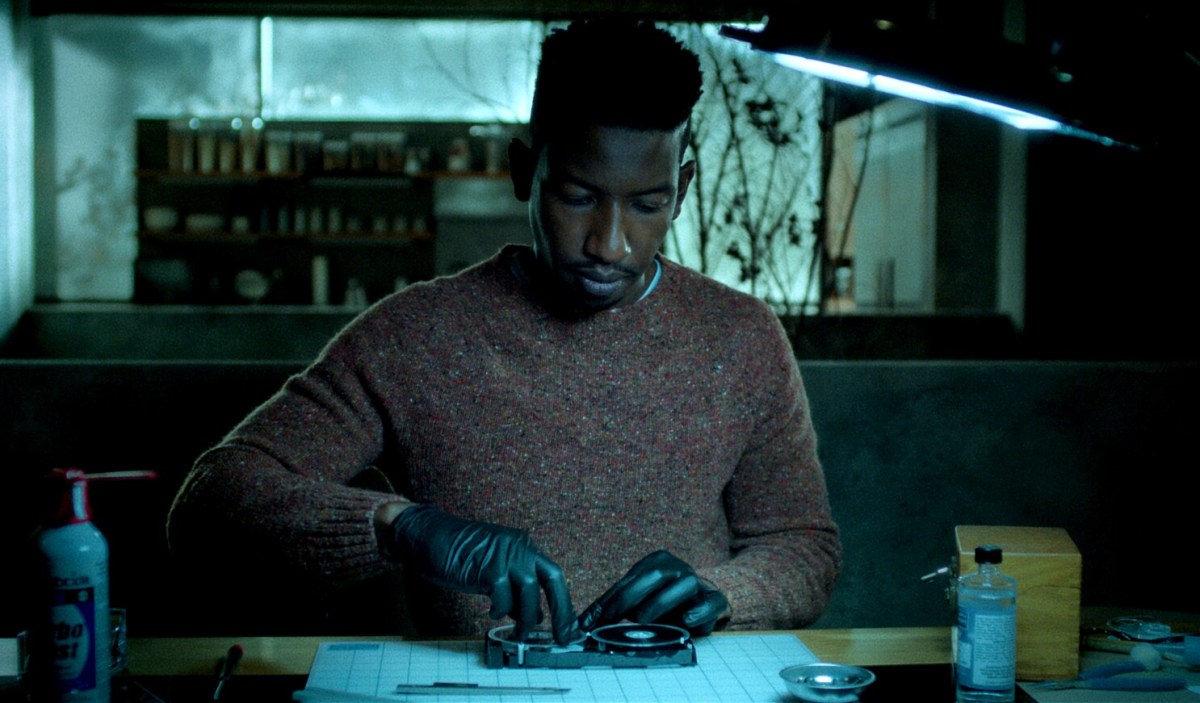
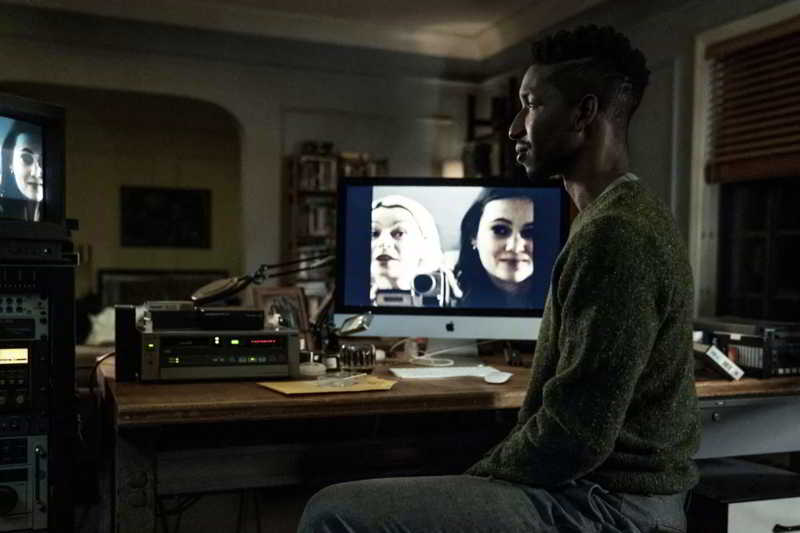
Our protagonist is Dan Turner (Mamoudou Athie), an analog enthusiast who makes a living restoring vintage media (VHS, cassette, Betamax and anything else pre-DVD), and spends his off hours crate-digging for rare recordings.
We meet Dan as he’s looking through recently-acquired VHS tapes at a street vendor’s stall in Manhattan.
“You know last month you sold me 16 hours’ worth of a T-ball tournament, yeah?” Dan asks.
“Yeah. But also, I sold you an uncut version of Phantasmagoria off channel 7,” his street vendor friend says. “That’s unreleased and very rare.”
When Dan balks at buying a box of random tapes, his vendor friend appeals to the hobbyist in him.”Look,” he says, “I know you love the hunt.”
“The hunt” he’s referring to is the obsessive drive that prompts collectors of all types to sift through yard sales, estate auctions and abandoned storage units. It’s the thrill of opening the unknown with the knowledge that most of it will be junk, but every once in a while a nondescript box will hold a rare gem.
It’s the thrill of the hunt that leads Dan to accept an archiving gig from a secretive company despite concerning red flags.
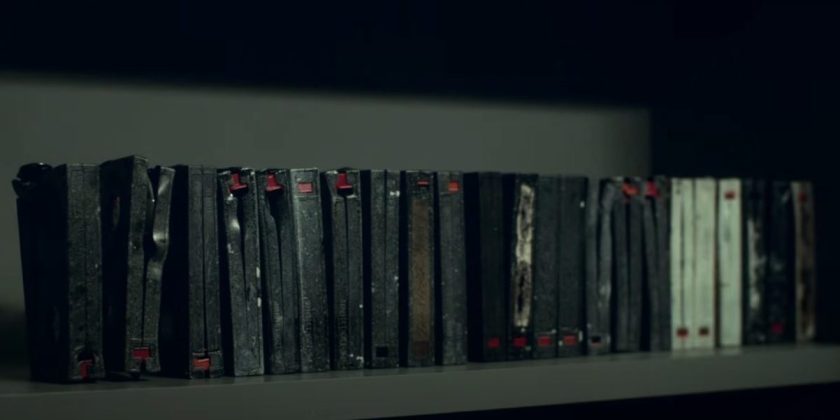
The job is to restore an archive of video cassettes scavenged from the charred ruins of a Manhattan apartment building called the Visser that burned to the ground in 1994. No one survived the building-consuming fire, and Dan’s employers believe the tapes could shed light on how the fire started as well as the people who lost their lives.
Dan finds himself increasingly invested in the story of Melody Pendras, who lived on the Visser’s fourth floor before the building was destroyed by fire. Credit: NetflixDan is hired by a company to restore fire-damaged cassettes that could contain important clues about a 1994 fire that destroyed an apartment building in Manhattan. Credit: Netflix
The company offers Dan a particularly generous fee for restoring and digitizing the footage, with the caveat that for the duration of the project he has to work out of a company-owned compound in the Catskills, a few hours’ drive north of New York City.
Dan accepts and it doesn’t take long for him to become engrossed in the content of the tapes he’s restoring. The collection of cassettes was shot by a young woman named Melody Pendras who moves into the historic and creepy Visser Building, ostensibly to interview its residents for a dissertation she’s doing on the strange history of the high rise.
With each cassette Dan restores and digitizes, a new chapter of Melody’s time at the Visser is revealed, and it becomes increasingly apparent that something is very wrong with the building and the people who inhabit it.
Think Ghostbusters and 55 Central Park West, also known as “Spook Central.” In the 1984 hit, 55 Central Park West’s bizarre design choices came courtesy of an architect who was heavily into the occult, and he built the high rise to serve as some sort of supernatural antenna for spirits from another dimension. The Visser has similar origins, although the details are best left unspoiled.
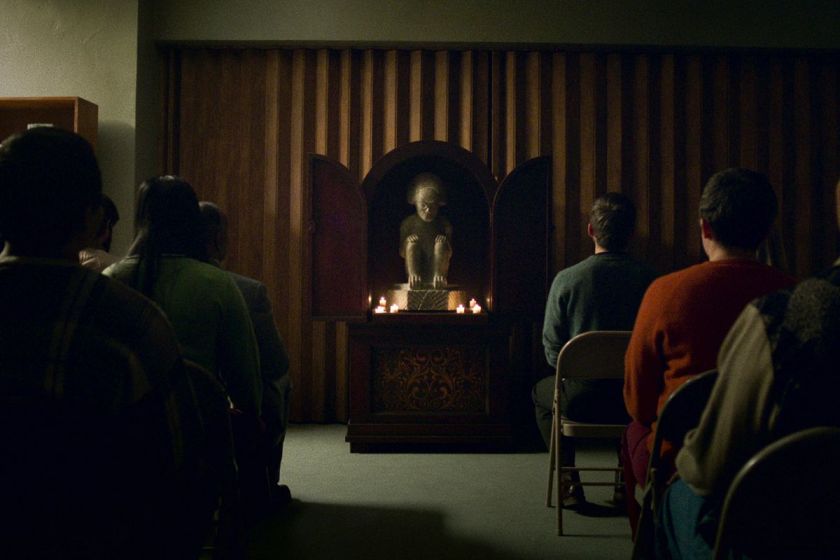
There’s something creepy going on in the Visser’s basement community room. Credit: Netflix
As Dan becomes increasingly invested in Melody’s story he begins to feel the effects of isolation, living in the brutalist compound that houses the repair studio and a cavernous living space. He’s not allowed visitors, as the content of the tapes are supposed to be confidential, he doesn’t get cell service and he begins to suspect the landline is tapped.
With a history of mental illness, Dan isn’t sure if he’s imagining things when he realizes someone else may be in the compound, and his paranoia is stoked by the discovery of journals that indicate he wasn’t the first archivist to work in the isolated building.
To make matters worse, he begins to experience vivid dreams in which he’s speaking directly to Melody — and she’s clearly in trouble, calling for help across almost three decades.
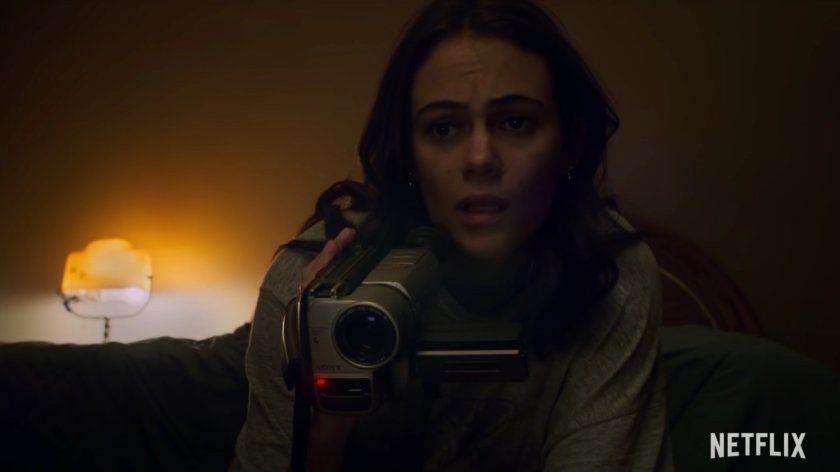
As Dan restores the damaged video tapes, he unravels more of the mystery surrounding the disappearance of Melody Pendras (Dina Shihabi). Credit: Netflix
Archive 81 is guilty of the so-called “mystery box” narrative format popularized by JJ Abrams and Damon Lindelof with Lost. The pair provided a template to string viewers along by unraveling just enough of the central mystery in each episode to keep viewers hooked, but as Lost proved, the mystery box form only succeeds in pissing the audience off if there’s not a solid pay-off at the end.
While Abrams and Lindelof dragged out Lost’s narrative and winged its conclusion to much derision, Archive 81’s Rebecca Sonnenshine clearly mapped out her story from start to finish. Momentum builds over eight roughly hour-long episodes until things escalate quickly toward the end. While I’m still not sure how I feel about the way things concluded, Sonnenshine’s story provides answers to most of the burning questions that pop up over the season’s run, and leaves just enough of a cliffhanger for a potential sequel. (And judging by the show’s several-week run atop Netflix’s charts, we probably will see at least another season.)
You could argue that mystery is baked into the genre: Archive 81 is a drama with elements of horror, but it doesn’t rely on jump scares. It avoids many of the latter genre’s most worn-out tropes while embracing others, layering the narrative with an ever-increasing sense of dread. It’s a clear attempt at high-concept horror.
There’s not much in the show to dissuade the squeamish and the writers are more concerned with exploring their characters than trying to freak viewers out. All the same, whether you enjoy the series or not probably depends heavily on how you feel about the genre. If you’re game for something a little dark, Archive 81 isn’t a bad way to spend a week’s worth of frigid January or February nights.
Lost In Space is a rare reboot with heart that updates the classic story with gorgeous visuals and a compelling narrative for kids and adults.
I wasn’t quite sure what to expect from Netflix’s reboot of Lost In Space.
Would it hew closely to the brightly-colored 1960s original in all its cheesy glory? Would it aim for a darker tone, as so many television series do these days? Would it be a low-effort nostalgia cash-in like so many ill-advised reboots of the past decade? And would the series, which was slated to keep things PG, have enough going on to appeal to adults as well as kids?
With Netflix delivering the third and final season last month, my verdict is in: Lost In Space is the rare worthy reboot, a visually spectacular retelling of the original that tweaks and modernizes the details in all the right places. There’s a generous amount of adventure, quiet character moments, and an overarching theme about the importance of family. Over the course of the story, the latter group that widens to include not only the Robinsons but also their closest friends who brave the cosmic dangers alongside them.
Speaking of danger, the original show’s most-used catchphrase — the robot’s “Danger, Will Robinson!” — will be familiar to almost anyone, even those of us who were born in the decades after the show went off the air. It’s become part of the pop cultural fabric.
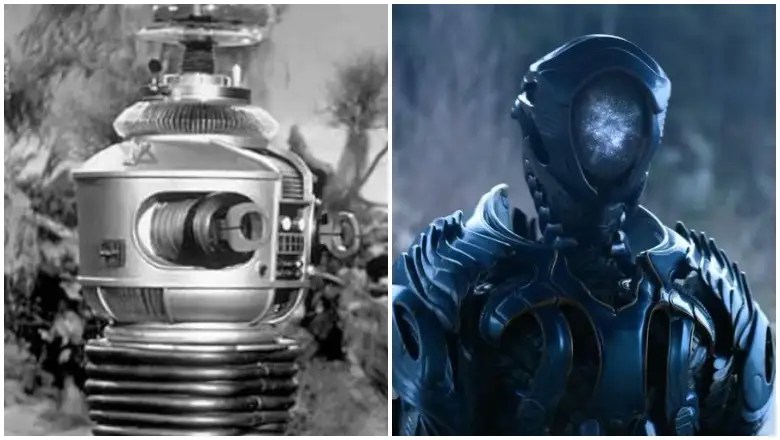
In the original Lost In Space the Robot is a human-engineered tin can, a 1960s retrofuturistic vision of what sentient machines might look like that was dreamed up at a time when servers occupied entire rooms and a computer’s output came in the form of punch cards.
In the reboot, the Robot is an alien intelligence: a towering, six-limbed, digitigrade machine with an inscrutable face and serrated claws. Where the 1960s Robot was risible, the reboot Robot is terrifying in its default form — until a brave Will Robinson, who encounters it after crash landing on an unnamed planet, helps the dying machine repair itself.
He does so as a raging fire engulfs the forest around them, reasoning that he can’t escape, but perhaps the robot can.
The curious Robot, awash with gratitude, immediately rescues Will and, on safe ground, studies the boy for a moment before rearranging itself into an androform shape to mirror Will. From that point on, boy and Robot become inseparable.
The Robot and Will Robinson form a mysterious bond, with the machine becoming fiercely protective of the boy.
It’s Robot who gets the Robinson family out of trouble in the first episode and many times over subsequent installments, earning the trust and eventually the love of the Robinson family, their friend, mechanic Don West (Ignacio Serricchio), and the mercurial Dr. Smith (Parker Posey).
It’s a credit to the writers and visual effects team that the series appeals to kids as well as adults. I watched the first episode with my eight-year-old niece, who’s younger than the target audience. She was absorbed in the story, her attention beginning to wane only during moments of expository dialogue.
The series is probably better suited for kids at 11 or 12 years old, as there are some relatively heady science fiction concepts and subsequent episodes range from PG to PG-13ish.
There’s no sex, the relatively little violence happens off camera, and the narrative regularly stresses the importance of family. Will, his sisters Penny and Judy, and the Robinson parents all rely on each other to meet challenges. There are, however, adult themes like divorce and near-death experiences, and occasional bad language which never gets more profane than Dr. Smith derisively calling Don West out on his “bullshit” in one episode.
Judy (Taylor Russell) and Penny (Mina Sundwall) play important parts in the narrative and bring different skills to the table.
The show takes off right away and delivers excitement and mystery, but it takes a little while to find its rhythm, with early episodes following a “crisis of the hour” format more suited to episodic television. The writers were clearly trying to convey the power of the united Robinson family, and how each member brings different skills and ways of thinking to the table, but the show is at its best when storylines work in service to the overarching narrative.
Mom Maureen is a brilliant engineer who designed the colony starship Resolute and its Jupiter landers. Dad John Robinson is a former Navy SEAL, a man of action who encourages his children to make bold choices. Eldest daughter Judy Robinson is a young medical doctor who, despite her obvious talent, often feels she has something to prove. Her younger sister, Penny, is the least scientifically-minded member of the family. Penny’s better with people, serving as a peacemaker and scribe who documents the Robinson family’s adventures.
Last but not least, young Will Robinson is a dreamer who marvels at alien worlds and distant stars, and takes after his mom in scientific aptitude. He becomes something of a legend among the colonists for his inexplicable bond with Robot, who is extremely protective of the boy.
The Resolute is attacked en route to Alpha Centauri, forcing its passengers to flee to their Jupiter “lifeboats” and make emergency landings on a nearby planet.
Of course there wouldn’t be much of a story to tell if the Robinsons and the other colonists simply made it to the idyllic colony at Alpha Centauri without incident. It turns out the colonists fled the Resolute — and crash landed on an inhospitable planet — because Robot’s brethren attacked the ship.
Although the viewers are shown the act of kindness that sparks the bond between Will and Robot, the other colonists aren’t as trusting once they realize Will’s seven-foot-tall protector came from the same place as the murderous machines that attacked the Resolute. Dr. Smith also has her own designs on the mysterious Robot, and the Resolute’s crew has been hiding a secret from its passengers that will come back to haunt them.
Can the colonists survive on a dangerous world without the resources they need? Will they ever reach Alpha Centauri?
Why did the robots attack the colony ship? What do they want from humans? And who made them?
Those are the questions at the heart of the mystery, but the characters can’t hope to answer them if they’re stranded on a hostile alien world.
Netflix spared no expense with Lost In Space and the writers clearly had a complete vision for the story, wrapping it up in just three seasons over the course of 28 roughly hour-long episodes. (The first two seasons had 10 episodes each, while the final season had only eight.)
In a sea of Netflix content, Lost In Space stands out as one of the streaming giant’s best original shows, especially for fans of science fiction and parents looking for a show they can watch with their kids.
Buddy’s Verdict: Four Paws out of Five
Big Buddy’s Verdict: Recommended
Will Robinson, front, with Dr. Smith, Judy, Robot, Penny and Maureen Robinson.
The horror-drama from Netflix is more interested in untangling uncomfortable questions from the abstract than it is in providing answers. And that’s just fine.
Movie: The Platform (2020) Director: Galder Gaztelu-Urrutia Genre: Horror, social commentary Medium: Netflix
The premise of The Platform is simple: A man wakes up in a concrete prison cell. The center of the cell is dominated by rectangular gaps in the floor and ceiling, and when our protagonist warily steps closer he can see levels of identical cells above and below him. The cells extend as far as the eye can see in both directions, each populated by two prisoners.
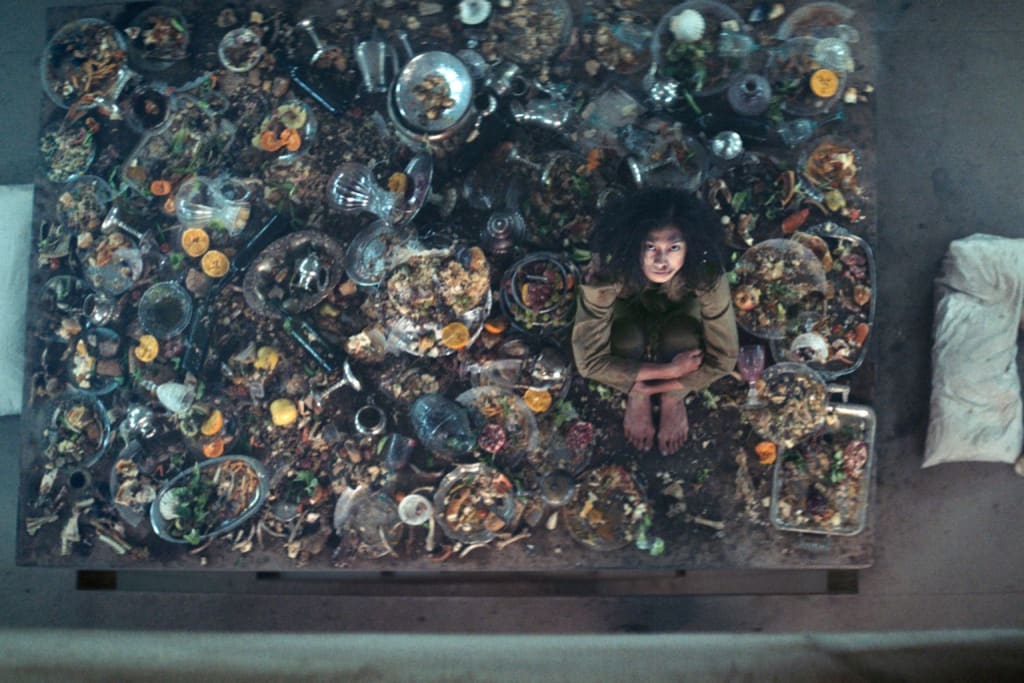
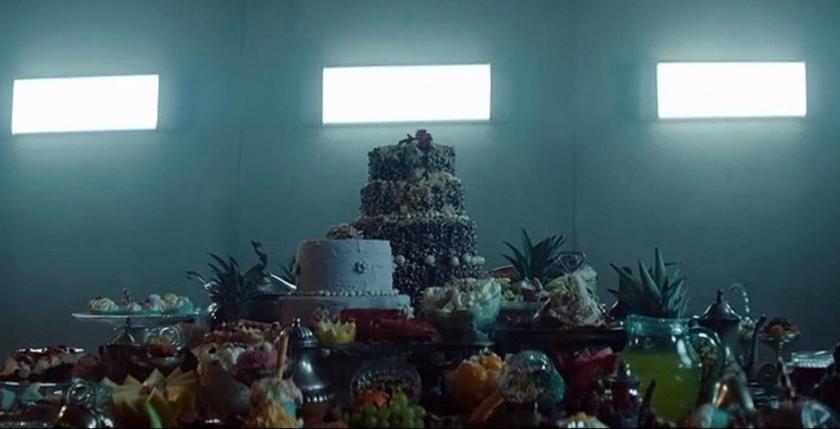
Every day, a platform is lowered level-by-level, laden with a massive feast: Meats, wine, cheese, bread, cake, soup, pie, fish, escargot, paella, salads, grapes, apples and other fresh fruit, vegetables, juice. Every kind of food you can imagine, cooked and prepared to perfection by professional chefs.
Goreng, our protagonist, is greeted by his cell mate, a kindly old man named Trimagasi who sits down next to the edge of the hole in the floor in anticipation of the platform’s arrival. When it descends to their level he pigs out, shoveling as much food as he can into his mouth before a buzzer sounds and the platform descends another level.
Goreng looks on, digusted: The food is scattered all over the platform, much of it half-eaten. Clearly, these are someone’s disgusting leftovers.
Trimagasi, top, pigs out while Goreng picks at food scraps.
Trimagasi urges Goreng to eat, and explains that they are very fortunate indeed: At level 48 there’s still enough food leftover from the prisoners on the 47 levels above that they won’t starve this month. At the end of every month, he says, each pair of cellmates are put to sleep with gas and wake up on a new level that is chosen at random by the people operating the cruel social experiment.
Trimagasi tells Goreng he once spent a month on level 132, where not a scrap of food is left by the time the platform descends. Goreng asks the old man how he survived, and Trimagasi demures.
We also learn that Goreng voluntarily entered in exchange for a real-world opportunity promised to him after he spends six months inside. Trimagasi was sent there as punishment: Infuriated by a TV commercial for a self-sharpening knife called the Samurai Plus after he’d just purchased a knife sharpening kit, Trimagasi threw his TV out of his window and unintentionally killed an illegal immigrant who was riding a bicycle below. He’s approaching the end of his two-year sentence in what the authorities call the VSC, short for Vertical Self-management Center.
Each prisoner is allowed to take one item with them inside: Goreng takes a copy of The Ingenious Gentleman Don Quixote of La Mancha, harboring romantic notions of finally reading the book with his time in the prison. Trimagasi, who loves to use the word “obviously,” told Goreng his choice of item was obvious: His prized Samurai Plus, which he cradles lovingly as he boasts about how it can cut concrete without dulling.
Goreng puts two and two together, realizing how Trimagasi survived on level 132.
Going down: Just a portion of the feast as it exists on the platform before it’s consumed, defiled and excreted, level by level.
The Platform is a blunt allegory for human civilization, specifically the enormous wealth disparities of modern societies. The occupants of level 1 are the Jeff Bezoses and Walton families of the world, people with unimaginable, multigenerational wealth pigging out on life’s resources without thinking of the starving street children of India, the homeless of cities like New York and San Francisco, the families in North Korea eating tree bark.
Some reviewers think it’s a critique of capitalism, but I think it’s more universal than that: The kleptocrats of countries like Mexico, Russia and Brazil, the monarchies and emirates of the Middle East, and the party bigwigs of communist countries like China pig out on their own respective first levels while the people 130 “levels” down starve just the same.
The rest of us? We’re in the 30s, 40s and 50s, happily scarfing down the scraps from above, the ad revenue the Zuckerbergs and Pichais allow us by their forbearance, the slightly comfortable salaries allowed by corporate shareholders, the house and garage we might enjoy if we’re fortunate enough to run a successful small business in an industry that hasn’t been pillaged by the multinationals yet.
Looking down at the levels below in The Platform.
A plan to preserve food for the lower levels by force.
Trimigasi with his beloved Samurai Plus.
A poster for the Japanese release of The Platform. Credit: Netflix
Some people might find the movie heavy-handed, but I don’t see it that way. As uncomfortable as it is to watch at times, reality is much, much worse. The fact that some of the movie’s scenes are difficult to watch is testament to how lucky we are to be born in circumstances where that kind of suffering isn’t part of our experience, let alone our daily lives. Show The Platform to one of the handful of people to ever escape a North Korean hard labor camp, for instance, and they probably won’t even blink.
It also shows how our betters divide and conquer to keep the rest of us distracted and themselves secure. The idea that most people who receive social services are lazy bums is a popular one in some quarters, encouraging people not to have empathy for the less well off, but to loathe them. Likewise, the people occupying the higher floors of The Platform’s prison don’t feel sorry for those beneath them. In one scene, two cellmates tell a man they’ll help him ascend to their floor, then literally shit on him as he’s just within reach, cackling with delight as he falls.
I didn’t take it as a call for socialism either. The movie makes it pretty clear that neither asking people to moderate their consumption, nor trying to enforce sharing works out for the people who try those methods. Indeed when socialism has worked in real world circumstances, it’s been part of a hybrid model that still uses capitalism as its economic engine.
Mostly, The Platform exists to make people think. While Jeff Bezos goes to sleep tonight in his $50 million compound estate, dreaming of his next vanity flight to low Earth orbit or the next hypercar he’s going to buy, there’s someone shivering on a park bench with 15 cents in their pocket, stomach grumbling, knowing the people who pass them by every day don’t even see them as human.