Our usually-brave (lol) hero didn’t take well to feline-centric tunes.
In case you didn’t know, music written specifically for cats is a thing.
I’d heard about it a while back, and the project seemed impressive: “Music for Cats” composer David Teie is a soloist with the National Symphony Orchestra, and he worked with animal behaviorists and veterinarians to come up with kitty-soothing sound textures and test the music’s efficacy on cats visiting the veterinarian.
A 2019 study in the Journal of Feline Medicine and Surgery concluded “Music for Cats” could help our furry friends relax and ease their stress. Keeping in mind an earlier study that suggested cats prefer “feline-centric sounds,” Teie incorporated audio of events cats associate with happy times, like kittens suckling milk from their mothers.
Using Buddy as my test subject, I went to Youtube, selected the track Cozmo’s Air from “Music for Cats” and sat back, expecting Bud to start nodding his furry head at any moment.
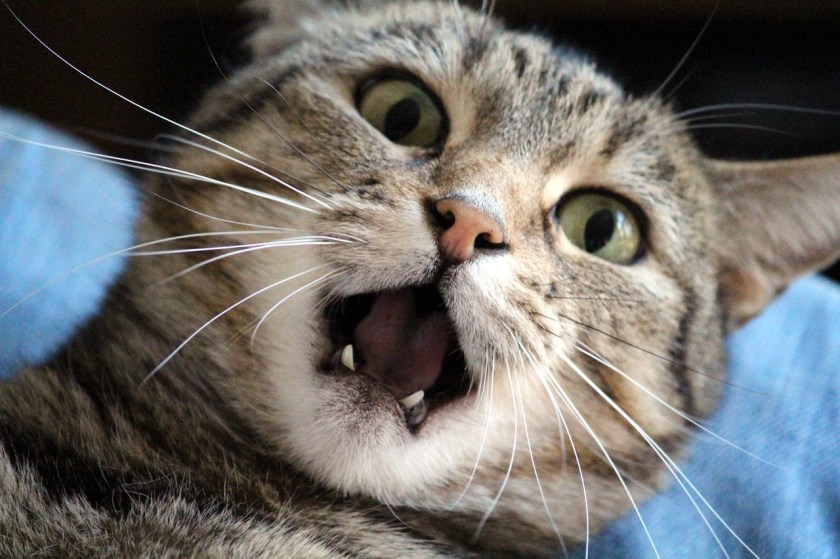
Instead his ears pricked up, did their radar-dish swivel toward the speakers, and his eyes went wide. As the song gained volume and intensity, Bud’s ears and whiskers snapped back and he let out a clearly anxious “yerrrrrrrrrrppp!” I tried to calm him down, to no avail, and a second track didn’t improve things.
He wasn’t having it.
This pretty much sums up Buddy’s reaction to cat music. Credit: Creative Commons
Teie’s cat music is back in the news with the release of the Kickstarter-backed Music for Cats 2, and there are quite a few imitators on Youtube hawking their own supposedly cat-soothing musical efforts. (Though your cat might think she’s in Guantanamo Bay if you subject her to six-hour videos of “cat lullabies.”)
Should I test some of the new music on Buddy to see if he responds more favorably? And for our fellow readers and cat servants, have you played any of this stuff for your cats? If you have, how’d it work out?
Common misconceptions can impact the way owners bond with their kitties.
We’ve all heart the familiar knocks on our feline friends: They’re aloof, selfish animals who are indifferent to their humans as long as their bowls are filled with food and they’ve got a warm place to sleep for 16 hours a day.
NPR hosts took a look at those stereotypes in their new segment, Animal Slander, in which they take “common phrases and stereotypes about animals — blind as a bat, memory of a goldfish — and figure out how much truth there is to them, or if they’re really just slanderous to these animals.”
Emily Kwong and Maddie Sofia of Shortwave — NPR’s daily science podcast — host the series, taking a look at a different animal in each segment.
“We can at least set the record straight on some potential slander that cats endure,” Sofia said, “such as cat are aloof, especially compared to dogs, that they love food more than they love us, and the idea that cats love people who don’t love cats.”
The feline mind has been a mystery to scientists for a long time. Credit: Shutterstock
Kwong and Sofia spoke to Kristyn Vitale, an animal behaviorist from Oregon State University. If Vitale’s name looks familiar to you it’s because we’ve talked about her work before on Pain In The Bud. Along with researchers at Sophia University in Tokyo, Vitale’s team at OSU has been putting out most of the headline-making cat research in recent years.
They were responsible for the much-talked-about study showing cats relate to their owners the same way human children relate to their parents in uncertain situations. They were also the authors of a study that found cats prefer affection from humans more than food.
The former validated the feelings of many cat servants by confirming the similarities between the parent-child and caretaker-animal dynamics. In other words, we’re surrogate parents to our cats.
“It was very interesting to find just how closely those numbers match what we’ve seen in dogs and humans,” Vitale said. “The majority of both dogs and human children are securely attached, and that’s anywhere from about 60 to 65 percent of the population, which is exactly what we found with cats.”
It wasn’t so long ago that scientists had apparently given up on cats, concluding they’re too uncooperative to serve as research subjects.
“I can assure you it’s easier to work with fish than cats,” comparative psychologist Christian Agrillo told Slate in 2014. “It’s incredible.”
Cats “freaked out” when taken from their homes to a lab for studies, Agrillo said, and most weren’t interested in the test.
“Very often, they didn’t participate in the experiment or they walked in the wrong direction,” Agrillo said at the time. “It was really difficult to have a good trial each day.”
“Be cooperative? What’s in it for me?” Credit: Shutterstock
The teams at Oregon State and Tokyo’s Sophia University have worked around those issues by designing studies that focus on feline reactions rather than scenarios that required them to take certain actions. That method may not yield results in the sort of comparative psychology studies scientists like Agrillo design, but it’s given researchers a window into the feline mind.
Stereotypes about cats can dissuade scientists from studying them, Vitale said, which is why it’s important to debunk them.
The stereotypes “do bother me because some of these ideas are why the field of cat cognition has been stagnant for a long time,” she said. “A lot of these expectations shape the work that people want to do, and if we say cats are aloof and untrainable, well, then they can’t learn to how engage in cognitive testing. But in our lab we’re showing cats can be trained just as readily as dogs.”
Likewise, stereotypes can negatively impact the way owners treat their feline friends. That’s something we’ve talked about before: While dogs warm quickly to people, earning the love and trust of a cat takes effort. The better you treat a cat, the tighter your bond becomes.
“If people don’t think they can bond with their cat, or engage in a lot of these interactions, why even try?” Vitale asked. “And if we don’t try with our cats, that’s going to produce a very different individual than we see with dogs.”
As for the NPR hosts, they concluded cats have indeed been unfairly maligned.
“The next time someone says ‘I love this cat so much because it acts like a dog,'” Kwong said, “lovingly tell them ‘No, this cat acts like a cat.'”
Do your cats graciously allow you to sleep on your own bed?
Here’s a question for cat servants: Do you “allow” your feline overlord to sleep in your bed?
I was surprised to learn there’s some controversy about this subject, because truthfully I didn’t think we have an option as dedicated cat servants.
The question becomes a little more difficult if your cat wanders outside all day. Outdoor cats can introduce fleas, ticks and dirt to your home and bed. (The Budster is an indoor-only cat, and on PITB we advocate indoor living for the simple reason that domesticated kitties live, on average, a whopping 13 years longer as indoor pets.)
When I adopted Buddy I had a sort of vague plan to restrict him to his own bed and the floor, but I was disabused of that notion in less than an hour after the little dude came striding out of his carrier and began laying claim to everything in his sight like a tiny, furry Genghis Khan.
Buddy didn’t want to use his fluffy new cat bed. He invited himself onto my bed and that was that.
“I set the rules here, servant!”
One of the first few nights after I brought him home, I awoke to find him contentedly snoozing with all four paws wrapped around my right arm, holding it tight like a stuffed bear or a security blanket. In the five years since, he’s established a consistent habit: Either he sleeps on top of me or burrowed in next to me.
“Let me in!”
Of course there have been times when I’ve crashed without checking to make sure he’s in the bedroom, or simply didn’t realize he was somewhere else. When that happens, I will be dragged out of bed again by his persistent, insistent, high-decibel meowing and door-scratching. Little dude is not subtle when it comes to letting me know he needs to be let in.
I’ve read about new cat servants who take a new kitten or cat home and lock the little one out of the bedroom at night. That’s not cool, especially with kittens. They’re babies! They need comfort. You’re their replacement for their mom and litter mates. (Just be careful about rolling over.)
If you shoo your kitty off the bed or lock her out of the room at night, you’re not only creating stress for your new family member, you’re missing out on a way to bond.
And if you don’t want your cat directly on your bed, say for allergy reasons, you can find a happy medium: Elevate the cat bed on a table or chair so your cat can snooze next or near to you without sleeping directly on your sheets.
If you’re having a difficult time motivating your feline friend, buy one of those nifty heating pads and watch as your furred one is drawn to it like a heat-seeking missile.
What’s the situation in your house? Do you allow your cats to sleep on your bed?
“Being the benevolent overlord that I am, I allow my human to sleep on the bed, and to enjoy the great honor of being my mattress.”
This kitten can’t hide her smile as she poses for the camera.
Do cats understand and appreciate when humans rescue them?
It’s a question that comes up often, even though cat owners servants are quick to answer in the affirmative based on their own experiences with thankful felines.
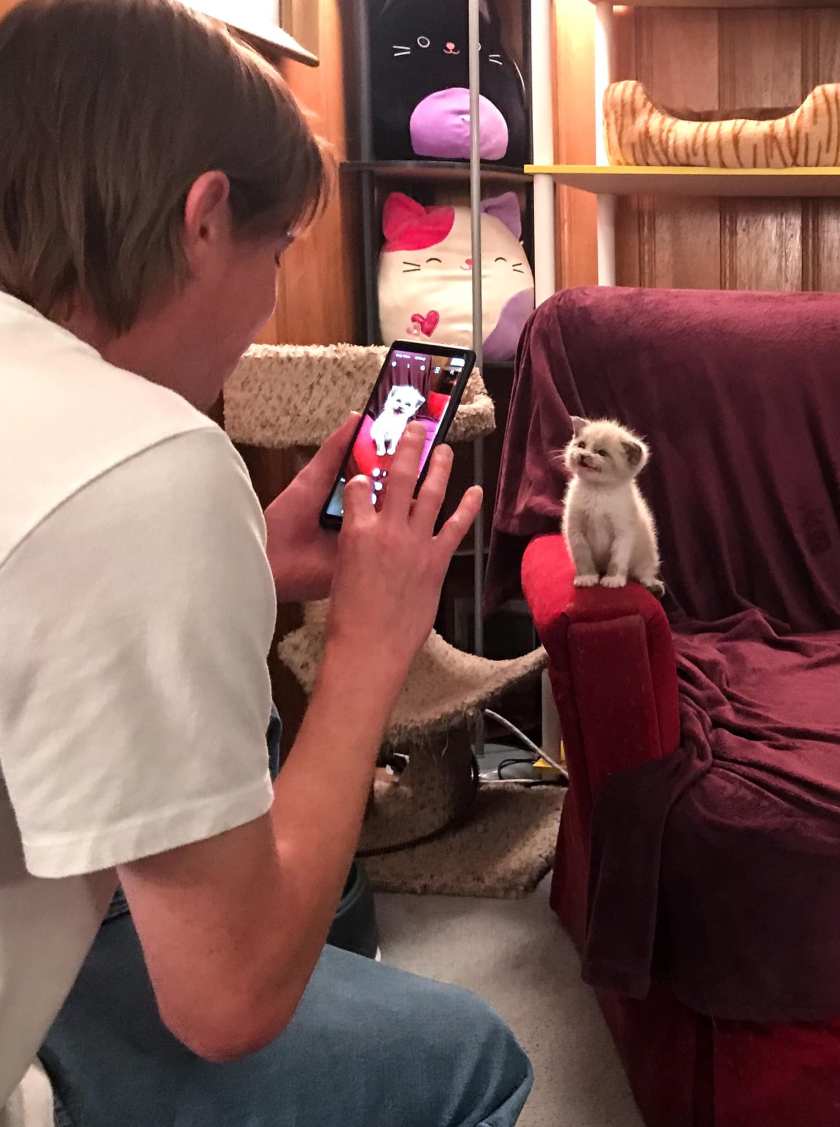
Thanks to a tiny rescue kitten named Blossom and her beaming smile, any doubts can be officially put to rest. Here’s Blossom happily posing for the camera in the home of her foster mom, Lauren Boutz of New Mexico:
“Get my good side! Got it? Good!”
Blossom and her two sisters are receiving round-the-clock care from Boutz and her boyfriend, who have taken over mom duties for the orphaned trio.
The grateful kitty’s sunny mug has been shared a few thousand times since Boutz shared the photos to Facebook. Like all good models, Blossom has several looks.
“My other good side!”
“You cannot resist my cuteness…play with me!”A natural in front of the camera.
Now if we could only get a certain grouch around here to smile…Why so serious all the time, Bud?
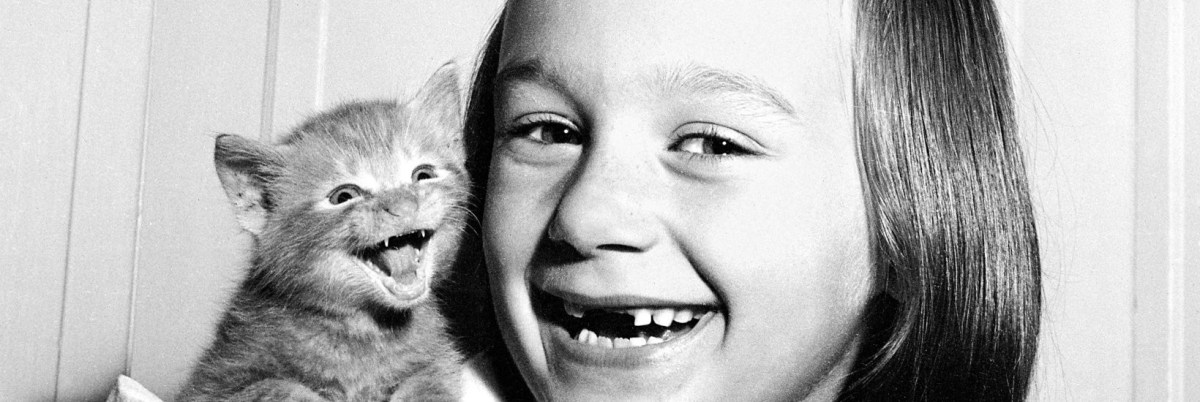
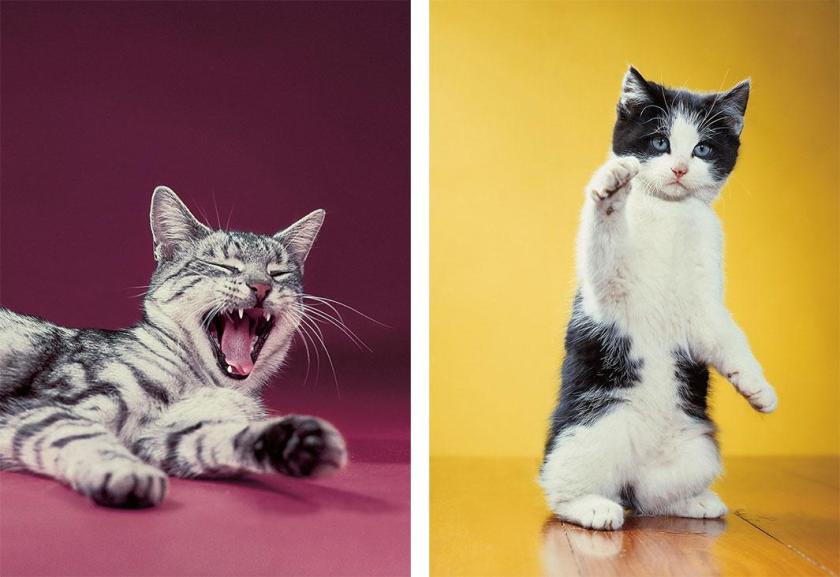
Walter Chandoha photographed cats for the better part of seven decades.
Walter Chandoha might not be a household name, but he’s a legend among photography enthusiasts and — most importantly for readers of this blog — a true OG of feline photography.
Chandoha, who took more than 90,000 photographs of photogenic kitties, passed away earlier this year at the ripe old age of 98. We don’t know the secrets to the photographer’s longevity, but it’s a good bet all that time spent with cute cats was a major contributor.
The New Jersey native and NYU graduate didn’t set out to become the most celebrated cat photographer. His work appeared on hundreds of magazine covers before the fluffy little carnivores pulled him into their world:
In 1949, Walter Chandoha adopted a stray kitten in New York. When he began taking pictures of his new pet, Loco, he was so inspired by the results that he started photographing kittens from a local shelter, thereby kickstarting an extraordinary career that would span seven decades
Now those photos are collected in a book called, appropriately, Cats: Photographs 1942-2018.
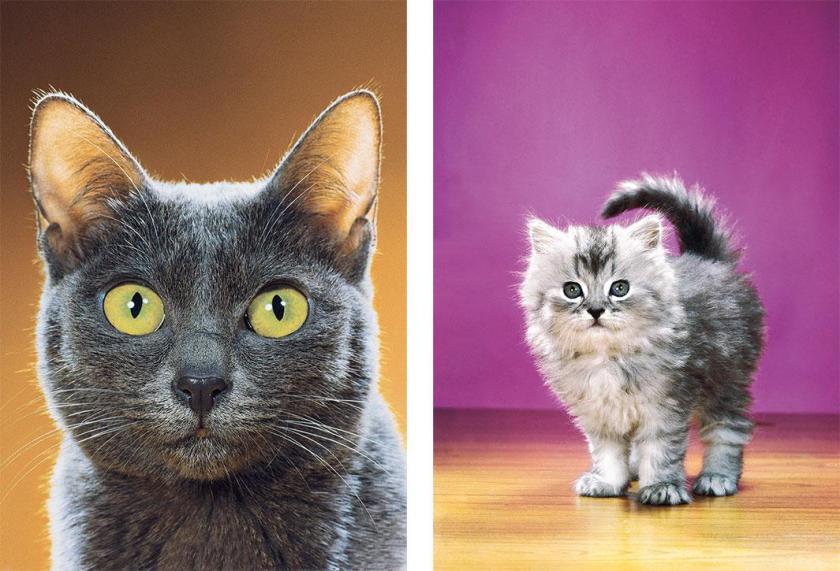
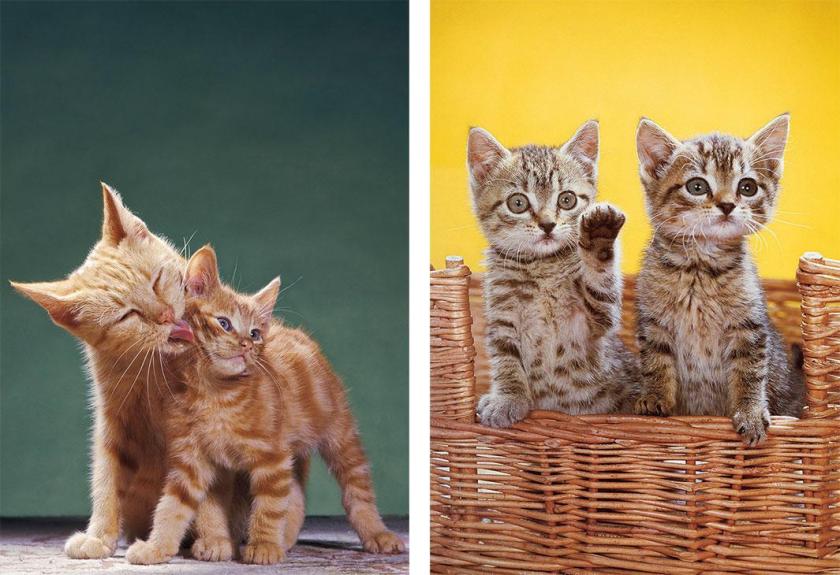
A pair of Chandoha’s kitty muses.
Fashion has Helmut Newton, architecture has Julius Shulman, and cat photography has Walter Chandoha. In 1949, his encounter with a stray kitten blossomed into a career that elevated feline portraiture to an art form. This is a tribute not just to these beguiling creatures but also to a remarkable photographer who passed away this year at the age of 98; and whose compassion can be felt in each and every frame.
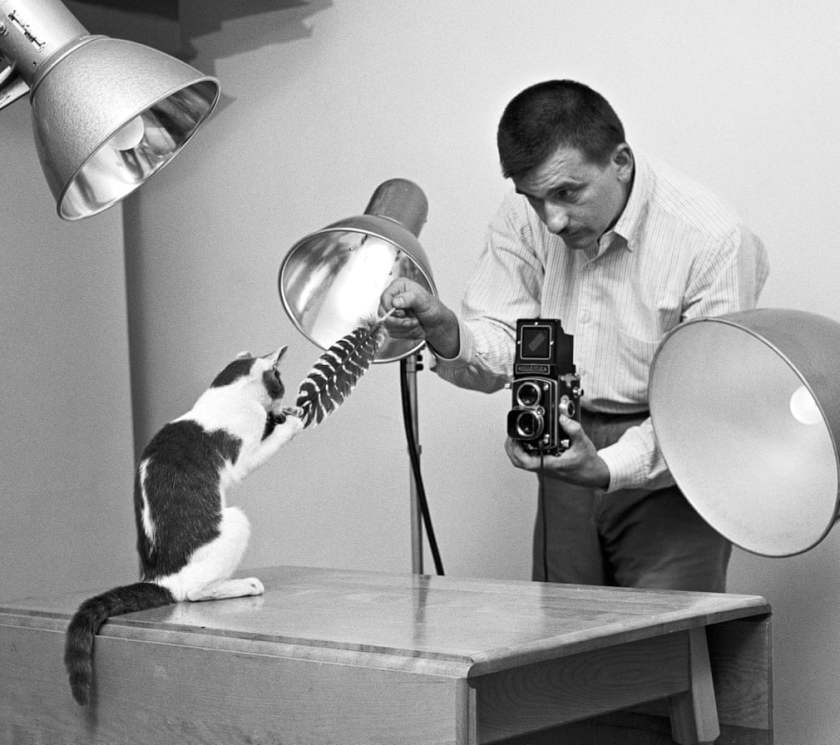
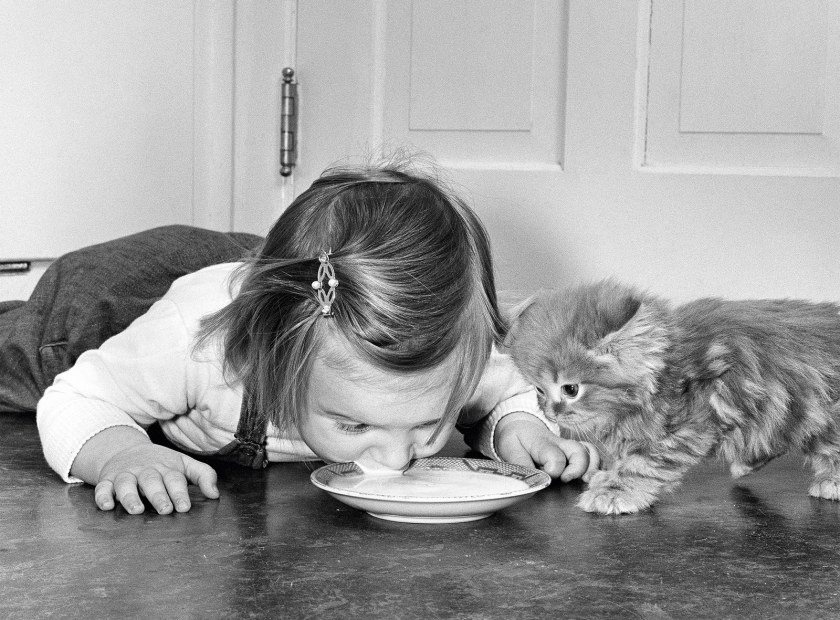
Hello, kitten!“Why are humans always putting us in baskets?”Chandoha and one of his feline models in the 1950s.Walter Chandoha was photographing adventure cats before it was cool.“Hey, get outta my milk, tiny human!”

 Pain In The Bud