A historian casts doubt on tales of widespread cat purging, tracing the origin of the claims to a novel published in the 1990s.
The Washington Post has a new guide for taking better photos of cats and dogs with some solid advice for people using smartphones as well as more traditional cameras.
The article is in front of the paywall so you don’t need a subscription to view it, and it emphasizes a few major points I’ve often written about when people ask me how I’ve been able to get certain shots of Bud:
Always let your cat get used to the camera, whether she sniffs it, head butts it or just wants to see it up close. Let her check it out and lose interest and then it becomes just another thing, allowing you to begin capturing more candid-style photos.
Bribe ’em: Your cat’s a model and deserves compensation. A few treats will keep him hanging around and happy as you snap away.
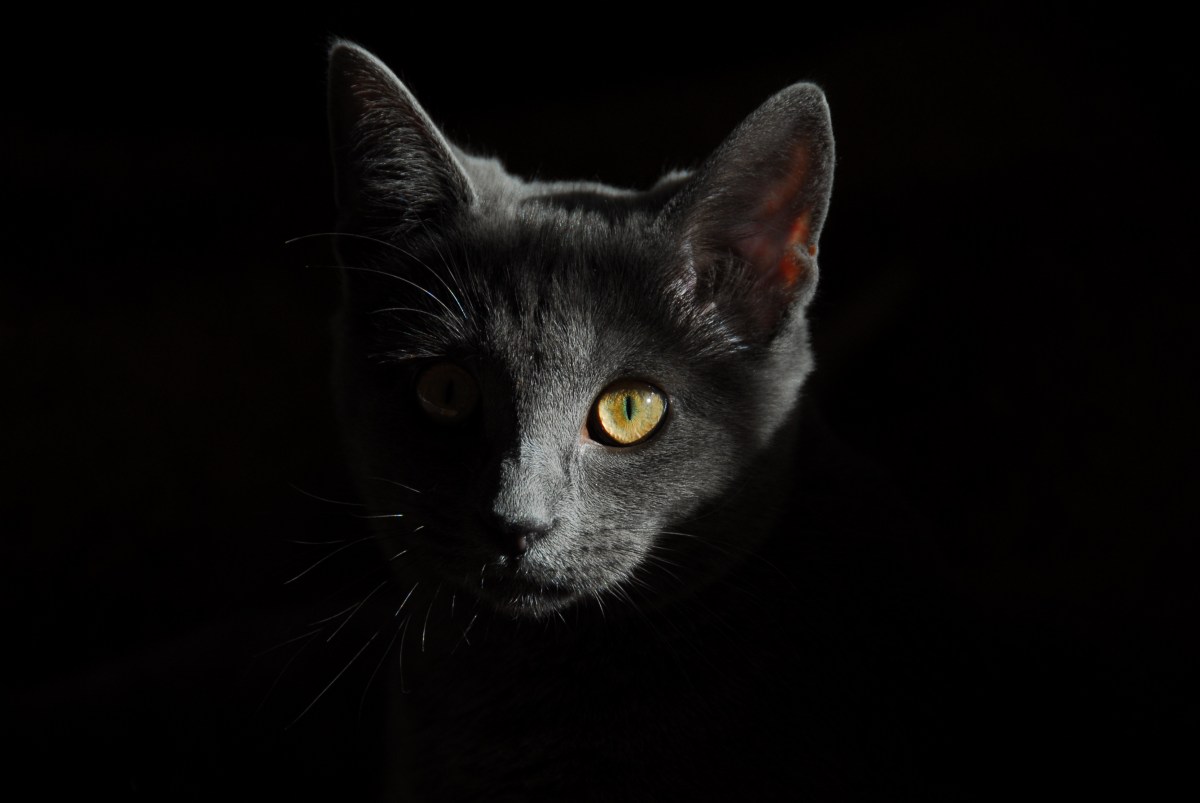
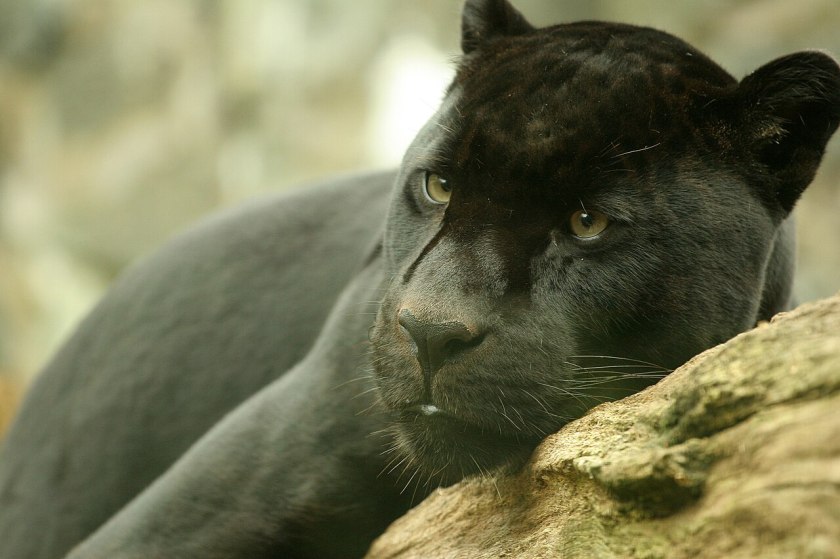
Pay attention to the lighting, especially if you’re shooting a black cat or a kitty with a darker coat pattern. Unless you’re going for a silhouette or a sunrise behind your furry friend, keep your cat facing to the right or left of the primary light source so you’re getting light and shadow to put those feline features in relief. It’s also worth taking a close look at how professional photographers shoot melanistic jaguars and leopards, carefully using light to highlight their features. In the right conditions their rosettes are still visible, they’re just slightly different shades of black. While house cats don’t have rosettes, the same attention to light and detail can help pick out the contours of their beautiful coats.
Under the right light conditions, the contours, spots and rosettes of a black jaguar are visible in beautiful detail. Credit: Edin Zoo/Wikimedia Commons
Did People Really Slaughter Cats During The Plague?
It’s often claimed that Europeans murdered felines en masse during the waves of Black Plague that devastated Europe during the Dark Ages, visiting countless cruelties on cats while inadvertently amplifying the spread by nearly wiping out disease-carrying rodents’ most effective predators.
In a new post that closely examines documents and evidence from burial sites of the era, Snopes concludes there was much less cat-killing than claimed, and the claims of widespread purging at the hands of pandemic-weary zealots have their roots in a 90s novel, which was then circulated on the web as fact.
Sites where as many as 79 sets of cat bones from the era were found show clear signs that the animals were slaughtered for their fur, and a singular slaughter in 1730s Paris often cited as proof is not only a few centuries off but was also motivated by class hatred, not fears of the plague.
While the papal bull Vox In Rama was real, and a famously zealous inquisitor really did make the preposterous claim that Satanists had a ritual that involved literally kissing the asses of black cats, the pope never called on anyone to kill felines and there’s no evidence that people took it upon themselves to do so. There was plenty of other unbelievable superstitious idiocy that led to the deaths of animals at the time, including the practice of putting animals on trial for alleged crimes, but Europeans weren’t rampaging through towns and killing cats.
Snopes quotes Welsh historian Mike Dash, who says the modern claims of widespread cat-killing are “almost certainly a modern internet-based fabrication.”
The pope’s comments were made in the larger context of an imminent “demographic winter” caused by an aging population and historically low birth rates.
Popes have a mixed record when it comes to cats.
Back in the 13th century Pope Gregory IX famously declared cats were at the heart of alleged Satanic rituals in Europe, relying on the account of one Konrad von Marburg, an author of massacres, church inquisitor and all-around idiot known for brutally torturing his victims to elicit “confessions” of heresy.
Von Marburg told the pope that Satanists had a ritual involving a black cat who would walk around backwards while the Satan-worshipers kissed its ass. The pope bought the risible story and believed von Marburg’s accounts of growing numbers of heretics, especially in Germany.
The resulting papal letter, Vox in Rama, did not declare cats were evil and didn’t ask Catholics to kill them, despite widespread claims to the contrary on the internet, but it did contribute to distrust of the animals a century ahead of the Black Plague, when people thought cats were carrying the disease.
The pope who loves cats
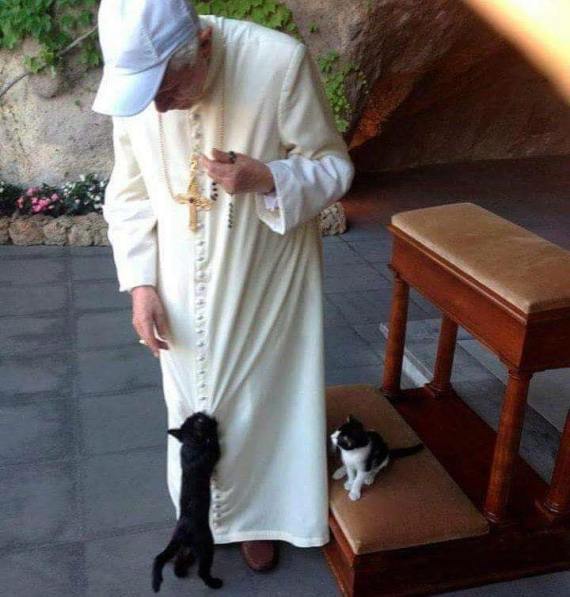
Then there’s the Pope Emeritus, Benedict XVI.
Pope Emeritus Benedict XVI with two kittens in 2017. Credit: The Joseph Ratzinger/Pope Benedict XVI Foundation.
Cat lovers around the world rejoiced when it was revealed Pope Benedict was a cat lover and had two pet felines of his own. Cardinal Roger Mahoney, the former archbishop of Los Angeles, said Benedict was wild about kitties.
“The street talk that the pope loves cats is incorrect,” Mahoney said in 2005. “The pope adores cats.”
Catholics petitioned Benedict to help with animal welfare causes and to lend his support to efforts to help the many stray cats of Rome.
Francis the Saint and Francis the Pope
That brings us to our current pope, Francis. The elevation of Francis was met with approval from animal lovers: His chosen papal name honors St. Francis of Assisi, a Radagast the Brown type figure who lived a life of luxury as a wealthy playboy and party-goer until he had a religious conversion, sold all his possessions and became a monk.
St. Francis believed true faith in God meant having a deep respect for animals. While it’s not clear what’s true and what’s apocryphal, there are stories of Francis preaching to birds, nursing various animals back to health and even convincing a wolf to stop attacking a village in Italy in exchange for the villagers feeding it. St. Francis was by all accounts gentle with animals and appreciative of nature.
St. Francis is revered in the Catholic church and beloved by groups like the Humane Society. He is the patron saint of animals, and on his feast day Catholics bring their pets to be blessed at church.
Pope Francis during a visit with former US Vice President Mike Pence. Credit: Wikimedia Commons
Pope Francis continued his namesake’s work with Laudato Si, a papal encyclical which endeared him to animal lovers all over the world.
The encyclical was notable for the church’s strongest language yet in advocating for protecting and respecting animals. PETA made Pope Francis its person of the year in 2015, and the pope was feted by many other animal welfare groups across the world.
In Laudato Si, Francis explicitly rejected the idea that animals are resources for humans to exploit, asserted the Catholic view that animal life has intrinsic value, and called on human beings to be stewards of animals and the Earth. Abusing and exploiting animals is “beneath human dignity,” he wrote, and the associated desensitization and heartlessness of practices like factory farming are a stain on the human race.
Animals, the pope wrote, not only have souls but will “take their place” in heaven, “resplendently transfigured” in the presence of God. He also pointed out the disastrous effects we’re having on wildlife by destroying habitats, carving up the remaining land, over-fishing the oceans, poaching and hunting.
What Francis said about pets
So why are people suddenly upset with the pope?
He made some off-the-cuff remarks about people choosing pets over children, said it was “selfish” to choose the former, and brought up the plight of the world’s orphans. He pointed out that people collectively spend hundreds of billions on pet food and products while humans in the third world lack basic things like clean water, food and medicine. He also said “denying” motherhood and fatherhood leaves us spiritually poorer, as the experience brings us closer to God.
As usual any time a pope speaks, his statements are taken out of context and rehashed in the media. That’s expected, especially in the age of clickbait, the 140-character tweet and the 15-second news segment. Pope Francis gets himself into trouble by sometimes speaking too candidly when he should know his message will be garbled by gatekeepers and information filters, leading to strong reactions to things he didn’t actually say.
The pope wasn’t condemning keeping pets across the board, and he wasn’t saying all pet owners are selfish. His comments were made in the context of a larger discussion on universally declining birth rates in developed countries, specifically Europe’s “demographic winter,” also called a “demographic time bomb.”
In simple terms, Europe’s population is rapidly aging and birth rates are historically low. Populations are dying off, there are fewer people to care for the elderly, and there aren’t enough babies to replace the dead. The average age in Europe is 43, which is 12 years older than the average in the rest of the world.
COVID has compounded the problem, partly due to social distancing and partly due to economic uncertainty as a ripple effect of the virus. Of course it isn’t all that simple, and the demographic winter’s wider effects are complex and well beyond the scope of this blog.
It also helps to remember the Catholic Church has a strong social justice streak. Not the kind that involves writing snarky tweets and first world problems, but real social justice through charity, schools, scholarships, food banks, shelters, soup kitchens, hospitals and innumerable other efforts.
The pope’s background as a native of Argentina, a former janitor and chemist who became the first Latin American pontiff, also colors his outlook. He doesn’t hesitate to call out the hypocrisy of first-world nations, and although we don’t like to hear it, most of the time we need to. After almost two thousand years of popes existing in or near the world’s seats of power, for the first time we have a pope who grew up from the outside looking in.
That’s not to say I agree with everything Pope Francis had to say on the matter, but I think it’s also important to recognize that he didn’t just take shots at people who care for pets out of the blue, and he didn’t condemn people for caring for animals.



 Pain In The Bud