

In Netflix’s Three Robots, a trio of intelligent wise-cracking machines tour post-apocalyptic Earth after humanity nukes itself out of existence. While humans are long gone from the planet, felines are not, and before long the robots encounter a gray tabby.
“What’s the point of this thing?” one robot asks its friends, looking skeptically at the yawning cat.
“Apparently there’s no point, they [humans] just had them,” the second robot says.
“Well, that’s underselling their influence,” the third robot says. Humans, it explains, “had an entire network that was devoted to the dissemination of pictures of these things.”
The ongoing joke that the internet and modern telecommunications systems were invented solely for the purpose of sharing cat photos and videos won’t die any time soon now, thanks to NASA.
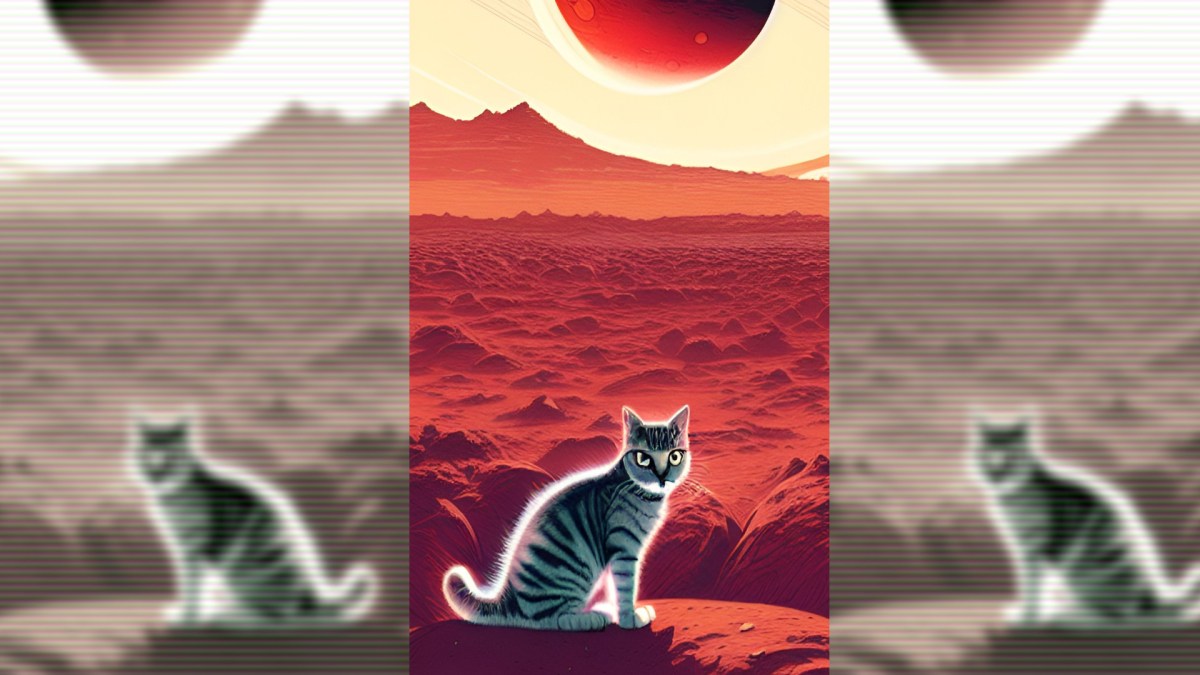
To inaugurate and test its new Deep Space Optical Communications (DSOC) system, which uses lasers instead of radio signals to transmit data, the famed space agency streamed a high definition video of a cat named Taters chasing a laser.
The 15-second clip took half a second to transmit from the spacecraft Psyche and 101 seconds to cross the 19 million miles (30 million kilometers) between Psyche and Earth. For context, that’s a journey about 80 times as long as the distance between Earth and the moon.
So why is NASA doing this? Why create a new communications network when the old one still works? And why send a video of a cat?

The answer to the first question is simple: Our machine proxy explorers need more bandwidth to send back data and ultra high definition photos/video of the strange worlds they’re exploring.
We send robotic probes to destinations like the asteroid belt and Venus because we can’t go ourselves, and because it’s the most efficient way to explore. The indomitable human spirit drove us to explore our own planet, and it’s expected that eventually human eyes will see the oceans of Europa and the surface of Mars. But we still have some big engineering challenges ahead of us, like figuring out how to build ships that adequately shield astronauts from radiation, and medical/biological challenges like how to prevent vision, bone density and muscle loss in low or zero gravity.
So in the meantime robotic probes are our ticket, and their numbers are growing quickly.
There are more than 30 active probes exploring our star system now. Most belong to NASA, but others belong to space agencies from the EU, South Korea, Japan, Russia and India, among others. Another 27 new spacecraft are expected to launch this year, headed to destinations like Venus, Mars and the many moons of Jupiter, and at least that many are scheduled to join them in 2026.
That’s a lot of probes.
Each of those craft will have to transmit data back to Earth — scientific data, but also high definition photos and videos of planetary and moon surfaces, asteroid compositions and more.
There isn’t a traffic jam — yet. But there will be soon if every probe’s data is bottlenecked by the lower-bandwidth radio system.
While laser and radio transmissions both travel at the speed of light, the shorter wavelength of laser light allows more data transfer. In simple terms, the DSOC network is like upgrading from an old phone modem to broadband.
As for why NASA chose a video of Taters chasing a laser, there are two main reasons: Fun and honoring history.
Taters’ human, Joby Harris, works for NASA as a visual strategist. When NASA employees were talking about the significance of sending the first high-def video from a probe to Earth, one staffer mentioned that one of the first — or perhaps the first — test videos in the dawn of television was a simple video of a statue of Felix the Cat.
The rest fell into place. Transmitting a video of a cat chasing a laser seemed like the natural choice to test a laser-based comms system. Taters has become something of a celebrity in the process.
One thing we can be sure of: if aliens are watching us from afar, there’s a good chance they’ll conclude felines are the ones running things down here. They may not be wrong.


 Pain In The Bud