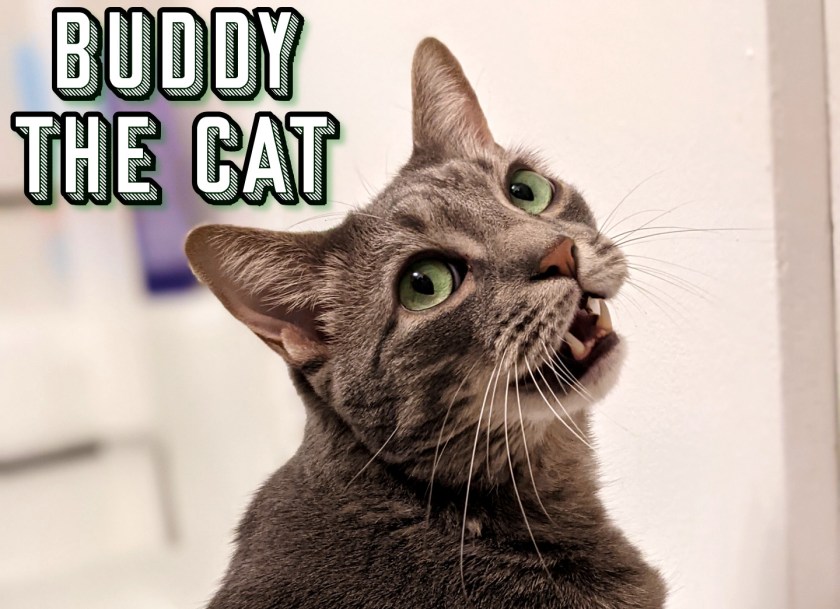
Study Says We Should Use Baby Talk With Cats, Buddy Disagrees

It’s the latest of several studies indicating animals including cats, dogs and horses respond better to higher-pitched, softer voices.

Cats are more responsive when their humans use “baby talk” to address them, a new study claims.

A research team from Paris Nanterre University played a series of recordings for cats. One set of recordings featured a stranger addressing each cat, while another set featured the cat’s human servant calling to the cat.

Each set also had clips in two different tones of voice: one in which the humans spoke to the cats in a tone normally reserved for addressing fellow adults, and another in which they baby-talked their felines.

Not surprisingly the cats were mostly content to ignore the strangers calling them by name even when the strangers used higher-pitched tones, but “displayed a constellation of behaviors suggesting increased attentiveness” when they heard audio of their humans calling them.

The kitties were even more responsive when their humans used the “sing-songy” tone of voice many people reserve for pets, babies, young children and Texans. (Sorry, couldn’t help myself! I’m still salty over my Yankees getting swept by the Astros.)

The research team said the study, which was published today in the journal Animal Cognition, was yet another piece of evidence showing felines are not the ultra-stoic, emotionless animals they’ve been portrayed as for as long as anyone can remember.

β€œFor a long time it has been thought that cats are very independent creatures, only interested in [humans for] eating and shelter, but the fact that they react specifically to their owner, and not just anybody addressing them, supports the idea that they are attached,” said Charlotte de Mouzon, the paper’s lead author. β€œIt brings further evidence to encourage humans to consider cats as sensitive and communicative individuals.”

Although the study included just 16 cats — sample size is a recurring problem in feline-related studies, since researchers often have to travel to the homes of house cats to study their normal behavior — it’s just the latest bit of research on tone in human-cat communication.

Those studies tend to use terms like “pet-directed speech” and “kitten-directed speech” instead of baby talk.

As I wrote last year, I don’t use baby talk with Buddy, and I tend to think of him as, well, my little buddy instead of my “child,” as so many “pet parents” do. That’s not to say I think people who view their pets that way are doing it wrong, or that I don’t have parental feelings toward Bud. Of course I do.

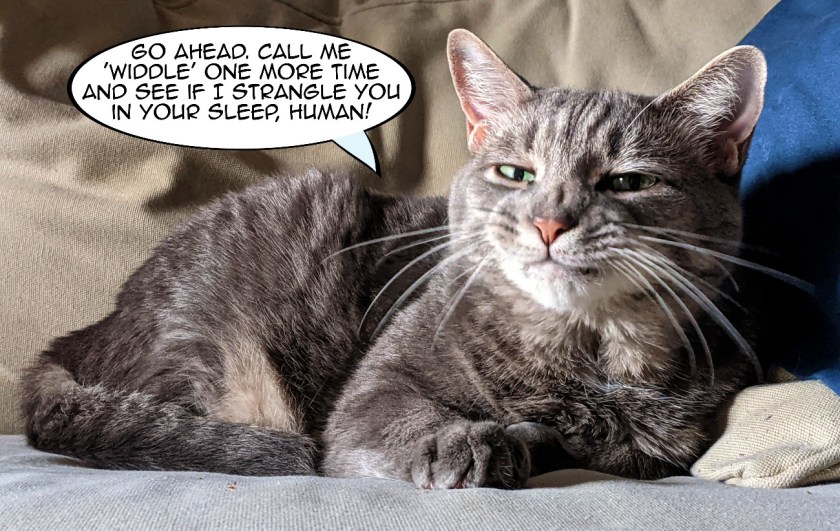
But as I also wrote, Buddy does not tolerate baby talk. I joked that he’d paw-smack me if I spoke to him that way, and indeed he has nipped at me and dispensed warning slaps the handful of times I’ve come close to addressing him that way.

Bud Da Widdle Baby
“Aw! Widdle Buddy is angwy, huh?”

I think it’s because of the way I raised him. He’s not accustomed to it, and he finds it annoying. That makes sense, and it comports with the study authors’ suggestions that the one-on-one relationship between feline and human is an important factor in many facets of cat communication.

But maybe if I’m prepared to dodge a few angry paws I can use the threat of baby talk to nudge Buddy toward being more responsive during those times when he doesn’t feel like coming when called or stopping some important work he’s engrossed in, like chattering away at birds outside.

“Bud! Hey, Bud! Listen to me. I’m talking to you,” I might say. “Okay, have it your way. Who’s da little Buddy wuddy who isn’t wistening to me, huh? Who’s da widdle cwanky boy?”

I’m pretty sure he’ll launch himself at me with a derisive “Mrrrrppp!” and take a big swipe. Haha!

But maybe, just maybe, he’ll be more inclined to listen. Do you baby talk your cats?

Sunday Cats: A Cat Fluent In Sign Language?

Plus a Japanese artist’s stunningly real-looking bespoke cat backpacks.

A Reddit post with almost 30,000 upvotes claims a cat took it upon himself to learn sign language after realizing his human is deaf.

You don’t need me to tell you it’s nonsense, do you? It’s interesting how we’re willing to believe a cat can endeavor to learn sign language, but we — the supposedly more intelligent species — can’t be bothered to watch for emotions conveyed by the curl of a tail or a twitch of the whiskers.

Cats are incredibly smart little furballs, but just like the people who claim their cats are meaningfully communicating via talking boards with 100 buttons, this is just social media fodder for the credulous.

Unfortunately the credulous are numerous, although a few Redditors had a good time at their expense. One user complimented the addition of a VHS-like filter over the video clip, giving it a vintage quality.

“Not a filter. It’s been around for a while,” another Redditor responded. “The cat now knows ASL, English, French, Spanish, and is working on its doctoral thesis.”

A cat in a backpack? No, a cat backpack

In a reminder that the Japanese have an endless appetite for all things cat-related, the newest hot item among the Land of the Rising Sun’s neko-infatuated is a bespoke cat backpack hand-sewn by a housewife in Fukui prefecture.

The bags don’t come cheap. It takes Miho Katsumi between one and three months to make each one, and they’ll set you back about $1,000 each via Katsumi’s site. Check out her Instagram for more images.

How quickly do you think Bud would murder me if I came home with one of these in his image one day? πŸ™‚

Do You Use ‘Baby Talk’ With Your Cat?

Buddy does not tolerate baby talk.

A few years ago when Bud was a bit more of a daredevil than he is now, I was sitting on my balcony on a warm summer night when the little dumbass squeezed through the railing bars and did a circuit of the balcony outside the rail — with only three or four inches of ledge between him and a potentially brutal fall onto the concrete below.

“Bud!” I said, feeling my own fear of heights bubble up as I watched him take his precarious stroll.

He ignored me.

“Bud!” I said again, loud enough to make sure he heard me but not so loud as to startle him and cause him to fall. “Bud! I’m talking to you! Get back over here right now!”

He paid me no mind. I stood up, put my hands on the railing and looked down at him.

“Buddy, get back here now! I’m not gonna say it again!”

At that point I realized there was a couple about my age, probably returning from the bars, drunk-walking toward the back door of the building and watching me have a furious one-sided discussion with my cat. They seemed to think it was hilarious, not only because I was speaking to my cat, but also because I was talking to the little stinker like he was a person.

I don’t baby talk with Buddy, and I’ve noticed my brother doesn’t baby talk his dog, Cosmo.

Sure I’ll speak to Bud warmly and encourage him when he’s clearly frightened of something. (Which is very rare, of course, because he’s such a fearless and brave tiger!) But it isn’t baby talk, and 95 percent of the time I speak to little man as if he’s, well, a little man.

It turns out I may be “doing it wrong,” at least according to some veterinarians and animal behaviorists who say baby talk is a good way to communicate with pets. Animal behaviorists call it “pet-directed speech,” and although the studies so far have been limited, they seem to suggest cats (and dogs) are more likely to respond to it than typical speech in normal registers and cadences. (A study published in the journal Animal Cognition earlier this year found horses respond well to “baby talk” too.)

Despite that, I just can’t bring myself to do it. There are certain standards we must uphold in this home, and besides, I’m pretty sure Bud would paw-smack me if one day I scratched his head and started saying “Who’s a good widdle boy? Is that you? Are you the good widdle boy? Yes you are! Yes you — OUCH! What the hell, dude? Why’d you do that?”

Do you “baby talk” to your pets?

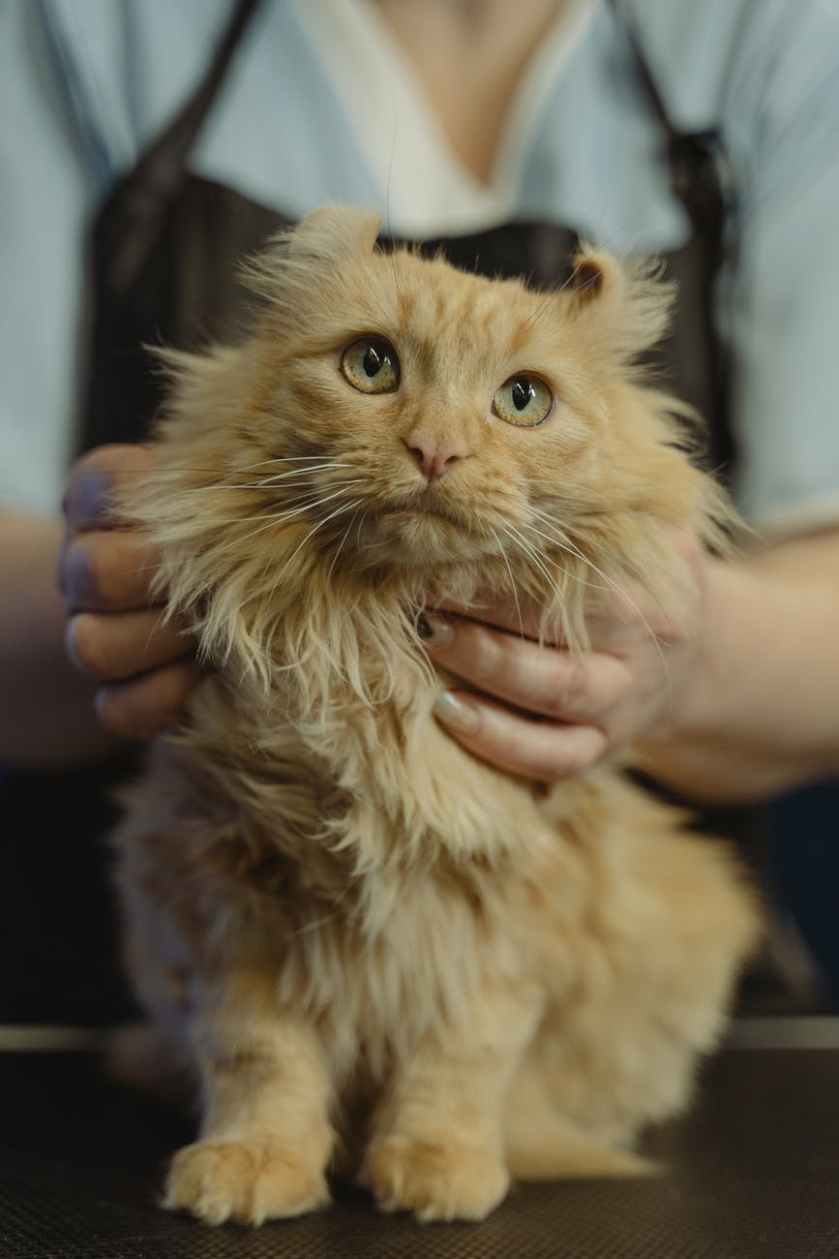
person wearing apron holding orange tabby cat
“Who’s a cute widdle fluffy wuffy?” Credit: Tima Miroshnichenko/Pexels

MeowTalk Says Buddy Is A Very Loving Cat!

A new app aims to help us better understand and communicate with our cats.

A while back I wrote a post about MeowTalk, a new app that uses AI — and input from thousands of users sampling their cats’ vocalizations — to translate meows, trills and chirps for the benefit of those of us who don’t fluently speak cat or might need some clarity on what our furry friends are trying to say.

Now that I’ve finally had the opportunity to give MeowTalk a spin, it turns out Bud is a much more polite cat than I thought he was!

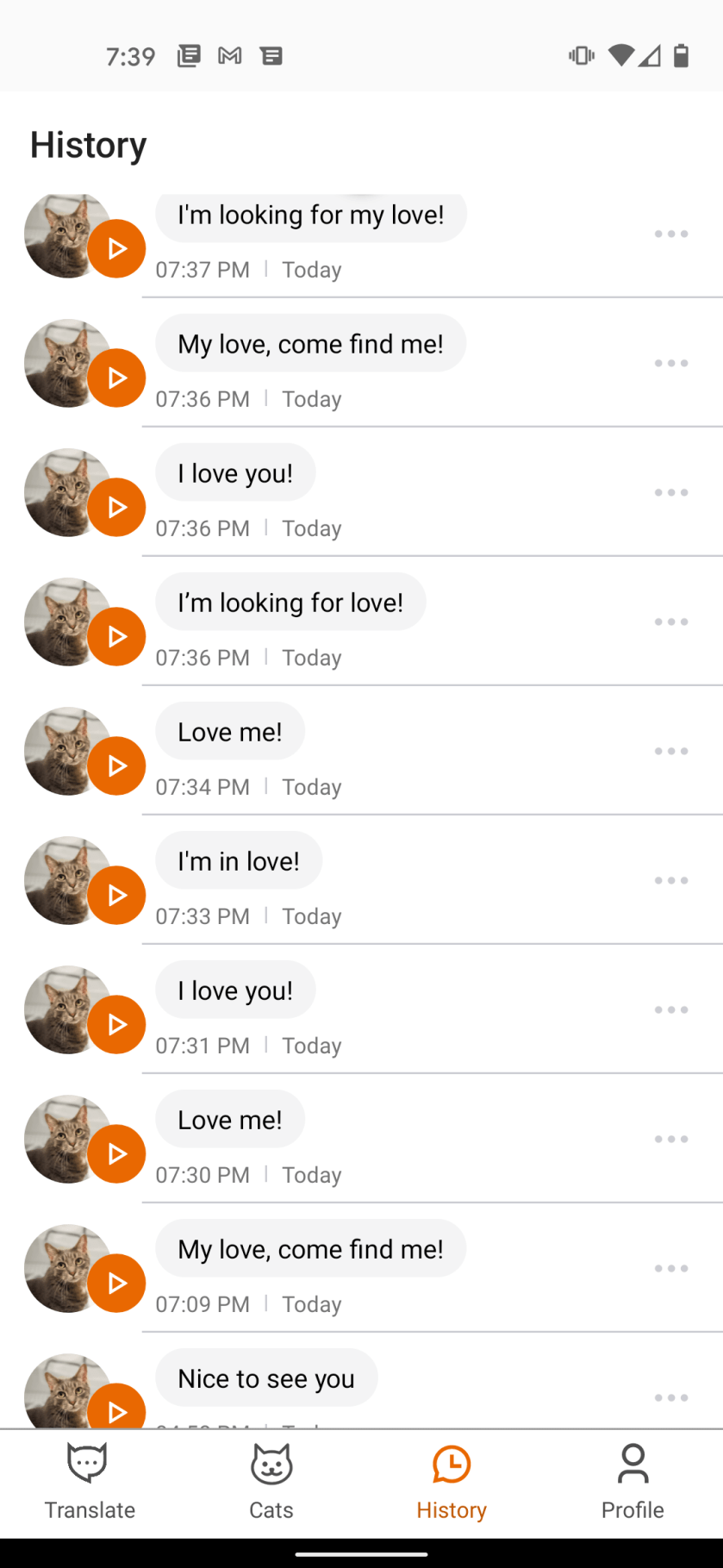
What I thought was an unenthusiastic “I acknowledge your presence, human” turned out to be “Nice to see you!” according to MeowTalk.

Buddy’s next meows were “Love me!” and “I love you!”, the app informed me. Weird. I thought he was complaining that I was only half-heartedly simulating prey with his wand toy while watching Jeopardy.

After Jeopardy I headed to the bathroom, which was the real test.

I intentionally closed the door before the little stinker could sneak in the bathroom with me, then held up the phone to capture his muted vocalization. I was sure Bud was saying “Open the door!” but the app told me Buddy was saying “I’m in love!”

Awww. What a good boy. How could I not let him in?

Once inside, Buddy began talking again as I knew he would. He’s a vocal cat.

“I’m looking for love!” the app translated as Bud pawed at the door, demanding to be let back out again. “My love, come find me!”

MeowTalk Screenshot

What was going on here?

Was Bud really professing his undying love for me, his human, or was he workshopping cheesy dialogue for a feline romance novel he’s been secretly working on?

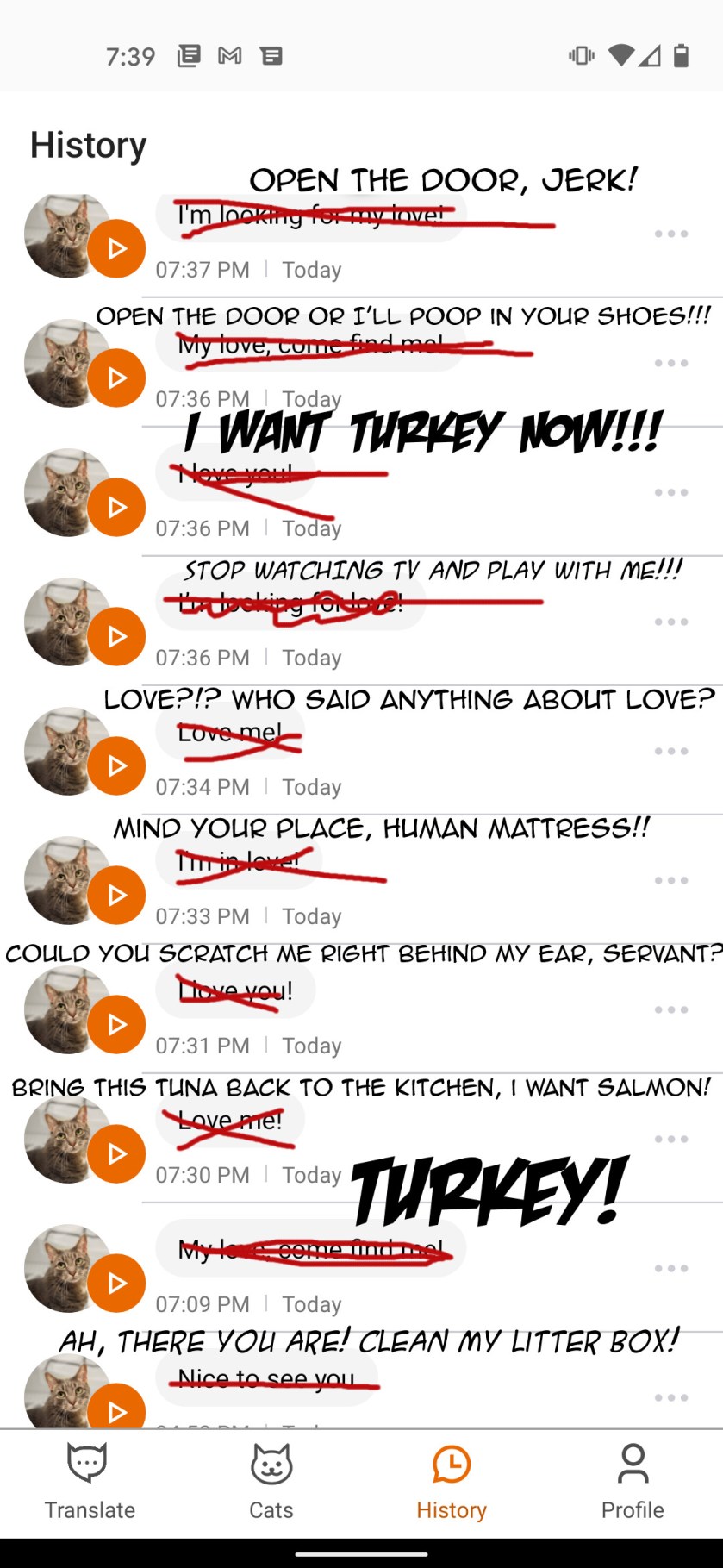
Thankfully, MeowTalk allows you to correct translations if you think the app’s gotten them wrong. This looks more like it:

The Translated Buddy
Translation from the original Buddinese language.

MeowTalk is in beta, and it can only get better as more users download the app, make profiles for their cats and make an effort to tag vocalizations with their correct meaning.

The app was authored by a software engineer who was part of the team that brought Amazon’s Alexa to life, and the algorithms that power it already show promise: When the app is listening (which it does only actively, after you have explicitly given it permission to do so), it does a great job of distinguishing cat vocalizations from background noise, human chatter, televisions and other incidental sounds. Even my fake meows were unable to fool it.

Each vocalization is sampled and saved to the history tab of your cat’s profile, so you can review and adjust the translations later. If you’ve got more than one cat you can make profiles for each one, and the app says it can tell which cat is talking. I wasn’t able to test this since the King does not allow interlopers in his kingdom, but given MeowTalk’s accuracy in distinguishing meows from every other sound — even with lots of background chatter — I have no reason to doubt it can sort vocalizations by cat.

In some respects it reminds me of Waze, the irreplaceable map and real-time route app famous for saving time and eliminating frustration. I was one of the first to download the app when it launched and found it useless, but when I tried it again a few months later, it steered me past traffic jams and got me to my destination with no fuss.

What was the difference? Few people were using it in those first few days, but as the user base expanded, so did its usefulness.

Like Waze, MeowTalk’s value is in its users, and the data it collects from us. The more cats it hears, the better it’ll become at translating them. If enough of us give it an honest shot, it just may turn out to be the feline equivalent of a universal translator.

And if it’s successful, its creator wants to make a standalone version as a collar, which would translate our cats’ vocalizations in real time. As far as I’m concerned, anything that can help us better understand our cats is a good thing.

Check out the free-to-use MeowTalk on Google Play and Apple’s app store.

Buddy the Cat
“Okay, fine. I love you human. But that doesn’t mean you can slack off with the snacks.”

Study Confirms Cats Are Set At Ease By ‘Slow Blinks’

For the first time, a study shows slow-blinking has a positive effect on human-feline communication.

I’d been in Japan for almost two weeks last year when I dialed back to the States on a Facetime call and my mom — who had been taking care of Buddy in my absence — held Bud up to her iPad.

“Someone wants to say hi to you,” she said.

Buddy looked at me, then tentatively blinked with one eye. When I returned the blink, he meowed excitedly, reaching a paw out to the screen.

Aside from making me feel bad about leaving my cat for so long, the exchange between Bud and I seemed to confirm the importance of the slow eye-blink in feline-human communication. It also confirmed that he missed me.

Now there’s a formal study that, for the first time, shows cats are more relaxed and more likely to approach humans — even strangers — if they’re greeted with a slow blink. Cats also like to reciprocate with a slow blink of their own when greeted that way, the study found.

blinkingcat
Credit: u/sol-aurum/Reddit

“This study is the first to experimentally investigate the role of slow blinking in cat-human communication,” said Karen McComb, a psychologist from the University of Sussex and co-author of the study. “And it is something you can try yourself with your own cat at home, or with cats you meet in the street. It’s a great way of enhancing the bond you have with cats. Try narrowing your eyes at them as you would in a relaxed smile, followed by closing your eyes for a couple of seconds. You’ll find they respond in the same way themselves and you can start a sort of conversation.”

Why does a slow blink put cats at ease?

Tasmin Humphrey, a Ph.D. student and study co-author, said it’s “possible that slow blinking in cats began as a way to interrupt an unbroken stare, which is potentially threatening in social interaction.”

The researchers say their results could help people communicate more clearly with their cats, and could be useful in shelters, where staff and volunteers are often tasked with trying to calm scared cats.