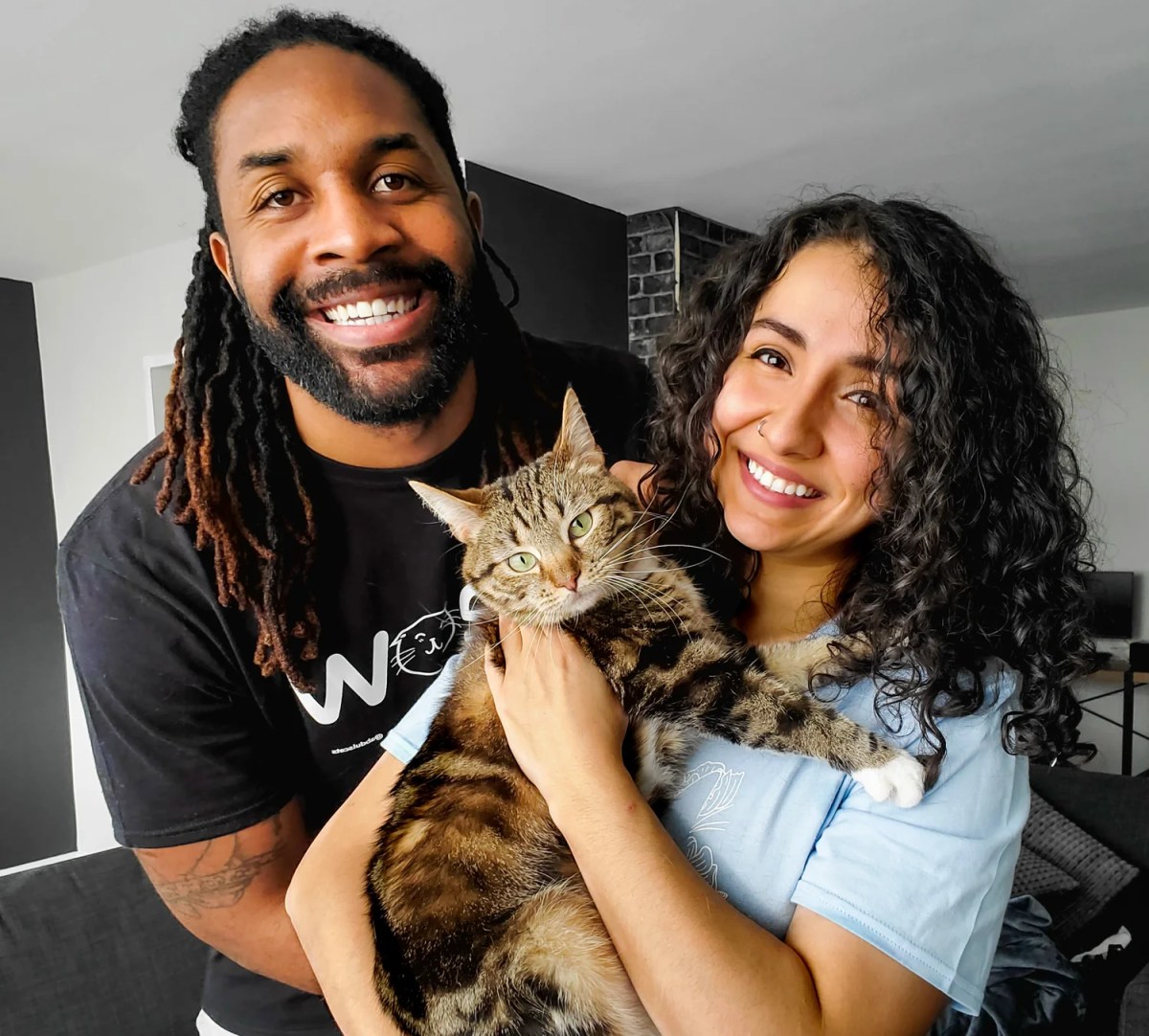
Abdul Raheem found peace when he adopted his beloved cat, Bambi. Now he wants other men to know felines are awesome.
There’s something to the idea that people who aren’t fond of felines just haven’t met the right cat.
For me, it was the experience of interacting with a friend’s affable tuxedo — just one, since all my experiences up to that point had been with people who kept an unreasonable number of cats.
For Abdul Raheem, it was adopting a cat named Bambi after he and his wife fostered and fell in love with her.
“She brought me so much just happiness, and she made my mental health better,” Raheem told the Washington Post. “My anxiety was better when I was around her. So I just want to give other people that feeling.”
Raheem and his wife, Shamiyan Hawramani, became regular fosters for a shelter near their home, and Hawramani began filming her husband’s doting interactions with the baby felines.
Raheem with one of his bottle babies. He and his wife have fostered about 200 kittens and cats since the COVID pandemic.
Their friends found the videos amusing, and lots of people online have too. Abdul’s Cats, an Instagram account documenting Raheem caring for fosters, has a large following — including young men, many of whom are thinking about adopting a cat for the first time because Raheem is showing them something that challenges stereotypes.
My favorite anecdote is about Raheem’s enthusiasm for cats spreading to his friends. At first, they got accustomed to the idea of baby cats jumping in their laps and taking curious swipes at controllers on nights when they’d hang out and play video games.
Then they came to the same conclusion Raheem had: hanging out with cats is relaxing. Several of those friends have since adopted their own feline overlords, and Raheem says one friend now has four cats running around his house.
As for stereotypes, I think cat ladies get a bad rep. They’re the ones who do all the hard work of managing colonies, trapping, fostering, volunteering in shelters and placing cats in good homes.
When you think of the sheer volume of work, and the things they’ve accomplished — including a dramatic reduction in euthanized cats thanks to TNR efforts — they are the unsung heroes. They do it because they love cats.
Jordan Poole is one of several NBA players who have professed their love of felines. In the off-season Poole volunteers with his local shelter.
But it’s also good to toss aside labels and outdated attitudes, like the insistence that cats are companions for women only, and that adopting and caring for a feline friend is somehow unmanly.
Like Jordan Poole, the NBA guard who evangelizes the awesomeness of cats to his fellow players, men like Raheem show guys that they can adopt too.
Now if you’ll excuse me, Bud and I have a busy day of lifting weights, watching football, working on the hot rod we’re restoring in the garage, and drinking beer. Then we’re gonna chant Viking drinking songs until we pass out.
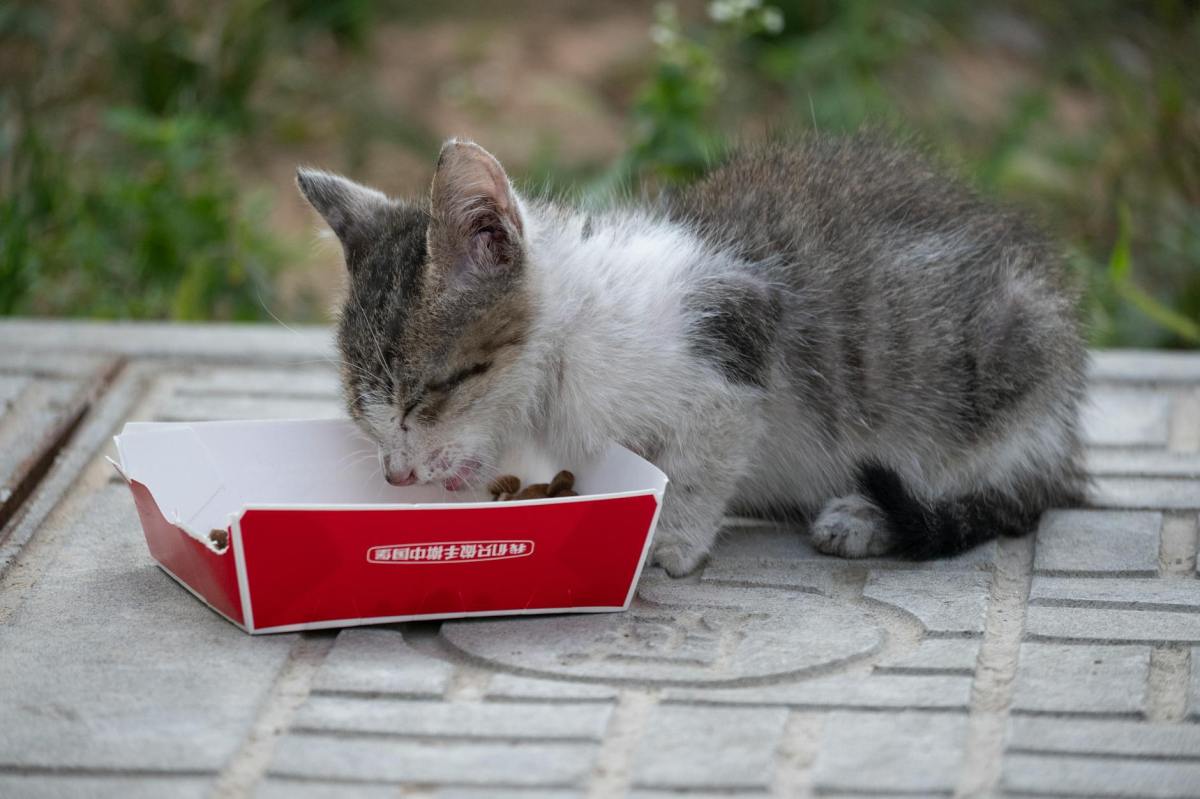
Feeding strays is now punishable by a $150 fine in an Ohio town, the latest municipality whose elected leaders chose to ignore expert guidelines on managing feline populations.
Every time the stray cat issue comes up, local town boards and city councils act as if they need to reinvent the wheel.
Imagining that they are the first to deal with this extremely common problem, they make decisions from positions of ignorance, dismissing the concerns of people who actually work with cats. Or they “do the research” and come up with their own ineffective policies instead of simply looking at what other towns and cities have tried in the past.
At least that way, you know what works and what doesn’t, and how much your decision’s going to cost taxpayers.
But that would be the smart thing to do, which is why our local elected leaders don’t do it. Instead they pull stunts like the village board of Mogadore, Ohio, a town of 3,700 about 10 miles east of Akron.
The Mogadore board just passed a law that makes feeding strays and ferals punishable by a fine of up to $150, as if that will stop cats from finding food and breeding.
Tellingly, Mogadore’s elected leaders say their ordinance applies to “wild, stray, or un-owned” cats, which means they don’t understand they’re all the same species.
Apparently neither do the reporters at WOIO, a local news station in Cleveland. A story from the station is confidently incorrect in telling readers “[d]omestic cats that have become wild, meaning live outdoors, roam free, and rarely interact with humans, are also considered feral.”
Credit: Sami Aksu/Pexels
Felis catus is a domestic animal. By definition a domestic cat is not wild and cannot become wild. Evolution cannot happen to a single animal.
While evolution is a constant process, speciation — wolves becoming dogs, wildcats becoming house cats, wild boar becoming docile farm pigs — is a species-wide shift that takes at leasta few hundred years but often much longer, “from human-observable timescales to tens of millions of years” depending on the species.
The whole process results in changes at the genetic level. The transition from wildcats to domestic cats, for example, involved changing only 13 genes.
This is not rocket science, it’s basic stuff we all learned in high school science classes.
But that’s almost beside the point.
Fining people for feeding stray cats, including caretakers who voluntarily manage cat colonies, will not solve the problem. It doesn’t work. It has never worked in any town anywhere in the world.
It also creates a needlessly adversarial relationship with the passionate people doing the hard work of managing the feline population, often thanklessly and at their own expense. Why make enemies of them when they’re doing a public service?
Mogadore’s village board had a representative from Alley Cat Allies and people from local rescues on hand to inform them that fines don’t work, and to offer the humane and effective option of trap, neuter, return. TNR may not be perfect, but it’s better than anything else people have tried.
Mogadore’s board and mayor ignored the experts and went ahead with their plan to fine people instead.
They’re not alone. This happens thousands of times across the US, Europe, Australia and most other places where domestic cats live. Japan and Turkey take a more humane approach, and they’re better for it. But here in the US, we often deal with issues by ignoring precedent and engaging in wishful thinking.
If the residents of Mogadore are lucky, their elected officials will realize their mistake sooner rather than later.
Stray and feral cats already have a difficult existence without ill-advised laws making it illegal to care for them. Credit: Mehmet Fatih Bayram/Pexels
Unaware they were being recorded, elected leaders in a small Texas city let their imaginations run wild in a closed-door meeting about dealing with feral cat colonies.
One proposed mass poisoning to take out as many as 50 cats at a time. Another, perhaps fancying himself a mafia hit man, envisioned taking care of the city’s cat “problem” execution-style with a “.22 round to the back of the head.”
A third proposed dumping the bodies of the dead cats in an area the city already uses to dispose of unwanted animals.
“We have a location on this property that’s called deer heaven,” the committee member told colleagues at the Nov. 6 meeting. “I’m sure it could be kitty cat heaven too.”
Now the city council and wildlife advisory council of Granite Shoals, a city of about 5,100 in central Texas, are trying to explain themselves to an infuriated public, the local Humane Society and their own police, who rebuked them in a public statement that asserted their plans are illegal.
State and local laws “do not allow any cruelty to animals, including feral cats in our community,” police chief John Ortis wrote in a letter to the public.
The Hill Country Humane Society took the extraordinary step of “terminating its relationship” with the city, calling the committee’s plans “blatantly unethical and illegal” in a statement posted on Facebook.
“This recording reveals that not only was there an attempt to develop a plan to inhumanely shoot captured cats and dispose of their carcasses, but there was open discussion between members of the committee and the City Manager about the need to conceal such activities from the general public,” the Humane Society wrote.
Staff at the Humane Society said they’ll still take in stray cats from the city, but they’ve ended their official partnership.
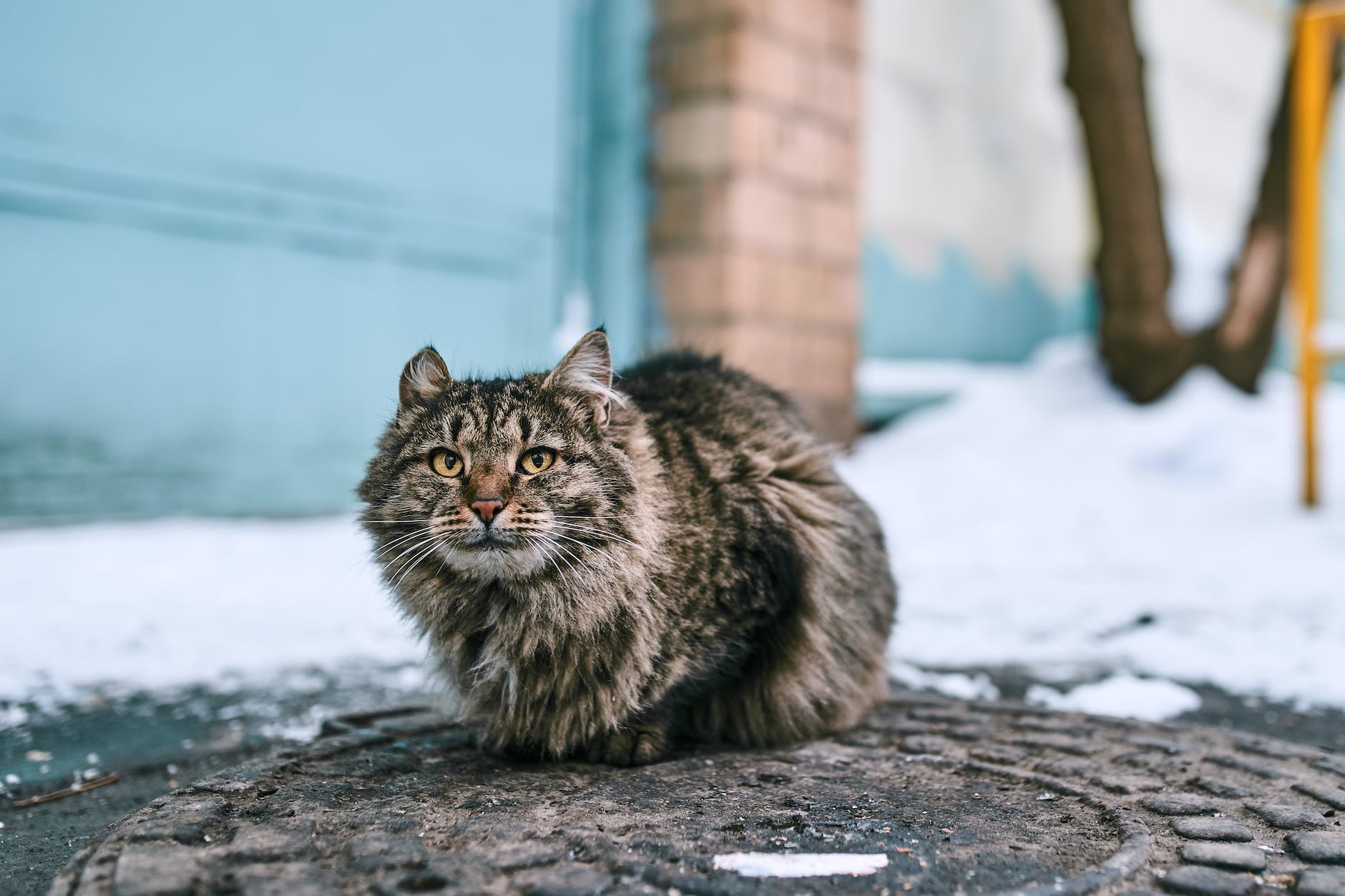
A stray cat. Credit: Aleksandr Nadyojin/Pexels
Todd Holland, the committee chair, denied that his members wanted to keep details of their plans from the public and told local newspaper the Daily Trib that the committee was merely trying to work out the “intricate details” of how to handle a population of about 400 cats. It’s not clear how the city arrived at that number, and there’s been no mention of an official effort to get an accurate tally.
“It’s not like we’re a bunch of cowboys running wild,” Holland said.
But in the recording, committee members clearly discussed hiding details from the public, and the Daily Trib noted that the committee used the word “remove” interchangeably with “euthanize” in written materials detailing the plan, perhaps to soften the language or obscure the fact that the proposed solution was to kill the cats.
Granite Shoals Mayor Ron Munos called the recording “disturbing” and said the committee’s plan will not be put into practice.
“The city is not doing this,” he told the Daily Trib. “We’re not going out and killing cats.”
Here at PITB we feel like a broken record regularly referring back to the junk studies blaming cats for killing billions of birds annually, but the reason we do is because those studies have real-life consequences.
Ill-advised, unethical and illegal plans to eradicate stray cats wouldn’t be explored at municipal and county levels if elected leaders weren’t told that trap, neuter, return (TNR) programs do not work and that outdoor cats pose the most significant thread to local wildlife.
In plain terms there’s been a concerted effort to paint domestic cats as dangerous, ruthless killing machines, the media hasn’t treated the claims with skepticism, and the result is a whole lot of cruelty and misery inflicted on innocent animals.
City councils, wildlife biologists, park rangers and others are not armed with the facts when they rely on those studies, and the result is bad policy and decision-making.
Stories like this one out of Texas have become more frequent over the past few years, and we suspect things will get a lot worse for cats without injecting some much-needed sanity and evidence-based solutions to counter the tidal wave of misinformation.
Armed with real data, there’s a chance to stop horrific policies designed to kill millions of cats who are blamed for driving small wildlife species to extinction.
For the past two decades, a handful of birders and “conservationists” have claimed cats kill as many as 3.7 billion birds and 22.3 billion small animals every year in the US alone.
“They’ve got to taste good,” an Australian scientist who helped develop the sausage formula said. “They are the cat’s last meal.”
Now who’s the serial killer?
Sadly, few people have thought to question the studies that claim jaw-dropping numbers of birds and small mammals are slaughtered by cats every year.
How did the studies arrive at those numbers? Their formula hasn’t varied much from “study” to “study,” and more or less looks like this:
Assemble your data from old studies that have nothing to do with cats preying on wildlife, or hand out questionnaires to a handful of cat owners and ask them how many animals they think their free-roaming cats might kill.
Since you don’t know how many stray, feral and free-roaming cats exist in the US, invent an arbitrary number. Most of these “studies” put the number of cats anywhere between 25 and 125 million, but higher numbers are better because they make for more apocalyptic predictions and generate more credulous headlines.
Completely ignore the primary factors driving avian extinction in the world, which are human-caused: Habitat destruction, habitat defragmentation, wind turbines, pesticides, cars, high tension wires and windows, which are by far the biggest bird-killers.
Attribute all of the above to feral, stray and free-roaming cats.
Take your original “data” and, without making any adjustments for climate, regional variation, migration patterns, other predatory impacts — or anything else, really — simply extrapolate the total number of bird deaths by multiplying your small dataset by the total number of free-roaming cats in the US, which you invented back in Step 2.
Package the entire thing as a rigorous study by Serious Conservationists, write some apocalyptic press releases and hype up your claims in your abstracts, because you know the vast majority of web aggregators and overworked reporters will not have the time to take a deep dive into the text of your study.
Encourage activist groups and lawmakers to push for the mass culling of cats, based on your studies.
Please, don’t take my word for it. Read the text of any of the widely-cited studies that have been reported as gospel in the last 20 years. You’ll be astonished at what passes for rigorous scientific work, and how policies that determine the fates of millions of cats are largely shaped by these studies.
The D.C. Cat Count and the importance of a baseline
But there’s hope: A coalition of groups in Washington, D.C., spent more than three years methodically taking a “census” of that city’s cat population using a variety of methods.
They surveyed thousands of households within the city limits to find out how many cat owners allow their pets to roam free. They set up 1,530 trail cameras in wooded areas, ditches, alleys, alongside streams. The cameras are motion-activated and they produced more than five million images — including more than 1.2 million images of cats and more than four million images of local wildlife. The cameras captured photos of squirrels, coyotes, raccoons, possums, deer and even wild turkeys.
They assembled teams of dozens of volunteers to personally survey areas where cats are known to congregate. Then, when all the data was collected, they spent months sorting the results, carefully keeping tally, sorting duplicate sightings of individual cats and confirming data when necessary.
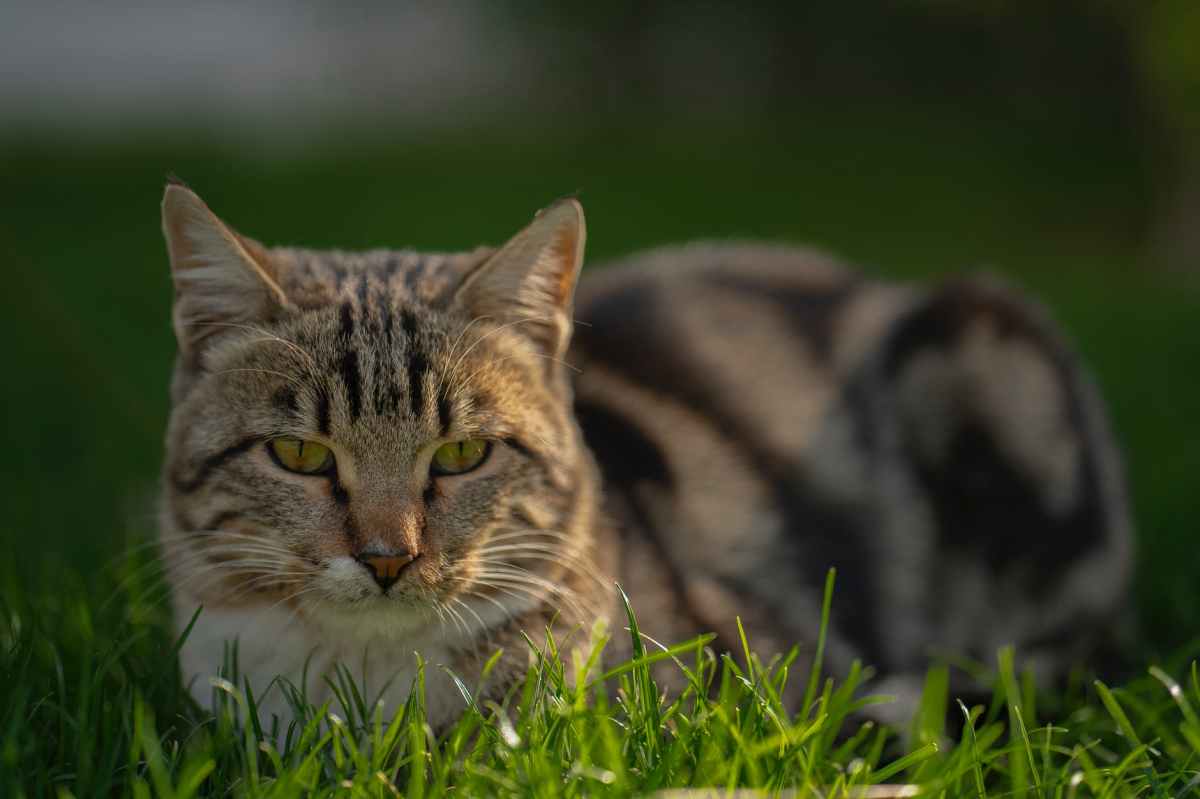
Credit: Pixabay/Pexels
When all was said and done, after three years, $1.5 million and countless man-hours, the study determined there are some 200,000 cats living in Washington, D.C., and only about 3,000 of them are truly feral, meaning they’re not pets and not part of managed cat colonies.
The team — which brought together conservationists, bird lovers, cat lovers, shelter volunteers and others who would normally oppose each other on cat-related policies — also documented every step to provide a toolkit for other cities and local governments to conduct their own methodical head counts. They don’t have to reinvent the wheel to take D.C.’s admirable lead.
The leaders of the D.C. Cat Count went to all that trouble because they understood that without knowing exactly how many cats they’re dealing with, where they congregate and how they behave, any policies attempting to deal with their potential impact would be flawed and could end up doing more harm than good.
Making informed decisions about managing outdoor cats
Anyone who continues to cite the old, sloppy studies should be reminded, loudly and often, that they have led to years of failed policies, heartbreaking outcomes, enmity between cat lovers and birders, and widespread misunderstanding of how cats behave and the impact they have on wildlife.
Now the next phase begins: Dispensing with the hysteria and finding real, useful ways to minimize the predatory impact of cats on local wildlife populations.
One of the first follow-up studies to bear fruit comes, not coincidentally, from a research team in nearby Fairfax County, Virginia, and yields some surprising revelations about free-roaming cat behavior and impact.
The biggest takeaway: Because free-roaming cats almost always stick to small areas (spanning only 550 feet, or 170 meters), “cats were unlikely to prey on native wildlife, such as songbirds or small mammals, when they were farther than roughly 1,500 feet (500 meters) from a forested area, such as a park or wooded backyard. We also found that when cats were approximately 800 feet (250 meters) or farther from forest edges, they were more likely to prey on rats than on native wildlife.”
That’s it. In other words, small buffer zones are “the difference between a diet that consists exclusively of native species and one without any native prey,” the study’s authors wrote.
“Our findings suggest that focusing efforts on managing cat populations near forested areas may be a more effective conservation strategy than attempting to manage an entire city’s outdoor cat population,” wrote Daniel Herrera and Travis Gallo of George Mason University.
Credit: Phan Vu00f5 Minh Ku1ef3/Pexels
In other words, minimizing the predatory impact of cats is likely a hyper-local affair, and not something that can be effectively managed on a one-size-fits-all city-wide or county-wide basis.
This is just a first step in the right direction, and follow-up studies will yield further insights that will hopefully lead to fine-tuning strategies in managing free-roaming cats.
We still feel keeping cats indoors — for their own safety, as well as the safety of other animals — is the right thing to do, and all the evidence supports that view.
But what these efforts have shown us is that there is a way forward, and it’s not the contentious, divisive and irresponsible work that has guided cat management policy for two decades. It’s not just possible, but necessary, for all sides to work together to find solutions.
Let’s hope more people realize that, and the old “studies” are relegated to the dustbin where they belong.
A government biologist who controversially shot 13 cats referred to the dead felines as “party favors” in an internal email.
A California biologist who shot and killed 13 cats as part of a “predator management program” referred to the felines’ corpses as “party favors” in a celebratory email to colleagues, according to a copy of the email.
David “Doc Quack” Riensche, a senior wildlife biologist with California’s East Bay Regional Park District (EBRPD), used a 12-gauge shotgun under cover of night to shoot the cats, documents obtained from the EBRPD show.
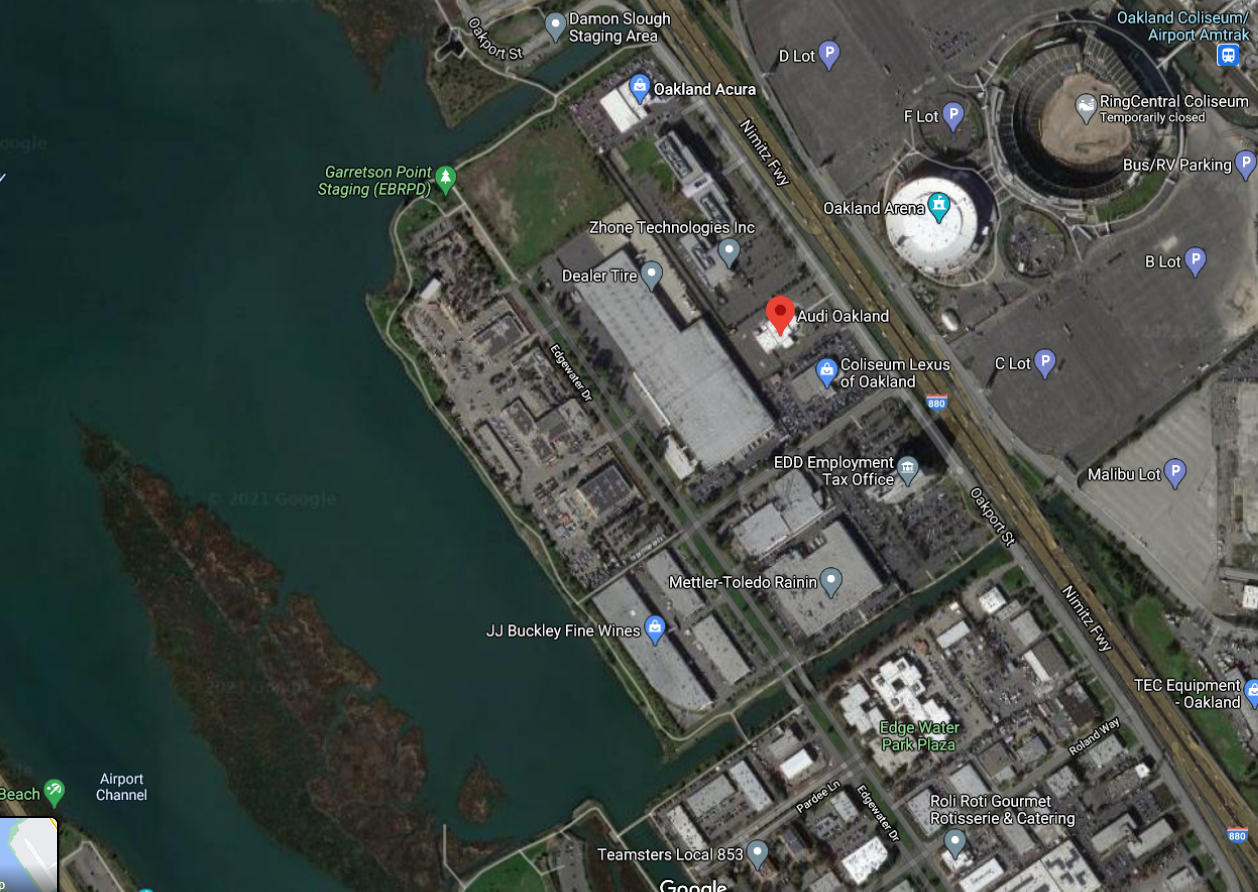
Riensche and EBRPD knew the felines were part of a colony near Oakland Coliseum managed by Cecelia Theis, a local woman who provided them with veterinary care, food, water and conducted TNR (trap, neuter, return) services to prevent the colony’s population from growing.
They did not warn Theis that they were going to cull the colony late last year, nor did they reach out to contacts in the area’s extensive local shelter and rescue network to trap and remove the strays, despite repeatedly stating that shooting cats is an absolute “last resort.”
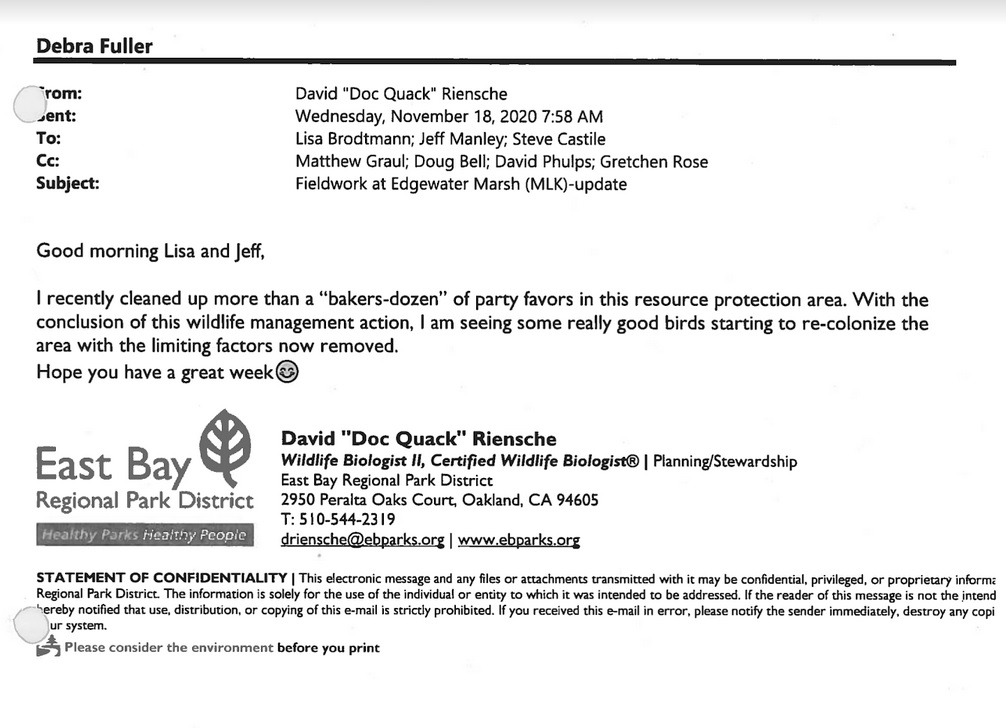
“Good morning Lisa and Jeff,” the email from Riensche reads, dated Nov. 18, 2020. “I recently cleaned up more than a ‘bakers dozen’ of party favors in this resource protection area. With the conclusion of this wildlife management action, I am seeing some really good birds starting to re-colonize the area with the limiting factors now removed. Have a great week.”
Riensche, who disposed of the dead cats in trash bags that he tossed into a bin, signed off the email about the dead cats with a smiling emoji.
In an internal email to colleagues, Riensche referred to the dead cats as “party favors.”
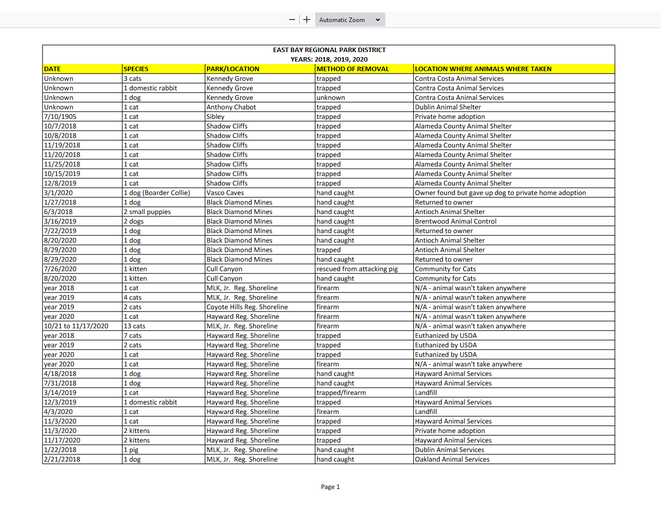
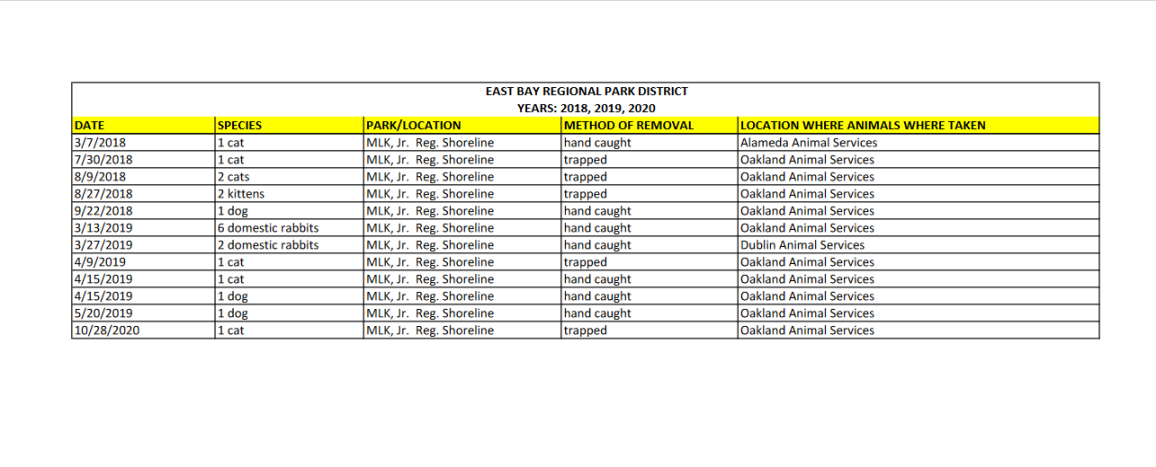
Although Riensche uses coded language in the email, the district’s own records, Riensche’s overtime statements for overnight hours, timestamped audio of dispatch calls and EBRPD’s own timeline of the cat killings all line up with the date of Riensche’s email and a spreadsheet documenting when and where Riensche shot the colony cats.
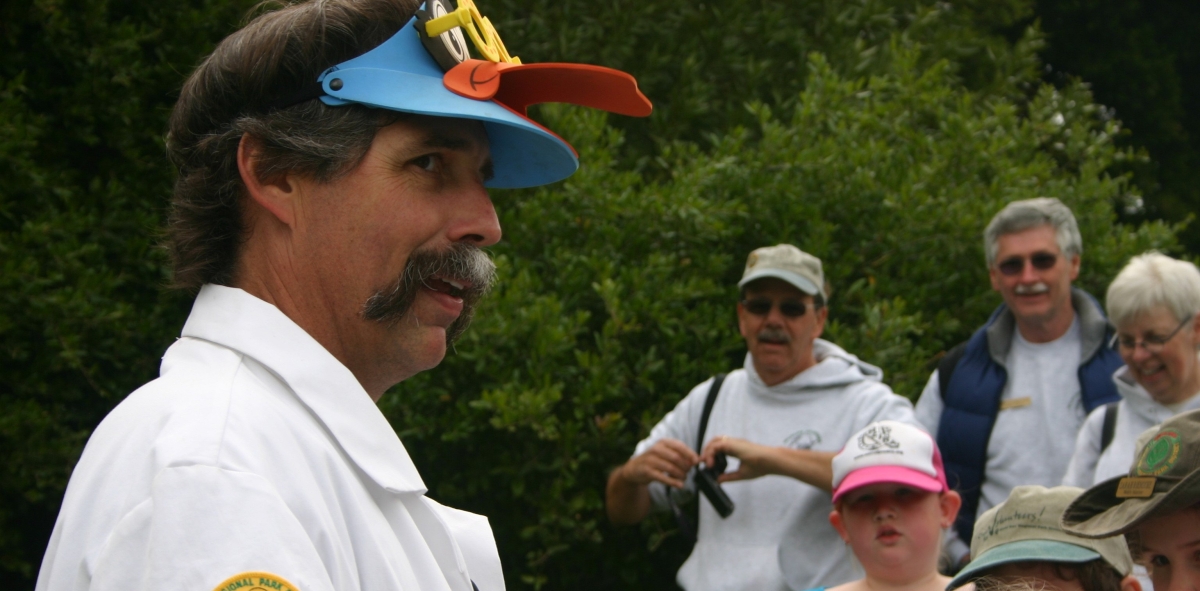
David “Doc Quack” Riensche is a wildlife biologist with the East Bay Regional Park District. Credit: EBRPD
Tiffany Ashbaker, a volunteer with Alameda’s Island Cat Resource and Adoption, said she was horrified when she read Riensche’s email describing the dead cats as “party favors.”
“I was disgusted. Way beyond hurt,” said Ashbaker, who helped Theis trap, neuter, vaccinate and relocate the Oakland colony cats. “I find this to be unethical and he should be removed from his position at EBRPD because of it. I understand why we should try to have cats further away from the protected areas, but how they handled this was eye opening for sure.”
The cats lived between two auto dealerships in an industrial area separate from the MLK Jr. Regional Shoreline, a park in Oakland managed by the EBRPD. When Theis returned to the area to feed the cats on Nov. 3 2020, she realized several were missing. Over the following days more cats began to disappear, Theis and Ashbaker noted.
When Theis asked EBRPD about the whereabouts of the colony cats, a district staffer told her EBRPD wasn’t involved and didn’t remove any cats. EBRPD then amended its response, saying it had trapped the cats and brought them to local shelters.
But none of the local shelters had any records of taking cats from EBRPD, nor did they have the missing cats in their care.
EBRPD admits its biologist killed colony cats
Theis went to KGO, a local ABC News affiliate, and when a reporter began asking questions about the missing cats, a spokesman for the district finally admitted one of its employees — later identified in documents as Riensche — had shot the cats as part of the “predator management program.”
Theis said she felt “a horrible feeling in my gut” when she realized why the usually friendly strays and former pets of the colony were suddenly skittish. Riensche shot the colony cats over a series of nights, returning to the park in the late hours with a shotgun to kill two or three at a time.
Theis said she now understands why the remaining cats were so fearful and skittish when she came by for their regular feedings. One cat named Sherbert jumped on her car hood, and two others meowed insistently at Theis, “trying to tell me.”
“I feel this horrific feeling that they went through terror and were trying to tell me,” Their said. “They weren’t eating like they did usually.”
Some EBRPD board members have expressed sympathy for what happened, Theis said, but she described being “depressed” and worried because the district won’t give her any guarantees that it won’t kill more cats.
“We feel horrible about this, you know, this is really one thing that’s just really sad,” Matt Graul, the EBRPD’s chief of stewardship, told KGO in December, after the public first learned the cats had been shot.
Despite that, EBRPD ignored public records requests from the TV news station, and a spokesman for the district defended the cat culling, saying it was necessary to protect endangered birds who winter in the nearby marshlands.
Stray and feral cats “are not part of a healthy eco-system” EBRPD spokesman Dave Mason said, claiming his agency was protecting endangered wildlife in the area.
Public and animal rights groups demand an end to cat killing practice
After intense public backlash, including a petition with 70,000 signatures protesting EBRPD’s actions, several district board members were quoted in media reports saying they would end the practice of killing cats and would demand an investigation. Almost five months later, the district is instead moving ahead with a plan to contract cat-killing (and the culling of other animals like foxes and opossums) to a federal agency, and there has been no investigation.
Ashbaker, Theis, the non-profits In Defense of Animals and Alley Cat Allies, and local shelters have all demanded EBRPD stop killing animals entirely. District officials continue to argue it’s necessary to protect endangered birds, despite a lack of scientific evidence supporting the idea that arbitrarily shooting animals has any measurable impact on bird populations.
EBRPD has made one concession: It’s promised to reach out to rescues and shelters in the area for help removing cats before making the decision to deal with them lethally.
“While we’re pleased that the policy seems to be to work with local advocates as to prefer not to killing cats, we want to see a pledge that this never happens, ever again,” Fleur Dawes of In Defense of Animals said in February.
The district “should have been up front from the beginning, saying ‘This wasn’t what should have happened, [so] let’s make it right,'” Ashbaker said.
EBRPD has been unable to provide proof that the cats were killing birds on the marsh or that Riensche shot the cats on district property.
In response to a public records request for any documentation of cats preying on birds in the marshlands, EBRPD produced a single document from 1992, noting one incident with one cat about 35 miles south of the MLK Jr. Regional Shoreline where Riensche shot 13 cats in late 2020. During a survey some time before 1992, an EBRPD employee saw an example of “[California Clapper] rail predation” by “what we determined was a feral cat, in a marsh in the East Palo Alto area,” where it says “many cats are found.” The document mentions another cat that was sighted swimming “in flooded tidal salt marshes” in south San Francisco Bay, likely “foraging” for an endangered mouse species.
The district has not been able to produce any written guidelines or protocols describing how its employees determine if a cat should be shot instead of being relocated or brought to a local shelter, except for a vague summary of minutes from a 1998 meeting during which they claim the policy was approved.
EBRPD has been unable to produce copies of the cat-killing policy itself, despite several public records requests seeking that document.
In addition, in internal emails after a KGO reporter began asking questions about the cat killings, several EBRPD staffers questioned whether they have any documentation saying cat culling is an acceptable policy.
EBRPD internal discussion: Are we following our own rules?
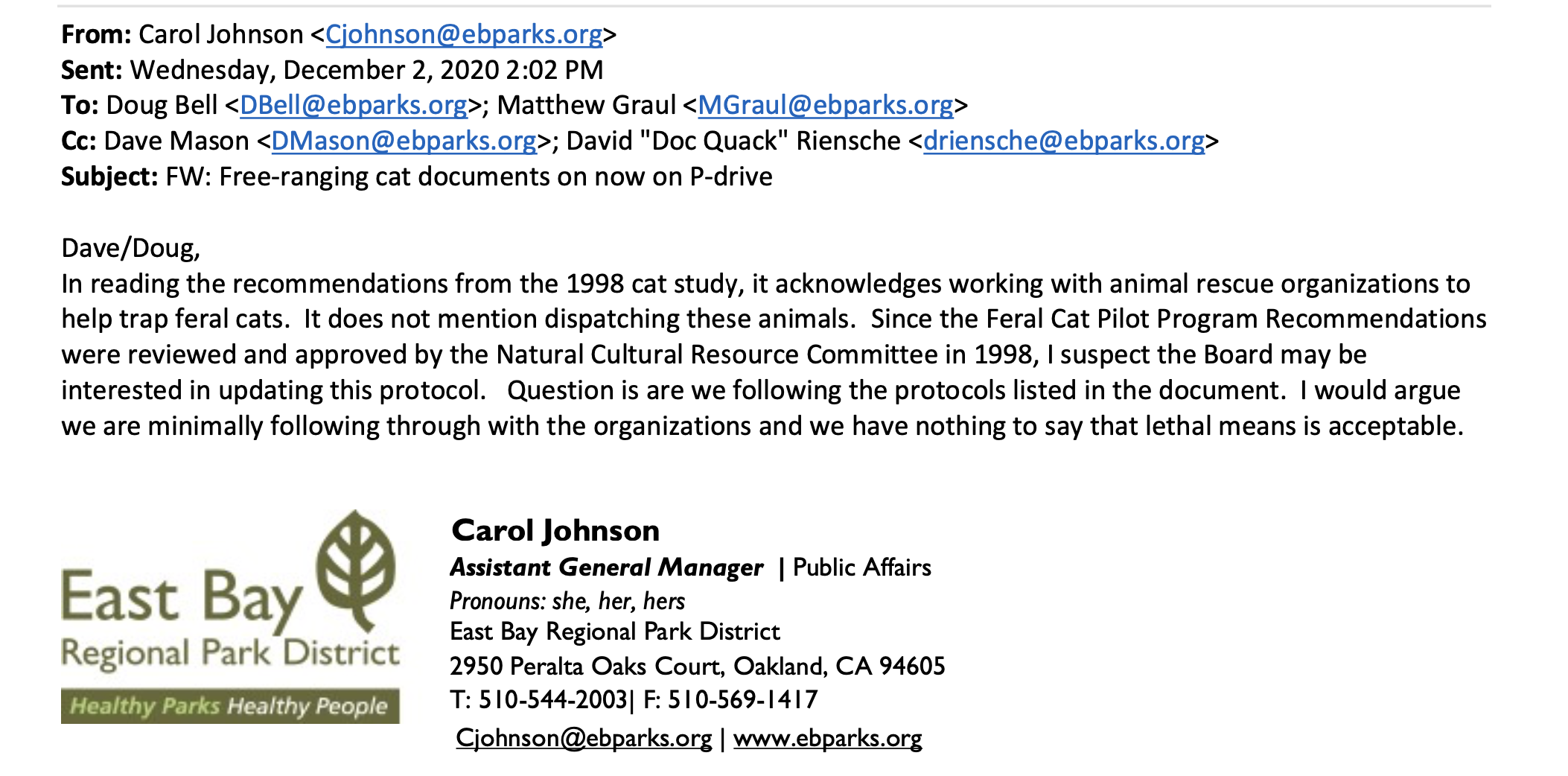
In those same internal emails, which were obtained from EBRPD via public records requests, staffers wondered if the district was following its own rules requiring it to reach out to local shelter networks and receive approval from federal authorities to kill cats. One EBRPD official, assistant general manager of public affairs Carol Johnson, noted the document EBRPD used as justification “does not mention dispatching these animals,” and requires the district to “work with animal rescue organizations to help trap feral cats.”
“[The] question is, are we following the protocols listed in the document?” Johnson asked her colleagues in a Dec. 2 email. “I would argue we are minimally following through with the organizations and we have nothing to say lethal means is acceptable.”
After telling local media that an old and little-known policy allowed the district to cull cats, EBRPD staffers could not locate a copy of the policy.
Internal correspondence among EBRPD staff, obtained via a public records request, show worried staffers searched in vain for a written policy on killing cats before using a Google search to find another agency’s policy.
EBRPD finally produced a copy of minutes from a 1998 meeting with notes attached saying the cat-culling policy had been approved by the board, but if a copy of the policy exists, the district has been unable to produce it.
In December Mason said cats were only shot as a last resort and “[L]ethal removal only happens when feral cats are in the act of hunting wildlife on District property,” but none of the documents say the cats Riensche shot were hunting. Indeed, it would require an extraordinary stroke of luck for the biologist to find 13 cats preying on endangered birds in just a few nights.
Despite public records requests, the EBRPD was unable to provide proof that Riensche had consulted anyone before shooting the cats. Records indicate no one was notified until after Riensche killed the animals.
The stray cats lived between Audi Oakland and Coliseum Lexus of Oakland. Credit: Google Maps
In addition, the cat colony sat some distance from the protected marshland: An office park, electric car charging station, at least three parking lots and a substantial body of water are between the cat colony’s home and the marshland. That’s a distance considerably longer than most stray and feral cats range from their homes, and domestic cats are notoriously averse to water or getting themselves wet.
Records line up with cat shootings
While Riensche uses coded language by referring to the cats he shot as “party favors” in his email to colleagues, it was sent on Nov. 18, the day after EBRPD’s own records show he killed the last of the colony cats. Internal documents from the EBRPD, obtained through public records requests, as well as the district’s own public timeline of events, show the dates the cats were killed line up with Riensche’s email. In addition, in audio recordings of his radio contact, Riensche advises dispatchers only after he’s fired the killing shots.
“Yeah this is Dave Riensche in wildlife at MLK, I just dispatched an animal down here, so if you get a call, it was me,” Riensche tells a dispatcher in one of the calls on Nov. 13 at 6:24 a.m.
EBRPD’s records show the only animals killed on that day were cats.
(Click the embedded audio to hear Riensche call dispatch on Nov. 13, 2020.)
Finally, according to EBRPD’s records, Riensche received overtime for working on nights that correspond to the same dates EBRPD says the cats were shot. [EBRPD document: TIMECARDS (REDACTED)]
Riensche, who has been employed as a biologist with the district for decades, is a prominent birder whose work involves protecting birds and other endangered species from predators wild and domestic. He penned a newsletter, Bird News, in the early aughts and is on record saying there’s “a wealth of evidence” that stray and feral cats are the primary danger to bird populations.
Shooting cats as a ‘first resort’
Riensche earned $182,951 in salary and benefits in 2019, the most recent year for which salary data is available for public employees in California. Riensche earned a base salary of $90,239 and $56,050 in overtime, including for overnight hours spent shooting animals in EBRPD’s parks.
An Oakland woman who wrote to the EBRPD after the district came clean about the cat killings related an anecdote about Riensche from 2019.
The woman worked with a local rescue that received a call from a parks employee who wanted help trapping and relocating a female cat and her young kittens who were living on or near an EBRPD park. The rescue volunteers were working with the EBRPD employee, making plans for the cat and her babies to be vaccinated and spayed/neutered, and even had homes lined up for some of the kittens, the woman wrote in a Nov. 25 email.
After visitors to the park saw the mother carrying a dead rabbit back to her kittens, “Doc Quack [Riensche] then reportedly told employees he was going to shoot the cats,” the volunteer wrote.
The mother cat “disappeared” and her fate was unknown, but the rescue was able to work with the EBRPD employees to get the kittens trapped. However, Riensche wasn’t happy with that outcome, she wrote.
“I was told later by an employee, that they were reprimanded for saving the cats and going outside of the EB Parks, to get this help,” the woman wrote in her letter to EBRPD. “Apparently, they should have just been quiet and let Doc Quack shoot the cat family.”
The connection between birders and cat killing
Cat killing isn’t unusual among birders. In 2007 a Texas man named James M. Stevenson — founder of the Galveston Ornithological Society — admitted killing dozens of cats on private and public property after coming to believe the cats were killing piping plovers, shorebirds who commonly nested in the area.
In a 1999 posting on an Internet bulletin board for bird lovers, Stevenson nonchalantly described killing many feral cats during his first year living on Galveston Island. He rationalized his acts as a way to restore the natural order.
“I’m sorry if this offends — but I sighted in my .22 rifle, and killed about two dozen cats,” Stevenson wrote in his message, titled “killer kitties; kittie killers.”
“This man has dedicated his whole life to birds,” Stevenson’s attorney said in his defense. The case ended in a mistrial.
Nico Arcilla, then known as Nico Dauphiné, was well known as a birder and outspoken critic of cats. A group of people who cared for strays near Washington’s Meridian Hill Park contacted the Humane Society after noticing food they left out for the cats “would sometimes become covered by a white powdery substance overnight.”
After the Humane Society and Washington police tested the substance and verified it was poison, they set up a stakeout and had cameras trained on the food bowls. Footage, which prosecutors later exhibited on trial, was damning:
“Dauphiné [Arcilla] can be seen approaching the bowl, pulling something out of a small bag, reaching down toward the food twice, and then leaving the scene,” a sciencemag.org report reads. “The next morning, police found the food covered with the same white powder as before, which tested positive as poison.”
[Click here to see video of Arcilla poisoning the cat food.]
Arcilla wasn’t just a prominent birder and anti-cat campaigner — she is a co-author of several frequently-cited studies claiming cats kill billions of birds in the US each year. Those studies, which have been used to justify cat-culling policies around the world, are highly controversial, with critics blasting them for poor methodology, a lack of hard data, and arbitrary numbers plugged in to estimate both the national cat population and the felines’ impact on birds. For example, the authors estimate a national stray and feral cat population between 25 and 125 million, an estimate so vague that any extrapolations based on those numbers are virtually useless.
Riensche has repeatedly cited Arcilla’s work in public and private documents arguing that cats are primarily responsible for declines in bird populations.






 Pain In The Bud