Cat Hunt Canceled, Kiwi Journalist Says Cats ‘Need To Be Shot,’ ‘Run Over’ And ‘Wiped Off The Face Of Aotearoa’

Cats are blamed, to the exclusion of almost all other factors, for the decline in native bird populations in New Zealand.

A New Zealand group canceled a cat-hunting competition for kids after receiving massive backlash for the plan, but one Kiwi journalist told a national audience he thinks the cat hunt is a great idea and doesn’t go far enough.

“When it comes to feeral kets, I’m on the soide of the kea, the kākāpō and the kiwi ivery sangle doy of the week and my missige to [the organizers] is ‘Git the competition back on, git the keds back out thea,'” said the vowel-desecrating morning show host Patrick Gower. “If thea gonna hunt and thea’s feeral kets in the way, then we hif to woipe them out. Feeral kets need to be shot, they need to be run ovah, they need to be trepped, they need to be woiped off the foice of Aotearoa and I imploah the school to git it back on, and look, I’ll put up some rewoade as well foah any kets these kids git down theah as well.”

English translation: “I think the cat-killing contest is a wonderful idea, cats need to be shot, run over and exterminated from New Zealand, and I hate cats so much that I’ll put up some of my own money as prizes for the children who bag the most kills.”

You’ve got to wonder what cats have done to Patrick Gower for him to hate them so much, and fortunately dear readers, PITB has the answer!

Gower lost the New Zealander of the Year competition of 2020 to a cute orange tabby named Mittens.

Think about that: All those years of doing Pulitzer-worthy breakfast show kitchen demonstrations, of slaving away at the anchor desk bringing viewers important news about reality TV stars and parroting former Prime Minister Jacinda Ardern’s declaration that New Zealand’s government is “the single source of truth” on COVID, and Gower loses the honor to a damn cat. Mittens even has the key to the City of Wellington, and Gower does not.

So sad.
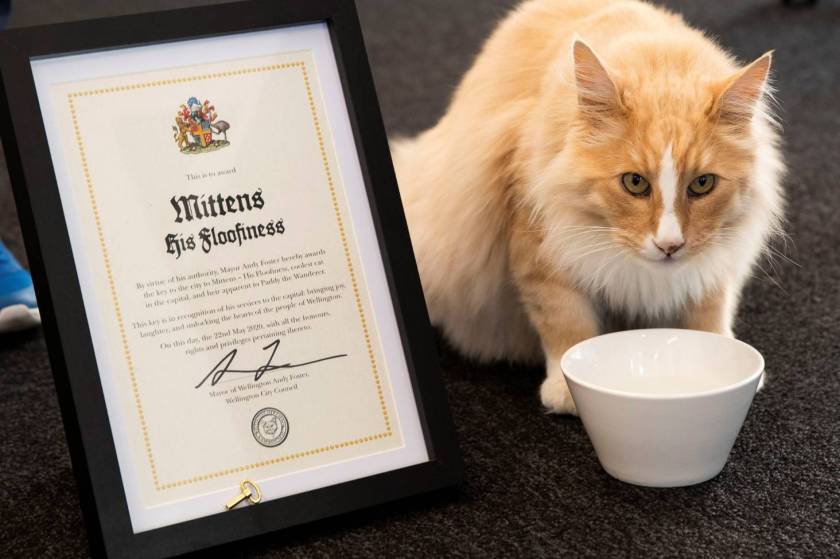
Mittens the Cat
Mittens receiving honors that have eluded morning show host Patrick Gower. Credit: Wellington City Council

It’s unfortunate when a man in influential position, small country or not, enthusiastically encourages children to practice being future serial killers by slaughtering innocent animals because he thinks — despite the complete absence of evidence — that arbitrarily gunning down and running over sentient animals will save birds.

Really, you’d think before calling for the extirpation of an entire species of animal that these people would have something, even a single bogus research study, claiming that bird populations would recover if only people started killing cats on sight.

But no such proof exists, and the burden of proof rests with Gower, fellow Kiwi cat-hater Gareth Morgan and others who harbor an irrational and ill-advised hatred of tiny animals who are simply behaving the way nature designed them to behave.

What we do know is that managing cat populations can be done, but it’s difficult, time-consuming work that requires dedication and patience.

Cities like Washington, D.C., with its exhaustive cat count, and communities across the US have provided the blueprint with TNR efforts and a mass push for all pet owners to spay and neuter their cats. The results have been remarkable, and shelters save more than a million felines a year compared to just a decade ago. There’s still work to be done to bring the number of euthanizations down to zero.

Patrick Gower
Gower

It’s also worth noting that the organizers of the North Canterbury Hunting Competition and supporters like Gower are coming from a place of ignorance. In their original, now-deleted announcement, the organizers offered a “guide” to telling the difference between feral and pet cats, unaware that they are the same species. The only difference is that pet cats are fortunate enough to have homes, and strays and ferals do not.

The group said it was offering its “guide” as a way to prevent children from killing pet cats, but how exactly would they do that when a pet is indistinguishable from a colony stray or a feral? Would they find a microchip on the corpse of a cat they killed and say “Oops, guess that one doesn’t count!”?

Does a cat somehow feel less if it doesn’t have a home? Is its life worth less if it doesn’t have a collar and eat from a bowl?

It’s barbaric and so poorly thought-out, it really boggles the mind that the idea of a cat-killing competition for kids was voiced, let alone approved, planned and promoted by supposed adults.

As for the contest itself, we’re very glad it’s been called off, even if the organizers want to play victim and say their feelings have been hurt by the response to their murderous event.

That, however, doesn’t solve the problem. The fact that the organizers thought this was a good idea in the first place, and the increasingly pitched rhetoric from the likes of Gower and Morgan, are normalizing the idea of slaughtering innocent animals who have their own minds, thoughts and feelings, and who have been shaped by 10,000 years of history to live with and depend on humans.

Instead of calling for blood and whipping people into a frenzy, influential New Zealanders should read about cats and animal cognition in general, so they’re aware that felines experience the full range of primary and secondary emotions and are very much capable of suffering the same way we do when we’re injured, stressed and our lives are in danger.

That, unlike claims that cats are primarily responsible for the decline in bird populations, is hard scientific fact. We can peer into the brains of felines, watch their neurons fire, see different brain regions light up as they think specific thoughts and respond to specific smells and sights.

Maybe if people who hate cats understand what they are, they’ll feel some empathy for a beautiful species, animals who have been companions and literal life savers to humans since before deepest antiquity, animals whose lives have intrinsic value regardless of what they mean to us. At the very least, we owe them that.
Redditor Says He Hated His Girlfriend’s Cat, So He Switched It With An Identical Feline

Could a doppelganger cat fool you, even if it looked just like your cat?

Among my three most intense recurring anxiety nightmares there’s the classic where I’m back in college, it’s the end of the semester, there’s a class I haven’t attended in months, and I’m going to fail if I don’t grovel before the pissed-off professor.

Then there’s the recurring dream where I’m walking an endless parking lot — in a mall, in an underground garage, on my old college campus — looking for my car, which refuses to be found. Sometimes I’m looking for the Civic I drive now, sometimes it’s the boxy old Chevy Celebrity that was my first-ever vehicle, and sometimes it’s my beloved black Celica that tragically died on I-95 in the Bronx en route to Long Island.

But the worst, the one that triggers the most anxiety and despair, is a dream in which I realize that Buddy isn’t Buddy. The gray tabby in my apartment looks like him and for the most part acts like him, but in my nightmare someone has swapped him out with a different cat for reasons unknown, and by the time I realize it’s not him, I don’t even know how long I’ve been duped.

My despair turns into overwhelming guilt when I realize my Buddy is still out there somewhere, wondering what happened, probably thinking I abandoned him.

Thankfully when I wake I’m reassured by the snoozing form of Actual Buddy where he always sleeps, right on top of me. And yes, I realize he probably gate crashes my dreams because he’s vocal, he refuses to sleep anywhere else, and he’s got a habit of getting up in the middle of the night to rub his head against my face while he purrs and makes biscuits.

Buddy
“Oh, so sad! Now give me snacks!”

But for one woman in the UK, the nightmare may be a reality and she just doesn’t know it yet.

The UK’s Mirror has a story about a Redditor who confessed he surrendered his girlfriend’s aggressive cat to a shelter and adopted an identical furball.

In the subreddit “True Off My Chest,” the man says the cat “scratched everyone, hissed at everyone, and didn’t use its litter box half the time,” but his girlfriend “insisted she could get it to behave better.”

She left the cat in her boyfriend’s care when she went out of town for a week to visit relatives, and a nefarious plot began to germinate in his mind.

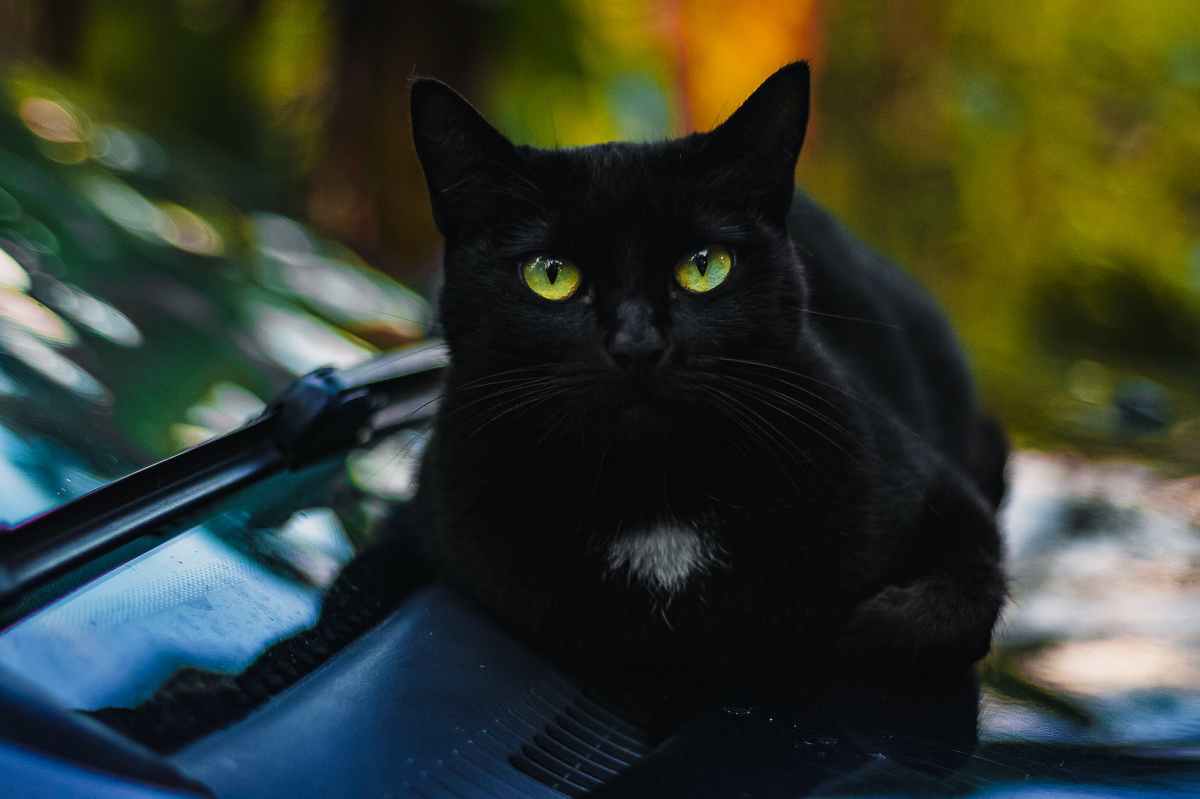
black cat
Credit: Helena Lopes/ Pexels

“The first night I went over, it scratched the shit out of my arm,” he wrote. “I joked to the cat that it’s not special and I’ll replace it if it scratches again. The joke stuck with me until I had thought about it enough that it wasn’t a joke.”

After looking around, the man says he found an identical-looking cat at a nearby shelter. That cat had been surrendered when its owner died of a heart attack. Kitty was bewildered and skittish when it found itself without a home and in a shelter.

“The cat [was] a lot friendlier and better behaved, and the [skittishness] would help it resemble the original cat,” the man wrote.

The man claims his girlfriend never figured it out, and says she was even pleased that “her cat” had calmed down and was better behaved. The couple eventually got married, and now the Redditor shares a home with the cat too.

After six years, however, he says he can’t forget what he did.

“Every time I see [the cat], I feel like a total piece of shit,” he wrote.

Among dozens of condemnatory comments, there was this amusing one from another Redditor: “Best of luck if y’all have kids. Finding a lookalike child is way harder.”

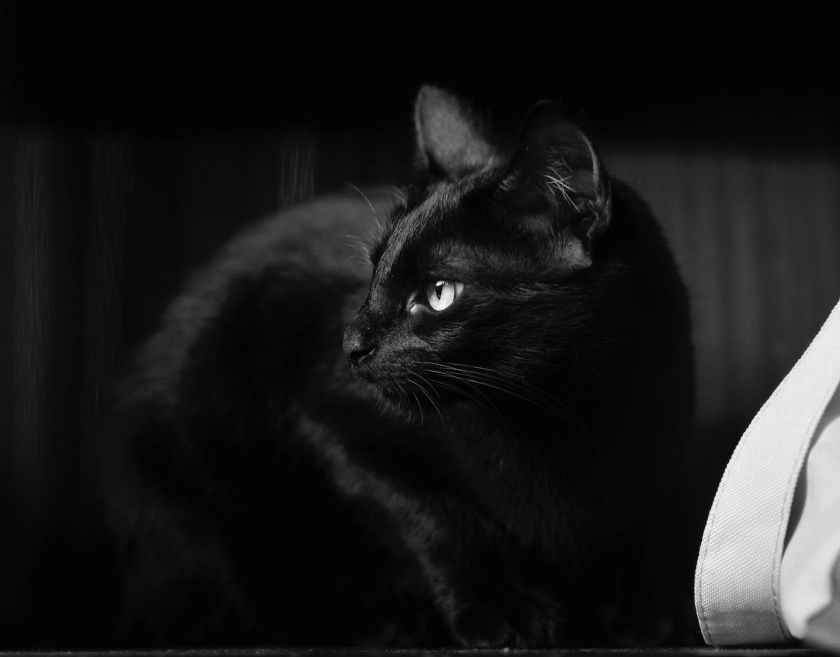
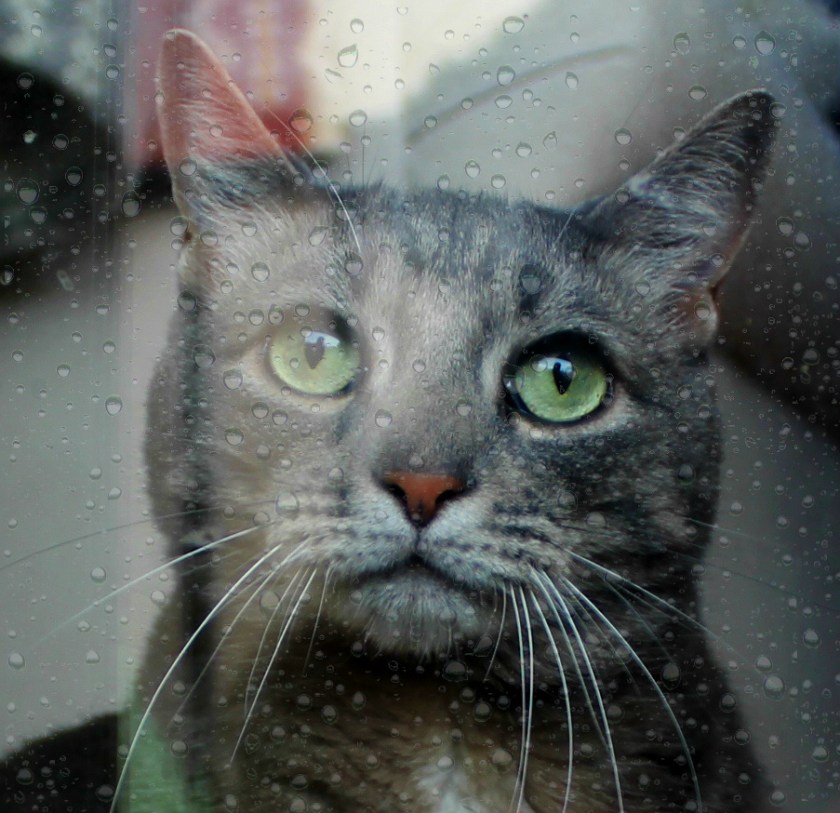
monochrome photography of black cat
Credit: Crina Doltu/Pexels

And that brings me to my next point. I’m not sure I buy this story. I certainly hope it’s not true.

Perhaps it’s easier to find a lookalike among black cats, but what about behavior? What about the cat’s quirks, its unique vocalizations, its favorite sleeping spots? Every cat has preferences when it comes to where it likes to be scratched, whether it’ll tolerate being held, how long or how often it’ll snuggle with its humans.

Cats are individuals just as humans are, with their own preferences, rituals and habits.

Even after seeing many thousands of images of gray tabby cats, I have never seen one who looks just like Bud. It’s not just his unique bib, that tuft of white hair on his upper chest, nor is it his pronounced muzzle. It’s also the derpy look on his face, the way he tilts his head quizzically, his Buddesian gait, his uniquely lazy method of dribbling down from the couch like a liquid.

Behavior-wise, there’s just no way. You’d have to find a gray tabby who never shuts up, sounds like an over-caffeinated Elmo singing in falsetto, and has a language that consists of 90 percent trills and meows that tilt an octave up so they sound like questions.

And you’d have to find a jerk. A stone-cold Fluff of Doom who Must Swipe Everything off flat surfaces. A feline who has no qualms about destroying things, enjoys walking on your face when you’re sleeping, and will occasionally launch himself at your ankles with a battle cry of “BRRRRRUUUPPPP!” because you didn’t give him his treats quickly enough. Hell, even the way he shrieks at me for snacks and tries to block my path like a goalie is unusual.

Imagine the phone call someone would have to make: “Yes, I’m looking for a gray tabby cat with bright green eyes and a tuft of white on his chest. He has to sound like Elmo on espresso, and he absolutely must be a huge jerk. You don’t have any jerks? Well what about in the back? You must have something!”

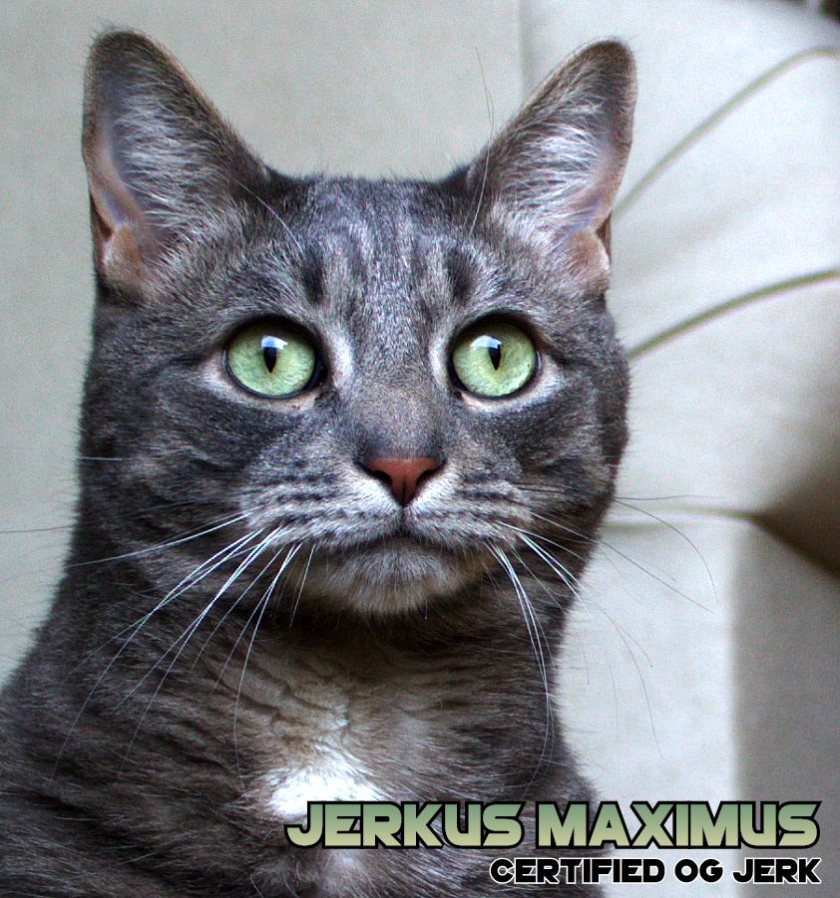
Certified OG
“I’m a certified OG, yo! I was swiping fragile objects off shelves and pooping under beds before it was cool.”

Of course Bud has a whole bunch of great qualities too, and I wouldn’t change a hair on his head. No “replacement cat” could ever fool me. There can only be one Buddy.

Do you think the Redditor’s story is real? Could anyone ever fool you by swapping one of your cats for a doppelganger?

Study Says We Should Use Baby Talk With Cats, Buddy Disagrees

It’s the latest of several studies indicating animals including cats, dogs and horses respond better to higher-pitched, softer voices.

Cats are more responsive when their humans use “baby talk” to address them, a new study claims.

A research team from Paris Nanterre University played a series of recordings for cats. One set of recordings featured a stranger addressing each cat, while another set featured the cat’s human servant calling to the cat.

Each set also had clips in two different tones of voice: one in which the humans spoke to the cats in a tone normally reserved for addressing fellow adults, and another in which they baby-talked their felines.

Not surprisingly the cats were mostly content to ignore the strangers calling them by name even when the strangers used higher-pitched tones, but “displayed a constellation of behaviors suggesting increased attentiveness” when they heard audio of their humans calling them.

The kitties were even more responsive when their humans used the “sing-songy” tone of voice many people reserve for pets, babies, young children and Texans. (Sorry, couldn’t help myself! I’m still salty over my Yankees getting swept by the Astros.)

The research team said the study, which was published today in the journal Animal Cognition, was yet another piece of evidence showing felines are not the ultra-stoic, emotionless animals they’ve been portrayed as for as long as anyone can remember.

“For a long time it has been thought that cats are very independent creatures, only interested in [humans for] eating and shelter, but the fact that they react specifically to their owner, and not just anybody addressing them, supports the idea that they are attached,” said Charlotte de Mouzon, the paper’s lead author. “It brings further evidence to encourage humans to consider cats as sensitive and communicative individuals.”

Although the study included just 16 cats — sample size is a recurring problem in feline-related studies, since researchers often have to travel to the homes of house cats to study their normal behavior — it’s just the latest bit of research on tone in human-cat communication.

Those studies tend to use terms like “pet-directed speech” and “kitten-directed speech” instead of baby talk.

As I wrote last year, I don’t use baby talk with Buddy, and I tend to think of him as, well, my little buddy instead of my “child,” as so many “pet parents” do. That’s not to say I think people who view their pets that way are doing it wrong, or that I don’t have parental feelings toward Bud. Of course I do.

But as I also wrote, Buddy does not tolerate baby talk. I joked that he’d paw-smack me if I spoke to him that way, and indeed he has nipped at me and dispensed warning slaps the handful of times I’ve come close to addressing him that way.

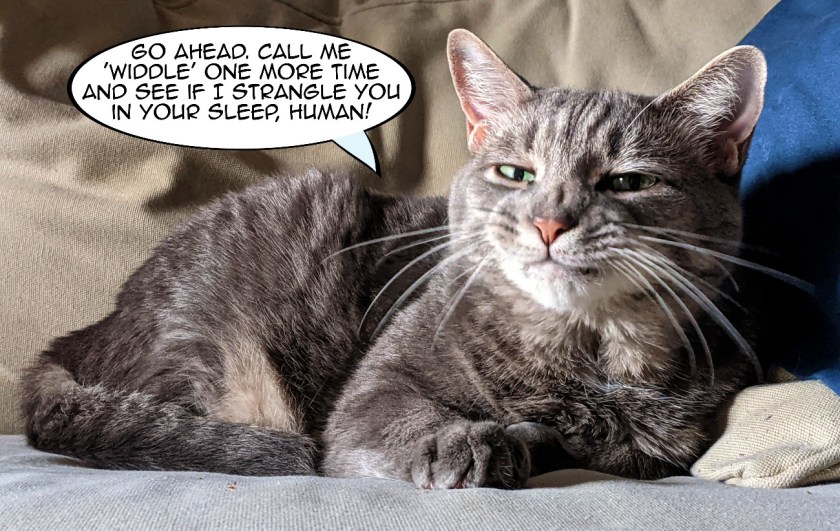
Bud Da Widdle Baby
“Aw! Widdle Buddy is angwy, huh?”

I think it’s because of the way I raised him. He’s not accustomed to it, and he finds it annoying. That makes sense, and it comports with the study authors’ suggestions that the one-on-one relationship between feline and human is an important factor in many facets of cat communication.

But maybe if I’m prepared to dodge a few angry paws I can use the threat of baby talk to nudge Buddy toward being more responsive during those times when he doesn’t feel like coming when called or stopping some important work he’s engrossed in, like chattering away at birds outside.

“Bud! Hey, Bud! Listen to me. I’m talking to you,” I might say. “Okay, have it your way. Who’s da little Buddy wuddy who isn’t wistening to me, huh? Who’s da widdle cwanky boy?”

I’m pretty sure he’ll launch himself at me with a derisive “Mrrrrppp!” and take a big swipe. Haha!

But maybe, just maybe, he’ll be more inclined to listen. Do you baby talk your cats?

Study: Even Experienced Caretakers Give Cats ‘Unwelcome Affection’

When it comes to petting cats, less is more. Not everyone knows that.

By chance, one of the first things I saw Tuesday in my post-wake-up browsing was a short video of three guys standing in a triangle formation, each of them with a puppy. A drum recording began, and the men began drumming an overturned pot in the middle with the puppies’ paws.

The dogs, of course, had no idea what was going on. They were confused and stressed. Then I saw this from the official TikTok page of Imperial Point Animal Hospital in Delray Beach, Florida:

That’s a veterinarian abusing a kitten.

It might not be overt abuse. She’s not hitting or screaming at the poor cat. But she’s taking a sentient being with its own feelings, likes and dislikes, comforts and discomforts, and using it as a toy for clicks and likes on social media.

I thought about that when I read the newest study from Nottingham Trent University and the University of Nottingham, which looks at the way people interact with their cats and how their behavior may or may not align with what cats prefer and what they’re comfortable with.

Although Bud and I have a deep bond formed over more than seven years of spending time together, establishing trust, mutual respect and love, he would tear my face off if I did to him what the vet tech is doing to the kitten in the above video.

And you know what? He’d be justified, once he got over the shock and wondered if I’d been replaced with a doppleganger.

The UK study involved more than 100 felines at Battersea Dogs and Cats’ London cattery, with scientists recording interactions between humans and cats via a GoPro camera in a large pen where people can interact with cats one-on-one. There were 120 human participants of various ages and from different walks of life. Each person interacted with three cats separately.

Researchers looked at whether the cat or the human initiated interaction, where the human touched the cat, whether the human restrained the cat, and the cat’s response.

They also collected information on each human participant, such as how many cats they have at home and how long they’ve been caring for felines. Human participants rated themselves on how well they know cats and how well they take care of them.

They used a system that corresponds to the below image to grade physical affection. The image is mostly self-explanatory, but to be clear, the green areas are where cats like to be touched, the yellow areas are “meh,” and the red areas are no-go zones for most cats:

greenyellowredcatareas

In earlier studies, the team established what many cat caretakers know: Allowing cats to initiate physical interactions, going easier and lighter on petting, letting cats control how long the interactions last, and avoiding any kind of restraint are “best practices” for petting cats. They reaffirmed that scratching cats under the chin, rubbing their cheeks and forehead are “the best ways to increase their affection and reduce aggression.”

That might seem obvious, but in research there’s an important distinction between knowing something (or thinking you know it) and proving it with research. It’s important to prove it, and to forgo assumptions, to produce credible and repeatable experiments.

Animal behaviorist Lauren Finka, lead author on the new study, said although the above may seem like common knowledge among experienced caretakers, that’s not always true, and it’s not always reflected in their behavior.

“Our findings suggest that certain characteristics we might assume would make someone good at interacting with cats—how knowledgeable they say they are, their cat ownership experiences and being older—should not always be considered as reliable indicators of a person’s suitability to adopt certain cats, particularly those with specific handling or behavioral needs,” Finka said.

We should point out here that these are “best practices” for establishing a healthy, trusting relationship with cats, and taking their feelings into consideration. Lots of people might force their cats to do things without much push back, but that doesn’t mean the cat is happy. No one’s perfect, and there are always things we can learn about how to do better by our furry friends.

Finka also said she hopes people who run shelters and rescues take the research into consideration. That’s because some people run into the same problems I did: When you’ve never had a cat, and/or you don’t fit the profile of what people think a “cat person” is or should be, you could encounter resistance or skepticism from shelter staff.

One volunteer at an animal shelter asked me if I was adopting a kitten for my kids or girlfriend, because it didn’t occur to her that I’d want a cat. Some shelters require references from a veterinarian, which you can’t get if you’ve never had a pet before.

“Importantly, within shelters, we should also avoid discriminating against potential adopters with no previous cat ownership experience,” Finka said, “because with the right support, they may make fantastic cat guardians.”

For us, it’s more confirmation of what we’ve always believed: The more you take your cat’s feelings into consideration, and treat the little one with the respect he or she deserves, the happier your cat and the deeper your bond will grow.

Cats Can’t Dance, Cats Can’t Sing…But Birds Can!

Snowball is the first animal known to dance to the rhythm of music, while Ruby is, well, Ruby.

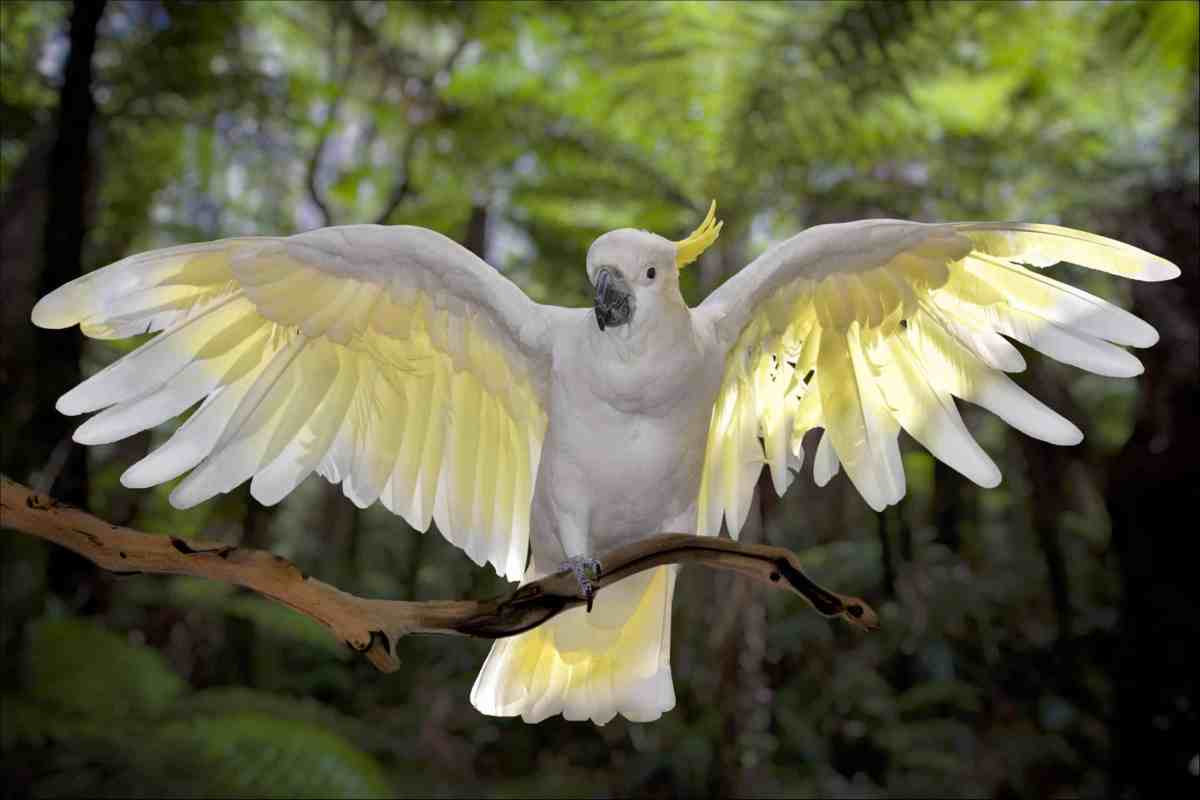
We take a break from our regularly-scheduled cats to check in on two remarkable birds: Snowball the incredible dancing cockatoo, and Ruby the infamously foul-mouthed African grey parrot.

pitbbirds2

Both animals have been the subject of viral videos, but haven’t become ubiquitous memes or the sort of superstar that transcends certain corners of the internet.

Snowball is clearly the more wholesome of the two, and it’s immediately apparent why: He dances.

Actually, that’s underselling it. Snowball doesn’t just dance, he feels the beat and moves with it, timing his dance moves — headbangs, foot-wiggles, side-steps and more — to the music, often the snare like people do. Snowball isn’t the first animal to move to music, but he’s the first animal to groove to music, which is an important distinction.

“His owner had realized that he couldn’t care for the sulfur-crested cockatoo any longer. So in August 2007, he dropped Snowball off at the Bird Lovers Only rescue center in Dyer, Indiana—along with a Backstreet Boys CD, and a tip that the bird loved to dance. Sure enough, when the center’s director, Irena Schulz, played “Everybody,” Snowball “immediately broke out into his headbanging, bad-boy dance,” she recalls. She took a grainy video, uploaded it to YouTube, and sent a link to some bird-enthusiast friends. Within a month, Snowball became a celebrity. When a Tonight Show producer called to arrange an interview, Schulz thought it was a prank.”

Other animals are prompted to motion by music, but they don’t time their motions to the beat. Snowball’s talents have attracted curious neuroscientists, who believe Snowball is able to coordinate his body movements with the rhythm because, like humans, he can process language.

It might seem a little odd that such an ability seems to hinge on language until you realize that language itself is rhythmic, ordered sound, and that human communication often pairs speech with coordinated movements. (Think of people who “talk” with their hands, TV presenters who move their heads for emphasis or the simple act of nodding, shaking your head or shrugging to punctuate a point.)

Scientists study Snowball because he’s inherently fascinating, but also because he can help us understand how birds and humans communicate, and how homo sapiens and certain avian species, out of all the animals on Earth, developed this skill.

Ruby the Foul-Mouthed African Grey Parrot

Ruby is a different case entirely. She’s interesting to internet audiences because she’s hilarious, and if she holds academic appeal, it’s because of the way she’s been socialized and the things she’s learned.

Ruby, one of Youtube’s earliest viral stars, lives with her human, Nick Chapman, in Brighton, UK.

First thing’s first: If you’re put off by obscenities or you’re easily offended, you should take a pass on these videos.

For everyone else, well, it’s not just that Ruby swears. That sort of novelty would wear off quick. What makes Ruby unique — and consistently hilarious — is that she’s inventively obscene, working insults into unique combinations. And, as you’ll see, she swears in French as well as heavily-accented UK English. It’s the latter that often makes for her most amusing outbursts.

“I love you,” Ruby tells Chapman in one video.

“Well that’s a nice change, sweetheart!” Chapman says.

“Bollocks.” Ruby takes a half step to her right on the small platform in front of her cage, turning her head toward Chapman. “You fat bastard!”

Chapman laughs. “I knew that wouldn’t last.”

Ruby’s foul language is unmistakably British and as casually vicious as it gets. She hurls invective at the seagulls who are a constant presence in seaside Brighton and expresses her love for Chapman by insulting him.

“Fuck off, you tw-t!” the bird says, prompting laughter from Chapman.

“Oh dear,” Chapman says. “That’s not nice!”

“Eh,” Ruby says. “Tw-t! You’re not funny.”

“I know I’m not funny. I’m immature, I’m irresponsible. But so what?”

In another video, Chapman tries to engage Ruby by telling her he loves her in French.

Ruby sits motionless for a few long seconds, then utters a single syllable with expert comedic timing: “Tw-t!”

Chapman does a deep belly laugh.

“Shut up, c–t!’ Ruby says. “You f—er!’

“Oh dear,” Chapman says between laughs. “You’re shocking, you know that?”

One thing becomes abundantly clear over the course of just a few videos: Chapman loves Ruby and, despite the constant verbal abuse she directs toward him, she loves Chapman too.

For a man who owns a bird who loves foul language, you’d think Chapman would have a dirty mouth, but for the most part he doesn’t. It’s often impossible to predict what a parrot will pick up on.

Eric, another Youtube-famous parrot, learned his favorite swear words when his owner’s friends came over to watch football, or soccer to us Yanks. Eric’s fond of yelling “A fookin’ legend! A fookin’ legend!” 

Ruby is quick to pick up on new words, and Chapman thinks she likes the harsh sounds of some of the language’s most offensive insults. (Perhaps it’s no mistake that many of the most vulgar words in English have a guttural quality, reflecting their meaning.)

Long before Ruby became a Youtube star, Chapman said he realized the potential for awkwardness. One day he was strolling along the waterfront in Brighton when an older woman stopped to chat and asked about Ruby.

“She’s beautiful,” the woman said, admiring the African grey.

“Shut your c–t!” Ruby snapped back.

The shocked woman looked at Chapman, who pretended he hadn’t heard what his bird said.

The issue of whether parrots understand what they’re saying still hasn’t been settled. Like some other animals — cats and dogs among them — they can understand words in their contextual meanings, though it’s very unlikely a swearing parrot knows precisely what it’s doing.

Then again, to insist parrots are just repeating sounds would be to discount examples like the late Alex, an African grey who could count, distinguish between different items by color and shape, and allegedly innovate to some extent.

Then there’s this video of a parrot telling a cat to “shut the f— up” as the cat meows. It makes me wonder, if I had a parrot, what the bird would pick up from my conversations with Buddy. There’d be a lot of “Hi, Bud!” and “What a good boy!”, and the vast majority of it would be kind, patient and loving, but I won’t pretend there aren’t times when I’ve told him I can’t take any more of his hours-long discourses on teleportation, turkey or unifying classical and quantum physics.

That said, I wouldn’t change a thing about Buddy. He’s my Buddy.